About this episode
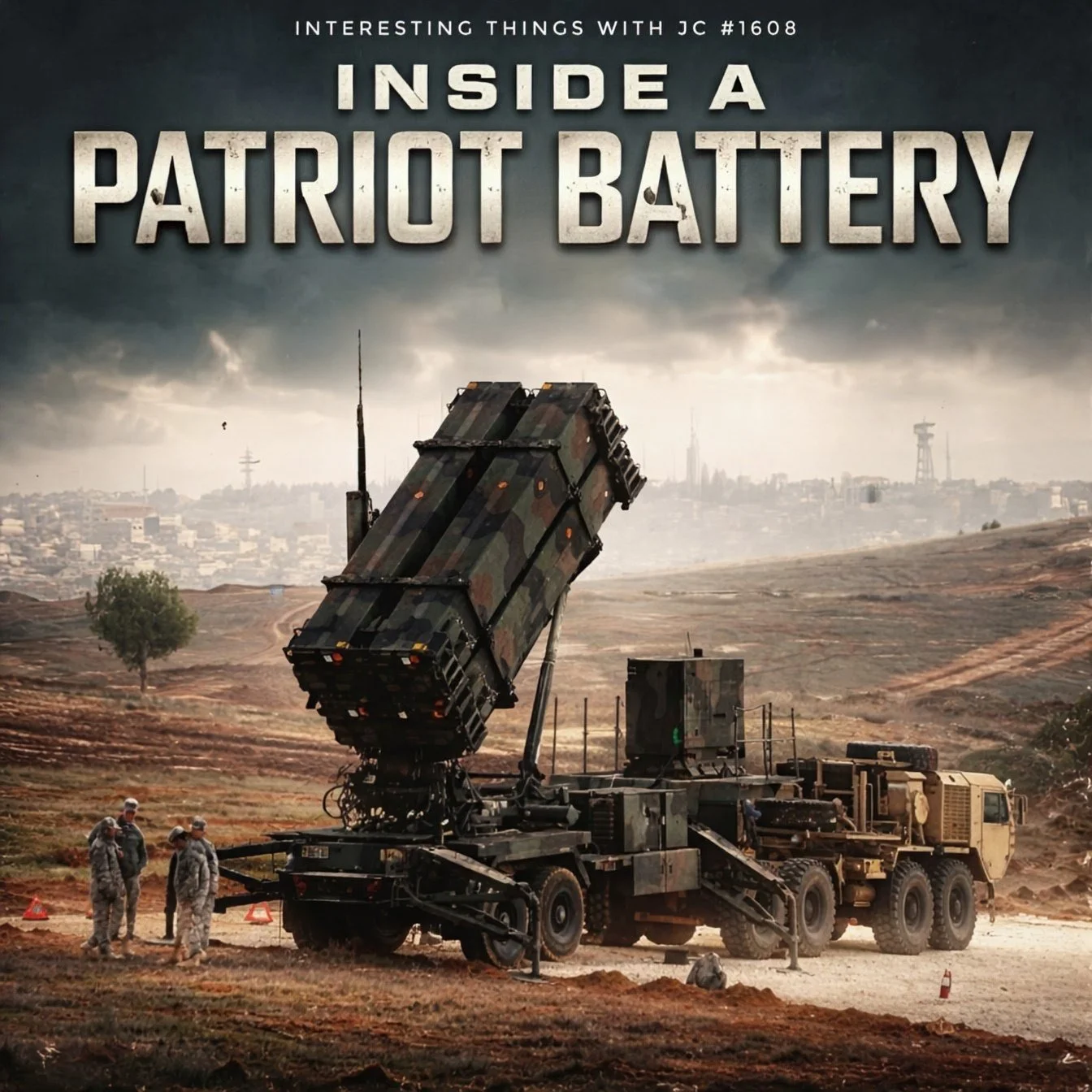
Interesting Things with JC #1608: "Inside a Patriot Battery" – When seconds decide everything, there is no room for instinct. Inside a Patriot battery, precision is not a preference.
Interactive timestamps
Jump to segmentGet every episode summarized
Each time Interesting Things with JC publishes, we email you a written briefing from the transcript — the topics, who appeared, and any specific claims, with the ad reads skipped.
Email me new episodesFree for 3 shows. No card needed.
Hosts & guests
Transcript ready
53 searchable segments. Every word is indexed and playable.
Full transcript
Interesting Things with JC — 1608: "Inside a Patriot Battery". Machine-transcribed; use the interactive transcript above to jump the player to any line.
0:00a Patriot battery. It doesn't run on instinct. It runs on procedure, training, precision. Every action is defined and every step has a sequence. Because once that system is up, there is no time to figure out anything. The Patriot missile system, the MIM-104, has been in service since 1981. A single battery is not one piece of equipment. It's a network. Radar, launchers, powered generation units, antenna systems, and the control station, all spread out and all ultimately connected. Each launcher can carry four missiles, each about 17 feet long, 5.2 meters, weighing close to 2,000 pounds, 907 kilograms. At the center is the engagement control station, the ECS. Inside, usually three soldiers operate the system. The tactical control officer makes engagement decisions. The tactical control assistant verifies and supports those decisions. The communications operator maintains the data
1:04link to higher command and adjacent units. They're managing a live air picture built from radar returns, identification systems, and external data feeds. Tracks appear, they change speed, change altitude, and shift direction all in real time. Some are friendly and some are unknown, and some are threats. A ballistic missile can travel over 3,800 miles per hour, 6,100 kilometers per hour. That means from detection to impact the window to act can be measured in seconds to a few minutes depending on the range. That timeline is why everything behind the scenes has to be exact. Before a Patriot system can operate, the battery has to be in place correctly. The radar, weighing over 90,000 pounds, 40,800 kilograms, it must be leveled within strict tolerances. Launchers must be positioned with clear fields of fire and proper spacing. Power units must deliver stable output continuously and the system relies
2:08on cables running hundreds of feet over 100 meters or more, linking every component. Each connection carries data or power. A single fault can break communication between systems and degrade performance. Crews don't just train this. They're tested on it repeatedly. They run formal gutteries certifications where entire crews are graded on simulated combat scenarios. Targets appear, timelines compress and decisions. They're tracked step by step. If identification is wrong, it fails. If engagement procedures are out of sequence, that fails. And if timing is off, it all fails. There's no partial credit here. These evaluations are not one time events. Crews cycle through them and standards they don't drop. Operators are expected to understand not just their role, but how the entire system functions, down to the components and the data flow. Now, not everyone stays in this field. The training pipeline is quite demanding
3:08and proficiency, it takes a lot of time. So even after formal schooling, it can take close to a year before a crew member is fully trusted in position. This is a small specialized group inside the army, highly technical, continuously evaluated and expected to perform under conditions where hesitation is not an option. Preventative maintenance checks, they're constant, radar systems calibrated, launchers, inspected power systems monitored, diagnostics run to catch faults before they matter. Reload crews, they add another layer of precision, missiles weighing nearly a ton. They have to be lifted, aligned and secured using specialized equipment. The process follows very strict steps and mistakes can damage equipment or delay readiness. Crews trained to complete reloads in under an hour because an empty launcher reduces coverage. Back inside the ECS, operators track every object within sector. The speed, the altitude, the trajectory, the identification,
4:13each factor feeds into a decision that has to be made quickly and correctly. They're taking that radar data and putting it all together. They can see it all. This system can intercept aircraft, cruise missiles, ballistic threats, and it all depends on human confirmation at essential moments. The technology supports the process. It doesn't replace the human. The Patriot system has been used in combat since 1991. During the Gulf War against Iraqi scud missiles, since then, upgrades have improved radar performance, engagement capability, and systems integration. In recent conflicts, systems have been used to intercept advanced threats, including high-speed missiles, with ease. But the system is only as capable as the people running it. This is a technical network working under pressure. Long hours maintaining complex equipment, repeating procedures until they are exact. Operating in an environment where mistakes are not acceptable and timing matters. Because when a real track appears, there's no time to prepare.
5:16You only have time to act and that moment, it depends entirely on the standard that was held long before the moment arrived. These are interesting things with J.C.
More episodes
More from Interesting Things with JC

1769: "Football Brain Injury Cover Up"
Interesting Things with JC

1768: "The Science of Jealousy"
Interesting Things with JC

1767: "The Spider-Man of Paris"
Interesting Things with JC

1766: "Autistici/Inventati - The Network Behind the Network"
Interesting Things with JC