About this episode
Mythology expert Richard Martin joins us to discuss why the Odyssey has been considered great story-telling by audiences across millennia.
As we talked about in episode 2 (on the Iliad), the Homeric epics came out of a long tradition of oral storytelling that stretched back hundreds of years into the Bronze Age. If there was a Homer, he did not just make up all these monsters and adventures up the top of his head. He inherited most of the individual episodes from the oral tradition. If we want to understand what makes the Odyssey great story-telling, we should look not for originality in the story per se, but at how the author weaves all the episodes together, puts them in a certain order to achieve maximum effect, and plays around with different tropes and formulas in order to tell a familiar type of narrative in an exciting way.
To find out more about the Odyssey (including our recommended translations) and about Richard Martin's books on mythology, visit the webpage for this episode at greecepodcast.com/episode15.html
You can also use this link to post, tweet, or share this episode with friends.
Get every episode summarized
Each time Ancient Greece Declassified publishes, we email you a written briefing from the transcript — the topics, who appeared, and any specific claims, with the ad reads skipped.
Email me new episodesFree for 3 shows. No card needed.
Hosts & guests
No transcript yet
This episode has not been transcribed. Request it and it moves to the front of the queue.
More episodes
More from Ancient Greece Declassified
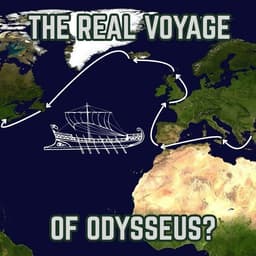
66 Did Odysseus Discover America?
Ancient Greece Declassified

65 From Vengeance to Justice: The Genius of Aeschylus' ORESTEIA w/ Doug Metzger
Ancient Greece Declassified

64 Plato's Republic: Full Summary and Explanation w/ Gina White
Ancient Greece Declassified

63 The Spartan Strategy for Acquiring and Wielding Power w/ Eric Robinson
Ancient Greece Declassified