
072. Accelerated hamstring injury rehabilitation exercise selection and progressions with Jack Hickey
About this episode
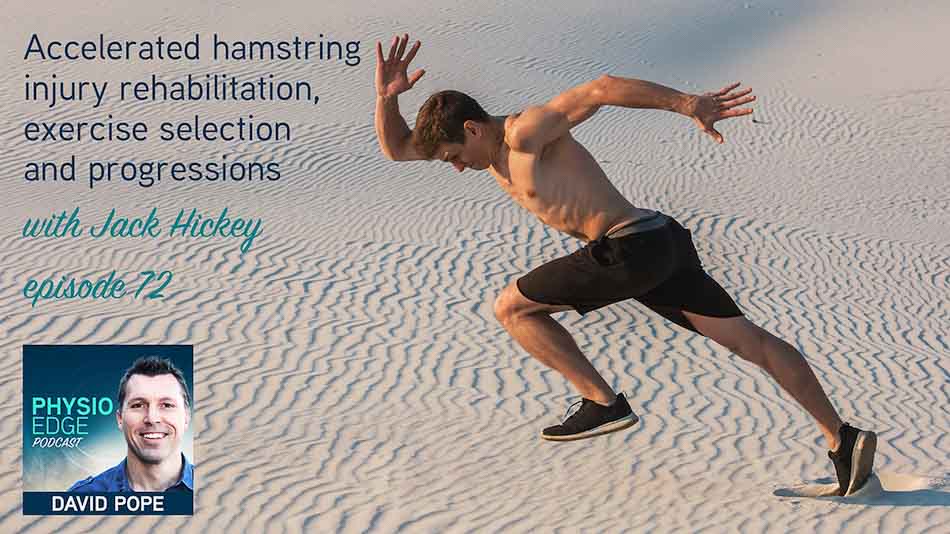
Injured athletes like to recover and return to play as quickly as possible, and we need to balance return to play against impaired strength, performance and risk of reinjury. Initial injury rehabilitation often commences with isometric exercises, progressing into concentric/eccentric style exercises when isometric tests are pain-free. Finally high load eccentric exercises such as the Nordic hamstring are introduced for their positive effects of increased strength, fascicle length and reduced injury risk.
High level and eccentric exercises are often avoided in the early stages of rehab, for fear of aggravating the injury. What if we could commence higher-level and eccentric exercises safely at an earlier stage? Would this impair or accelerate your patients' recovery?
In this podcast with Jack Hickey, currently completing a PhD with the QUT/ACU hamstring injury research group, we explore an accelerated hamstring injury rehabilitation program, and how this can be implemented with your patients. You will discover:
- The limitations of traditional rehabilitation
- What is the evidence for only using isometric exercises in the early stages of rehab
- Why eccentric exercises are commonly thought of as too high a load for initial rehab
- More modern rehabilitation programs for hamstring strain injuries, including the Askling (2013), Aspetar (2017) and Mendiguchia (2017) programs
- An accelerated rehab program, introducing higher-level and eccentric exercises at an early stage
- When you can start your patient's rehabilitation
- Which exercises you can use with your hamstring injury patients
- How to know when to progress your patient's exercises
- How often high-level exercises need to be performed
- When your patients can return to running
- How to progress your patients through a return to running program
- When your patients are suitable for return to sport




Links associated with this episode:
- Sliding discs to use in hamstring slider exercises in your clinic - available in Australia. Use the code "clinicaledge" to get 20% off your order (at the above link, not applicable on Amazon)
- Amazon (outside Australia)- Sliding discs to use in hamstring slider exercises
Other episodes of interest:
- PE 071 - Hamstring strengthening, lengthening and injury prevention with Dr David Opar
- PE 019 - Hamstring strength, flexibility and injury reduction with Dr Kieran O'Sullivan
- PE016 - Preventing hamstring injuries with Dr Kristian Thorborg
Articles associated with this episode:
-
- Askling et al. 2013. Acute hamstring injuries in Swedish elite football: a prospective randomised controlled clinical trial comparing two rehabilitation protocols
- Aspetar Hamstring Protocol
- Hickey et al. 2016. Criteria for Progressing Rehabilitation and Determining Return-to-Play Clearance Following Hamstring Strain Injury: A Systematic Review
- Jacobsen et al. 2016. A combination of initial and follow-up physiotherapist examination predicts physician-determined time to return to play after hamstring injury, with no added value of MRI.
- Järvinen et al. 2007. Muscle injuries: optimising recovery.
- Mendiguchia et al. 2017. Hamstring rehab for football players.
- Silder et al. 2013. Clinical and Morphological Changes Following 2 Rehabilitation Programs for Acute Hamstring Strain Injuries: A Randomized Clinical Trial
Get every episode summarized
Each time Physio Edge podcast with David Pope publishes, we email you a written briefing from the transcript — the topics, who appeared, and any specific claims, with the ad reads skipped.
Email me new episodesFree for 3 shows. No card needed.
Hosts & guests
No transcript yet
This episode has not been transcribed. Request it and it moves to the front of the queue.
More episodes
More from Physio Edge podcast with David Pope

180. Patellofemoral pain 4 - How to get runners back on track (and trails, hills...
Physio Edge podcast with David Pope

179. Patellofemoral pain 3 - Effective rehab that won't flare their symptoms wit...
Physio Edge podcast with David Pope
178. Patellofemoral pain 2 - What to do when runners won't reduce their training...
Physio Edge podcast with David Pope
177. Patellofemoral pain 1 - Why it has such a high recurrence rate, and what mo...
Physio Edge podcast with David Pope