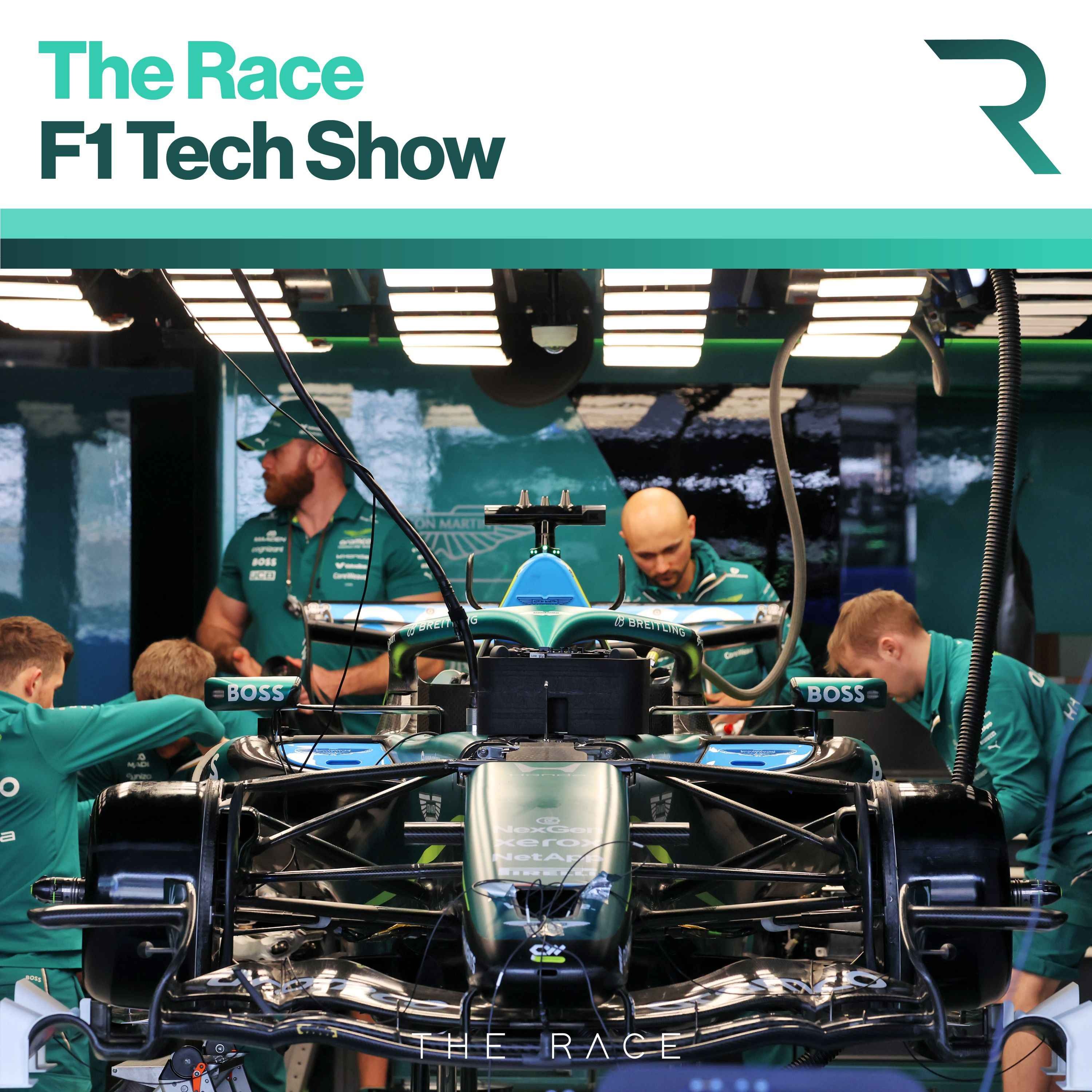
About this episode
Aston Martin's start to the season has been dogged by reliability problems, with serious vibrations from Honda's power unit damaging batteries beyond repair and leaving its drivers in pain. But who is to blame for these issues, and why is implementing a fix so difficult? Host Edd Straw and former F1 technical director Gary Anderson dig into those questions on the latest episode of The Race F1 Tech Show.
Gary also gives his views on the news that Aston Martin are set to bring in a new team principal to allow Adrian Newey to put all his focus on technical matters, shares his thoughts on power deployment at the upcoming Japanese Grand Prix, and answers questions from listeners on battery charging, front-axle harvesting and 3D scanning.
Got a tech question for Gary? Send it to [email protected]
Get bonus F1 podcasts, extra content and ad-free listening, sign-up to The Race Members' Club on Patreon today. For a limited time you can get 90% off your first month!
Hosted on Acast. See acast.com/privacy for more information.
Interactive timestamps
Jump to segmentGet every episode summarized
Each time The Race F1 Tech Show publishes, we email you a written briefing from the transcript — the topics, who appeared, and any specific claims, with the ad reads skipped.
Email me new episodesFree for 3 shows. No card needed.
Transcript ready
688 searchable segments. Every word is indexed and playable.
Full transcript
The Race F1 Tech Show — Why Honda's F1 engine fix is so difficult. Machine-transcribed; use the interactive transcript above to jump the player to any line.
0:00The ticket, Lady Jennifer of Coons. Well, many thanks, good sir. Here is my Discover Card. They accept a discover at Renaissance Fairs? Yeah, they do here. Discoverers accepted at the places I love to shop. Get it with the Times! With the Times! You're playing the loot. Yeah, and it sounds pretty good, right? Discoverers accepted at 99% of places that take credit cards nationwide. Based on the February 2025 Nielsen Report. Where's your playlist taking you? Down the highway? To the mountains? We're just into daydream mode while you're stuck in traffic. With over 4,000 hotels worldwide, Best Western is there to help you make the most of your getaway. Wherever that is. Because the only thing better than a great playlist is a great trip. Life's the trip. Make the most of it at Best Western. Book direct and save at bestwestern.com. Instacart makes grocery shopping easier.
1:02And just because you're not doing the shopping yourself doesn't mean you don't care how it's done. With Instacart's shopper notes, you can get particular about what you want right in the app. Like rotisserie chicken that's extra crispy. Steak with marbling the Romans would have loved. And lettuce you'd actually pick yourself. Just leave a note for your shopper so that they can get it right for you without having to ask. That way, you can get groceries just how you like. Download the Instacart app and shop today. The Athletic Gary tackles who's to blame for Aston Martin Honda's car and off track troubles heading into the Japanese Grand Prix. And what we should expect from these new power units at Suzuka. We also answer your questions on battery charging, front axle harvesting and marker dots. Welcome to the Race F1 Tech Show.
2:04I'm Ed Straw and with me of course is the real focus of this and indeed every episode Gary Anderson, the former Jaguar Jordan and Stuart F1 technical director with many, many decades of experience in Formula 1. So Gary, we've got the Japanese Grand Prix coming up. It's going to be an interesting one isn't it Suzuka? What a test that's going to be for these cars. Yes, it is indeed. I mean, Suzuka's always a fantastic track. Just that fast asses. The whole circuit really. It's not just the fast asses, but you know, from an engineering point of view, and from a driver point of view, it was one of the most challenging of the season. Because you just had to get the balance of the car right so that the driver could stay online up through the asses. Because you know, if you just, if you start wandering with each corner, the every corner just gets tougher. So it's really important to get a good front end on the car. But obviously as well, you know, the circuit's got some long straights on it, so you need to have a pretty good efficiency as well. And the old degner corners usually catch somebody out there as you go underneath the bridge.
3:09So it's always been challenging. I've always enjoyed it and the Japanese fans are absolutely fantastic. I mean, they just love the sport. They just love the team that they follow and the driver that they follow. They just support them that you cannot believe. So yeah, lots of very, very good memories from there. And of course, the engine manufacturer that they follow is, of course, Honda's home territory, literally, because they own the Suzuka circuit, which brings us to our first topic, which is the world of Aston Martin. Now, when Adrian Nui was appointed team principal back in November, it never seemed to be that permanent. Although the team when they announced it didn't suggest it was into him or anything like that, they were absolutely about it. So what do you make of this latest change with the fact that Jonathan Wheatley, who has now left Audi, is being targeted to come in on whatever timeline is possible after his gardening leave? Yeah, it's all a bit confusing, really. I think it's disruption. It's disrupting the company. All these changes all the time. And to be honest, you have to look back.
4:11They've never been very stable as As Racing Point or Aston Martin. It's never really been, I've never seen it as a stability of the personnel. So it's difficult to say. Adrian is a very good, highly qualified, highly successful technical director, engineer, aerodynamic, you name it. But he's not a politician. And to be a team principal, you need to be a bit of a politician. What happened in Australia, obviously, wasn't the best thing. The public sort of denouncing of the Honda problem I suppose you might call it. So it's difficult to know. I think, you know, Jonathan Wheatley and Adrian have worked together. They knew each other for years at Red Bulls. So that would be one step that would be easier to accomplish, getting the two people that have worked together for that length of time to work together again. And, you know, the time Adrian was promoted to a team principal as well as
5:15technical consulting, whatever it is, officer. You know, I've said at the time, you can't do those two jobs properly and efficiently. You know, these teams have grown so big now. Adrian, in the technical department, there's probably 250 people that, you know, Adrian has to sort of oversee. I wouldn't say manage is the more because when you get that many people, you have to break it down to sections. But, you know, he has to oversee it. He has to make sure that he knows all the bits of the jigsaw it's going to go together somewhere because everything relies on everything else. And that's a big enough job to be honest. That's 24 hours a day. Mind-wise, you're always thinking about it. You never really don't think about it. You might not just be doing it, but it's a 24-hour day job. And I was doing it, you know, at a lot less people. But you wake up in the middle of the night with ideas and you have to sketch and down and put them out of that paper. Because in the morning, you'd probably have forgotten about it. But, you know, it's so difficult to get your mind to clear out and not think about what the project that you're doing.
6:17So, to take on that other role as well with another, you know, probably 800,000 people that are involved in the manufacturing and the team, the race team, just all the other stuff that goes on. Again, there are lots of people managing lots of areas, but you still got an overview of all that stuff, if you're going to do it efficiently. So, they need a person in there that's going to be what you might call the team principal. The guy that sort of makes it all work and harm, and I suppose you might call it, and let Adrian get on the technical side of the company. Because they're in a bit of turmoil, you know. They're heading off to Honda's home races, we know it's a Zooka. And the pressure's on Honda. The pressure's on Aston Martin to show that they've made a step in some direction. But, you know, one of the things that we don't really know, I suppose, is the reality of the problem. You know, we hear about this vibration and the driver's nervous system and shaking their hands and feet and, along with the last race, having to retire because of that. You know, if that is real, then somebody has to step in. You know, but we had the, the promising with the ground effect cars.
7:19The FIA made the teams put sensors on the cars to monitor it. And if you're the levels, the G levels that they were, the drivers were suffering, it was felt to be too high. Then they were going to do something about it. You know, that's all sort of dissolved now or dispersed. But it's still, it's still the reality. If these levels of vibration are enough to, to sort of interfere with the driver's health, then, you know, if I ain't any step in and say, excuse me, chap, but, you know, there is a, this is the limits here, health wise. We need to stay with them not somehow. Where that vibration is coming from, you know, we hear it's engine vibration. We hear Honda saying it could be from a gearbox. Who knows? We don't really know in detail, to be honest. But if it's high enough frequency vibration to hurt the driver's nervous system, I would say it's something that's, you know, moving at high speed. I don't see how it's a gearbox personally, because I think that would be a very low frequency vibration.
8:20I don't really see how it could be there. The actual engine structure itself is, you know, the things that are going at a high level rate and knots is the MGU K and the turbo. So there's some, maybe something in there that's the way they're mounted or whatever that's passing that vibration through the car. So something needs to happen, but they only need to work together. And I think Adrian B and Team Principal and Technical Director are such, is too big a task for any focus on the real problem. He's very confident about the quality of the underlying car in that he said that he's confident it could be a leading midfield chassis and presumably I suspect he really thinks a bit more than that, but obviously we don't get to that because there no way near the limit of performance. Now, Honda have put out a few quotes, this only in a press release, but Shintaro or a horror. The trackside general manager and chief engineer talked about progress in terms of battery reliability in China. Thanks to a reduction in the vibration affecting the systems, but said we must find more solutions to establish the cause of the vibrations
9:23affecting the drivers and talking about reliability. Performance still not what we want it to be, especially regarding energy management et cetera. So nothing surprising there, but it's interesting that they're still talking about really still trying to understand the root cause. Just to get into this a little bit more, I'm going to throw in a listener question now because it fits in very, very well, which is from Reggie who says, please explain how modern day F1 engines are mounted in the car and what are the effects of unrealistic options for reducing vibrations from the engine at source. For example, how it's attached to the chassis and around the driver, EG cushioning of contact points. Obviously this is very much an Aston Martin related question. Yeah, it is. I mean, basically all the cars are the same. The chassis itself is a very rigid structure and the engine itself is a rigid structure. Those two are bolted together at the front face of the engine, the back face of the chassis. There are six mounting points which are defined in the regulations as to their position. So in theory, you could take a Mercedes engine and bolt it in the back of the Aston Martin.
10:27You could, except for, it's not quite as simple as that. Those location points for the, as I say, for the front of the engine and the back of the engine to the gearbox, they're all structural fixing. They carry the transmit the loads through the chassis. They give the chassis the gearbox and the engine are rather tough stiffness. So all of them are as rigid as possible to a certain level. So you can't just put rubber bushes in there and hope that the vibration will be taken out. You can't sort of mount the engine on rubber bushes. It is a structural member of the complete car. And it's part of the package, it's transfer as the load from the rear wheels through to the front wheels. If you can imagine if you had a very soft chassis, all the setup changes you do with springs or rule bars, the front and rear axle wouldn't talk to each other. They just get lost in that spongeiness. So they have to be as rigid as possible or as rigid as you lay down in your technical brief for the car.
11:32So to insulate the vibration of the engine from the rest of the car is almost impossible. You have to look for it at source and try and fix it. As far as the driver is concerned in the car, he can be mounted a little bit flexibly. The driver doesn't want to be moving in the car. He wants to feel the car, every movement of the car he wants to feel. However, as a human body, the human body has some compliance. So to add another maybe 5% or 10% of that compliance to how the seat fits into the chassis or even how the steering wheel mounts onto the steering column, it might not be impossible to do that. Again with your feet where they sit on the pedals, you may be able to do something there and not affect the overall performance of the chassis itself. The driver might need to take a little bit of time to get used to it. But you shouldn't have to do that. As I say, it's like anything.
12:32You want to find the right cause of the problem and identify it and try and resolve it. If you put bandages on all the time, you just go round into the circle because your focus is on the wrong thing. So yes, I'm not saying Adrian's right. By saying that Honda have created this vibration problem. I'm not saying Honda, right? I'm saying that it may be the gearbox. I don't know enough in detail about it. But I think we need to look at the root cause and work together to identify it and find a solution to the problem. Honda said when they spoke between testing and the first race that they detected a few of these vibrations on the bench testing, but nothing at the level that they encountered when they hit the track. So that's one thing we know. They still say they don't know exactly where it comes from. They have said, obviously you can have them originating potentially in the engine. But I'm interested in terms of potential origins. How much of it can it just be excessive vibration being caused from the way components operating as they're intended to are moving? And how much of it can it be the interaction of different things?
13:35Can it be quite a complicated problem to run down? Because normally you want it to be okay, we can point at this thing. That's what's causing it. But when it starts to get into the world of interactions and things you're trying to do structurally to dampen things and how everything interacts. I guess that's when it starts to get somewhat complex in terms of running down what's really the root cause. Yeah, those, I mean, you just don't know. It'll fill the car full of sensors to try and find out where it's originating from if you can. I mean, if they can't measure it on the dyno, obviously the engine bolt onto the dyno is a completely different mining system as such to the engine bolt onto the car to an extent. Because obviously the masses are all the componentry rounder or different. But, you know, you should be able to measure to some level the vibration in the engine. Now, I would have thought if it was a physical engine vibration to that extent, it would be detrimental to the engine itself.
14:36Because, you know, you can't live without sort of thing within the engine. Whenever they had the Renault V10s back in the old days, I remember Ralph Schumacher whenever he went from Jordan to Williams saying that setting in the car, you know, it just made it cough because the vibration threw the seat back from the way the engine was different. That was in the pits setting, you know, at low RPM. But whenever it was on the track, it wasn't a problem. But, you know, there was our different characteristics. We had a Ford engine in 2003, I think it was at Jordan. And, you know, for whatever reason, the vibration at the back of that engine, we had cracks in the gearbox, you know, just constantly cracked the gearbox. So, it can happen. But, you know, we're talking about times back then when the engine RPM was quite high RPM. Now, we're talking about, you know, the engines, as we can see on TV, they used 11, 12,000. There's a 15,000 RPM limit, I believe, on the engines, RPM limit.
15:36So, it's not as early running at high RPM. It's got this flat plane crank, which is defined in the regulations. And that can cause a better grief here and there. But, you would have thought that you would build as Honda, you would build an engine that would be a vibration-free as such, because what's the point? What does the vibration do for you other than be detrimental? Now, we see a lot of teams that also put the car on to fill car dinos as such and run the car. I mean, that's a place to go, because obviously that's where the pick and the vibration act from. Things you can do, for example, the MGUK, although I'm sure most teams mount it onto the engine. It is something you connect your mind on the chassis and drive it with a remote drive to the engine. I'm not saying I asked the Martin to do that. Only David knew. It would be something that you would be looking at quite deeply, because those sort of things can cause you grief, especially whenever the car is in a corner loaded up.
16:39As we say about the chassis to the engine mounting system, it's all going to be rigid. But what is rigid? Where does that come in at? Where do you stop the stiffness? Where do you sort of not allow for tolerances and things moving that little bit? And if you have a remote drive to the MGUK, it can run up to 150,000 RPM, which is quite high speed, as far as I know. And if you've got a remote drive to it, it could be that that's causing some grief. So there's lots and lots of things, but only asking Martin the Honda to know really what they've got as a package. Only they know what the whole package works like or intended to work like. And only they can drill down into it and find the solution to it. And all the interactions of all the different componentry, what it could be doing. So I'm sure they're working very hard on it, but the most important thing has worked together on it. One interesting thing that was revealed also by Honda was that they did make some changes.
17:43At some point later in the process, it's not clear exactly what the timeline was, but at Aston Martin's request. So you've got this interesting circle of causation, haven't you? That let's just say for the sake of argument, it is a problem that's originating with the Honda product. There's then the question of whether compromise is forced by the packaging demands of Aston Martin has maybe led to that happening. So this is why we talk about partners, the works partners, the engine and the chassis side having to work together, isn't it? Yeah, there isn't it because it's about working out those trade-offs collectively. This is when McLaren learned, wasn't it? There's echoes of the whole size zero thing when basically Honda would just pushed into this small box. And indeed, one of the first things they did when they left McLaren and they had that season with Torosso was they said, well, can we have the engine block just that little bit longer from memory? It's maybe 150 millimeters longer, something like that. And Torosso said, yeah, sure, and that made life a lot easier for them.
18:43It's possible that the root cause could be in that, couldn't it? Yes, it could be. I mean, I would be surprised if Honda were asked to do anything too dramatic to the actual architecture of the engine, the main architecture of the engine itself, because they, you know, they and Aston Martin should have been working together, even before Adrian knew arrived on the scene. I could see Adrian looking for packaging sort of advantages from the car, the whole lot, bringing it from his experience. And, you know, the battery may be one of those sort of things, from things that I've read, they've got two-tier battery, as opposed to a single-tier cell as such. And that's probably because of the disruption you have in the form of the chassis underneath, to get the battery pack into the bottom of the chassis, because when you do that, you raise the fuel level higher, so you're sort of looking at trying to compromise that battery pack relative to the fuel level.
19:45If you can imagine that the battery pack will always be the same size, whereas the fuel capacity in the car will change, A for a qualifying B for the race. So you may want to do something with where the fuel's placed in the car, as far as weight distribution is concerned, to generally help the car overall. But that, you know, that battery being a big, flat battery pack underneath the fuel tank, just means the fuel tank is higher, rather than the fuel being placed in a slightly different position. So there's lots of little things you would be trying to do with the car, depending upon what your beliefs are, for them to get the best out of the package, as far as the car performance is concerned, and maybe those compromises have pushed too far on some areas, or too late when they're doing the ride. But, you know, we had Andy Karl there, I'm not sure what's happened to Andy now, I haven't heard anything about him lately. And, you know, we have to give Andy a lot of credit for the Mercedes engine package back in 2014, and how he oversaw the creation of that unit.
20:47But really, interestingly, I don't think he got involved with Honda early enough. For some reason, it seemed to be a breakdown in communication between Honda and Austin Martin in the very early days to understand what was going on early enough to make sure that Honda had time to put together a package that they were happy with. And, if they did get change of direction, because Adrian came in and said, I want this, this and this, then, you know, somewhere along the line, somebody had to be strong enough to stand up and say, no, we can't do it in the time. We can do it for six months, time, or whatever, or for next year. But for now, this is what we got to build. So, if Honda give way, lay down and say, okay, we'll do it. Then, somewhere along the line, somebody has to accept the fact that, you know, you can't ask for too much to lay it. And, you can suffer the consequences of it then. And, you know, you dig a big hole for yourself. So, it'll take time, but I would have confidence in Honda for my experience with them.
21:48The thing is, you have to work with them to make sure that they're working, you're working together and all pulling in the same direction. So, that's going to be a big test for Aston Martin, I suspect, but whatever happens, it's going to be a pretty tough weekend at Suzuka. There's absolutely no doubt about that. Now, quick reminder, we do have our special offer for your first month's membership with the race members club 90% off your first month. In fact, loads of extra content there. Approximately enough, I do a series called Edge Sheds, where I talk about very bad F1 cars, maybe the 2026 Aston Martin could be destined for that in the future. And, I'm pleased to say, I've never had to tackle a Gary Anderson car in that. I don't think any of your cars really, truly qualify Gary. Maybe the 2000 Jaguar, but I'm not sure that was really your fault. Let's put it that way. And we know actually that car got quite quick. What's the problems have solved? So, I'll stay away from your cars, but there's loads of extra content there. Scott Mitchell, Mom and John Noble will be doing stuff from Suzuka this weekend as a thriving community. So, like I say, 90% off your first month, hit the link in the episode description or head to Patreon and search for the race.
22:55All the race members club to find out more. Oh, could this vintage store be any cuter? Right? And the best part? They accept Discover. In a little place like this? I don't think so, Jennifer. Oh yeah, huh. Discover's accepted where I like to shop. Come on, baby. Get with the times. Right, so we shouldn't get the parachute pants? These are making a comeback. I think. Discover's accepted at 99% of places that take credit cards nationwide. Based on the February 2025 Nilsen report. Okay, I have to tell you. I was just looking on eBay where I go for all kinds of things I love, and there it was. That hologram trading card. One of the rarest, the last one I needed for my set. Shiny like this. Designer handbag of my dreams. One of a kind. eBay had it, and now everyone's asking, ooh, where'd you get your windshield wipers? eBay has all the parts that fit my car. No more annoying. Just beautiful.
23:55Millions of fines, each with a story. eBay. Things. People. Love. So listing your home address on business documents. Stable gives you a permanent business address. One you can use for the IRS. Banks, vendors, you name it. So you can keep things professional and keep your personal address private. Stable also digitizes all the mail that comes to that address. Accessible from our secure online dashboard. Which makes it easy to manage your mail from wherever you are. No PO boxes, no miss mail. Just one less thing to think about as you scale. Sign up for a virtual address today at usestable.com slash pod and get 50% off your first three months of a grow or scale plan. That's usestable.com slash pod. Your business moves fast. Your mail should too. Let's move on a little bit more to Suzuki Gary. What are you expecting from these new cars in Japan in terms of the racing? Particularly considering we're going towards the trickier end of the spectrum in terms of the energy recovery level. Australia was pretty terrible.
25:03China was pretty good. Japanese getting back towards the pretty terrible area of Australia in terms of how much you can harvest. But probably not quite as bad as Australia in terms of the overall configuration. But it's it's at the trickier end, isn't it? It's at the trickier end and the problem is this is in general the circuit layout as to how you'd want to use that. That the battery pack you know up come up and come up straight into 130R. That was always the big corner, the challenging corner. It's a corner where it's never been easy to take flat. It was a ground effect cars. It was much much easier. But these cars are going to be less grip through there. They're going to arrive there quite quick because of the active aerodynamics. I believe that'll be able to be opened on the way up to that corner. So the thing I see is quite a lot of harvesting through 130R and up to the chicane. And that's a little area where we always saw somebody that might just be able to do something through 130R and jink out, come up to the chicane for an overtaking maneuver.
26:08I mean I'm talking overtaking here. I'm not talking about mirror signal maneuvers that we've seen in some races. I'm talking about genuine driver overtaking another driver. And you'll want to charge the battery up because obviously start lines not far away from the chicane. So you'll want to arrive at that start line with as much power as you can. And then again down through down the pit street, use that energy down turn one because they're all areas where you know there's a lot of lap time if you don't basically down the straights as fast as possible. And then up through the s's you can also have a better recharge to just top the battery up a bit more. It's going to be a bit of a tip for top circuit, I think. But the one thing I sort of stick out, I was saying that I think it probably ruined 130R is the corner that is just like a ruse at spa. You know, it's one of those circuit corners where you think, is it flat? Is it okay? And as a spectator, it's just one of those sort of things for you. That's what you want to see.
27:13As an engineer, it's always being getting the car set up so that 130R was able to be taken flat for many many years. It used to be a kiss on the left foot on the brake pedal just to sort of stabilize the car a little bit. But now you'll see that all was harvesting just taking the speed out of the car or the effect what I'm saying is you won't see it all was harvesting because we never see that. We don't know what's going on really. It's just the cars that become sort of up more on rails. And that's not because they got more grip, it's just because they're bigger and slower. So, you know, I know I'm looking forward to the race and I enjoyed China and I enjoyed Melbourne. I enjoyed it for different reasons. You know, I think that what we're seeing is entertaining for sure. But one thing I keep saying is sport can be entertaining, but entertainment is not sport. I think we need to look back a little bit. Liberty media won't entertainment because that's the mass audience likes to see something that is entertaining. So they've got what they wanted. Now they have to live with it and try and make it work to stop the criticism from the media.
28:20But the criticism from the drivers themselves is just getting a bit over the top. The problem is the drivers that are doing well are not really criticizing. The drivers that are doing badly are criticizing. So, where's that fine line at? Somewhere along the line that needs to be a whole group of them saying, look, we need to make this better in this way X, Y, Z. Because we all come up, we all got opinions of how we can make it better. But the guys driving the cars, you know, they are the people that are at the cliff face. They're the ones that are actually doing the job. And, you know, surely as a group, they could put a plea forward to the Liberty Media and the FIA. How do you get a slightly better balance? But I'll be looking forward to it. I'll be getting up to watch it because it is entertaining. And I like entertainment, but I like sport even more. And Suzuki should be a fascinating track to look at how they're doing the harvesting and deployment. Simply because there are going to be questions of what impact does it have on going through the S's.
29:24As you said, they could do a little bit of harvesting through there. So there is going to be a kind of intellectual interest in that. But whether that delivers the kind of qualifying laps or whatever, for example, you want is a big question. But in terms of these power units, obviously we've got this big gap coming up. There's a lot of discussions about what's going to change. We know one thing that is going to change as of the first of June. So that's after not just Suzuki, but then Miami and Canada. And then we'll have Monaco, which will be the first race where this has changed. So probably not the best ones are judging, but we've got the compression ratio, the hot and cold test rule change now. So previously testable, currently tested only cold. Now I'll be tested hot and cold. And there's interesting questions about what impact that will have, especially considering Mercedes don't seem to concerned about the whole thing. And they seem more keen to ensure that when it's changed, it wasn't only changed to hot, but they wanted it measured hot and cold. I'm not sure Mercedes actually have to change a great deal, but maybe they do. Maybe others might have to as well.
30:27Yeah, I mean, it just has one of those things that I don't think that many engine manufacturers or PU manufacturers will actually really know. And 100% detail, the compression ratio they have at high elevated temperatures that the engine runs at. You know, these engines run at, you know, when you look at it, they're 130 degrees or something like that, as far as just the water temperature, etc. But in the combustion chamber, it's much, much hotter. So there's room for material expansion to allow for for the compression ratio to change. But what you got to understand is that everything changes. You know, it will change for everybody. All the materials that are in there, no matter what they are, will alter due to the temperature difference between an ambient temperature and the running temperature. So if you're just talking about doing it between 20 degrees, let's say ambient and 130 degrees, then the change will be relatively small.
31:34So I think that would disappear into the undergrowth as far as this compression ratio thing. I think it's picked up something a bit in momentum. It's not really necessary to talk about 30 horsepower, so I'm not, I don't see anything like that. I think it'd be talking probably single figures of horsepower. But there will be something there. And why make it simple, I suppose, whenever you can make it complicated. It's one of those sort of situations that F1 is very good at. The compression ratio at 18 to 11's, it was last year, was acceptable. It's been out for four years, five years, whatever it's been, even more than that. But to go down to the 16 to 11, just change that wording. So it's ambient instead of just a compression ratio. Never, don't define the temperature. If you don't define the temperature, then it has to be legal all times in theory. Because you can measure that different temperatures and say, oh, excuse me. So the room for discussion, the room for people, plotting and skull documentary, et cetera, et cetera.
32:39But I think it will end up with all this disappearing under the wash. Like most things do you end of the day because a measuring it, properly that the sort of temperatures is, is not impossible. And be, it just doesn't really matter. It doesn't really matter. I don't think so. As long as it's a level playing field, then no, it doesn't matter. Would you be looking for changes with these power units? Obviously as a limit to what can be done. But there are a few things that can be done. You can, you can up the fuel flow rates a bit. But obviously there's a limitation in terms of how big your fuel tank is and that kind of thing. And there will be a point where if you've got the fuel flow rate too much, it will cause other problems and the redesigns. Let's talk about, do you knock back the power of the MGU K when you're deploying so that you can use it for more seconds. You say 250 kilowatts rather than 350. There's arguments for upping the super clipping. So when you're at full throttle, but harvesting, which is currently limited to 250 kilowatts to you up, that's a 350. Yeah, those are the sort of the obvious levers that can be pulled. What would you be thinking needs to be done if anything in the shorter term?
33:46I don't think you have to panic. I mean, I think at the end of the day, you know, the FAA have defined this 5050. I would reject the 5050 horsepower or torque as near as practical. So at the end of the day, I think they want to see that. There one thing I keep saying is instead of having this power, MGU K torque step in like a light switch, then ramp it up because you'll see a power then. Just ramp up, depending upon where the engine torque is. So you basically, you know, the driver's got a pedal in the car that says I want more torque when he's flat out, give him the maximum. But instead of just putting out the MGU K torque and as a light switch and making it maximum immediately, give it to him in a ramp that's reflective of a normal engine ramp of torque. Because the torque from the engine isn't a flat line. The torque from the electric motor can be a flat line.
34:48That's why we hear, whenever the driver comes out of the corner, he'll hear the wheel spin just suddenly because he gets another 350 kilowatts of torque immediately at the rear wheels. And the car is not ready for that. And then there is he really, to be honest, that's why we've seen people spin it off. So it happened to Oscar Pastry and Melbourne on the outlet. That's what happens if he suddenly puts 300 extra 350 kilowatts of torque into the rear tires, he just can't cope with it. So ramp it and always ramp it and relative to the torque, let's say from the engine or relative to time, something which then will save some of that that power you've got. But try to manage that at each circuit so that you always end up with 350 kilowatts, which was the objective. So that'll keep the FIA and the objective of the regulations happy. And again, you know, it's one of those things where recharge, you should be able to have the maximum. The maximum is available to you, you should be able to have it recharge at the maximum rate at all times.
35:53Why would you want it to be 250 kilowatts for super clipping? Why not 350 kilowatts? As long as it doesn't mean the car flows down dramatically in front of another car, you know, that's one of the sort of things you've got to be very, very careful of. So you just, you know, it's one of those situations, again, as I say, where I think there's little things you could do to drop the ice across the teas that would just make it more usable for longer without the drama of a major change. Yeah, of course, there are some sort of ramps and things in terms of all sorts of, I'm just going on, but I think what you're suggesting is sort of a bit more of a progressive shallower one to change your distribution. That is an interesting idea in terms of tuning that circuit to, to circuit, but I imagine there's going to be a lot of talk about this in the, in the gap, but also a lot of this. I mean, personally, I tend to think, yeah, okay, tweak it if you think there's something you can gain with, but actually I think someone needs to be thinking a little bit longer term and, you know, starting to learn some of the lessons of what's been created because a lot of the things that are happening were known about and predictable because fundamentally it's dictated by the fact you've got a form.
37:03Make a dual battery and you've got a constantly discharging charge because you can harvest on a normal lap 8.5 megajoules, it does vary a bit on various conditions, but that means you've got a, you can't sort of save it all up and then deploy, you've got to be charging during qualifying laps, which is like drivers are backing off. So there's going to be a lot of talk about this, but I mean, you've been in the thick of these kind of discussions in your career. So easy is it to sort the kind of signal from the noise in so far as everybody's got their agenda when they're going into these technical discussions and these proposals, you'll have been the same rightly so, you know, you were there to fight the corner of whatever team you wanted and you'd be, it'd be ridiculous if you went in. And unless there was a really strong compelling case for the good of the sport that genuinely was overwhelming, you'd be fighting your corner. So how difficult is it in that scenario to hit upon something that is the sensible route that is fair and equitable. And actually is a neck gain for everyone in terms of how Grand Prix racing is working when you've got all of these interacting agendas going on and you can never really be sure who's saying what for what reasons.
38:14I think it's a one word sums that up and it's impossible to get a fair solution to set up problems because everybody will, as you say, look after your own agendas. The big thing is that the liberty media and the FIA seem to be working together in reasonable harmony at the moment. There was a while there, a few years for this sort of did seem to have a bit disgruntled with each other, but they seem to be working together in reasonable harmony at the moment. So the reality of it is that the sport is theirs, liberty media are their promoter and they've done a fantastic job in what they've done as far as getting it out there of people seeing it more and more people all the time. But they want a spectacle out of it. So the FIA's job is to make sure that's a level playing field, which they're doing okay at the moment. There is times when you can sort of wonder about that. But there are the two leaders as far as you're buying the desk and saying what they want.
39:15It's not down to the teams. All I'm saying that really is to listen to the drivers who drive the cars and try to get a consensus of opinion as to the areas where they think it's too hard to get the best out of being a racing driver. Because that's what we all want to see. We want to see a racing driver driving a racing car to the best of their ability. At the moment, what we're seeing was having to lift and recharge in certain areas where you didn't have to do that sort of stuff before. We want to see that taken away. So the driver does drive the car, especially for that one-lab and qualified. I don't mind it being a bit more technical during the race than you have them to. Managed things a little bit more because of the duration of it. But that one-lab and qualified, something should be done where it's just basically the driver with a car that's X weight, new tires, X amount of power, X amount of downforce and off you go and put in the best lap time you can. That's what Formula One should be about. And that's what driving a racing car should be about.
40:16Then in the races, you're always managing something with tires, brakes, whatever, heating conditions or cooling conditions or all sorts of stuff. You can manage the battery as well, to that extent. So at the end of the day, I think that some Formula One line, there is a better, a happier medium than what we've got. But we haven't got there yet. And it's up to Liberty Media and the FIA to bang the desk and get it redirected if it's necessary. I'd like to see some races where there's, instead of theoretically four cars at the front, there's eight, maybe even ten cars at the front battling to see how that unfolds. And we haven't really got there yet, but it'll be exciting if we come. But that's down to Red Bull and to McLaren to achieve that. It's not down to the FIA chains and the regulations or Liberty Media want the regulations to change. Because what we saw with the battle between the Ferrari's and the Mercedes, it wasn't bad. But still the best car combination probably came out on top at the end of the day.
41:18So, you know, as long as that happens, that's OK. Anyway, time will tell, let's see what happens at Suzuki. The ticket, Lady Jennifer of Coug. Well, many thanks, good sir. Here is my Discover Card. They accept Discover at Renaissance Fairs. Yeah, they do here. Discoverers accepted at the places I love to shop. Get it with the times. With the times. You're playing the loot. Yeah, and it sounds pretty good, right? Discoverers accepted at 99% of places that take credit cards nationwide. Based on the February 2025 Nielsen Report. Hi, this is Pablo Torre from Pablo Torre. Today, I want to talk to you about Boost Mobile. Because we spent a lot of time analyzing inefficiencies in sports, overvalued contracts, money tied up in the wrong places, and so on. But those inefficiencies aren't just on a roster. Sometimes, they're in your own monthly expenses. Boost Mobile says switching to their $25 unlimited forever plan can unlock up to $600 in savings a year.
42:22That's $25 a month for unlimited data, talk and text when you bring your own phone. If that money is trapped in a pricey phone bill, it might be worth a second look. Visit BoostMobile.com to learn more. After 30 gigabytes, customers may experience slower speeds. Customers pay $25 per month as long as they remain active on the Boost Mobile and Limited Plan. Savings claim based on January 20, 206, Boost Mobile Survey of 1,000 Americans with single line on limited plans, comparing average annual payments of major carriers to 12 months on the Boost Mobile and Limited Plan. For full offered details, visit BoostMobile.com. Over 90 of the top 100 US accounting firms trust Bill to simplify and secure Bill Pay. That's proven financial infrastructure built on over a trillion dollars of secure payments. Visit bill.com slash proven for a special offer. As always, we'll finish off with questions from listeners.
43:22If you'd like to ask Gary a question, file it through to podcast at the race.com, that's podcast at the hyphen race.com. I'll try to get to it in a future episode as we've got a gap coming up. I imagine we will tackle a job lot of questions as well. So now might be a good time or certainly straight after there's a Zooka Weekend or during. There's a Zooka Weekend as things strike you. Might be good time to fire some through. So we've got a nice arsenal of them to work through. So first up, a question from Shaby, Jr. This seems like an easy fix. So why are teams not allowed to charge the batteries in the paddock or on the starting grid? It seems like if they were able to start their quality lap or the formation out with the full battery. Some of the issues with energy harvesting on warm-up laps could be eliminated. Yeah, I don't disagree with you. It's just, you know, it's just part of the regulations. It's just what's in the rules at this point in time. The thing is you've got to remember that you can use that four-megagule battery pack. You've got about 11 seconds, 11.5 seconds of full power, 350 kilowatts to get to empty that battery pack.
44:27So yes, you could charge it up on the garage, you could charge it up on the grid. But it's not, you know, that's part of the regulations. It's making sure that the car recharges itself to that level. So it's easy enough to change the regulations as we say. Everybody's got an opinion of how to do it. Which is what our debate's been about earlier on. But what do you do to do that? Because there'll always be somebody that says, no, I don't want that because we designed our package to suit the fact that we could cope with the regulation as it is. So this majority rule thing in the regulations to get changes is very, very, very, very difficult. So it's not easy. I wouldn't, you know, I wouldn't be surprised if they did allow something to start to happen where you can leave the garage with the battery pack charged up completely. You've always been worried a little bit about doing that in the environment because the amount of time you've got, it's not, it's not long. So you just got to be careful with doing that, making sure that it's safety wise, it's all okay.
45:28Yeah, I think the other problem is that if you leave the garage with the battery pack full, you're going to spend it because you're warming stuff up, et cetera, et cetera. You've got your, and sometimes there's a few kind of downstream problems there. But yeah, it's a valid question. Right, the next question comes from JG Proponet. I understand that teams were reluctant to allow harvesting from the front wheels because Audi had experience with this technology from other racing series and could gain a potential advantage. Could a possible solution be similar to other standardized components in Formula One, where the FIA mandates a common system used by all teams. Audi could develop a system under FI specifications, much like the halo being produced by Red Bull. Such an approach might allow for greater energy harvesting while reducing the amount of super clipping and lifting cost that has negatively affected the quality of racing. Seems like quite a sensible idea, what do you think, Harry? Yeah, it is a sensible idea. I've said many, many times, you know, it's something that we're missing because it's a huge amount of energy that's wasted from the front axle. It's one of the things, you know, you don't have to have a single motor and drive shafts,
46:32which you could sort of work on to try to, I don't know what you like, or cheat with having torque characteristics that help the car rotate. I think you could have a single motor in the front with one controller, single motor at each side, so basically you'd still be able to lock one inside wheel if one tire has got less grip than the other one. But you could get back quite a lot of energy from that into the car. Again, the thing is that we're all pushed for, and I think the achieved, to some extent, is the smaller and lighter cars. But so everything you add, like that, will add weight to the car. And you're probably talking here about, you know, if the package you would be talking about, maybe five kilograms, I suppose, you know, the two motors and one of each axle and each front upright assembly, then the control unit you need for it, you know, wouldn't be surprised if it was not going to do or five kilograms more, to get a reasonable amount out of it. I don't think that would do all your braking by any means, but it would do a percentage of it.
47:33So it's one of those situations yet. I think it would be a good idea designed into the car, but I do think the cars are far too heavy, even still. Some cars are even heavier than those at the moment. So it's pretty difficult to achieve that minimum weight limit for all the teams, I think. But for some teams, almost impossible. So you've got to be very careful. You can make one thing better and hurt something else dramatically. Yeah, it's a good example of nothing happens in a vacuum, does it? And there's a lot of downstream consequences and unintended consequences as well. In terms of any kind of rule, decisions you make, and this rule set is full of unintended consequences. Right, the final question comes from Roger T from Canada. In preseason testing, several cars appear to have smaller marker dots applied around certain aerodynamic surfaces, especially winglets and small flexible aerosurfaces. They look very similar to the kind of markers used for 3D scanning or motion capture systems. I'm curious if those are indeed photogrammetry or 3D scanning markers.
48:35And if so, how teams are using them in practice? For example, are they part of a high-resolution photogrammetry setup to capture wing or element deflection under reel on track loads? If teams are able to capture accurate deformation data at speed on the circuit, how much aerodynamic analysis there historically would have been done in the wind tunnel is now being validated or even performed at the track? I'll be fascinated to hear examples of the kind of measurements or tests that might have migrated from control tunnel testing to real-world running. And our teams also capturing a high-resolution imagery of other teams' cars to study how their aerosurfaces flex at speed. It makes me wonder whether this type of optical measurements could also become part of how the Fi monitors the long-running issue of wing flexing. Well, there's a lot in that question, but it's an interesting topic. We know you're not allowed to do 3D captures of rival cars, but what's going on, Gary? Well, yes. First of all, I'll answer the simple questions. I mean, the teams will take pictures of every other car on the pit lane. As best they can to try and understand it, be that on the track or in the pit lane
49:38or if they could capture some pictures that might help them understand the right heights of the car through certain corners, you know, the gap to the ground. And that's all relative to car movements. If you get the car leaving the pits, then you could sort of have a good go at working out the stiffness of the car, the mechanical stiffnesses, et cetera, et cetera. But yeah, most teams will be looking at their own imagery to try to understand the flexing of componentry. Because there's no good in doing all your wind tunnel research or a completely rigid component that are then putting on something onto the car that you don't understand what's happening to it. You know, we used to even do this a long time ago. It was done very, very differently. But you would try to measure wing deflection by having some type of a strain gauge on the wing or a cable that basically would stretch and leave its position
50:39that were its stretch to you on the track. So you'd find out how much the wing had deflected. And then for the wind tunnel, you would make a wing that's deflected like that to compare to the standard one to see whether or not where the workforce went to, whether the wing got into a position where it was stalling. So you're trying to make your research level as realistic as possible to what's happening on the track. Because as they all year, your wind tunnel model, 60% model, all your wind tunnel research is done around that. Your CFD doesn't know about deflection. It can do if you can't do design and stuff and do proper FE analysis on it. But what you really need to do is make sure you know what the real car is doing and then try and match your FE analysis and deflection for the CFD and your wind tunnel component tray to that car, to the real car. And so that's all that stuff is about just gathering data of different sorts.
51:39And it's also used for, as you say, the 3D scanning just to make sure that all those things are in the correct place and coming back to the right place is the best way to put it. So you can go out of the pits and do your run, et cetera, et cetera and come back and then have a look at your 3D scanner again to see if everything's back in the same position. So it's just the size of the teams now. I've got themself to a position where there's so many people. They can do so much stuff. Whereas back in my day, you were sticking your finger in the air to see which way the wind blew. It's not like that anymore. You create the data and then you try and make sure you understand the data. But as I say, even now, I think there's some teams that are what they research in the wind tunnel with their models and in CFD. The component tray once it's on the car isn't exactly the same. Due to flexing because you'll never stop it. You can't make everything rigid. It's just impossible. Everything will be on the move to a certain extent.
52:40So you've got to try and capture that and make sure that your research and your development direction encompasses that, the real car as opposed to encompasses the theoretical car. The FI does keep a close eye at times on flexing as well with high-speed cameras and the sort of locator markings on them as well. As Gary's just explaining, there's multiple different things going on there. Thanks very much for those answers. Thanks to everybody for the questions. Like I say, it's podcasts at the race.com. That's podcasts at the hyphen race.com. If you'd like to fire in a question for a future episode, like I say, I imagine we'll get through quite a few of them in the gap before the, what's the next race? The Miami Grand Prix, which is going to be at the start of May. Thanks to Bahrain and Saudi, not happening. So, yeah, get your questions in. Have a think during the Japanese Grand Prix weekend if everything strikes you because, as I always say, there's no such thing as a stupid question. Some of the simplest questions are often the ones that come up with the most interesting answers
53:40because there's often all sorts of unstated assumptions and things that we don't get into. So, any question number, how simple or complex will give it a go? So, podcasts at the hyphen race.com. So, we're going to be paying attention very, very closely to goings on at Sir Zooka and you can join us after that for more from Gary. The Athletic. Hi, this is Pablo Torei from Pablo Torei finds out. And today, I want to talk to you about boost mobile because we spent a lot of time analyzing inefficiencies in sports, overvalued contracts, money tied up in the wrong places, and so on. But those inefficiencies aren't just on a roster. Sometimes, they're in your own monthly expenses.
54:40Boost mobile says switching to their $25 unlimited forever plan can unlock up to $600 in savings a year. That's $25 a month for unlimited data, talk, and text when you bring your own phone. If that money is trapped in a pricey phone bill, it might be worth a second look. Visit boostmobile.com to learn more. After 30 gigabytes, customers may experience slower speeds. Customers pay $25 per month as long as they remain active on the boost mobile unlimited plan. Savings claim based on January 2026, boost mobile survey of 1,000 Americans with single line on limited plans, comparing average annual payments of major carriers to 12 months on the boost mobile unlimited plan. For full offered details, visit boostmobile.com. Over 90 of the top 100 US accounting firms trust bill to simplify and secure bill pay. That's proven financial infrastructure built on over a trillion dollars of secure payments. Visit bill.com slash proven for a special offer. This spring, follow your nose to what feels good. Right now, get a free pure plus diffuser when you subscribe to Two Samps for 12 months.
55:43Fill larger spaces with scent inspired by layers of spring. And let your home open to the season. Now at pura.com.
More episodes
More from The Race F1 Tech Show

F1 control systems explained + How F1 is approaching solving its power unit prob...
The Race F1 Tech Show

Where can F1 make improvements to the new formula?
The Race F1 Tech Show

A racing revolution? Our tech preview to F1 2026
The Race F1 Tech Show

The key tech trends of F1's 2026 cars
The Race F1 Tech Show