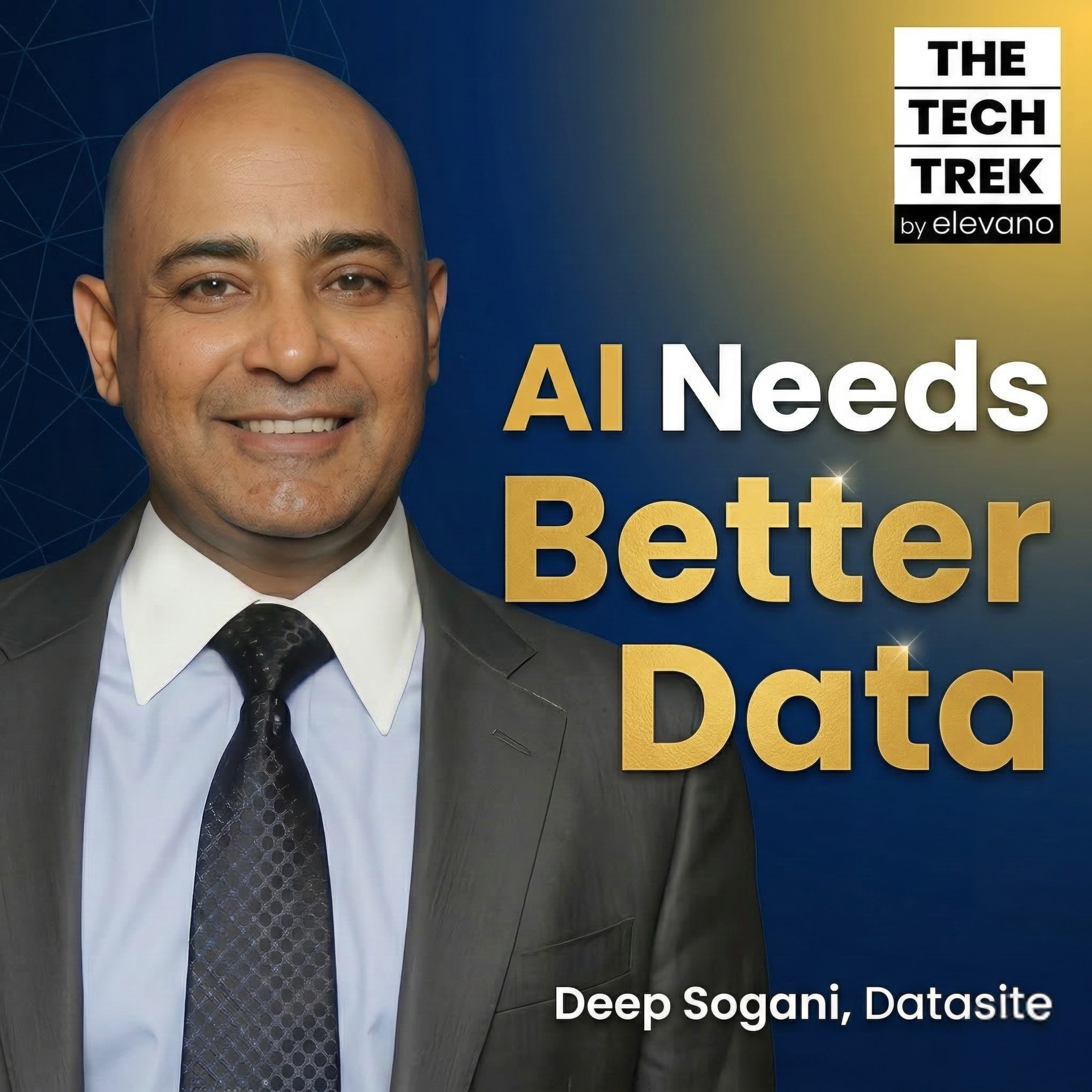
Why Enterprise AI Fails Without Better Data and Business Process Design
About this episode
Deep Sogani, SVP and Group Data Management Officer at Datasite, joins The Tech Trek to unpack why data governance, lineage, and business process design have become mission critical in the age of AI. This conversation gets past the surface level AI hype and into the operational reality, how companies actually build trustworthy systems, where AI initiatives break down, and why strong data foundations now shape business outcomes in real time.
This episode explores the shift from downstream analytics to data that actively drives live decisions, workflows, and automation. Deep explains why many AI projects fail before the model even matters, how business architecture should lead technical design, and why human oversight still matters in high stakes environments.
In this episode
Why AI has made data governance and data lineage far more operational
Why business process clarity matters before data architecture or tooling decisions
How real time AI changes the demands on data quality and system design
Where agentic AI fits, from workflow automation to more advanced decision support
Why human judgment still matters in AI systems shaped by risk, ethics, and security
Timestamped highlights
01:47 Why AI raises the stakes for governance, lineage, and trust in data
04:57 Why business architecture has to lead before technical design
09:11 The progression from predictive models to agentic AI workflows
17:55 Why the human in the loop is still essential
21:16 What makes an AI project worth prioritizing
26:06 What has changed, and what has not, in AI related change management
Standout line
“Business architecture and business thinking should dictate the what and the why, and the data architecture is the how part which needs to follow.”
Practical takeaway
If you are evaluating AI inside the enterprise, do not start with the tool. Start with the business problem, the workflow, the decision risk, and the quality of the data behind it. Strong models on the wrong problem still fail.
Follow The Tech Trek for more conversations with leaders shaping technology, data, AI, and the future of modern business.
Get every episode summarized
Each time The Tech Trek publishes, we email you a written briefing from the transcript — the topics, who appeared, and any specific claims, with the ad reads skipped.
Email me new episodesFree for 3 shows. No card needed.
Hosts & guests
Transcript ready
583 searchable segments. Every word is indexed and playable.
Full transcript
The Tech Trek — Why Enterprise AI Fails Without Better Data and Business Process Design. Machine-transcribed; use the interactive transcript above to jump the player to any line.
On this episode of this show, I have with me Deep Segani. He is the SVP and Group Data Management Officer at DataSight. And we're going to be talking about, well, data has moved upstream in a lot of companies. We're going to be talking about the factors that are becoming even more important when AI, data governance, data lineage. We're going to talk a little bit about business processes and workflows and a couple of things in there as well. Deep, thanks for taking the time. Glad to be here. Thank you for having me. Absolutely. Before we start, what does DataSight do? So DataSight is a leading dealmaker platform company. We provide a secure platform for companies in the deal space, like a merger and acquisition, to securely exchange data and information. And as you mentioned, my role is SVP and Data Management Officer. Absolutely. All right. So I guess this episode, we're going to be talking a little bit about data. Obviously, data is becoming the forefront of all your discussions.
And let's actually maybe start there. So with AI, we have seen a lot of concepts come to the forefront that we've known about for a long time. But we haven't really done much about, I should rather say, we haven't done as much as we could, because somebody's going to message me and go, hey, Data Governance has been going on for a long time. I agree with that. But it sounds like it's even becoming more pressing. And a lot of other various areas. So I guess when you look at AI and you look at companies that are obviously very data intensive, what are some of those things that maybe we've been talking about for a while that are at the center of attention at this point? Is this getting their line right now? Yeah, so Data Governance and the generally talk around data as a discipline, data quality, that has always been there. And I've been in the industry for two and a half decades. And we always took pride in creating great data
warehouses with good, clean data. But now it has taken on a totally different dimension. As AI becomes part of every day work, these factors matter a lot more, especially things like Data Governance and Data Lineage. Because AI is only as good as the data behind it. So we need to know where the data came from, how it has been transformed, what's the data lineage, what's the data provenance, where is it coming from, the source of origin, and whether it can be trusted. Because if you do not have all this information, then your AI can hallucinate. And your agents can actually create bad results with workflows. So teams, they cannot trust governance just as a checkbox anymore. It's become a real time discipline, and it's become very operational. It supports operations in real time. Because this data lineage that we talk about, it helps us understand the full journey of data
feeding these models, which is essential for model accuracy, transparency, and of course, the overall risk management for the organization. So without all these foundational aspects of data governance, AI can't really scale responsibly. Absolutely. That's 100%. I think fair with what we're seeing out there. When we look at data, and traditionally, it's been, I call it responsive. So meaning there's a bit of a like. Obviously, somebody has a business problem, the business problem has to be defined. And even though the need is immediate for the most part, a lot of things have to happen to provide those pieces of data. I guess with AI, I mean, the holy grail of, hey, I'm going to have some kind of interactive AI that I can sit on top of my data and give me answers faster. I think that sounds great. I mean, we talked about self-service BI 30 years ago.
That was never really the easiest thing. But when we look at the promise of AI and we know data is going to be key, how much of a bottle the next does data become to delivering on its potential? Because I think there's AI that can help with workflows at some levels. And then as we get deeper to companies that have proprietary workflows, proprietary semantic to data, proprietary context of data, the AI is no longer as reusable as it was maybe at a general level. But when we start thinking about AI sitting on top of data to deliver the solutions that people are starting to just have conversations about, what are some of those challenges? What are going to be some of the pitfalls of preventing us from getting there potentially? Yeah, so one of the main challenges here is the understanding of business and business architecture and how business process works before we
get into data design and technical data architecture. Because in my experience, real transformation can happen only when business architecture leads and the technical data architecture supports it. Too often, over the course of my career, I've seen organizations jump into the tech pieces straight away, tools and platforms without understanding why the business operates the way it does. Very often, I've seen data architects just jump into technical data flows. Or I've seen projects of the projects get implemented, just solving for the immediate data needs, connecting data from one point to the other, without really understanding the business processes or the overall data landscape, that should support these processes. So that is our traditionally, even traditionally, silos, data sprawl, multiple copies of data, different versions of truth that have come about. Now, you always had some lead time that you talked about in the traditional world, right? You had these silos, but you also had the time to cleanse the data downstream in a warehouse. You always had the time to create these reports
after the fact. But now, with operational needs, with AI agents, you don't have that time. Everything needs to be in real time these days because business, because data is very operational in nature now. It is, and that's one of the biggest changes and one of the biggest challenges too, that data is now fully embedded in the day-to-day operations of a company. It's not something that teams can go fetch later or analyze after the work is done. No, this is part of the operational workflow. This is how decisions are made in real time. And how downstream processes run based on what happens in what your models generate, right? So this is how work is managed. So whether it's automation or it comes to customer's interaction, live interaction with your customer rep creating the next business action or relying on the next business action model or relying on the customer churn model for the next business action and offering customer discounts,
all this is happening in real time, right? And I work for a leading supply chain company where in the past, your packages are delivered, you can do analysis, you can do time series analysis, see how the packages, what was the estimated, what was the time of delivery for the package and all that. But now it's all has to be calculated in advance and it has to take in actually really happening things at that moment like traffic patterns and weather patterns and how they can change the delivery time of the package. So now you have models that are estimating these delivery time of the package in real time and then based on that, you're dynamically routing your network, your supply chain network downstream. So there are multiple models at work here which basically inform operations in real time. Now that, all that data and all that modeling within real time at the speed of business is only possible if your data is kosher,
if you have built your data foundations and as I said, your data architectures have been built to support your business processes and how the business is evolving. So you mentioned obviously business workflows have to be a front and center. When we're looking at AI solutions and obviously the data that feeds through these business workflows, for us to have AI sit on top of these workflows help automate, help with the human loop all those things that we're talking about, there's a lot that we have to understand and a lot of these processes are not, and there are a lot of standardized processes but there's a lot of processes that are very unique to companies. I mean, if we're looking at AI, is there a lens at which we want to stop looking at a company and looking at what AI can do just because there might be diminishing love returns in terms of how deep we get with business workflows and AI? Yeah, so with AI, of course, there is two levels
of, you can have multiple levels of support from AI and of course, we talk about the traditional machine learning models, which would be where you could do regression analysis and you could do predictive, and I just talked about prescriptive analysis that you can do in supply chain company by dynamically routing packages and things like that, right? To make sure that the package delay is avoided as much as possible. So there is that level of AI. Then there is, of course, automation by agent AI where agents, you know, they automate the work, they do the work of humans. Like in my past organization in healthcare, agents could now adjudicate claims. Earlier, it used to be a human, completely manual and human process on adjudicating medical claims, looking at which claims the companies, the insurance company needs to pay for
by looking at medical necessity, by looking at the doctors or providers' bills, by looking at the right codes, the ICD codes or the procedural codes being there and whether and also detecting for fraud, possibility of fraud and things like that. You have to go through so many different kinds of analyses and connect with different applications or, you know, historical data and permissions and things like that, meaning the policies to be able to adjudicate over a medical claim. All this workflow which was human driven can now be done by an agent or a bunch of, or multiple agents kind of talking to each other, right? In a multi-step agent AI scenario. So we've moved from traditional machine learning models now to these agentic models, right? Which are automating these workflows. But these are at the end of the day business processes, right? You can't create these agentic AI driven workflows
unless you have a very good understanding of business processes underneath and how applications connect with each other to make this business process happen. You can use a very soon AI with AI will be in, in term, we would be solving problems that are clear, which I term is clairvoyance, where we don't even know what quest into us, where our business, you're looking at new product and development, like in a pharmaceutical industry is looking at creating new drug intermediaries, which we don't, by combining chemicals or raw materials and things like that into, which is something that humans cannot do manual. Your existing models cannot do. And that's where AI is going basically, and that's the, that's the next stage of evolution. But then again, you cannot make AI go to the next stage and tell you something, you don't know,
until it understands what is the current process and how we can, you can take it forward and leapfrog here, the human mind to create, give that clairvoyance to you. So I've talked about different stages, right? There's traditional machine learning and predictive prescriptive. Then there are very complex agentic AI driven workflows where you are completely automating the current business and then you're taking the business with the help of AI driven clairvoyance into the next stage where you haven't even solved those problems for a year, but AI is already there with the capability of solving those future problems, right? So, but all this thinking finally, the banks on the understanding of business processes, the clarity around current processes, the value stream, the understanding of the business operating models, and then only you can create these business, these blueprints, I should say, to process blueprints to drive the business.
And a data architecture should be in support of all this. Again, coming back to my earlier point, data architecture is a means, it's not an end by itself. Business architecture and business thinking should dictate the what and the why and the data architecture is the how part which needs to follow. And of course, all this finally depends on coming back to the original idea of clean data, data that is trustworthy, data that is reliable, that can, systems that can scale, data feeding those systems. So again, we kind of have come back a full circle, but the simple thing is that yeah, your business today and your business in the future completely depend on this on your business thinking, even if it's AI leading the thinking on the and driving the data architecture and the data discussions. I guess when it comes to technology and you talk about business and everything you said,
absolutely agree with. I guess from your perspective, when you're looking at what technology has delivered, especially when it comes to internal teams, when you're looking at that and you're looking at some of the challenges that we've seen with mapping business processes to technologies, is revisiting those and looking at agentic, does it change some of the things that you do? Is it less complicated, more complicated? Is it a case of a different perspective on the business because you're solving the problem at a different, from a different focal point? Cause obviously as you alluded to and we've come back full circle and it comes back to this understanding the business process and understanding the workflows and mapping it to the right technology. I kind of feel like that's not too different than what we've always wanted to do, but the complexity has seen higher with agentic in some ways. The complexity may be higher,
but the results are also at a higher plane, if you will. You know, and the one way of thinking about this is, you know, when it came to databases, we always, we started with relational databases, right? We thought about data in a tabular fashion, then came, you know, the no SQL databases and the unstructured information can be structured into databases, if you will, with document databases. And so on, then comes the graphical database which allows for very complex relationships to be expressed in, you know, a database structure. If you go by traditional thinking, you know, we were still thinking tabular, but eventually it led to advances in that field, to graphical interfaces and so on. All this becomes much faster with AI
because it can get into that mind space where you are not right now. So in that sense, agentic AI can open new horizons that you are not aware of right now. It would have taken maybe another 10, 20 years to get there who knows, but with agentic AI, you know, we'll just get there much faster. But again, all that needs to be based on very solid foundation if you don't want the AI to hallucinate and give you realistic possibilities in the future. Absolutely. When you are looking at that aspect of hallucination, I think I saw a posting that's circulating on social media about a company that used an AI to help with their analytics and they found out several months later that the AI was creating some false data as well as some of the data that the company had. When you think about those hallucinations, you think about the human and the loop. I guess when you think about those dynamics,
and obviously stakeholders at the executive level, business leaders, they need this data, but that relationship is a human and the loop. Is that something that is that for now thing we need because the technology is still being tested or is a case where that's going to be a part of the process. The AI is there truly as an assistant not to potentially automate the decision-making as well. I think the human and the loop is extremely important to keep things grounded because the way things are happening with AI and the results of the next stage of computation and the next stage of computation can come, computation and inference both. It can be exponential in speed, but if you are starting out wrong or somewhere along you get in on the wrong path, then the downstream computations or inferences are all wrong. So the human in the loop is extremely important to keep it, for now at least to keep it grounded
and to keep it directionally correct. Also there's always an element of, this is not just about accuracy, either it's about ethics, it's also about governance. It's also about security because if you're completely dependent on AI and there's no human in the loop, then obviously you could have some ethical issues there in terms of what data is being used, right? It's self data, data sets itself is biased and not ethically correct, could be racially biased data, could be a sample of data which is not even representative of all the categories of data, all the parameters of data, things like that. So again, I would say that the human in the loop is very important at multiple stages of this AI implementation. We may get to a stage where after so many cycles,
the human in the loop can be removed in certain cases, but not completely from the process, but from certain maybe milestones within the process. But at this point, I feel given the immaturity in the industry and also the way it's going so fast and there's obviously doubts around the governance of it, the doubts around the security of it, doubts around even the existential security of human beings and then you hear that every day in the news. I think the human in the loop and the review by humans in the loop before AI is approved to do anything is very important. Absolutely. I guess a question for you, when you are obviously at the executive level or at the business level, every level of AI is the discussion, when you look at that and you're trying to understand what to prioritize in your AI roadmap.
I mean, there's a lot of competing factors. You mentioned obviously, even in medical, in the medical healthcare field claims can be automated. We can have that as an option. We understand it very well, so that process. When it comes to looking for areas of opportunity of AI, there's lots of projects going on. What qualities in those requirements do you need to go? You know what, these are the right characteristics for a good implementation of AI. Are there any, or I guess have you seen ones that are better than others? Yeah, and many of those we have touched upon here in this podcast already, right? The projects that would succeed are need to be grounded in the business reality. They need to be able to, because AI implementation has to follow the business processes and the,
so I would think, starting with the business thinking, getting the right data set, the accuracy of the data, the cleanliness of the data, the discipline around the data governance, which makes it secure, which makes it ethically correct. All these are things that are very foundational for making any AI projects successful. Because without it, you know, the business problem that you're trying to solve, either problem may be wrong, you're trying to solve the wrong problem, or even if you're trying to solve the right problem, you may be following the wrong processes or wrong, you know, to solve the problem, or even wrong set of data to solve the problem. I mean, I give you an example. I mean, I used to work for a home security company and be created a model that would identify false alarms, 99.9% of the time, meaning that if people are,
if alarm is sounding at a home, and it's a false alarm, then you don't need to send anybody in terms of law enforcement and so on, because that's a false alarm, it's not a security issue, a phone call will do it, but so we could predict, you know, 99.9%, but and when we took it to the CEO, he basically, you know, called our work unacceptable, because not because 99.9% of, you know, prediction of false alarm accurately is a bad statistic or a bad result. The problem is with 0.1% that you are saying are false alarms, but are not false alarms. They're actually two alarms. So when you talk about hundreds of thousands of alarm, or tens of thousands of alarms every over a period of time, like say every month or so, that 0.1 really adds up,
and you can't risk it because even if one of those ends up in a loss of life or property, then your brand suffers a lot here in terms of damage. So great model, great engineering, very good data set, not no problem with the processes, you know, the AI itself or the data we use, but we didn't understand the business problem, right? You get the business problem, you were always solving for the wrong business problem. So that's why I'm saying the understanding of business, you start with the business, the right business problem, you understand the business process well, then you get into the architecture and the data. All of that has to be correct, yes, all the ducts have to be lined up in a row, but you know, it's, you can't just get there with one piece of it, you have to look at the entire, you know, set of components that make into that AI journey successful, that makes sense. Yeah, I love that story, and I do like,
you know, when you talk about business process and understanding it, I think there's a notion within technology that I wanna say this polite link correctly. That's been, that's always the hard part, right? Technology itself, I mean, as technologists, we know how to write SQL, we know how to code, we know how to do all those things, but that translation layer is, is so difficult. And when you look at that over the history of what technology is done, obviously the tools have gotten easier, the processes not change that much, but when you look at AI and you look at, you know, as you say, if you don't understand a business process, and you're talking about enterprises looking at agentic and we do need that governance, we do need the human and the loop. To re-engineer that business process does require some bit of change management for the stakeholder, because they're, they're going to be involved differently, potentially, we're asking them to do different things.
I mean, that change management aspect, I mean, it's still coming, but when you look at change management and you look at AI, is it any different than anything else we deliver from technology or is it the same principles or does AI change anything? I don't, when it comes to the aspect of change management, you know, the pace now is very different from, you know, when there is change management, then there is a time that people take to accept the change and get adjusted to the change. There are always early, early adopters and there are laggards, right? That time has considerably reduced now, because things are moving so fast. So I think the pace has, pace of change has really, you know, become much faster. And so the people need to adopt and adapt fast, but the basic stages of change management
or acceptance of change or how you manage change in terms of, you know, communication, in terms of allowing people's fears, in terms of making the change and seeing its effect test, test, test, right, making the change, seeing its effect and then, you know, changing, taking that small test to a larger, you know, you know, larger set of data or larger set of people basically brought basing that change a little more and then a little more things like that. Those stages, I don't think the stages have fundamentally changed, but the pace has definitely gone up a lot and then a lot of this can be even aided by AI itself, whether it's a generative AI or agentic AI, they can really help, help you expedite the change in the organization, but you still have, there are still, you know, people still have to get comfortable with it, accepted, adapt to it, adopt it, you know, adopt it
and that, of course, those processes by which that has to happen, they haven't fundamentally changed. Love it, deep, great advice, great insights, I appreciate your time. If somebody does have a follow-up question if someone wants to ask something about something you mentioned, what's a good way connecting with you? I think my LinkedIn would be the best way to connect with me. You can always send me messages over LinkedIn and I would be happy to get in touch with you. Would love a deeper discussion on this with anybody who's interested. Absolutely, appreciate the time. Thank you for coming on the show. No, no, thank you so much for having me for the great discussion. Thank you, Emmer. Absolutely. All right, that's it for this episode. Be back again, different guests, different topic. Until then, two things. One, deep talk to us about, really, we have to look at that business process and understanding that architecture and being able to build AI off on top of that because those workflows, they are going to be all business process.
So that was great advice and some great insights and just what he has seen working. So please share this episode with somebody else that might benefit from it. Also, like, subscribe, comment. Leave me the other shows going for you. Until next time, thank you and goodbye.
More episodes
More from The Tech Trek

How AI Is Changing Engineering Workflows and Software Teams
The Tech Trek

How AI Agents Are Changing Who Can Build Software
The Tech Trek

How to Build a Data Team Ready for AI
The Tech Trek

How AI Startups Can Challenge the Enterprise Services Model
The Tech Trek