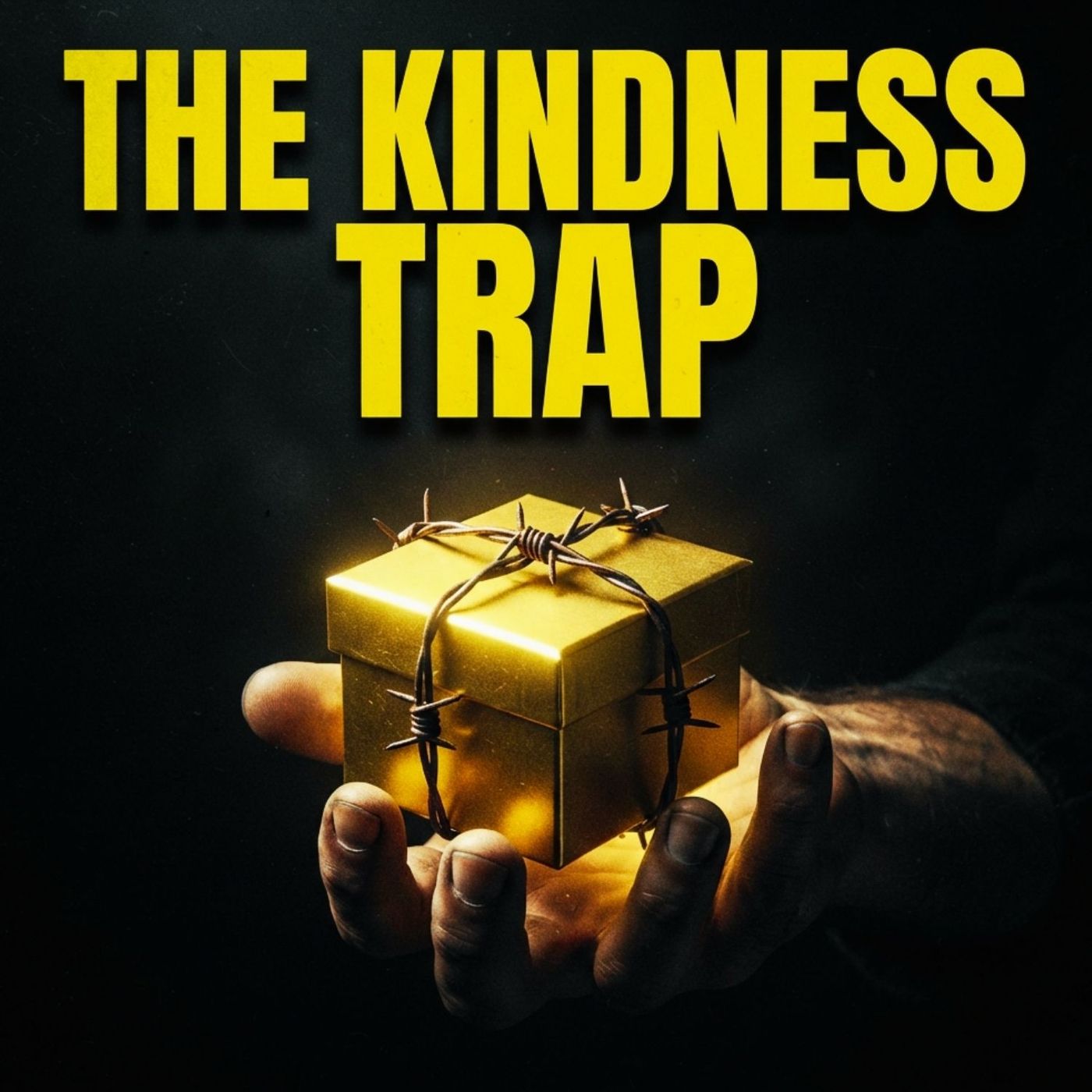
Weaponized Nice: How to Spot a Manipulator Before It's Too Late
About this episode
Ever felt like you were being steered down a path you didn't choose, yet somehow, you were the one who said "yes"? Subtle psychological manipulation isn't always about screaming or aggression; often, it’s wrapped in a "warm blanket" of false generosity and a helpful hand. In this eye-opening episode, we peel back the layers of dark psychology to reveal the invisible strings pulling at your daily decisions.
🎭 The Mask of Warmth
We dive deep into the controversial reality that some of the most toxic relationships start with kindness that feels just a little too perfect. We are dissecting how master manipulators use emotional influence to bypass your logical brain and target your vulnerabilities when you least expect it. Is it a genuine connection or just strategic control? The answer might disturb you.
In this episode, we break down:
- The 'False Generosity' Trap: Why that "no strings attached" favor is actually a debt you'll never finish paying.
- Forced Choices: How manipulators use choice architecture to make you feel in control while they pick the destination.
- Gaslighting & Isolation: The brutal strategy of eroding your self-confidence until you have no one left to turn to but them.
- The Power of the Pause: Why slowing down your decision-making is the ultimate mental self-defense.
Most people don't realize they are being manipulated until the cage is already locked. We explore the behavioral psychology patterns that serve as early warning signs. Whether it's in the office, at home, or in your social circle, learning to spot these psychological red flags is a total game-changer for your mental health and autonomy.
Stop being a pawn in someone else's game and start playing for your own team. 🛡️
🎧 Listen, Learn, and Level Up
Don't let your kindness be weaponized against you. If you’ve ever felt "crazy" for questioning someone’s "nice" motives, this episode is the validation you’ve been looking for. Hit that follow button, share this with a friend who needs a wake-up call, and let’s reclaim your power together! 🙌✨
Become a supporter of this podcast: https://www.spreaker.com/podcast/life-hacks-diy-more-transform-your-everyday-with-simple-tricks-and-diy-magic--5995484/support.
Get every episode summarized
Each time Life Hacks DIY & More - Transform Your Everyday With Simple Tricks and DIY Magic! publishes, we email you a written briefing from the transcript — the topics, who appeared, and any specific claims, with the ad reads skipped.
Email me new episodesFree for 3 shows. No card needed.
Hosts & guests
Transcript ready
670 searchable segments. Every word is indexed and playable.
Full transcript
Life Hacks DIY & More - Transform Your Everyday With Simple Tricks and DIY Magic! — Weaponized Nice: How to Spot a Manipulator Before It's Too Late. Machine-transcribed; use the interactive transcript above to jump the player to any line.
Just a quick reminder before we really get into it today, the conversation you're about to hear is for informational and entertainment purposes only. Please always consult with a qualified professional, you know, like a licensed therapist, psychologist, or mental health counselor, before making any decisions regarding your mental health, your well-being, or your personal relationships. Right. So usually when we talk about diagnosing a problem, there's this expectation of precision, right? It feels like engineering. Yeah, exactly. Like it's a math problem. Right. Like if you break your arm, the x-ray shows that jagged white line, and the doctor just points and says, there it is, broken, it's binary, it's clean. But then you step into the world of behavioral psychology and interpersonal dynamics. And suddenly, the x-ray machine is, well, it's completely broken. Oh, absolutely. It's all gray area. You are looking at a landscape that is just incredibly murky, which brings us to a concept that completely stopped me in my tracks today. The idea that the most dangerous person in your life is not the one who is screaming at you.
No, not at all. It's not the person throwing things or making overt threats. The most dangerous person is the one who quietly steers the conversation so smoothly and so seamlessly that you leave the room feeling like everything was your own freely chosen idea. That is the really scary part. It is. So you all sent us this fascinating behavioral analysis transcript. And you asked us to break it down because, well, you were struggling to identify where the boundaries are in your own life. Yeah, which is so common, honestly. You are asking, how do we spot the invisible mechanics of interpersonal control? So that is our mission for this deep dive. OK, let's unpack this. We are taking the source material and unpacking the premise that real manipulation does not look like a threat. Right. It looks warm. It looks patient. It looks like it's entirely on your side. Yeah. And I think that's where people get so tripped up. The region of manipulation that might be working on a person right now is, well, if the exact version they would never label as manipulation. Because it doesn't fit the stereotype.
Exactly. Our cultural script gives us a very specific archetype for toxic behavior. We picture force, pressure, a notoriously demanding boss or a mustache-whirling villain. Right. The guy tying someone to the train tracks. Right. But those archetypes are clumsy. Yeah. The people who are truly adept at interpersonal control are not overriding your decision-making process in a way that you can actually feel. Oh, wow. They're quietly paving a pathway for you to follow, making it look like a scenic route you just decided to take all on your own. It's like a magician forcing a card on you. I mean, if you've ever watched a close magic, you know the feeling. They fan the deck out. They say, pick any card, and you pull one out, entirely convinced it was your free will. But the deck was stacked from the beginning. The magician knew exactly where your hand was going to go. But I have to push back on this premise just a little because it makes these individuals sound like criminal masterminds. If we can't feel it happening, if the card is being forced so smoothly,
it implies they possess this superhuman level of social intelligence. I mean, are they really all evil geniuses? Well, that is a really common assumption. But the source material makes a brilliant distinction to dismantle that exact myth. We really need to stop viewing manipulation as this dark mystical personality type. Oh, so what is it then? It is far more accurate to look at it as a mechanical failure. A mechanical failure. Yeah. Manipulation is simply what a request turns into when someone wants a specific outcome, but they lack the courage or the trust to use honesty to get there. Wait, a lack of courage. Because we throw around the word manipulator as an identity, almost like a predator, but you're saying it's actually rooted in a kind of functional cowardice. That's exactly it. They want something from you, whether that's your time, your agreement, or your undivided attention, but they know that if they ask directly, you maintain your autonomy. Right, because you could just say no. Exactly. You might say no. And they cannot tolerate the psychological discomfort
of hearing no. Direct requests require vulnerability, right? You have to accept that the other person is free to decline. I see. So to bypass that vulnerability, they use tactics designed to bypass your autonomy altogether. They engineer the situation so that saying no feels socially or emotionally impossible for you. That reframes the entire dynamic. It takes away all the mystique. It really does. So if we want to trace these invisible strings, we have to start by looking at the tactics that actually feel pleasant. We are looking at how our own best traits are weaponized against us. Let's look at the first mechanism detailed in the transcript. Right, the generosity piece. Yeah, it deals with generosity being used as a strategic investment, rather than an actual gift. What's fascinating here is that the initial act is utterly indistinguishable from genuine care. Right. The help arrives just a little too eagerly. It's the favor you didn't quite ask for, but they just insisted on doing anyway. Yeah. And from an evolutionary psychology standpoint, humans are hardwired for reciprocity.
Oh, totally. We owe each other. Right. In early hominid tribes, survival depended on the gift economy. If I share my hunt with you today, you share your fire with me tomorrow. We have this deep, neurological social contract embedded in our brains. That makes sense. So when someone does something nice for us, our brain automatically registers a social bet. But I want to challenge where the line is drawn here, because isn't reciprocity just a normal, healthy part of human relationships? Oh, absolutely. Like, if I buy my friend dinner three times in a row, and they never once offered a pick up the check, I'm going to get annoyed. Does that make me manipulative just because I noticed the imbalance? No, no. Let's look at the difference in the intent and the accounting. Healthy reciprocity is about mutual flow. It's a natural give and take. The red flag in this behavioral analysis is the meticulous, itemized ledger. Ah, the ledger. The true nature of this controlling generosity isn't revealed in the moment of giving. It's revealed weeks or months later
when it gets referenced as a debt to be collected. After everything I have done for you. Yes. That phrase is the tell. When someone says, after everything I've done for you, you realize that what you thought was kindness was actually a tab they were quietly keeping. Oh, wow. They aren't asking for mutual support. They're caching in a chip to force compliance on a specific issue. It feels like you walked into a restaurant, someone handed you a beautiful plate of food, told you it was on the house, and then chased you into the parking lot with a bill. That is the perfect analogy. And the text points out something incredibly insidious about this. It weaponizes a decent person's conscience, because decent people pay their debts. They do. I was struck by a specific phrase in the transcript, real generosity forgets itself. That's such a good line. It really is. That's a metric you can actually use. If someone has a perfect photographic memory of every single nice thing they have ever done for you, and they rattle off that list, the second you try to establish a boundary,
it was never a gift. No, the transaction was entirely one sided. It's designed to keep you in a state of perpetual emotional debt. And this transitions us naturally into how they weaponize your empathy, which is perhaps even more pervasive than weaponizing your conscience. Right. Because if they don't have a fake gift to hold over your head, they can manufacture guilt at a thin air just by shifting the emotional weather in the room. Oh, the heavy sigh. Passive aggressive mood shifting. The transcript calls this the sneakiest maneuver of all. It's the classic phrase, you know, it's fine to do what you want. I'll just deal with it myself. Yes. Reading through the material you provided, I had this visceral reaction because I think everyone has felt the physical weight of this tactic. Everyone. And the brilliance of it, from a manipulative standpoint, is that firmly speaking, no one is actually asking you for anything. Right. If you were in a courtroom, you could not testify that they demand to you change your plans. Yeah, the judge would throw it out. Exactly. Yeah. They want to say one thing, go have fun.
But the emotional reality says another. Through mirror neurons, human beings are highly attuned to the emotional states of those around them. We naturally want to alleviate distress in our social groups. So we take it on. We do. They take their bad mood, their disappointment or their anxiety, and they successfully outsource it, making it your job to fix. It just sits there in the room with you, getting heavier and heavier until you realize that saying yes to whatever they implicitly want is the only way to make the suffocating feeling go away. But if they are asking, what is the end game? Why not just say what they want? The end game is compliance achieved through a mechanism that leaves them completely blameless. Of course. If they say I demand that you stay home instead of seeing your friends, well, you have a tangible grievance. You can fight a direct demand, but you cannot easily fight a mood. Right. You can't argue with a sigh. You really can't. They use guilt because guilt is an invisible cage. You lock yourself inside voluntarily,
just to relieve the pressure of their engineered disappointment. And it creates this wild optical illusion for anyone watching from the outside. The source points this out, and it's tragic, honestly. From the outside, the manipulator looks like the calm one. They aren't yelling. They just look slightly sad, playing the role of the patient saint, putting up with a difficult partner or friend. Right. Meanwhile, the victim, who is twisting themselves into knots, trying to alleviate this crushing unspoken guilt, looks frantic, anxious, or even unhinged to outsiders. Yeah, and that optical illusion serves a dual purpose. It forces compliance while simultaneously isolating the victim. If the victim tries to explain to a friend what is happening, it sounds trivial out of context. Yeah, they sighed at me. Exactly. Or they said it was fine, but they look sad. The friend naturally responds, well, they said it was fine, what's the big deal? The sheer weight of the repeated conditioning is completely invisible to the outside world. Man, so we've looked at how emotions are compromised.
You know, weaponizing the conscience with fake gifts and weaponizing empathy with heavy moods. But the source material outlines how this escalates from hijacked emotions to hijacked cognition. Right, the next level. Once they bypass your feelings, they go after your actual decision making process. They introduce the illusion of freedom. The phrasing in the transcript is chilling. It's totally up to you. We can do it my way. Or we can do it the way where everyone ends up miserable. Your call. Right, it mimics the language of empowerment. Perfectly, your call. Totally up to you. I was trying to visualize this while reading through the sources. And the best analogy I could come up with is being offered two doors. One of the doors is completely normal and the other is literally engulfed in flames. And the person standing next to you says, you are completely free to choose whichever door you want. Walk through the fire or walk through the safe door. I support your autonomy. That is so spot on. Sure, technically you chose the safe door, but functionally, you were shoved through it.
And the kicker is you get thanked for making the right decision. And the psychological mechanism at play here is forced triage. When the brain is presented with a false binary, my way or total disaster, the amygdala flares up. You perceive a threat, the disaster scenario. So you go into survival mode? Exactly. In a state of threat, higher level creative problem solving shuts down. You stop looking for fair compromises and instinctively run away from the door that is on fire. You choose the manipulators preferred outcome. And because you technically picked it, you bear the total responsibility for it. I feel like a lot of people would notice the doors on fire, though. How do we fall for the artificial constraints? The red flag to watch for is the overemphasis on your freedom. Genuine freedom does not need a PR campaign. Oh. People offering real choices do not need to repeatedly remind you that the choice is yours. The performance of giving you a choice exists entirely to distract you from looking for the third door. The third door. The option that isn't on the table,
the option where neither of you is miserable or where you decide to walk away entirely. The third door, I love that. The option they are desperately trying to hide by making you focus on the flames, but what happens when you catch them in the act? What happens when you say, hey, wait a minute, neither of these options are really fair to me. Right, when you call them on it. According to the transcript, that is when they pull out the most damaging tool in the entire arsenal. They begin the slow rewrite of what is real. Yes. If we connect this to the bigger picture, this is a direct attack on a person's ability to trust their own mind. It is the psychological equivalent of pulling up the foundation of a house. The scenario painted here is so common. You approach this person to talk about something that genuinely hurt you. You have legitimate grievance. Instead of meeting that grievance, they completely change the structure of the conversation. They deliver these lines with total calm and total certainty. That's not what happened. You're being so dramatic. I never said that. And the delivery is everything.
Total calm, total certainty. The manipulator knows if they act completely grounded while you are emotionally heightened because you are hurt, the contrast in your energies will make you doubt yourself. Because you look like the crazy one again. Exactly. You are already a little unsure because vulnerability brings uncertainty. They project absolute certainty and the dynamic flips. It flips so fast. You came in with a real issue and you leave apologizing for having had one. You end up on an apology tour for your own feelings. But let's dig into the biology of this. Okay. Why does the human brain choose to doubt its own memory rather than just accept that the other person is lying? Why do we cave to the reality rewrite? Well, it comes down to cognitive dissonance and attachment theory. For the human brain, accepting that a trusted loved one is intentionally deceiving you is incredibly painful and psychologically destabilizing. It threatens your sense of safety in the world. It is actually less painful in the immediate moment to believe that your own memory is simply flawed.
The brain protects the attachment over the truth. It takes the path of least resistance to maintain the relationship. You couldn't just argue, you know, people remember things differently. Human memory is fallible. Where is the line between an honest disagreement and malicious reality rewriting? That's a great question. Two honest people can absolutely disagree about what a moment meant. I might say, when you left the party early, I felt abandoned. And you might say, I'm so sorry I had a headache and thought you wanted to stay. Right, totally normal. That is a disagreement about intent and meaning. But we both agree the party happened and we both accept that the other person's feelings are real. We are looking at the same reality from different angles. But this tactic is different. Very different. When someone repeatedly goes after your ability to interpret the moment, when they attack your memory, your judgment, or your actual sanity, that is not a disagreement. As the source material you sent brilliantly puts it, that is a renovation. A renovation. They are remodeling your version of reality
to make more room for themselves. The signature move is that the problem is always your perception. It is never their behavior. Remodeling your reality. They are knocking down walls in your brains they have a bigger living room. That is a haunting way to describe it. Because if you cannot trust your own memory, you become completely dependent on them to tell you what is real, what actually happened yesterday, and what you are allowed to be upset about. You completely tethered to them. And this brings up the massive question that people always ask when looking at these dynamics from the outside. If someone is handing you itemized bills for their kindness, making you responsible for their heavy moods, forcing you through fake doors, and rewriting your reality, why on earth do you stay? Because it doesn't look like control at first. People stay because this controls almost always disguise as the deepest love you had ever felt. The psychological hooks are masked by profound validation. The closeness that is actually a cage, the source material highlights this as the most dangerous element because it feels intoxicating at first.
Right, it starts with flattery. The target's your deepest insecurities. Nobody gets you like I do. Your friends don't really care about you, not the way I do. We are against the world. Us against them. Exactly. You are soaking up this feeling of ultimate belonging. But while you are distracted by how good it feels, the circle around you is slowly, methodically shrinking. The isolation tactic. The transcript describes how one by one, the other people in your life suddenly turn into problems. Every outside friendship gets a little crack put in it. The controller points out how your best friend is actually kind of selfish or how your family doesn't really respect you. And it is always framed as protection. It is dressed up as love. I just want you all to myself, or I just hate seeing them treat you that way. This brings us to a fundamental truth about human connection, which the text highlights beautifully. This is the crucial distinction that protects you. Someone who genuinely loves you wants other people to love you too. I read that line and I just had to stop and stare at the wall for a minute.
Someone who genuinely loves you wants other people to love you too. They want you to have a village. They want you to have a robust support system. Because healthy love is expansive. Yeah. It adds to your life. Controlling love is reductive. The person who is slowly closing your social circle wants the exact opposite of a village. They want to be the only voice you hear. Right. Why? Because a lonely person is vastly easier to control. When you have no one else to reality check your experiences with, when you have no one to say, hey, the way they spoke to you wasn't OK. The manipulators renovated reality becomes your only reality. Wow. Colts operate on this exact same evolutionary principle, ostracization equals dependence. The loneliness isn't an unfortunate byproduct of their intense love. The loneliness is the entire point. They are building a cage, painting the bar's gold, and telling you it is a palace. So we have these five powerful invisible strings. But the transcript you provided saves the most practical insight for last. It discusses the catalyst.
The timing. Yes. The master key that makes all five of these previous moves actually land. And that key is timing. Right. Because if we look closely at human biology and decision fatigue, none of these manipulative tactics work effectively on a person who is calm, rested, and has the time to think critically. That makes total sense. If your prefrontal cortex is fully engaged, and someone tries to hand you a fake choice, you will spot the third door. If you are centered, and someone tries to rewrite your memory, you will hold your ground. They can't run the play when the defense is ready and rested. Precisely. The manipulation almost always strikes when your defenses are naturally lowered. They wait for the hard moments. They strike when you are exhausted from a long work week, when you are greeting a loss, when you are embarrassed about a mistake you made, or when you were just so desperately tired of fighting that you will do anything to keep the peace for one more night. The engine driving all of this is pressure. I need an answer right now. We have to decide this tonight.
The text points out that this pressure isn't an accident. It is not just them being impatient. The rushing is a deliberate mechanism to stop you from stepping back and seeing the board. It creates a false sense of urgency. When we are rushed, our brains default back to the amygdala, the fight, flight, or freeze response. Higher-level critical thinking physically shuts down. So you just can't process it. You literally do not have the cognitive bandwidth to analyze whether generosity is a trap or whether it choices an illusion, because you are just trying to survive the immediate emotional pressure. Which brings us to the ultimate defense mechanism provided in the source material. It is so beautifully simple. The best defense against this invisible control is to just slow the timeline down. You use the phrase, let me think about it, I'll tell you tomorrow. It is the ultimate diagnostic test for any interpersonal dynamic. Let's break down why that specific phrase is so powerful. Why does, let me think about it, I'll tell you tomorrow. Break the spell. Because an honest person, making a genuine request, can wait a day.
If a friend asks you for a favor or a partner suggests a change in plans, and you say, I need to sleep on it, an honest person says, no problem. Let me know. Their goal is collaboration and collaboration respects time. But someone who is running a game on you cannot tolerate that delay. Why not? The delay gives you time to consult your village, to regain your energy, to let your prefrontal cortex come back online and to see the strengths. Oh wow, so their reaction to that single sentence gives you the complete diagnosis. Absolutely. If they escalate, if they throw a tantrum, if they suddenly lay on a thick layer of guilt, like, well, I guess I'll just do it myself then, since you don't care enough to answer me. That tells you that the urgency was never about the decision. The urgency was about the control. It's all about the control. You sent us this material to help untangle these dynamics, and as we synthesize all of this, the fake kindness, the weaponized moods, the illusory choices, the rewritten reality, the isolating cage of love and the pressure cooker timing,
I imagine the temptation is to become incredibly paranoid. Oh, for sure. You read this, and suddenly you want to treat every nice gesture as a track. Someone buys you a coffee and you're thinking, what's the hidden agenda? You start viewing every strong emotional connection as a potential cage. The source material actually anticipates that exact reaction, offering a profound psychological parallel to caution against it. The people who get controlled easily, and the people who trust absolutely no one, are actually suffering from the exact same underlying fear. The overly trusting and the overly paranoid have the same fear. Yeah. They both carry the terror that if they really let someone in, if they truly become vulnerable, they will get hurt. The overly accommodating person tries to manage that fear by pleasing everyone and ignoring red flags, hoping that if they were just good enough, the other person won't hurt them. The paranoid person tries to manage that same fear by building a fortress and letting no one in at all, both her trauma responses, both prevent genuine connection.
The goal of understanding these tactics isn't to make you trust people less. It is to give you the discernment to trust the right people. It is so you can finally tell the difference between someone genuinely reaching out to connect with you and someone reaching out to control you. Exactly. That's the real takeaway. As you process all this, our listener, I want to leave you with one final thought that goes beyond the transcript you sent us. We spend so much time trying to decode other people's intentions, but the ultimate defense against invisible strings isn't just seeing the manipulator clearly. It is seeing yourself clearly. The greatest act of rebellion against control is radical self honesty. When you know exactly what your own values, boundaries, and desires are, no one can effectively remodel your reality because your foundation is made of concrete. It is when we are vague about what we want that we become malleable to what others want for us. That's a great point. So as we wrap up this deep dive customized for you, I want to ask you a direct question. Think about a time you found yourself staring at that door on fire,
feeling the immense pressure to walk through the one they chose for you. How did you finally locate your own third door out of that situation? Leave a comment and let us know what that realization looked like for you. Because when we bring the invisible into the light, it loses all its power. Until next time, keep looking for the third door.
More episodes
More from Life Hacks DIY & More - Transform Your Everyday With Simple Tricks and DIY Magic!

A CIA Spy’s Secret to Reinventing Your Life (And Why You’re Not Actually Stuck)
Life Hacks DIY & More - Transform Your Everyday With Simple Tricks and DIY Magic!

Why You Secretly Hate Having People Over: Carl Jung’s Radical Defense of Your Pr...
Life Hacks DIY & More - Transform Your Everyday With Simple Tricks and DIY Magic!

The Original Lucky Girl Syndrome: How to Cheat the Game of Life
Life Hacks DIY & More - Transform Your Everyday With Simple Tricks and DIY Magic!

Xennials: The 1977-1985 Microgeneration Bridging the Analog and Digital Divide
Life Hacks DIY & More - Transform Your Everyday With Simple Tricks and DIY Magic!