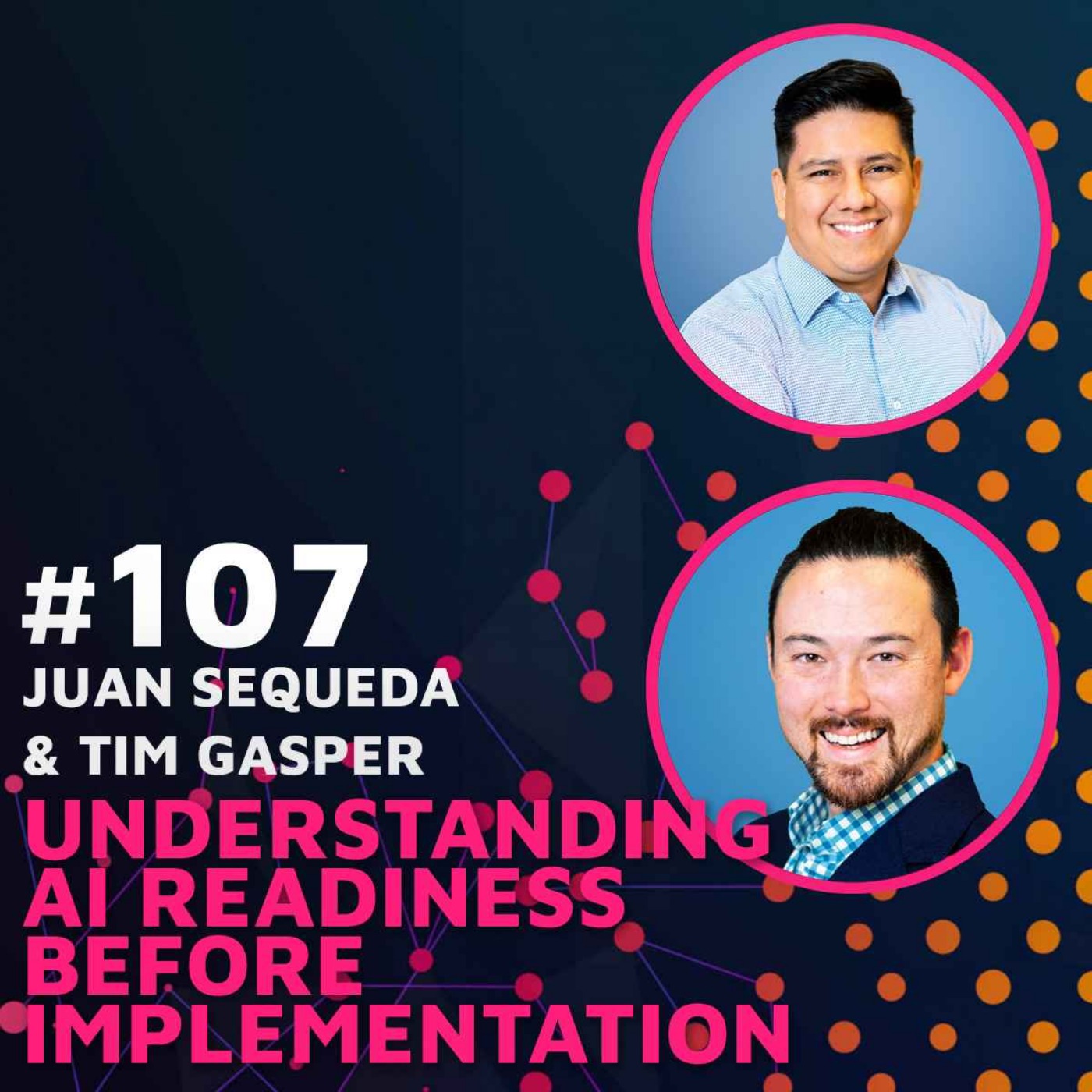
Understanding AI Readiness Before Implementation w/ Tim Gasper & Juan Sequeda
About this episode
Enterprise AI adoption is accelerating across industries, but many organizations are discovering that the real challenge is not the technology. It is the data behind it. In this episode of Data Unchained, host Molly Presley speaks with Juan Sequeda and Tim Gasper from ServiceNow about what it truly means for enterprises to become AI ready. The conversation explores why metadata, governance, and context are becoming critical foundations for AI strategy, how companies are moving from experimentation to production, and why successful AI initiatives must connect directly to real business workflows and decisions.
Find Juan & Tim's podcast 'Catalog and Cocktails,' here: https://www.linkedin.com/showcase/catalog-and-cocktails/about/
You can find more information on service now here:
https://www.servicenow.com/
Cyberpunk by jiglr | https://soundcloud.com/jiglrmusic
Music promoted by https://www.free-stock-music.com
Creative Commons Attribution 3.0 Unported License
https://creativecommons.org/licenses/by/3.0/deed.en_US
Hosted on Acast. See acast.com/privacy for more information.
Interactive timestamps
Jump to segmentGet every episode summarized
Each time Data Unchained publishes, we email you a written briefing from the transcript — the topics, who appeared, and any specific claims, with the ad reads skipped.
Email me new episodesFree for 3 shows. No card needed.
Hosts & guests

Transcript ready
503 searchable segments. Every word is indexed and playable.
Full transcript
Data Unchained — Understanding AI Readiness Before Implementation w/ Tim Gasper & Juan Sequeda. Machine-transcribed; use the interactive transcript above to jump the player to any line.
0:00Hello, welcome to the latest episode of Data Unchained. I'm your host Molly Presley. Before I introduce today's guests, let me tell you a little bit about this podcast. So we called it Data Unchained as we think about the evolution of how data is both being created as well as how it's being used. If you think back to the mainframe days, decades ago where the humans, the applications, the computers were all in one building together to the way the world runs today that we have applications in the cloud and human beings working all over the place and compute. That's quite powerful in our devices as well as all the way up to big supercomputers and GPUs. So data has become very distributed and that introduces interesting challenges, certainly, with how to just protect it, know what you have. But then as you want to put
1:00it to use in things like Enterprise AI, it can also be challenging. That's what Data Unchained focuses on and today's guests are experts in this space. So we're really excited to have you on today. I'll start with Juan, Juan Zacata as a principal researcher for data lakes, data and analytics at ServiceNow. Juan, thanks for joining us. Hey Molly, thank you so much for having us. So yeah, as you said, my name is Juan Zacata. I have been in the data analytics space for close to, right, a little over now two decades. I'm a scientist by training my heart. I did my undergrad in my PhD in computer science at the University of Texas at Austin. I've been working in this whole area, but we're now very popular of knowledge graphs coming from the semantic web world back in like 2005 when I got into it. So for me, it's really exciting that I've been working in this space for so long. And finally, the stuff that I've been working on is heading more mainstream and one of the reasons why people are paying attention is because of AI. So I've done startup, Sunderger, the research and now at ServiceNow through the acquisition of Data.World, we're
2:03rejoined like six months ago. Great. And Tim Gasper is a partner in crime. I guess over at ServiceNow and I know you guys are also podcast hosts and have your own podcast. Yeah, there's so maybe Tim, you can talk a little bit about your podcast and a little bit of your background. I'm at ServiceNow, you're the senior director of Outbound Product Management for the Data Analytics division. So tell us a little bit about yourself as well. Maybe you guys can jointly share a little bit about the podcast that you guys run. Yeah, sure. I'll start quickly by saying thanks, Molly, for having us on the show. And yeah, just to briefly introduce myself, Tim Gasper, I've been in the Data and Analytics space mostly in a product management capacity for the last 15 plus years starting in really on unstructured document management. I spent a lot of time when the big data craze really became the top headline. And so Hadoop streaming got to do a lot around those technologies. And then more recently, it's been of course more around advanced analytics and AI. And I know some of that will be part of our discussion today. So it's been cool to see
3:05all these different things and be involved in lots of mostly startups, but also some larger companies like ServiceNow most recently as well. And for fun, I've got three kids at home. I got a little piano over here next to me. So I like to play the piano when I can go running when I can and do some podcasting. So you mentioned, you know, Juan and I do a podcast together. It's called catalog and cocktails started off at the very beginning of the pandemic. And we were like, man, how do we connect with people in this virtual world? And you know, a lot of cool data podcasts cropped up. Yours is one of the best ones out there. And so it's it's cool to do that and a lot of fun. So Juan and I get to do that. And it's called catalog and cocktails because we drink cocktails while we talk with data people. That might be a nice ad for data and chain them. That's one of the things you do, right? So we got 250 episodes. We got, I mean, we're over five years doing it. So a lot of cocktails we've had and a lot of data conversations too. So lots of old fashions. Very nice, very nice. You'll have to invite me to yours so I can have an old fashioned with both of you.
4:07Yes. Yes, please. All right. So we're going to talk about AI readiness for the enterprise today. Let's jump right into maybe you can give us your feel. I mean, service now touches so many big enterprise customers. You guys are great area of authority in this space. Can you give us your feedback on when an enterprise says they're trying to be AI ready or they are AI ready? What does that mean to them? Yeah, great question. And I think just to kind of start off, right? Like, you know, a lot of people know service now traditionally as more of like a workflow and ticket management system, right? And it started off mostly in kind of the support and IT realm, but now is involved in running all sorts of different workflows across the enterprise from HR to, you know, IT to finance to legal to, you know, so on and so forth. And now with AI, right, a lot of folks want to automate business processes and they want to be able to leverage AI to either augment people. So that way,
5:07you can do things in a more scalable fashion. Or so that way, you can actually automate and hold, you know, tasks or parts of business processes. And that's exciting because that's going to allow us to do a lot more with our time and with our systems. But to your comment that you're making around AI readiness, I think one of the things that both service now has figured out and I think the whole industry has figured out is that we're not going to just take LLMs and Gen AI, especially systems and throw them at problems and it just be able to solve them for us, right? It needs context about your data. It needs context about your business. It needs context about people. Like who are you and what is your job and what do you do and, you know, what are your decisions and things like that. And so this concept of AI readiness and AI ready data has become very much front and center. It's something that service now is trying to solve. It's something that a lot of companies are trying to solve. And I think where a lot of the focal point is around governance,
6:14really, right? It's kind of a slightly unsexy term. Mostly came to the fore, I think, around, you know, the early 2000s into the kind of early 2010s as you have like socks regulation. You've got the financial meltdown and so you get a lot new regulations and things like that. And needing to manage safety essentially and regulatory compliance. But what started off as much more of a regulatory use case now fast forward to today is at the center of this whole AI readiness conversation. Because if you don't have trusted data, quality data, good documentation, you're going to really struggle with leveraging AI in an effective way. What I think that wanted to add here is that when we start looking at data, humans will interact with that data and they they have all that context in their heads and how they're interacting with it. But now because we want AI, we want these agents, these large language models of gen AI, they were going to pass work to them. Those things don't have all that context and don't have all
7:16that semantics, all that meaning. So I think very early on people were experimenting like, oh, this is great. It's all this magical stuff. But then it works great. I can trust it for kind of my personal things a little bit. But hey, for my enterprise where I want to keep track of like the I need to have accuracy of the numbers, like that's a different ballpark. And I think that's what people start realizing. Oh, wait, I need to really keep track of my meaning, the understanding, the knowledge of semantics like that. That's why metadata has kind of very quickly people been working on it for so long. And then just suddenly just increase and like, oh, wait, wait, that stuff that we were working on that really they want to pay attention to that much because we just now we need that. And now everybody is focusing on the semantics, the context of metadata. I think context is probably going to be the big popular world word in 2026. So so long story short, AI ready data is having data that you actually have an understanding to. You have meaning semantics and it aligns with a different context that you may have with an organization. I do think it's interesting. A lot of the topics that you know, we've all been around this space for a while now that maybe weren't in vogue or you know, they were very nitchy and where people
8:20were thinking about them have become really important. Now with AI and you know, I think about the governance topic, assigning and creating metadata. And you know, we've all talked about the stuff for ages, you know, especially in the metadata size. Sometimes it just never got prioritized. And now all of a sudden, it matters a lot. And AI is definitely a driving factor for that. I'm interested in your thoughts in that area of as you're adding context and kind of that semantic layer or metadata layer. How do companies and how do enterprises approach that right now? Is it lots of different groups are all taking different approaches to it? Is there kind of a standard way that this has been implemented across business units, data types? Yeah, I think that's a great question. I think there's an alignment that's starting to happen on some best practices. I think as a space role still learning, right, from vendors to product practitioners. So I think there's a degree to which we're figuring this out as we go. But some of the best practices we see
9:21people really starting to hone into to leverage context in these applications is, well, first of all, it's use case specific. It's fit for purpose, right? So this idea that, you know, oh, well, your organization is AI ready. Like, that's kind of a misrepresentation of what it means to be a ready because like, what does that even mean? Does that mean that you, you know, have perfect data or something like that? And you have, you know, 1000 GPU systems, like that doesn't make sense. It's boiling the ocean, right? And what it means to have next generation like high quality AI capabilities is changing by the minute, right? As these models get better and things like that. And so really it's about, hey, for your specific use case, do you have trusted data that you can leverage? And where does that context live that that particular AI application needs? So like, just to give a specific example, let's say that you're trying to identify customers that might be at risk of churning. And then you want to have an agent automatically propose some deals to that
10:28customer that allows you to get in front of their potential churn. And rather than it be reactive, you're being proactive to say, hey, I'll renew you for 10% or how would you like a free addon or something like that to see if you can actually address it in a proactive way? Well, then you need to understand, well, what are the offers that we have available? Right? What is, what does churn mean for our organization? What does churn propensity mean for my organization? These things need to be defined somewhere. And so from a technical standpoint, what's usually happening is you're going to store that context somewhere, right? If it is something that can be a little bit more probabilistic and something that you don't necessarily need to depend on on a literal way, then you might just have it be like a document that you feed into a vector database or something like that. And it's going to be a little bit more of a document oriented approach. But if you want to have it be much more structured and dependable, more of a rule that it's going to
11:32leverage, then it need that context needs to live in a graph or in your catalog or something like that. And then usually what's happening is what's very popular right now are patterns involving retrieval augmented generation or rag. And so we're seeing, you know, knowledge graph rag approaches where folks are trying to get the right context, pass it to the LLM, and then have a feedback loop because a lot of times these agents, you're not doing it in one shot, you're actually creating a feedback loop. So that way it gets to the right answer. So that's a little bit of a blend of both the business and the technical, but that's kind of the architecture that we're seeing here. And one, I know you're involved with quite a few customers that are working on this. What would you add to that? So there's two aspects. Let's talk about first the kind of the business side and the technical side. I mean, we got to say the obvious over and over again, you realize, right? It has to be use key striven, right? What is the business probably trying to go solve? But I'll be to be very, very specific. I tell folks is like, do you know what are the top objectives or organizations?
12:34If you do OKRs, what is literally the objectives that the CEO that the board is carrying about? Right? So then whatever work that you're doing, you need to make sure that you're tying it as directly as specific to an objective. Because otherwise, it's just blah, blah, blah. And people just experiment things. So that's the number one thing to go do. Because that's how you're going to avoid boiling the ocean. And you know that you're doing something that's going to provide a value for. So I think, I mean, this kind of seems obvious, but I have to repeat this over and over again. So that's one aspect. And then once you have that as the framework, that's what's going to help me really focus. So and this is just regardless about about AI right now. Like this is, I mean, you were saying that Molly before, it's like, this is the thing that we were doing before, but it wasn't kind of as sexier or needed. But it is now, this is like eating our vegetables and go to the gym. Like, not realizing, yeah, we need to go do that type of stuff. And I think these are the foundations that we need, which is not just for AI, but it's for just, I, this is going to help me to do my business intelligence better, my analytics that I'm doing right now, the machine learning models that are building already better for that. And I think what you, when you start thinking about that,
13:37you, you start making these investments to foundations, which are going to really, what I call the OnePlus one is greater than two. So if I'm going to be focusing on really understanding, go back to Tim's point, okay, what is turn or how am I defining what net revenue is? Well, there's a specific formula that I'm going to go do that. And that's a formula that I'm going to keep managed. I'm going to govern and I'm going to map it to this particular data set, or that or heck, maybe there are multiple definitions of net revenue fine. At least I know the context that this is the net revenue definition for marketing, the net revenue for sales, for customer, the customer team, we know exactly what that is such that when people are looking for data, because they're trying to go to analysis, they're trying to build a machine learning model, because they want to be able to chat with their data, you already have all that context, you define it once and you're reusing it for so many different things. I think that is the mentality that we need to have, and I think we need to start getting those incentives to be able to define, to do that work and make sure that it is reusable, repeatable, because that's how we scale. When a customer calls you and says, hey, I need your help with my AI, is do they generally have a
14:39specific project? Is it the OKRs? They're like, I have these OKRs, I'm trying to figure out how to map AI to it, or is it, my boss told me to build an AI factory, what do they call you asking for? I'll start up a little bit and then I'll pass that tip. The honest NOBS is that, I think for most people, we've got to do something with AI, and I think this is the typical thing, the board is telling us to go do something, we have to go do something with AI. I would agree that the majority of people are doing something. I think the strategic data leaders are the ones who are really able to kind of pause things a little bit and realize, I get that you're trying to go, we need to go do that, but we also need to, they're making that translation and transition to, but this is what the business really needs. Now, what you want to be able to say is, hey, we should definitely use AI for this problem we're solving because it's going to augment that. It's going to make this
15:39problem that we're working on to make it faster, better, and so forth, and I think that's the way how to get there. Now, it's all about the trust. So, we really realize that if data leaders have or trusted by the business executives, then they're the ones who have the way to say, push back, saying, I get that, I get that's a hike, we want to go do that stuff, but these are the real goals we need to go do. And if you have data leaders who still need to earn a lot more trust, they're thinking, hey, the way that earn trust is, I'm being told, I need to go do that AI stuff, and so that, I'm going to go do that for a second. So, that's kind of what we see. When we get a lot of folks who're saying, oh, we want to go do this AI, then I actually see that it's our responsibility as not just vendors, but like as partners, they want to do because our success is your success is to really push you and ask, why, why, why, why, right? The five wise figure out like, this is really where we should be focusing on. And that's really why I personally want to be able to work with customers, like, I just don't want to go influence some technology that will come
16:41a shelf where later on, because that's not going to make me look good. Like, I really understand what your problem is because solving your problem is make use of successful with big stuff successful, but I think that's a really good, that's a good framing. And just to extend a word that you said, Molly, you called it like the AI factory, right? I think that organizations are trying to establish this kind of process and capability within their organization. And as Juan mentioned, like strategic leaders are thinking about, okay, where's the low-hanging fruit? How do I manage expectations properly here? Because everybody gets to play around with chat GBT and things like that and gets very excited about what could be possible. The goal is not just to have wandering conversations that's to have real business impact. And so I think they're trying to do things at two levels, right? One of them is more at the foundational level, right? So if it's the factory, it's kind of like the factory floor, right? And that's where things like data governance, metadata management,
17:42data quality, observability, right? These are the things that are really foundational about capturing context, managing context, assuring that we're passing trusted information to different AI agents. And so this foundation is really, really important in kind of the factory floor. But then what sits on top of that is an agile iteration process, right? And really good data and AI and analytics teams are partnering with the business, finding the key stakeholders, building a roadmap and a backlog of what are the most valuable use cases that we can focus on. And then iterating so that way they don't just create cool looking demos, right? And they actually iterate in partnership with them to move from kind of POC to alpha to beta to ultimately rolling something out in production because we don't just want cool demos. We actually want to be able to roll these things out to production. So the ones who are laying that foundation and then
18:42doing an iterative process on top of it, they're the ones who are being successful and we see more and more companies now rolling out these AI applications in production and seeing a lot of real value. And one more thing to add there quickly is are the data teams that are actually working with the business lines because you want to have that feedback loop and that means that I understand what your business problem is. And it's not just I'm you're telling me what you need. I'm just going to give it to you and then I just leave. Like no, because what you really want to do is like actually be participate and be part of that high-watership to there. That's why even like you need to be connected to their objective. Well, that reminds me a lot of when data scientists first appeared, they could come up with lots of interesting observations about data but not didn't necessarily have anything to do with what the business needed to know. You know, it was kind of a interesting dynamic as data science came about. And but you kind of win a direction. I was thinking about asking one that is there there's certainly this pressure use AI go faster. Don't let us be left behind no matter what industry it is. How do people do things in parallel? There's
19:45a lot of foundational business process work that both you and Tim have talked about getting data ready. You know, whether it's applying some antics or making it accessible to whichever models you're using or agents you're using. How can businesses work in parallel as the IT and infrastructure and data teams get things organized while the business figures out their policies and their goals. Can this happen in parallel? It definitely and it has to happen in parallel because if it doesn't then this then then think about two things. Let's assume let's kind of do the thought exercise of it's not capital parallel right. So if I do let's call it the bottoms-up approach where we're like oh we need to have this pristine infrastructure and architecture and cover the data then then okay yeah so first of all you need to kind of make the case to get all this in resources money time to go do and all that is happening you're not showing any value you're showing technical stuff you know so that that's not going to work right. Now if you
20:47completely do top down what you're thinking about well I'm the business needs this and I'm giving me this and then what ends up happening is when you become like this reporting machine oh I just do and then you're cranking you're not really knowing like okay I gave this the business but I even know what it is or how it's being used how valuable it is and then what you start that what ends up is you generate a bunch of debt and then then then you then you say well I'm leaving a bunch of debt and then then you have to spend so much time with that so that's kind of what if you go if you go on each of these on the left side of the right hand or the top of the bottom so you really want to find it as a spectrum so you have to go do that but I mean a mentality that needs to change is is arguably like perfect as the enemy of great right and I think this is goes back what Tim was saying is that we want to have a roadmap I want to say we're going to go do this thing first and then this thing second and not everything is going to come out as a big bang and when you start having that roadmap you set the right expectations you want all these things we're only going to do this for this part and I think once you start kind of getting those called parts of the product out you are also making an investment in that foundation
21:52so think about it almost as a tax for the foundation work thing you could do but you know that it's kind of like a slice of the work is it'll be done to that foundation and then you start iterating around that stuff you want to be able to have the quick wins kind of get people the momentum going people saying I love that I want more of that you're like perfect you want more of that but to do more I need to actually do this other thing too which is kind of like in the back it in the back in the vaccine but if I don't do that stuff you can't get that okay got it I I understand you to go do it so I think that's part of it and an analogy I call it is like the iron thread you want to be able to go all the way from the top to the bottom right business all the way to the technical things but it's a thread it's a thread so don't go do everything but it's iron it's really it's really it's really strong but for something very specific and then you go and wrap another thread around that iron and then these things get stronger and stronger and that's how you start iterating around that oh Tim yeah take it away yeah I think that was really great exactly what you said one thing that I would add which I think is is separate and additional is the operating model right and and first of all if you can just get
22:57more resources that's great right so for any like chief data officer chief AI officer right if you could just get more engineers and do more great now you can parallelize right but I think all of us live in a resource constrained reality right despite all the excitement around AI and so what that means is that in order to parallelize in addition to like what Juan talked about you also need to build an operating model that kind of identifies the things that need to be centralized right like what what are the things that my team needs to do with my own resources right because maybe it has broad based impact right across all functions across lots of business units or maybe because the expertise really is centralized within your group right but then what I what you see I think a lot of companies trying to do right like why are they rolling out you know clawed code and things like that to all their employees they're trying to figure out a way to federate the innovation that's going on and the impact that AI can have and so I think that's what's very interesting is when you take some of these platforms and you try to empower more people with them right and for example service now has its AI platform right that people can build apps with and things like that
23:59that you can get a federated approach and so whether it's a federated embedded approach where you've got some central people kind of interacting with the spokes or it's literally a fully delegated approach where you're saying hey I'm giving you tools you do what you want to do and just you know keep me updated there's going to be a little governance around it right oh we have an AI council every month like you can present at the AI council if you want to if you want to roll something off to production I got to give you the thumbs up right so long story short as I think these operating models we have to we have to it would get right but also you don't never be perfect so you got to iterate on it but that's the key so that way it's not like it's all on you know for the data leaders they're listening it's not all on you it's not like you're the one Superman or superwoman you have to drive all the AI progress for the organization you're creating an environment and an operating model where lots of flowers can bloom it's a very cultural dependent of organization so if you're a very centralized cultural organization then it's hard to put in a completely decentralized if you're very decentralized so that really depends on the culture
25:03organization you really need to understand that that's one thing and then another kind of framework that I've learned in this work for us is I call it the fixed flexible and custom so there are things that you're going to realize that need to be fixed just because of it's just mandated right this is this is our definition of a customer that we have an agreed upon and we agree and that's it everybody uses it period and this is our definition what PII means and we need to agree because PII people we we talk about PII but that can mean different things to different people this is our definition and it's for regulatory purposes you need to go do that type of stuff but then there's something flexible as like wait I'm trying to go do this I I looked up in the fix it doesn't exist I am going to but it kind of exists I'm going to extend in my version of that or custom means I'm I'm in a green field I'm starting with something new and then that then if you're starting something new it kind of becomes more cost and more flexible becomes more fixed depending on the needs around that and another aspect that I also bring up and this is a cultural thing again it's being comfortable with with ambiguity is hey if you realize that there are
26:05things that people that are probably incorrect because there's two different ways of viewing this but nobody's complaining about it then either everything's okay or nobody is using it so just let it be but if people are complaining about it that's great news that's friction that's energy there's an investment let's go figure what that is and this because maybe there are two custom things that we realize oh we should probably start consolidating kind of a shared agreement and then that will naturally come up from that custom to maybe something flexible something fix and then you start iterating on these things I think that that is that when people want to be full in control they realize wait we kind of have to let it go a little bit that's hard letting go of your Legos is a hard thing sometimes at least for us only children that's for sure well there's a good article that you should look at that let it go of your Legos so so when you think about this is complex multi-dimensional multifaceted and different different organizations have different requirements how do organizations
27:05get out of experimentation and into production so saying yep we've passed the litmus test of there's a value prop um you know you have to make sure the right data is being used by the right people you know a lot of things that we're talking about I mean is there you mentioned that monthly council but are there checklists that are becoming kind of standard of you have to have done and passed this test on these 20 points and now you're ready to go or how do organizations get there I think there's a few elements here one is you know we see a lot of organizations that are getting mature mature here having some kind of a council which we've mentioned I think once or twice right and so that's a thing where you can make sure that you have a checkpoint right now even that is a little bit manual right in the in the way that you're trying to create a bit of an artificial throttle on things so some organizations we see really creating more of a checklist and I think a good analogy out there is you think about like data uh like software quality right like if you're about to push software into production you usually
28:07have a checklist of like okay did all the unit tests pass um you know to have the integration test pass um do we have documentation right have the uh did the product manager sign off on the acceptance criteria so these kinds of checklist also apply to AI but have some AI specific oriented things right and it connects to some of the foundations we talked about right like for example is it logged in our catalog you know is the is there documentation around it um you know have we defined what fit for purpose quality means for this particular AI model or AI agent uh but also it can relate to um you know uh things like who's going to use this and uh and what does success look like when we roll this out right so it gets a little bit I think into the business side as well uh which is important because if you're going to roll out these agents to production it's gone from kind of pilot land where where you're just kind of experimenting and you need to actually support it like it needs to be something that now people could rely on it isn't going to
29:07atrophy and become something that maybe they liked it at first or they trusted it first but now they don't trust it ongoing right and so this kind of almost product management oriented approach where you care not just about the launch of AI but also the ongoing caretaking and management of the quality and the trust and then sometimes retirement uh becomes really important because maybe that AI model doesn't make sense or AI agent doesn't make sense anymore don't be afraid to then kill it put it away and put your energy and your resources toward something else so I think that's that's one key thing. Tim and I kind of put out a framework uh for data products but actually I think it applies to to AI agents and anything we call it the ABCs of data products so you want to be able to think about accountability boundaries contracts and expectations your downstream consumers and the explicit knowledge around things so accountability right is like well who who who owns this who's responsible for this who who fixes it when it was broken right
30:07all that type of stuff uh boundaries right as this is about bringing product mindset like let's go draw a box in here right and my fulfilling everything in that box and in my getting requirements that are outside of that box and so forth right what is my roadmap my my boxes are going to be expanding I'm we heading there uh and so see contracts and expectations right what what what are my consumers and what are they expecting how they're going to go do this am I fulfilling all those SLAs SLOs and so forth my best performing how fast does it have to be how fast it would be what what how are people supposed to be interact with it and my downstream consumers right I am building something for us that are consumers how they tested this are they are they satisfied with this right for the next possible consumers out of this too and the explicit knowledge is I want to make sure that this data product people will find it will understand what it's what it's about and how they can use this right I think so we we put this out there several several years ago and I believe the same framework applies for building agents and models and stuff like that and I think that would be some of the checklist and arguably it's not like you have to think about all these
31:10different things it's like what is it what you need with the organization and at the end of the day I think it's a product mindset that's coming to that's coming now into the fold and I figured the type of company you come from with service now that those kinds of frameworks and checklists are part of what you work with your customers to build um thinking though as you've you've all some of these you know maybe data best practices that were coming about as we were thinking about big data and analytics now in this AI world you do have this new member of the team the agents or the machines um how are they evolved when you think about what does the human decide how did they work with the agent what do you let the agent do on their own you know kind of how how are you advising customers to think about that human the loop design with the machines I think in general even though there's a desire and a vision to achieve full automation around different business processes and things like that and certainly service now is at the forefront of that right autonomous IT autonomous customer support management right um right now the best practice really is human in the loop right
32:14it's just how can we make that human the loop only when it really matters to ping you because you know what's what's interesting when you really scale automation in AI if when the human comes into the loop is too frequent or too noisy you start to not pay attention to it and you know uh you know I'm an iPhone user right and I get lots of notifications I don't do a good job of managing all the notifications that are showing up on my phone and uh and so what happens is unless it's really like a text message I'm not really paying attention to what's hitting my phone uh and so that's an important part of the I think the human loop process and something at service now we've tried to focus a lot on is like how do we make sure that like the right tasks come to a person and the stuff that really should just be automated or just set everything up on a platter so I can say yeah that looks good approved uh that that happens so I think I think that's really important um I think also uh what's really interesting about you know the the the human the loop aspect is if you invest
33:16in context and if you're investing in the semantics then you're going to feel more comfortable letting AI agents take on more responsibility and so that's why you see you know service now investing in bringing in metadata management and governance and things like that it's part of its portfolio and that's why you see now everybody in the AI space talking about context management and semantics and things like that so I think that's where you get a little bit of you know uh you slow down a little bit to speed up doing that kind of work is that slow down piece that helps you speed up what we're seeing is that this context is at the center because what you want is for users to realize oh wow this agent actually understands the stuff so if I a question I'm like I asked a question how many customers do we have or whatever right and like wait uh we actually have three official definitions of customers by department but I think because you're you work work in the marketing department I know that already you probably care about the marketing definition of customer so I can just give you the answer and I can explain to you look this is the definition
34:19that came from this stuff by the way if you have more questions about that here's here is the linies around the stuff here's a person should go talk to and so forth and I think that is a context that starts giving people more more trust and then they're actually going to keep and that's kind of just gets the the momentum going okay I I get it I trust it let's keep using this more more one more thing to mention that I think it's interesting in this this human loop arena is is is where does the human come into the loop so there's like a user experience aspect that I think's really interesting so like at at service now we have kind of like four different AI user experience paradigms right like one of them is in the context of a workflow so like you're in a workflow you you get a task hopefully as I mentioned right it's a task that actually deserves your attention right so that's kind of more your workflow then there's more of the AI native or AI first experience which is like hey I've you know we've used many of you've used chat chat GPT and clawed and and co-pilot and things like that right that chat experience it's more of a chat first kind of paradigm right and then you've got more of the like embedded approach well it shouldn't it
35:23could it ping me in slack could it ping me in teams could it send me a text message right and then that or you know even things like a dashboard right if I'm in Tableau or Power BI or some dashboard could it could it ping me there and could I interact with it in context there and then lastly is kind of like custom experiences because people build custom internet portals people build custom customer support and customer applications and things like that you know how do we provide them kind of the right experience and the right place where that human in the loop should happen so as you guys look forward I know it's hard to predict given the cadence of change that's happening in the space right now but thinking the next 12 to 24 months and thinking specifically about the enterprises that will be able to say you know claim success we did it we implemented AI and we're an AI first company or AI forward company whatever determines out being what will differentiate those who are successful and those who are not I think one of
36:24the big differentiators and I think it's been a theme throughout this entire conversation is the foundations right and so those who have invested in the governance the quality and increasingly thinking about metadata and context are really going to be the ones who are more successful and a lot of folks are going to be building those foundations potentially for the second third or fourth time in you know recent history because folks have attempted this in the past but you know it's been more of a passive approach or it's been just focused on regulatory governance and not really addressing more of the enablement part of data or the AI usage part of data they're going to be trying to lay that foundation properly and then you know as we mentioned earlier trying to make sure that it's fit for purpose right so not trying to boil the ocean with that foundation the tooling and the processes and the operational model all have to be there but then applying it in a specified way to different use cases that's going to be really key and one term that I think
37:26kind of got popularized maybe three years ago or so but I think it's going to come back to the four again is active metadata because a lot of people they've been collecting metadata information but they're not doing a lot with it right it's passive it's kind of sitting in the library and nobody's going to the library but active is how do we actually incorporate that metadata in proactive ways whether it's a machine learning model or an AI agent or rules based to take actions be part of AI workflows things like that so that's going to be a big focuses active metadata so so many things but I'm going to pick two number one is that whatever AI agent probably you have you have clearly shown how it's making money saving money and then there or there's also the whole mitigate risk at the end of those are the three things that organizations care about so I think you'll be able to go to very specifically tie that down and second which is the foundations part if you do the foundations right that means that you'll be able to do more with less so I think every
38:33time you're going to build the next thing it's going to be cheaper and I think that's a true sign of success I mean let's put it I'm just putting economics around this stuff so I will say that people the companies who are being successful being AI first and forward are the ones who say oh we got that project that new thing that's going to involve data perfect I know that's actually going to cost me less to go do that thing that that previously than I did before and I think that's the true size success because you're compounding all that investments that you've done foundations correctly at the end of the day like we're seeing this also like I want to be able to have and create my company's growing we're going to hire more employees and the cost of supporting that should go lower we're going to have more customers the cost of support customers should continue to go lower and lower that's the sign of success all right guys so as we wrap up I want to switch gears for just a second we've talked a lot about all the things enterprises and different work groups should do was maybe the one misconception or the one thing people need to unlearn about AI that just hasn't proven to be true yeah I think one thing I'll call out is I think that as there's been
39:37a lot of experimentation with AI that some company it's not all like there's a lot that are that are being more strategic but there's a lot of companies also that are thinking that okay if I rolled out you know like a chat GPT or Claude or co-pilot to my organization that I've kind of achieved my AI goals right that like now everybody has access to it and they could be more productive right and and and and that is not the bar that we should hold ourselves that's a that's a low hanging fruit that we've aligned on great right we should take advantage of any low hanging fruit that we can take advantage of but the true value is going to come over the next couple of years here of embedding and incorporating AI or AI powered workflows directly into the business process and the business line right so in your HR process how can we make sure people are happier that they leave the company less that we hire the right people in IT and in support right how do we make sure that people have more uptime and better experiences in sales how do we make sure that we're driving more sales right how do we provide better leads to our sales people how do we you know
40:42on board customers you know a little bit faster that's where you're going to get the value from AI is an incorporating it directly into the business into the business operations so I think that's going to be a misconception people are going to overcome over the course of this year you're still my thunder in a way there but let me explain that I Tim and I gave a talk at Big Data London I think we said a couple things about what you should stop doing and should start doing so you should like stop being in your own bubble of data analytics and realize that there's there's everybody else around that you need to start then working with your business counterparts and actually developing your your okay ours and your objectives with them directly so I think that's one so go back to like our conception is that oh like yes I my goal is that data analytics is my world and that's what like no you got to get out of that that's that that's one of the important things and another one is like just stop thinking about your end of goal is to generate analytics and insights we think about like oh faster time to insights that's not your goal that is not the goal the goal is how do I take
41:42action with those insights again can I get back to the business and I think that's the difference and I see you traditionally see people like I created this dashboard I created this machine learning model we created this chapel you can go do things that's not their goal your goal is to be able to drive action workflows to be able to go make the impact of those insights back into the business so those those two things are to call yeah that makes sense and sounds it's good that you tour kind of aligned on the way you're looking at it so as we wrap I want to thank you both for joining and sharing your very extensive knowledge in this space are there any places related to service now offerings or how to engage as enterprises who are listening to this episode are thinking you know I think I really ought to reach out to these guys like what would you point them to I would say go to service now.com and and start exploring around and learning a little bit more about service now I think a lot of people in both the data realm and the AI realm are starting to realize that you know service now is not just a workflows company it's workflows and data and AI all together and we're doing some really interesting stuff around context management and around data governance
42:43and data management so I think it's just explore and and and learn more to add to that for folks listening who are living the data world they're like wait service now like what a service not to do with data like well that's that's changing and our ask is two things number one go reach out to your service now colleagues internally because I mean service now is everywhere so you if you work at a large company you probably are already a service now customer so go reach out to them and kind of help build bridges and we need to do that right the usually data teams work underneath the CIO and IT so I think there's an opportunity there so that's number one and second follow us Tim and myself on LinkedIn and just go reach out to us happy that we we listen to our podcast you can find a lot of a material also on the service now community a YouTube channel that we're putting all our podcasts and that's a way to go really broaden and get to meet more of your peers sounds great Tim one really lovely to meet you I'm going to follow you as well and hope to keep you know the the connection going so thanks for joining data and change thanks so much for having us and I'm looking forward to sharing that
43:46cocktail with you and and have a new one our show perfect sounds fantastic thanks for listening to data unchained powered by hammer space to learn more visit hammerspace.com if you have a guest you would like to hear on the show email me at Molly at hammerspace.com
More episodes
More from Data Unchained

Global Namespace for Precision Medicine: The Data Breakthrough w/ William Baird
Data Unchained

Data Storage Shortage: What Options Do You Have? w/ Chris Mellor
Data Unchained

Inside the SSD Shortage Crisis w/ Tom Coughlin
Data Unchained

The Race to Build the Right SSDs for the AI Revolution w/ Hao Zhong
Data Unchained