About this episode
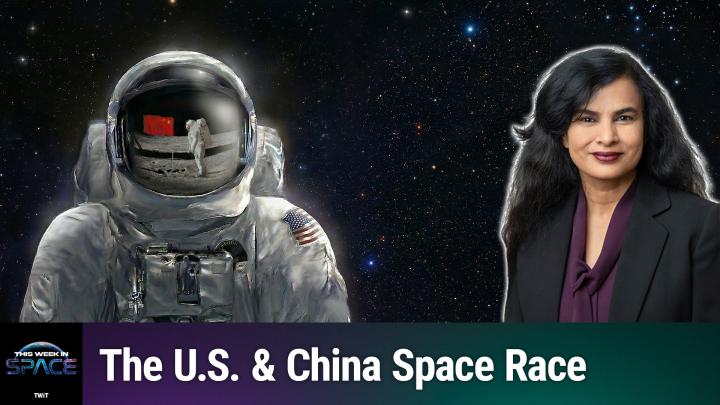
Many suggest there is a new space race afoot, this time between the US and China. We've also seen that America seems to be at its best in innovation and achievement when challenged by some external force. Will the Chinese human lunar program light the fuse of American innovation and accomplishment when it comes to our lagging lunar program and other spaceflight initiatives? Dr. Namrata Goswami of Johns Hopkins University joins us to examine the intricacies of potential threats to American leadership in space and the possible outcomes. Who will be first to land astronauts on the moon? Does it really matter? Who controls what regions of the moon? Will cislunar space be contested between major space powers? This and much more in this episode of This Week in Space.
Headlines:
- Artemis 2 Mission Nears Launch, Astronauts Arrive at Kennedy Space Center
- Stunning New Images of Saturn Released from Webb and Hubble Telescopes
- "For All Mankind" Renewed for Sixth and Final Season
- Nancy Grace Roman Space Telescope Clears Vibration Test, Launch Date Set
Main Topic: U.S.-China Competition and Global Ambitions in Space
- Dr. Namrata Goswami Explains the Evolution of the New Space Race
- China's Strategic, Economic, and Cultural Goals for Lunar Exploration
- Comparison of U.S. and Chinese Approaches to Public Messaging and Program Identity
- The Role of the Artemis Accords vs. China's International Lunar Research Station Partnerships
- The Legal and Political Implications of Lunar Safety and Exclusion Zones
- Space Force's Emerging Role in Cislunar Security and Commerce
- Increasing Global Participation: India, Japan, and Developing Nations Expand Space Competition
- Impact of Lunar "Real Estate" and Resource Maps on International Strategies
Hosts: Rod Pyle and Tariq Malik
Guest: Dr. Namrata Goswami
Download or subscribe to This Week in Space at https://twit.tv/shows/this-week-in-space.
Join Club TWiT for Ad-Free Podcasts!
Support what you love and get ad-free audio and video feeds, a members-only Discord, and exclusive content. Join today: https://twit.tv/clubtwit
Interactive timestamps
Jump to segmentGet every episode summarized
Each time All TWiT.tv Shows (Audio) publishes, we email you a written briefing from the transcript — the topics, who appeared, and any specific claims, with the ad reads skipped.
Email me new episodesFree for 3 shows. No card needed.
Hosts & guests

Transcript ready
1,422 searchable segments. Every word is indexed and playable.
Full transcript
All TWiT.tv Shows (Audio) — This Week in Space 203: China Rising. Machine-transcribed; use the interactive transcript above to jump the player to any line.
0:00With Sam's Club, you have the freedom to shop your own way. Curbside pickup? Deliver to your doorstep? Come in and grab it yourself. Yes, yes, yes. They've got plenty of options. You're call. Say yes to shopping the way you want. Join now at samsclub.com slash yes and. You must be 18 years or older to purchase a membership and membership is subject qualifications. Visit samsclub.com slash yes and for details. Introducing Home Care Plus. A new subscription service from Lowe's that helps make life easier by giving members a hand with home maintenance. Let Lowe's tackle the tasks you keep meaning to do like electric dryer vent cleaning, replacing hard to reach light bulbs, and more. Subscribe to Home Care Plus for just $99 a year and consider your to-do list done. Members get more at Lowe's. Available in Selection Code Zone will cancel anytime, non-refundable fee, product purchase required, terms and service restrictions apply, details of Lowe's.com slash terms, subject to change.
1:00Hey there, it's me John Stamos and partnership with Colorguard. And a little birdie told me you're over 45. Listen, that's not old, it's really not. But it's an important age. If you're at average risk, that's when you start screening for colon cancer. And look, it's okay to be nervous, but it's not okay to ignore your own health. It's time to see if the Colorguard test can be an option for you to get screened. All right, I'm glad we had this little chat. Coming up on this weekend's space, Artemis II is one more step closer to launch. Could we get off the ground? We've got an amazing picture of Saturn to show you and Rod and I get down to brass tacks about whether or not the United States is in a space race to the moon with China with Dr. Nomrata Kuswami of Johns Hopkins University. Stay here and check it out. Podcasts you love. From people you trust. This is Truth. This is This Week in Space episode number 203 recorded on March 27th, 2026, China Rising.
2:00Hello and welcome to another episode of This Week of Space, the China Rising Edition. I'm Rod Pyle, Editor-in-Chief at Ask magazine. And I'm with, as you probably guessed, taricmailicofspace.com. How are you guys? I'm doing well. How are you doing? Yay! We're back this week. We're going to be joined by Dr. Nomrata Kuswami, who is an author and professor of space security at Johns Hopkins University, who specializes, as I believe she will tell us, in looking among other things. She actually does quite a bit. But one of her primary areas of study is kind of the East versus West in space, everything from civilian programs to top security stuff. Before we start, of course, please don't forget to do us a solid, make sure to like, subscribe, and support the podcast with all your might, because it means everything to us and keeps taric happy, which isn't easy to do. So give us, give us your, give us your thought. I need it. I need the validation. Both Rod and I do. Rod needs it more though. But I need out of, but now to make you happy,
3:03let's go to a first space joke from Corey Klamaski. Hey, taric, that's what. Corey. Yes. Hey, taric, guess what? Oh, what? What, Rod? Gravity is one of the most fundamental forces the universe, but if you removed it, you get gravy. Mmm, crazy, you're removing it. Oh, it, it, oh, I get it. Gravy. I was just thinking, I'm hungry, I guess. So I was thinking, my gravy, yeah. Gravy, mmm, I've heard that some folks want to make us into a slurry of warm gravy when it's joke time in the show, but you have the power to help keep that from happening, because I don't want to be a stain on somebody's shirt, any more than I'm already a stain on somebody's soul. Oh, wow. That's your best-based jokes. I got dark on TV. Oh, blame it on you in the air. And now, on to headline news. headline news. I got it, I got it, I got it. It's okay, sigh.
4:04It's time for another Artemis update. I've made the last one. Maybe the last one. And today, it's the week before, whoo, I'm vibrating with excitement, watch. As we, as we are recording, we are like five days away, six days away. What is it? It's the, it's yeah, we are, we are just four days away. Five, five, five days, I don't know how many days away. It's anyway, April 1, April 1st is the launch date. And as we are talking, math challenges. Oh my gosh, it is, it is a hoot and a half, apparently. But as we are talking now, the four astronauts of the Artemis 2 mission are arriving at the Kennedy Space Center for the actual mission. So we are already closer than we got the first time around, back in February before the rollback. So it seems like everything has been going, according to plan. I heard from NASA this week, they're all extremely confident. It seems like it's an actual thing.
5:04And now we have the schedule of events from NASA, which we didn't have before. So as of right now, it seems like Artemis 2 is on track to launch to the moon on April 1st, at 6.24 p.m. Eastern time. And then we are off to the races and we're going to swing around the moon. And it's going to be a hoot and a half, I tell ya. So there we go. That's your update. It's all good news. So far right now, let's enjoy it. So. Let's enjoy it until we hit those TSA lines as we're getting on our flights to go over this thing. Oh, don't try to not think about that. Although as we are speaking, there is an agreement making its way up the hill. So John, do not shake your head. Do not shake your head, John. No, we are going to get through this. Don't curse us. Oh, okay. One of my flights, just a quick aside, one of my flights home was going to be through Houston's George Washington or George Bush airport. And that's the one that has like the eight to 10 hour lines. And I changed it. I changed it because I don't want to deal with that. So just take a train. Yeah.
6:05Okay, let's talk about Saturn. You've never seen Saturn like this. This is your story, so go for it. Yeah, I will. By the way, I'll point out that that Artemis 2, that confidence came because NASA had a lot of big new moon-based shakeups. And in that big announcement, they unveiled this new photo of Saturn from the Webb Space Telescope, also from Hubble. And it's just shiny. And we don't talk about science a lot in the new section here. We don't, you know, sometimes we do, but most often it's not because I'm a spaceship guy. I get the feeling that Rod is a spaceship guy that we talk about, space flight a lot. And this is spectacular. These are views of Saturn as seen through different wavelengths from the Hubble Space Telescope, which has, of course, that visible light spectrum and the Webb, which sees it in infrared light. I like the infrared one because it has more oranges in it personally. And it's the most detailed view yet of the planet and with all of its bands as seen by these telescopes.
7:06And I just wanted to kind of point this out to people because we're on like the five-year anniversary of operations for Webb. And we keep thinking about how it keeps looking back. In fact, this week it found like the most distant galaxy yet again, you know, because it keeps seeing deeper and deeper. But it can find some really gorgeous things close to home to them. And we can even see some of Saturn's moons and this I think it's Titan is what we're seeing on the image in the Webb because it has that thick atmosphere that keeps it warm. Titan! Yeah, I know. It's exciting. It's really exciting. I just wanted to call this out. And these were taken in 2024 by both of these space telescopes and then of course they have to download the data and what do they call that process it, process it over time so that they can show it. Are we moving towards rings edge on or the rings moving out of that phase? I think they moved out of that phase recently. And because it was if memory serves
8:09because we can see clearly in these images that the rings planes are in that nice tilt so it's a really great time to observe Saturn through a telescope because when it is edge on you can't see the rings except for a line and that's kind of sad. But it's a nice view. It's a nice view for sure. And I want to share, so. Yeah, well I miss one of the things I miss about working a group of the observatory back in the day when I was there, gosh, 10 years was after hours we'd be able to go up and use the Zeiss 12-inch refractor and look at things like Saturn because in an observatory on a hill overlooking one of the largest metropolitan areas in the country, you don't get to see a lot. But planets are good and Saturn was amazing. Yeah. Speaking of amazing, for all mankind on Apple TV who is getting its sixth season, but that's gonna be it. And the showrunners are very happy because they feel that allows them to tell the story they wanted to tell. And that season five will go live on March 27th.
9:14So you'll be seeing that soon. My question is, it means it's going live now. So as we're recording, it's going live today. But my question is, is anybody else sick of Ed Baldwin yet? I am not. I certainly am. Do you think that he survives this season? Because he's like in the show, he's elderly. No, I miss the two that got flash frozen like a couple of foil rep burritos on the moon. Yeah, they had a great arc. They had a really good arc. And they saved the moon base. Oh, listen to you, this is a showbiz. Yeah. So anyways, it's coming. You'll get your season five starting today. And you'll get your season six starting, I don't know, in a year, year and a half, however long it takes them to do that kind of thing. So people who love the show are ecstatic. If you haven't seen the show, it's a fictional, alternate history of human spaceflight starting with the Soviet Union beating the US to the moon. And from there on, we ramp up Apollo missions. We don't stop Apollo missions. We all love seeing that and we go on to Mars
10:15and of course, all along the way, we're fighting each other. Yeah, and it's a really good to point out that every season is like a generation after the last season. So each season is a 20 year time jump. And so I think we're getting very close why this season six news is important is because I think that season ticks pretty much will bring them close to present day. And that's kind of like the story of what could have been if we didn't stop and we had a different approach to space expression. I love alternate history. It's really great, especially when it involves space stuff. So. All right. And finally, give us your read on progress on the Nancy Roman space telescope. They had it on the shake table. Well, not only did they have it on the shake table, they put it up there at Goddard where they shake it to make sure that they can. It can launch exactly. They blast it with acoustic sound waves for what the conditions might be at liftoff to make sure that nothing breaks off, right? Which by the will point out that when they did this for James Webb, like a bunch of screws rattled loose. Remember that? Do you remember that right? Right?
11:16They go find them all. So, but no, it sounds like it passed the test with good colors. And actually we got news akin to this because just today, right before we started recording, NASA put up an announcement that they're going to unveil the completed Roman space telescope on April 21st. So they're going to show that off to everyone. So it is done. It's finished. And we're going to go and see how it does when it gets to space. This is supposed to be one of the most comprehensive space telescopes ever. And if folks might be wondering where it came from, this is built on, I think the bones of an old spy satellite that was given the NASA and then turned into the W first project and then renamed the NASA Greece Roman Space Telescope. Oh, you know, I followed the blisteringly difficult track of W first for a long time. But amazingly, I didn't realize that that was what, are you sure this is?
12:16I'm pretty sure they renamed it because they were going to cancel the project and then they named it after a famous female scientist and then that made it uncancellable. So maybe I'm wrong. If I'm wrong, someone call me out and then I will eat a hot pepper in front of rod on the stream. So I may regret that I said. Oh, boy. It's like Jeremy Clarkson on top gear where he offered to eat his hair on a pizza or something. If he does that. Oh, no, I'm going to eat a hot pepper because I like hot peppers. But it'll be like a hot one. So yeah, I'm pretty sure. I'm pretty sure. You know, you're right. The Wide Field Infrared Survey Telescope W first is now officially the Nancy Grace Roman Space Telescope. There we go. I knew it. Because W first, I don't remember the exact year, but W first was in work since the 2000s at least, I think. Wow, that's some creaky hardware, by now. Well, the spy telescope bones that they made for, they basically gave them two spy telescopes and then they were able to take them. They were Hubble class reconnaissance satellites
13:19and they were able to take that the bones and like adapt them for this W first project. Because it was on the, what do they call that? The big 10 year, the Decadal Survey as an important space telescope to develop. So they were able to put that together out of a bit of a savings advantage because they already had like the bare bones as long as you got comfortable with that. So it's nice to know that we're done now. So let's hope it gets off the ground and everything works fine. That's hope so. And let's run ourselves to a break and we'll be right back with our guest, Dr. Nomratagoswami. Ever seen a musical so good you didn't want it to end? Like you could live inside it forever. Then you're going to love Schmiggadun. Get your one way ticket to Broadway musical paradise. Have you ever felt trapped at a musical like you literally couldn't escape? Then you'll hate to miss Schmiggadun because you'll never want to leave and you can't. But the important thing is you'll never want to.
14:21Get tickets at SchmiggadunBroadway.com. And bye. And we are back with Dr. Nomratagoswami. All right, now put on your seat belts because I got to read you this introduction. She is an author, a professor of space security with the Schreiber and West Space Scholars program with the School of Advanced International Studies at Johns Hopkins University, which would be enough by itself. But no, she's also taught space policy and international relations at the Thunderbird School of Global Management at Arizona State University. Good program is a faculty affiliate with ASU and their Interplanetary Initiative. At a Jennings Randolph Senior Fellow at the United States Institute of Peace and a Research Fellow at the Institute for Defense Studies and Analysis. Did I miss anything? No, those are former appointments, but thank you. Well, any appointment is a good appointment. So that's pretty exciting. And as I picked up from reading a little bit about you, your areas of research include geopolitics. That's a big one. Ethnicity, word piece, and many others.
15:23And of course, we're interested in the news space race East versus West, if that's indeed how we wish to frame it. But before we do so, we have two bits of home housekeeping. You have a quick disclaimer, and then Tara has a question for you that he loves to ask. Yeah, sure. So everything that I say is my own opinion and does not represent the perspective of the US Space Force, the US Air Force, the US Department of Defense, or the US government. So thank you for letting me do that. All of whom you've worked with, Tara. Oh, yeah. Well, thank you. Thank you so much for being with us today. And I know that we've got a lot of great stuff to talk about here about space competition. But I'm very interested, and I usually ask everyone at the start kind of where their origins in space began. How did you get involved in studying space programs and their advancement? Is it something that you really enjoyed when you were a kid
16:25and you were looking to fall into it? Or is it something that you kind of found later and discovered that passion at that point in time? Yeah, sure. So great questions to start with. So I actually talked about that a little bit of my life journey at a TEDx talk at the Rosapox Museum in Montgomery, Alabama, a great honor to be in that particular forum. So growing up in Northeast India, which is the intersection of Burma and India, these are areas which are extremely remote, very beautiful, mountainous. So the one thing that I grew up inspired by is the view of the night sky. So the stars were exceptional in these particular areas, the view and very less unnotch artificial light. So in some sense, attraction to the universe is a part of the oral tradition in Northeast Indian communities.
17:26Many of the communities draw their origins, origin story from out on the universe, and these are tribal communities. And so that was something that got me interested. But in terms of a very focused study and discipline, I would say that I was interested in studying international relations and grand strategy since high school. I've always been interested. My father had a very good library that gave me access to great world history. Going forward, what happened was that, once I specialized in understanding Asian international relations and grand strategy in general, I realized doing literature review that there were a very few who actually focused very specifically on the comparative study of, say, US, China, India, and other Asian nations. So in some sense, I came to it based on my earlier work on international relations and realizing that this is a particular area that needed more focus and more research.
18:26So in my reading on this topic, I have not infrequently seen the phrase, the great game and vote, which of course refers to the European scrambling over what parts of the world they could carve up over a century ago, and applied to this new race, which, if you conceive of it as a race, as East versus West, once again, to get to the moon, do you see it in those terms? Or is this not really race for China, but just a progression that we happen to be the other number in? So I would see it more like a scramble, right? So one of our book called Scramble for the Skies, the Great Power of Competition, to control the resources of other space, talk about that. So I think why I would see it different, for example, from the concept of a race during the Cold War, is that both nations were going to a particular mission together, so sending humans to the moon, for example, who gets there first, right?
19:27Very, very specific focus. In the Scramble we see today, which might rot turned into a race from the recent announcements by Jared Isaacman and NASA. You see that there is a race happening right now, right? But in the earlier framework, if you think about China Space Program, it was a lot about going to the moon around 2002 to access the resources on the moon, and to basically then think about what kind of infrastructure does a nation need to build, to basically enable that particular nation to think about, how can we extract the resources on the moon? What kind of infrastructure do we need to build, for example, in the lore of orbit, to then help you to do what you want to do on the moon? And then if at all you're able to actually achieve some level of proficiency on the moon, you think about deeper space settlement ideas, right? So because of that, you now see a scramble
20:29happening around the world, where space is viewed not just as a support for Earth and understanding, for example, how the climate works or whether for casting, it's becoming a lot about which nation has the ability to showcase the first economic potential beyond Earth's orbit. So it is a scramble, but I see that a race is possible from what I've seen in the last few months. All right, Tariq's got a question, but first let's boost ourselves into an ad break and we will re-enter shortly, Stan. Are you stuck staring at your W2? Our tax refund worry is holding you back. You probably have FOMO, the fear of messing up, the fix using turbo tax on into a credit karma. They find every credit and deduction to help you get every refund dollar you deserve, or your money back. It's time to overcome your fear of messing up and get your taxes done right.
21:29Start filing today in the credit karma ad. Zootopia 2 has come home to Disney Plus. Let's go! Get ready for a new case. We're the greatest partners of all time. New friends. Go eat this snake. And your last name, the snake. Dream team, new habitats. Zootopia has a secret reptile population. You can watch the record breaking phenomenon at home. Zootopia 2, now available on Disney Plus rated PG. Here right now you can get Disney Plus and Hulu for just $4.99 a month for three months with a special limit to time offer ends March 24th. After three months playing auto renews at $12.99 a month terms apply. And games are only available while parked. Bye. You know, that was actually my next question
22:32because Rod and I were having a discussion about if we are truly in a race or not. And when I've spoken to folks in the past, they would say, well, China doesn't know we're in a race. If there is a race going on, but as you mentioned, Jared Isaacman earlier, just a couple of days ago, the chief of NASA, without naming names in terms of saying China outright referred to them as our great rival that the United States has out there. And I guess from that standpoint, I mean, because it does seem like it's not a race where we have to get there first against all out. But from the, I guess the question was, is there really a race going on? But it sounds like from what you just said, it could turn into that, depending on what happens with this new initiative that NASA is, because China seems to have been going on correct on their own kind of stepping stone approach towards 2030, if I understand that right. Yeah, that's correct. So if you think about China's space program, they announced their mission goals in 2002.
23:33So that's more than 10 years ago, right? Way more. That's like constellation project times, yeah. That's like 20, yeah, nearly 2002, is when they started thinking about their lunar program. And then by 2004, in consultation with their senior lunar and space scientists, they started giving out dates, right? And what exactly are they doing? And so the focus on space resource utilization, as well as identifying which areas in space, this included lower Earth orbit, Gisengrenas orbit, Syslunar space and beyond, are important to be developed. And I think in some sense, China was actually setting the framework for the post-school war, which is that it's not the Apollo kind of missions that we can think about, which is about sending humans and sustaining them. But for a shorter time, the idea was about how do you actually build infrastructure
24:34that is able to sustain presence beyond a few short months, right? And in some sense, when you think about Mike Benson's famous speech in the National Space Council in 2019, he indicated this. So he basically tasked NASA. And this remember happened right after China landed on the far side of the moon, for the first time for humanity, with a space resource utilization perspective. And so at that time Vice President Pence, who was the chair of the National Space Council, pointed out that, well, the US really needs to compete with China because this is not a race as we thought about in the Cold War. This is a very different kind of race. This is about having the strategic high ground. So in some sense, when we think about that, and to answer your question, Tariq, China actually set timelines at that time, and they were not really competing at that time with the US. They were wanting to be the leader in terms of a return to the moon. And if you remember, at that time,
25:35President George Bush had come up with an initiative to get back to the moon by 2020. So in some sense, there was some kind of assessment of what the US was going to do. We couldn't predict at that time that President Obama would change the mission, right, where he'd be president. So yeah, in some sense, China was setting those timelines, and at that time, they also identified the years when they're going to do some of the activities. And while they had slipped on a few years because of the Long March 5 rocket failing twice when they were testing it, they have somehow caught up with the years that they had put forward. And so yeah, very steady, very focused development of capability. That's interesting. You know, I had gotten comfortable with kind of equating when people would ask if I was doing radio or something. Whereas China now, and I'd say, well, they're right about in the middle of the Gemini program or they're kind of nipping up the heels of the command module in terms of technology. But since they put up the modular space station, everything, of course, that argument's out the window.
26:36I did want to ask kind of a slight tangential question here. You know, when you look at the way the US tries to sell its programs to the public in terms of, look, this is a good thing to do, a good thing to support. You know, we name our programs after Greek mythology. We name our spacecraft after famous naval vessels usually. And that's fine. That works okay. The Chinese, though, do something very different, which is they wrap their program deep in Chinese mythology, which goes back thousands of thousands of years. And if you read their white papers, there's a lot of talk about, you know, China needs, I'm not in paraphrasing, obviously, but, you know, China needs to be an integral part of outer space and control this and dominate that and blah, blah, blah. So it's not, it's not we want to catch up with the West anymore. It's that this is our new ocean and it belongs to China. And here's why because it goes deep into, you know, the rabbit on the moon and all these other mythological things.
27:39I'm not really expressing this well, but do you have thoughts on how skillfully they've managed that with their public perception? Yeah, I'm glad you brought that up because one of the focus of my research is culture and strategic culture primarily. Oh, interesting. Okay. So how I define strategic culture is how elites perceive a particular opportunity or threat. And so here they see a big opportunity in terms of extending China's attractiveness to countries they want to target, for example, in the Belt and Road Initiative, right? They're trying to build that kind of influence that nations would join. For example, their international donor research station. Very similar to our Artemis Accords, not the Artemis program. People always mix up the two. They're two different things. And so for China, the ILRS is actually a fused thing which is not just a chord, but also the actual program of what they want to achieve, right? So now in terms of answering your question in terms of culture. So Chummer, as you know, is the famous moon goddess
28:41which you mentioned. So historically, she was the one who went to the moon. There's a whole story of her drinking the accelerier of immortality. So there's a lot of work on that. So yeah, they name it after that. In fact, when I visited China and did field work and I asked them the question as to how much societal acceptance is there in terms of the lunar program? Like, for example, how much do people relate to this, right? So he said, well, you should go visit the moon festival. There is a moon goddess festival. And we connect that. We are present there in terms of connecting it to our space program. There is a lot of education that happens, for example, at the level of schools to explain why China is doing this. And that's why Rod, you notice their lunar scientists do a lot of interviews in Chinese media. Like Wu Wehring and Yipek Yang do interviews very often. To explain why China does that, right? So for example, look and exit to the historical legacy that China needs to achieve based on their culture.
29:45But he also argues that, for example, when you think about a program like Chang'er 6 and Chang'er 7, he gave an interview a year ago in Chinese media saying that, well, if a young Chinese student listens to me, well, he should realize is that every program that China has built from Chang'er 3 onward to say the research base on the moon, they are interconnected. So one builds on the other. And so he was very good in explaining why China bought back, for example, samples from the lunar South Pole, the first nation to do so. He connected it to the idea that, well, one day, we are hoping that once we have a good sense of what those samples are in terms of platinum group metal, water ice, we are going to then use it to scale up the program, right? And so, but he always, as you very wonderfully put it, connects it to that historical sense of China's destiny. And so, locating it within Chinese folklore and culture.
30:48Very well said, way better than I did, by the way. What all I needed to know to understand their approach to this, I was in Shanghai, well, I go there a couple of years, but is there probably six years ago? And I went to the Science and Technology Museum. And of course, they have a rocket wing. The exhibits aren't great, but they've got a full size Shenzhou and so forth there. But they had a room that had a bunch of models of rockets. So they had Chinese rockets, Russia's rockets, American rockets. And the Long March 2 was exactly the same size as the Saturn 5. So they were a little out of scale, but Goli does that work into their narrative. You know, I've never had the chance to be there, but on like the integrating it into the culture, I've seen like images where they, I think they built like restaurants in the rockets themselves, it was like Donald's, Rod. Oh, yeah, yeah. And that kind of level of, I mean, it's, we're all used to NASA being on t-shirts and stuff like that here, but it seems like there's like a different approach to what space is and why we're there.
31:53That I'm getting. Let's get back to that after we rock it off to a break, I didn't think the pain from the shingles rash would affect simple everyday tasks, like bathing, getting dressed, or even walking around. I was wrong. Though not everyone at risk will develop it, 99% of people over the age of 50 already have the virus the cause of shingles, and it could reactivate it anytime. I developed it and the blistering rash lasted for weeks. Don't learn the hard way, like I did. Talk to your doctor or pharmacist today. Sponsored by GSK. Ryan Reynolds here from Mid-Mobile, the message for everyone paying big wireless way too much. Please, for the love of everything goodness world, stop. With Mid, you can get premium wireless for just $15 a month. Of course, if you enjoy overpay no judgments, but that's weird. Okay, one judgment. Anyway, give it a try at MidMobile.com slash switch. Up front payment of $45 for three month plan equivalent to $15 per month required, intro rate for three months only,
32:53then full price plan options available. Taxes and fees extra, see full terms at MidMobile.com. Jackson Hewitt has a great tax prep deal, $149 or less. Missing out is like ignoring the check engine light in your car, you regret it. Seriously, the price is only $149 or less, no matter how complicated. So don't wait, like when you go to password expires today alert or you're shopping online and there's only one item left, it's like your taxes are in the cart, just complete the purchase. Hurry, this deal for $149 or less is like your phone at 1%. It's about to power down. Limited time offer for new clients and federal returns, participating locations only, terms at Jackson Hewitt.com slash 149. Bye. You know, no matter, I'm very interested. You kind of alluded to this earlier about what the end goals are. You know, during the space race between the US and Soviet Union, it was get their first, you know, hell or high water. And it seems like there are very different goals in the US about what, why we're going to the moon. We heard that even, you know, just a few days ago as we were recording this from Derek Isaacman about, you know, there's a decree from the president to build this moon base. So we're going to go build the moon base
33:54and do all these other things. He actually said, do the other things, you know, to evoke JFK's with that. And so from what you've seen then, like what is the pure goal then, is, you know, aside from the science there for China to not just get to the moon, but for the space program itself overall to show, I guess, the folks in China, what they're doing there. Yeah, absolutely. So it's a combination of goals. One is, of course, to showcase that China has very advanced capacity to do space science. So collect data, understand it, and then share it with the world. So their scientists and academics in this field are publishing in peer-reviewed pieces in the West, right? Nature runs a lot of articles, for example, on the Changar 4, the Changar 5, and so they do a collective work there. That's one goal. But if you think about it from the Communist Party of China or the larger goal, as to why they are invested in space, there are three interconnected goals.
34:57One is, of course, the civilian goals, which is that we become as far as possible capable to have a permanent presence in lower orbit with the Tongong Space Station. But the Tongong Space Station is a stepping stone to understand how to survive in space, including challenges of cargo support, human support, to then scale it up to CIS Lunar Space. They call it the Earth Moon Economic Zone. So CIS Lunar, very clear connection to the economy, because they have to explain to their people why they're investing in this capability. So for the moon itself, they are focused on understanding the far side and the South Pole, primarily for reasons identified by the China Lunar Exploration Program team, that this is about three things. One, two, C, if water ice can actually be extracted so that you can turn it into fuel, for example, for rockets and for human sustainability. But that's not, human sustainment is not the focus.
36:00The focus is to see if you can do automation, 3D printed building of architecture. So that's number one. Number two is helium three. For the longest time, countries like China and India have been focused on accessing or extracting the helium three component that is existent on the moon. For nuclear fusion and for that kind of experiment, once that becomes feasible, right? Indian scientists, in fact, point out that the country that cracks this is going to be leading in the way we do space or space travel. And then the final is basically to understand if you can build with the resources on the moon based on a base and infrastructure capability rockets that can then take off from the moon, right? To do other deep space varying activity. So the rationale for them is clearly explained by Wu Wehring, who's the chief designer. He argues that the fact that we try to launch from Earth
37:00with the deepest gravity well in the system is a false goal because your rocket is mostly fuel. Your payload is very less. And reusability helps, but it cannot compete with, for example, if we have a capacity that can launch from the moon that has one sixth the gravity of Earth, right? And so that's the goal for the moon. But they are not given up on their goals for Mars. So while they do not connect their moon capability to their Mars program like the US does for Chinese strategic culture, they argue that the moon is strategically important for its own sake. They do not connect it to their Mars program. Their Mars program is a very separate deep space program, right? And so, and they say that, well, the moon and Mars are very different, you know, if you think about the atmosphere, Mars is very thin atmosphere, but you cannot really say that just because you survive on the moon, you'll be able to survive on Mars. So their argument is that, well, in 2028,
38:00the goal is to get samples from Mars. Don't forget that they are the first Asian nation to land on Mars surface. Soviet Union did it, but never communicated back successfully. They crash landed. So their goal was to show that in their first independent mission, they were able to not just get to Mars orbit, enter Mars orbit and land, but they could also communicate back, right? And so, including determining what kind of radar support was needed, the autonomous landing. And so the goal is now to bring back samples from Mars. And then by 2041 to establish a Mars base, very similar base. And interestingly, one way that I kind of vindicate, or try to see if my data from open source can be validated is to see three things. One, that first of all, it's made it to some level of official media, but that's not enough because that could be propaganda, right? Second, what are they actually doing, right?
39:01Are they actually accomplishing missions to the moon? Have they got the Mars, okay? That takes. And then finally, has it made it to official statements and official documents, right? Within the China National Administration and the China Academy of Sciences. And so, seems like these missions are all within those. And more importantly, for your audience, one way to really understand China's space program is to see if it is reflected in the 14th Fiber Plan and the 15th Fiber Plan, right? And all these missions are now part of those long-term budgeting. So yeah. So those are their... Oh, as I was going to say, I've heard that that's a key benchmark is to see it in the documents, in the government documents. And once it's there, you know that they're committed to the missions themselves. So... Yeah, they're very careful not to claim... I mean, outlets like Global Times are propaganda, right? They would say things very bombastic, right? Like China's the first nation in the 21st century to plan the flag on the moon.
40:02Very, very bombastic. But they're nationalistic, that's... You know that, right? That opinion pieces would be propaganda. But in the official document, what I noticed is that because they are worried about saving face, if they do not accomplish that, they're very careful. So for... Let me give you an example. So when they were talking about lunar sample return, they actually simulated the sample return for 10 years on Earth. Wow. Before... In 656 times. Wow. Before they actually did it. And so, yeah, you can see that there's very a lot of care because ultimately it's all about the legitimacy of the Communist Party, their scientific prowess. And a historical lesson too, that if you don't accomplish it, you lose reputation. And you know, I have to say from the peanut gallery here, the time I spent working at JPL, a lot of what I was looking at and covering was from Mars sample return.
41:03So talking to the guy who was working on the sixth degree of freedom arm for the fetch rover, the return craft, the casks that everything was going in. And of course, all the work that Perseverance was gonna do towards that. So here, we're launching this mission that's gonna take samples, put the little cap tubes and preserve them for pickup and return to Earth without having yet budgeted for that pickup and return to Earth. And it's kind of... And I'm a product of my generation, I'm a boomer, but it's kind of heartbreaking to see us losing that lead that we had because there had been a lot of money and effort spent on that. Let's run off to a break and I'll try and regain my optimism and we'll be right back, stand by. So Nami, one of the big questions for me is kind of the ground rules for contested Syslander space, particularly on the surface of the moon. So this is two part question, I guess. Part one is what role will safety or exclusion zones play
42:05on the moon in lieu of claiming property, which we can't do under the outer space treaty, at least as it's written. And part two of that question is, it seems to me, and I haven't read this anywhere, this is just me bloating, whoever puts down the first nuclear reactor for safety reasons can claim the first big exclusion zone, which is kind of a de facto real estate claim in a sense, at least in terms of birth mover advantage. So can you comment on that however you choose? Yeah, I think you raised a puttin' and question, I've been grappling with that too, right? So when the outer space treaty of 1967 was written, I was wondering if there kind of thought through a scenario where even if you don't claim sovereignty, if you build a permanent structure on a particular area of the moon, and as you know, the moon is the size of Africa, not every area has strategic advantage. So that means like, it feels like you're claiming it, right? Because you're the one with the permanent structure.
43:07From Jared Isaacman's recent announcement, we learned that the US is not going to build a 20 billion lunar base, right? And it's about permanent presence, it's about showcasing that sustainability. So yeah, so the question you ask is vital. The Artemis Accord talks about safety zones that you have to establish. And as you said, if there is a nuclear power generating capability, what about that? So in the legal subcommittee of the United Nations Committee on outer space, uncopeless, you uncopeless, they talk about the importance of, for example, Article 9 due regard of the outer space treaty. How do we do consultations? For example, if this future is coming, what about if you establish safety zones? So the inspiration behind the safety zone under the Artemis Accord was to ensure that others, when they come in, have some level of consultation.
44:07It's not to negate someone from coming in. It's basically to have that safety process in place, right? But think about a situation, Rod, if you have, for example, a safety zone around an infrastructure, a space resource utilization facility, or a nuclear reactor facility, right? That makes it much more complicated. I haven't seen discussion surprisingly on these particular aspects, right? So at the level of the legal subcommittee, the focus is a lot on ensuring that, especially from the Russia and China position, that while we can do space resource utilization, and their positions are shifting too, for example, China was the first nation to say that, well, outer space treaty, Artemis Accord does not comply because it's outside of OST, right? Then when they prove that they can do a lot of activities on the moon, they shifted to say that, well, we can do space resource utilization, and our entire China mission is under that particular framework, right? Russia was totally against it,
45:10but then slowly changed its perspective, saying that from it being illegal, do now say that, well, you can do space resource utilization, right? So in some sense, this is a future I see, that the nation that are the most capable, be the first, be the second, if they establish a permanent base, where they have spent money, infrastructure, their own citizens risk, which is risky, right? They will be establishing zones, for example, for China, it might be a zone of non-interference, but the Artemis Accord is a safety zone. Once you have that, no matter what, you will want to limit who you actually allow to come in, because there would be proprietary technology there that some commercial companies might not want you to open up. So that's the kind of future I am seeing, and I'm actually concerned that we are not taking this more seriously.
46:10I have been talking about this for several years now, that we need to think about this future, and it's upon us, it can be reactive, right? I don't think people realize that establishing structures on the moon is not similar to having an international space station in lower orbit. This is where it's a permanent structure, which means that you really actually take over that particular area, and that you might limit someone else from coming in. And it's on a big rock that has resources unlike. Exactly. Yeah, yes, yeah. Dark. Well, you mentioned the Artemis Accord earlier there too, and one of the questions Rodden and I had was kind of what happens. I think as of now, we have more than 60 partner nations that have signed these accords, this list of agreements of how to behave and on the moon that NASA has established over time. And should this moon based plan falter, that Jared Isaacman has announced,
47:11as you were talking about, and China, it does build these first structures on the moon. Do you see the potential for that, that Artemis Accord's coalition folks, I don't wanna say jump ship, right? But if there is more immediate partnership possibilities, you know, with the China that already has a structure on the moon first, rather than waiting for NASA and their partners to get there, is that a risk that exists, or is that there's something that folks are rattling sabres and fear mongering to say this is what we could lose if we're not there first in the US? Well, I think the way the world has been configured today, and so when you talk about the globe, talking about nations in Latin America, nations in Africa, there are 55 nations in the African Union, they have an African space agency,
48:11they are actually right now looking to see who they can collaborate with, right? Several African nations have signed under the Artemis Accords, as you know, so I think how I see this playing out, is that on one hand, you have the Artemis Accord that is a non-binding bilateral agreement between NASA and a particular space agency, that has multilateral effects, right? So India signed onto the Artemis Accords, which is quite interesting in 2023, and the reason I see India signing in is because of the fact that this allows India a seat on the table, because India, after all, can get to the moon today, has already shown that they can land on the moon, and now they have announced their own individual program to build a lunar habitation by 2040, right? And so in some sense, when I think about the countries that signed the Artemis Accords, their entire desire, especially space for nations like Japan, India,
49:12was that we will be on the table when that particular permanent infrastructure is built by the United States, and we can actually then add to the governance infrastructure as to how you use this resources. This comes from a particular trauma, especially for India. India did not test nuclear, when the nuclear non-proliferation treaty was established, and because it did not test nuclear, it has never been able to get into that regime, whereas China has, because China tested in 1964, the regime was established 6768. So because of that, India's taken choices, and the Prime Minister's office pointed it out that we need to be on the table today. Now, in some sense, what China is doing is a little different, they haven't come out with a set of principles that actually enable space governance, they are saying that they are going to establish a cord-like principle structure with the International Lunar Resource Station Space Governance Mechanism, right?
50:12So they are solely focused now on partnering to build space technology and capacity together. Now, when you want to, so for example, say a big space, very nation in Asia, like India or Japan, joins with China to build a base on the moon, right? Given the geopolitical nature of space investment, given the fact that Japan and India sees China's claims, for example, on territory here on Earth, which is theirs, which they argue is their territory, very unlikely they will jump ship, right? In terms of that context. Now, that's those two nations I cannot see, but I can see some nations that are in the developing world, that sees that well, China has actually built capacity, they are offering it to us in terms of enabling our own infrastructure, our ability to get to the moon. And for some reason, the US does not, is not able to do it, right? Because it's just announced it today.
51:13China announced it as in 2002, 2003, much earlier, right? And they're showing capability. So that could happen. That could happen that if you can get there first, and are able to establish presence in strategic real estate, which is the moon, the country that doesn't first will have an advantage. To my mind. Yeah. Wow. Boy, you know, we're getting close to the end here, and I think we've gotten through half the questions with town, maybe 40%. So we may have to ask you to come back, but I guess one that kind of is unnatural here is, you know, besides the lunar surface, there's contested space in orbit as well, and says lunar in general, or potentially contested. Let's put that way. Primarily East-West, U.S.-China, but others as well. From your perspective, since you were kind of an insider here, what is the role of space force if this becomes a contested area?
52:15Because, you know, when it was first being sold to us in the mid-20 teens, and there's a little bit of inference here, but, you know, the idea kind of came across, at least the administration is, and I'm only exaggerating slightly, basically, we're going to have land and jawed military guys and viper fighters zipping around at orbit, shooting at each other. I don't think it'll ever be crude, but maybe it is, but I mean, what forms does this take in your understanding? Yeah, so if you look at the latest executive order that the president put out, called American Space Superiority, there is tasking for the U.S. Space Force to establish a Sys Lunar Space Domain Awareness, first of all, to understand what's out there, and then to build capacity to be able to respond to some level of eventuality if it happens there, right? So, if you think about orbit, we already know what the Space Force does, right? It basically enables space assets to be used
53:18for joint operations. This includes intelligence surveillance, you know, reconnaissance, missile tracking, law of orbit, constellation structures help in that as well, and then geosynchronous orbit for nuclear command control. But when it comes to Sys Lunar Space, I think the Space Force is only recently waking up to the fact that once, because it's a new service, it was established in 2019, that its area of responsibility extends to that level, right? And so right now, I think it's trying to understand and focus on what would that mean to develop Sys Lunar SDA. In the future, when we actually have a base, for example, a permanent base that vice-agman just announced, and the US is hoping to achieve by the 2030s, where we will have scaling up, including American citizens, I can see the Space Force doing activities like responding to say a disaster very quickly. NASA is not geared and built towards that, especially there is escalation of dispute, for example,
54:20some level of response there, and also enabling, for example, as the US Navy is doing for us in the oceans, enabling US commerce. So if we have commercial activity, I can see the Space Force playing that role, enabling that the access routes are free, including not just for us, but for our allies and partners that Tariq pointed out in terms of the Autonomous Accords. So I think when I hear the allies and partners sign the Autonomous Accord, there is an expectation that the US, not just NASA, but the Space Force, will also play a role in this future, including the role of securing lines of communication. We've talked a lot about this great race, if we're gonna call it that, you know, between the US and China, but you mentioned something that was, I think it's really important, is that there are other space agencies that are out there, and a lot of them are targeting them, and you mentioned India, in particular, and it reminds me that, you know,
55:22we didn't have confirmation that there was water ice on the moon until Chandrayaan, you know, the Orbiter, and the essential findings that that mission made for that, and then we've seen the lunar landing progress that's going on there. And is it possible, or do you see just in your research that there's an over focus on this kind of dual power race, if we're gonna call it that, when really there could be a lot of other players that are just, you know, just as in the running, if we're gonna call it this race, then, you know, as the US and China there, because I could see a lot of wiggle room, you know, with all of these different stages going forward, about, you know, who might, who might, you know, get where first, you know when it comes to the moon. Yeah, I mean, specifically for the moon, right?
56:23So the, I think the biggest shift that has happened in the post-Color period is that you have nearly 76 nations establishing space programs, and not just focused on what space low Earth orbit can do for us on Earth, including navigation, financial transactions, communication, but also what can we do beyond that, just as lunar space and beyond, right? And so, and this, what this has done is that, I always say that the words are used really matter. So the focus that the US has is on so much on missions, and unlike that, nations in Asia and Africa talk about activities, mission. So that's a big change when you talk about, when you think about space in terms of the activities you can do that changes the game, right? So in that context, the moon is also seen as what kind of activity can you generate? Economic commercials of military, what is it, right? So what I'm noticing is that besides India, Japan, Japan has been focusing on developing the capability
57:25to get to the moon. This, in their perspective, it was not a success with their slim lander, that topple, but I would think that it was a success because they communicated back, and they were able to find the problem, the solar power issue. You have Australia now, interested in the moon, you have Turkey, it's fascinating. You have nations in ASEAN that are thinking about whether we can join a particular lunar infrastructure development capability. India, Japan signed an agreement to go back to the moon to now confirm where the water is, specifically to build a base with the Chandrayaan 5. So there is a lot of interest on the moon. And I think in some sense, it has been inspired by what China accomplished in the last few years and their missions to the lunar far side sample return. And by the way, the one thing that I don't think people realize is that China is also building a new map for the moon.
58:28They just released it with their data, not their polo data. So the China brought back a lot of data, and now they have done this beautiful pictorial depiction of the moon of where the resources are, where is the water rise. And so that is galvanizing a lot of activity from other nations and interests. And so yeah, and commercial too, Japan. Oh, the other thing which is so important with the moon is regulation. Nations have established very specific regulation to enable their commercial sector to go and do space resortualization. I-space is one. That's great. Wow. Well, I've got a whole list of questions hanging on here, but they're going to have to wait. I want to thank everybody for joining us today for episode 203 of this week in space that we call China Rising with Dr. Nambara Goswami. Nambi, can you run this where you might best follow your work online? Yeah, I think the best place is LinkedIn. OK, and where can we find your book, Scramble for the Skies?
59:30It's in the Bloomsbury website, but I recommend Amazon, because Amazon gives discounts. So yeah, so that's where you'll find it. And I would recommend buying the paper back because it's a lot cheaper. Yeah, which is what I did. Have him read it up, and I've got it. Tark, where should we look for you in Webland? Well, you can find me at space.com, as always, on the social at Tark.J. Malik on YouTube at space-tron place. And hopefully soon with Rod at Artemis II at NASA Mission Control at the Johnson Space Center, if the star is a line, and we get off the ground, I'll be really excited to see. And of course, you can find me at pilebooks.com, or at astermagazine.com. And as my good pal mentioned, possibly, hopefully, I hope, fingers crossed, in Houston next week, haunting Mission Control for the Artemis II mission, God willing, and the River Don't Rise, is John Wayne used to say, remember, you can always drop us a line at twistedtwitter.tv. We welcome your comments, suggestions, ideas, space jokes,
1:00:32and insults for Tark. And new episodes, this podcast, published every Friday, and your favorite pod catcher, so make sure to like and subscribe. We'll take five stars, 3010 issues, whatever you got. Just give us five of something, because we need to show the network that we're with or trouble. And you can follow the Twitch Tech Podcast Network at Twitter and on Facebook and Twitter.tv and Instagram. Thank you very much. Thank you, Nambi, for joining us. It was a real pleasure having you today. I hope we could do this again. And we'll see you all next week. Take care, everyone, and go Artemis II.
More episodes
More from All TWiT.tv Shows (Audio)

This Week in Tech 1100: Yoloville
All TWiT.tv Shows (Audio)

Untitled Linux Show 269: Kerfluffel
All TWiT.tv Shows (Audio)

Hands-On Tech 283: Is Airplane Mode Necessary?
All TWiT.tv Shows (Audio)

This Week in Space 226: Who Owns the Moon?
All TWiT.tv Shows (Audio)