About this episode
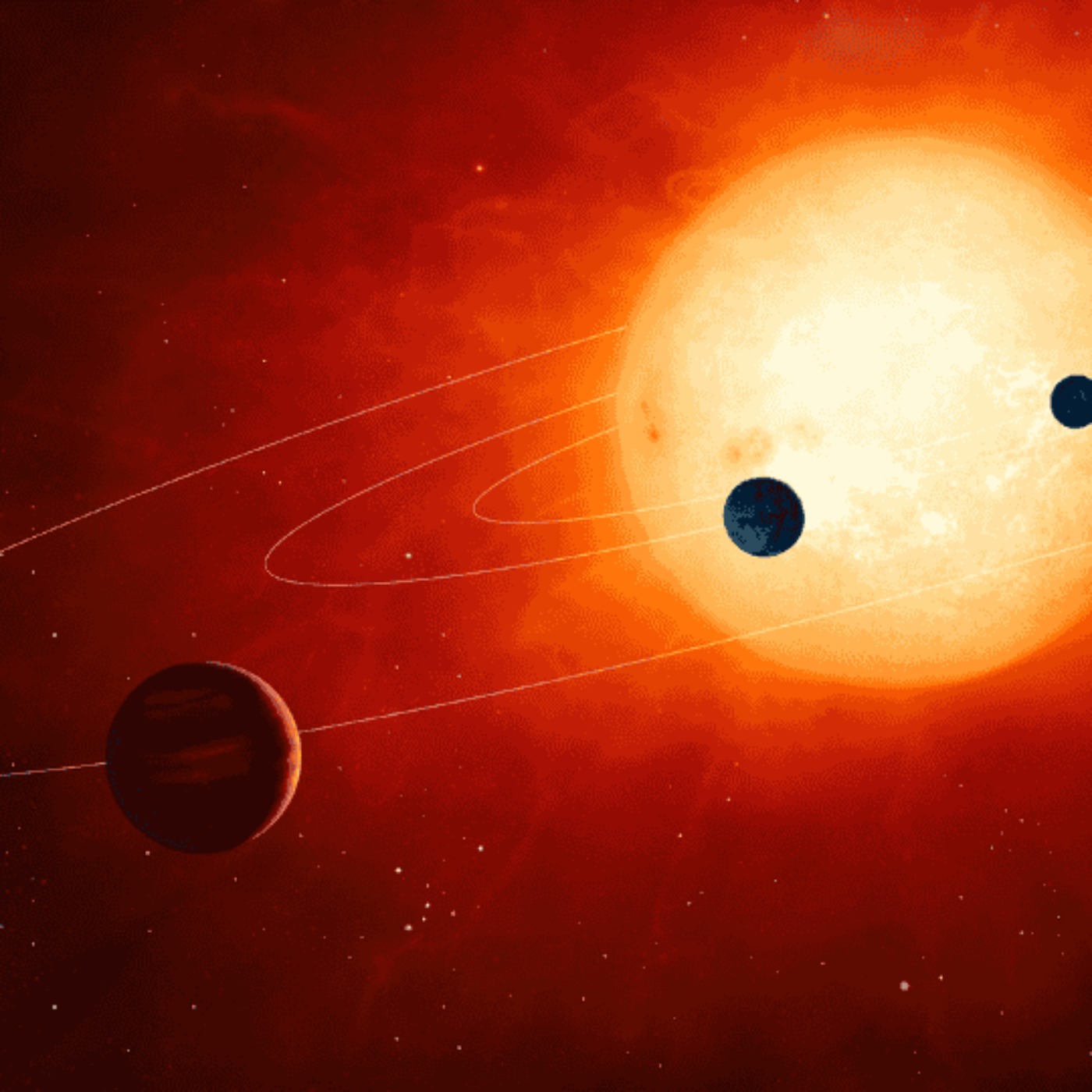
In this episode, we journey to K2-18b, a "sub-Neptune" exoplanet that has become the center of a profound scientific debate. Orbiting a cool red dwarf star, this world sits in the elusive "Habitable Zone," but it is unlike anything in our own solar system. With a mass eight times that of Earth and an atmosphere rich in hydrogen, K2-18b might be a Hycean world—a planet covered entirely by a massive liquid ocean.
It challenges us to rethink what a "habitable" world looks like and reminds us that the first aliens we find might not be walking on land, but swimming in a global, alien sea.
Interactive timestamps
Jump to segmentGet every episode summarized
Each time Mysteries of the Universe publishes, we email you a written briefing from the transcript — the topics, who appeared, and any specific claims, with the ad reads skipped.
Email me new episodesFree for 3 shows. No card needed.
Hosts & guests
Transcript ready
179 searchable segments. Every word is indexed and playable.
Full transcript
Mysteries of the Universe — This Planet Might Be Alive. Machine-transcribed; use the interactive transcript above to jump the player to any line.
0:00For centuries, we've gazed at the sky, wondering if we're alone. Yet every attempt to find alien life has come up empty so far. Our universe holds more planets than grains of sand combined on all of the Earth's beaches. Some estimates put it at up to a billion for every grain. So it seems inevitable that life must exist somewhere out there, right? While scientists think they've just found our strongest hint yet, a mysterious planet called K218B, it's eight times Earth's mass, possibly hiding a vast ocean beneath a hydrogen-rich sky, and it might be on the verge of revealing that we're not alone in this universe. Join us on this journey to unravel K218B's secrets, from how it was first discovered to the remarkable new data from the James Webb Space Telescope, JWST, data that might whisper the possibility of habitability.
1:00This single world over a hundred light years away is redefining our expectations of what's habitable. Are we finally at the doorstep of alien life? K218B is a planet orbiting a cool dwarf star called K218, in the constellation Leo, about 124 light years from Earth. Solar's K2 mission discovered it back in 2015. Astronomers spotted a faint dip in starlight, the hallmark of a planet passing in front of its host star. That star, known as K218, is a relatively cool red dwarf in the constellation Leo, about 124 light years away. Right off the bat, the star's smaller size and cooler temperature made the planet's signals easier to detect, because the star's own brightness was more modest. Best forward to 2019 and an international group at University College London, led by Dr.
2:02Angelo Ciaras and Professor Giovanna Tennetti, studied archival Hubble data. They discovered water vapor in K218B's atmosphere. The first time we'd seen water vapor on a sub-neptune in a star's habitable zone, it was a huge what if moment. Did that water vapor hint at oceans beneath the thick atmosphere? What made it so interesting to astronomers is that it orbits within the star's habitable zone, where temperatures might allow liquid water. The habitable zone got astronomers intrigued, but it was just step one. To be able to support life, you also need an energy source, stable conditions, and essential elements such as carbon, hydrogen, nitrogen, oxygen, phosphorus, sulfur, and, hopefully, a class of compounds that scientists call biosignatures. Biosignatures in essence are tell-tale chemical or physical markers that strongly hint at biological
3:03processes. They could be molecules like oxygen or methane on Earth produced chiefly by living organisms or more unusual gases such as phosphine and dimethyl sulfide, which are hard to generate in large amounts through abbiotic means. K218B remained intriguing, but everything ratcheted up in 2023, when the James Webb Space Telescope came online. A team led by Professor Niku Marusudan at the University of Cambridge used JWST's instruments to reveal methane, CH4, carbon dioxide, CO2, and maybe even something we associate with life on Earth, dimethyl sulfide, or DMS. Now, that's when the news started to blow up. You may wonder, how do we even see these molecules on a planet hundreds of light years away across the galaxy?
4:04The short answer is, we read starlight. If a planet crosses in front of its star, a slice of that starlight filters through the planet's atmosphere. The technique is called transit spectroscopy. Picture a planet crossing in front of its star, like a mini eclipse. A fraction of starlight passes through the planet's atmosphere. If the atmosphere has methane, carbon dioxide, or any other gas, those molecules absorb specific wavelengths. It's like shining a flashlight through colored glass and noting which colors get blocked. Of course, a single molecule alone doesn't guarantee life. Potential biosignature doesn't mean we found aliens. We need multiple lines of evidence. So long story short, transit spectroscopy is not easy. Planets are dwarfed by stars, akin to a mosquito crossing a giant lighthouse, and in case of K218B, the star itself is 124 light years away, so the signal is faint.
5:09So how have we found the strongest hint yet of alien life? Enter JWST, or James Webb Space Telescope. With its immense collecting power and advanced instruments, JWST can parse out these tiny dips in starlight and identify the missing bands. And that's how we precisely came upon K218B, whose discovery has fundamentally changed our understanding of extraterrestrial life. Using JWST in 2023, an international research team led by Prof Nikumad Huzudhan at the University of Cambridge detected methane and carbon dioxide. The planet's about 2.6x Earth's radius, 8.6x Earth masses, so it's bigger than Earth, but smaller than Neptune. That puts it squarely in the sub-Neptune category, something we don't see in our solar system. Near infrared observations revealed about 1% methane, CH4, and roughly 1% carbon dioxide
6:16CO2 in its atmosphere. That might not sound like much, but for exoplanet atmospheres, these are surprisingly high fractional abundances, especially in what's believed to be a hydrogen-dominated environment. On the other hand, ammonia, NH3, which some models predicted, is absent or below detection limits. While Hubble data from 2019 mostly pointed to water vapor, JWST's advanced resolution shows that some signals Hubble interpreted as water may have been overlapping methane lines. The new data indicates water vapor is less obvious, perhaps locked down by a cold trap, meaning it's condensed out of the upper layers we can measure. What's perhaps most interesting is the detection of potential biosignatures. Observations in the 612 micron range uncovered spectral features consistent with dimethyl sulfide, DMS, or dimethyl-dysulfide, DMDS.
7:19On Earth, DMS predominantly comes from marine plankton. You might recognize it as that sulfurous smell near the seashore. If confirmed, such a molecule in large quantities on K218B is eyebrow-raising, because known abiotic pathways typically produce it in far lower amount. At this stage, the detection sits around three sigma confidence, about a 99.7% chance, it's real rather than noise. But scientists prefer five sigma for rock-solid claims. Another uncertainty is that DMS and DMS have somewhat overlapping signals, so we're not fully sure how much is DMS versus DMS. We just know something sulfur-based is showing up in that region of the spectrum. The mystery only grows deeper. The presence of methane and carbon dioxide in a hydrogen-rich atmosphere suggests chemical disequilibrium. Typically, if a planet had no ongoing source, geological or biological, you'd expect these
8:23gases to react away, or settle into lower concentrations. So either K218B has some exotic geochemistry in its deep interior, or it has a biosphere that continually replenishes them, or it's an as yet unknown phenomena. Bio-signature is a chemical sign that hints at life processes. On Earth, DMS is about as biolinked as they come, over 90% from marine organisms, so the detection or near-detection of DMS or DMDS on K218B is thrilling. But one molecule alone does not equal, we found aliens. Could these sulfur molecules form aboeutically with no biology? Possibly, though known lab experiments in hydrogen atmospheres produce minimal amounts.
9:25Some theoretical photochemical pathways or volcanic processes might manage it, but nowhere near the abundance we suspect. One of the major unanswered questions is about K218B's surface. What does it look like? One possibility is that it is just a mini-neptune with no real surface. It could possibly be a high-sian planet. High-sian stands for Hydrogen Plus Ocean. These exoplanets have thick, hydrogen-rich atmospheres, and potentially large water oceans beneath despite not being strictly Earth-like. They can exist in a wide range of star distances. Some even tidally locked, some with global oceans, perhaps super-heated or high pressure. K218B, with its hydrogen environment and the potential for watery layers, fits the high-sian blueprint nicely. However, whether K218B actually has a comfortable ocean or super-critical water is a separate question.
10:27Some models propose the bottom of that ocean, if it exists, is under such crushing pressure and temperature that the water goes super-critical. No distinct liquid-slash gas boundary. Still, the possibility of a temperate layer can't be dismissed. So far, K218B is expected to check every box on the habitability checklist. First, it seems to have liquid water. The internal structure model suggests a thick, hydrogen-rich atmosphere with an ocean layer beneath, though the ocean could be extremely high pressure. Some or all of it might be super-critical water. Still, there might be a zone with more Earth-like water conditions. Then the planet is in its star's habitable zone so it probably receives enough stellar radiation for potential photosynthesis-like processes. While the star K218 is cooler than our sun, photosynthesis can adapt to redder wavelengths
11:32in principle. Further, the planet exists under stable conditions. M-Dwarf stars can be quite active, but K218B's moderate flare behavior and 3 billion-year age mean it's relatively stable for an M-Dwarf. The planet's mass suggests it retains its atmosphere over billions of years, despite some hydrogen escape. Finally, there is essential chemistry. It has methane, carbon dioxide, likely some water vapor deeper in the atmosphere, and a suspicious hint of DMS or DMDS. That's a robust set of building blocks or potential biosignatures. That is why K218B is such a prime target for further investigation. So where do we go next from here? The team behind these discoveries is scheduling more hours of JWST observations to confirm
12:33whether DMS or DMDS truly appear in that mid-infrared range. They want to push the detection from three sigma to five sigma, which lowers false positive odds dramatically. If that happens, we'll likely see a flurry of papers dissecting how if at all non-biological chemistry could produce so much DMS or DMDS. Missions beyond JWST also loon. Lisa's aerial mission, set for 2029, aims to study thousands of exoplanet atmospheres. K218B included. It might require multiple transits, 20 to 50, to build up enough signal, given how faint this star planet system is. Still, Ariel's broad sample approach might show if K218B's sulfur signals are unique or part of a bigger pattern in sub-Nepton. On Earth, the upcoming extremely large telescopes, ELTs, could zero in on some aspects of temperature
13:37profiles or phase curves, revealing more about the atmospheric structure. Scientists are also exploring if there's any feasible abiotic route that could produce these sulfur molecules under hydrogen-rich high-pressure conditions. So far, it remains unproven. We stand at the edge of a mystery. K218B is something we never imagined a few decades ago, a warm, watery sub-Nepton that may produce biosignatures. The next few years could see a revolution in how we define habitability and search for life beyond Earth. If the DMS or DMDS signals hold up and can't be explained away by geology or photochemistry, K218B might become the leading candidate for alien biology in our cosmic neighborhood. I'll be at a neighborhood that's 124 light years away. Until then, we keep our telescopes trained and our minds open.
14:41A single molecule might be all it takes to change humanity's story, unless we find that nature can forge it without life, too.
More episodes
More from Mysteries of the Universe

Our Galaxy is Headed for A Collision
Mysteries of the Universe
Fermi Paradox: Where The Hell is Everyone?
Mysteries of the Universe
The Biggest Battle in Cosmology Right Now
Mysteries of the Universe
How Scientists achieved Ignition - The Biggest breakthrough in Nuclear Fusion
Mysteries of the Universe