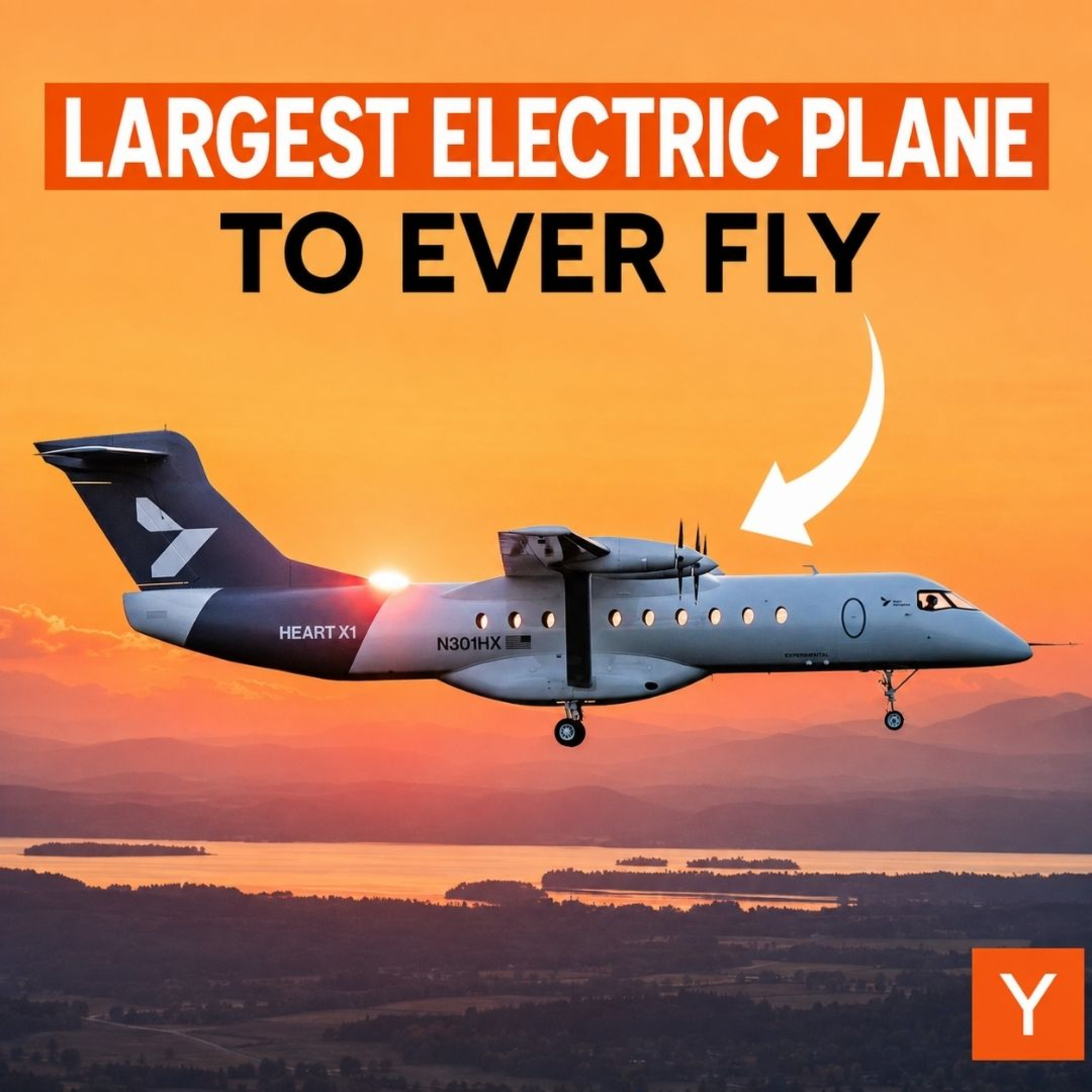
The World’s Largest Electric Aircraft Just Flew
About this episode
Heart Aerospace (YC W19) just flew the largest electric airplane ever flown — a 100-foot wingspan, a takeoff weight of 25,000 pounds, and $5 of electricity to get it off the ground.
In this episode of Hard Tech, YC's Gustaf Alströmer visits Heart's pilot plant in LA and sits down with co-founder and CEO Anders Forslund to find out how they went from a 3D-printed model to a full-scale electric aircraft in seven years, why the jet engine has left short flights behind, and what cheap electric flight could unlock for the future of regional air travel.
Get every episode summarized
Each time Y Combinator Startup Podcast publishes, we email you a written briefing from the transcript — the topics, who appeared, and any specific claims, with the ad reads skipped.
Email me new episodesFree for 3 shows. No card needed.
Hosts & guests

Transcript ready
257 searchable segments. Every word is indexed and playable.
Full transcript
Y Combinator Startup Podcast — The World’s Largest Electric Aircraft Just Flew. Machine-transcribed; use the interactive transcript above to jump the player to any line.
This is the largest electric airplane ever to fly. It's got a hundred foot wingspan, it takes up weight of 25,000 pounds, and the electricity to get it off the ground costs just $5. Its successor, the ES30, will fly up to 125 miles on battery alone, up to 500 miles as a hybrid, and recharge in about 30 minutes. It's the world's largest electric aircraft by about a factor 2. It's the first clean sheet airliner to be flown in any category, electric or not, in the US in the last 18 years. This is Anders Forstland. He's the CEO of Heart Airspace. Seven years ago, Anders showed me this plane. It was a 3D printed model that you can hold in your hand. It's surreal, yeah. I came to IC with that 3D printed plane. That was like this size, and now it's a hundred foot wingspan hurtling down the runway during taxi testing. So how do you go from basically a toy model to this?
I visited Heart Airspace's headquarters in LA to find out. I've worked with Anders since he came to IC 7 years ago. Back then it was Anders and his co-founder Clara, and that 3D printed model. Today, it's a 40% team in LA building a real airliner. How would you describe Heart Airspace and two sentences? We build a hybrid electric aircraft, but our mission is to reduce the cost of air travel, and we're building the technology to support that. With a relatively small team, they're going after something that Boeing and Airbus have not been able to pull off. Hearts plane swapped the jet engine for electric motors. You'd be holding a motor that weighed a few grams that you put on a drone and has one moving part, and then you look at the 400kWh. It's just scaled up. So it's this really, really simple thing that has very few moving parts, so it means that you can produce them a lot cheaper.
They don't break because they don't really have combustion or fluid, so you get basically zero wear. Let's break that down. A jet engine has thousands of parts and birds fuel hot enough to melt metal. An electric motor has essentially only one moving part. No combustion and doesn't really wear out. When you're taxing with a jet engine, the rest of it is by definition, it's noise. And this, but you have a constant torque profile so you could spin it at like, you know, one tenth of the speed is virtually silent if you stand like a hundred feet away from it. And the power source is eight battery packs laid across the floor of the plane. It's eight facts that are laid across the floor of the fuselage. It's actually only about four Tesla's for this one. It's worth $40 worth of fuel. To understand why this is such a big deal, let's look at what's broken about the jet engine, especially when it comes to short flights. It has complex to build a jet engine for a 30 citer as it is for a 70 citer, so it costs the same. It wears the same whether you fly a hundred miles or a thousand miles.
So it's pushing the industry into this direction of going larger and larger planes and longer and longer routes. They're extremely inefficient at taxi. You can spend, you know, for a short flight, you can spend 10 percent of your fuels just taxi up to their runway. Takeoff is inefficient, landing is inefficient. So that sort of segment of flying regionally is really badly served by the technology they will have today. And there's already an existing market. Half of all flights in the world are under two hours. There's a replacement market here that's not even driven by cost. The aircraft that we're competing with are 40 year old designs. Regional connectivity is not about how far you fly. It's about how cheap you fly. This aircraft will be absolutely best if it was flying the shortest possible route. Think island hopping in Hawaii or in a region furtown that goes from being six hour drive to 20 minute flight. In the last year, you're gone from like being 33 percent better operating economics overall to 48 percent just because of this increased price and oil.
So why hasn't anyone built this before? It started in Sweden. And I grew up right next to a Nair Force base in Sweden. You saw like the Viggen fighter just going over the soccer field. That was always I was super excited about that. Really into paper airplanes. Just been fascinating with planes, you know, rockets and all of these things. He did a PhD on jet engines and ended up at MIT. That's where the idea found him 12 years ago. He comes to MIT. This is 12 years ago. Elon shows up and he's talking about electric planes. He says at one point that, you know, eventually all modes of transportation will go electric besides rockets. He's talking about like 400 watt-arph per kilogram and it kind of felt like a call to arm. Yes. This time I was like working on jet engines during the day. I was like tinkering with drones at the kitchen table at night, becoming kind of obsessed with this. I was actually doing research on this being paid by the Swedish government to go around
and speak to all the airlines and before I even had a company. It's established the relationships with the airlines and the Nordics before I even like try to build something. When Anne has got to IC, there was no playbook for this. With IC we were all focused on getting some like early interest from airlines. We got some L.O.I.s from S.A.S. and Braun, instead of the three Nordic airlines. We really had no technology. Like I came to YC Demo Day with a little 3D printed model. So we went from L.O.I.s to then building like the 400 kilowatt motor, which was like the size of a small jet engine. That in turn attracted actual pre-orders and then they came from United and then that attracted more capital and then we started building and now we're building towards the plane. If you're a founder listening to this, the learning that you should have is every time you need more capital, it needs to be something material. It needs to be something physical you can touch that you can show that you made. Their first big airline customer actually came out of the spam folder.
United Airlines came through an imbound email through our info email. Clara was looking at it and she was like, I think this might be a thing. He was like cleaning out the spam and that led us like through the front door. We just brought them over and showed them the electric motor we built that was the size of the jet engines we tried to replace and they kind of immediately got it. And the design itself, most electric aircraft startups try to look futuristic. Hard to the opposite on purpose. It looks very much like the Turbo Props were trying to replace. We're not trying to build a sports car. I'd rather build something that looks very conventional but is kind of hiding its Superman cape under the hood. This is the first one. We never even tested this one because we just realized that it wouldn't hold. And the new one just goes all the way through to the bottom here and it's like it's big thing so it's like really sturdy. This is the pilot plant. Most of this plane is designed and built right here. This is a cylinder body for the actuator. 661 aerospace solubinum.
There's about 15 machine components in the actuator that we're working on developing in-house processes for. International aerospace, this would be a supplier. I mean, you'd store it to get them a year to get one and now you can just play around with it and test it. This is the same basic architecture for Aileron, Rutter, landing gear extension, braking, even in the pitch of the propellers. If you want to build something in-house, you should start with the things that you don't have to go to one supplier but you go to like eight different. So then it's just scales with the number of technologies rather than the number of suppliers. The whole plant is wired like one giant test bench. You can deconstruct it like a Picasso painting and here's the cockpit, here's the cabin, the tail and all of this is being fed, you know, 1.6 megawatts of power. You could keep the aircraft in the air from just everything that's happening here. We're going to be testing fault injection so everything from like putting in programming
error, cutting a wire, everything's got to work, even if everything goes wrong. It'll be like the first time you get into model three and you're like, there's this one screen. I think that's a lot of the idea here. That's the guy that's signing this, he worked on the Dragon Space Capsule. You can fit up to 36 passengers but most common probably going to be already passengers which means everybody's going to get like six inches of extra leg room. And the heart of the operation is the battery lab where the team is choosing to sell for the next aircraft. This is the battery cell lab where we are trying to determine what our cell is going to be. We have lots of different cells with around display here from Chinese, American and Korean and manufacturers. We can determine which one's going to have, you know, the most flight cycles, the best safety, cost and energy debt. We talked about Elon coming through MIT 12 years ago and talking about like 400 watt hour per kilo grams batteries. Do we have any cells that are like 400 watt hour per kilo grams? I think that we have on this table right now is about 370.
One of the manufacturers is producing something at that 400 level that we are expecting to have within the next couple months. Easily meets our targets for the first generation of the aircraft. So you got the countdown timer there 23 days. It's part of YC demo day, Chrome extension. The hardest problem had nothing to do with the motor or the battery. It's probably the biggest challenge we've had in the company. One in every thousand flights in the US gets diverted to another airport. You can kind of need 45 minutes of loiter and then you need to go to something that could be like a hundred miles away. So if you build a battery electric aircraft, you kind of have to carry two thirds of your battery needs to be for reserves. Unlike Jeff Hule's batteries, I'm good lighter. Their answer is a hybrid engine. We're basing it on a very simple turbo prop engine. One of the most inexpensive ones. We don't have to use it for most flights. And it's still adding about, I guess, 20% of the upfront cost of the aircraft.
And I think it's worth it. You can fly up to 125 miles all electrically and then you fly up to 500 miles with a hybrid system operational range. That call comes out of the philosophy the energy bar from SpaceX about how you should treat risk. Traditional aerospace is like, well, the impact is always catastrophic. So let's minimize the probability. We don't know anything until we know everything. Whereas if you look at how do we minimize impact to getting it wrong, then you can select a process that's a lot cheaper. That's a lot easier to iterate on. Plains don't crash these days because of a broken wing. They crash because of broken logic. We want to build a software to find vehicles, the computer on wings. Anders has heard all the doubts. For example, why not just build flying taxis first? It's super cool. Like they're really trying to build a flying car. We're attacking not the helicopter market, but the main line, you know, like airplane market. While these companies have like three or four passengers, we have, you know, 36. We're also operating from an infrastructure that is already there.
You know, there's 5,000 airports in the US. Another common question he gets is why not use hydrogen? And the same with hydrogen. The great thing about using hybrid electric is that it's already now at a significant like negative green premium. So you're surfing in a much bigger way. The planes were trying to replace their 40 years old. It's becomes an appreciating asset. The plane will actually be better in 10 years than when you buy it. It becomes like buying a house. 36 seats is only the beginning. We love to build bigger planes. The large market is the narrow bodies. The 737 is the A320. There's ridiculous backlogs. Somebody doing what's basic stood with rockets on airplanes just makes sense. Longer term. The planes built for a world with fewer pilots in the cockpit. A remote pilot that is supporting many aircraft. Kind of like there's remote operators of the way most. Then we're going to see autonomy happening in cargo where there's, you know, lower stakes. And then, you know, eventually making its way into aircraft.
Obviously a lot less noise. There's a lot less vibration as well. There's going to be more flights. They're going to be cheaper ticket. So you're going to be able to go to your neighborhood airport and take a plane. And the way you actually could in the past, it's also why heart is building it here in LA, the new center of gravity for this kind of company. This is the ground zero. The most historic place when it comes to aviation. You have the new space ecosystem that's kind of coming from SpaceX. You know, companies don't build planes. People do. It's the moment of seeing it literally take off. This is obviously a moment I've imagined for the last seven years. And even seeing it going on the runway gives me the goosebumps. So it's hopefully, I'll get a moment where it kind of starts seeing the forest for all the trees kind of thing. When this airs, you will have flown the largest electric airplane in the world. Come a long way from Demo Day seven years ago. I'm so grateful that you got that opportunity. And now the day's here. It's going to be amazing.
Seven years of hard work finally led to this. Their first flight on Wednesday, August 12 in Plastburg, New York. If you start a new hardware start today, everything that you know about building heart and your tri-career, how would you get started? I'm a pretty good duck, right? Like I know a little bit how to swim. I know a little bit how to fly. And I know a little bit how to walk. And that's enough for me to know when I find somebody that's great. I would never start a company based on the fact that I wanted to have a company or be a founder. I would start because I really enjoy a problem.
If we can get stuff that is lower emission, lower cost, lower pollution, just better quality of life, we should be doing it.
More episodes
More from Y Combinator Startup Podcast

Paul Graham On Startups, Ambition, and Great Founders
Y Combinator Startup Podcast

Max Junestrand: You Need The Willingness To Learn Faster Than Anyone Else
Y Combinator Startup Podcast

Susan Kare: Designing Icons & Graphics For the Original Mac
Y Combinator Startup Podcast

Chelsea Finn: This is the State of the Art in Robotics
Y Combinator Startup Podcast