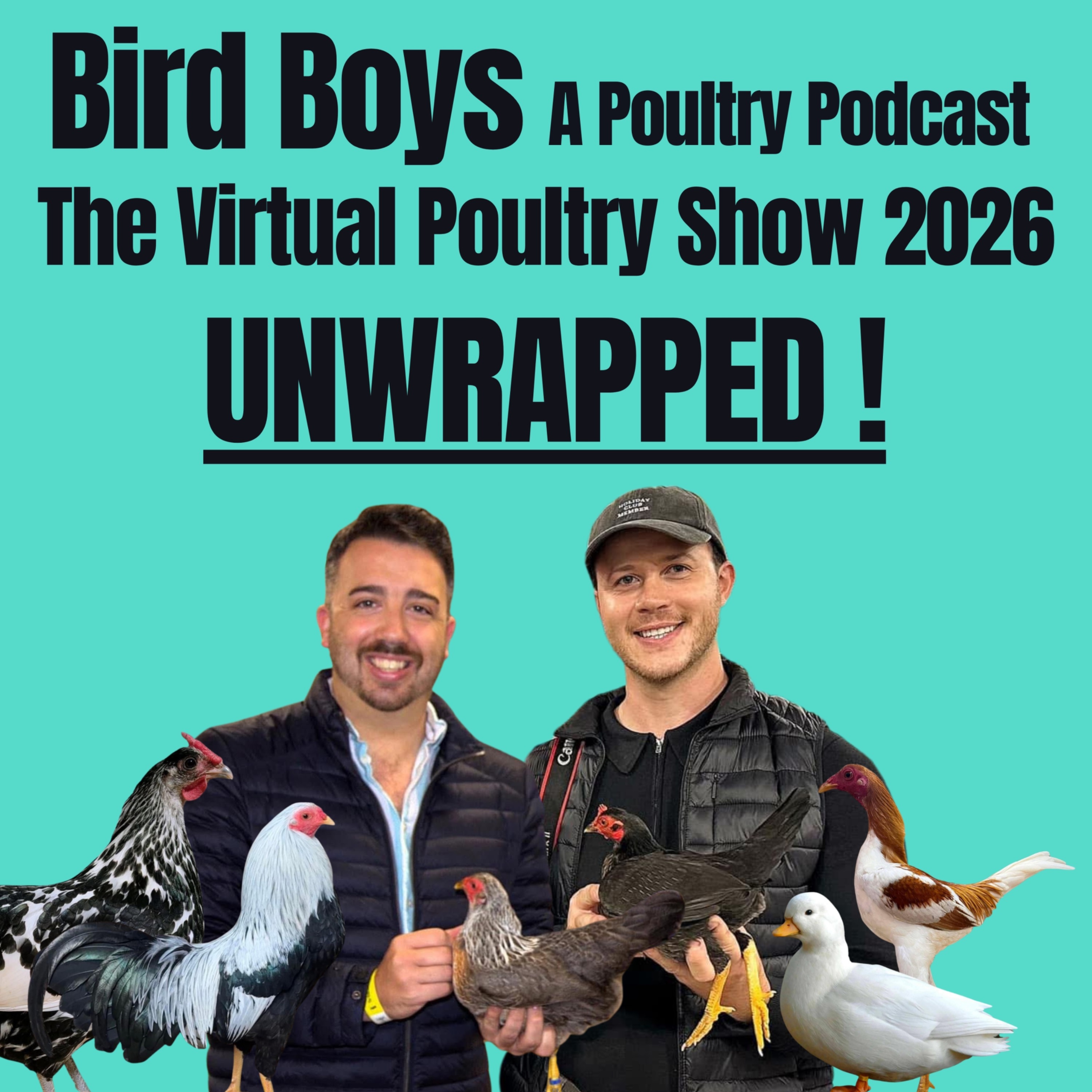
About this episode
Hosted on Acast. See acast.com/privacy for more information.
Get every episode summarized
Each time BirdBoys - A Poultry Podcast! publishes, we email you a written briefing from the transcript — the topics, who appeared, and any specific claims, with the ad reads skipped.
Email me new episodesFree for 3 shows. No card needed.
Hosts & guests
Transcript ready
777 searchable segments. Every word is indexed and playable.
Full transcript
BirdBoys - A Poultry Podcast! — The Virtual Poultry Show 2026 - UNWRAPPED!. Machine-transcribed; use the interactive transcript above to jump the player to any line.
Hello and welcome to the Bird Boys Pop-to-pop cast with me, Jed White and me Oliver Woodle. I'm afraid it is just the two of us today. We wanted to do an episode where we focused on the virtual poultry show. It was, what was it, beginning of February, it's about a month now. So Ollie and I have had time to get our thoughts together. It was heavily featured in the March issue of Fantasy File Magazine. Thanks very much to Ollie who pulled a lot of that together, particularly around judges' reports for inclusion. We thought we'd go over some of the entries and just give our thoughts.
None of this is personal for anyone listening who happens to have birds in this selection that we talk about, but I know when I pop photos of my birds upon social media, no bird is perfect, it's never going to be. So I always try and point out some of the good things about that bird, but also some of the things that need to be improved in future years and how I might look to do that. And I think that's something that is really helpful and beneficial for our hobby. And I think the more that we will do that, the better and in particular, it's a really great opportunity for others to learn too. So that's kind of in similar vein to what we're going to be doing today. So we're going to be looking at some of these birds giving our opinions and they are just our opinions on what we think of these birds. We're not the complete experts on all breeds,
but hopefully can give a decent level of insight. And we're going to start with some of the championship birds to look through. But before we do that, I thought Oli might give a bit of a background on what it takes to put on this virtual show, because I know you were kind of part of the committee, if you like show committee, virtually that helped to pull it all together Oli. It is a lot of work. I think people don't necessarily appreciate just how much work goes into it all. And there were so many entries again for this one more than I think people anticipated. That is a huge amount of work goes along with that, particularly because you have all the majority of the breed clubs are involved as well. So just reach out to them all to make sure that is the case and they're happy and etc. It all takes efforts. So do you want to give a bit of a low down Oli?
Yeah, well, really, all the legwork really is done by the women really. And we say that on our international women's day, so there you go. So yeah, I mean, that was the Fiona, Rosie, Jane and Christine, who really do put the legwork in. I and a few others stepped in then sort of in the middle, so if you like to really get things moving along, and as you say, try and get all the different breed clubs that are out there, involved to ultimately to represent their breed. You know, we're not having real-life shows. They're not able to get any information out there like they would, particularly for newcomers, which is part of kind of why we really do this to encourage those that might not necessarily normally show.
And a great way of doing that is breed clubs doing their bit to be involved, and you know, just get that kind of, not not looking for, sort of vibe, and you know, the hobby that we love, you know. You're so Gen Z with the vibes. Yeah, and just the camaraderie that we all miss from, you know, real-life shows. Obviously, it's never going to be the same. We can only do our best for me. You can get as much as we can like a normal show. In a sort of respect to organising it, to an extent, it's very much the same as organising the normal show. We do everything that a normal show would do in preparation for this, apart from their actual birds, their photographs.
You know, all of the back and forth liaising with breed clubs, exhibitors, the questions that we get, you know, it's all the same, it's all what you'd expect to a normal show. Again, like a normal show, everyone that organises the virtual show, we're all volunteers. We all do it because for some reason we like to. And yeah, you know, it's just a really nice feeling at the end of it when you see, you know, everyone doing so well with their photographs and what have you. But as I say, yeah, the women really do put all the work in. So, you know, huge thanks to them, really. And yeah, as you say, it was, I think, well, certainly for me, it was far more successful than I was expecting, I think, in my head, I'd kind of told myself that was this going to be the last one, if people kind of really lost the love of it now, you know,
it's been going on for a few years now, having to do that. It's been going on since the pandemic, yeah. Yeah, which, you know, it's just, it's crazy. We also, the committee, if you like, that organised the virtual shows, we kind of realised that the date that we chose was not that much after. I think the Silky Club had just recently had a virtual show. Yeah. I think the, I don't know what, who'd also had one. Er, Karno's called X-Hand as well, they had their big ones. So we were a bit like, God, you know, as this, but actually, you know, it worked out, we had so many photographs entered. Can you remember what the entry was in the end? No, no, I don't know. I don't think I brought the right up, because I wasn't sure in the end. I have no sense of what they were saying. Oh, yeah, definitely. I mean, I had numbers from some, some classes, were not classes sections, yeah.
They were, them on their own were in the hundreds, I mean, I think the pecans were up, I mean, yeah, the cool ducks, as I kind of expected, they had a great entry as well. Thank you, in particular, I think, to the Weed family. Yes, very well supported. You supported it a lot, yeah, that's good. Although I was cursing Paul Thomas when he sent me all those photographs. He's keen. He's keen. He is keen and represented nearly every colour. I mean, no, nice. But certainly, the classes were well supported by the Weed family. So, you know, yeah, thanks to them. But yeah, I mean, that's it really. I guess like any show, you know, you do get some people that test you, which is frustrating when you put in so much work. Makes them think that really is to benefit everyone.
Ask because I'll be honest, by the end of all of the admins that upload all the photographs, when it then comes to doing your own photographs, I think I could probably speak for all of us. You get to the point where you're a bit like, I don't know, I really can't be asked. Right, I've looked at hundreds of photographs now. So, ladies and gentlemen, Oli actually did quite well as we'll come on to you a bit later. So, well, he has this now. I say this now, but I mean, in fairness, all the admins we've got, so obviously all the photographs have to be in from all the exhibitors by whatever time it is on the Friday. But then the admins, we've kind of, we have Saturday for us, the photographs, which is quite nice, but it always ends up being a mad rush, trying to get everyone's photographs in, you know, making sure that we're not letting anyone down, but, you know, anyone. But yeah, otherwise, I think all smoothly, all the judges turned up.
They didn't have to go far. And yeah, and obviously, very successful show, which ended in some lovely birds going up on to championship, right? As we'll go into now. Right, well, let's get cracking. So, which of bet was the championship judge, which should have kept many, many, many different breeds over the years, very experienced learnt from Ian Kay, one of the best, and has been on this podcast with us before, alongside his friend Stuart Kay and also Philly Wilson. So, please do go back and listen to what they had to say. But the championship lineup, I thought was an okay lineup. There were some decent birds. I do think the two that he ultimately chose, when I looked at their lineup were exactly the two that I also would have chosen. Yeah, I probably would say the same.
How many look? So, he picked out a white cool drink of Kelly Miller's as show champion. And cool ducks have a pretty good track record of winning these virtual shows. I think they're the kind of breed that photographs pretty well. And we've got, as Ollie said, the Cool Duck Club had its own virtual show and had hundreds and hundreds of entries. The quality and the breed is very good, has maintained despite all the challenges we've been through. Not many people have gone out of keeping cool ducks during that time. They've kind of all carried on. And so, still a lot of really, really, really good cool ducks across the country. And Kelly Miller has done very well with her, has for quite a few years now, particularly her whites and her little drape that she want with. So Rich had described it as what a great example of the breed, deep bodied, lovely head and high
excellent condition. And that pretty much sums it up, to be honest. In really good cool ducks, it's quite easy to end up with what they call piggy-eyed, where the eyes are kind of smaller, it's because you get the bigger cheeks and it doesn't quite work. It's quite difficult to have the big bold eye on a bed that still has the broad skull and all the rest of it. But Kelly's drape does definitely demonstrate that while he is really nice and deep in the body, he's got a really good bill angle, which is important, so he's not downbuild in great condition. So, yeah, nice bed. Yeah, no, I mean, there's not really much else I can add to that. You've hit the nail on the head there perfectly. Like Jed mentioned about the bill angle that's something that really, really bugs me. You see, particularly the white, I think, because it's the color in the cool ducks.
You know, show after show these days, you see almost nearly all of the whites, particularly all the good ones that are so downbuild. And I think that is something that comes with having such a powerful head. Yeah, you lose build quality, but I mean, this bird has got probably one of the nicest bill angles I've seen in a long time. Yeah, yeah, that's true. Then Miserve was there a crime cop banter. So, from the cool being a regular winner as a breed, crime cops do well within the rare breed section, has to be said, both in large amp bantam. But it's not that usual to see them then going on further. This bantam cop grill is a really, really stylish bird. So, exhibited by Josh Clark, you know, again, further condition. Now, he just looks immaculate, he's standing really beautifully. As a crime cop
should, they should be kind of strutty and proud. And some, some you see, they kind of look, not saying, well, some are not strutty and proud, but they should have a very different look about them. And some that you see, they do have that kind of more blocky, well, some look about them. Yeah. And that is not what a crime cop should be. And yeah, I thought it was angle and stuff that was really good, really tidy, heavy look, really fit. Yeah, a very clean silver colour, just, I thought again, a really good choice. Yeah, no, absolutely, totally agree with you. I'll let you leave on some of these. If you just want to, like, jump in first. I don't want people to say that I'm hogging it as a voice. What did you do? What did Riches say? So Riches, they're lovely, very great type colour and markings, which, yeah. Yeah. And something that I always really like to pick out on birds is feather quality.
You know, you can, you see so many birds that are full of type, full of style, but they just lack that, that sort of finishing detail in feather quality. Yeah. And this bird, I mean, you can see it, you know, the sheen on its tails. There is something, yeah. And that is partly kind of about photography as well though. Yeah. If you had photographed that bird in a dull environment or, you know, you have to catch the light on feathers to, to bring out that lustrous green sheen. And Josh, Josh just did that really well with, with him. What would have been your next pick, Holly, you got the spot? Um, see, see if we agree or not. See, I, I was put on the spot not long after these birds were put on this album by John Grubb and, you know, what I, I sort of struggled to come with like a third place because
I really quite like the, the, um, the white silky. Okay. But the photograph ever so slightly annoys me. Um, just not standing up. No. So I was kind of like, um, no, I particularly like the little Sarama Cockrole. Yeah. The juvenile. Yeah. I think that is a really neat little word. Um, yeah. Showing about the comb. Yeah. Not only keen on the comb. Um, for me, he's, he's what I like a Sarama to be. He's not too extreme. Um, I think the only thing I think with the photo is I don't think his wing probably is in front of his legs, but the face has been taken behind slightly from behind. It looks like it is. And I see
you don't want the wings in front of the legs. You want them covering the legs. So the wing angle is really good because it comes straight down. Yeah. In their, in their vertical line. Yeah. And if you were to draw a line down the back of its eye down the leg, but it's wing sits nicely. Yeah. Um, yeah. I see, I really struggled because I try to tell you what I think. I liked the turkey as well. Okay. Yeah, turkey is nice. You know, it's a good example. It's nicely marked, but I think I probably would have gone for, but I also liked the modern. I really struggled. I think I gave like, I think I messaged John about three times. I'm saying, oh, I like this. I like that. I think I probably would go with the Sarama. I think it's interesting. Interesting. Okay. So I think it is difficult because I think the cool and the crying cops stand out so much above the others. And that's not to say the others aren't good
quality birds, but I think the other two are, are pretty exceptional. The other bird that stood out to me actually was the hamburger. Interesting. So her markings aren't perfect on, on the tail. You'd like a slightly better shape to the spangling. The spangling looks good, you know, evenly distributed. It looks pretty decent shape through the whole body. Perhaps a little bit dark over the head, but you've got a nice head, dark eye, nice comb. It's a nice head. It's a nice face of the bird as well. Nice body. You know, it's one of Steve Darts. It's, it's, um, Dave Darts. Sorry. Dave Darts. Who? Dave Darts. Is it? I put S star. Yeah, it's Dave.
Oh crap. Sorry Dave. Is it? Well, that's who's been tagged. Oh, why did I put S star? Anyway, um, why did I think his name was Steve? I don't know. Apologies. I did know your last name was start and I have met you at some of the shows before. Um, and more importantly, I'm basically saying that your bird would have been the third choice for me. Um, I, I just think it's a really nice face of the bed. I think the bed looks good. Um, and I think when you weigh everything else up, it would probably be my, my third choice. I like the peak in, but I just think I had looked through all of the albums, uh, before, uh, the championship judging have been done. And I think I probably saw some other birds in, in classes that I just thought
might have, um, put on a better show, if you like. And I thought the peak in, there's nothing really wrong with her. I think it might be the photo. To me, she, the photo makes her look a bit narrow. Yeah. Um, and I don't think she probably is. And the light isn't great. So, you know, she, you've got a bit of shadow and stuff like that. Can't really see her comb. Yeah. Cause she's looking dead at the camera. So, um, yeah, I thought the modern was nice. Um, I wasn't overly, uh, something about the photo of the modern that just wasn't quite so keen on, but, um, and it does look like a nice bird. Yeah. Same as the car light. The car light probably is a nice bird, but, um, you know, half, half the photos in shadow.
I'd also just like her head to be, uh, a bit higher, um, kind of showing a bit more lift. Same with the Langshan. That German Langshan is probably a really nice bird. Um, but I think she actually probably has a nicer shape. She looks a bit, she almost looks like someone, tapped her beak to get her to hold her head up and she's gone back with her head. Yeah. She just looks a bit top heavy. Yeah. She's just instead as well. Yeah. So she's got a lot of lift to her. I think I had let her feet slightly too far apart. Yeah. He's got a, so she's not standing properly. Exactly. Yeah. Um, lovely way to change because I think she actually probably does have a lovely floater. And this is the thing with virtual shades, right? It's so hard to visualize what these birds actually look like in a pen. Yeah. And I mean, I've had this
conversation with, um, a few of the judges that were involved in the virtual show, along with some of the admin. If you're not someone that necessarily knows how to get a bird to stand correctly or, or what the breed outline should look like. And if you're not a particularly great photographer, this is actually a really hard task to do. Yeah. Yeah. If you're doing it on your own, trying to get those three aspects right. Yeah. Is, is not an easy feat, which then sort of means you appreciate all the, all the, all the poetry photographers that do such great work at the shows, for them to capture such lovely photographs. Yeah. So, you know, fair plates, probably want to put that, you know, they're tying an effort into the photographing their birds for the virtual show. Yeah. It's like, like I said, some of those things that you just need to think
about is, you know, kind of job to see the head profile. Can they see the comb and, and things like that? Because that is important. Now, it's difficult to place a bird highly if you can't really see the, the comb. And I think it's about, you mentioned about the comb. Yeah. I think, I don't if it was me and you had this conversation, I might be with someone else. Different breeds need to be photographed ever so slightly differently. Mm hmm. It's going to be certain things that you want to see on one breed that, like a peaking, for instance, you know, you want to see skirt, you want to see where it's held. You're not going to see those if you have a side on profile. Yeah. But then a different breed. I don't know, let's say a rose comb, and for instance, you go side on profile because you want to see particularly on a, a cock bird, you want to see the comb, you want to see that tail, you want to see the shape between the net going through to the back. Mm hmm. So that's something that people want to pay attention to. But the same as the
silky sea. So that probably is a really nice silky deserves to be there. But it is sat on whatever that is. So, so that to me, I can't really see the bird properly because it's not standing up. Yeah. Yeah. And it's something a lot of people do a peaking, actually. They don't actually make them stand up for a photo. No, that's it. And so they don't look any good because they're not actually standing up. I always, when I used to take photos properly, I always used to get a bird moving around. Yeah. And, and then wait for it to relax and then take that shot. It's probably one of the reasons of Kordak and the Kronkopp. And for me, the Hanberg do better because they are, they are just in their natural state, really. Yeah. They haven't really been put all that much. It's just particularly the Kronkopp. Definitely, you know, that is just how, how he is,
and he's the Kordak. So, yeah, we better move on some of the, the best of breeds. Yeah. But, yeah. Plenty to like. So, true bantams. We're right, okay, there we go. Yeah. So, see the peaking one, this, this section. I'm going to be slightly unpopular with what I say next. No, true. So, these birds at all, I think, good birds. By the way, the race came from Francis Fowell is, is, is not here. Because for, for anyone who, who doesn't know, and this is the funny thing about doing a virtual show, you get some interesting things happen. But my understanding at least from social media is, is that that bed, and it's not the person's fault, you know, people just understand how these things work in different ways. But my understanding is that the race came
actually belong to someone else and was photographed by someone else as well, different to the person who owned it and the person who entered it. So, really, I was kind of just like, well, it's not really one. And also, I'm not sure if that bears even alive anymore because it was from the Federation show and we haven't had a, you know, not the 2024 Federation show, but the one before that. So, 2019 or before, it was a very nice race game of Simon Patel's. And I think you didn't run at the show. I think you won at the show. But obviously, what we're looking for with these virtual shows is photos taken, you know, within the past month or so, very much the beds that still live and doing well. And that if there was a show tomorrow, you can enter them and see how they do. So, the race came isn't here. And then, of the other, some of this is photography, I think. I thought the JAP was nice. I just thought, Ollie, you're more of a JAP
pro than me. For me, that tale is a little bit forward. Yeah, I mean, she's probably got, she's not, she's not square-tailed. No, no, it's a little bit more. I think the fan to her tale is a little bit exaggerated. You almost want to remove what would be like Harrow Krippling of her sickle feathers. Yeah, yeah. Move, yeah. They're just going straight up. Yeah. The sea bright is nice. I mean, the sea bright just never really show that well. No, she's not going to be relaxed, does she? No, I think they can so easily look kind of long in the back. But she looks like she's got nice lacing. Yeah, yeah, nice colour. Nice, nice base colour, ground colour, nice lacing. No, kind of gypsy face, dark eye.
So, that's good. The gold Dutch female, quite pale in the face. Yeah. I mean, again, I just wasn't sure how well she was actually standing. She looks kind of like she's slightly back on her hawks. Yeah, I was just about to say that, which and the colour contrast looks good, hako breast, and I'm not zooming in on the fatigues. I can't see what her peppering is like. Pretty good. I'm zoomed in. Yeah, I can't see good nodes on my phone, but it looks pretty good. Yeah, I mean, she's not terrible, but I think the photo perhaps doesn't show her offers as well as it could. The Belgian. So, the Belgian has something that I really like. So, really good green sheen and some black downers lack that now.
Decent sword shaped tail sickles, which is really important in in a Belgian. Again, a lot of them miss it. Really good beard. Nice, nice comb. He's obviously a cop beard, so an older beard. For me, he lacks a bit of style. Yeah, I was thinking that. I'm struggling to put my finger on it, and I think in a show pen, he might look different. I've had bears like this before. Their nice bears have really useful breeding birds. But yeah, I don't know what it is about him. He almost just looks too tight. Yeah, he doesn't. Kind of showy. And the problem is, you either have him or when I had looked at some of the others in the class, some of the others were just too not long, but flowy. They look like they've been kind of cross with the rows came or something.
They had too much flow to them. Some of them had too much sickle. They had long sickles, which absolutely is a name known in Belgium. But they did have kind of quite tidy heads, and the wing carriage was nice and stuff like that. So yeah, I'd be really interested to see him in a show pen. The peaking we've spoken about. The trauma is nice. I mean, short of tail for my liking, really. You wouldn't want the wings to be any higher, because they're quite high on the leg already. Yeah, kind of a nice setting for a photo. I'm not sure it shows him off that well with lots of kind of work behind him. He kind of looks like, I feel like the photograph was taken late afternoon,
and they've used a flag. The lighting is in all that good. Yeah. As I do think, he's a bit short in the wing. And he almost, he's very front heavy. So because he's not got a massive tail, it's a bit unbalanced. He does. It's all front loaded. So that's my opinion on him. The Suffolk Checker is a Suffolk Checker, and I mean, is that really mean of me? I'm basically, if I look at that, and I'm sorry if I'm offending anyone who has Suffolk Checker, it's Fiona, I know it's one of you all, so if you're listening, please don't take a pen. I'm just not a fan of this breed, and that is really unlike me, because I can get on board with pretty much anything. But they do look like a cross between them around, and a plymothrock, and not in a good way. And I'll say they don't really suit the tree bantam section, because they are
as well bigger than any other tree bantam. And him in particular, they just don't have that ornamental look about them. No, they don't look like a soft feather. And we don't need a soft feather, it looks like that, because you've got either bardrock, so you've got more hands, take your pick. To no offense, Fiona, but that wouldn't be a winner for me. I think they're just one of those sorts of breeds that are just a bit of something and nothing. And it's really sad, but I can't remember the gentleman who created them, but he was such a lovely guy, so passionate about it, and he really worked to get them standardised. But there's a reason that lots of people aren't keeping them, and I think we just... They sort of remind me, again, apologies if I'm offending anyone, because I know people have done lots of work on this breed, but they sort of remind me of like
the Lincolnshire buff. They're sort of... They're just breed of nothing, you know? I sort of think if I was going to pick a Lincolnshire buff or a new Hampshire, I'd go for a new Hampshire, because they've got a little bit more possess about them. Yeah, I suppose at least in Lincolnshire buff, say, they've been around a long time. Yeah, I mean, they have, and they actually have a history to them, and their heritage breed. Yeah. Yeah. And they do have a relatively good following the Lincolnshire buffs, particularly in Lincolnshire. They do now, yeah. They do Lincolnshire. I remember going to a show in Lincolnshire later then, whereas I just don't think I was going to happen with Suffolk checkers. I don't know. Was there any at the National? I don't remember seeing any at the National. I don't remember seeing any. And then we have the booted. So I have skin in the game with the booted, because obviously I enter some booted suits. The first thing I say is really nice to see a marked booted winning, because generally blacks or whites, one for a bit, then blacks, one and blacks have been winning
ever since, really. So it's generally been a black booted that gets best of breed, sometimes best of breed, and was there best of breed. So really good to see a, not just a marked variety, but a milflair variety winning. I thought that was, that was really good. Great, like incredible fit feather posed, you know, she's posing nicely. So for me personally, and Ollie and I actually disagreed on this, which is fine, that's been known to happen. So for me, she, she's a bit too gay, which means she's too white. And what I'm saying when, when I say that is when I think of anything mottled, which a milflair is a mottled bird, porcelain is mottled, anything with white tips on the end, you want that kind of concentrated, kind of V-shaped modeling. And you should still be able to see the ground colour all the way through,
it shouldn't overtake that. And I'd also say her ground colour is a little bit on the pale side, but that's not uncommon in, in gold, gold milflares over here, and it's something that, that some of mine had to. So that'd be my only thing. I think she's a really nice bird. I was really pleased to see that colour variety be there and win. And my only other thing would be I'd just like her back to be a bit shorter to have a proper U-shape, so they should have a fairly tight U-shape. So the net comes down, it kind of goes into that U, and then it comes back up with the tail. And it may well just be that she's on a perch in this photo, and therefore trying to balance, and so not, you know, not holding her tail up as well as she might otherwise do. Yes, that's where I would come from. I'll guess my angle on it, and then we'll go to Oli,
who I know discreet would be in that style. So tall will be pleased to hear what Oli has to, I think. I disagree and agree with you, because what you're saying is completely correct. I always refer to anything that's mottled as basically being a bit of a ticking time bomb. Yeah, never got a finished piece with every molt you're getting more white. In theory, in theory, so this is the thing, yeah. In theory, and I almost feel like she's got to that point where she's... So, yeah, it's a hen, it's like, it's definitely, you know, probably two, maybe three, four-year-old hen. Yeah, so like with lots of breeds that have short show lives, anything that's mottled, typically is never particularly great in their first year, because they've not comes through with their markings properly. Second year, you know, you're probably looking at a good bird.
And I feel like she's got to that point now where I like how she looks, yeah, she is gay in colour. Her next molt, that's it. Go on, we'll be sure to be no good for the show bench. But it is so interesting that because we're going into a bit of a rabbit hole of of beeteds and colour now. But I found really mine, because I remember working with people who bred specklesusics, for instance. Their specklesusics had no white in them pretty much in their first year, when they were young, and then they started getting in their second year, third year. A second year was probably the best year, third year was to locate 40, they were gone, as you said. With my beeteds, they look great in their first year. Yeah, I honestly think so now. Yeah, so now I need to see what they look like. And actually, Belgians were like the specklesusics, so they didn't look anything in their first year, second year, third year, they look much better.
So it will be really interesting to me to see what mine looked like next year. And the porcelains, I think you can't really see that easy if I'm honest, because it's also pale as a colour palette. It's difficult to see if they're really heavily mottled and too gay, but you can see it in the golds, you can see it in the in the lemons. Yeah. And yeah, I'm interested to see, because I had a gold mule flare hen from from Jane, so it was none of my work, it was Jane Harnett's work, and I'm sure Dickie's before, as they worked together. She didn't get any, she was a hen when I got her, and in the time I had her, she didn't get any, her colour didn't change at all. And you saw that hen, you know, she was a nice, very lot. So, so sometimes I think you can strike gold in that you get a bird that is well marked in their perhaps their first year, and actually they hold that colour, then that they get older. And if you get that kind of bird,
then that's a bloodline you want to continue with, because... So that, yeah, yeah, something that's stable, and you know working with is far better than having something that you're constantly sort of thinking, oh, gold, you know, what this is going to be like in two years time. Yeah. So, yeah, interesting. So yeah, to the bird itself, totally agree with Jed, I do think the ground colour is probably on the lighter side. My personal preference, I'd want to add a slightly darker. Interesting that the birds in on the continent have, they are much darker, much darker ground colour, and more... Yeah, they're verging and almost being red. Yeah, they are much darker. But talking about the markings, there's a normally marked beautifully in their first year. They have that, you know, great base colour, you know, tic-you-black, tic-you-white, and it all, and when you look at the bird, it looks like a painting. I don't know what their birds look like as they get older, but they don't have the type,
that's the thing. So if you look at their birds, they don't have that beautiful u-shape, and they have great big foot feathers, but they don't have beautiful u-shape, and they don't really have, they're a bit like some sea rights that you see in the UK that they are, they have a good base colour and they're beautifully laced, but they're built, you know, they're painted on a brick. You know, it's not a lovely ornamental tree bantam looking bird, and I feel like, no offense to any beauty breeders over on the continent, and they're not all like this, but most of the ones I've seen, they don't have a lot of shaped, particularly the females, the males seem to, but the females don't have a lot of tree bantwike or tree bantam style to them. No, it's almost as if so much effort has gone into markings, and I'll let they forget on about the bird. Yeah, exactly. Yeah, silhouette, you know, if that, if you put that bird into a silhouette, does it look like a good example of a beautiful bantam or not? And I think
that's how we should all look at every breed that we're working with. Absolutely. Cool, did you have anything else to add? No, I think that's that's the truth. We're going to have to start whizzing through, taking that time on. Okay, what do we got here? Hard feather and juvenile entries. Say, the modern and the color one this, in fairness, I thought the hard feather section was a good section. One of the most difficult ones, because obviously you always handle hard feathers, one of the key things about them. Yeah. The genuinely wasn't a bird there that I thought was a bad example. Say you had a dark, large dark Indian game, which I thought looked really nice. I thought the photo, Ben, if you're listening. I thought the photo, the angle and stuff was good.
Yeah, I, to be fair, actually, it's not a bad photo of that bird. I think just I would have cropped it a bit, I think. And Indians both look good from the front or at an angle, like she is kind of from... Yeah, if you want to be showing off that width and... Yeah, but they can also look good from the side, depending on what the bird is like, because you then have that slate back from the back of the net down to the tail. That can look good too. The color, like I said, I think I would just like her head a bit higher. The dark wing looks like a really nice bird. I'd like a bit more bend in the knee. And again, I'd like him showing off a bit more. He's completely opposed. He's completely opposed in that photo. And so he's not, he's just not standing, as he would in the Chopin.
But yeah, definitely like a bit more bend in the knee. And then his, yeah, again, his head to be high, but it would be, if he was standing up and showing off a bit more, I think he'd look better. I think the modern is posed nicely. It's a nice bird. It looks really clean. I think it's on a James weather up, so I've been surprised if he washed it, to be honest. The Oxford, I think, looks really nice. Really interesting color for an Oxford, which I think is one of the nice things about the breed. It looks nice, but I not says it's all about the handling. So I'll be interested to see what he handled like. The, sorry, the Sharmo, I think, is a really nice bird. So sharp. Yeah. I think they really suit that black color, actually. Yeah. Yeah. That's really nice. Ben, Ben, who owns that, did a, did a fan spectacle with
us a little while ago. It was really nice. It always takes him in those kinds of ornamental themed garden, part of his garden as well, which I like. And then I don't know enough about American game, if I'm honest, to know if that's a good, good example or not, but it looks like it does look like it, you know, what I do expect an American game to look like, kind of big flowy tail, kind of that line down from the head down to the base of the tail, not, you know, quite cut away front, things like that. Interestingly, when I was over in America, there were people showing the more Oxford style games. Yeah, when I said I might have had some nice birds. Yeah, judging that class. What would be your, what would be your pick? I think I would have gone with the modern and I would have gone with the color. I definitely would have gone with the modern for banter. I might have gone with the charme for large. And it just looks really fit and in great condition.
And it's a nice example of the bed. And maybe we would have like the head a bit higher and a little bit further back. So you have the the wing, the legs, but it's good example. I mean, it's not a bad lineup, like I said at the start. I mean, game is probably my weakness, but I do think it's a strong lineup of birds. Yeah, right. Coming to the juniors. I think you could easily see why the charme one. I think the charme really stood out in this class. Peaking is nice. Chain that the comb is gone over beautifully, you know, prepared, so clean. Look at that. I like the smooth furnace, old English. Old English. Yeah, it's quite a sweet bed. Very full crop, I think, in that photo. Yeah, yeah. Again, you'd like the head higher. So she's showing off a bit more style.
Yeah, I think if I was a photograph, I'd probably photograph, ever so slightly on an angle to get a bit more width. Yeah. Yeah. Nice high wings, so hopefully not crossing not kind of too high at the back. The silky is nice. And with the silky, you need to see the side profile of the head because it looks like the crest is too big for that angle. And covering the eyes, but you can't really tell because when a photo of a silky is taken either from the front or from an angle, it's really difficult to see what like crest is actually like. I wouldn't be surprised as well if that photograph was taken looking down at the bird rather than all. Yeah, possibly. I think the booted they've used a flash which has made it almost mottled, which I'm sure it's not, but that does happen often with booted with blues.
If you use a flash, it kind of lightens the feather, particularly the tips. But also dark in other areas, so it's kind of dark in the neckhackle. So made the color look a bit uneven. Really fit, looks really fit. Looks the left small bed. Does, yeah. Yeah. Yeah, and the others look young. So the drama looks like a young bird, the cook all off. Looks like a young bird. We've got down there some red sacks. Red sacks, I think. Yeah, nice sea red sacks, don't we see them. Let kind of nice and square that bird, long back. It's on the move, so kind of hard to see. Yeah, but good section. Right, then we've got the software, the heavy. Onto software, the heavy cheese. Look at them all. You can synthesise the port ad my colleague Adam, who laid all these photos out in the galleries. I think we'll just pick out some birds that stood out to us. So the large black
orpintin stood out to me. I thought that was a really nice bird. Lovely, lovely. That's the cockbird, yeah. Yeah. Yeah. No, it's a nice bird, though. Really nice. It kind of reminded me of a David Poundall star bed, who I think judged all the orpintins. The buff orpintin, so that's Matt Hemsley's. Matt will recognise that that's just a poor photo of the bird, because then he shared another photo and he looked like a different bird and could have been on championship row, I think, in the other photo. It just shows how important photography is, and it's not a criticism. It's just the way it is, because he looked like an excellent bird in the other photo that was uploaded. I quite liked the Bard Wine Dot at Cockbird. I thought that was quite a nice, he looks really nice shape, nice head, nice beak. I kind of just like it a bit more
at the back. Yeah, it's a bit front heavy. So a bit more on tail. The silver lace wine dot I thought was nice as well. It's my own, the silver lace band sim. The only thing I thought was it's pillabry, though, really, because it's laced on its wing. And on its shoulder on its wing, and Richard Batty, who did the championship, I remember seeing one of his that he bred one in, and it had this beautiful silver shoulder to its wings, and that is what a cop reading silver lace or any lace that they should have a clean shoulder to them. So that was my thought on that. Amazing, very quickly at some others. I think in the Dawkins, so nice to see some good Dawkins. He's both Tom Davis's. I thought the
band sim was really nice. Proper block. You know, and you just don't see, you know, you never see good examples really of Dawkins. A proper block of them down the bottom. It's a little silver grey female. You know, proper block of a bird, really square, nice colour. You know, I thought that was a really good example of the breed. And so it was a male actually, the dark male. Yeah. Again, I thought it was a good example of the breed. Cochins, I thought were good. In the Cochins, I would have just liked more of a cushion. Yeah, I think the tail feathers are quite stiff, so they haven't got that cushion to them. No, but I wonder if that's because they haven't been prepped. No, and I know exactly, so I do think if you prepped them, you kind of want the opposite, actually, on the all-pintins, or the all-pintins, you want to have stiff tails.
You don't want a cushion. And then on the on a caching, as you would in a peaking, banter, you want that cushion, you want the tail feathers to fold over. I thought the barn of elder banter, and I thought it was nice, just had a not the best comb on her. But I thought she was nice. Yeah, like that, she's a sudden little thing. Aussie banter and Cochre thought was nice. He's just his head is too big. But I have seen some, I think it's Sam balance. I've seen some of his in the flesh, and they are lovely, and he puts them down to perfection. And I think when I judged, I think I gave her an Aussie banter and female of his best-in-show. So he's got a really good line of bears. So he's speaking about the German Langshans. Buff Rocks, they thought two nice birds, I think they're both tombs, aren't they? Yes, they think they're tomboy boats, they're good birds. There's a Sussex in here, Oli,
that you might recognise. Yeah, I don't know who's it is, but it's a bloody nice bird. I was just going to say it's crap. Yeah, and he's not a bad bird, and this is where sometimes you do need to position them, because actually you can say it's about silver lace wind, or as well. So his wings are a bit down, and it actually looks because he's displaying to the bed next door, which will be why. So obviously with these, you want the wing up under the saddle. He's got a decent front to him, pack all its clean. I'd probably like, it might be the angle of a photo. I'd like a bit more length to the back. And then you've got the silver Sussex of tombs. And Kai said tom, I speak to him on the phone, I'd actually have chosen a different silver Sussex of his. Which, which some might have said was too light, which I didn't think.
But I thought just shade it slightly better, longer. It's a nice top line to this female, but I felt the other bed kind of just had a more Sussexy type to her. There's so many birds here, it's difficult to go over all of them, but we have been to quite a lot. The partridge wind ox, particularly their number 54 in France, so I want to grant. Really, I think they're both grants, weren't they? But the one with a blue background, I just think posed really nicely. You can see the top line and the bottom line really well. And then the large barn of elder is a really nice bird. And actually I think for me that would have challenged for best large software, the heavy. Again, that was Kelly Miller's. And any others that you'd pick out? I thought the speckled Sussex was quite a decent bird.
Yeah, you just can't really see her front. Lovely back, beautifully marked. But yeah, because the photo is kind of taken slightly from behind. You can't see her front as well. I do like that large black or cockbird. Yeah, so I think the three for me would have been the coach in that it was best large software, the heavy, the black orp and the large barn of elder. And then for the banter. The banter, I think I actually would have gone with the white German Langshan Cockroot. Cockroot. Yeah, that is a much nicer. It's just showing off better, I think. And they're both Jake Huatson's.
But yeah, I mean, the wing characters lovely, you know, you've got that lovely kind of wine glass shaped him. It's got a bit more lift. So he was obviously reserved, best of breed, which is why he didn't go further. But I think if I'd had the choice, I would have given it to him. Absolutely. Yeah. No criticism of the judge that did that judging. Anything else? Very helpful. Let's move on to the lights. Talk to the light. Okay, okay, what have we got here? Yeah. So a few bears that say, I really like the handbag, because I've already said that the large handbag that ended up a championship race. I liked the banter handbag actually. Cockroot. The Cockroot that was best off its size. I liked the cuckoo leghorn,
which I would have picked over the black leghorn. And it's partly because of the photo. So the black leghorn, you just can't really see that's bad. So the cuckoo is next to the left of the black 92. Oh, right, okay. Yeah. Yeah. So the black you just can't really see the bear. So you can't really see the cone properly. You can't really see the shape properly. It's kind of bending its hocks, where the cuckoo is beautifully standing really beautifully. It's still got substance to it as a bird. You know, nice comb, nice wattles, looks a decent colour. Yeah, I don't think I found out who owned either of these. I couldn't find out, so I don't know who who owned them. I'm sure the black is a nice bed, but I just don't think
the photo shows it off very well there. But the cuckoo, I think, you know, I would have been really happy to vote to own that bed and to have taken that photo to be honest. The only thing I'd say about her is she almost looks a bit too too too blocky too. She's a bit dumpy. Yeah, she hadn't got the kind of... I wonder if she needs like a slightly bigger tail. Yeah, she kind of, I don't know, she looks like she lacks that active vibe to me, whereas I feel like the black kind of almost looks like she's ready to jump out the cage. That's what I like. Typical leg on. Yeah. But no, I do like the cuckoo. I think I remember seeing it in the classes and thought that looks like I bet that's a really nice bed in the flesh. I think the other bed I pick out is the large well summer, which I thought looks like a really nice bed. Yeah, and I liked that.
It was not a banter. It was not a banter well. Oh, it was the silver, was it? Yes. Yeah. So yeah, they're probably the beds I would have picked out. What was you have gone for? Sorry, is that good? I think they're the beds I would have picked out. What was you have gone for? Definitely the gold well summer. Yeah. Beautifully photographed as well. Yeah, that's yeah. They say suit being out on grass, don't they? Oh, yeah, that and there's a few breeds that I always think like say like a black leg horn with their gorgeous yellow legs on lush green grass. I just can't beat it. Yeah. The gorgeous well-colored gold well summer
on lush green grass. I just think, you know, yeah, beautiful. So yeah, definitely her. I I do like the silver spangled hamburger that cotton crawl. I think he maybe lacks a bit of front though. He just looks a bit too narrow for me, but I do think he's a nice bird. He's got a nice, well, what I can see from this picture anyway. Nice comb. Pretty well marked. Actually, do you know what that little little scott's gray palette is quite nice? Yeah, she's not bad at him. Yeah, probably those.
I'm struggling a little bit. I'm not overly keen on. I don't like how the monocles have been photographed. No, yeah, no. And they don't have finished. No, particularly the pillar in a tail. Yeah, um, I'm saying about the Americana not standing very well at all. She looks so dumb. Yeah. Yeah, I think those. Cool, right? Moving swiftly on to Ollie's favorite one because he's got a few winners in this next one. The waterfowl. That's so quick. Let's say the cool duck definitely would have won for me as it as it did out on the day. There were some other nice birds though other than definitely not Ollie's. So I liked the peaking duck. I just thought it needed a boulder. I
were talking about that with cool ducks. These kind of German peaking stuff are from the same thing that they can look a bit piggy-eyed. And I thought that one for all of its many, many qualities and it's got just about everything else. I thought if it had a boulder eye, you know, that then it would have challenged that cool duck to be honest. Yeah. The pied cool duck is a really again a really lovely example of the breed just so you don't have to get the markings right on a pied. So up against a white, it's always going to struggle. I actually thought your sacks need drake was really nice, you know, plenty of length to him, nice head, good colour. The same awful photograph. Yeah, terrible photograph. The apriada I think is also nice. Nice head marking stuff. I'd just like to split down the chest. He looks a bit too solid
at the top. You can disagree with me if you want Oliver. I know the bird in person. The coyuga is too heavy for me. So it's not that he's too heavy in terms of the bird, but he almost looks like he's got a jew lap coming underneath. Would you absolutely don't want? So yeah, for me, I actually preferred the female of the two, but they both show a bit of a kind of jew lap. You look to them. The barley ducking is really nice, one of which is Adler's. There's a pro at them. Been breeding them for years. One lots with them. Probably not the best photo you can't take them from above with quite big shadow, but I think that is a nice bird. Blackest Indian, I think, is a nice bird. You kind of get a bit of the sense of the colour on that. So difficult to photograph. Blackest Indians well. Be interested to see what the colours
like across the flanks we can see it all over the head and over the back. Your abacot range, I think, is probably nice. I think the photo is a bit light, so you can't see her markings very easily along her flanks. She is badly marked. Oh, is she okay? She's actually a bit pale in the head. Yeah. Yeah. And the Toulouse, I think, is nice. Yeah, and we've seen Simon Spares have a way. Excellent. And the check for me of Tom's, it's just taking its neck out a bit too much. So this is what I mean when you photograph in different bears, they need to be photographed differently. And for me, the check, you don't want it to be standing out with its neck, you know, head high in the air. Difficult with geese because they love to do that. But you kind of want it a bit shorter and probably perhaps a little bit further back. He's
standing up too much. He's a bit too proud in that photo. Nice heads on the white one, I say. Yeah. Yeah. The ruin is too fine for my liking. Yep. Perhaps a young duck first. Yeah. What are your thoughts, Oliver? Like you said, hands down would have definitely gone with the white cool duck, um, particularly like the little pied, um, cool, it's a smart little thing like you said, a particularly hard color to get right. Yeah. Love the, the barley duck, I think that's a lovely bird. I mean, I am partial to anything with a crest anyway. It's got lovely, it's got a lovely crest on it at one. Yeah. I think that's a beautiful bird. Like you say, Richard, is a product that we've been doing for a long time. Um, I love a kayuga. This kayuga drake
is beautiful in colour. Love its head. Yeah. You know, it's got a powerful head. A lot of kayugas you see now are becoming quite fine in the head. Yeah. Good. Like it's not got some neck or anything like that. No, I like it's, it's got good length to the body. I like it's stature. To me, it is just far too chunky. Um, you know, it's almost becoming keel like, um, yes, yeah. To me, it's not, it's not what they're supposed to be. They're not supposed to be a black ruin. And that's kind of how he's going, which is a shame because, you know, Kelly, the breeder, that's so well with all their breeds. Um, and I've seen them at, uh, when the fed, looks nothing like this. I was, I was in awe of them when I saw them at the fed. Um, so I was, I was kind of a little bit guided when I saw him. I was a bit like, oh, he's becoming, he's,
he's just become an extreme, really. Um, which is a shame. Everything outside and not about him. In fairness, I wonder, and we spoke at some length for Simon James when we were with him about diet. And actually, if you change that bird's diet, could, could you slim it down, actually, and, and condition it in a different way? I think so. Many years ago, so this is probably going back when I was heading off to uni. I had some saxonies that you'd almost think that they were basically Saxony, um, Ruhon and they'd say, yeah, so keely, so heavy. Uh, probably, I'd go as far as saying, double the size of my other saxonies, they were human. Um, and I completely changed how I was feeding them. And yeah, okay, obviously they weren't going to shrink in body to what my saxonies, they were still big birds, but I did manage to get rid of that kind of keel, um,
keeliness about them. Um, so maybe it is that maybe he has just had a very high protein diet for a long time or, I don't know. Yeah, I think, I think diet is important for, for those kinds of birds, the heavy birds. I do love that the head on it though, it's such a powerful head. I agree with what you said about the Ruhon, far too fine. Trying to think, uh, 115. Can't remember if that was an American person, that's something that picture. Um, I'm not quite sure. Um, then the Shatlin Drake, now thanks to the, the lady, it's an awful photograph. Um, it's a breed that I don't think I've actually seen at a show. Um, not really sure of their history and how they've come about,
they're kind of a breed of, again, something on nothing, no offense, they kind of look quite nice. Uh, you know, they, I'm sure the people of Shatlin would disagree. Um, well, that, that, they used to be actually a person over here that bred them for some time. On mass, they're quite nice, you know, all these sort of bibbed black ducks. Uh, what else have we got? Yeah, we're moving on, shall we, Ollie? For, for the event and the others. Yeah. Lee's an age, later listeners. Um, particularly like the Black East Indian. Um, yeah. Yeah. Nice bird, nice and fine. Um, yeah. Which is quite nice. Um, the, to lose, I like for me, it's, um, not overly extreme. It's got a nice due lap.
A lot of them that you see nowadays are like double due lap. Yeah. Yeah. We went too over the top, which I don't like at all. Um, oh, I can't really find any if we've got it. The, the Welsh Harlequin, I think it's a lovely breed. Um, not the best photograph. Yeah, a bit blurry and from a weird angle. Yeah, could argue that she's, um, there's no, maybe a bit too light in the head. Uh, she's, she's almost, she lighten the head in too dark in the body. Yeah. Um, yeah. But there's something about her, you know, you can tell that she's a light dark, but it's a lot of the weeds, I think of getting a bit on the heavy side nowadays. I can't, I mean, I, I'd argue that my avocats, I, I personally think they're too heavy. Yeah. Which I think you can kind of see in the picture of my, my avocat duck there. Um, um, yeah, that's, that's my rap on the duck classes. Nice. Well, that, I think that wraps up the, the whole thing actually.
So anybody who would like to listen to us and flick through Frantzfeld magazine at the same time, you can buy the March, 2026 issue of Frantzfeld from Frantzfeld.com. Uh, you could subscribe for a whole year, uh, which I'd be really grateful for, but you can also just buy individual issues. So if you want to pop on and, and buy that one, there's a beautiful porcelain beauty band and female on the front. Uh, and I don't normally, I'm going to defend myself, because I don't normally put my own bears on the front cover, but I was struggling to find a front cover photo from honest. And it is just such a nice natural photo. I must admit, it's a, it's a real, it was timely for the spring weather that we've had. And I thought, what, that's actually quite an uplifting bus. Yeah. So, yeah, she is a dawn in front cover. It's a good issue at very much,
because she's on a virtual show. And, uh, yeah, why don't you get a copy of this and then listen to our podcast, and you can be there flicking through as we've just done. And I, they're agreeing or vehemently disagreeing with what Ollie and I have had to say. There's also some really nice, uh, grudges reports that go along the photograph, uh, galleries that Jed's put together. So they are definitely worth a, um, a read as well. Um, yeah, see what, what each of the judges thought to. Yeah. Cool. Well, that was, hey, I'd be really interested to know, listeners, whether you found that helpful and whether you think it's interesting. And, um, because we could do that kind of thing again. The thing I'm really aware of is, is if you do this, but you haven't actually caught the boat that, you know, it's a podcast, not a YouTube channel. And we did do it at one point. Didn't we, Ollie, with different breeze, where we would get them on screen,
and we'd be talking about them and we'd, uh, we'd upload that, that onto, um, Facebook. But the quality is just never very good doing that using zoom. And so if, if anyone, uh, does want to look at the photographs, as we're talking through them and doesn't want to buy the magazine, you can also go, uh, on the, um, go on the virtual poultry show. Yeah, and then go on the albums and, uh, the categories are obviously all there, coincide with, um, the gallery is on the gallery from the magazine, but obviously it'll be far more beneficial if you buy the magazine. Yeah, there's so much more to it. Including all the judges' reports and everything. Um, cool. I think we're wrapping up there, shall we? Nine o'clock on a Sunday night. Cool. Uh, thank you everyone for listening. Um, well, we're back in a couple of weeks. We will have a guest for when we come back. We wanted to do this kind of special, uh, virtual show,
episode, um, to review that. I needed Oli here with me for that one. He was obviously away for, for our last episode when, when I had a chat with Billy, but he is fully recovered and, uh, back with us again, which is great. I know our listeners were so concerned about you, Oli, they're just writing in their hundreds, um, to find out. It's all in on me. Yeah. Um, so yeah, we've got Oli back, uh, we'll be back again with a guest in a couple of weeks time and look forward to speaking to you then. Happy hatching. Yeah, happy hatching. See you then. Bye. Bye.
More episodes
More from BirdBoys - A Poultry Podcast!

Chicken Chat, and get that rat!
BirdBoys - A Poultry Podcast!

Calling in the experts: Jason Green!
BirdBoys - A Poultry Podcast!

Calling in the experts…Billy Sumner!
BirdBoys - A Poultry Podcast!

The boys chat with Ollie’s Poultry Mother & Mentor Collette Bisson!
BirdBoys - A Poultry Podcast!