About this episode
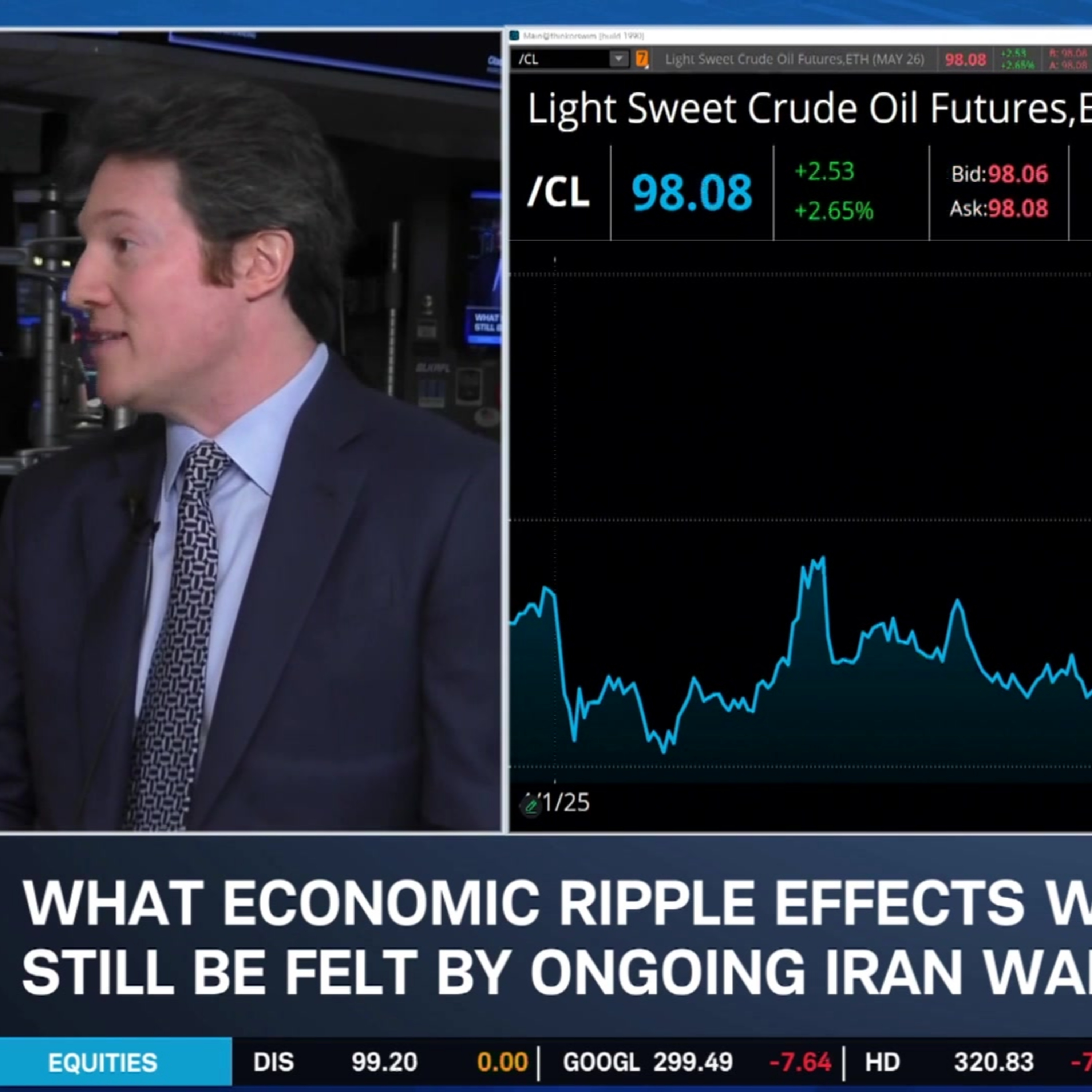
Jordan Rizzuto thinks the inflationary impacts of the Iran war are only just being priced in globally because markets thought it would be over quickly. The modern world has “never seen” an energy disruption of this magnitude, he notes. He’s not sure the market is going through a “true rotation” because gold hasn’t bid, instead traders are sitting on the sidelines, potentially creating liquidity issues. Also ahead are likely higher food prices, military spending creating more inflation, and other issues.
======== Schwab Network ========
Empowering every investor and trader, every market day.
Subscribe to the Market Minute newsletter - https://schwabnetwork.com/subscribe
Download the iOS app - https://apps.apple.com/us/app/schwab-network/id1460719185
Download the Amazon Fire Tv App - https://www.amazon.com/TD-Ameritrade-Network/dp/B07KRD76C7
Watch on Sling - https://watch.sling.com/1/asset/191928615bd8d47686f94682aefaa007/watch
Watch on Vizio - https://www.vizio.com/en/watchfreeplus-explore
Watch on DistroTV - https://www.distro.tv/live/schwab-network/
Follow us on X – https://twitter.com/schwabnetwork
Follow us on Facebook – https://www.facebook.com/schwabnetwork
Follow us on LinkedIn - https://www.linkedin.com/company/schwab-network/
About Schwab Network - https://schwabnetwork.com/about
Interactive timestamps
Jump to segmentGet every episode summarized
Each time Schwab Network publishes, we email you a written briefing from the transcript — the topics, who appeared, and any specific claims, with the ad reads skipped.
Email me new episodesFree for 3 shows. No card needed.
Hosts & guests
Transcript ready
62 searchable segments. Every word is indexed and playable.
Full transcript
Schwab Network — The Multiple Factors Driving U.S. Inflation Higher. Machine-transcribed; use the interactive transcript above to jump the player to any line.
0:00Welcome back to Market on Clothes, I'm SoundVartus on the floor of the New York Stock Exchange. Time to welcome in our next guest here, Jordan Rizuto, who's the founder managing partner and CIO at Gamma Road. Capital partners. Jordan, thanks so much for joining us today. Obviously, a very fluid situation. We are seeing quite a bit of movement in these markets off the back of some of these headlines. Obviously, a ranked declaring force measure according to Reuters. You believe the inflationary implications here are only beginning to be priced in to global market. It's just walk us through that. Why has it taken so long? Sure. Well, I think there's, you know, it's really a time component, right? So it seems that the market consensus really, at least the first several weeks into this conflict was this is going to resolve in the near term. Maybe in a matter of weeks, or at most slightly more than a month. I think as we continue to learn more about the reality on the ground from the regional reporting of what we're seeing particularly in terms of the energy shock, which let's face it, modern civilization has never seen an energy supply disruption, excuse me, of this magnitude.
1:06I think this week, in particular, the tone of the selling, the cross-asset relationships are picking up on the fact that this may persist for quite a bit longer. The underlying drivers for it to persist longer do not seem to be turning or abating anytime soon. I mean, that's quite a statement as far as, you know, modern civilization having never seen an energy disruption of this magnitude. I mean, so do you believe it's underpriced right now and what happens next? I mean, you know, when you're talking about continued blows to energy infrastructure and the thinking that this might not be back up and running, repaired for not months, years. It's really difficult to handicap the time period. I think that's why we're seeing a gradually increasing sensitivity to the situation. Right? So if we look at the underlying drivers, I mean, first, the question is it priced in. With respect to energy markets, you can see just even by the hour-to-hour volatility in both crude markets, in gas markets,
2:08and as well in fertilizer and grain-related markets, which are heavily impacted by the straights closure as well, we're witnessing the price discovery in real time. But in terms of the drivers that could make it persist for quite a bit longer, you know, we've seen the maritime insurance and re-insurance plug completely be pulled. Right? So there's no insurance coverage right now. We see that in response to the military conflict, the Iranian military force, the IRGC, enacted their mosaic doctrine, which essentially dictated, and this is a strategic plan that's in place for decades, to split military force from one autonomous unit into 31 autonomous units. That makes it incredibly difficult to deal with, you know, on a military level, on a geopolitical level, to the degree that there could be any diplomacy going on. And the key word there is that these groups, these 31 groups now, by virtue of the doctrine, have autonomy in terms of military strike capability.
3:13You know, we see, we know that de-escalation, regardless, is a prerequisite. We see no evidence of de-escalation, de-escalation. Just look at what you've been reporting on on force measure in Iraq just in the last hour. So we don't see that, and then finally, once we do see a resolution to the military conflict, turning energy supply back on, especially with all the production shut-ins, with the damage that has been done, the damage still to be done as this goes on, it's not like turning on your kitchen faucet. It's a matter of weeks, the process to then reassess the insurance coverage, to rewrite it, to recapitalize and re-enter that market for the insurers. It's likely measured in months, not in weeks. And so that doesn't mean we can't see tremendous price wings around it, but I think the inflationary impact from that is now starting to be felt. You're seeing that in equity markets, you're seeing it at the long end of the Treasury curve. It's interesting how the dollar is responding, while everything else is selling off as well, that tells us that this is, at least at the moment, more about liquidation and broad portfolio de-risking, as opposed to safe haven rotation.
4:26If it were a true rotation, we would see gold getting a bid at some point that may be coming soon, but since this has started, since the beginning of the month, gold has sold off. U.S. Treasuries have sold off, the dollar is bid. That tells us proceeds are not rotating into safe haven assets. They are sitting outright in cash and money market equivalence. Right, so that's a liquidity issue right there. I mean, it seems like the conversation, or at least the debate, has been around the resilience versus the complacency of this market. I mean, some would call it resilient, and they put it down to the earnings profile. They put it down to, as you mentioned, the dollar, WTI, that's spread between Brent, but the U.S. is going to be in a different situation, or maybe a different story and better off in this situation. But you had the folks over at JPM, JP Morgan, cutting their S&P 500 price target. Now, they've used the word complacent. We perhaps starting to come around to the idea that that's where markets are. I mean, would you characterize markets as complacence? Or do you think there's enough resilience based on all those tailwinds that I mentioned, factors that would be able to be used or act as a buffer?
5:32You know, I think for those that are inclined to view it as resilience, it's understandable because after the litany of drivers that you just went through, you could argue that we should expect to see that risk-based asset prices be lower than they are. At the same time, I would certainly characterize the first several weeks as complacency, and I think what's slowly evolving is this appreciation of the time element that we just went through, and the fact that this could persist for quite a bit longer. I don't know, especially after the tone of the selling in the last couple of sessions this week has really picked up, and particularly in non-US equity markets. So, coming into this year, a big theme that we were following collectively was, are we seeing a bigger rotation now out of US dollar denominated assets into international assets, particularly in equity markets, seeing over a one-year basis European and Asian markets how performing US markets? Those markets are disproportionately sensitive to the energy supply shock. I think their markets are less complacent in the sense that they're having a more violent price reaction.
6:36Particularly today, you see in the futures across the board. Right, and these bond yields. If you take a look at the guilt market, I mean, I was looking at a breakdown of the tone coming from all the major central banks we heard from this week, although most of them held fire and sat on their hands, the BOE was seen as being the most hawkish of the bunch, just because of the narrative shift there. So, as I mentioned, look at the guilt market. I'm looking at 10 years right now. We are knocking on the door of 440. What are bond markets telling you? Because it seems like yields are driving the story today as well. I think that's primarily reflecting the increasing inflation expectations, and also the time element of that. It's compounded by the fact that war in general tends to be inflationary. You've got the physical supply concerns for very basic elements, even in the US, even if we are somewhat insulated from the price risk. The impact that the hold up on fertilizer shipment is going to have later this year on crop yields, if this persists, is very meaningful. That will show up in grain prices, that will flow through ultimately to the supermarket.
7:43I think the bond price is picking up on all of that, so you're seeing yields rise higher. I think the anticipation is that the longer this goes, you'll see even further military spending, which will be inflationary in nature. This comes at a time when we are not exactly looking at a healthy deficit picture. We start to touch on all of those things that never seem to matter until they're extremely important right now. It feels like the market doesn't really agree with what we heard from the Fed this week either, with respect to at least one cut in the system given, of course, the performance we've seen in Treasuries this week. Jordan, we have to wrap it up there, a really busy show, but thanks so much for dropping by and just giving us your sense of how things are unfolding right now. That is Jordan Resuta, who is from Gamma Road, Capital Partners.
More episodes
More from Schwab Network

JNJ Balances Growth, Patent Transitions, and Legal Overhangs
Schwab Network

nCino (NCNO) CEO on Earnings, AI in Banking & Overcoming "SaaS-pocalypse"
Schwab Network

The Big 3: NET, TWLO, ASTS
Schwab Network

Tie Lasater on Inflation Floors, Energy Risk, and Private Credit Stress
Schwab Network