About this episode
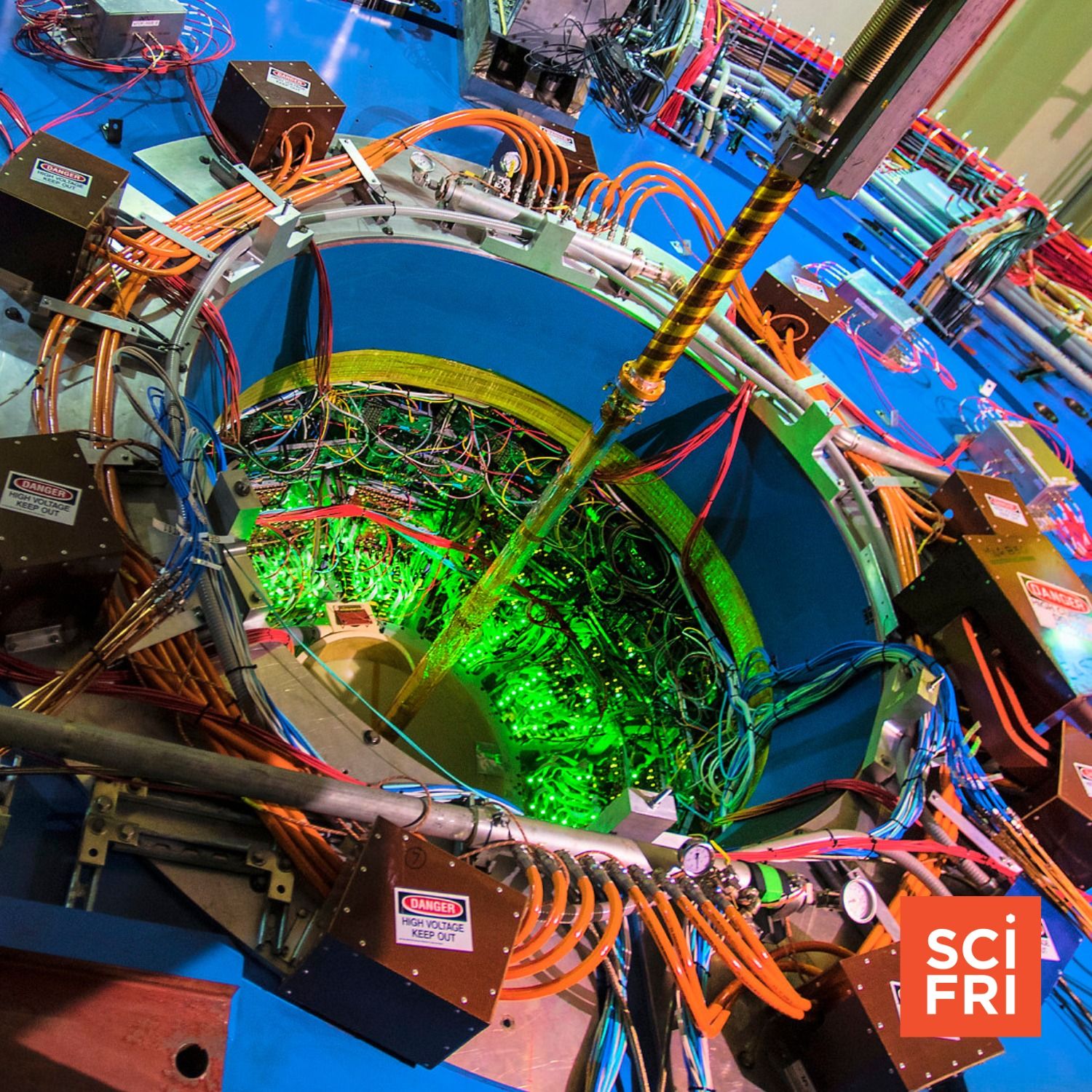
The Relativistic Heavy Ion Collider (RHIC), the largest particle collider in the United States, collided its last particles in early February. RHIC is a massive accelerator ring and set of instruments based at New York’s Brookhaven National Laboratory, and was designed to accelerate gold ions to near-light speed before collision. It was the second most powerful accelerator on the planet, second only to CERN’s Large Hadron Collider. Since RHIC began running in 2000, scientists have used it to study the tiniest subatomic particles, which give insight into some of the universe’s biggest questions.
Brookhaven nuclear physicist Gene Van Buren joins Host Flora Lichtman to look back on the history of RHIC, what physicists have learned from the collider, and what lies ahead for particle physics.
Guest: Dr. Gene Van Buren is a nuclear physicist at Brookhaven National Laboratory in Upton, New York.
Transcripts for each episode are available within 1-3 days at sciencefriday.com.
Subscribe to this podcast. Follow our show on Instagram, TikTok, Facebook, and Bluesky @scifri and sign up for our newsletters. Got a science question that’s keeping you up at night? Call us: 877-472-4374
Hosted by Simplecast, an AdsWizz company. See pcm.adswizz.com for information about our collection and use of personal data for advertising.
Get every episode summarized
Each time Science Friday publishes, we email you a written briefing from the transcript — the topics, who appeared, and any specific claims, with the ad reads skipped.
Email me new episodesFree for 3 shows. No card needed.
Hosts & guests

No transcript yet
This episode has not been transcribed. Request it and it moves to the front of the queue.
More episodes
More from Science Friday

For Jennifer Chayes, math is a 'native tongue'
Science Friday

What an mRNA melanoma vaccine may mean for cancer treatment
Science Friday

Why it's so hard to tell the age of a fungus
Science Friday

The power of the stories we tell about the ocean
Science Friday