About this episode
Rev. Tessie Mandeville, Carrie Koehnline and Judith Kaftan, Guest Speakers
Su Livingston, Guest Musician
Nancy Philip, Worship Associate
Our speakers will share a recently rediscovered story, "Grandmother Waits." They'll reflect, as the elders they are now, on its messages of autonomy, depth, creativity, and what it takes to be a healthy, diverse community. Led by Carrie and Judith, who co-wrote the story more than 30 years ago, and woven together with poetry and songs by Tessie, this promises to be an engaging and wonderful service.
Rev. Tessie Mandeville is an affiliated minister at Bellingham Unitarian Fellowship (BUF), a hospital chaplain (ret.), and an Interfaith spiritual director, who lives in Bellingham with her wife, Lisa.
Carrie Koehnline is a journal therapist, artist, writer, and frequent worship leader at BUF who lives in Bellingham with her wife, Dominique.
Judith Kaftan is a longtime psychotherapist, artist, and writer who has recently retired. She lives in Seattle along with her wife, Marra.
Su Livingston is a former educator, worship celebrant at BUF, and a lifelong musician who lives in Bellingham with her husband, John.
Get every episode summarized
Each time Sunday Mornings at Cedars publishes, we email you a written briefing from the transcript — the topics, who appeared, and any specific claims, with the ad reads skipped.
Email me new episodesFree for 3 shows. No card needed.
Hosts & guests
Transcript ready
564 searchable segments. Every word is indexed and playable.
Full transcript
Sunday Mornings at Cedars — The Language of the Roots. Machine-transcribed; use the interactive transcript above to jump the player to any line.
nous Our journey on the original game right now Aquaman This year we need to go into the sample future Good Morning My name is Rod Kämpkas I'm the Member of the board of trustees here with City Sound就 Editorial University Church a We welcome to our service this morning We're glad you're with us Before we get started We have a few announcements They're all Bostelio printit on the back of your order of service today after the service is another in our continuing series of exploring major religions of the world that's presented by Alan Miller and David Thomas. So join us on the stage after the service. And today's topic is Islam. On Thursday there's a meeting of the social action committee on zoom at five o'clock.
And we are doing a ride matching survey right now. So if you get the beacon you can find a survey in there and you can there's only two questions. One would you like to offer a ride to someone or if you need a ride and we'll try to get the answers those questions and then we'll try to match up folks to get rides to our Sunday services. And if you don't have the beacon you can talk to Susan Schaeffer and she can help with that. And then the last one I have is the social action committee is organized a private tour of the Suquamish Museum on April 26th starts at 12.30 and there's a could be the sign up board will be on the table back in the back after the service. So take a minute or two now and say hello to the folks sitting around you. So we hope you'll continue these conversations after the service during our coffee hour.
So this morning you get four for the price of one. We have four speakers today. Reverend Tessie Mandaville is an affiliated minister at Bellingham Unitarian Fellowship. Buff, a hospital chaplain retired and interfaith spiritual director who lives in Bellingham with her wife Lisa. If Carrie Conline is a journal therapist artist writer and frequent worship leader at Buff who lives in Bellingham with her wife Dominique. And Judith Captain is a newly retired longtime psychotherapist and artist and a writer she lives in Seattle along with her wife Mara. And Sue Livingston is a former educator worship celebrant at Buff and a lifelong musician who lives in Bellingham with her husband John. So welcome to all of you.
Well, good morning everyone. I'm Reverend Tessie and yeah, four for the price of one. So I hope you brought lunch. We're going to be here for a little while. He said four speakers. So okay. Well, it is a pleasure and a privilege to be here with you today. And with here with my friends, we've got Sue. We have Carrie. Carrie, what do you raise your hand? And then Judith. And you know, and it's not nice to make people pronounce last names of people that they don't know. So this is this is Carrie Conline. This is Judith Cofton. And I know it can be when you see it in writing. You don't always know, but I just thought I'd clear that up for you. But Roger did great. Thank you so much. And I want to begin in gratitude to your minister, Reverend Margo. She was originally scheduled to preach this morning, but she changed her schedule to accommodate the four of us.
And so that was very gracious of her. So I want to say thank you. I want to bring you greetings from your former co-ministers, the Reverend Dr. Barbara Wells, Tinhove, and the Reverend Jaco Tinhove, who I'm sure you know, have retired up in Bellingham. And so we get to sing and play and worship together. In fact, Sue Livingston and Barbara Tinhove created and led the worship service together just last Sunday at Buff. And what's that? Not really retired. Yeah, not really retired. It depends on your definition of retirement. And I've found that people that are in retirement have a very broad definition of that. And I also want to say thank you to Naomi. You know, we know her from Buff and she was our original connection to you all here. So this is the first time that all of us have come here. So it's been very exciting. We started our adventure yesterday by coming down to Seattle and staying with our friend Judith.
And then we got in the car this morning and caught the 755 ferry. So that was exciting. So we've already had quite the morning before we even got here. And there are stories we could tell you, but you probably don't want to stay here all day. So we'll save those for another time. But we are glad to be here and we appreciate your welcome. So as we continue, let's want to take some opportunity to kind of draw us all in and ground us into our time together. You know, in our Unitarian Universalist's faith, we draw our wisdom from many sources. And one of those sources is the natural world. And we are fortunate to be surrounded by such natural beauty out here in the Pacific Northwest. And some of the most sacred experiences I've ever had have been in forests with the color green.
And with the magnificent mother and grandmother trees whose root systems stretch out before me, entangled, interconnected, nourishing ways that sustain generations of their descendants. Henry David Thoreau, speaking of descendants, I like to think of us as spiritual descendants of Henry David Thoreau, the Unitarian and Transcendentalist forefather. He believed that divinity could be found more in nature rather than in Scripture. And he asked this, he said, shall I not have intelligence with the earth? Am I not partly leaves and vegetable mold myself? And with this question, he invites us into an embodied experience. He takes us from seeing ourselves as separate from nature.
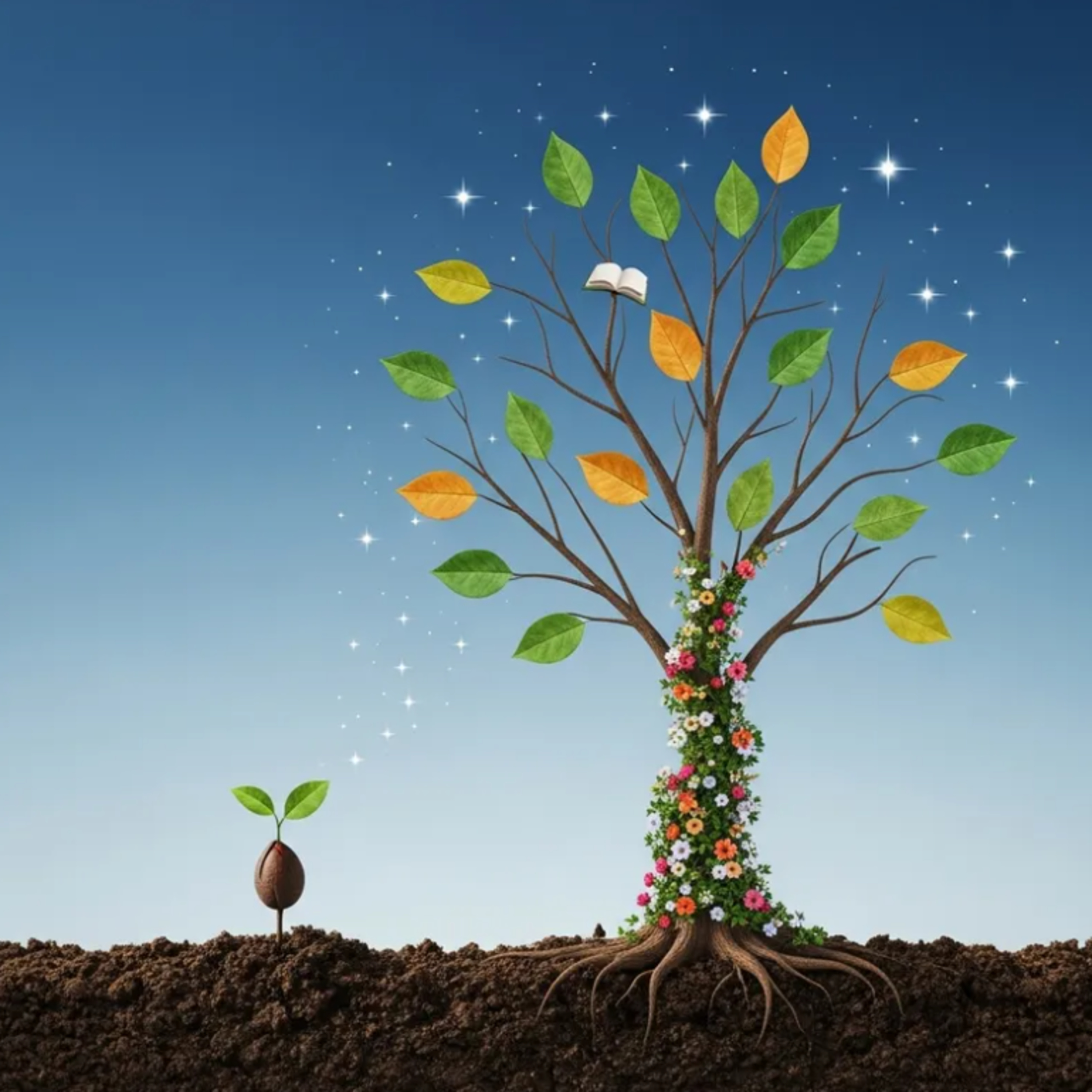
As anyone who thinks we ought to have dominion over it, to understanding ourselves as part of nature, even as compost. And now is always the best time to remember that we are part of the earth. The tree teaches us many things, and one of them is that if we are going to survive, we have to connect at the roots for that is where our nourishment comes from. And we need one another for that nourishment, for joy, resistance, survival, community, and sanctuary. And Carrie and Judith wrote a story about the grandmother tree. So this is a store that's going to take place in the natural world.
And there's this forest of trees that are intertwined with their roots. And so we titled this service, the language of the roots. And as we travel together this morning, and as Sue sings and plays the song, sanctuary, we invite you to be aware of your own root systems. In fact, on the boat this morning, they had, was advertisement, but it was lovely. And they asked the question, where are you rooted? How awesome was that? It's like they knew we were coming. But these questions, with what and with whom are your roots intertwined? And we invite you to think about the root system of cedars, you, you, and all of its life-giving connections.
And as we travel together this morning we invite you to think about the root system of cedars, you and all of its life-giving connection, one for every thing you know. And we invite you to think about this. Will you keep the embers warm when my fires are begun? Will you remember and bring me sprigs of rosemary? Be my sanctuary till I can carry on This one knocked me to the ground
This one dropped me to my knees I should have seen it coming, but it blindsided me Will you be my refuge? My heaven in the storm Will you keep the embers warm Till my fires are begun In a state of true believers On the streets of us and them It's gonna take them change Till the world feels safe again
Till the world feels safe again Till the world feels safe again Will you be my refuge? My heaven in the storm Will you keep the embers warm when my fires are begun? Will you remember and bring me sprigs of rosemary? Be my sanctuary till I can carry on
Be my sanctuary till I can carry on Thank you For our chalice lighting this morning I'm gonna share a pantome that I wrote A pantome is a style of poetry that originated in 14th century Malaysia Pantumes were short folk poems that were often sung They have a repeating pattern in them that I especially love Because every time that sentence repeats, that line repeats
It's a chance to engage with it a little differently This pantome is called psalm Last summer I met a young man at Costco named psalm as in sacred song His mother named him after a book in the Bible that is full of songs I told him how much I loved his name And he said he'd be sure to tell his mother of my delight Song as in sacred song The very first song in the book of psalms is about a tree I told him how much I loved his name and he said he'd be sure to tell his mother of my delight
I could not help but wonder if his mother's prayer was that her child would be like a tree The very first song in the book of psalms is about a tree A tree planted by the water with roots so deep that when a storm comes it is not moved I could not help but wonder if his mother's prayer was that her child would be like a tree Brooded, strong Drawing on the ancient wellspring of songs as he struggles to live bravely on this earth A tree planted by the water with roots so deep that when a storm comes it is not moved
His mother named him after a book in the Bible that is full of songs Rooted, strong Drawing on an ancient wellspring of songs as he struggles to live bravely on this earth Last summer I met a young man at Costco named Psalm As Nancy comes and lights our chalice for us this morning We dedicate it to everyone everywhere who is struggling to live bravely on this earth May we be rooted, may we be strong
Today the affirmation of the chalice lighting is not printed in your order of service So I am going to repeat after me as a colony strikes As we come together to worship We remind ourselves to treat all people kindly We remind ourselves to treat all people kindly Because we are one family To take good care of the earth Because it is our home Because it is our home And to live lives full of love and goodness So that we can all become the best that we can be So that we can all become the best that we can be
And now if you would please rise in body and in spirit as you are able and willing Let's sing together him number one two three spirit of life Roots close Wings set us free Yes, let's sing it through two times through We remind ourselves to treat all people kindly We remind ourselves to treat all people kindly Roots close
Wings set us free Yes, let's sing it through two times through We remind ourselves to treat all people kindly Because we are one family To take good care of the earth Because it is our home Because it is our home Because it is our home Because it is our home And to live lives full of love and goodness We remind ourselves to treat all people kindly Roots close And to live lives full of love We say to live lives full of love and goodness N'n'n'n'n'n'n'n'n'n'n'n'n'n'n'n'n'n'n'n'n'n'n'n'n'n'n'n'n'n'n'n'n'n'n'n'n'n'n'n'n'n'n'n'n'n'n'n'n'n'n'n'n'n'n'n'n'n'n'n'n'n'n'n'n'n'n'n'n'n'n'n'n'n'n'n'n'n'n'n'n'n'n'n'n'n'n'n'n'n'n'n'n'n'n'n'n'n'n'n'n'n'n'n'n'n'n'n'n'n'n'n
�� i mi petun Raun Ray Ray Rя Ray Ray Ray Ray Ray Ray Please be seated. And Carrie and Judith and I are going to sing a song for you. This is the time where we have time for all ages, moments, and so it looks to me like we have a variety of ages here this morning. And so we're going to sing a song that was originally written by Betsy Rose and it's
called Standing Like a Tree. And so if you want to stand back up, you can, but it's also okay to sit because one of the things that trees teaches is adaptation. And so everything can be adapted. All right, you ready? Ready? Okay, so we'll be on either side of these. Sure. You get it. There we go. Because it's got motions. We'll play a beat for you. Standing Like a Tree with our roots up down, our branches wide and open, come down the way, come down the sun, come down the fruits to my heart that is open to be standing like a tree with our roots down, my branches wide and open, come down the way, come down
the sun, come down the fruits to my heart that is open to be standing like a tree with our roots down, my branches wide and open, come down the rain, come down the sun, come down the fruits to my heart that is open to be standing like a tree. We were just discussing, there's a new
song that we're going to sing, and we thought we'd be singing it with you, but it appears that the words are not in your order of service. So we're going to be singing it for you, and we're happy to do that. And it's going to be a song that if you grew up in a Protestant church at all, it's going to be very, the tune in the title are going to be very familiar to you. Be holy, holy, but this has been rewritten by Peter Mayer, and he is a songwriter out of Stillwater, Minnesota, been writing songs for 30 years, you may have sung other songs of his, blu, yes, blu, blu, blu at home, well, then we have sung other songs of his, that's right. But he has taken this song, holy, holy, holy, that I feel has had this triumphant spirit to it, the way I grew up singing it in my Southern Baptist church, and has really become
a centering song, a contemplative spirit, to the way that he sings it now, and the lyrics have changed to the natural world, and at least most of them, yeah, and it's just lovely. So we're going to have this moment, again, where we're just, we're drawing ourselves in into our bodies, I know, we know, there is a lot happening around us, there's a lot we could talk about, there's a lot of information coming, and it's important to be aware of that, and it's important to keep finding our places of rootedness, and our places of sanctuary,
to keep getting the nourishment that we need, so that we can keep going back out here, doing the work that we're called to do, so it is, it's a coming in, so that we can go out and are coming in, breathing, and so that we can go out, and so that's, to me, that's what this centering moment is about, and so we bring these new lyrics to you, this contemplative spirit, as we're seeing, holy, holy, holy. Holy, when the wronged me, holy sky above and holy, ground beneath my feet,
over and below me, all the earth enfolds me, sheltered, holds me, holy land and sea. Holy, holy, holy, holy, holy life inside me, long ago be God telling, when evil ocean steaming, long and greenly breathing, heart and bright wing meeting,
knowing, singing, holy life inside me. Holy, holy, holy, holy, holy ancient story, from so small a seed is born, a trillion galaxies, and from one proceeds us, children of the stardust,
and sparks rising up from holy fire are ye, holy, holy, holy, source of endless beauty, lifting up our grateful hearts, we sing a song to thee, forever is that tree in us, grow the love between us, teach us wisdom, holy history.
Teach us wisdom, holy mystery. That was a beautiful intro to our hymn of the month. It's my understanding that as the hymn of the month will be singing this on subsequent Sundays, and there's no number, so we'll either, it's either a hymn in one of the hymnoles, and has a number that we can read, or the lyrics will be printed in the Order of Service.
I'm not sad that we didn't get a chance to sing it because that was such a beautiful rendition. As the trees in a shared forest, we are rooted in love, reaching toward light, and growing stronger through our interconnection. As we gather our offering today, may we give as trees give, steadfastly, generously, and interest that what we share will shelter, nourish, and sustain this beloved community. For gifts, be seeds, planted for justice, compassion, and hope. As yours, please come forward for the offering.
As we gather our offering today, may we give as trees, planted for justice, compassion, and hope. As we gather our offering today, may we give as trees, planted for justice. As we gather our offering today, may we give as trees, planted for justice, compassion, and hope. As we gather our offering today, may we give as trees, planted for justice, compassion, and hope. Thank you very much.
Well, good morning, everyone. I'm Carrie, and as you heard, we've been having a lovely time with our friends, and we're really honored and excited to be here. I haven't been to Bainbridge Island in a very long time, so I did write a song about the Winslow Fairy. I'm here this morning with my dear old friend, Judith Kauffman, from Seattle, and Jyd and I are both 68 years old now. We met in Seattle in 1987 when we were both about 30, and I was doing my internship for my master's degree in psychology at a used service bureau in Seattle, where Jyd had just been hired as a brand new therapist. So these two brand new therapists were given the task of leading eight-week groups for eight to 12-year-old boys who've been sexually abused.
And it was a little daunting, so we tried a lot of things, but what we eventually found our way to was writing a kind of an eight-chapter hero's journey story to hold and guide the group, which we eventually called the Silver Swords of Cavalve. And it was very exciting to experience writing a story together, and also to see how that kind of storytelling actually did help that group of boys travel safely through very vulnerable territory. And that bonding experience got us engaging in other creative collaborations together and forming Lucky Us, a lifelong friendship. At one point, we became a little storytelling team, and it was during that time that we wrote a story called Grandmother Wates, which is the story that we're going to be sharing with you today.
We were about 32 years old on the early end of our adult lives, new to our careers as psychotherapists and questioning everything, including our sexual orientations and who we got to be in the world. So a little over a year ago, Jude was retiring from her long career as a therapist, and I decided to travel down for her retirement party from Bellingham. And before I left, I found our story again, and I brought it to her, so after the party, we sat there and we read it together. We were kind of amazed to discover that, first of all, we still really liked it, and that also it carried so many things that had turned out to be important to us in our lives. And we realized that while we had written the silver swords of Cavalais for the boys, this was a story we had written for ourselves.
It was almost like our elder selves were speaking to us through the story, saying, as you go through guys, pay attention to these things. And now, looking through the eyes of our elder selves, we did do a little editing. Originally the title was Grandfather Wates, and the wise elder was an old grandfather tree. The female elders, we are now, we both immediately felt the need to shift the title to Grandmother Wates. Also in the first story, the tree that strove so desperately to be the first tree chosen by the humans was a disgruntled old lady. We turned her into a young one, instead, who always felt she knew best, and we decided to model her on a modern day social media influencer, which of course didn't exist back 30 years ago.
So we're about to share the story, and even though it's a bit of a performance, we ask that when we finish the story, you don't applaud, that you just hold silence with us. And then we'll sit down, and Sue will play a musical reflection, and then we'll come back and share a few reflections after the story. So can anybody see well enough? See anybody want to shift places? Okay, so we're going to get rid of our books here, and our glasses. Haha! Grandmother waits. Once upon a time there was a forest of very twisty trees.
Each one grew different from the next. Their roots spread far and dug deep into the rich soil. And every season added new twists to their trunks and branches. Life is certainly never dull around here. They said fondly to one another as they bent and curved in the wind and the rain. But one day some seeds blew in from a distant tree farm, and they started to grow in the forest a very new kind of tree. These trees weren't twisty at all. They grew exactly alike tall and clean and straight, and their roots stayed neat and shallow. A few years later, human beings came to the forest and were surprised to find such uniformly perfect trees growing among the twisty ones. Aren't these beauties?
Now these would be perfect for a house. Then they left without paying any attention at all to the twisty trees. One of them, a young tree who always felt she knew best, began to lament. No wonder we twisty trees, we just grow so slowly and so twistily, the human beings are never going to choose us. And we're going to have to spend the rest of our lives in this crappy forest, getting burnt by the sun and soaked by the rain. Frankly, getting uglier and uglier every year. But it won't be long before those perfect trees get chosen to live in a house. Now I don't pretend to know exactly what a house is, but I guarantee you it's a forest far more awesome than this one, without snow or rain or winds.
The other twisty trees pretended not to care, but secretly, most of them began wishing they could be a little more perfect. They didn't like being overlooked by the human beings, and they also realized they were getting kind of tired of the harsh and quickly changing weather, season after season. So it wasn't long before stories began popping up all over the forest, stories of a beautiful, trouble-free forest called House, where only the most perfect trees gained entry. And so they began to train themselves and their children to abandon their twisty ways, to fight the temptation to curve and bend, and always to grow up, up, up, without looking back. But there were a few old trees, however, who were not shaken by that sweeping critique that they had all heard.
I've been a twisty, narrow tree all my life, and I'm certainly not going to change that now. Come or storm this forest is my home. I roots are settled. Fearing the old tree, called grandmother, would set a bad example, along with her old-fashioned cronies, the other twisty trees decided to stop all contact with them. They pulled their roots away. This is hard enough work on ourselves and our children without having to listen to their old-fashioned ideas. Feasons came and went, but they tried not to notice. If we just keep concentrating on growing up, up, up, and not looking back, the seasons cannot twist us as they used to. We are so much more evolved now, but at night sometimes they would dream of twisting with the wind and wake up, feeling ashamed.
With discipline and concentration, some of those twisty trees actually began to be less twisty, but the human beings still ignored them. Whenever they came to the forest, they went straight to the tallest of the new trees, and then they pulled them up right by their shallow roots and took them away without even a glance of the other trees. The ambitious young tree was so frustrated and confused. She couldn't understand that she had worked so hard to improve herself and help everyone else improve so they could have a better situation. Why wasn't it working? But one day she had a revelation. No wonder the human beings are not choosing us. They would never be able to pull us up neatly by the roots, like they do with the perfect trees, and that's because we dig our roots so deep in that nasty smelly dirt.
And we spread them out in the weirdest way. It's disgusting. It's embarrassing. For the first time in their lives, many of the trees started to feel ashamed of living in the dirt and embarrassed about their roots. So they started working to pull their roots up close to their trunks, trying to make them as shallow as possible. As it turned out, the hard-working young tree was really good at making her roots shallow and at making herself tall and clean and perfect when she put her mind to it. By sheer willpower, she managed to unbend nearly every bend she had ever made. Don't give up. If we just keep concentrating on growing up, up, up, and we keep our roots nice and shallow, the human beings, they will begin to choose us for their nice warm house.
There we will live perfectly safe, no more depressing seasons ever again. Well, she was the very first of the formerly twisty trees to be chosen. Her relatives beamed with pride as they watched her being pulled up neatly by the roots which she'd successfully made so shallow she has really made something of herself. With a new burst of hope and inspiration, they worked even harder to straighten themselves and tighten their roots and with joy they watched even more of their kind being chosen. Each time that happened, competition increased throughout the forest to be the tallest, the straightest, the most perfect and the most shallow. The seasons came and went, something else started happening. First everyone was far too busy to notice, but the time came when everywhere they looked, leaves were yellowing, branches were withering and trunks were rotting.
Yet it wasn't until a young tree died, his hollow trunk and shallow roots blown over in a mild windstorm. That one of the twisty trees made a courageous decision. I've got to go and talk to old grandmother. And though it was really painful after so many years of shallowness, she pushed her roots down, down, down into the dark soil and spread them slowly until at last she touched the roots of the old grandmother tree. Why, oh my dear, how good to have you come to me. It's been years. Hope it's you must be so tired your roots are not used to it. I did not know if I would make it. I have grown so weak over the years.
I don't even know where to begin except to say I'm feeling desperate. We are in big trouble. These are dark times for the whole forest. And I know it's crazy, but I was wondering if you would consider coming to talk to us. I just thought maybe you could make a difference. Maybe the others would listen to you. After they'd talked for a while and made a plan, she thanked the old grandmother tree and said goodbye. And then she allowed her strained roots to begin to pull back. With her leaves and branches, she cautiously began sharing the news with the other trees. Some of them didn't think they needed any help. Some were too tired to argue.
And some of them actually thanked her. On the night of the next full moon, the trees waited and whispered to each other. She said she was going to talk to us how? Through our roots if you can believe that. What do you think is going to happen? I have no idea. And then they grew silent. For suddenly there was a sensation of warmth underground and a feeling in their roots. Many had never felt before almost as if the earth itself were talking. Old grandmother had arrived. Perhaps you've never heard of the days when this forest grew twistily without shame. Time was when no tree looked like any other. We each grew in the way that suited us best, bending and curving when it felt right.
We spoke the same language you do now with your leaves and your branches, but you also spoke a deeper language. The one you can feel me using now. The language of the roots. It was in that language that the most important things were said. Deep beneath the soil, the roots of every tree in this forest were intertwined. The trees were confused. For some old memories were stirred. And for others, this language was completely new. I remember how scared I was to reach my own roots downward. Down there it was frightening, but exciting. It was ugly. And it was beautiful. It was there that I learned my deepest lessons.
And as I became more full and sturdy, the little creatures of the forest found warm places in my trunk and my branches. I can't say I know what it feels like to live in a house, but I know what it feels like to be a home. The trees shifted uneasily. Old Grammothers seemed to be inviting them to dig their roots deep and to make themselves at home in the forest, to even invite the creatures of the forest to use them for a home. But they'd all been convinced that having birds and squirrels in their trunks and branches was nothing but a noisy nuisance. And everyone knew that underground it was cold and dark. And there were fat, oozy earthworms. Maybe old Grammothers was just a crazy old twisty tree after all. Many did not want to listen to her.
There are just a few of us now who still speak the language of the roots. And we've been tending and protecting those roots all these years. Now I can't pretend to know what you should do. But I can tell you this. That in my own life I've stood strong through many windstorms that would surely have blown me down, if I'd stood alone with shallow roots. I've known no deeper joy than to touch the roots of the other trees. I can't imagine my life without that joy. But now you have a decision to make. If you choose to reach your own roots downward, we will help you. That I can promise. But I cannot force you. You must choose. At that moment a strong wind blew through the forest and shook all of the trees.
And then the night air was silent. As if waiting for their answer. I've been waiting for the answer. I've been waiting for the answer. I've been waiting for the answer. And then the night air was silent. I've known no deeper joy than to touch the roots of the other trees.
I've known no deeper joy than to touch the roots of the other trees. I've known no deeper joy than to touch the roots of the other trees. I've known no deeper joy than to touch the roots of the other trees. I've known no deeper joy than to touch the roots of the other trees. I've known no deeper joy than to touch the roots of the other trees.
¶¶ We have to admit that writing the story did not save either of us from the challenges of being human. A student I reflected on how our lives had unfolded since writing the story. It was clear that we both sometimes got off course, struggled with self-doubt, gave our power away. Life is full of seductions and distractions and things that promise to be the right way of doing things. But something called this back, some deeper sense of knowing that emerged and made itself evident in that story all those years ago.
So much of what our story expressed has remained important to us throughout our lives. So when I think about how the wise old twisty tree may have been speaking to me in my life, I realize that she's been telling me that my path in this life is unique to me, that I have to bend and curve in all the ways that are true and right for me, and that no matter what anybody else says or does. I had a huge experience of this right about the time we wrote the story. I had found out, not that long before, that my grandfather's original Jewish name was a Russian name that was totally different from the last name I grown up with. And I loved the new yet old name, Koptan, which had such a different shape and melody than the more generic Jewish name Greenberg I'd grown up with. In addition, I liked the sound of my full name, Judith, more than the Judy that I had been.
A cousin of mine joked at the time, she called me up one day, and she captured the spirit of it all. She said, hello, is this Judith, Judy Greenberg, Koptan? And I said, yes, it is me. And that's the core message of the story for me, to give myself permission to step into my sovereignty, to claim the name that felt like mine, to reclaim those roots, the family roots, and to let go of what didn't quite fit. I learned to pay attention to what lit me up on the inside, no matter how it appeared on the outside. I could admire what others were doing and learned that admiration was actually different from what might be right and true for me. And I learned that often my path in life is found just by feeling my way along inch by inch in the dark,
and that that's how I tapped into the language of the roots for myself, that the greatest gift I could give myself was one of deep alignment of being a home for myself, not arguing with my actual experience, but noticing it. And as long as I keep listening and responding, I started to understand that I would keep bending and twisting into just the twisty tree that I am. So since rediscovering grandmother weights, I've been reflecting on the various choices I've made in my life. And choices that indicate I was influenced by the messages in the story. And I think about the fact that I gave myself permission not to marry until I really wanted to, not to have children, to have relationships with both men and women and then marry a woman.
I think about my meandering career trajectory as a therapist and cutter coach, where I was always trying to move towards what felt joyful and satisfying and away from what felt constricting and prescriptive. One thing that interested me was something that I learned from trees, that each new season is an opportunity to shed what is no longer bearing fruit, to make room for growth and possibility. I also practiced and taught different ways of tapping into the language of the roots, using journaling and other methods to find clarity and calm when life got frantic and noisy. Reflecting on the story and its messages, I'm struck by the decision I made to settle my roots in Bellingham, and in the Bellingham Unitarian Fellowship and the larger UU community. A place where I can be deeply rooted without having to be constricted by a rigid set of beliefs.
I can be myself and belong, and I can be part of building a rich and nourishing root system for all ages. And finally, as we tell the story now with our 68-year-old voices, we are listening for guidance for ourselves as elders, and doing our best to be like the elder twisty trees in the story, who knew how to make themselves at home and be a home for others, to be a supportive presence, extending invitations, practicing patience, listening, and trusting that with the right nourishment, we can all grow into who we're meant to be. Thank you. Thank you. Awesome. Awesome. Awesome. Thank you, Carrie and Judith and Sue.
And if you all would please rise in body or in spirit, let's sing together, number 1051 and the teal hymnol. We are our grandmother's prayers. We are many things, and this song is going to recount those for us. And for people who read music, you will notice that there are some repeats in this song, but we're only going to take one of them. So let me just tell you, at the very beginning, for each child that's born, this is everybody there with me, let me make sure 1051. Okay. For each child that's born, a morning star rises, and sings to the universe who we are, we're going to sing that two times. And then when we say, we are our grandmother's prayers, when we start there, we're just going to sing all the way through. Just keep turning the pages till we're done. Don't worry about the repeats.
We're not going to repeat anything else, okay? We're just going to keep it simple. It's a beautiful song. If you ever get the opportunity to hear Sweet Honey in the Rock, this is their song. And we're going to sing it in our UU ways, but we're going to pay homage to Sweet Honey in the Rock. All right, Sue. That's right. I can't forget your hand. Here we go. For each child that's born, a morning star rises, and sings to the universe who we are, for each child that's born, a morning star rises, and sings to the universe who we are, we are our grandmother's prayers,
and we are our grandfather's dreamings, we are the breath of our ancestors, we are the spirits of God. We are mothers of courage and fathers of time. We are daughters of dust and the sons of great visions, we're sisters of mercy and brothers of love. We are lovers of life and the builders of nations, we're singers of truth and keepers of faith. We are makers of peace and the wisdom of ages. We are our grandmother's prayers,
and we are our grandfather's dreamings. We are the breath of our ancestors, we are the spirit of God. For each child that's born, a morning star rises, and sings to the universe who we are, for each child that's born, a morning star rises, and sings to the universe who we are. Blessed be, we'll have our chalice extinguishing with myself and Nancy.
I've final thought by Ramdas. When you go out into the woods and you look at trees, you see all these different trees, and some of them are bent, you sort of understand that it didn't get enough light, and so it turned that way, and you don't get all emotional about it, you just allow it. The minute you get in your humans, you lose all that, and you are constantly saying, you are to this, I'm to this, or I'm to this. That judgment mind comes in, and so I practice turning people into trees, which means appreciating them just the way they are, and again, that was Ramdas.
We'll do it together. As I extinguish our chalice for us, I've got a call and a response, and I will ask you to repeat after me, we extinguish this flame, but not the light of truth. We extinguish this flame, but not the light of truth. The warmth of community, or the fire of commitment, the warmth of community, or the fire of commitment, these we carry in our hearts until we are together again. Amen. Amen. Amen. Amen.
Amen. Amen. Amen. Amen. Amen. Amen. Blessed be. Amen. Amen. Amen. Amen.
Amen. Amen. Amen. Amen. Amen. Amen. Amen. Amen. Amen. Amen. Amen. Amen.
Amen. Amen. Amen. Amen. Amen. Amen. Amen. Amen. Amen. Amen. Amen. Amen.
Amen. Amen. Amen. Amen. Amen.
More episodes
More from Sunday Mornings at Cedars

Finding Your True North: Celebrating the Graduation of Gavin Barnes - August 16,...
Sunday Mornings at Cedars

Depolarizing Ourselves The Braver Angels Way - August 9, 2026
Sunday Mornings at Cedars

Flourishing Together: We Belong to One Another - August 2, 2026
Sunday Mornings at Cedars

The Wisdom of the Higher-Self Offers New Perspectives - July 26, 2026
Sunday Mornings at Cedars