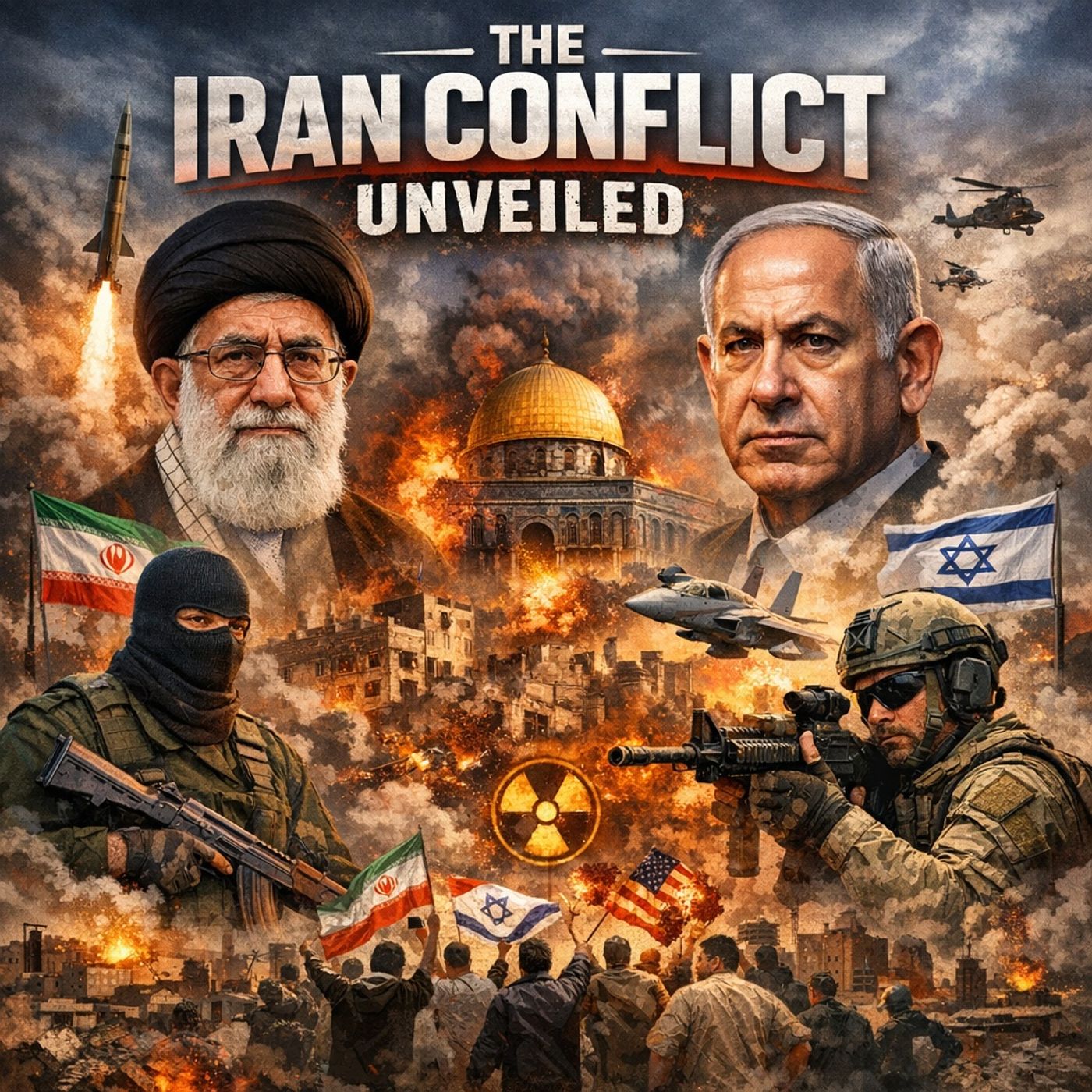
About this episode
Become a supporter of this podcast: https://www.spreaker.com/podcast/conspiracy-theories-exploring-the-unseen--5194379/support.
Get every episode summarized
Each time Conspiracy Theories Exploring The Unseen publishes, we email you a written briefing from the transcript — the topics, who appeared, and any specific claims, with the ad reads skipped.
Email me new episodesFree for 3 shows. No card needed.
Hosts & guests
Transcript ready
157 searchable segments. Every word is indexed and playable.
Full transcript
Conspiracy Theories Exploring The Unseen — The Iran Conflict Unveiled. Machine-transcribed; use the interactive transcript above to jump the player to any line.
Access to affordable credit helps me pay my employees, but I don't really need it. Infliction is killing me! Who cares? Big retailers and making record profits! That's why we support the Durban Marshall Credit Card Bill! See, things in credit unions help small businesses make payroll. This bill would cut the vital resources they need. While increasing Megastore profits, they deserve it. Don't they? No Congress, stop the Durban Marshall Money Grab for corporate megastores. Paid for it by the Electronic Payments Coalition. Finding great candidates to hire can be like, well, trying to find a needle in a haystack. Sure, you can post your job to some job board, but then all you can do is hope the right person comes along. Which is why you should try Zip Recruiter for free. At ziprecruiter.com slash zip. Zip Recruiter doesn't depend on candidates finding you. It finds them for you. People technology identifies people with the right experience and actively invites them to apply to your job.
You get qualified candidates fast. So, while other companies might deliver a lot of hay, Zip Recruiter finds you what you're looking for. The needle in the haystack. See why four out of five employers who post a job on Zip Recruiter get a quality candidate within the first day. Zip Recruiter, the smartest way to hire. And right now, you can try Zip Recruiter for free. That's right. Free. At ziprecruiter.com slash zip. That ziprecruiter.com slash zip. Ziprecruiter.com slash zip. Or oil and the world on edge. The Iran conflict explained. Oil over $100 a barrel. Tankers burning in the Persian Gulf. A new supreme leader in Tehran. And a US president saying the war is practically over. While his own defense secretary promises the most intense bombing campaign yet. Welcome to Fortune Factor. Today we're breaking down the Iran War. How we got here, what's actually happening on the ground, and what it means for the global economy, energy markets, and geopolitics for years to come.
This one is going to matter to every investor, every business owner, and frankly, every person on the planet. Let's get into it. Segment 1. How did we get here? Let's set the stage. On February 28th, 2026, the United States and Israel launched a coordinated military strike on Iran. This wasn't a skirmish. This was described as the largest US military build up in the Middle East since the 2003 invasion of Iraq. Right, and it didn't come entirely out of nowhere. In his state of the Union address just days before, President Trump accused Iran of reviving efforts to build nuclear weapons and advanced missile capabilities. He warned the US was prepared to act, and then they did. What's remarkable is how fast this escalated. Just days before the strikes, Iran's foreign minister was saying a historic agreement to avert conflict was, quote, within reach. Hawks were scheduled in Geneva, and then the bombs fell.
So what were the stated objectives? Trump outlined four when he announced the strikes. Destroy Iran's missiles, raise its missile industry, eliminate its ability to project power, and this is significant. He said the purpose was effectively regime change. That last point is crucial, and we're going to come back to it. Because regime change is not a military objective, you can declare complete in two weeks. Not even close, and that tension between Trump's optimistic public framing and the realities on the ground is really the central story here. What's actually happening right now? Let's talk about the current state of play as of this week, day 12 of active conflict. So Trump held a press conference on Monday at his derailleur club in Miami. His first formal press conference since the war began, and he said the US had wiped out Iran's naval forces, its Air Force, its anti-aircraft defenses. He said Iran has no leadership. He predicted the war would end, quote, very soon.
In the very next day, Defense Secretary Hedgeseth stood at a podium, and announced the US was launching its most intense day of strikes inside Iran yet, sending the most fighters and bombers of the entire war. Those two statements are hard to reconcile. They are, and it reflects something we've seen throughout this conflict. Trump projecting confidence and near victory publicly, while the operational reality tells a more complex story. When Axios asked him directly about the contradiction, he said both things could be true, which is a creative answer. Meanwhile, Iran is not acting like a defeated force. Hinkers are being attacked in the street of Hormuz, and in Iraqi territorial waters. Rones and rockets are being launched across the Gulf region. Iran's new supreme leader, Mojtabaq Khameini, who took over after his father was killed, has threatened that US bases will be attacked unless they close. And crucially, Iran has set formal conditions to end the war, recognition of its rights, war reparations, and guarantees against future aggression.
That is not the language of a government about to surrender. Seven US service members have been killed as of this week. Casualties on the Iranian side are in the thousands, and UNESCO has flagged serious damage to multiple world heritage sites, including Nox to Jahan Square and Golaston Palace, which is a whole separate dimension of this tragedy. The economic shock wave. Let's pivot to what our listeners are most closely watching. The economic fallout, because the ripple effects of this war are already being felt in markets around the world. Dark with oil. Crude rocketed above $100 per barrel last week, the highest price since Russia's invasion of Ukraine in 2022. The driver is obvious. The straight of Hormuz, the narrow choke point through which roughly 20% of the world's oil passes, has seen near total disruption. To put that in perspective, we're not talking about a temporary blip. We're talking about a supply shock at one of the most strategically critical maritime lanes on Earth.
Only a handful of commercial vessels are actually moving through the straight right now. And the downstream effects are staggering. Qatar's energy minister issued a stark warning that other Gulf producers may be forced to declare force measure, meaning they legally can't fulfill their contracts if the war continues. He said, and I want to be precise here, that this could bring down economies of the world. That's not hyperbole from a random commentator. That's a sitting energy minister from one of the world's largest LNG exporters. The Fertilizer Institute flagged something that gets less attention but is hugely consequential. Nearly half of global Urea and sulfur exports and about 20% of global LNG are disrupted right now. That's a direct threat to global food production. The UN World Food Program has already issued warnings about food price inflation. So we're looking at an energy shock layered on top of a food security shock. And those two things together create enormous pressure on developing economies in particular.
Countries that were already dealing with tight budgets and elevated debt. Doc markets have already felt it. The Dow fell over 400 points in early trading after the war began. And the longer this drags on, the more corrosive the uncertainty becomes for business investment and consumer confidence globally. Trump has said the oil price surge is a small price to pay for defeating Iran's nuclear threat. That's a calculation that makes sense in a narrow national security frame. But it's a very different calculation if you're a small business owner, a logistics company, or a family trying to fill your gas tank. The geopolitical chess board. Let's zoom out even further because this isn't just a U.S. Iran Israel story. This is reshaping the entire regional and global order in real time. Dart with Russia. Trump spoke with Putin about the war this week. The Kremlin said Russia had not shared intelligence with Iran during the conflict. That's a significant statement and one worth watching carefully.
China is another key variable. China is Iran's largest oil customer. And Iranian oil has actually continued flowing to China through the strait even amid the disruptions. China's economy is in some ways better positioned to absorb oil price volatility than many Western economies, which gives Beijing a certain strategic patience here. Then there's Turkey. NATO missiles were just deployed to the Malatia province after projectiles entered Turkish airspace twice. Turkish President Erdogan is threading a very difficult needle. He's a NATO ally but has cultivated relationships across the region and has been vocal in calling for restraint. And the Gulf states. Iran has been striking its Gulf neighbors who are now saying their trust in Tehran is broken. Qatar, Saudi Arabia, the UAE, these are countries with enormous sovereign wealth and energy infrastructure. And they are acutely exposed to the fallout. One thread worth watching is the question of Iran's new leadership. Mojtaba Kamani taking over from his father changes the dynamic in ways that are hard to fully predict.
He's untested. Trump called him a lightweight. Israel has taken a similar line. But dismissing him publicly carries risks too. It can entrench hardliners who feel they have to prove themselves. Degment 5. The big picture. What comes next? So where does this end? That's the trillion dollar question literally. The honest answer is nobody knows. And that includes it seems the people running the war. Trump publicly predicts it ends very soon. His military commanders are planning for at least two more weeks of intensive strikes. Israel's defense minister says it will go on without any time limit. Those are not the same war. There are a few scenarios we're thinking through. In the most optimistic scenario, US and Israeli strikes degrade Iran's military capacity to the point where a ceasefire becomes possible. Iran's new leadership negotiates to save face. The strength reopens and markets stabilize. That's the scenario Trump is selling.
The more cautious scenario is a prolonged conflict. Weeks or months that keeps oil markets disrupted. Accelerates global inflation and draws in more regional actors. The food security implications in that scenario become genuinely severe. And then there's the tail risk scenario nobody wants to say out loud. Escalation that involves nuclear infrastructure or that spills into a broader regional war involving Gulf States, Lebanon, and potentially others. The nuclear question hangs over everything. The Isfahan nuclear site has already been struck. Though the IAEA director general says the damage appears limited. Natanz has also sustained damage. The line between degrading nuclear capability and triggering a desperate escalation is a very fine one. What's clear is that this conflict has already changed things that can't be unchanged. The Strait of Harmuz has been weaponized. Iran has a new supreme leader under fire. Multiple world heritage sites are damaged.
Seven Americans are dead. Thousands of Iranians are dead. Whatever the outcome, the world on the other side of this conflict will look different from the world that entered it. We'll keep covering this closely here on Fortune Factor as it develops. The economic and geopolitical implications are too significant to look away from. If you found value in this episode, share it with someone who's trying to make sense of what's happening. Subscribe wherever you get your podcasts. And as always, stay informed, stay analytical, and make better decisions. This has been Fortune Factor podcasting. We'll see you next time.
Thanks for watching.
More episodes
More from Conspiracy Theories Exploring The Unseen

The Digital Mirage_ AI and the Death of Authentic Romance
Conspiracy Theories Exploring The Unseen

The Trust Trap_ AI and the Future of Romance
Conspiracy Theories Exploring The Unseen

The Ghost in the Machine_ Navigating AI Romance
Conspiracy Theories Exploring The Unseen

The Love Recession_ Why Digital Romance is Offline for Good
Conspiracy Theories Exploring The Unseen