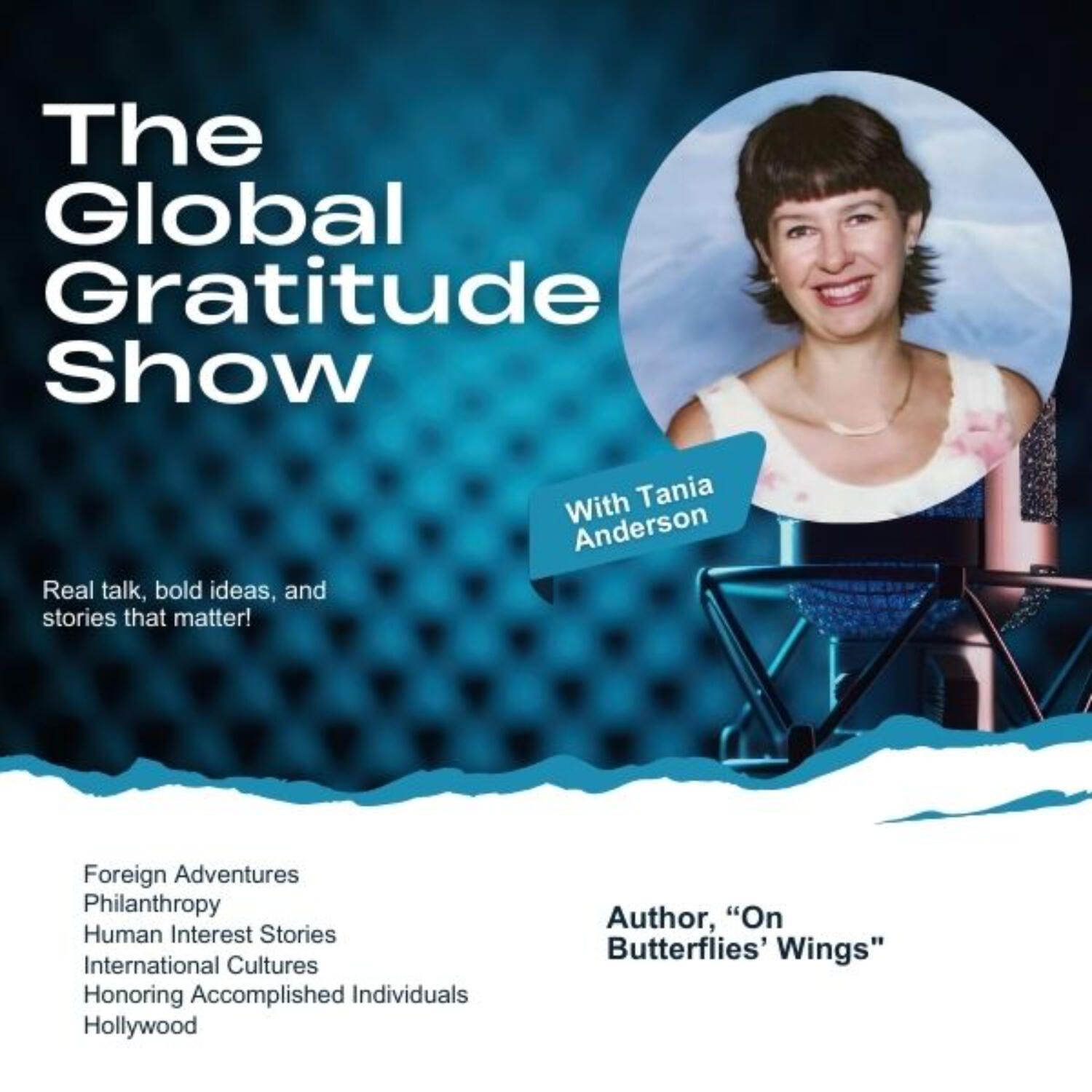
About this episode
The Global Gratitude Show with Debbie Wright
Interactive timestamps
Jump to segmentGet every episode summarized
Each time Brushwood Media Network publishes, we email you a written briefing from the transcript — the topics, who appeared, and any specific claims, with the ad reads skipped.
Email me new episodesFree for 3 shows. No card needed.
Transcript ready
1,102 searchable segments. Every word is indexed and playable.
Full transcript
Brushwood Media Network — The Global Gratitude Show with Debbie Wright. Machine-transcribed; use the interactive transcript above to jump the player to any line.
0:00Welcome to the Global Gratitude Show with Tanya Anderson, where hearts open, kindness connects us and stories of giving light to the world. Each week, Tanya brings you inspiring voices from around the globe, people spreading hope, love and gratitude in their own extraordinary ways. So take a deep breath, open your heart, and get ready to celebrate the power of positivity. Ladies and gentlemen, thank you for tuning into my weekly show, the Global Gratitude Show. Today, my guest is a very special lady who carved out a rather unusual path for herself in the health field. Debbie Wright is only one of very few gifted people I know personally, whom I have told that she will never know how many lives she saved until she gets to meet St. Peter. Debbie hired me as her personal assistant in 2011 to assist her in getting her 501-C3
1:06a vision of health up and running. That was a learning curve for both of us that we discovered together. Today, Debbie is my honored guest who continues to inspire women to safeguard their health more diligently, and now we are about to discover how Debbie accomplished that. Good morning, Debbie. And thanks for tuning in from Puerto Vallarta. That's really great. It's so great to be here. And what a path, huh? I know. I know. And you continue to do well and inspire others. And I hope that two groups of people, younger people that hopefully tune in like the millennials of the Gen Zers are inspired by your path and how you carved it out for yourself. And also, man, I don't want you to tune out because this is a show mostly about ladies' health and breast health and diabetes prevention. But if you have a lady that you love in your life and most probably you do, you want to hear what Debbie has to say because she is a wealth of knowledge and she has really, really done so well for herself.
2:12So give us a little bit of a background about how you were inspired and how you started out becoming interested in breast health and diabetes. And then also your mentors, your mentors along the way are extraordinary. Yes, I've had some interesting people that have launched a lot of interest in what we're doing now. And it started when I was about probably 15 or 16 in high school in Manhattan, the age of North Coast stuff. I had a biology teacher who was a young, good looking surfer and this was his first class we ever taught. That was helpful, man. I was not getting a good grade though. So my counselor said, how about we switch you to Mrs. Estelle? Mrs. Estelle took us to UCLA to see the fruit fly experiments on DNA. And that was it. I said, oh my God, this is the coolest thing in the world. And then I took anatomy and physiology in high school.
3:15And when I got to Fullerton College, I met Mary Shaw, my counselor. And she looked at my grades and she said, well, I don't know. My math wasn't all that great. And she says, you know, I think probably I can't see you being under a microscope all day. This was a nine minute interview. And she said, I think probably you should be around people. And so she recommended radiologic technology. I said, what is that? And I said, oh, okay, well, I'll try it for a few weeks and see if I like it. And fell in love with it. It was amazing. I was on the Dean's list. I did really well in chemistry, physics, all those things I had avoided in high school because I was afraid. But I got straight A's and was on the Dean's list and really enjoyed it.
4:15Never saw Mary Shaw again until 40 years later. No kidding. Really? Oh, yeah, interesting story. So I took, you know, I took transcription in high school. So that was very helpful being an x-ray tech and ended up going into business. Never knew that I would be pulling on that from high school. But it's important to know how to type too, you know. And then from from there, I went to took a past data lab and majored in health and safety. Most of my classmates were actually policemen trying to get into the FBI, which was kind of nice. I saw, I know I laughed at what I saw that. That's so funny. It's a certain kind of energy. I was having a conversation with one of our Marines recently coming back from Okinawa. And he was saying after I get out of the Marines, I wanted to go for the FBI. Well, I started giving some pointers because I have a really good friend with the FBI since 1988. But anyway, so go ahead.
5:15So from there, I actually, after I graduated, I started with a master's degree in health administration. About halfway through the semester, I got a job offer from Cypress College to teach red tap. And I dropped everything and accepted that I had a transfer over to one beach state to get a degree. And for my teaching, for that cell, a vocational education. So that was fun. I made a lot of money, too, which was really kind of a cool thing, more than as an x-ray pack. So I talked for seven to ten years in that area, that field. And I also worked as a part-time ultrasound tech and x-ray tech at Nana Hospital in Westminster. So I never left my day job completely and just ended up doing it part-time. So I was busy. I was president of the x-ray society, the Oriental District Radiologic Society. And just had fun.
6:15You know, I was just doing a little bit of everything. And I went to Chicago to the Radiological Society of North America. It's called RSNA. And that particular meeting is just like a big candy store for our business. MRIs and ultrasound machines and every single expensive piece of equipment in radiologic technology was there. And I started attending lectures on brass centers and the multidisciplinary aspect of breast imaging. And at that time, women were only about 5% of women were getting their mammograms routinely. So I kind of took the turn of thinking, well, I'm the next red top. And I ended up going to work for one of those radiologists to learn the various death techniques on mammography.
7:18At the women's press conference in Monica. So I scooted over there. I left teaching and went over there for a few months to learn. And I met two wonderful female radiologists. And we opened up the Beverly press center in Beverly Hills. And that was fun because I did mammograms on many, many, many famous women. Right, right. You said that. That's so interesting. And then tell me about that led to an article in Newsweek magazine. Yes, yeah. And yeah, I was doing automated breast filters now, which was very cutting edge at the time nobody was really listening to. And it was, I was, I was well. And I got to the point where I said, you know, I really want to do this on my own. I felt like I was running the breast center by myself and trying to get the radiologists to work. Sometimes it was a little difficult and I thought, you know, I really want to be in control. So I run my own show. Exactly. Well, I ended up launching my out myself.
8:20And I think I mentioned to you that my, my mom was diagnosed with cancer. One coma when she would turn 50. And that was back in, I know it was really tough in the mid 80s. And she was working for Western Airlines at the time and had worked there for many years. And I think it was in the mid 90s that Delta purchased. Right. Western. And because of that, she had cancer, she was able to turn up her life insurance to the map. So I received a benefit of about $50,000 from her life insurance as one of the, you know, my siblings. And I had gotten a call from the medical director. He was an important doctor, Martin Stein of Brafodine. Right. Right. And why did you mammograms on all of this employees? And I searched around and I couldn't find anybody that wanted to do that.
9:21I know. Yeah, I love that. But you took the, you took the bull by the horns and ran with it. I worked it pretty hard. I took a friend of mine who was a psychologist who had breast cancer. We met with a board of directors at Brafodine and convinced them that this was a really smart thing to do. So I became a preferred provider with Etna, so that I got paid, which was really cool. Right. And with that money, I, you know, I purchased a machine and a van and went to work. And we found these several cancers right out of the gate. Wow. Well. And we're there. There for many, many, many years. And every year the cancer is just got smaller and smaller and smaller, which was very rewarding. And from there, I started doing mammograms in corporations. I was working with the American Cancer Society as a volunteer. We did a lot of those $50 mammograms. I did mammograms that, and that was a may company back in the day.
10:21Right. Right. And it was, I don't know if I've ever mentioned this to you before, but I didn't feel like I was working because I was loving what I was doing. That's such a big deal. It's so important to, yeah. And you know, like if my stepfather was here when you, you're describing, you know, how you got started everything, he would say, Debbie, you're a square peg and a square hole, you know. But there's something else I want to interject here as well, which is a good lesson for listeners and for all of us. When you inherit some money or something comes in, some kind of benefit or insurance payoff, you did absolutely the perfect thing you invested in yourself and your career. You know, everybody wants to run out by a Ferrari or do something silly, you know, but you did the right thing. And you were the age where you could have said, hey, let's, let's go do something fun with this money, which a lot of people do. But that's another good lesson coming from you, you know. Yeah. You made gratification. No, it's great. You invested it yourself.
11:21That's, that's a powerful thing. It's a really, because you were taking a chance. Nobody knows what the outcome is going to be. Sometimes it seems like all cylinders are in overdrive and it's going to be a go. And then something happens, I'm for scene. And then you're like, oh, you know, so anyway, you took the chance and you looked at you. I don't know why I kept on saying to myself, why am I here doing this? I know nothing really that much about business. Remember I dropped out of healthcare administration and I thought a million times darn, I wish I had stayed in that program. Because I really need it now. So, you know, I ran the show for almost, you know, 10, 15 years by myself. I was alone. I was doing the transcription and the reports. And at rock a dime, my radiologist was very conscientious. Dr. Leonard Davis, he overread the mammograms. So I had about 20% of the women that I saw that were abnormal and that was pretty high.
12:22So I, well, I met Dr. Lawrence Bassett at a conference at a training with Lasso Tepard, who's the guru internationally in the world, on the very best high quality mammography. He came to the United States to teach us the recipe for doing an excellent mammogram. Because in Sweden, he got the government to pay for mammography for all women. That's a big step forward. He trained us. So I met Dr. Bassett there. So I asked Dr. Bassett, what do you think about, could you reread those abnormal mammograms that Dr. Davis read and what would you charge me for that? So he charged me with 10 bucks. And so when I went back to the women at rock a dime, I was able to tell them, you know, I think we went down to about 5%. We went from 20% to 5% abnormal after Dr. Bassett. We read those.
13:22Some of them might be able to teach to go back to them and say, I've had them reread. And this is just what, you know, you've got some some some benign findings, but this is your normal for you. And so if we pulled previous mammograms from their other facilities, if they had ever had one. So it worked out really well. And then from there, I ended up moving into UCLA. So I spent about five years with Dr. Bassett and all of his residents and interns. They were double reading all my mammograms. So we were all who was doing banks and prudential and pepper dying. I was doing mammogram. Every woman died of mammogram, no matter what. And they were doing biopsies in there. It was crazy times. I would do like 40 or 50 mammograms in a. Wow. Wow. It was so exciting to be at USC and to be at the same time. It was pretty cool. And then from there, UCLA kind of went into competition with me.
14:23They had a great big fancy motor home and mobile unit. Big brothers in town. So I tried a little bit that night. Yeah, it was frustrating. Yeah, it was a little bit frustrating. And I was by myself. I really didn't have anybody to really lean on, you know, financially. I had to kind of pull it together. But, you know, I was busy. You know, I had United Airlines was one of my long term, you know, just excellent clients. Good for them. Yeah, they're my favorite airline too. Yeah. So I just kept on going and kept on going. And I had met Dr. Illaj called Colley, who is kind of a famous radiologist and developing molecular breast imaging. And he was working down at Harbor UCLA and Torrance Carson area. And so he agreed to read my mammograms.
15:24And so I was popular again with UCLA, which was really fun. And then when he retired, Dr. Greg Ethel became my radiologist. It was a wonderful career. But, you know, it took me, you know, 15 to 20 years before I can start branching out. And so we started acquiring. I started acquiring on the machine almost every year up until the point where the year I turned 65. I ended up selling the entire practice to my competition. Who was a radiologist and his wife who had an MBA. Right. And they were wonderful people, the wax parties. And we sold 13 machines when my husband Lewis quickly. You got it. You got to mention him. All right. My lawyer is my my dearest friend Sean Arnold. She's wonderful. Yeah, yeah, yeah. Yeah.
16:24And so we, it took about 13 months and we sold it to them, which is really great. Because if I wanted to sell it, do you think I could have? I wasn't sure, you know, when I was thinking. Yeah, because it's your baby, too. It's your baby. So that's a big deal. Yeah. Yeah. I understand. Never all the thought that I would retire. I thought I was going to be doing this. I used to dream. I was doing mammograms even on an airplane. You know, this year is the 40th year that I'm flying. And, you know, people ask me, you know, when I'm going to retire. And it's really, it's really hard to say because I love flying the military. They're absolutely wonderful. They're the best passengers in the world. And, you know, we fly 24 seventh. So I mean, I might have a 0300 in the lobby, something like that. But let me tell you something, Debbie, the minute I see those guys get on you from men, women, paratroopers, any branch of the military. I automatically get a second win. I love them. I honor them. And they can feel the vibe.
17:24They can feel the vibe. I mean, I mean, we've had some one, I mean, not so long ago, I had four full birds and a two star on. I mean, you know, yeah, a lot of stuff going on. And I love them. So that's, you know, that's how I honor them. But to get back to the mammograms and stuff, I did want to interject this, even though it's a newer thing. And you probably knew about it months before it happened. I think in January of last year, the FDA approved AI. So like you go and you have your MAMO and you pay $40 out of pocket. And then, you know, Chris, the radiologist looks at it. The doctor looks at it. And then they send it for AI, which is just that many more eyes. And nobody had to talk me into it. I'm like, for, you know, for the price of a couple of glasses, wine in a nice restaurant, you know, you get a life-saving, like how many different opinions is that? So that's perfect, right? It's a win-win, I think. Yeah. Well, yeah.
18:24I mean, the breast has been a complicated organ to image because it's tissue on top of tissue. So being able to cut through it like tumble synthesis and then molecular breast imaging, we're able to actually see inside much, much, much better. And also, you know, at MRI, magnetic breast imaging is also very valuable to us. Kind of an expensive one. So I think some of these like the tumble synthesis and the use of AI makes it more affordable and for mass screening, which is super important. You know, the country has taken a mammography away from us a few times because like when I was at UCLA with Dr. Bassett, Canada said that mammography wasn't finding any breast cancer. So we actually removed our mandatory screening through the US preventive task force for much younger women.
19:25Right, right. They started at 50. And it's like, you know, this one for about a year, a Dr. Bassett flew up to Canada, looked at the mammograms up in Canada. And he came back and he said, guess what? The quality is so poor. Dr. Tamar evidently hadn't gone to Canada yet. Oh boy. Oh boy. And the quality was so poor, as you couldn't find a cancer there if there was one there. So then we were able to believe it or not. The US preventive task force reversed their decision and went back down to 40. So I was there for that. Yeah, good for you. Good for you. Like our night in tiny armor that he saved all those women. And you know, and Canada and United States, do people how many lives were saved just by that alone? I know. I know. I met a gal one night. Tina Turner's son Ronnie lives about 15 minutes for me. Really, yeah, super super. Well, I think you met him at one of my parties. And I was over at his house one night at dinner party.
20:27Six or seven of us. And I met a gal who was 53 years old and she never had a mambo because she was afraid that it was going to be painful. And I, Debbie, I spent the rest of the dinner trying to talk her into it. But she couldn't do it. And I said, you know, it's so much easier now than it was when I was in, oh, you and I were in our 20s because you know, we're the same age. Because, you know, the, the paddle, you know, if the, if the, if the radiologist didn't like you, she could just keep you screw it in and say, I've got, I'm going to go smoke a quick cigarette. I'll come back, you know, after a break. It's like, hey, my, my boob is in jail with you too. So, but it went with the modern radiologist when I tell them that, you know, they, they just laugh because now it just doesn't really fast and then bounce is right off. You know, but I love the whole idea of the, the thermal synthesis because you don't need to go down so tightly. And there's guidelines for this too. There's always been guidelines of specific amount of, of pressure. But if you're not following the guidelines,
21:29then the more compression you put, the sharper the image. So you can see where the issue is. Right. You know, you want to get very, very, very best picture possible, but there are guidelines. And if you break those guidelines, then that woman's never going to come back from the mammogram. And I said that so many times of, that's why women be late coming back because it was still painful the last time. And I've seen nanotechs literally take the machine and lift their feet, swing and lift their feet off the ground to bring it in back from the early, early, early days. Yeah, they see that's crazy. But you know, last month I had a, last month I had a follow up MRI. And you know, I really, really liked the, the technician Maria. She, she was really good. It's just loud. It's like being in a tight tunnel when it's loud. So I got extra ears on you. You know what I mean? And you, you just behave and just, you know, you just meditate for 15 minutes. That's it.
22:29You know, it's, it's pretty loud. But, you know, and as a result, I think if, I mean, I've always tried to be aware of things because my, well, my grandfather was a doctor. And my father, who was an attorney read his entire medical library. So my father knew a lot about medicine. So, you know, I've always been into preventive stuff. But I think because of my experience with being around you, I've been a little bit more assertive about it. For example, I can think of three flight attendants right off the bat who take their cell phone and stick it in their bra. I'm like, what are you doing? And I, and this guy out, she, she's an attorney too. I love her to death. And I, I barked at her twice on the last trip about it. I said, get that thing away from your boobs. Just get it away. You know, absolutely, you know, flight attendants, you're up in the ozone area, right? You're up there really high. Right. And so there's a lot more radiation up there. And there is a lot of evidence. We have a lot of published papers that show that flight attendants
23:30do have an increased incidence of breast cancer because of that. Yeah, yeah. I'm aware of that. They did a, they did a study. Some of the Pan Am people did a study just about the time that we went bankrupt in 1991. But there's something else here too. Also, when that report came out, it's been a long time ago. Before I met you that, you know, that lotion, body lotion, sometimes has, has these beans in it. So the minute I heard what, at whatever point that report came out, I said, okay, this, this is going to be the gig. I'm going to use alo gel instead. Just take that away, you know, use alo gel instead because that, that whole area is so sensitive. I mean, you know, if you know, if you have the knowledge, then get in just some preventive measures. You know, not to mention the diet. Yeah. Yeah. Aluminum and deodorant can look like a microscopic cancer. And that's what, that's the magic of mammography is that we can see things that are so tiny and so small
24:33because of the fact that, you know, milk is wondering, you know, through those mammary ducts. Right. Right. And have calcium. And so a cancer, an early, early cancer kind of forms a little web. And the, the little particles of calcium get caught in there. And that's the reason why we're able to see a very early two years before maybe you could even feel it. Right. Right. Really the benefit of mammography. And that's the reason why you always hear, do I have to have a mammogram till I get an ultrasound instead? Well, ultrasound can find some calcium, but mammography always finds it. So you kind of have to have both. And that's been a big, big issue for women. And they passed a lot of laws about breast density. Breast density is really important. Yeah. You know, a lot of the harder to see through some of that tissue. Now that we have tunnel synthesis and all these other things
25:33where we're doing so well. Right. The truth. So much better for breast. Right. And I was, I was also, you know, it was, it was so delightful when you were so excited about this, the Sophie. You were talking about Sophie. Not like it, like it was some kind of cool person. But it, but it is because, right? See now, and then when you just threw your head back smiling, that, that would have been great too bad. This isn't a video show instead of radio. But, but yeah, no, you're, it's just, it's really really cool. And the steps forward, like, oh, over. It's so satisfying to, you know, and you kept at it. I mean, when you hired me, I was amazed. And you had 10 bank accounts. And you had, you had 10 vans, right? And each one had a, had a MAMO machine. And they're driving all around California and the every women counts program. And. And that is amazing. That was the most amazing thing. Jackie Spears passed this breast
26:33and cervical. Like more poverty, more quality, these prevention act back in 1991, I believe it was. Uh-huh. And that, but any woman in California, who couldn't afford to get a mammogram, could get it a mammogram. It was, it was an acted almost like a, a grant with the CDC, lovely department of public health. So it's just like one of the coolest things in the California. It really takes part of their people. Yeah. Yes. And, uh, and then there was at first, there was no money for treatment. So women were afraid to get a mammogram because they said, well, I can't, I can't pay to get treatment because I don't have insurance. So then California got a treatment fund. And they would, they would pay for the chemo and for the, the surgery. So it was a, it was a really great program. At first, I was finding cancers and, you know, we had a city of health and begging them to take a few people at no charge. And so we, you know,
27:33then we started, you know, calling around all the different hospitals. But asking them if they could take a couple of patients and spread it around to do no costs. Yeah. And then the violin. There's the incentive right there. How much is it going to cost me? Yeah. That, that's, yeah. That's a really, really big deal. And you know, and thank God we live in a place where, where we have that available. People just have to be inspired and say, I just need to do this. I just need to go get screened and that's it. I would like you to talk about some of the cancer smancer and your vans and some of your involvement with celebrities like Fran Drescher and celebrities from the American Cancer Society, that sort of thing. Because people like to hear about the involvement that, you know, a-listers and other celebrities have with this particular thing. Same as people that I met with the American Cancer Society was doctor Dennis Slayman who invented the Hurtuneu test
28:35to check for that cancer, which is a very aggressive cancer that happens in women in their 40s. What is it, Debbie? A Hurtuneu test. And that type of breast cancer is very aggressive and kills many young women. And if you'll want, there's a movie. Harry Comet Jr. plays the Dennis Slayman part and Angie Harmon is- It's okay. And Bernardette Peters is in it and a couple of other famous people. So really, it's a good movie. I think it's called Triple Ply for something like that. I can't remember the actual title, I think that's it. And I mean, what a genius, right? I would never see him at UCLA with through the American Cancer Society, where there was about 20 of us in a room and he was talking about all these targeted therapy so that you wouldn't have to get chemo to the entire body. You would be able to just do a target. Oh, yeah, yeah. Yeah, so he's like a real genius.
29:38And I think Jen and tech picked that up and made him famous for saving women's lives. That's my opinion. And then, you know, through I'm in a Catholic faith and in Catholic faith and in Jesus, I've met so many people through the American Cancer Society. But many, many years ago, I was introduced to friends' Russia through one of my employees. Right. And she was in Kenya with a Y. So she had a contact and so we flew to New York to meet with her in her apartment there. And she formed a partnership with me and we were able to put her image and cancer to cancer, which is profit. This friend was developed a female cancer when she was in her mid, you know, in her midlife. And she really wanted to give back.
30:40She's so, she's so into health and she holds her heart so much every year. So we put her picture of her with cancer shamans around there and her website on there. And so we have a relationship. Big smile. Yeah, yeah. Great relationship with her and her staff. And then, and the other thing is people, you know, well, you know, I've done mammograms on, you know, it was in Beverly Hills for a while. So, you know, I, you know, I did a lot of mammograms with babies women and lots of senators wives that flew down from Sacramento to see us because we were all female. Right. And it was kind of cool to see me out of Dr. Yeager and Dr. Peck were my female radiologist I work with. So it was really fun. And then I countless, you know, countless celebrities that I've met along the way going into offices, doing mammograms in Santa Monica, Beverly Hills, you know. Right.
31:40And then with you, a few very famous women walking down the hall to get their mammogram and then, oh, you're pregnant. You can't get your mammogram and it's like, stars. That's food. It's been, it's been an awesome ride. It really has for me personally. And then, you know, I met you and that was wonderful. This nonprofit, you know, we started off as a breast cancer prevention program. I wanted to do this program. Somebody of my patients were overweight. And I knew that if they could lose weight and be more healthy, we wouldn't have as much breast cancer. Right. Absolutely. So I met a big celebrity of mine, which is Dr. Kathleen Nunn, Public Health PhD. Oh, she's wonderful. Yes. Yes. At same time. And so we started a project. You were there when we started that.
32:41And we met with Dr. Julie Stilbert, who's the famous nutritionist. She's left season, she went to Chicago. I think she's still there. Okay. And Dr. Dilbert was kind of her own celebrity because she was consulting with the military for organizing all their meals all over the world so that they would eat healthy. Oh, boy, that's a big deal because MREs. You were in the room. You went in the room now. And that was very, very exciting. And so we did some work at the diabetic kitchen in San Fernando. And the kitchen recruited about 20 Spanish-speaking women. And we were able to get interns in kinesiology, nutrition, and public health. And we taught them how to do breast health exams. And we really introduced the idea that you don't need to go on a diet to lose weight.
33:43You just need to make that a choice. So we were teaching them what's good and what's bad and what won't hurt you. So that was kind of the whole idea. We did a pre-test and we did a post-test. And the women learned so much. But I had a tough time getting them to take their jackets off for weight, and we weighed them every week. I don't know how to weigh them. No. You know what's all that? I had a full physical couple of months ago. And I'm a 152. I mean, I wish I could lose 10 pounds. But it's kind of funny because when I was at Pan Am, one of the things they did when you were first hires, they weighed you. And then they measured, you know, like are you in my small bone, medium bone, or big bone? And then I distinctly remembered, they said, Tony, you can go up to 155 if you go over that. We're going to have to put you on a weight restriction. And you know, I think sometimes you just got sent home. You just had to lose the weight. I mean, you just have to really get the discipline going.
34:46But I know it's funny to reality in this situation, Lord. But also, I would like to talk to you about also along the same lines and celebrities. Because you invited me to some very interesting, well, some of the people were celebrities in the health field, you know, these doctors and researchers. And you say, but you invited me some very interesting gatherings where they are lectures where researchers would talk. I mean, one was, you know, his thing was pancreatic cancer. I mean, he picked like a really difficult one. And they were so informative. But also, I was thinking about Richard Roundtree recently because, you know, the star of Shaft. And I remember you took me to, you know, a talk with him. And he was so silly. That was it. That was it sad, yeah. I remember we were doing mammograms that side that day.
35:46Right, right. He was on the panel with Richard Roundtree. Yeah, he had a breast cancer. But I mean, he, I remember him making a joke and bless his heart. You know, he said, me, Shaft, I have breast cancer because, you know, it was such a macho film. And he was considered like, I think it was in 1972. He was considered one of the first African-American, like, action heroes. So it was so kind of ironic, though. And then he had a double mastectomy. I mean, I was just so interested. I mean, I admired him so much for being so honest and straightforward about it because it had to be just a really bad struggle, you know? But he did live for 20 years after his diagnosis. And yeah, that made their breast cancer awesome. And that's what kind of led me into, you know, the breast cancer prevention was important to me. I mean, there are some breast cancers, of course, that are genetic that we inherit. And there's a gene for that. And all women who have had breast cancer
36:48should get tested for genetic testing every couple of years because we're finding more and more and more genes that we can target, so that we can actually target. That's what Angelina Jolie did some years ago, right? Is the BRCA gene, is that what you're referring to? Yeah, it's a whole family story. I mean, they're finding more and more and more and more besides the BRCA. BRCA was one of the first and then now there's like, and this is true of cancer in general and not a breast cancer. So when you can find this specific gene, then you can just target that. And you don't have to kill all the healthy cells that you can just attack the cancer cells when you know what that particular gene expression is. Now, Julie, thank you for that info. Do they still have an annual fundraiser at Sony Studios? For American Cancer Society, or did they change the location? Or I don't know.
37:48I really, I assume. Okay, I was just curious. My earpiece is quite working, so here. I know, so I tell you, I got so mad at my printer this morning, but that's another story. So yeah, I admire people that have had a difficult experience, but they're straightforward and honest enough to speak about and the challenges, because that's how we learn and encourage you even more to get better and better. So the whole idea with the nonprofit that we started, because you were there at the very, very beginning, and that was a long time ago. And I was able to get interns in public health and health administration from CSUN and from Cal State LA. We've had hundreds of interns go through on nonprofit. No kidding. Well. I kind of think I always like to say we have an intern lead organization, because that's good, not so young anymore.
38:49And these guys are so smart. They love prevention, and they're so passionate about what we're doing. So I'd like to kind of run through real quickly before we run out of time to talk about the program. Yes, please do. And so this is the CDC had did research back in 1997 with 4,000 people and four locations across the country. And half of them took net foreman, which is a glucose lowering medication. You don't lose weight on it. It's not like a GLP, but it does lower your glucose, which does make you more healthy. They pitted that against the national diabetes prevention program that the CDC developed, which is, I'm going to explain what that program is. I'm going to explain what that program is. I guess one that the people that were involved with the CDC's program, doing the protocol, the lifestyle intervention, were able, they were able to lower their glucose much more
39:52than the people that were taking the net foreman. So that did it, so that then in 2012, Congress passed the National Diabetes Prevention Program Act. And every state and every public health department in the country, the problem is not very many people know about it. So that's why I'm so honored to be here today with you. Wonderful that we share this with the world. I actually went to Africa and spoke about this. Little part of Africa has the highest BMI and the lowest BMI, different states. And around the world, we're not the healthiest in the United States. And unfortunately, we have over 100 million Americans who are pre-diabetic. So what is pre-diabetes? Pre-diabetes is a glucose level that is 5.7 to 6.4 A1C.
40:56Or it is a fasting glucose of 100 to 125. And then if you ate a meal, you're allowed 140 to 199. And that is the actual specific requirement to get into the program. You have to meet that criteria. Okay. And then you also have to be overweight. So you have to have a BMI of 25 or higher or 23 if you're Asian-American. So, and then there's one more loophole. You don't need to meet that glucose level if you had gestational diabetes because you already are at risk for developing diabetes. Again, when you were pregnant, you gained weight and you got diabetes, so you're at risk. So that's the requirement to get into the program. The program is run by the CDC. We have a coach. I happen to have a master coach, who's the Missam, Villamaria, and Sam has an incredible, he's incredible. So, once we've convinced people to get into the program,
42:00I ask them they have to agree to lose 5 to 7%. Their body weight in one year. So if you're 200 pounds, we ask you to lose 10 pounds at the end of a year. We like you losing in the first six months because we can spend the last six months in maintenance making sure you don't gain the weight back. Because we're trying to teach people new habits. This is not a diet. That's one thing that's really important. We're trying to, we're coaching people. We're motivating people. We're trying to help people understand how important it is to fall in love with healthy foods. Bravo. Bravo, there you go. We're really loving plants. Plants are so important for our gut biome. And the more of them we eat, the as many as we can, and we encourage them to try different things. So once they agree to that, to lose the weight, because most people can, losing weights easy is hard to keep it off.
43:01And I heard that, you lose the weight, and then what happens after that, then you don't gain that weight back, but then usually you add a little bit more on because your body's pissed off at you for it. Right, right, right. It's really your brain is not, not the body. It's really up here that. Mine control. Yeah. Right, right, right. Yeah. So then at that point, we ask them if they can exercise, at least 150 minutes of moderate to brisk exercise per week. And they, and they usually will grace, I make sure they don't have any issues with their joints. And you know, most America, most senior Americans tend to slow down as they get older. So most of our participants are older. And fortunately, Medicare pays for this program. And so we do bill Medicare, straight Medicare, 100% will pay for this program for anybody. But a lot of Medicare-advanced plans will deny it.
44:03And then we do offer them like $40 a month, times 12, if they would like to join the program anyway. Now, this is a CDC program. So we have to report every wait, every time we meet with them, we meet with them 22 times in one year, 16 one hour Zoom sessions in the first six months. And then once a month after that, the last six months. So, you know, it's a pretty diligent program, rigorous program, I guess you would say, because the participant has to send us a picture of their scales before they meet. That's how it's going to ask the requirements. Yeah. And then they have to also do food logs. We like them to do food. Like, we want to see what they're eating, what they like. Keep that diary, right? The interns will do a nutritional analysis with that. And Sam trains them to do that. So they circle, you know, what was like two pieces of pizza, one piece of pizza and a salad. For instance, that might be something that we might do. You know, so they change the habit like you said.
45:04OK, right. And then give them a recommendation. You know, if we circle something, we give them a recommendation. So at that point, they agree to do that. And so what happens? Now we start in with myplate.gov, which is, you know, pretty much what we've decided that we're going to do. I heard that myplate.gov might be changing a little bit for a different take than we've had in the past. But basically, you know, the important food groups and so on. And then we go in and we really talk about the important making good choices, like going to a party. What do you do? How do you stay away from the cheese and the alcohol? So what happens there is that you're in a support group. So you're in a group of 5 to 10 people. We're meeting one hour zoom. And we cover at 22 different subject matters, one hour zoom.
46:06So Sam is an amazing coach. We have Spanish-speaking coaches also. We have interns that speak Spanish. And so we're always looking to further that. And we talk about things like sleep, because that's really important. A whole program on sleep. And then we do one on how do I turn negative thoughts into positive thoughts? Because this is a lifestyle intervention program. It's very stressful. It's comprehensive. You go to the psychological. Yeah, yeah. We talk a lot about stress. Stress is like everything. Because you make bad decisions when you're really stressed out. You run out of time and you've got a hurry. And you get stuck in the garage gym. And you don't have anything to eat in your car. So you pull into a gas station and get some junk to eat. And that's all there is. And those kind of places just garbage. You have to plan for that. Because you never know when to keep a protein bar or an apple or something with you. Right. And then we talk about the good fats, the bad fats, the good carbs, the bad carbs, and how much protein should you have in a day?
47:07And it's just all about my husband's laughing at me. It's all about really and truly getting people engaged with making those changes and getting them to learn to love more healthy foods. That's why we look closely at those food logs because we want food is one of the few things that we have control of in our lives. Absolutely right. And so we'll talk about disease. Lowering your glucose level. Glucose causes inflammation and just think of all the diseases that are related to that. Because of inflammation. And heart disease is number one. So we can lower your glucose level. We can lower your inflammation. And we can do it in a day. Our body changes, our gut biome in one day. We could be eating junk food for 20 years. Right. And one day we start eating more vegetables and more fruits.
48:08And your body goes, wait a minute, there's been a change, you're a positive change, right? Yes. And in one day we can flip it. You don't have to wait. That's amazing. It's wonderful. And for people to understand that because you know how our brains, we turn negative. We really do. Yeah. We feel guilty. We feel bad about ourselves and everything. And then we start, you know, we react to that. So I call brain bugs. Yeah, but people don't realize how powerful thoughts are. Affirmations, I say I have three big affirmations I'm saying now. And I have a whole new project coming up that it's television project that has nothing to do with this radio show. So I've been saying my affirmations and things like that because you convince your your own brain and your own psyche and the universe that this is on the agenda. And then things start to align. And that's the beauty that you know all about that. Now I got a quick question. How old is her? You have to be a minimum age to join.
49:08You have to be 18 to get into the majority of our participants are older, starting at 50, 55. We start, they start coming in. We get a few young people. Most people will drop out the first day if they're not interested. But usually once they've, and the research is CDC has shown, even a person that takes one class can delay their diagnosis of diabetes. And the more classes they take, the longer it is before they'll develop and the success rate, which I'm just going to give you the success rate from people at age 50. It's a 58% success rate for people age 60. It's a 71% success rate. So that's pretty exciting because most diets are 8, 9, 10% at the very highest, usually around 5 or 7%. And now we have the GLP's out, which is great because the more plants we eat, the more our body produces the natural GLP hormone.
50:12So if you've got a little gardener. One hour of not being hungry, if you eat three plants, you get three hours. So we are really pushing that because it is, and hey, it's good for us. And I love it when you're breaking it down to a science too. It's just amazing. So we have only just a few more minutes. Can you please tell the listeners how to, you know, your contact info and your website and how to get in touch? Well, thank you. Yeah, my phone number is 310-628-4191. And my website is a vision of health.org. And don't forget the A, because we get a lot of calls because of that silly little A, because we are in a registry. We're in the CDC registry. And if you want any information about the program, my website has information, but also just putting Google, CDC, National Diabetes Prevention Program, and the entire curriculum is online.
51:14You can read all the lesson plans and everything are all there. And the magic of our program is really in that support group that everybody kind of, you know, shares the good, the bad, and the ugly of all their life experiences with, you know, gaining and losing weight. So yeah, I'm pretty easy to reach. I was doing well-watching yesterday, and I got a call from Alaska, which I mean, we know how that goes. Actually, I can take any medic care anywhere in the United States, straight medicare. And since we do everything with Zoom, it's just really easy. So... I love that. And the program's successful. That's the definitely part. I mean, that is, you know, that is so cool. Like you've met your mission, you know what you're doing, and you're very visioned about it. And I think I'm honored to know you. I think it's amazing. And I was so happy when you hired me because I was so broke. I just desperately needed a job. And then you interviewed me at your house,
52:15and then you hugged me, but you didn't say you're hired. And I thought, well, I think I'm hired because you hugged me goodbye. So it's been wonderful. It's been really wonderful ride. It really has. And I was so thrilled, you know, when back in the day, they, every woman counts program shut down. And that's when I couldn't afford, you know, we weren't getting, we didn't get paid for nine months or something back then. The head of the, every woman counts program was a pediatrician from Southern California. And he forgot to notify. He didn't tell Congress in Sacramento that they ran out of money. And, and then as soon, and I actually went and testified before the, the health committee up in Sacramento. It took nine months to get that thing turned back on. So I couldn't afford to pay you anymore after at that point. And that's what really when things, they, they were able to open it up again. And it really kind of ended up working out okay.
53:15But it was very stressful back then, remember? But we got it off the ground. It worked. I know it's, it's amazing. It's, it's really amazing. Yeah, the, the whole roadway was such a wonderful learning curves. Something totally new for me because, you know, I'd never studied too much about health or even biology for that matter. So, you know, it was a, it was a complete learning curve. Well, listen, my dear. Thanks so much for this interview. It's been marvelous. Love you, miss you, say, say goodbye to your technician, Louie. Thank you. I'm even dead, aren't you? I love you too, Nathan. All right, all right. Take care, God bless. Talk to you soon. You've been listening to the global gratitude show with Tang Anderson here on the Brushwood Media Network. Every week, Tang, you bring stories that remind us, gratitude is a universal language when the transcends borders, upless hearts, and inspires us to give back. If today's conversation touches your heart, share the gift of gratitude. Pass this episode along to someone you love
54:18and help the ripple of kindness grow. Join us next time for more voices of compassion, joy, and hope, celebrating the goodness that unites us all. Until then, remember, be kind, stay grateful, and keep sharing the love.
More episodes
More from Brushwood Media Network

Awaken Hope PM Edition with Ben Lemans talking about his book Between the Tines
Brushwood Media Network

Awaken Hope with Patrick Sangimino on Patrick Sangimino
Brushwood Media Network

Never Hand Over the Blank Page | Your Biz Needs a Book with Chris Fenning #2
Brushwood Media Network

Stacy Lee - Storyteller of Resilience and Strength of Family
Brushwood Media Network