About this episode
The Society of Aurelians brought butterflies out of their undeserved obscurity. Nigel Andrew’s audio essay sheds new light on Britain’s first entomological society. Read by Leighton Pugh.
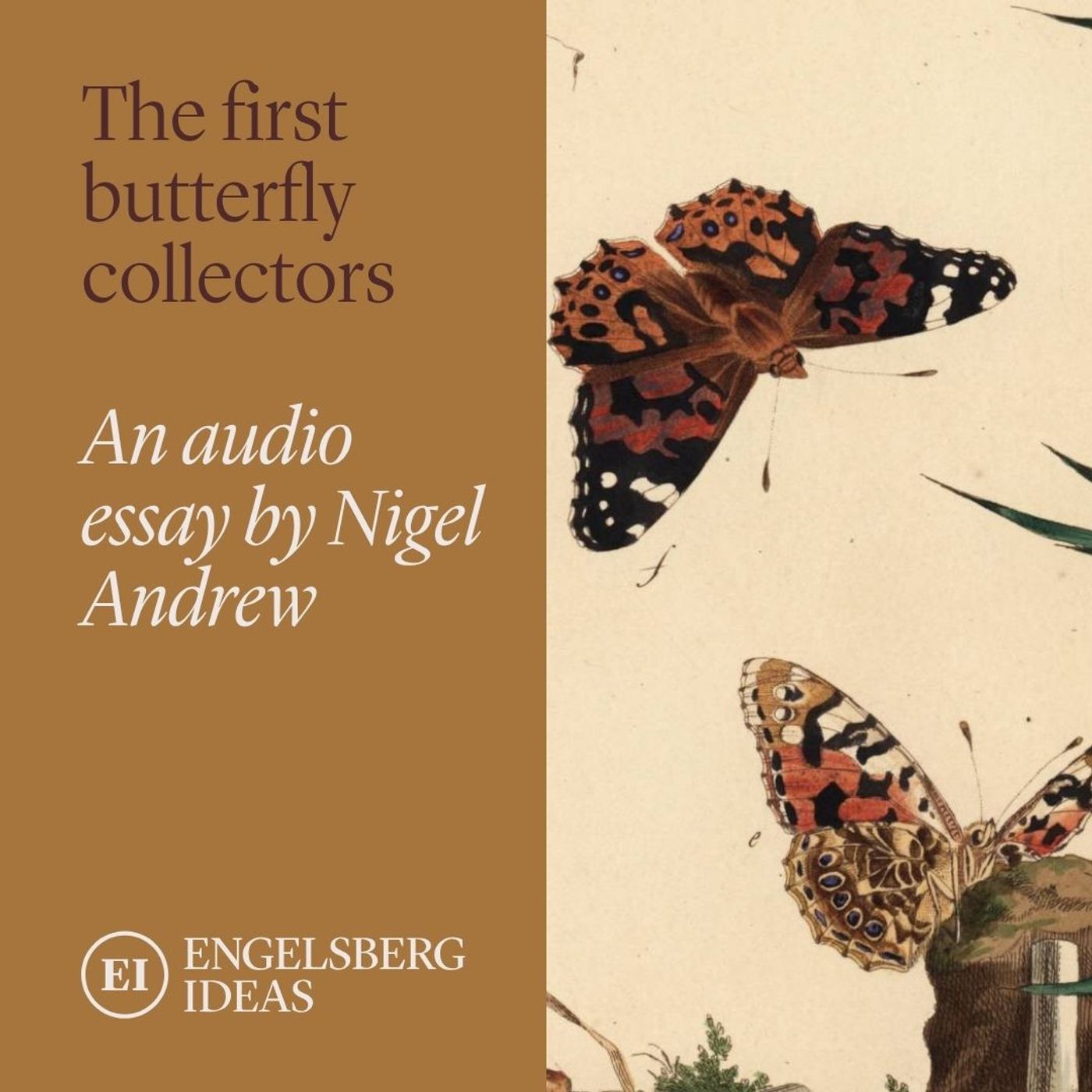
Image: Detail from ‘The Aurelian; a Natural History of English Moths and Butterflies’, published by Henry Bohn, London, 1840. Credit: Getty
Interactive timestamps
Jump to segmentGet every episode summarized
Each time The EI Podcast publishes, we email you a written briefing from the transcript — the topics, who appeared, and any specific claims, with the ad reads skipped.
Email me new episodesFree for 3 shows. No card needed.
Hosts & guests
Transcript ready
79 searchable segments. Every word is indexed and playable.
Full transcript
The EI Podcast — The first butterfly collectors. Machine-transcribed; use the interactive transcript above to jump the player to any line.
0:00This is an audio essay from the E.I. podcast. Nigel Andrew tells the story of the Society of Aralians, Britain's first entomological society. The first butterfly collectors, Nigel Andrew. Late on the night of the 25th of March 1748, a fire sweeping through the Cornhill District of the City of London destroyed the Swan Tavan in exchange alley, forcing a group of gentlemen in an upper room to flee for their lives. So sudden and rapid was the impetuous course of the fire that the flames beat against the windows before they could well get out of the room, many of them leaving their hats and canes, reported the entomologist's weekly intelligence, for whom this was a big story, as the gentleman thus forced to flee with
1:00the members of the Society of Aralians, the first entomological society established in Britain. It was not only their meeting room that was destroyed, but also the Society's records and collections, library and regalia, so that we know little in detail of their activities. We know enough about the Aralians, however, to recognize that their enthusiasm for insects, in particular butterflies, was driven at least as much by aesthetic delight as by scientific curiosity. The very name of the Society, with its glamorous, classical sound, so much more attractive than entomologist or lepidopterist, suggests as much, as does the fact that so many of the members of the Society were painters, printmakers and textile designers. One of them, the painter Benjamin Wilkes, recalled attending a meeting of the Society of Aralians where, he first saw such specimens of nature's admirable skill in the disposition, arrangement and contrasting of colours, as struck him with amazement. He joined the Society and went
2:04on to create one of the beautiful illustrated books that are the great legacy of the Aralians, English, Moths and Butterflies, 1749, a volume full of fine hand-colored, copper engravings of butterflies, moths and plants, brought together in attractively arranged compositions. These books were published by subscription, aristocratic patrons paying for individual plates to be dedicated to them. Many of the subscribers were women, for in the 18th century entomology was a fashionable interest among aristocratic ladies. One third of the plates in Moses' Harris's The Oralian, 1766, the most attractive of all the Georgian butterfly books, are dedicated to ladies, though needless to say they were not allowed to join the Society of Aralians. Still less were they encouraged to go chasing butterflies, a pursuit that was considered wildly unladylike, or even a clear sign of insanity. When in 1709 her disgruntled elder son disputed the will of Eleanor Glanville, after whom the Glanville fertility is named,
3:10he did so on the grounds that she was clearly insane to go around chasing after butterflies. The will was duly overturned, and the sun inherited. The Oralians represent the first phase of serious interest in butterflies, and it was driven by appreciation of their beauty as much as scientific curiosity about the different species and their life cycles. But why did it take until the 18th century for butterflies to attract serious attention? Why did even Shakespeare, a poet who was very much alive to the beauties of nature, and knowledgeable about flowers, birds, and other animals, make no mention of butterflies beyond a couple of generic references? Why were butterflies seen as little more than emblems of frivolity? Partly the explanation is practical, unlike many plants and animals butterflies had no obvious utility and posed no potential danger, so there was no need to inquire further into their various kinds. Also, in the medieval Christian world view, butterflies had no place except
4:13as emblems of frivolity and idleness. While many birds and animals, the dove, goldfinch, and pelican, the lion, and the lamb, and more, had symbolic significance, and in a short place in Christian iconography, butterflies appear only in marginal doodles decorating medieval manuscripts, where they flutter about unseriously, attracting the interest only of frivolous idlers. Once again, why would anyone wish to know more about these creatures? Oddly, this Christian world view ignored an older, deep-seated parallel symbolism that associated butterflies with the soul. In Greek, both are denoted by the word psyche. It seems an obvious association, the butterfly in all its glory emerging from the dead seeming chrysalis like the soul escaping the body, and yet Christianity ignored it. Butterflies only appeared on church monuments and gravestones at the time of the Greek revival, when they were obviously a nod to the ancients. However, the association between the butterfly and the liberated
5:17soul has persisted to this day when a single symbolic butterfly is often released at funerals. The Orelians had brought butterflies out of their undeserved obscurity, lavishly illustrated their beauty, and even made them fashionable. The books they created were, however, prohibitively expensive, and butterfly enthusiasts were still few and far between. All that was to change in the nineteenth century as interest in nature became more scientific, with the likes of the Linnaean Society founded 1788, and the Entomological Society of London, 1833, taking over from the Society of Orelians, and then in Victorian times the emergence of butterfly collecting as a popular pursuit, with men and boys from all walks of life, and the occasional woman, flocking into the countryside with their nets and collecting bags. This golden age of collecting, enabled by the growing railway network, improved roads and ubiquitous bicycle, continued into the early years of the twentieth
6:21century. Before the industrialisation of agriculture, the traditional patchwork countryside of England was alive with an abundance of butterflies that we can scarcely imagine today. A collector in the New Forest, in the 1890s, talks of swarms so thick that I could scarcely see a head, and indeed resembled a fall of brown leaves. It was common for collectors to take hundreds of specimens in a day, and many proudly sent records of their mind-boggling halls to the Entomological magazines. Few thought that collecting, even on such a scale, would have any serious impact on butterfly numbers, such was their abundance. However, as the twentieth century went on, and butterfly numbers began to go into decline, it gradually became apparent that they needed protecting and conserving. The decline continued and continues to this day, to the point where, in 2024, a butterfly emergency was declared. So after the age of collecting came the age of conservation,
7:25with the camera replacing the butterfly net and killing bottle, and serious efforts being made to save both good butterfly habitat and particular vulnerable species. It is telling that the representative body of British butterfly enthusiasts today is not a convivial group of easteats like the Society of Orelians, but a hard-working pressure group named simply for what it does, Butterfly Conservation. Thank you for listening to the E.I. podcast. If you enjoyed this episode, please follow, rate, and review the show, and find our writing at www.englespokeideers.com.
More episodes


