Loading...
About this Episode
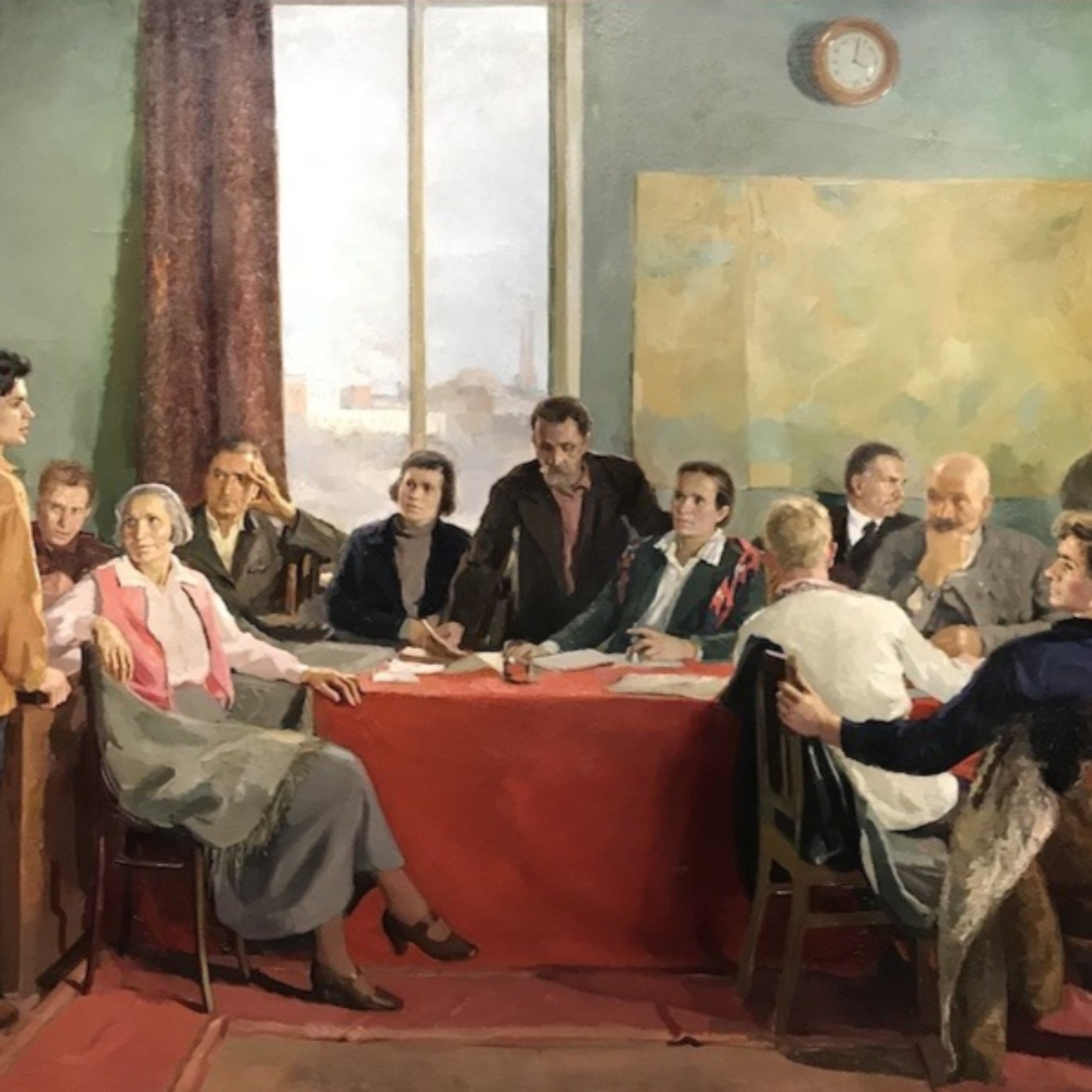
In 1917, the Bolshevik Party had roughly 24,000 members. A decade later, it boasted about 1.2 million. Recruitment came in waves and so did the purges. Still, Party members were found at the top and bottom of the system. In the Kremlin and in the factories. The Party rank and file were vital to the establishment of the Soviet system, its day-to-day functioning, and the human material for campaigns whether they be for literary, industrialization, collectivization or terror. But who were these people? How engaged were they in politics? Were they a constituency for Party leaders to appeal to or was the rank and file mere material to be mobilized and directed without its own agency? There are few studies looking at the Party at the shop floor and its place in shaping Soviet socialism. Yiannis Kokosalakis’ book Building Socialism does just that. The Eurasian Knot spoke to Kokosalakis to learn more about the role of the Bolshevik rank and file in the early Soviet system.
Guest:
Yiannis Kokosalakis is a visiting researcher at Bielefeld University. He’s the author of Building Socialism: The Communist Party and the Making of the Soviet System, 1921-1941 published by Cambridge University Press.
Hosted on Acast. See acast.com/privacy for more information.
Hosts & Guests
Transcript
Hello and welcome to the Eurasian Nautam, your host, Sean Gillery.
And I'm your fellow co-host, Russana Novikova.
Eurasia Naut is sponsored by the Center for Russian East European and Eurasian Studies
at the University of Pittsburgh, and listeners just like you, and I'm happy to report
Russana.
I think we got three more patrons.
Well, I should say this.
We got a couple of new ones, and then we got a couple that increased their donation.
Oh, wow.
That's a bigger move than just signing up.
Indeed.
It did.
Listening to our show and they were like, you know what, these guys deserve a raise.
Right?
Isn't that cool?
I was very like, I was like, whoa, that's really cool.
So thank you to all of those new and old patrons who are like really stepping up their
game.
Thank you.
Yes.
You can become a patron by going to patreon.com slash urnaught or to urnaught.org and
find the Patreon link there and join the growing number of people, the cool people who
are becoming patrons and really showing us how much they like our show.
The growing urnaught army.
Yes.
I know.
Do you ever, I once thought of joining the kiss army.
Do you know the kiss army?
No.
You know the rock band kiss?
Yeah.
They had the kiss army was like, the army is their fan club.
So they go around kissing people or what do they do?
Well, there's probably like a lot of rock and roll and drinking and, you know, whatever,
wearing makeup like kiss.
It's just too bad gene Simmons turned out to be such a dickhead, but you know, what can
one do?
All right.
Yeah.
A lot of creative geniuses about people in real life.
Yes.
That is true.
As we continuously find out indeed.
So how are things on your end?
Yeah, things are going much better.
I'm finally sort of getting over this horrible flu.
Yeah.
You do sound better.
I feel like I feel like alive again.
I'm like optimistic.
I'm like, oh, yes, springtime.
Here we come.
Yeah.
How about you?
Oh, I can't wait till spring.
I'm so tired of this weather here in Pittsburgh.
Mm-hmm.
I mean, the snow is finally all melted, but really just to be able to go outside and not have
to put on a jacket or a coat.
Is it like rain miserable at the time of the year?
No, it's just kind of the weather fluctuates from like fairly warm to like around like
60 degrees to cold in the 30s Fahrenheit.
Oh, wow.
That is very cold.
Yeah.
It's just enough already.
So anyways, we do have a sound submission this week from a repeat listener.
And I should say, I'm doing a lot of these Miyakopas recently where, you know, this sound
submission was sent in a couple of months ago.
And I'm finally getting around to playing it.
And this is actually from a listener named Amanda.
She had sent us something before though at this point I can't recall when that was.
But she sent us another sound and let me play it for for us here.
So I expected when it just started, I thought, oh, that's just a typical at Bivanje.
I don't know how to say it in Russian.
When somebody dies, you know, you just liturgy, yeah.
And then the stahewski came up and was like, oh, somebody paid for them to do the liturgy
for the lyrics.
So what's going on?
What's the backstory?
So Amanda says that this is a dose stahewski related sound straight from St. Petersburg in
honor of the author's 204th birthday from November 11th, 2025.
So she actually was there.
She was at the fifth annual dose stahewski conference, which was at his apartment museum.
It was a three day long affair.
And then on the final, the final event was this liturgy at the nearest Orthodox church
kind of giving praise to the great author of Russia, Dostoevsky.
So she happened to record a bit of it and send it our way.
So wow, yeah, I don't even know what I'm more impressed about about the fact that there
was this religious ceremony to commemorate the stahewski's birth or about the fact that
Amanda apparently traveled to an academic conference to Russia, like, please, tell me
more.
We're here sitting all depressed, talking about the scientific ties being caught by these
regimes and like all these, what do you call them, saboteurs, I would call them academic
saboteurs.
And here we are.
November, 2025, and Amanda travels to a conference.
Now you need to do a follow-up Amanda and tell us more about how the hell you got to
Russia.
This kind of climate.
Yeah.
And especially since it's a something special for his 200th and 4th birthday, right?
I wonder what they do when it's on one of those nice round numbers, like, you know, 225th.
It's going to be like a huge celebration.
But yeah.
Do you, are you a fan of Dostoevsky's work?
Yeah, of course.
I am.
Oh, of course.
Yes.
Yes, yes, yes.
Well, very much so.
Yeah.
I have to make a confession, you know, I've read Dostoevsky for, you know, I've read some
of his novels, I've tried reading others.
And at some point I was like, you know what?
This shit is not for me.
That's fair.
Yeah.
I just, I think I had this realization reading demons and I'm just like, you know what?
I tried.
I did the good college try.
But it's just, you know, not for me.
Well, it's not for everybody, I guess.
It's not everybody's cup of tea.
I'm more of a Dostoevsky fan than I am a Tolstoy fan.
Oh.
Even though my kids, both my kids make up Tolstoy's first name.
Oh, I guess so.
That's right.
Levnik Alevich.
Yeah.
Was that, I was obviously a subconscious thing.
Yes.
This is something going on.
Yeah, for sure.
Well, but yeah, I couldn't get through war and peace in school when we had to read it.
I only read the first book, the first volume and I was like, you know what?
I'm done.
Yeah.
This is way too much.
These sentences take half a page.
I'm not dealing with this.
Yeah.
I gave up on all, trying to read all of that 19th century classic Russian literature.
I'm just a bad people are probably like cursing me now of my literature friends of, you
know, like, the, all these people they get into, how do you get into Russia?
Like, this is a common trope, right?
Oh, because of the literature, yeah, not, not me, it wasn't my thing.
So, yeah.
All right.
Well, thank you very much, Amanda, for sending that very special and interesting sound
there.
I really like this.
The singing.
And please do send us a message telling us how the hell you got to Russia.
Right.
And the rest.
Yeah.
Indeed.
That would be a good, be good to learn for you.
So if Amanda, if you do hear this, please, I invite you to send us.
If you want to even record a response, that'd be great, but you can write one too and we
can just do it on, on the, actually, that makes me wonder maybe we should do like an episode,
like a more of a practical guide to Russia type of episode for academics with people who
recently traveled and, you know, just share the kind of the tips and tricks of everything
starting from the visa application to just keeping yourself safe out there.
Well, I have to find somebody that I know who actually has gone.
I would openly come out.
Yeah, that's the other thing, right?
Well, think of your pseudonyms.
I don't care.
That's true.
That's true.
You could use a pseudonym to protect one's privacy.
So, all right.
Well, let's move on to the episode.
You know, we did this interview about the Bolshevik Party in the 1920s.
Out of my wheelhouse, I had lots of flashbacks doing my research and reading and thinking
about this book, and I found it incredibly interesting.
So why don't you go ahead and introduce our guest, Yannis, and, yeah, tell us a bit
about him.
Yannis Kokosalakis is a visiting researcher at Bielefeld University.
He's the author of Building Socialism, the Communist Party and the Making of the Soviet
System, 1921 through 1941, published by Cambridge University Press.
Here's Yannis Kokosalakis.
Yannis is really nice to talk to you, and thanks for reaching out.
Your book was, I flagged it a while ago, but of course, you know, in the scheme of things
I never got around to reaching out to you.
So I really appreciate you reaching out to us about your book Building Socialism, the
Communist Party and the Making of the Soviet System, 1921 to 1941, and as I was telling
you before we started, I really appreciate this type of history.
It's a history that's this kind of social political history that I feel, particularly
on the inner war period.
It seems like the 20s and 30s are kind of dropping off in terms of historical work, which
for some reasons is very good, but in other ways, kind of tragic.
And your book is the first book, at least the first book that I'm aware of, that really
looks closely at the Bolshevik Ranking File Party members and the role they played in
the Soviet system.
And for a first question, I just want to know, why was it important for you to look at
the Soviet system from this grassroots level?
Well, so when I was trying to decide what I wanted to do for a PhD, I was reading a lot
of that good social history that came out in the 90s and the early 2000s, and I was
fascinating with this notion that there was an agency in the grassroots of the Soviet
system.
And this was variously framed as resistance or as participation, or you had this notion
of the weapons of the weeks and times, and it seemed to me that what was missing in
that regard was to look at the extent that which was structured.
And because I had a background in political science and intellectual history, I was already
quite familiar with the ideas or Leninism on the importance of the party, both in sort
of pre-immolitionary situation, but also during evolution.
And it seemed to me that it would be a sort of natural place to look at if you wanted
to see how people who were choosing to be involved in the system would operate in.
And like what kind of, I'll give you an example, like from your book.
So you talk about the opposition and the factional fighting in the 1920s and one of the things
is really interesting is that there's always been a question, at least in my mind, like
how did the grassroots, like how did rank and file members participate?
What did they do with this?
And you showed that they're actually quite involved, far more than I thought they would
be.
Always assumed from the history that we've been given is these factional struggles were
really like at the top of the system.
So looking at it from below, like how does that change your understanding of even the
political debates in the 1920s about the formation of the system?
Well, it's clear to me now, at least that these debates are dead.
I mean, they're definitely the art of a large extent and elite affair, but they are addressing
a constituency and the constituency is the parties, the mass membership of the party,
which is at the time a party of industrial workers and the sort of a debate of how we build
socialism, right?
How we move on from this job in between fears of the NEP to something better is not only
an ideological question, but it's also a very practical question for a lot of people because
it has to do with the extent to which there will be industrial jobs, how well paid there
will be hands, you know, what the future of those barely surviving industries at the
time is going to be, and one of the interesting things, I wouldn't say I discovered by
realized by looking at these things, was actually how important people told the zinnovia of
opposition was of the newer position, the learning that based the position.
Because I mean, when I came to the topic right, I had this of basic shape of Soviet history
the 20s is the time of the internal factional struggle, it's basically Krotsky against Stalin
and Stalin wins, but what I found fascinating was that in practical terms, zinnovia of
opposition was the most powerful one, organizationally, because zinnovia was this boss of the
Leningrad organization, and he basically, he were both mobilized, but also sort of rode
that wave of discontent with the pace of industrial growth, to launch his bit for power, and it
was quite shocking because Leningrad was the sort of major part of organization, it was
a cloud of revolution, and it was such an intense affair that in the aftermath of the congress
where zinnovia lost, the central committee had to send people of the caliber of, you know,
Molotov and Varsilov, and Kirov to win back the organization, factory by factory, and
to have those letters from Varsilov saying, wow, this is something I hadn't experienced
in 1917, this sort of fights on a three level.
You just mentioned the pace of the industrial growth, and that made me think about this idea
of Vanguard and the party as a Vanguard, right?
And from what I understood, this is a central story to your book.
So could you elaborate for our listeners, what did it mean for the Bolshevik Party to
be a Vanguard at the time?
The basic meaning of the Vanguard concept, right, is that you need a leadership for political
change, and it emerged during the early debates in the Russian social-democative labor,
and the idea was that this couldn't just be a party for everyone, they had to organize
the people who were the most committed, the most prepared, and ready to actually put
the effort into making the revolution happen.
And obviously the question is, what does this mean after you win power, right?
You are in power, you're not seeking to overthrow a regime, a state, a political system
anymore, but you're seeking to govern, but also achieve a social transformation.
They weren't a time where the Communist Party was happy to sit still and just exist.
They wanted to get somewhere else.
And basically, in practice, that means that you recruit people to the party, primarily
and industrial workers who are willing to promote party policy in their workplace and in their
sort of living environment, right?
And this has things to do from obviously industrial policy, in a factory, this is the obvious thing,
but also everything else from foreign policy or cultural matters, you have to be
actively involved in this, this is what's being in the Vanguard means.
You care about this stuff and you put the extra time to get them done.
These people sometimes end up in paid positions in the party or the state, but they're not paid
to be in the party, this is being in the party is a voluntary thing, it's a personal commitment,
it's being an activist essentially.
Just interested trying to picture, like say, an exemplary party member,
were there any, how would you describe what kind of character, what kind of traits should that
person have, were there any explicit expectations or maybe like implicit expectations around that,
around the person's not so much identity because we know, sure, certain class background,
maybe certain formal achievements, but in terms of morals, character, that sort of thing.
The expectation was that you would be morally upstanding, right? You had to be an example to
your comrades and the masses in society that weren't part of that Vanguard.
Obviously, this isn't always the case, right? It's a normal group of people, but there is this
expectation that by joining the party, you commit to making yourself better all the time.
So you have to obviously join these things like self-education circles and all those voluntary
sports societies and so on, so what you have to be a busy, active person on top of being good
at your job. And you also have to be quite combative, right? That's the idea. You shouldn't be
satisfied with things as they are. You should be ready to confront both your peers but also
colleagues to promote this off the line, but also the orbital program of the party.
Creative disruption of sorts. Absolutely. They get very disruptive at some point.
I'm glad you brought this up because in terms of like, what is a party member supposed to be
because the Bolshevik party in 1917 has about 25,000 members? By 1919, it has 400,000.
And then it gets basically cut in half to about two, I think, 200,000. And it kicks out a lot of
people and a lot of the reasons why they kicked them out is because, well, there aren't these morally
outstanding individuals. But talk about the Bolshevik party and the 20s that goes through this
again too. But just taking this early period like at the end of the civil war, what is the Bolshevik
party like? And how does it compare to say three years earlier? At the end of the civil war,
the party is more or less, I would say, a civil organization within the military.
In the sense that they've put most of their efforts into fighting the civil war,
they're best people have joined the Red Army, whether as soldiers or as commissars. And at the same
time, the economic life of Russia, after the civil war, is such that you can't really do the
things that they knew how to do before the revolution. This isn't a sort of functioning economy
where you can go and organize workers to go on strike or to even organize workers to work better.
Things aren't really working at all at the time. And the industrial organizations have really
declined. There's like a few hundred people in the giant factories. And it's even worse,
obviously, in smaller enterprises. So in many ways, basically, it's a political organization
that is split between a small core of committed ideologists who really believe in
sort of vision of international socialist revolution, but also a very large bunch of people
who have joined the party during the civil war because they felt that this is the winning side,
or because this was the only option based on where they were living. And in 1921, obviously,
we begin with a purge. My book starts with the purge, essentially, sort of cutting out the dead
wood on fine to the builds in the party from scratch with those recruitment campaigns and the
mid-lane trains. I'm going to press on with my anthropological questions. As I should.
Now that we've covered the question of morals on the individual level, I'm curious if you
through your research can paint as a picture of communist rank and file as a group,
what would be like the things that would characterize them as a collective?
Well, they would ideally be industrial workers. They would have been recruited
in off the bench, essentially. They're mostly male, although there are efforts to involve more
women in the party, but at the time, especially in the 1920s, women haven't entered industry
on mass yet. So the women that do exist in the party will usually be in collections from before
the revolution had joined the parties, or famous B. Proig groups, for example.
But they are mostly great Russians, although obviously there is some ethnic variation.
Yes, they're very tired. The being in the party is essentially a second job. A lot of them have
military experience, and they have sort of internalized that as essentially their first experience
or administering stuff is within this sort of military environment. And a lot of their ideas about
political conflict is seen through a militarized and therefore securitized lens. So this is
a part you don't want to dramatize and say warriors, but they are people who are like,
will have experience of fighting and are generally comfortable with this idea. And this is
deflected in the language for a lot. Everything is a battle for something. And that was a metaphor
before the revolution, but now it's become something a bit more literal in the sense.
And this becomes a big problem in the culture of this political organization, of the Bolshevik
party in this sense of, you have these kind of warriors. And I think it's safe to say, I mean,
a lot of them are military, they're veterans of war veterans, either from War 1 or the Civil War.
As historians have said, and even themselves at the time said this, it was a formative experience.
This is how they learned to be communists. But governing requires a different type of person.
Right? Revolutionaries are there to destroy. They're there to tear down the old order.
And now, particularly under NEP, you're asking them to build, but build slow, and also to govern.
How do they deal with this question? Of all of these news members coming in, they know how to
fight their military people, as you said. And now they're putting, they have to push paper.
How is that dealt with on the local level?
Well, I think on a personal level, they'll find this pretty difficult to deal with. And
it's obvious, especially that a lot of the, not necessarily the trots gives the position,
but the, a lot of the farther left, the position, not had already sort of emerged before.
They are not comfortable with settling into a civilian life. They want, you know,
clear cut, conceptual tools for identifying enemies and friends. They can't deal with the fact that,
you know, someone can be maybe is not on our side politically, but they can work for us because,
you know, they have the skills. They can't deal with facts. Some people just don't know how to
operate machinery and they will make mistakes. It has everything gets gradually put into this.
It's seen through this politicized lens that is also very sort of militarized and
contextual and sort of zero, some sense, right? Because someone isn't working well, they might
be an enemy. It's already pleasant in the 1920s. It reaches sort of an extreme facendo in the late
1930s, obviously, as we know, but this is part of the political culture at the time. And maybe they
don't necessarily mean that, you know, we should shoot everyone who's not a very good engineer or
administrator or even sort of foreman. But they do mean that these people are holding us back. They are
in a way, our enemies. And I think this is why there's also so much mention of discipline,
as a good crawler, as you write this labor discipline. It's something that you should aspire to
almost in the same way as you would in the military, right? Because this is what will keep us
together and this is what will help us survive. Just a side question. I would assume that most of
the population would be then viewed as enemies, right? Because nobody can catch up with a vanguard,
right? That's why you have the vanguard. But since you're no longer, well, at least at the
beginning, right? You can't just kill everybody who you consider the enemy. How do they approach
dealing with those people who say are undisciplined or unimpuciastic or dragging us behind?
Well, I think there's some serious, comic edition is that you'll bizarre throughout the
period in question. And although there will be this extreme variable inflation of the word enemy
and sabotaged and so on and so forth, these same people will also immediately defend their
immediate colleagues. You know, my comrades, something that he doesn't really know how this
machine works. He didn't break in purpose. And what's really going on is the foreman had given
us a better plan. We would have managed this issue much better. So this sort of political
culture that emerges, I think, from this very difficult economic situation that these people
find themselves in. It creates the conditions for conflict and the possibility for conflict,
like it's like, it has a sort of material for political explosions building up. But at the same
time, the same people who carry these ideas will always try and diffuse situations when
they have to deal with people that they know, people that they trust. And people who
who they are and necessarily in a conflict situation with. So there is definitely
our social status and almost class dimension to this problem, right? It is usually
the management and industrial enterprise that gets the worst of it. Okay, walk us through
somebody joins the party. First, how do you join? Then let's say you're like gun hoe, you're into it,
you want to be an active, you know, one of these volunteer member rank and file members.
What is life like for them in party circles? What do they have to do in terms of,
do they have a lot of meetings? I mean, we all know communist love meetings. There's lots of
meetings, you know, do they have a, what else, what other things are they obligated to do to
maintain themselves as a good active party member? Well, a lot of people join during those
massive recruitment campaigns, right? They join and mass. And you have a whole shop sections
volunteering to joining the party, you know, on the occasion of Lenin's death, for example. And
the extent to which massive recruitment happens changes, it varies over the years.
And then obviously people can join as individuals. They can be approached by other party members
in order to join. And what usually happens after that is that you get a usual candidate status,
right? Again, that varies. There were sort of different lengths of candidacy, depending on class.
And then in 20s, but then in the mid 30s, that changed. And there was one single sort of period
for everywhere. And during that time, obviously, you took part in meetings, but you didn't have
a vote that counted. And you were expected to do stuff, like take on missions for the party
and kayak them out. And that could be anything from increasing your output if you are a work in
particularly sensitive sort of line of production through recruiting other people studying theory.
Sometimes you go have to do all these things together, but that is definitely a lot of studying.
People are expected to read Marxism, Leninism, learn the sort of basic texts that are being offered
to them by the departments of the party that are responsible for training people theoretically.
This is usually the education propaganda department, but sometimes there are other people involved in
this as well. And again, the intensity of this varies. And in the 1920s, that's not the priority,
but then in the 1930s, it becomes a lot more important, especially with the publication of the
short course of history of the Bolshevik party. This is something that people spend a lot of time
on. They have to be in chapters, discuss them, and then they also keep records of how many meetings
they're aware in the factory discussing this chapter. And are we falling behind in terms of
of collecting, mastering, or party history? Yeah, and I think people need to understand these
are also people who have minimal education. A lot of them don't read or don't read very well.
I mean, there's some basic problems with cultivating the party and the party member, but I just
want listeners to understand that you're dealing with a population that their first generation,
like if they're workers, their first generation, right? They were peasants yesterday in a
many respects. I mean, a lot of them are learning to read with parking materials, right?
Sean, you're foreshadowing my next question, which was about education. I'm very curious
about how this was going on because I am right now teaching Marx to college students.
And most of them cannot get through the cap at all. So how was this education?
Not so much organized, but like how were these ideas translated to the masses so that they
do go away with some basic understanding of Marx and Lenin? And how much of their ideas were
bastardized along the way? I mean, they were obviously very simplified that when you're looking at
the very bottom of the parties of structure, a lot of it is basically people learning course,
right? They learn that Lenin said this and then they discuss things like, you know, what
did he mean by this? How is this relevant to us? You know, it wasn't necessarily very deep.
It was more about learning a certain vocabulary as a way of creating a common language
in which to express social and political problems. I doubt, for example, that they got into the
complex teams of, you know, the labor theory of value because I don't think it was being very
relevant either to what these people were trying to achieve. Some people were more interested and
they did take the time to learn more and read more. In the party archives of the primary party
organizations, you can see elements or both things. So you will have like a confidence in the
keto factory on early socialism and you will have people talking about, like, Fourier and
San Simon. In a generally informed manner, I'm not a specialist on that. So I don't know if
what they said was interesting or factually true, but they talked about things that were
intellectual history, essentially. And you also have things like, you know, a meeting in the
tractor shop of the factory where the instructor is giving a lecture on imperialism,
right? The imperialist political economy. And then the power goes out and he answers questions
in the dark. This is what you get in the archives, right? This is how it's recorded. So
it was probably a less successful slash less interesting affair. But nonetheless, it was
something that was part of the normal functioning of the organization. So then my follow-up question,
what would an average party member then have to know about Marxism, Leninism in order to
you know, maintain his status as a party member? Like what were some sort of like the basic
ideas that everybody had to share? What you needed was to, it was more important to be a good
colleague and a person who was committed to making things work and keeping the show running
than to be a sort of theoretician. And you definitely get that in the records from the
early purges, the free mass depression purges, or the 19th very three and 29 purges. And you see
people there being, these were like massive public affairs. So people who weren't in the party
were allowed to participate in them. And you know, the party member would be grilled by everyone.
You can see questions are like, they are obviously either trolling or meant to
really determine whether this person is at all familiar and aware of what Leninism is. And I
remember very clearly a question, when would Lenin rise from the dead? So obviously the person
asking the question was trying to gauge whether the purgee had sort of transferred some sort of
religious faith to Lenin's person rather than being a committing Marxist Leninist. You get people
who are removed from the party for being flakers or for having, I mean the big sin is having
as of counter-revolutionary past that you hadn't disclosed. There are people with
class alien backgrounds that don't get parsed because this was known to their colleagues.
And people will come out and defend them and said, yes, we knew this. Comrade, I don't know,
Comrade Son is a good worker. He's been working with, no, his father was a cooler, but this doesn't
matter because he's a solid Bolshevik. But then you would have people who had
and weaseled themselves into positions of relative leadership like who had been Coolerx,
but never said anything about it and they get parsed. I want to ask you about this ideological
aspect because I'm wondering, did you find, for example, just an adaptation of the language
of Bolshevism? And here I'm not talking about like a speaking Bolshevik thing. To me,
it always seemed like you are part of an ideological atmosphere where certain words describe certain
things like take the kulak, right? You have an image of what the kulak quote-unquote is.
To what extent do you think that the language of Bolshevism was adopted to describe
conditions that you're involved with and how deep as opposed to embracing the ideology,
even if it's a rudimentary embrace of the ideology of Bolshevism?
Do you find this kind of like language taking over in terms of how to describe personal
relationships as well? We're just going about your day, even. I can't speak about personal
relationships because this isn't obvious from the material I've seen, but it's definitely true
that every day life becomes politicized. But it's important, I think, not make the mistake
of thinking that this people were somehow being cynical about this and manipulating public discourse.
They were really thinking in those terms because the Soviets industrial enterprise, and I imagine
a rural enterprise, even more so, was a very conflictual environment, because there were a lot
of things going wrong at the time, because of the pace of industrialization, because of the lack
of experience with the machinery, because there being people who were angry at the Soviets used to
demand trying to solve, maybe not actively sabotage it, but not trying to help.
So, I've mostly looked at an industrial environment, but the idea that people are xenobia
vice, for example, after xenobia gets so blamed for Kirov's murder is definitely something
that is present. And the art is xenobia vice because they aren't good workers. This colleague,
right? He doesn't observe security protocol. He's putting us all in danger.
Why can that be? He's probably xenobia vice. And it's amazing how this happens almost,
not automatically, but it's like, it's often that it happens in tandem with what's going on at the
top. These people aren't just learning the things that are being discussed in Pratha and using them.
They have access to the same conceptual categories, and they're using it in the same way. And
this becomes obvious, for example, in some of the meetings, the memorial meetings are held
immediately after the murder of Kirov's sort of talk about it amongst party members. You have
those like all both of the types, taking the floor and saying that this is clearly, you know,
the enemies amongst their mist trying to undermine our own words of words towards socialism.
And one of these guys makes this amazing sort of analogy to Peter the Great's statue in St. Petersburg,
in Leningrad at the time, obviously. And he says it's like, you know, like the snake that is
all Russia is trying to keep Peter from marching forward. So this is the same thing when we have to
cross the snake under, under our hooves. And at the time though, the boss of the party press
is suggesting a foreign angle, like, as if the, the murderer was some sort of foreign agent,
rather than being this sort of internal threat. But the party rank and file knows better,
and they, they think that it's an internal threat. So when it starts being framed as such by the
top later on, during the, the recressions, I mean, it's, it's fertile ground. So just to paraphrase
what you just told us, you're saying that when they were coming up with these accusations,
they really, if I may use the word sincerely, believed that to be the case. It wasn't just
deployed to sort of destroy your political opponents, or not even political, I don't know,
a neighbor you don't like that you share a fence with or something. They truly believed that
this was the case. And this was shared both amongst the high apps and the ordinary party members.
So to give us the parallel for the present day situations, when people are say,
when people call in other people domestic terrorists, we should take that seriously, not just as
a tool for destroying your political opponents, but also that some people actually believe that there
are these terrorists who are basically dragging our country down to the bottom. Is that what is going
on or what's going on over there? Obviously, both things happened. There were people who were just
complete cynics and, you know, would be very keen to have that extra apartment space if their
neighbor got, you know, taken away. But I think it's important to realize it's, you know,
mass episodes of repression and violence like so we had in the Soviet Union in the late
night and theories. They do require some sort of real input from society. And people
believe in witches, right? The witches were real in the sense that a lot of people believe that
they're aware, which is about, it's like a moral panic in a way. And it obviously doesn't help,
that's, you know, they're aware people trying to sabotage stuff in the Soviet Union. So
I'm glad you brought up the kind of present of Rysanna, because I've actually been thinking a lot
about this over the last several months of how political discourse really captures the minds of
people and not even in a certain, in the terms of belief, but in terms of just language, how
certain words have meaning in certain contexts where they wouldn't otherwise, like domestic
terrorists, for example, or, you know, yeah, exactly. Like that, that term becomes the way we
understand the world, whether we adopt the idea or not through like repetition and through debates
and context through the media, et cetera. And this brings me to another issue, you know, the part,
the Bolshevik party and the government, the Soviet government relied on a kind of process of
mobilization and campaigns. They really had to use like the human material of the Reagan fall
party to do things like industrialization, collectivization. All of these things were, or in my case,
the research I did in terms of like cultural campaigns of young communists. How did the Reagan
fall respond to these campaigns and mobilizations? And to what extent did they understand this as a
form of kind of small D democracy? Like this is the democracy that the Soviet system has been preaching,
this active. So when we talk about mobilization and I mean, especially in the sociological literature,
it has a sort of a meaning of getting masses of people to somehow extend the reach of
an organization of a state of political party. That's definitely the case. In the Soviet system,
they are initiating those campaigns to achieve certain political ends to get things done that they
couldn't do otherwise because the state apparatus isn't as developed as they would have wanted to be
because some of the things that they want to do can't be done by bureaucrats. They have to be
done by people like if you want to get people to knock on doors and you know get someone to read
the new constitution, you have to rely on activists, right? It's not something that the state as a
state can do, but it's it's very important to I think to realize that this has a sort of ideological
dimension in when the Bolsheviks took power, right? They literally believed that the state would
start withering away and they wouldn't have to govern at all in maybe a few years' time, right?
Have the so famous dictum of Trotsky about when he was foreign minister and I'm just going to
issue some revolutionary proclamations and then I'm going to shut up and that'll be it.
But this I mean this isn't how it turned out and they applying the style of this notion of
the withering away of the state by fusing society and the state and making the boundaries between
them, boundaries between the government and the governing less obvious and they do that by
getting people who are everyday people to do stuff that is administration, basically.
Whether they view that as democracy, I'm going to say yes in the sense that this is what
meant to them, like we didn't have the Bolsheviks, generally the Russian revolutionary tradition,
didn't have a procedural idea of democracy, it wasn't about you know counting the Bolts and
getting different political representatives in different positions, this isn't about, this isn't
assist them all, I don't know, determining who is in what position, but what time.
It's not a liberal democracy, you know, it was never that. So the idea of democracy has this
sort of populist element to it, but it has a class dimension, it's about people who aren't elites.
Being involved in the business of governance and these ideas do exist outside of Russia as well,
but then they do survive in some, also in, there is this Russian expression that I like about,
you know, cheap places having democratic prices, right? What does that mean? It means that it's
accessible to the people, right? It's accessible to normal people who aren't elites and this is
definitely the case, there is a lot of that's in the discussions amongst the party elites, like
in terms of increasing democracy means getting more people to participate in campaigns, whether these
campaigns are strictly political like elections or they are more social or economic like industrial
ization and how they are experienced by the rank and file, obviously that there is, right?
If something requires a lot of extra effort, some people might try to avoid it, some people might
not see it as very relevant, if, for example, it's not something that is directly within their
of zero interests as party workers, but what usually happens is that they will try to,
don't say bend because that has this sort of cynical connotation to it, but they will try to
adapt any campaign to something that is meaningful to them. And for example, I remember discovering
in the archives was how they were organizing these competitions about having the cleanest
contain in the factory and the language there was very militarized as well, it was like they were
having a battle against cockroaches, for example. And and this was all done through the
the cultural strand of activism, obviously this was important in a material way, to these people,
because obviously you got your your food from there, right? You were someone working very heavy
job, like in a machine building factory, the food situation in the sort of union is in great
time, so you want the place where you get your food to provide good quality food that is clean and
won't give you disease, right? Does this mean that they don't believe they are participating in an
ideological campaign when they do that? I don't know, you can't tell, it might not matter exactly,
if this ideological campaign is what gives you the good food, then you might also believe in it,
why not? Yeah, it's this brings me back to Alexei Yurchuk's idea of a normal Soviet citizen.
Yeah, you go to the meeting, you raise your hand and you do that, not because you're naive, stupid or
you know, adamant party member, whatever, you do it because then you get to go and have lunch
or you know, you can ask your colleague to take some time off to pick up your kid from daycare,
but like it doesn't necessarily mean that you don't really meant raising the hand either.
Yeah, and you raise your hand because you don't want to be seen as different than anybody else,
not for any kind of danger, but just because you don't want to be like, what did you notice?
Like, why didn't you raise your hand? What's a matter? You singles you out, right? So, you know,
you just kind of participate, I mean, I do this all the time in meetings and of you know, so.
So, yeah, looking around. So, anyways, last question, did you, Rosanna?
Yes, that brings us to the last question about Stalinism, after conducting research on the Communist
Party at the grassroots level. Did that change how you understand Stalinism?
So, you realize this big conceptual take for me from doing this work is that the Soviet Union
during the 20s and 30s, during the period where you associate with the first phase of pre-war
Stalinism was definitely still a revolutionary state committed to some sort of massive social
transformation, and it was in that regard ideology as it was pronounced and as it was experienced
and believed or not believed by both people and the party elites was very important.
But at the same time, it's important to realize that it was present as a factor in the very bottom
of society at a very grassroots level, and it was transformative in the sense that the policies
that I promoted and the the behaviors that it encouraged were transformative and transformative
of the state society relations. And this is what I mean by revolution, right? It was a
photo-going change of the way the state, the governing entity, related to society.
And I think this is an important idea to keep in mind when we are also looking at
instances of revolution in the 20th century, especially those that are associated with state
socialism and have the same political model of the Vanguard party, because how that Vanguard
party was organized, recruited in the beginning and then functioned in society during the decades
that they were in power, or still are in power in some parts of the world, is I think an important
determined factor in what goes on in those societies. That was Janis Kokosalakis. Janis Kokosalakis
is a visiting researcher at Bielefeld University. He's the author of Building Socialism,
the Communist Party, and the Making of the Soviet System, 1921 through 1941, published by
Cambridge University Press. Thank you very much, Rosanna. I'm your host, Sean Gilere.
And I'm your fellow Kokos Rosanna Novikova. This episode was edited in the mix by Daniel Cooper
at Podkuts editing. Thanks a lot, Daniel, for your continued service. And this is the Eurasian
Knot, which is sponsored by the Center for Russian East European and Eurasian Studies at the University
of Pittsburgh. For the time being. Yeah, for the time being, thank you. Yes. Thank you for those
who are patrons. We really appreciate that and hope that you, if you're not a patron, you really
seriously consider becoming one. But you can help us out in other ways by promoting the show,
share it with your friends, family, pets, children, whoever relatives. And of course, you can write
us a review, which I need to check. I wonder if anyone's written this a review recently,
but hopefully they're nice reviews. So those are some things you can do. So until next time, bye.


