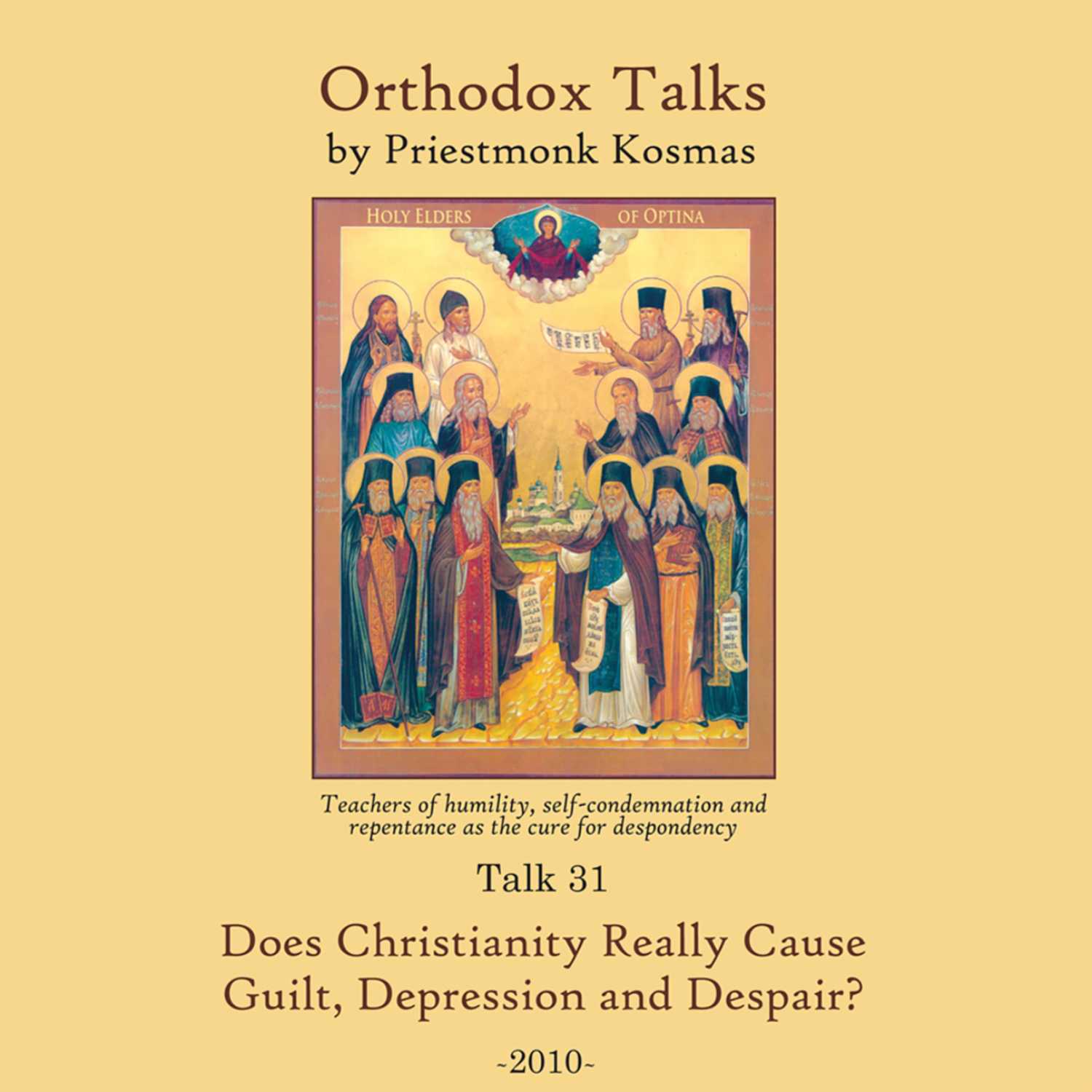
Talk 31: Does Christianity Really Cause Guilt, Depression and Despair?
About this episode
In the writings of the Holy Fathers we often find statements such as this: “One must consider oneself the worst person of all”; “Self-esteem is a sin”; “One must only look at one’s failures, never at one’s virtues”; “The proud cannot be saved”; “Always consider yourself a sinner”; and “There is nothing good in us.” Many find these types of statements upsetting, and come to the conclusion that Christianity causes guilt, depression and despair.
In this talk Father Kosmas explains that these things are caused not by Christianity, but by an incorrect and distorted approach to Christ’s holy teachings. Furthermore, he emphasises that our sins, weaknesses, passions and failures can be used to acquire self-knowledge, repentance, humility, faith, trust in God, grace, peace, spiritual joy and, ultimately, the salvation of our souls.
The following questions are also discussed: is constant fear of deception spiritually healthy? What is meant by “our passions are our spiritual friends”? Is medication the only solution for unwanted thoughts? Is a certain degree of self-esteem acceptable? How is spiritual correctness dangerous? Are Orthodox zealots and the ecumenists actually of the same spirit? What are spiritual freaks? How was the apostle Peter’s betrayal of Christ different from that of Judas? What did Elder Porphyrios say about people trapped in the sickness of guilt? What are the different causes of depression?
Other points covered in this talk include: how an inferiority complex is a spiritual illness and should not to be confused with humility; how the demons can help us teach the truth to others for the purpose of deceiving us later; the untrue teaching of some Catholic theologians that Judas repented; how distorted spiritual struggle can lead to heresy and blasphemy; how the passions cause spiritual blindness; how self-esteem drives away the spirit of God; the difference between weaklings and the spiritually weak; the true root of despondency; and an account of an Orthodox priest who believed that Francis of Assisi, a Roman Catholic saint, is also an Orthodox saint.
Duration: 2hrs 52mins
Visit our website: www.OrthodoxTalks.com
Get every episode summarized
Each time Orthodox Talks publishes, we email you a written briefing from the transcript — the topics, who appeared, and any specific claims, with the ad reads skipped.
Email me new episodesFree for 3 shows. No card needed.
Hosts & guests
No transcript yet
This episode has not been transcribed. Request it and it moves to the front of the queue.
More episodes
More from Orthodox Talks
Who Should We Listen to Regarding Contraceptives and the Avoidance of Having Chi...
Orthodox Talks

Talk 83: The Importance of Reading the Lives of Saints when Dealing with the Her...
Orthodox Talks
Talk 82: The Importance of Reading the Lives of Saints when Dealing with the Her...
Orthodox Talks
Talk 81: How to Overcome Doubt or Unbelief When Reading the Lives of the Saints
Orthodox Talks