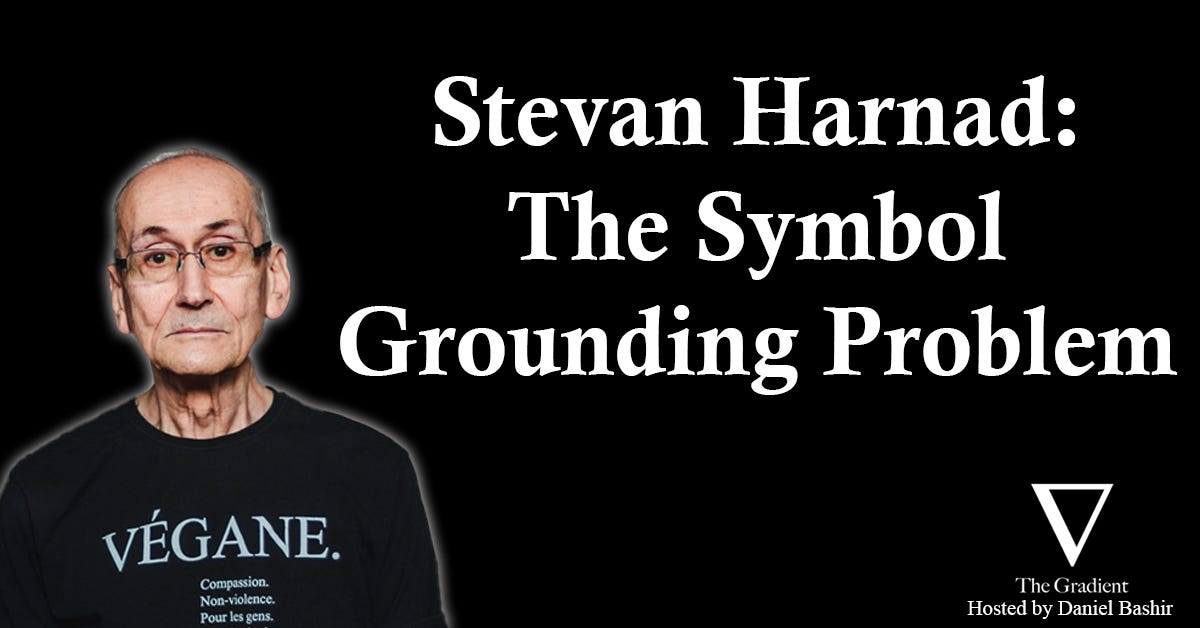
Stevan Harnad: AI's Symbol Grounding Problem
About this episode
In episode 88 of The Gradient Podcast, Daniel Bashir speaks to Professor Stevan Harnad.
Stevan Harnad is professor of psychology and cognitive science at Université du Québec à Montréal, adjunct professor of cognitive science at McGill University, and professor emeritus of cognitive science at the University of Southampton. His research is on category learning, categorical perception, symbol grounding, the evolution of language, and animal and human sentience (otherwise known as “consciousness”). He is also an advocate for open access and an activist for animal rights.
Have suggestions for future podcast guests (or other feedback)? Let us know here or reach us at [email protected]
Subscribe to The Gradient Podcast: Apple Podcasts | Spotify | Pocket Casts | RSSFollow The Gradient on Twitter
Outline:
* (00:00) Intro
* (05:20) Professor Harnad’s background: interests in cognitive psychobiology, editing Behavioral and Brain Sciences
* (07:40) John Searle submits the Chinese Room article
* (09:20) Early reactions to Searle and Prof. Harnad’s role
* (13:38) The core of Searle’s argument and the generator of the Symbol Grounding Problem, “strong AI”
* (19:00) Ways to ground symbols
* (20:26) The acquisition of categories
* (25:00) Pantomiming, non-linguistic category formation
* (27:45) Mathematics, abstraction, and grounding
* (36:20) Symbol manipulation and interpretation language
* (40:40) On the Whorf Hypothesis
* (48:39) Defining “grounding” and introducing the “T3” Turing Test
* (53:22) Turing’s concerns, AI and reverse-engineering cognition
* (59:25) Other Minds, T4 and zombies
* (1:05:48) Degrees of freedom in solutions to the Turing Test, the easy and hard problems of cognition
* (1:14:33) Over-interepretation of AI systems’ behavior, sentience concerns, T3 and evidence sentience
* (1:24:35) Prof. Harnad’s commentary on claims in The Vector Grounding Problem
* (1:28:05) RLHF and grounding, LLMs’ (ungrounded) capabilities, syntactic structure and propositions
* (1:35:30) Multimodal AI systems (image-text and robotic) and grounding, compositionality
* (1:42:50) Chomsky’s Universal Grammar, LLMs and T2
* (1:50:55) T3 and cognitive simulation
* (1:57:34) Outro
Links:
* Professor Harnad’s webpage and skywritings
* Papers:
* Category Induction and Representation
* From Sensorimotor Categories to Grounded Symbols
* Minds, machines and Searle 2
* The Latent Structure of Dictionaries
Get full access to The Gradient at thegradientpub.substack.com/subscribe
Get every episode summarized
Each time The Gradient: Perspectives on AI publishes, we email you a written briefing from the transcript — the topics, who appeared, and any specific claims, with the ad reads skipped.
Email me new episodesFree for 3 shows. No card needed.
Hosts & guests
No transcript yet
This episode has not been transcribed. Request it and it moves to the front of the queue.
More episodes
More from The Gradient: Perspectives on AI
2025 in AI, with Nathan Benaich
The Gradient: Perspectives on AI

Iason Gabriel: Value Alignment and the Ethics of Advanced AI Systems
The Gradient: Perspectives on AI
2024 in AI, with Nathan Benaich
The Gradient: Perspectives on AI
Philip Goff: Panpsychism as a Theory of Consciousness
The Gradient: Perspectives on AI