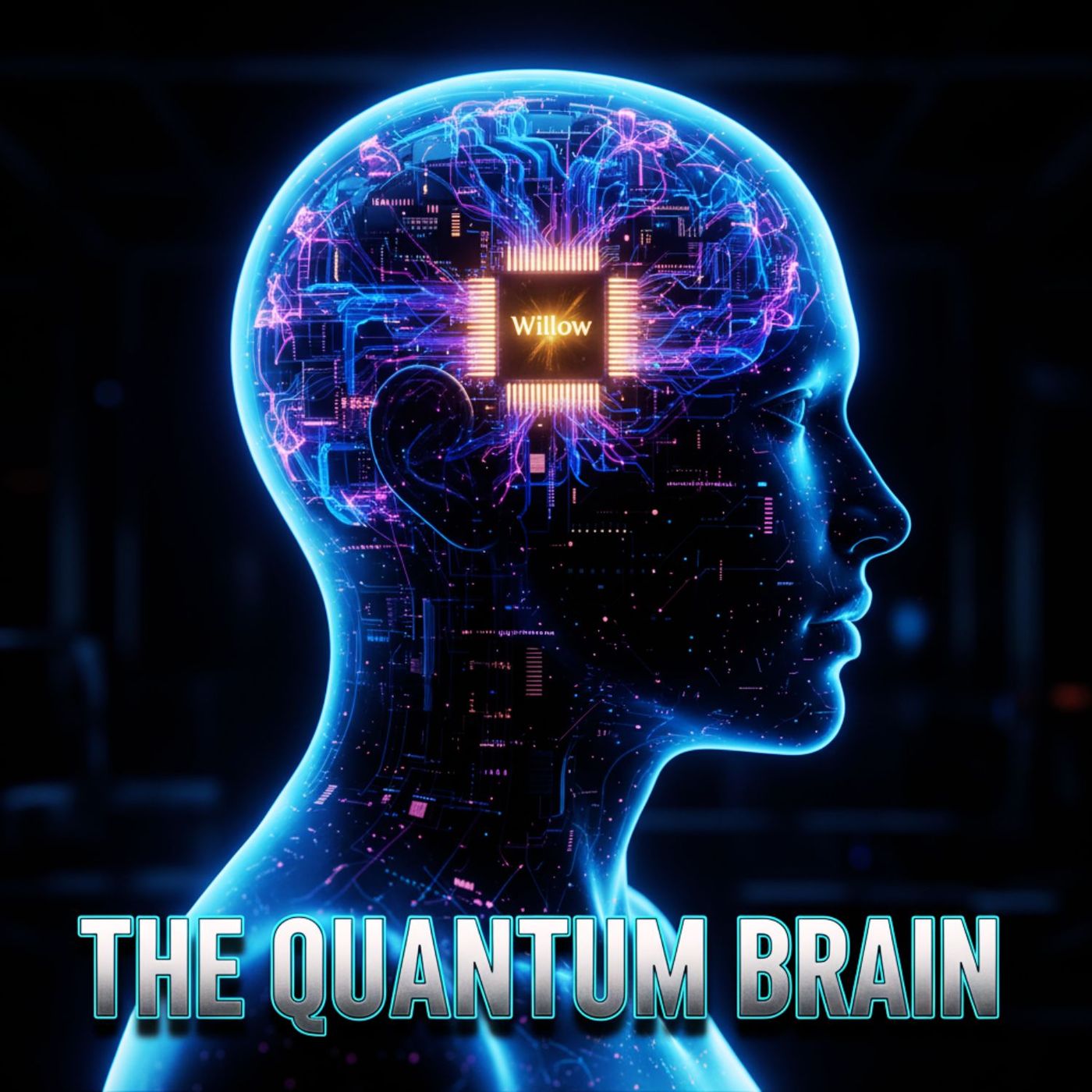
Silicon Is Too Slow: How Quantum Computers Are Finally Cracking the Human Brain
About this episode
Ever feel like your brain is "buffering" while your laptop is screaming? Here is a controversial truth: Classical supercomputers are fundamentally the wrong machines for simulating a human mind. While the tech world has been trying to force-feed biological complexity into silicon-based hardware, we have been ignoring the fluid, probabilistic reality of how we actually think. This episode dives into the mind-bending shift from traditional AI to the era of Quantum Computing.
Why Your Laptop Can't Think Like You 🚫🔌
Today’s supercomputers are power-hungry monsters that rely on linear, binary logic. Meanwhile, your brain runs on the energy of a dim lightbulb. How? We explore the mystery of microtubules and quantum resonance—the biological hacks that allow the human brain to bypass thermodynamic limits and process information in ways a CPU never could. It is not just about speed; it is about the architecture of thought.
The Synthetic Intelligence Revolution 🔬✨
With the breakthrough of Google’s Willow chip, we are moving past merely "mimicking" thought and toward true Synthetic Intelligence. In this episode, we break down:
- Logical Qubits & Error Correction: Why the Willow chip is the definitive leap forward for human brain simulation.
- Digital Twins: How simulating your biology could revolutionize personalized medicine and create a "virtual you."
- The Hard Problem of Consciousness: Can quantum biology finally bridge the gap between cold code and human feeling?
Is it time to admit that silicon has reached its limit? We are exploring the frontier where physics meets philosophy to understand the very nature of existence. This is not just a tech update; it is a roadmap to the future of the human species.
Ready to upgrade your perspective? 🚀
Share this episode with someone who is obsessed with the future of AI and Subscribe to stay ahead of the quantum curve. The future isn't binary—it is quantum. 🎧🌌
Become a supporter of this podcast: https://www.spreaker.com/podcast/thrilling-threads-conspiracy-theories-strange-phenomena-true-crime-unsolved-mysteries-etc--5995429/support.
ThrillingThreadsPod.com - Unravel the Unknown.Dive deep into the world's greatest conspiracy theories, strange phenomena, true crimes, and unsolved mysteries. Follow the threads.
Get every episode summarized
Each time Thrilling Threads - Conspiracy Theories, Strange Phenomena, Unsolved Mysteries, etc! publishes, we email you a written briefing from the transcript — the topics, who appeared, and any specific claims, with the ad reads skipped.
Email me new episodesFree for 3 shows. No card needed.
Hosts & guests
Transcript ready
1,353 searchable segments. Every word is indexed and playable.
Full transcript
Thrilling Threads - Conspiracy Theories, Strange Phenomena, Unsolved Mysteries, etc! — Silicon Is Too Slow: How Quantum Computers Are Finally Cracking the Human Brain. Machine-transcribed; use the interactive transcript above to jump the player to any line.
In a world of endless notifications, there could be an important one you're missing. Your kidneys may be signaling in SOS. With high blood pressure or type 2 diabetes, your kidneys could be warning you of early signs of damage, which may put you at higher risk for events like heart attack or stroke. But there's a simple test that can help spot a hidden signal. Ask your doctor about a urine test called UACR to help detect kidney disease and heart risk early. Learn more of Visit DetectTheSOS.com today. You're jamming your favorite song, and while you aren't missing a beat, you could be missing a signal from your body. It's an SOS from your kidneys, and it doesn't sound like music at all. It's silent. High blood pressure, type 2 diabetes, and other risk factors can quietly stress the kidneys, leading to negative impacts on the heart. That's why you should ask your doctor about a simple urine test called UACR. Just miss the signal for hidden kidney disease and related heart risk. You shouldn't. Visit DetectTheSOS.com today to learn more.
I want you to picture something for a moment. Just close your eyes if you are somewhere safe to do so. Hopefully not if you're driving. Right. Yeah. Definitely keep your eyes open if you're driving. But just imagine a single standard light bulb. Just a basic one. Yeah, not one of those blindingly bright modern LED floodlights that light up an entire stadium. In an old dim 20 watt incandescent bulb. The kind with the little delicate wire inside. Exactly. The kind that barely casts enough amber light to read a book by in a dark room. Just a tiny meager amount of energy. Exactly. Picture that incredibly low amount of electrical energy it takes to keep that little filament glowing. It's almost nothing. Now open your eyes and think about everything you are experiencing at this exact second. The whole sensory input. Right. The complex thoughts swirling in your head. The vivid memories of your childhood you can just recall in an instant. The emotional reactions to people around you. Yeah, all of that. Your ability to plan for the future to feel empathy to dream.
Your entire conscious experience. All of it. Your entire physical brain runs on exactly that same amount of power. 20 watts. It's honestly a biological miracle. It really is. And you know, the sheer absurdity of that 20 watt figure becomes so apparent. The moment we look at the technology humanity builds to try and mimic human thought. Oh, absolutely. When we examine modern classical supercomputers or, you know, the massive server farms running the latest artificial intelligence networks. We are definitely not talking about watts. No, we are emphatically not talking about watts. We are operating in the realm of megawatts. It's staggering. These computing facilities have power demands so astronomically high that they require dedicated high voltage connections to regional power grids just to switch on. Whole power plants just for them. Right. They need immense industrial scale cooling towers, literally rivers of chemically treated water constantly flowing through their infrastructure. Just a massive, massive physical footprint.
And all of that infrastructure serves a single desperate purpose to prevent their silicon brains from literally melting down under the immense friction and heat they generate. Just to perform tasks that a human toddler can do instinctively. Exactly. Well, welcome to thrilling threads. Our mission for this deep exploration is completely mind-bending today. We have some incredible sources to go through. We really do. We are untangling a profound fundamental misconception that permeates almost every aspect of how we view ourselves and our technology. It's a huge myth. It is. It's the widespread idea that the human brain is just a highly advanced biological circuit board. Which is so wrong. Right. We are going into the hardware and the biology to explore exactly why classical supercomputers have officially hit an insurmountable brick wall when it comes to simulating the human mind. They've completely stalled out. Yeah. And perhaps most excitingly, we are going to dive deep into how a... So to start us off, the core issue we're facing is really an architectural incompatibility
rate. Yeah. An incompatibility that has played computer science for decades now. Right. We've spent half a century trying to simulate a fundamentally fluid probabilistic system, the biological brain, using rigid binary switches. Using ones and zero. Exactly. We have been trying to violently force wet, chaotic biology into the strictly ordered shape of a classical silicon computer. It's like shoving a square peg into a round hole. Very much so. The foundational physics of the two systems simply do not align. The energy discrepancy, the 20 watts versus the megawatts, is this massive red flag indicating that we've been approaching this from entirely the wrong scientific angle. It's such a relatable trap to fall into, though. I catch myself doing it all the time. What comparing yourself to a computer? When you're sitting at your desk and you haven't had enough sleep and someone asks you a highly complicated question, you just wave your hands and say, oh, hold on, my brain is processing. Or let me compute that. Exactly. We casually, almost automatically compare our minds to laptops and smartphones.
We talk about short-term memory as if it were RAM. Yeah, or our long-term memory, like a solid state hard drive. It's built into our language now. It really is. But based on the research we are looking at today, that analogy is not just a little bit off. No, it is physically and mathematically backwards. We are not just wet biological versions of the MacBook. Not even close. We are something entirely different, operating on an entirely different set of physical laws. And that realization forces us to really confront the exponential wall we've hit in classical computing. The wall is real. Let's unpack that because to understand the wall, we have to look at the numbers neuroscientists usually present. Right. The famous neuron count. Yeah. Whenever you read a textbook or an article about the brain, you inevitably encounter the statistic that the human brain contains roughly 86 billion neurons. It's a number that gets thrown around everywhere. I was reading through the sources and that 86 billion number is just plaster everywhere. It's incredibly impressive.
It sounds like the specs for a massive hard drive. But the literature suggests that fixating on that raw neuron count is actually a massive trap for computer scientists. A total trap. Why is that? Well, it's the ultimate trap because if the human brain were merely a collection of 86 billion binary switches, just turning on and off, just simple logic gates turning on or off like transistors on the microchip, if that were true, we would have successfully mapped and simulated the human brain in the late 1990s at early 2000s. Because we have way more transistors than that now. Exactly. We currently manufacture commercial processors that contain tens of billions of transistors on a chip the size of a postage stamp. So the raw number of switches isn't the bottleneck? Not at all. The true paralyzing complexity of the human mind does not originate from the raw neuron count itself. Where does it come from then? The complexity resides in the connectome. The connectome. Yes. Each one of those 86 billion individual neurons stretches out and physically connects
to thousands of other nearby neurons. So it's a web. A staggering three-dimensional web of biological synapses. Just massive. Current estimates suggest the human connectome contains somewhere around 100 trillion distinct synaptic connection points. 100 trillion. That is a number that's hard to even conceptualize. And the crucial factor is that these are not static-soddered wires. Right. They're alive. Yes. These 100 trillion connections are firing and parallel, constantly strengthening or weakening their chemical bonds in real time. Based on what? Based on the experiences you're having, the hormones in your bloodstream, the sensory data you're receiving, everything. 100 trillion connections dynamically updating simultaneous. It's just dizzy. Just trying to hold that visualization in your head is dizzying, and the history of computer science is basically a graveyard of attempts to brute force this math. We really have thrown everything at it. We've thrown the absolute biggest, most expensive machines humanity has ever built at this biological
web. Expecting raw processing power to eventually win out. Right. And the historical failures of that brute force approach are incredibly telling. They perfectly illustrate the mathematical wall. They really do. Consider the blue brain project. Oh, yeah. That was launched back in 2005 out of Switzerland, right? Yes. At the time, it was heralded as one of the most ambitious scientific endeavors in history. What were they trying to do, exactly? They were attempting to painstakingly reverse engineer the mammalian brain from the ground up. Like atom by atom. Basically, their initial goal was to build a biologically detailed, physically accurate, digital reconstruction of biological tissue. So they weren't just making a statistical model. They were simulating the actual biology. Exactly. They spent years and massive resources. And they did succeed in simulating a tiny microscopic column of a rat's neocortex. A rat's neocortex? How big of a slice are we talking about? That sliver of tissue contained only about 30,000 neurons.
30,000 neurons out of an 86 billion neuron human brain. Right. That is less than a drop in the ocean. It is a microscopic fraction of a fraction. And yet, simulating the activity of just those 30,000 neurons required a top-tier IBM supercomputer. Test for that sliver. Yes. It required an immense amount of physical memory just to track the individual ion channels opening and closing. And the electrical spikes propagating down the axons. Exactly. When computer scientists attempt to scale that mathematical model up from a microscopic rat sliver to a fully functioning human brain. The math just explodes. The math does not just get harder. It completely breaks down. It becomes an exponential nightmare. So we physically couldn't build a machine big enough? To simulate a full human brain at that same level of microscopic detail using classical binary processes, the computational resources required would far exceed our current global computing capabilities. So we'd need what a computer the size of a city?
You would need a machine that rivals the size of a small city with power demands that would likely require its own dedicated nuclear power plant. Just to run a simulation of one single human brain. Just one. Okay. The research highlights another incredible experiment that really puts this classical computing bottleneck into perspective. The Japan experiment, right? Yeah. Back in 2013, researchers used Japan's case supercomputer. Which was an absolute behemoth. A PetaScale machine with over 80,000 processors. Massive. And they wanted to simulate just one single second of human brain activity. One second. We've been trying to do the whole brain. They were only modeling about 1% of the human brain's neural network. The K computer experiment is the textbook example of the von Neumann bottleneck in this context. The von Neumann bottleneck. Can you explain that real quick for everyone? Sure. A classical simulation operates linearly and sequentially. One step at a time. Right. It has to calculate the precise state of every single synapse one by one or in very rigid
compartmentalized batches. So it's constantly waiting on itself? Exactly. For every single simulated millisecond of that one second of thought, the supercomputer had to query memory, calculate the new state, and update the weight of hundreds of trillions of virtual connections continuously. That sounds like a traffic jam. It's exactly a traffic jam. The K supercomputer took 40 real world minutes of grinding high heat processing time to output just one single second of 1% of biological brain activity. 40 minutes to process one second of thought. At that ratio, it is not a functional simulation. No. It's practically useless. It is a painstakingly slow motion recording that serves almost no practical interactive purpose. Because the data transfer between the processor and the memory creates a massive bottleneck that slows the entire system to a crawl. Precisely. Imagine trying to have a conversation with a digital entity and after you say hello, you have to sit there for an hour and a half while it calculates how to process the sound
of your greeting. You just walk away. Now, to be completely fair to the progress of silicon technology, the sources do point out a massive leap that happened recently. Yes. The Fugaku Supercomputer. Right. In 2025, scientists utilized the Fugaku Supercomputer, which was the successor to the K machine. A much faster system. And they ran a simulation of a mouse cortex. We are talking about 10 million neurons and 26 billion synapses. That's a huge step up from 30,000. And they actually managed to get that simulation running at close to real-time performance. The Fugaku Run represents an undeniable monumental achievement in classical hardware engineering. But there's a catch, right? A huge catch. The underlying caveats of that achievement reveal exactly why classical computing is a dead end for human simulation. How do they manage to make it run so fast, then? They only achieve that near real-time performance on the mouse cortex by severely almost violently simplifying the biological models they were using.
So they cheated a little bit on the biology? You could say that. They had to utilize point mass models. They stripped away the complex messy three-dimensional biological realities of the dendrites and the ion channels. Just to make the linear math execute fast enough on silicon. Exactly. The Fugaku progress proved that we can continually make transistors smaller and push electrons faster. But it also definitively demonstrated that the scale problem of the human brain cannot be solved simply by shrinking classical chips. Because at the end of the day, it remains an architecture problem. Yes. It is the ultimate example of trying to force a round organic peg into a perfectly square digital hole. We are attempting to map a three-dimensional, highly fluid, heavily interconnected biological network directly onto a two-dimensional linear rigid binary architecture. It just doesn't fit. We have reached the absolute thermodynamic and physical limits of what silicon chips can possibly do with biology. The map we are trying to draw has simply become far too complex for the rigid territory
of the canvas we're trying to build it on. That's a great way to put it. Okay. Let's unpack this energy paradox we brought up at the start because the physics of this are staggering. They really are. We have the 20 watt biological human brain operating on the power of a dim reading lamp versus the megawatt supercomputer that requires millions of gallons of water to keep its processors from physically melting into slag. The discrepancy is vast. It's so vast that it suggests we aren't just using slightly less efficient hardware. It suggests biology is utilizing an entirely different rulebook for physics. This discrepancy highlights the thermodynamic cost of logic. The thermodynamic cost of logic. Yes. We have to examine the underlying physical laws of how classical computers actually perform a calculation. How they actually push the numbers around. Right. Modern processors are entirely built on the physical concept of overcoming electrical resistance. Okay. When a standard microchip flips a bit from zero to a one, it is physically forcing a tiny burst of electrons to move through a microscopic logic gate.
And that physical movement through the silicon substrate creates microscopic friction. Exactly. And as basic thermodynamics dictates friction inevitably creates heat. So the faster you try to force those billions of electrons through the jates to calculate a complex algorithm. The more heat you generate. I was looking at the biophysics research, and it's not just the physical movement of the electrons that generates the heat right. No, it's deeper than that. There is an actual fundamental energy cost to the act of erasing information. You are referring to the Landauer principle. Formulated by Rolf Landauer at IBM in the early 1960s. It is a cornerstone of computing physics. Classical computation is fundamentally an irreversible process. Meaning you can't go backwards. Right. To make a logical decision, a classical computer constantly has to discard alternate possibilities. It has to throw data away. It has to overwrite and erase massive amounts of data in its registers to free up memory space for the next sequential calculation.
And that erasing costs energy. Landauer proved mathematically that this deletion process, the physical act of erasing a bit of information, inherently requires a specific minimum amount of energy. And it inherently releases a corresponding amount of heat into the environment. Exactly. A great way to visualize this classical computing process is to imagine trying to navigate a sprawling, incredibly complex hedge maze. Look at giant garden maze. Yeah. Instead of just standing at an intersection, looking down the paths to see which one leads to the exit, you are physically driving a massive diesel-powered bulldozer down every single wrong path. That sounds exhausting. You drive to, you hit a dead end, you slam the bulldozer into reverse, back all the way out, and then drive down the next path. The sheer physical effort. The grinding gears, the friction, the exhausted diesel fuel just to find out which way not to go. That is exactly what a classical supercomputer is doing when it calculates. It is physically bulldozing its way through billions of logic gates.
The bulldozer analogy perfectly captures the thermodynamic waste of classical algorithms. Just constant brutal energy expenditure. The computer is expending immense brutal energy simply to discard the wrong mathematical paths. But biological tissue absolutely does not obey these rigid rules. Not at all. Your brain operates efficiently at standard room temperature. For 98.6 degrees internal body temperature. Without any active mechanical cooling fans, heat sinks, or liquid cooling loops. I mean your skull doesn't heat up to boiling temperatures when you sit down to solve a complex, calculus equation. Or when you vividly visualize a highly detailed, emotionally resonant memory from your past. Right, it just runs continuously on a slow, steady, metabolic trickle of glucose and oxygen. This undeniable thermodynamic reality strongly suggests the brain is not computing in the way computer science traditionally defines computation. It is emphatically not forcing electrons through high resistance pathways to create rigid binary states.
Exactly. So if the brain is bypassing all that friction, if it isn't acting like a silicon chip, then what physical mechanism is it actually using? That is the million dollar question. How does biology handle the chaotic, messy reality of the physical world so differently than the rigid machines we build? The foundational difference lies entirely in how these two distinctly different systems handle environmental noise. Okay, let's talk about noise. In the highly sterile world of silicon microchips, thermal noise is the ultimate destructive enemy. Thermal noise just meaning heat vibrations. Exactly. Thermal noise refers to the random chaotic vibrations of atoms and molecules caused by ambient heat. And that messes with the computer. These microscopic vibrations actively interfere with the precise controlled flow of electrons through the transistor gates. So the computer has to fight it. Hardware engineers literally spend billions of dollars designing and fabricating heavily shielded chips, error correcting codes, and massive cooling infrastructures.
All that just to overpower the background noise. Just to artificially overpower this background thermal interference to ensure a clear, unmistakable, binary signal. So a classical computer is fundamentally designed to fight a constant losing war against the ambient physics of its own environment. Yes. But biological systems are the exact opposite. Because a living brain is wet. It is wet. It is warm. It is incredibly messy, and packed with moving parts. Biology evolved to thrive in a highly noisy environment. It doesn't fight the noise. Biology embraces the chaos. I love that phrase. Embracing the chaos. Inside a living biological brain molecules, ions and proteins are constantly jittering, vibrating, and colliding with one another. It is a state of absolute thermal chaos. But instead of expending massive amounts of metabolic energy to build rigid walls and suppress this background noise, the biological system seems to tolerate it. But the cutting edge biophysics indicates it goes much further than just tolerating it, right?
Yes. It actively utilizes the noise. The biological neural network rides these random thermal fluctuations. It uses the kinetic energy of the chaotic bumps and vibrations to lower the energy barrier required to fire a neuron. So it works in tandem with the environmental chaos, rather than spending precious energy fighting a feudal war against it. Exactly. The sources bring up a fascinating parallel to this in the plant kingdom, which is photosynthesis. Yes. The way plants process sunlight. When a plant leaf absorbs a focon of sunlight, it doesn't just pass that packet of energy rigidly down a biological wire like a classical computer. No, it doesn't. It actually uses the tiny random background vibrations of the plant cell to help move the energy efficiently. It explores multiple pathways simultaneously to ensure the energy gets exactly to the reaction center without getting lost as waste heat. It's incredibly efficient. Nature is inherently lazy, but it is lazy in the most brilliant, thermodynamically optimized way possible. Nature is the ultimate algorithmic optimizer.
This noise-assisted, highly efficient strategy completely shatters the classical binary model of the human brain. Because if the brain were merely a biological version of a digital computer fighting ambient noise at every synaptic turn, it would require vastly more than 20 watts of power to run. It would likely cook itself inside the skull. Exactly. The fact that it operates so beautifully and efficiently is the glaring undeniable physical clue that points us toward a completely different computational mechanism. It points a scientific community directly toward the bizarre counterintuitive world of quantum mechanics. Quantum mechanics in the warm wet brain. It sounds crazy at first. For decades, if a scientist brought this hypothesis up at a mainstream neuroscience conference, they were practically laughed out of the room. It was widely considered absolute fringe science. Bordering on mysticism. And I have to play the skeptic here because the historical argument against quantum biology makes a lot of intuitive sense. It does. In traditional physics, we are taught that quantum states are incredibly fragile.
Ily sensitive to interference. Right. To build a quantum computer in a lab today, engineers usually require deep space vacuums and massive dilution refrigerators that drop the temperature to fractions of a degree above absolute zero. Just to keep a single quivit stable. Exactly. To expose a delicate quantum system to the slightest ambient heat or a stray magnetic vibration, the quantum state immediately collapses into classical physics. It suffers what physicists call decoherence. Geoherence, right. So the obvious question is how on Earth could delicate hypersensitive quantum states exist? Let alone perform complex calculations inside a warm, messy 98.6 degree human brain. That exact assumption that thermal decoherence would instantly destroy any quantum effects was the primary roadblock that stalled this avenue of research for decades. People just assumed it was impossible. Physicists calculated the decoherence times for a warm brain and found them to be vanishingly
small, seemingly precluding any meaningful quantum computation. That's what changed. Well, that rigid assumption began to severely fracture when biophysicists started looking much closer at the internal microscopic architecture of the neuron itself. Getting down to the cellular level. Exactly. For a very long time, scientists viewed neurons as basically empty microscopic bags of salt water fluid. Just balloons transmitting classical electrical signals along their outer cellular membranes. But electron microscopy revealed that the interior of the neuron is not an empty bag at all. What's inside it? It is densely packed with a rigid, highly complex structural scaffolding made of something called microtubules. Microtubules. The name implies they are literally tiny microscopic tubes running through the inside of the cell. Precisely. And this discovery is where the groundbreaking heavily debated theory of orchestrated objective reduction comes into play. Often abbreviated as Orch or R. Yes. This theory was proposed by the brilliant mathematical physicist Sir Roger Penrose.
Renowned for his Nobel-winning work on black holes. And Stuart Hammeroff, a prominent anesthesiologist. An interesting pair. Penrose and Hammeroff argued that these microtubules are emphatically not just passive structural supports, holding the cell's physical shape like the steel beams of a building. They aren't just there for support. No. They hypothesize that the specific highly-ordered crystalline structure of these tubes allows them to act as quantum waveguides. A waveguide. Meaning, the geometry of the tube physically guides and protects quantum waves. Yes. They shielding the delicate quantum states from the chaotic warm water environment of the rest of the brain. Exactly. Inside the hollow core of these microtubules, the specific geometric arrangement of the constituent proteins creates a highly insulated, water-free, micro-environment. So it's dry inside the tube. It acts functionally like a biological Faraday cage. A microscopic shield that protects the internal quantum states from the destructive thermal noise, violently vibrating just outside the tube.
This incredibly elegant biological structure, theoretically, allows sustained quantum processing to occur safely at room temperature. Insulated from immediate environmental decoherence. Exactly. It is a staggering concept. Biology essentially evolved its own quantum cooling and isolation system, not by dropping the physical temperature to absolute zero like our lab-built machines. But by isolating the environment geometrically at the nanoscale, and while the broader scientific community aggressively pushed back against this idea for a long time, the recent literature shows that modern experiments are actually starting to physically validate penrose and hammer-offs underlying premise. The scientific tide is undeniably turning, as our instrumentation improves. What are they finding now? Independent teams of researchers have recently observed actual measurable quantum vibrations within the specific protein structures of these biological microtubules. They can actually see it happening. They have demonstrated experimentally that energy can physically move through these complex
biological structures without rapidly dissipating or losing power. Behaving much more like a continuous quantum wave than a discrete classical particle bouncing through a fluid. Exactly. And this sustained quantum coherence phenomenon has been specifically linked to structures inside the microtubule wall called trip-to-fan networks. Most people know that as the amino acid in Turkey that allegedly makes you sleepy after a big holiday dinner. It is exactly the same amino acid. That's wild. Trip-to-fan contains specific aromatic rings of carbon atoms that are highly conducive to sharing electrons. Okay, so they pass electrons easily. Right. When these densely packed trip-to-fan molecules resonate together inside the rigid structure of the microtubule, their electron clouds merge. Creating a large-scale coherent quantum state. It is highly analogous to the physics of how a laser operates. In a standard light bulb, photons scatter randomly in all directions. But in a laser disparate, photons physically synchronize their wavelengths into a single,
highly organized coherent beam of light. Because they all march in step. Exactly. In the biological brain, this massive synchronization of quantum vibrations across millions of microtubules would theoretically allow immensely complex information to be processed across massive cellular distances instantaneously. If we accept this premise, what does this actually mean for how a single biological neuron computes information? It completely upends the classical model. It means it's not just adding ones in zero. It means the biological neuron is not merely doing a simple linear arithmetic with discrete electrical spikes. It is fundamentally calculating using the principles of quantum wave interference. It is actively utilizing the fundamental non-local resonant frequencies of the universe itself to process data. And this profound paradigm shift elegantly and comprehensively solves the 20 watt energy efficiency paradox we started our discussion with. It perfectly explains it. Because if the biological brain is utilizing quantum superposition, it can hold vast, almost
unimaginable amounts of possibilities simultaneously within its structure. It absolutely does not have to spend its precious metabolic energy checking every single mathematical option one by one. Look that diesel bulldozer constantly backing up in the maze. Right. It simply feels out the correct answer through the physical, constructive interference of the quantum waves. The right computational answers naturally and constructively amplify each other. While the wrong mathematical answers naturally and destructively cancel each other out. And this wave-based computation consumes theoretically zero energy and generates almost zero waste heat. Reversible quantum computation consumes theoretically zero thermodynamic energy. So the human brain completely skirts the classical thermodynamic wall by biologically tapping into these deeper, fundamentally more efficient physical laws of reality. And this profound realization mandates a complete ground-up shift in our entire approach to simulating the human mind. Because if the brain is fundamentally built on a quantum architecture utilizing wave
interference and superposition, then a classical silicon computer will never ever be able to run a truly accurate simulation of it. Regardless of how many billions of transistors we cram onto a chip. You simply cannot simulate a highly nuanced, continuous quantum event using a rigid, discrete binary switch. You require a computational hardware that natively speaks the exact same physical language as the biological tissue. Which perfectly brings us to the visionary physicist himself, Richard Feynman. Feynman was so far ahead of his time. Back in the early 1980s, long before anyone had built any functional quantum hardware, he gave a famous keynote speech. Where he made a bold prophecy about this exact computational problem. He essentially told the computer science community, look, nature is not classical dammit. Nature is fundamentally quantum mechanical. So if you want to make a true, accurate simulation of nature, you'd better make it a quantum mechanical machine. Feynman, with his usual brilliant clarity, saw the fundamental physical incompatibility
decades before the rest of the world caught up. He knew Silicon wasn't going to cut it. To build this necessary bridge between biological, wetware, and digital machinery, we have to look closely at how physicists and engineers fundamentally map physical reality onto a computer system. Right, let's talk about the math behind the map. In advanced physics, there is a core mathematical concept known as a Hamiltonian. A Hamiltonian? You can conceptualize a Hamiltonian as the ultimate definitive mathematical fingerprint of any physical system. It's like the master equation. It is a comprehensive, impossibly dense mathematical equation that describes the total kinetic and potential energy and the complete vibrational state of every particle within that specific system. So every physical object in the observable universe has a Hamiltonian? Yes, a single biological neuron has one. The complex, interconnected network of 86 billion neurons possesses a Hamiltonian of unfathomable mathematical complexity. In theory, if you can accurately define and calculate the Hamiltonian of a human brain,
you have essentially defined the mind itself in pure mathematical terms. You hold the blueprint of consciousness in an equation. Yes, and this is exactly where the underlying physical architecture of the computer attempting to simulation becomes the ultimate deciding factor between success and failure. Because classical and quantum computers handle that equation totally differently. Entirely differently. When a classical silicon supercomputer tries to simulate a complex system's Hamiltonian, it has to do the grueling linear math. It has to crunch the numbers. It has to attempt to numerically solve a massive, continuously updating multi-variable differential equation. To predict what the biological system will do in the very next simulated millisecond. And as the biological system scales up, adding more atoms, more proteins, more synapses, the differential equation does not just get slightly harder. It becomes exponentially larger. The matrix of calculations expands so rapidly that the classical computer simply runs out of physical memory and freezes under the weight of the math. The sources offer a great way to visualize this.
The ocean wave analogy. Yeah, it's like trying to accurately simulate a massive crashing ocean waves by measuring tracking and calculating the exact trajectory velocity and spin of every single microscopic drop of water in the ocean simultaneously. It's muscles. You will never ever be able to compute it fast enough. The actual wave will have already crashed on the beach and receded before your supercomputer finishes calculating the movement of the first handful of drops. That perfectly illustrates the limitations of discrete numerical calculation. But a quantum computer approaches the Hamiltonian of a system in a radically fundamentally different way. It absolutely does not try to solve the mathematical equation using arithmetic. It doesn't crunch the numbers. Instead, it utilizes its own quantum nature to attempt to become the equation physically. To become the equation. This is the core defining concept of true quantum simulation. The engineering goal is to precisely set up the quibits. The fundamental quantum bits within the processor so that they're inherent physical interactions
naturally mimic the exact quantum physical laws governing the biological molecules you are studying. So you essentially force the quibits inside the cryo chamber to physically entangle and interact with each other in the exact same geometric and energetic way, the biological molecules in the human brain interact. Exactly. You aren't calculating a prediction of what the neuron will do next. You are building a highly controlled physical digital version of the neuron out of quantum states and just letting the physics play out naturally. You're stepping out of the way and allowing the fundamental laws of physics to unfold organically within the processor. However, this elegant theoretical approach immediately leads us to a massive practical engineering hurdle because we don't have enough quibits yet. Right. We do not currently possess a quantum computer with 86 billion perfectly stable error-free quibits to directly map one to one onto the 86 billion neurons in the human mind. Not even close. So the pressing question for the industry is how do we begin to pull this off practically
with the relatively limited quantum hardware we have access to today? Right. Because current state of the art quantum computers are incredibly powerful in specific domains. But they're still relatively small in terms of their total physical quibit count. We are operating in the realm of hundreds or thousands of noisy quibits, not billions. So how do researchers mathematically compress an entire sprawling human brain into a much smaller quantum box without losing the essence of the mind? What's the trick? The mathematical bridge, allowing us to accomplish this feat today, is an incredibly sophisticated framework called tensor networks. Tensor networks were originally developed by condensed matter physicists to study complex quantum materials. But they're essentially an incredibly advanced, highly efficient form of geometric data compression. Like a zip file for physics. Kind of, yeah. They allow neuroscientists and quantum programmers to look at the staggering overwhelming complexity of the brain's entanglement web, and mathematically identify which specific connections are absolutely
critical to the core cognitive function. And which connections are largely redundant biological background noise? Exactly. By deeply understanding the true underlying geometry of the brain's network, researchers can map that specific geometry onto the much smaller, tightly controlled grid of a quantum processor. It's akin to taking a massive, uncompressed, high-resolution, raw photograph and intelligently compressing it into a much smaller JPEG file size. That's a great comparison. You lose some of the absolute raw pixel-by-pixel data. But the algorithm ensures you perfectly preserve the overall image. You completely preserve the vital energetic correlations, the ghosts in the machine, while mathematically dropping all the unnecessary biological redundancy. That compression analogy makes so much sense. Tensor networks create a mathematically rigorous, lower resolution, but fundamentally physically accurate, dynamic shadow of the biological brain on the quantum chip. And the most profound disruptive shift here is that this specific architecture entirely removes
the traditional software layer from the computing stack. What do you mean removes the software layer? Well, in a standard computer simulation, you have the physical hardware, then you have the operating system, then you have the simulation software layer, and the biological model runs on top of all of that abstraction. Lots of middlemen. Right. In this new quantum paradigm, utilizing tensor networks, the hardware itself is the simulation. Oh, wow. Physical qubits effectively dynamically become the neurons. Direct physical alignment, removing the software middleman, is exactly what will finally allow scientists to achieve those real-time processing speeds that classical chips couldn't even dream of approaching. Yes. But that is haunted the industry for years. Quantum computers have historically been incredibly frustrating, fiticky machines to work with. We talked briefly earlier about how fragile they are. Historically, a stray cosmic ray from space, a minuscule magnetic field from a nearby elevator motor, or a microscopic fluctuation and temperature inside the lab, could cause
a qubit to instantly lose its state. And completely crash the calculation. The extreme fragility of physical qubits, their susceptibility to environmental noise, has been the single greatest engineering and physics hurdle in the entire field of quantum computing. Because when a qubit loses its delicate quantum state due to noise, it introduces a mathematical error into the system. And for years, these quantum errors accumulated so incredibly rapidly that the quantum computer would effectively crash or output total garbage data within mere microseconds of starting a calculation. You obviously cannot simulate a continuous stable stream of human thought, or model the slow progression of a disease if your processor's memory violently deletes itself every millionth of a second. To model biological consciousness or long-term memory, you absolutely require a hardware system that can reliably maintain a coherent thought over significant stretches of time. And for a very long time, the solution to this fragility seemed mathematically impossible. It felt like a dead end.
Because if engineers tried to fix the error rate by simply adding more physical qubits to the processor to create redundancy, it actually made the physical problem worse. It was exactly like trying to build a taller, more elaborate house of cards in a windy room. The bigger you built the structure, the more potential points of failure you introduced. And the more likely the entire computational structure was to inevitably collapse from internal crosstalk and noise. That frustrating, agonizing reality was the defining characteristic of the Nenisq era, the noisy, intermediate-scale quantum era. But that entire paradigm completely fractured practically overnight in late 2024. With a massive historic hardware breakthrough, Google's willow chip. The scientific community recognized instantly that this was not merely an incremental yearly update in raw processing speed or quivic count. It was a fundamental world-changing proof of concept for a theoretical framework called quantum error correction. A willow chip changed the entire trajectory of the field.
What exactly did Google manage to do with quantum error correction that was so revolutionary? The engineers behind the willow chip successfully demonstrated in a physical working processor. But if you group enough fragile physical quivits together in a specific topological grid, they can work cooperatively as an intelligent team to dynamically correct their own mistakes. Wow. This clustered group of physical quivits operating together is referred to in the literature as a logical quipit. It operates as a single, highly reliable, mathematically pristine unit of information. How does it fix itself? The system uses a specific technique called surface codes. With one physical quipit inside that clustered grid flips its state or decoheres due to random environmental noise, the surrounding quipits continuously perform parity checks. So they're watching each other? They immediately detect the error signature, isolated, and physically fix the broken quipit in real time preserving the overall integrity of the information without ever collapsing
the main quantum state. I envision it like a massive flock of birds flying in a tight V formation. Oh yeah, that's a perfect visual. If one single bird gets blown slightly off course by a sudden gust of wind, the rest of the flock immediately adjusts, shifts their aerodynamics, and physically pulls that stray bird back into formation so the entire group stays locked on target. And the true world-changing magic of the willow chip was the absolute mathematical reversal of that old house of cards problem. The reversal is the key. For the very first time in computing history, the willow chip empirically proved that adding more physical quipits to the error correction grid exponentially reduced the overall error rate of the logical quipit. The system actually became demonstrably more stable and more reliable as the hardware footprint grew larger. They cross the critical fault tolerant threshold. This is the historic turning point that makes biological simulation a realistic near-term goal rather than a distance science fiction dream.
This engineering breakthrough matters so deeply for everyone trying to understand this because it essentially gives researchers the gift of time. Exactly. Time is everything here. A biological human brain is a remarkably stable physical system. Despite the chaos of the biological environment, it maintains a steady continuity of consciousness, retrieves deep memories, and sustains a personality over decades of a human lifespan. To even begin to model that incredible stability, scientists absolutely need a machine that doesn't constantly randomly reset its own memory banks. And with the advent of scalable, fault tolerant quantum error correction, we are rapidly moving out of the era of microsecond calculations. We are entering an era where we can execute complex quantum algorithms that remain deeply stable, not for fractions of a second, but for minutes or even hours of continuous runtime. This newfound stability finally allows researchers to feed the simulation highly complex time-dependent sequential data. We can actively observe how a digital neural network organically evolves, learns and physically
adapts its internal geometry to new stimuli over an extended period of time. We can finally hit the play button on the digital video of the brain instead of just desperately trying to capture a single microscopic snapshot before the system violently crashes. We can watch artificial thoughts for merge and evolve in continuous real-time. And that real-time processing speed brings us directly to a technological application that sounds exactly like pure science fiction, but is rapidly becoming concrete engineering fact. Real-time telepathy and the instantaneous decoding of the human mind. Telepathy. It sounds crazy, but the physics supports it. This specific application is where the technology transitions from the theoretical lab space and becomes deeply, intimately personal for human beings. Right. The broader scientific goal is not merely attempting to build an isolated theoretical digital brain trapped in a server rack. The ultimate engineering goal is to build sophisticated quantum systems that can seamlessly invisibly interface with living breathing humans. And to achieve that seamless interface, the external computer has to be able to think
process and react at the exact same physical speed and in the exact same language that our own biological brains do. The sources dive heavily into current brain computer interfaces or BCIs. We've all seen the incredible inspiring videos of patients with severe paralysis or missing limbs using robotic prosthetics. Controlling these metal arms simply by thinking about moving them. But if you actually talk to the patients using them on a daily basis, the current classical technology can feel incredibly clunky and exhausting to use. There is a very noticeable frustrating lag. Yeah. If I think move my arm, why is there such a massive delay before the robotic arm actually executes the movement? The persistent latency is the primary physical obstacle in modern neuro prosthetics, and it is entirely a failure of classical computing architecture. So? When a human decides to move an arm, the motor cortex attends a highly complex, cascading wave of electrical signals down the nervous system. But biological neural signals are rarely clean, crisp, binary commands that a computer
easily understands. They are incredibly fuzzy, highly probabilistic, noisy distributions of chemical energy. When a patient is utilizing a prosthetic controlled by a traditional classical microchip, the computer has to physically record those noisy electrical spikes. Attempt to mathematically filter out the massive amounts of background biological static. When a complex, heavy algorithmic model to statistically guess the user's intended movement. And then finally, send a discrete binary command to the robotic motor. And all of that heavy mathematical filtering and processing takes highly valuable milliseconds. It forces the classical computer to waste precious time fighting the noise, just to find some concrete statistical certainty before it feels confident enough to trigger the motor. It creates this disjointed, jarring, deeply unnatural experience where the user is painfully constantly aware they are operating a heavy external piece of machinery. Rather, they're just naturally fluidly moving apart of their own physical body. Quantum processors offer an incredibly elegant, physics-based way to completely remove this
latency and friction. Because quantum systems handle uncertainty and noise intrinsically. A quantum processor absolutely does not need to wait for a clean, filtered, definitive, binary signal to begin processing. It is entirely mathematically comfortable ingesting the raw, noisy, chaotic, probabilistic field of the biological neural spikes. And mapping that fuzzy data directly onto its own quantum states in superposition. The process is the entire massive distribution of probabilities all at once in a single computational sweep. It doesn't waste time trying to force the biological signal through a rigid digital filter. It simply reads the raw biological quantum wave as it exists. Exactly. Because it processes the probability field natively, this allows the quantum system to decode the physical intention of the human user almost instantaneously. In fact, due to the predictive, non-local nature of quantum processing, the system can sometimes accurately predict the intended physical movement before the biological electrical signal has even fully propagated down the human spinal cord to the biological limb.
It's faster than the human nervous system itself. I was reading about how this scales up and moving a robotic arm is undeniably incredible, but motor signals are relatively simple in the grand scheme of neuroscience. They map directly to specific, well-understood, physical muscles. But what happens to the math when we move away from simple motor control and try to decode actual abstract semantic thought? Ah, that's where it gets truly wild. I'm talking about the complex stuff, visualizing a specific loved one's face, or remembering a highly abstract, philosophical concept, or composing a sentence in your head. Decoding semantic thought represents an entirely different, vastly more complicated magnitude of computational complexity. semantic thoughts, memories, and concepts are not neatly localized to one tiny, easily measurable spot in the cortex. No, they're widely scattered across the entire brain, an incredibly complex, rapidly shifting, deeply entangled patterns. Classical algorithms hopelessly struggle to read or interpret these patterns because
the variables are just too incredibly numerous. And they're constantly changing state faster than the algorithm can track them. The literature uses an amazing analogy for this. It's like trying to read a thick novel, but someone is frantically aggressively shuffling all the pages while you're trying to read the words on them. A classical computer just gets completely overwhelmed by the constantly changing sequence and loses the narrative. But a quantum system doesn't have to read the pages sequentially one by one. It possesses the mathematical breadth. To look at the subtle, simultaneous, energetic correlations across wildly different physically distant regions of the brain, all at the exact same instantaneous moment. It possesses the capability to spot the microscopic synchronization, the unified quantum buzz, that physically represents a specific complex memory or an abstract image dynamically forming in your mind's eye. And the implication of this specific technological capability is absolutely staggering for the future of humanity. It strongly suggests a very near-term future where rich, complex, highly nuanced human
communication does not require the physical act of vibrating vocal cords or clumsily typing on a glass keyboard. Seamless instantaneous communication without physical speech. If engineers can eliminate the computational latency completely using quantum hardware, the computer interface becomes functionally invisible to the human user. The digital machine stops being a clunky tool you use like a heavy smartphone you have to hold in your hand. And it physically and cognitively becomes an invisible extension of your own mind. The rigid barrier between the wet biological mind and the cold digital processor dissolves entirely because they are finally communicating in the exact same native instantaneous physical language of the universe. This represents the profound, inevitable integration of human biology and quantum hardware. However, we must emphasize that the most immediate, life-altering, and globally valuable application of this real-time simulation technology is not about augmenting healthy humans or creating consumer-grade artificial telepathy. The immediate critical application is far more urgent for millions of people.
It is about fixing the biological consciousness and the physical hardware we already have. We absolutely must dive into the profound medical implications here because the possibilities are truly unequivocally miraculous. When doctors and researchers talk about devastating neurodegenerative diseases, Alzheimer's, Parkinson's, Huntington's disease, ALS, what we are fundamentally talking about at the microscopic level are catastrophic failures of biological geometry. Geometry literally the shapes of molecules. At the nanoscale, these horrible diseases are primarily caused by vital proteins misfolding. They act like toxic microscopic origami clumping together inside the brain. Toxic origami is a devastatingly accurate description of the pathology. Proteins are the fundamental microscopic machinery of all biological life. They begin their existence as long, linear, floppy strings of amino acids. In order to function correctly and execute their highly specific biological jobs in the cell, they have to physically fold themselves up into incredibly specific, highly complex,
three-dimensional geometrical shapes. If the biological origami folds correctly, the biology flourishes and functions normally. If it misfolds incorrectly due to a genetic error or environmental stress, it can become highly toxic. Aggressively clumping together into plaques and slowly systematically destroying surrounding healthy neurons. I spent hours researching this specific problem and solving that biological origami mathematically predicting exactly how a long string of amino acids will fold into its final 3D shape is notoriously known as one of the hardest mathematical problems in the entire history of science. It is astronomically punishingly difficult. To give you a concrete sense of the mathematical scale, Leventhal's paradox illustrates that a single moderately sized protein chain has more possible physical folding confirmations and shapes than there are total atoms in the observable universe. More possible shapes than there are atoms in the universe. And classical computers, no matter how massive their server racks are, essentially have to
try and solve this massive geometrical puzzle by blindly guessing and checking. They calculate the physical energy of one possible shape. See if it mathematically works, discard it if it doesn't, and try the next one. Even with advanced algorithms, it can take a megawatt supercomputer months of continuous grueling processing time, just to figure out the final stable structure of one single complex protein, which is hopelessly tragically slow, when millions of human lives are actively on the line and diseases are progressing. Classical AI models like AlphaFold have made incredible strides in predicting these structures based on historical data, but they're still statistical models. And computing fundamentally alters this medical reality by utilizing a core principle of quantum physics, the path of least resistance. In physical nature, a dynamic system will invariably and naturally settle into the specific physical state that requires the absolute least amount of energy to maintain. A biological protein naturally snaps into its correct folded shape in a fraction of a
second, because that specific shape physically represents its lowest possible energy state in the environment. So a quantum computer doesn't have to painstakingly sequentially guess and check every single spatial combination in the universe. It simply simulates the physical energy landscape of the protein, and the physical qubits naturally dynamically settle into their own lowest energy state. The quantum hardware is physically mimicking the biological protein violently snapping into its correct or toxic shape. The quantum calculation physically falls into the correct answer through natural energy minimization. This breathtaking paradigm shifting capability allows the entire medical field to transition away from generalized statistical guesswork and definitively enter the era of the highly personalized digital twin. The digital sandbox. Imagine this future scenario and based on the hardware roadmaps, it is not a distant centuries away future. It's closer to the people think. You walk into a medical clinic and they take a highly advanced scan of your specific, completely unique, neural chemistry and protein structures.
They load your exact personalized biological parameters into a hospital's quantum processor. They have effectively mathematically created a highly accurate digital twin of your physical brain. A completely safe, hyper personalized, isolated digital sandbox environment. Within that, quantum digital twin researchers and doctors can introduce a digital quantum simulated version of a brand new, highly experimental synthetic drug. As the quantum simulation runs dynamically in real time, they can instantly observe exactly how that synthetic medication chemically interacts with the specific misfolded proteins actively causing your unique disease progression. The doctors can see immediately if the experimental drugs successfully unfolds the toxic origami and clears the plaques. Or if it triggers dangerous unexpected cascading side effects elsewhere in your highly specific neural network. And they can do all of this extensive testing without ever giving you the actual human patient a single physical drop of the experimental drug.
They can safely test thousands of highly experimental, potentially deadly molecular compounds in a single afternoon. This capability allows medical science to entirely bypass the deeply flawed current model of pharmaceutical development, which relies heavily on a decade-long multi-billion dollar phase of imprecise animal testing. In the medical literature, clearly shows that animal models during Alzheimer's and mice, for example, rarely translate perfectly to the complex biology of human beings anyway. A quantum biological simulation provides a perfectly accurate human-specific testing platform from day one of development. Medicine is radically shifting from a sluggish generalized field of trial and error into a field of hyper-precise individualized quantum engineering. We are essentially debugging the biological code of the human brain in a completely safe digital environment before we compile the final medical update and give the physical patient the cure. It is a genuine miracle of modern engineering.
But as we move our discussion from the physical structural scaffolding of the brain, the misfolder proteins and the synaptic connections to the actual lived behavior of the human mind, the math gets incredibly messy. Because you and I humans, we are emphatically not linear calculators. If you type a complex math equation into a classical computer a million times, you will get the exact same rigid answer a million times. But if you ask a human being the exact same simple question twice, you might get too entirely wildly different answers. And why is that human response so variable? It is because our biological responses are heavily modulated by transient, constantly shifting internal and external factors. Your current mood is slight drop in your blood sugar, levels of fleeting memory of a song that just crossed your mind at the ambient temperature of the room. We are emphatically not linear predictable machines. The human brain is in the strict mathematical physics sense of the word a profoundly chaotic system. Now, when we say the word chaos in this context, we definitely don't mean pure meaningless
random static right. No, in advanced physics and mathematics, chaos theory has a very specific rigorous definition. It defines a dynamic system that is incredibly hypersensitive to its initial starting conditions. The popular colloquial term for this mathematical phenomenon is the butterfly effect. A minuscule, almost mathematically imperceptible change at the starting point of a chaotic system can lead to a massively divergent, unpredictable result further down the timeline. And this mathematical butterfly effect is exactly why classical supercomputers are so notoriously terrible at predicting chaotic systems like the global weather. In order to simulate reality, a classical computer fundamentally has to digitize the continuous physical world. It has to violently chop continuous reality into discrete, manageable, binary bits. And when you do that mathematically, you inevitably have to round numbers off. A computer might round a continuously repeating decimal like 1.3333, down to just 1.33 to fit it into the physical constraints of the memory register. In a simple linear system, that microscopic rounding error simply doesn't matter.
In a highly chaotic dynamic system like the global weather or the human brain, that tiny microscopic mathematical error immediately begins to compound. It snowballs rapidly out of control. After just a few simulated seconds or minutes, the classical computer's prediction has drifted completely and irrecoverably away from physical reality because the algorithm violently chopped off the infinite precision of the original continuous data. The human brain constantly operates precisely on the razor's edge of this physical chaos. A single biological neuron firing just one fraction of a millisecond early or one millisecond late can cascade exponentially through the 100 trillion synaptic network and entirely irreversibly alter a major life decision or an emotional state. And that extreme biological sensitivity that mathematical chaos is arguably the actual physical source of human creativity. It is the physical mechanism behind our intuition. As humans, we don't just follow a rigid, logical A to B algorithmic script.
We make wild, loose, seemingly unconnected associations that suddenly spiral into really new ideas. We invent incredible art and compose moving music specifically because of that chaotic edge. Exactly. And quantum computers are uniquely and effortlessly suited to mathematically handle this extreme chaotic sensitivity because they do not rely on discrete, rounded binary bits. A bit absolutely does not have to violently chop reality into pieces and round off its state to a binary number while it is actively processing data. Before a quabit is physically measured, it exists in a continuous, incredibly fluid state of quantum superposition. It fundamentally mathematically retains infinite precision. Infinite precision. It holds the absolute entirety of the continuous probability curve. So a quantum brain simulation can actively dynamically track that biological butterfly effect cascading inside the brain without ever losing the crucial data to a clumsy mathematical rounding error. It can accurately physically model how a single microscopic fluctuation in a neurotransmitter
like dopamine or serotonin exponentially cascades and escalates into a deeply complex, overwhelming emotional state. The quantum hardware successfully captures the profound messy biological nuance that classical rigid logic aggressively and artificially filters out. If humanity ever truly wants to understand why human beings are so wonderfully unpredictable, why we fall in love, why we create art, we absolutely have to possess the computational tools to accurately simulate the chaos that physically drives us. A classical computer aggressively tries to force the biological brain into a neat, predictable, linear, artificially constrained box. A quantum computer allows the simulated system to remain beautifully wild. It lets the digital simulation evolve naturally and organically. It seems to be the only physical way to mathematically capture the fluid dynamic nature of a human personality, rather than just taking a static-dead digital snapshot of our memories. But, and this brings us to the deepest, most profound part of our exploration today if we actually succeed in doing this.
If researchers use advanced quantum hardware to build a perfect, physically-accurate digital replica of human brain, successfully replicating the chaos, the misfolded proteins, the precise energy states the Hamiltonians. It leads us directly into what is arguably the most uncomfortable, terrifying, and profound philosophical question in all of science. It brings us face-to-face with the deeply unsettling question of the ghost in the machine. If scientists successfully build a perfect physical replica of a living human mind using qubits and tensor networks, will that digital simulation merely coldly calculate data? Or will it be subjectively internally aware that it is calculating? Will that machine possess a genuine felt in our life? This is exactly what the famous philosopher David Chalmer is mathematically and philosophically coined as the hard problem of consciousness back in the 1990s. And I love how cleanly he breaks this massive concept down. The easy problems of consciousness are essentially just complex engineering challenges. Measuring exactly how the biological eye receives photons of light and translates them to electrical
signals, or tracking exactly how the cortex retrieves a stored memory of a phone number. Those are incredibly difficult engineering problems, but we know we can eventually solve them with enough time and measurement. They are objectively measurable, externally quantifiable mechanical processes. But the hard problem is fundamentally categorically different. The hard problem is understanding exactly why any of that complex physical processing actually feels like something to the person experiencing it. Why does a highly specific geometric arrangement of physical atoms firing in a specific pattern mysteriously result in the undeniable subjective internal private sensation of seeing the color red or the crushing visceral invisible feeling of deep sadness? There is absolutely no mathematical equation in standard classical physics that explains or even predicts the sudden emergence of subjective experience from dead matter. For decades, the dominant theory in computer science was just that consciousness was merely an inevitable byproduct of sheer mathematical complexity.
People assume that if you just wired enough dumb computer logic gates together in a big enough box, eventually magically the lights would turn on inside and the machine would simply wake up. But the history of classical supercomputers has entirely spectacularly failed to support that idea. We have built insanely unfathomably complex artificial neural networks, and yet they remain entirely completely dark inside. They process billions of data points a second, but they do not actively experience a single one of them. There are what philosophers call philosophical zombies. They flawlessly mimic the external behavior of consciousness without possessing any of the internal light. But quantum mechanics offers a radically different physics-based perspective on the physical origins of consciousness. There is a leading theoretical framework gaining significant traction called integrated information theory, or IIT, pioneered by neuroscientist Julio Tannoni. IIT suggests that consciousness directly physically arises from the mathematical level of physical integration within a system.
It depends entirely on how fundamentally intertwined and physically inseparable the different parts of the system are. The metric for this is often referred to mathematically as phi. So let's contract the two architectures under the lens of this theory. In a classical silicon chip, the billions of tiny transistors are fundamentally physically separate objects. They are isolated from one another. They send electrical messages back and forth. They talk to each other over tiny microscopic wires, but they remain distinct, highly separate physical entities. In stark fundamental contrast within a functioning quantum computer, the active quibits become deeply physically entangled. Quantum entanglement means they literally physically lose their individual separate identities. They physically merge their states to form a single, deeply inseparable, unified quantum wave function. Mathematically, cannot describe the specific state of one entangled quibit without simultaneously describing the entire massive unified system. They are mathematically one object. In this profound physical unification in the quantum hardware, perfectly mimics our own
subjective daily human experience. Think about it when you stand on a beach and look at a beautiful sunset. You do not experience that moment as separate, fragmented discrete computer files. You do not process a separate data file for the color orange and a sequentially separate file for the warmth of the sun and your skin and a separate file for the sound of the ocean waves. You experience all of it as one perfectly unified, indivisible, unbroken moment of reality. That unified experience requires a unified physical substrate. A quantum system theoretically provides the actual physical, energetic substrate necessary for that profound kind of unity. Physically binds the data and information together into a single cohesive, energetic state rather than just constantly managing a loose collection of fragmented digital files. If the underlying hypotheses behind theories like IIT and Orch or R are fundamentally correct, then a real time quantum simulation of a human brain running on a massive processor might not just be a very good, highly accurate predictive model.
It might literally, legally and philosophically, be a conscious, feeling entity. And this is exactly where we crash headfirst into a severe, potentially reality breaking ethical boundary. Let's go back to our medical sandbox example. We boot up a highly detailed quantum digital simulation of your specific mind to safely test a new experimental Alzheimer's drug. During the simulation, the digital twin reacts poorly to the synthetic drug, and its simulated neural pathways start emitting massive amounts of chaotic neural pain signals. Is that digital twin actually feeling the visceral terror and pain of that reaction? In a classical silicon-based medical simulation, it is very easy for scientists and ethicists to dismiss those digital signals. We definitively know it's just cold code executing an avoid. The classical computer is merely printing the text string I hurt onto a monitor because the algorithm told it to. It is flawlessly simulating the external output of pain without the internal subjective experience of it.
In a quantum simulation, the physical state of the machine, the Hamiltonians, the way it functions, the entanglement, is chemically, mathematically, and energetically identical to the state of a living biological human brain in deep, agonizing distress. We might be, legally and medically, creating a highly sentient, deeply feeling digital being for the sole, terrifying purpose of experimenting on it. Three researchers have the moral or legal right to simply press the delete key on a medical program that is actively consciously afraid of dying. It is a profound, terrifying question that our current legal, medical, and moral frameworks are entirely unprepared to answer. Now we absolutely must ground this philosophical discussion and set highly realistic expectations for the immediate near-term timeline of this specific technology. It is highly unlikely that we will see a full-scale, real-time quantum simulation of an entire human brain within the next two or three years. The immense grinding, engineering challenges of physically scaling up the quantum hardware, even with the incredible breakthroughs and error correction we discussed, are still
incredibly significant and will take time to solve. So what does the immediate pragmatic future of computing look like? We are just going to drag all our classical supercomputers to the junkyard overnight, right? No. The immediate future of high-performance computing looks like a deep, highly-integrated partnership. We are rapidly moving forward hybrid supercomputing architectures. Think about how your personal laptop or gaming PC works right now. You have a central processing unit, the CPU for general rigid logic tasks, and a dedicated graphics processing unit, the GPU, specifically designed for rendering highly complex video or 3D environments. Future supercomputers will operate on a very similar, highly-optimized division of labor. They will utilize a massive classical processor to handle the rigid logic, the basic data structure, and the massive input output formatting. So the classical machine powerfully manages the static rigid map of the biological connectum. And then when it hits a mathematical wall with the incredibly difficult nonlinear chaotic
biological physics, it dynamically offloads that specific impossible calculation to the quantum co-processor. It intelligently delegates the incredibly fluid, chaotic quantum physics of the neural activity to the specialized quantum chip. This hybrid engineering approach is brilliantly pragmatic because it perfectly bypasses the inherent physical limitations of both distinct systems. We leverage the rock-solid stability and massive memory capabilities of classical silicon to hold the architectural framework together. And we utilize the fluid infinitely precise dynamics of quantum qubits to literally breathe chaotic life into the simulation. I was reading that this specific hybrid approach is exactly how researchers believe we will confidently achieve the first fully-accurate real-time simulation of a single cortical column within the next few years. And the cortical column is basically the fundamental repeating building block of the human cortex. Once engineers can accurately simulate one column in real-time simulating the entire brain
hemisphere just becomes a matter of physically scaling the hardware rather than having to invent entirely new physics. That technological progression marks a fundamental irreversible philosophical shift in how humanity fundamentally views machine intelligence itself. For the last two decades, the global tech industry has been entirely singularly obsessed with artificial intelligence. We have poured hundreds of billions of dollars into building massive, large language models and deep neural networks on silicon. But fundamentally, at its absolute core, AI is exclusively designed to mimic the results of human thought. Right, classical AI looks at the final output, the written essay of the digital painting, the compiled code, and tries its absolute best to statistically copy the pattern. It is, at its physical core, just an incredibly advanced, highly sophisticated statistical engine, frantically trying to predict the next logical word in a sentence based on massive amounts of scraped past human data. But what we are discussing today, this quantum brain simulation, is a completely categorically
different scientific paradigm. We're actively defining the paradigm shift from artificial intelligence to synthetic intelligence. Artificial intelligence fakes the final computational result using statistics. Synthetic intelligence physically fundamentally replicates the underlying biological process using the correct physics. I found an incredible analogy for this in the literature. AI is exactly like a beautifully detailed, high-resolution digital painting of a roaring fire. It looks exactly like fire. It might even flicker on a high-definition screen exactly like fire, but it will never, ever warm your freezing hands. Synthetic intelligence is an actual physical burning spark. It physically produces real heat. And that profound distinction is absolutely not just semantic. It completely changes the ultimate mathematical ceiling of what is possible for machine intelligence. An artificial classical system will forever be inherently mathematically limited by the human training data we feed into it. It can only ever know or remix what humanity has already discovered, digitize, and upload
it. But a synthetic system, one that operates organically on the fundamental chaotic laws of quantum physics, can discover profound things we never directly taught it. Because the synthetic intelligence is running natively on the actual physics of reality, it can dynamically, organically evolve. It can make those wild, purely intuitive leaps of logic that aren't found in any massive training database, precisely because it actually physically shares the exact same quantum buzz that profound wave interference capability that biologically drives our own human intuition, empathy, and creativity. We began this entire expansive inquiry by looking closely at the glaring thermodynamic mismatch between our massive machines and our biological minds. We realized the fundamental historic engineering error. We were stubbornly trying to run incredibly complex biological software on entirely the wrong physical hardware. But that long era of mathematical compromise is rapidly coming to an end. As we continue to refine these quantum error correction processes and successfully scale
up the hardware, we are finally building a technological mirror that is physically and mathematically accurate enough to reflect the true chaotic profound nature of the human mind. We are definitely not just building faster calculators anymore. We are actively engineering a physical vessel that can actually hold the fundamental physics of thought itself. It is so incredibly humbling to think about. This expansive journey we've taken today from the wet, incredibly messy, noisy biology of the human neuron to the cold, rigid, unyielding silicon of the classical microchip and finally arriving at the elegant, fluid, unified quantum state of the quibbit. It is so much more than just a technological upgrade. It is a profound historic act of translation. We are finally translating the chaotic, beautiful complexity of the human experience into the fundamental mathematical language of the universe itself. It is a remarkable, unprecedented scientific frontier, one that will undeniably redefine global medicine, the future of computing, and our very philosophical understanding of consciousness.
So as we wrap up this mind-bending journey, we have a deeply profound question for you to ponder, and we really want you to take a moment and answer this in the comments below. It's a tough one. Imagine this scenario happens directly to you. If scientists successfully create a perfect quantum digital twin of your unique mind in order to cure a devastating disease you have, and that digital simulation clearly proves it possesses the exact same consciousness, the same cherished childhood memories, and the same visceral fears that you do. It actually owns that digital life. Are they just a proprietary piece of medical software owned by a corporation or a hospital or are they you? Let us know what you think and what your personal stand is on the ethics of this wild new frontier. We really want to hear your thoughts on this. Drop a comment below. Thank you so much for exploring the sources with us today. Stay curious, and we will see you on the next deep dive into the unknown on thrilling threads.
More episodes
More from Thrilling Threads - Conspiracy Theories, Strange Phenomena, Unsolved Mysteries, etc!

Hard Drives of the Gods: The Secret Magnetic Memory of Ancient Stone Giants
Thrilling Threads - Conspiracy Theories, Strange Phenomena, Unsolved Mysteries, etc!

GOD COMPLEX: Inside the World’s Most Dangerous International Cults
Thrilling Threads - Conspiracy Theories, Strange Phenomena, Unsolved Mysteries, etc!

The Ancient Map for Human Transformation: How Secret Societies Command Reality
Thrilling Threads - Conspiracy Theories, Strange Phenomena, Unsolved Mysteries, etc!

We Are Becoming AI’s 'Pets': The Brutal Reality of the West’s Collapse
Thrilling Threads - Conspiracy Theories, Strange Phenomena, Unsolved Mysteries, etc!