Self-Spreading CRISPR and the Sun Battery That Outperforms Lithium-Ion
About this episode
This episode is brought to you by the Daily Quote. The podcast designed to kickstart your day in a positive way.
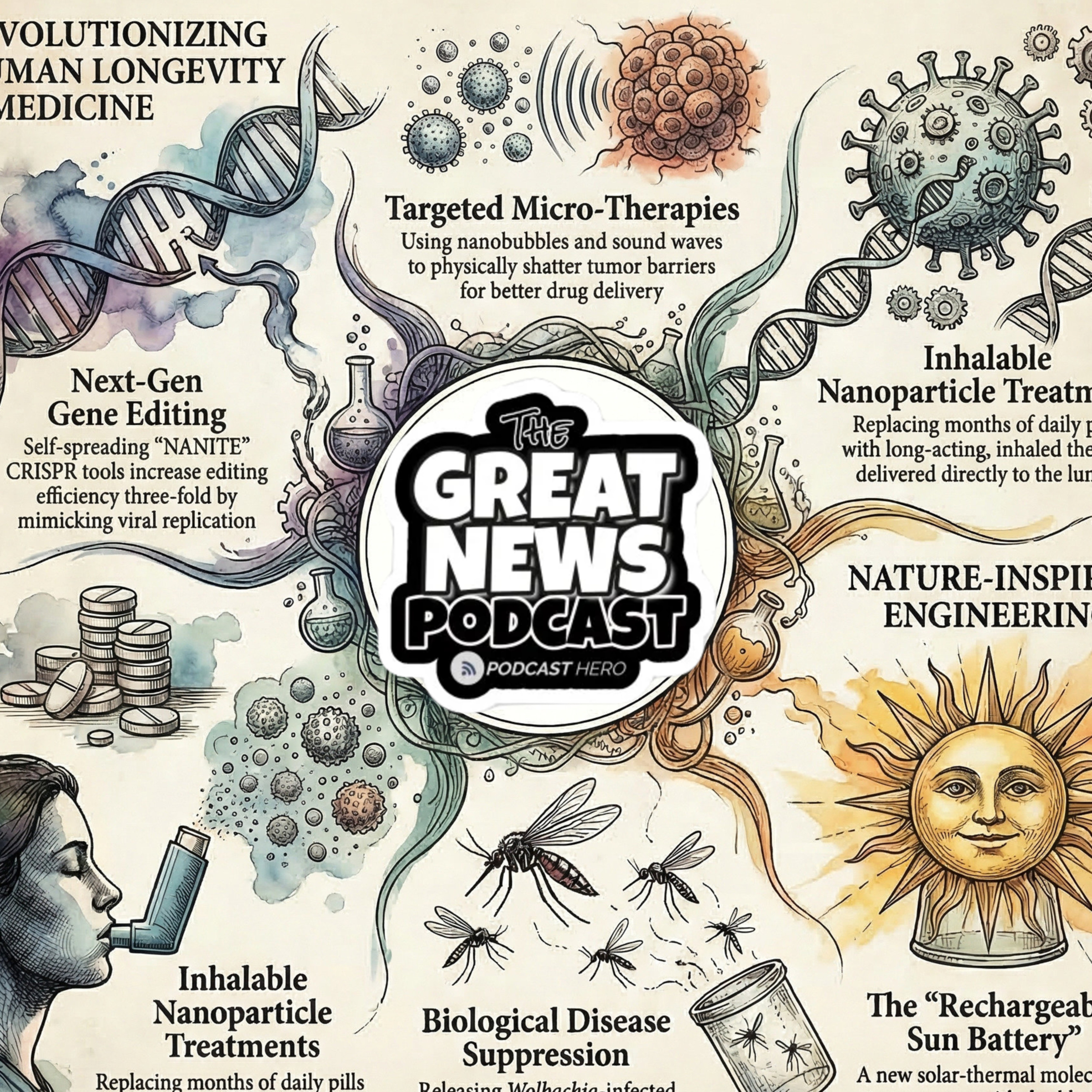
Today, we are diving into some truly groundbreaking advancements in medicine, biotechnology, and sustainable energy. What if a gene editor could replicate and spread like a virus to ensure it reaches every cell that needs a cure? That is our lead story today.
Plus, we have a "rechargeable sun battery" that outperforms lithium-ion, tiny bubbles that shatter cancer’s defenses, and a city-wide success story in wiping out Dengue fever.
CRISPR Gene Editor Replicates and Spreads Like a Virus
New Sun Battery Beats Lithium-Ion
Bubbles and Ultrasound Break Soften Tumour Walls for Better Treatment
And don’t forget to stick around for the speed round, where we’ll dive into even more great news.Prime C Shows Striking Survival Benefit in ALS Clinical Trial
Inhalable Treatment Could Replace Months of Pills for TB
Could a “Longevity Protein” Slow How We Age?An Inflammation Suppressor Decreases Mortality
Turning Our Own DNA Against Cancer
Until next time, keep looking for the good in the world, because it’s not only there—it’s everywhere.
Get every episode summarized
Each time Great News | Inspiring Stories, Positive Developments and Good News publishes, we email you a written briefing from the transcript — the topics, who appeared, and any specific claims, with the ad reads skipped.
Email me new episodesFree for 3 shows. No card needed.
Hosts & guests
Transcript ready
80 searchable segments. Every word is indexed and playable.
Full transcript
Great News | Inspiring Stories, Positive Developments and Good News — Self-Spreading CRISPR and the Sun Battery That Outperforms Lithium-Ion. Machine-transcribed; use the interactive transcript above to jump the player to any line.
PodcastUro.com Podcasting from my secret underground layer, here are the latest great news stories from greatnewspodcast.com brought to you by The Daily Quote. The podcast designed to kickstart your day in a positive way. Tired of all the doom and gloom news from mainstream media? You'll get none of that here. Instead, you'll find inspiring stories and developments making the world a better place. I'm Andrew McGivern, and this is the great news podcast. Today we're diving into some truly groundbreaking advancements in medicine, biotechnology, and sustainable energy. What if a gene editor could replicate and spread like a virus to ensure it reaches every cell that needs a cure? That's our lead story today, plus we have a rechargeable sun battery that outperforms lithium ion, tiny bubbles that shatter cancer's defenses, and a citywide success story in wiping out
dangoo fever. And don't forget to stick around to the end for the speed round, where we'll dive into even more great news. First up, our lead story, a conceptual shift in medicine that could make gene therapy more practical and accessible than ever before. Researchers at the University of California, Berkeley, led by Nobel Prize winner Jennifer Doudna, have developed a souped-up version of CRISPR-Cas9 that can actually self-replicate and spread to neighboring cells. While traditional gene editing is a numbers game, where tools only work in the cells they initially reach, this new system, called Nanite, uses a virus-like transporter to carry its genetic cargo beyond the point of injection. In laboratory tests, this upgraded editor was roughly three times more effective at editing cells compared to standard CRISPR. It even successfully
lowered harmful protein levels and mice with metabolic disorders, while the original version had little effect at that same dose. By lowering the effective dose required, this technology could expand the reach of gene editing to tissues and organs that were previously considered untouchable. If you like the Great News podcast, you'll love the Great Newsletter, because the Great News podcast is great, but the Great Newsletter is greater. Link is in the show notes. Moving on to a breakthrough in renewable energy that doesn't require bulky batteries or electrical grids. Chemists at UC Santa Barbara have developed a rechargeable sun battery that captures solar energy and stores it within chemical bonds. The material, a modified organic molecule called pyrimidone, acts like a mechanical spring. When hit by sunlight, it twists into a high
energy shape and stays locked there for years. When a trigger is applied, it snaps back and releases that stored energy as heat, intense enough to boil water. This bioinspired molecule boasts an energy density of 1.6 megajoules per kilogram, which is roughly double the density of a standard lithium ion battery. This tech could eventually provide off-grid heating for everything from camping gear to residual water systems, storing the sun's power during the day to use on a cold night. I know what you're thinking. Energy on cubes. Transformers. Next, we look at a blunt, but brilliant new approach to treating cancer. Solid tumors often build a rigid protein barrier that acts like a wall, physically blocking drugs and immune cells from getting inside. Scientists at Case Western Reserve University have bound a way to below the
wall up, using microscopic gas bubbles and ultrasound. These nano bubbles are injected into the tumor, where ultrasound waves cause them to vibrate and collapse, sending shock waves that shred the tumor's protein barrier from the inside. After just one session, tumor stiffness dropped to one-third its original level, allowing six times more T cells to flood into the mass. This makes the tumor far more receptive to existing treatments, and because it works independently of any specific drug, it could potentially boost the effectiveness of many different cancer therapies. And finally, a massive win for public health in Singapore. Researchers have successfully used male-wabachia-infected mosquitoes to suppress a local, a. Egypti-population, and control the spread of dengue fever by releasing these specifically
infected males, which do not bite humans, they were able to significantly lower the abundance of wild-type mosquitoes. The results of the 24-month trial showed a protective efficacy of over 70 percent, against symptomatic dengue infection in the intervention areas. This cluster randomized trial proves that biological control methods can be a powerful and effective tool in protecting tropical cities from mosquito-borne diseases. All right, let's dive into the speed round for even more great news. A phase 2B trial of the new investigational therapy called Prime-C showed a 65 percent reduction in the risk of death for patients with ALS, extending median survival by more than 14 months compared to placebo. Scientists at the University of Buffalo have engineered an
inhalable nanoparticle therapy for tuberculosis. It delivers drugs directly to the lung immune cells, or bacteria hide, potentially replacing months of daily pills with a single once-a-week dose. Longevity Biotech Clatilla has become human trials for an mRNA therapy designed to boost levels of the Clothoprotein. This longevity protein is associated with healthier aging and protecting organ systems, and this trial marks a major step in testing interventions specifically for human health span. A new study using Mendelian randomization has confirmed that an inflammatory factor called IL-6R is protective against trope diabetes and heart disease. This finding strengthens the case for using existing clinical treatments to reduce cardiovascular mortality.
The OVISEL project is pioneering a new immunotherapy for ovarian cancer by targeting human endogenous retroviruses. Viral sequences that are normally dormant but wake up inside tumor cells, using AI-driven data analysis. The team at ERVIMUNE is developing T-cell therapies that precisely attack these viral targets, while leaving healthy tissue alone. And my favorite quote of the day from the daily quote podcast this week is from Bill Phillips, who once said the difference between who you are and who you want to be is what you do. Listen to an inspiring quote every single day by following the daily quote in your favorite podcast app of choice. And just to make it easy for you, there's a link in the show notes. That's it for today's episode of Great News from souped-up gene editors and sun-powered heat to shattering cancer barriers and extending human life. Science and innovation
are moving faster than ever, solving problems we once thought were unsolvable. And these aren't distant possibilities. We're seeing them happen right now. If you love this content be sure to follow, subscribe, share and send it to someone who needs a little positivity in their day. Until next time and there will be a next time keep looking for the good in the world because it's not only there, it's everywhere.
More episodes
More from Great News | Inspiring Stories, Positive Developments and Good News

Reversing Blindness with Cellular Rejuvenation and the Beating Heart-on-a-Chip
Great News | Inspiring Stories, Positive Developments and Good News

Cancer-Eating Bacteria, 10-Passenger Flying Taxis, and the First Moon Harvest
Great News | Inspiring Stories, Positive Developments and Good News

Can We Bottle the Sun? Plus the AI Tool Outperforming Doctors in Rare Disease Di...
Great News | Inspiring Stories, Positive Developments and Good News

Lower Crime and More Energy
Great News | Inspiring Stories, Positive Developments and Good News