About this episode
Interactive timestamps
Jump to segmentGet every episode summarized
Each time What The If? publishes, we email you a written briefing from the transcript — the topics, who appeared, and any specific claims, with the ad reads skipped.
Email me new episodesFree for 3 shows. No card needed.
Hosts & guests
Transcript ready
445 searchable segments. Every word is indexed and playable.
Full transcript
What The If? — Reality Is Making Stuff UP!. Machine-transcribed; use the interactive transcript above to jump the player to any line.
0:00What the if is brought to you by listeners like you thanks to our Patreon members patreon.com slash what the if Go there now and find out how you can become a member and get all kinds of cool rewards Thank you for supporting our mission for science education and science fun Welcome to what the if the show that pops in and out of existence without warning that's just a tease of our upcoming episode and and hint at some of the technical difficulties we've been chasing down that's right yeah it's been quite a challenging morning morning nothing has worked everything is working again we hope everything's working for you listeners wherever you are whether you are
1:02virtual or real whatever that means yeah I guess real listeners would suggest they're like sitting under your kitchen table right now so you should you should be able to see yes that's just a tease of what's coming up in just a moment Gabby Penicia of Harvard University is on assignment this morning chasing down something you know some sort of situation in the world of fungi yeah you know you wouldn't think it would be hard to chase fungi not really mobile but I totally feel I could win a foot race against fungi I'd like to see that the fungi marathon yeah well actually I should say distance running they would probably beat me because presumably they do not get tiresome but that's a question for Gabby tireless fungi they can't be stopped but with us oh first of all I'm Philip Shane documentary filmmaker and probably couldn't even beat fungi in a race you know but you know if you could if you had to
2:07program something or edit if there was a movie about fungi that needed to be edited I could probably beat them to it yeah also with us those solarist tones are coming to you from Dr. Matthew Stanley professor at New York University historian of science how are you today sir at least well it's Monday morning so there's only so much so much goodness you can have but it's what 20 degrees warmer than it was on Friday so it's spring is finally arrived here in New York so it's quite indeed indeed people are out again the birds were out this morning much to the delight of my cat so everything's everything coming back to life for everything let's get right to our episode now sometimes our episodes are inspired by you listeners and we encourage you to send in your ideas we'll run with them sometimes they come from the New
3:07York Times science section or other sources of literature or science journals even sometimes thanks to my scientific co-hosts today comes to us from YouTube and some of you I'm guessing if you listen to this show you may also be a fan of Anton Petrov an astronomy astronomy journalist astronomy reporter a science educator on YouTube he has a wonderful channel and I watch him fairly frequently and he had a really interesting story recently called the title was actual evidence of virtual particle turning into real matter so I watched that and that was super cool and then I sent it to Matt and said can we do an if and you said you texted back through a strange series of events I
4:12had the idea about what if our internal organs communicated with us by text message that's a different that's another one we'll put up that's it for the future we'll find out if that has anything to do with this story of virtual particles if you are like me listener you probably maybe you've heard of virtual particles but may or may not fully understand them but we're going to do what we do every week which is a run with a thought experiment in which we have some fun we create a scenario of absurd proportions and through the help of Matt some real science will fall out or shall we say pop pop out into reality and so the our thought experiment this week launching from this story was what oh well I'll announce it in a moment with with fanfare so that everyone is
5:13suitably warned as we travel through the wormhole it takes us into this alternate universe where our thought experiment is taking place are there any safety precautions or safety equipment our listeners should don now if something goes wrong with this we're just doomed there's no point in trying to protect yourself all right sign the waiver please keep your hands and legs inside the car as we begin and we ask what the if virtual particles we're macroscopic in size maybe one of our more jargon laden if's Matt will help us understand what that means explain it to me like I'm five as I tell blood or Czech UBT on occasion what if virtual particles or macroscopic in size so let's
6:22just say what was it the experiment that was it a specific experiment I think that Anton was referring to yeah so we'll need to talk a bit about what virtual particles are and how they work before the experiment makes any sense so this is a dive into some of the shadier and more bizarre aspects of quantum mechanics so Heisenberg's uncertainty principle can be interpreted in a couple different ways kind of the the most basic version that people have have heard of is says that you can't know with precision both where a particle is and where it's going and it's it's kind of a balancing act it's not a one or the other that is the the more you know about where a particle is the less you know about where it's going so you can know a little bit about each or if you want to
7:23know one of those properties precisely I have to give up on knowing the other one at all and we don't encounter this in our daily life because the numbers are still fantastically tiny so this is this is only relevant for sort of individual electron image the image that comes to mind is a base let's say a picture has just thrown a baseball and it's headed with great velocity depending on the picture to the batter and we freeze frame it in the middle right somewhere I think is what you're saying is that if I only saw that one freeze frame without the background so that's right so this is so this is a good analogy right so you've got the picture they throw the ball and then the catcher catches it in their met right so what you suggest is exactly right which is I'm going to sit in between the the picture's mound and home base and
8:24I'm going to hold up like a hula hoop I've got a bunch of hula hoops of different sizes and I'm going to watch to see if the ball goes through that hula hoop so if I've got a big hula hoop then I and the ball goes through it I don't know much about where it is right it's plus or minus a meter or something like that but the tradeoff then is that according to Heisenberg is that I can know exactly whether the ball is going to make it whole plate okay so I can know exactly where it's going but not exactly where it is at that moment but if I use a really small hoop now I know exactly where the ball is as it passes me but I can I can no longer tell you exactly where it's going that is I can't tell you if it's going to make it home base anymore so that's a tradeoff I can is that because the small hula hoop might be pointed slightly to the left of home blighters the because involved in the uncertainty principle is a little
9:28complicated there's so the standard interpretation is actually the one that Heisenberg hated the most so it's kind of unfair to say it has to do with wave particle duality so this is probably getting too much in the weeds for for today's if but one way to think about it is when you're trying to detect an individual particle like a single electron you do that typically by bouncing a photon off of it so you and then and you watch to see where the photon bounces to and then you can infer where the the particle was so Heisenberg's original reading of this was to say that the the bouncing of the the photon off disrupts the motion of the the particle you're trying to measure so the more actively you try to measure it the more you interfere with it the problem is that that's actually not right like this is actually that that is just an
10:29incorrect way of understanding what's what's happening there but it is kind of helpful for for visualizing what's going on what's actually going on as a weird thing with the fact that the the particles actually away if and you get this phenomena called the fraction that we don't need to get it right now so it's actually I think in an important sense in the spirit of the uncertainty principle to to hand wave this a little bit and say don't worry about the why so much but the for for understanding virtual particles the important thing is that the uncertainty principle doesn't just apply to position and direction but it also applies to energy and time there's actually a bunch of different things that have this this is called a cognate relationship where if you understand one of them really well you have to give up on understanding the other the position and velocity is just the best known one but for us it
11:30turns out energy and time because this way so it's the same kind of problem so if I imagine I've got a box this time and I want to know how much energy is inside the box I have to take that measurement over a certain amount of time it's you know I thought I might spend a quarter second measuring it I might spend a hundred years measuring it and the more time I spend the more precise of measurement I can make of the time or of the energy that's inside but if I do the measurement quickly then I have great uncertainty and how much energy is inside the box and now because of Einstein Church E equals MC squared when I say I'm measuring the energy I'm really measuring the mass so the the question I want to know for instance is I've got a box and inside the
12:32box there might be some particles there might be a certain number of electrons say and those electrons have a certain energy equivalent to their mass so the what seems like should be a trivial thing I want to count the number of electrons in the box turns out to be complicated because the uncertainty principle says well if you want to know how many particles are in the box you need to tell me how much time you're willing to spend looking and if I say you know I'll spend a hundred years measuring that and then the uncertainty principle says okay no problem I'll tell you exactly how many particles are in the box but that's not like very helpful right yeah if if I say how many trains are in the subway station right now you know is there a train in the subway station right now and the uncertainty principle says well what time what do you mean by now and I say well a hundred years because I want to I want to know precisely and then certain principle says oh yeah there's
13:33definitely a train in there within a hundred year time frame that doesn't help at all right so then I say well how about one day and they say okay I'll give you a 90% confidence that there's a train in there today that's more helpful but still not very helpful right so what I really want to know is is there a train is there a train in the station in this 30-second interval because that's when I'm walking in it but now the uncertain principle says I can only give you even odds that there's a train in the station so the more precisely a time measurement I want to know the less certain I am what's actually there that I'm being measured so this is is irritating for all sorts of reasons that you might imagine but has the following totally upsetting consequence so I got to stick with me here for a minute so as as the amount of time I'm interested in gets smaller and smaller and smaller like when I get
14:34down to to a nanosecond the uncertainty in how much energy is inside the box how many particles are inside the box becomes essentially infinite becomes extremely large so if I declare something like I'm only going to spend a nanosecond looking in this box are there any particles in it the uncertainty principle says I have no idea there could totally be particles in there but I'm not gonna tell you so that's irritating on its own but then the the following principle has to get attached to it in quantum mechanics anything that can happen will happen all right and this is so this is a consequence of this statistical nature of quantum mechanics so the old old timey philosophers will call this the principle of plenitude which is that everything that can happen will happen somewhere very optimistic I like that well it's something to
15:37that right and that's actually how it was interpreted like back in the 18th century was oh this is the best of all possible worlds but in quantum mechanics this is literally true this is actually how you calculate things you say all that you get a list of all the things that can happen and then statistically all of them went so if it's possible that the box is empty thanks to the uncertainty principle it will be for some chunks of time if it's possible that it's full of particles it will be for some chunk of time so the the way to think about this problem is that this box that you're holding is sometimes empty because it is possible that it is sometimes empty but it is possible that it is full because it is possible that it is full so the box the space inside the box is actually this seething mass of emptiness and particles and and you say this is this is this can't be right because you know
16:40things either are or they are not and the uncertainty principle says sorry that's actually not true you can only know if the box is empty or full by opening it up and looking at it and then once you do that then you've chosen a certain amount of time to be observing and then and then things actually happen in one way or the other but in the time when you're not looking at it all possibilities are there so this is the irritating thing this is why we call them virtual particles because this is the obvious question is this really true and and the answer is it's really true as long as you don't check to see if it's really true so we call them virtual particles because these are the particles that are popping in and out of existence when you're not looking so they're virtual in that sense as soon as you open the box then they are either
17:40real you can poke them with a stick or they're not there but as soon as you close the box then it's just this so sometimes we call this quantum phone because you can sort of sort of visualize it as these particles popping in and out of existence and the probably the the way I think about it is that the particles pop in and out of existence so fast that the uncertainty principle says you can't detect them directly and because you can't detect them they might be there or they might not be there and then the principal plenitude says they are all of those possibilities are true at any given moment so the vacuum is actually quite a busy thing in quantum physics where these particles are popping in and out of existence and when you say we call them virtual when you say not in existence it's not that they've gone somewhere else well they they went from nothingness to somethingness and then back to nothingness again and we
18:42say this is outrageous reality cannot behave this way and the uncertainty principle says you just can't because you can't check to see if it's happening it is happening and I said this is very upsetting right this is not the way we're yeah and you can so there's there's a bunch of things we have to kind of get in place here so one of them is that the why should we think this happens at all right this is just the fever dream of Werner Eisenberg why should we think this is the case and it turns out that even if you're not measuring them directly you can measure the effects of these particles indirectly as well so like if I just place an electron and let it hang out in a place where virtual particles should be seething in and out the particle actually gets knocked the real particle gets knocked around a little bit by these virtual particles and that's a thing you can actually measure so you can actually see particles real particles getting knocked around indirectly by
19:44the virtual particles and there's other effects you can demonstrate in the lab but it's something called the Casimir effect which you should just go Google it's bizarre and interesting so you can you can see the indirect effects of virtual particles without any particular trouble but whether or not that satisfies you that they're real is is something else so the the YouTube video that you saw has talks about that Brookhaven National Lab which is actually not not far from us you can use particle accelerators to watch these particles flipping in and out of existence and I don't I actually don't entirely know why he was particularly excited about this one experiment because this is actually something that gets done in the lab regularly and has been for like six years so I'm not a hundred percent sure why he was super excited about this I mean it's really cool but I don't know why this
20:46particular experiment is excited but one of the one of the things that comes along with with the notion of virtual particles is that these particles still have to obey all the other laws of physics even while they're upsetting our general sense of how reality should work so one of them one of the rules that they have to obey is the law of conservation of charge that is if you think of electrical charges positive charges and there's negative charges and any interaction that happens in the universe has to preserve the amount of charge so if I have a box of electrons that has a whole bunch of negative charge to it and no matter what I do to those electrons even if I destroy them somehow that charge has to be maintained in the universe so this is one of the sort of iron clad rules that we used to do particle physics so a side effect of this is that one electron can't pop into existence by itself because
21:52that would break the law of conservation of charge so suddenly so my box has zero charge in it and electron appears now it has one negative charge in it and we say that's that's not allowed so the workaround to that is that an electron and an anti electron called a positron have to appear at the same time so there's nothingness and then virtual particles appear and it has to be a pair so it has to be both because if if I have an electron and a positron the total amount of charge is still zero because I have a plus charge and a minus charge right so they both pop into existence at the same time and then typically run into each other again and disappear and cancel each other out tricky so that's right so you get this little surge of energy and then the energy vanishes and the charge vanishes as well so they always appear in in pairs and as well and just a bit clearer I think this is not just happening in a imaginary box it's not just happening at a secretive conspiracy theory
22:58laden laboratory on Long Island this is happening everywhere it's happening in front of you right now it's happening inside you right now that's right yeah in your pockets in your pockets there are virtual particles so there are billions of virtual particles popping into existence in your and in space and popping out of existence that's right space all around us and this is again we don't need to get into this right now but this is where Hawking radiation comes from is a strange side effect of virtual particles as well so we're quite sure these things exist there are bizarre and upsetting for all sorts of reasons and you can see it in the lab as well the and the question is all right why don't we see it happening in our daily life and the Heisenberg's answer is they pop in and out of existence so fast that the uncertainty principle says you can't detect them directly so what we're doing today is messing with that so now it's not individual electrons and individual
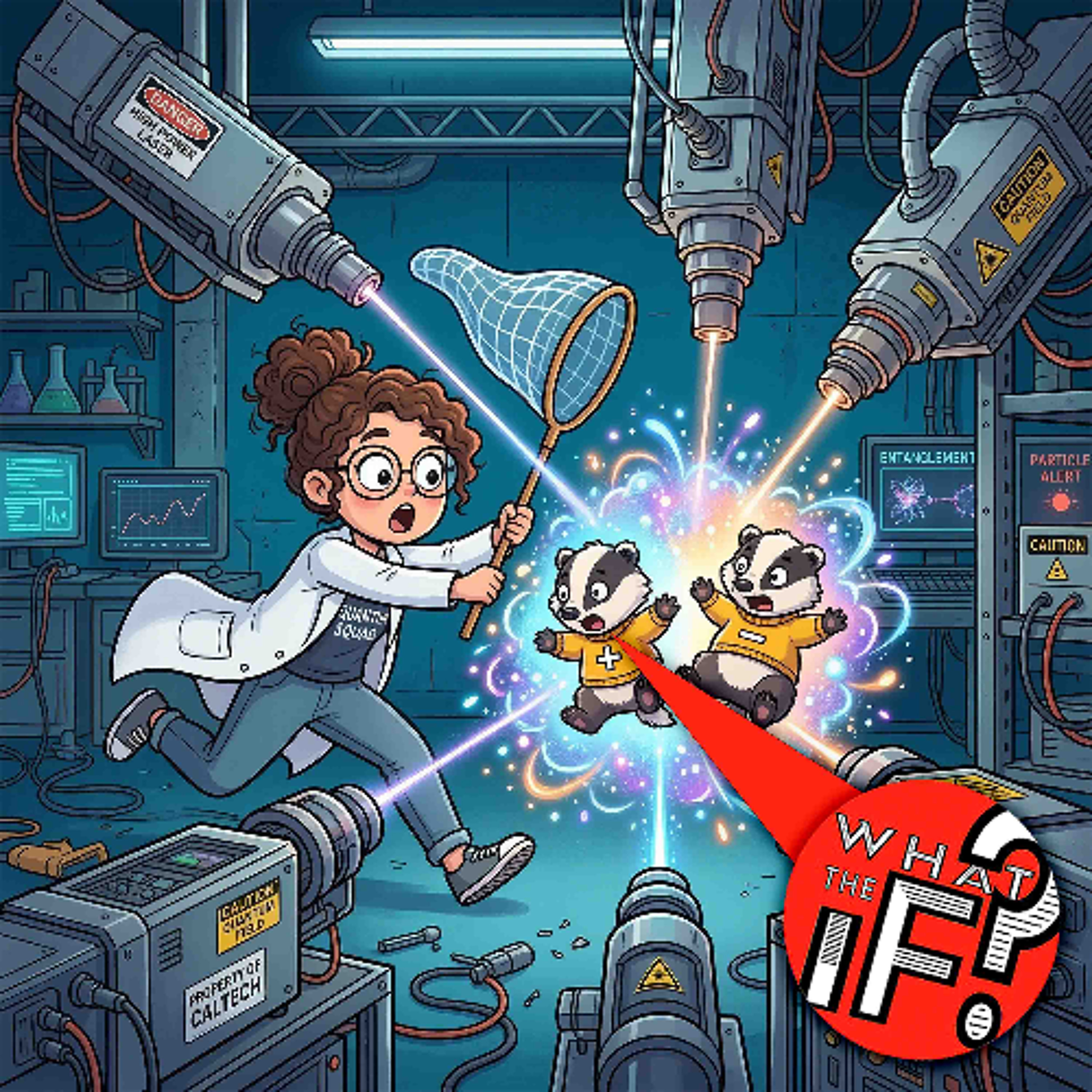
24:02positrons popping in and out of existence quickly so we're gonna scale it up so instead of electrons individual particles I think it's gonna be badger so we've got virtual badgers popping into existence and then we're gonna mess with the time frame here so instead of disappearing in a fraction of a nanosecond how long should we let our virtual badgers appear five minutes five minutes okay that sounds good so and this is statistical so on average a badger and an anti-badger will appear spontaneously and then on average after five minutes they will run into each other again and disappear excellent excellent we got this all right so the the way virtual particles work is the the smaller the
25:03area you're looking at weirdly the more likely it is for a virtual particle to appear and the more energy kind of in the place the more likely it is as well so like in the lab what we do is we will fire essentially like a super powerful laser into a particular spot and then that energy can hopefully turn into a virtual particle as well so if we want our virtual badgers to appear I suggest we get say a dozen high energy lasers to all fire their beams in one particular spot and then where the overlap happens the badgers will pop into existence and again because it's the uncertain principle you don't want to look at it because these are only virtual badgers so we need to fire our lasers and then everybody in the room look away and then after a little while a
26:04pair of badgers may appear and they're totally normal badgers in every way except that one is positively charged and one is negatively charged so actually are our best bet for but I mean they're normal badgers so they're gonna make badger noises I don't know what kind of noise is bad you know I assume it's some kind of hissing angry you know yes but maybe that's just me being a story especially if they're suddenly forced into existence you know well that's true that would be a really upsetting experience for the badgers right they do not exist then suddenly they do exist in a lab and then their arch enemy appears right next to the event as well right the anti badger so if they if they fight as I assume badgers would then they will disappear as soon as they touch each other they will disappear again there is a side effect here which is
27:04that when the part when the the particles disappear because they're running to each other they give off a little bit of energy that's the other half of the equal assumption squared badgers have a fair bit of energy in them though actually yeah can you google average mass of a badger massive a badger sounds like money buys on episode 6.3 to 7.2 kilograms or 14 to 16 pounds all right so let's call that 7 kilograms per badger that seems about right so that's a large size cat do you know how much your cat weighs 13 pounds okay that's almost exactly that's why she's on a weight loss diet so there's two of them remember they have to appear in pairs so that's 14 kilograms and can you
28:05ask you I'll bet you've got an AI open right now I can yeah okay ask what the energy equivalent of 14 kilograms is so this is what we're doing here is where we're multiple so the m in equals mc squared is now 14 kilograms and we're multiplying that by c squared the speed of light squared which is a very big number so we're gonna get some some large number for e right now I don't feel like doing no we have a plot Claude has done the work for you and Claude says using Einstein's equals mc squared and then it lists the equation it says equals about 1.26 exa joules or roughly 301 megatons of TNT all right so so that's and say three three megatons ads interestingly I don't know if it's correct that's 301 megatons of TNT is about six times the energy of the largest nuclear weapon ever detonated the
29:09largest yeah the largest ever detonated six megatons oh wow so so an enormous amount I should say no one builds nuclear bombs that big because there are no targets that require well they don't know about the badges that are coming our way so one megaton is about enough to destroy an entire city cleanly so so we've accidentally destroyed the lab or it's maybe intentionally depending our point of view so yeah so we go into the lab we set up our lasers we start firing the lasers we turn away from the lasers so as not to ruin the quantum nature of the experiment after a little while there's a popping noise and the two badgers pop into existence and start hissing at each other so as soon as they touch each other again then they will be converted back into energy and destroy the entire city and we're release a
30:10gigantic explosion which is why I said there's no point in the safety protocols right a gigantic explosion that destroys the lab and the entire city but the experiment is success the experience of success that's right we've successfully created virtual badgers so I think our our trick here is we need to keep the badgers from touching each other again so somebody's job has to be keeping the badgers apart as soon as they pop into it so the badger randler who my guess would be is a graduate student because that's the kind of jobs that graduate students get get assigned to do so there's somebody who has to sit right next to but not look at where the badgers are likely to appear and then they listen for the hissing and then they have to whip around instantly and actually we need to write into badger anglers one to grab badger a and one to grab badger negative a and they have to grab each badger immediately and
31:15wrangle the badger out of the room to to prevent the gigantic explosion so that energy that means that the there there was energy that came out of the virtual base into our so this isn't that's right so this is so then you say well why doesn't this violate the law of conservation energy and the uncertainty principle says it does it just happens so fast that you don't notice it that you can't tell so if you're the the police officer charged with enforcing the law of conservation of energy you've got your energy detector and you say okay as soon as I see a violation happen I'm giving this universe a ticket and saying this is not allowed but the the the virtual electrons zoom but pop in and out of existence so fast the cop can't catch them I can't catch these things so I can't give the universe a ticket but so that's that's normally how we we get
32:17around that problem is that happens so fast that we don't so the total engine universe remains zero as far as you can measure but the but then if we have our badger wrangling situation so normally the badgers pop right into existence so there's zero energy there's two badgers worth of energy and then they explode and the energy goes away and then we say the total amount of energy in the lab is still zero because the energy has has vanished in this explosion but with our badger wrangling experiment now we catch each badger and prevent them from exploding so then we say oh we've we've we've we've tricked you we've tricked the universe and now the universe actually has two badgers worth more energy than it did before and so and now we're in trouble and so in the in the real experiment or if we if we were imagining being able to see not badgers but actual particles like electrons or quarks or I don't know
33:23some some real piece of matter piece of an atom in this experiment at Brookhaven and and you say has been done elsewhere they were actually able to see a particle that did exist moments before yeah so we that's right so we call that vacuum energy and the conclusion of this is that in fact empty space has a certain amount of energy just kind of ready to go and this is something that people that you can start a good argument about with with physicists they well where does vacuum energy actually come from and and the answer isn't really clear in in the case of Brookhaven it's that you just set up the experiment so there's a little extra energy leaking around and that's that's not the amount of energy is is so small that it's not a big deal but for instance with Hawking radiation this is energy that seems to come out of a vacuum but Hawking says it's actually leaking out of a black hole so black holes
34:25will evaporate over time because their energy leaks out through these weird virtual particle situations and that's why black holes as we were talking about the other week with with Dave Kaiser black holes will eventually evaporate so that evaporation is just a weird consequence of this as well so in our particular and normally as you say that's individual electrons so if I or quarks so if I sit around the black hole I will see electrons popping into existence and I say well where does that energy come from and the answer is from inside the black hole and the black hole eventually gives up all of its energy in these individual particles but now in our universe our if universe we're sitting outside the black holes and an entire badger pop into existence and go hurtling out into space so the black holes will evaporate this is called Python radiation so the black holes will launch badgers and anti-badgers into deep space at a
35:32steady rate and the black hole will eventually evaporate as these badgers zip off into nothingness but again the problem are the dangers we need to make sure these badgers and anti-badgers do not touch each other otherwise gigantic explosions will will occur so I think there's actually a growth industry here in Badger Wrangler yes this is a really important job is keeping the badgers and the anti-badgers apart the badger defense agency explosion there's going to be a three-letter acronym for it but lastly lastly to wrap up if if our listeners were to hold out their hand let's say and just you know hold your palm up there are and this has been measured right this is this is confirmed if not proven that they're in in the air above your hand let alone within your hand and everywhere else there are little particles
36:38appearing out of nothingness and and then disappearing and then and then disappearing again instantly so fast yeah and that's and I should say statistically this because that's how quantum mechanics operates the smaller the particle the more frequently they appear so your hand your hand is full of electrons and neutrinos and things popping in and out of existence on our regular basis but statistically a whole badger will eventually appear in your hand you're gonna have to wait a really long time so so in our if we've just crunched those numbers but statistically it will eventually happen you're gonna have to wait trillions of times the length the the history of the universe before it actually happens unless you're on our if world well and actually this is a thing we need to think about too is we've set up our experiment with our giant lasers to make badger appearance more frequent but in
37:43a universe where that's possible at all it's going to happen regularly spontaneously too so it's not just in our lab that badgers are going to appear but if you hold out your hands and you wait a little while I mean on the time scale we're imagining it might be days you're every now and then a pair of badgers is just gonna appear and scurry off so that'll make all sorts of things interesting you know first dates faculty meetings every every now and then a pair of badgers is gonna pop into existence and you better be ready to keep those badgers apart or though there's going to be a gigantic explosion so every now and then there's gonna be a megaton size explosion somewhere on the earth yeah for a pair of yeah a pair of badgers that just happened to get back together before people could good grab safety first because who wants to
38:43who wants to grab a pair of angry badgers as they are even if the whole universe depends on it as it might in this particular case yeah wonderful well this is quite the mind-bending if and a lot to learn about reality as well oh yeah last thing I'll just say just for those who are perhaps the uninitiated these quantum these ideas we've been talking about from quantum mechanics quantum mechanics is among the most highly tested and I guess I think scientists hate the word use the word proven is that right you say confirmed but that's right yeah another good way to start an argument among physicists as you say as quantum physics proven this has been measured with extreme accuracy that's right it is to you know I can't remember what is 27 decimal places or something like that and and it places like Brookhaven when you
39:47get an experiment running you test it billions of times a second too so it's not even like you just do one go and you're done so the the quantitative predictions can can be confirmed every day and an important sense like all electronics runs on quantum physics too so your smartphone is is a confirmation that virtual particles is a good way to think about the universe I was about to say virtual particles actually exist but that's not right but rather this is a helpful way of understanding the way the micro world works whether or not it's true is is a more complicated question wow well I could go on and on this is such such a fascinating topic yeah thank you man thank you for taking us here how do we how do we get back to where is merely virtual particles popping you know well we got to make our
40:47badgers small and in frequent again so the next time you catch a badger you need to compress it so grab the badger and roll it up into a tiny little ball and the badger will no doubt shout out thank you Matt thank you for taking us on this quantum journey let us know what you think listeners write us at go to our website what the if dot com and click contact or if you are Patreon supporter um hit us up that way and patreon supporters also are gonna get a bonus episode bonus content only for you Patreon supporters to find out more about our membership program which starts at the free level go to patreon dot com slash what the if Gabby will be back next week and we'll see you then
More episodes


