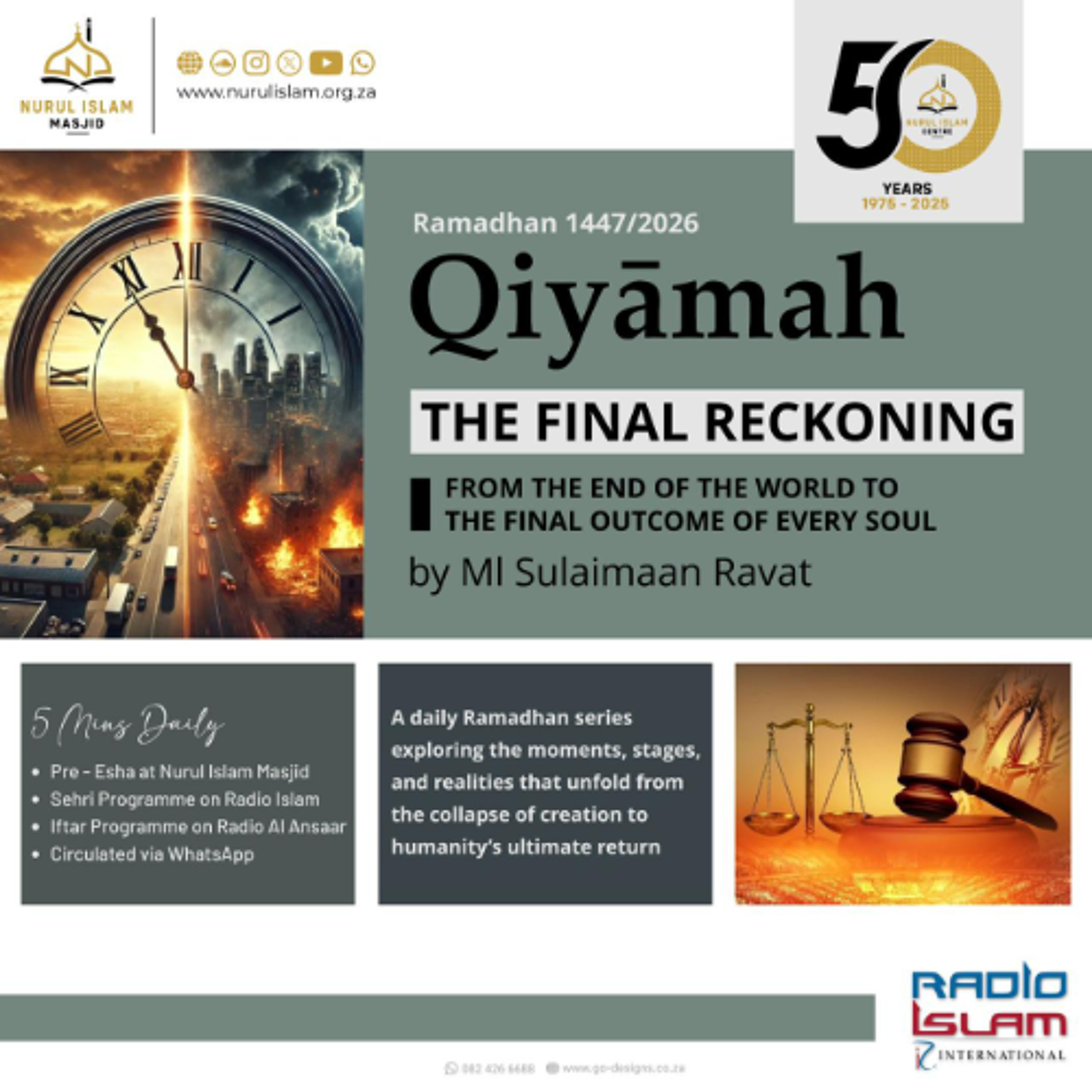
About this episode
Interactive timestamps
Jump to segmentGet every episode summarized
Each time Radio Islam publishes, we email you a written briefing from the transcript — the topics, who appeared, and any specific claims, with the ad reads skipped.
Email me new episodesFree for 3 shows. No card needed.
Hosts & guests
Transcript ready
119 searchable segments. Every word is indexed and playable.
Full transcript
Radio Islam — Qiyamah E24 The Mark Sheet. Machine-transcribed; use the interactive transcript above to jump the player to any line.
0:00Assalamu alaykum wa rahmatullahi wa barakatuhu. Welcome back to the series Kiyama the Final Reckoning. In the last discussion we spoke about whether the unbelievers will face reckoning or not. There is one view that their actions have no weight because they didn't have iman and hence there is no need to assess them. You know they will be condemned straight to the al-Fair. But the more correct view is that they will be assessed and we went through the various reasons. One is to establish justice against them. The other is Allah will rebuke them when assessing them. The third is that they are responsible when it comes to the injunctions of the shariha even though they did not bring iman. So they will be questioned about why they didn't give zakah, why they didn't perform salam. Then also not every unbeliever is the same as the next summer worse than others and hence they would have to be an assessment to determine the extent of punishment. The Qur'an talks about the mona fithin in the mona fithin of Idarqil as Fali minnaal that the mona fithin are the worst of unbelievers and hence they would be in the lowest level of hell.
1:00In general the higher you go the better it is, in jahanam the lower you go the worst it is. Then we spoke about the difference between Abu Talib and Abu Lahab. Both unbelievers both condemned to hell for eternity but they were not equal in their evil and hence the one would get greater punishment than the other. We also spoke about how they would actually be assessed. Some say that they could deeds will be weighed on the one pan of the scale but it will be totally outweighed by the disbelief and evil deeds on the other side. Others say they will be no weight to their good deeds. They will have no good deeds to put because Allah says, they are batanna amaluk that your disbelief has rendered all of your good deeds in vain and Allah gives them some benefit to their good deeds in this world so that there is nothing left for them in the year after. However the lesser evil will result in lesser punishment like we see in the case with Abu Talib. Taking the discussion further now the scholars write that when people are first resurrected
2:00they will stay for the equivalent of 60 years without speaking and they will not be permitted to make excuses. Then they will be granted permission to speak and when they speak out of desperation they will say, Rabbana Absarna was Sama'ana Farajana Na'am al-Salihan Inna Mokinun, our Lord we have now seen and heard so send us back to the world that we will do righteous good deeds. And these are the those who were not righteous. They will start arguing in front of Allah. Then on the day of resurrection you will be disputing before your Lord and Allah will then rebuke them. They don't argue in front of me. I gave you advance notice. I told you before what would happen. So we move on to the point now of the principles on which people will be brought to account. Allah t-Tabarakahu t-Ala is Aadil Allah t-Tabarakahu t-Ala is just fundamentally Allah can do with his creation whatever he wants. And no one can question him. Because Allah owns us.
3:06So Allah can do with us whatever he wants. However, notwithstanding that fact Allah t-Tabarakahu t-Ala will still deal with us according to principles of justice. Allah says Tumma Tawaffa Kullu Narsim Ma Kasabat wa Hamla Yudhalamun, then every person shall be paid what he earned. And they shall not be dealt with unjustly. Lukman Ali Salatu was salam, when he was telling his son about the justice of Allah he said, Ya Buneia, O my son, inna hain takumeth tala habbatim min Khardalin, fatekun fi sakhratin, o fi samaawati, o fi lardiyyati bihalla, inna allaha latifun khabir. That if it be anything equal to the weight of a grain of a mustard seed, you know, something is minuscule as that. Although it be inner rock, so small and inner rock, or in the heavens, or in the earth, Allah will bring it forth. Allah will bring it forth, because Allah is just, in allaha layad alimu mith qala dharrah, Allah wrongs not even of the weight of an atom or a small ant, wala tudalamuna fatila, you will not be dealt with unjustly equal to fatila, fatila is the scalish thread in the
4:10long slit of a date stone, you know, the thin kind of membrane in the incision on the pit of a date, even to that minuscule extent Allah says you won't be oppressed, wala yud lamuna nakhira, Allah uses the word nakhira in another verse, meaning the speck on the back of a date stone, fa meya amal mith qala dharrah, khaira yara, that whoever does equal to the weight of an atom of good will seed, and the same with evil. Wala atasir wazira tuizra ochra, one person won't be responsible for the wrong actions of another person, each will be responsible for his own actions, as Allah says, wala salil insani illa masaam, and that man can have nothing but what he does, good or bad, what you responsible for. Yes, wala dhassay, wala yahmi lunna at qala hum, a thqala maa a thqalihim, and verily they shall bear their own loads, and other loads besides their own, that's where you with the means of others doing wrong, then you'll bear your own load and their load. The other principle is that you'll be shown, you'll be shown your records, it's not
5:13that you will be just told what the decision is, illa llahi madadji akum, Allah says, the return of all of you used to Allah, fa meya na biukum bi maakuntum ta'amelun, then he will inform you about all that which you used to do, yau matajidu kullu nafsim maa aminat min khairi mohdarah, on the day when every person will be confronted with all the good that he has, has done. Allah says, eqra kitabak, it will be set for him on the day of qayama, that read your book, your own pokridid, kafabinafsikal yau maa alaikahaseeba, you yourself are sufficient as a reckoning against you this day, it's like you give a student, say, yes your exam paper, look, look at your answers, yes the mark sheet, yes the question paper, yes your answer paper, look at it for yourself, look at it for yourself, through the mercy of Allah tabarak wa ta'alam, good deeds will be multiplied, but evil deeds will not be multiplied, Allah says, manja abil hasanati filahu ashram taliyah, whoever comes with a good deed intact, you must never intact on the day of qayama, it will be multiplied by ten minimum and beyond that depending on your sincerity and the mercy of Allah, wa manja abi sayyati filah
6:16yujaza illa mithlaha, but whoever brings an evil deed, then you will get the extent of that evil in terms of sin, there is a hadith of Abu Dhabr al-Lawhan narrated by Imam Ahmad ibn Imam Hakim, the Hassanah is for ten like it or more, and the sayyah is one, I will forgive it, this is a hadith of Putsi, wa Allah says, and if you meet me with sins nearly as great as the earth, so long as you did not associate anything with me, I will meet you with forgiveness nearly as great as the earth, I will meet you with forgiveness, nearly as great as the earth, so we see for example the incident of Mehraaj, when Abis went up and down, two and four with Musa al-Issalam, 50 Salah, and then bring it down by five by five, eventually from 50 it came to five, but Allah said, I will give you the reward of 50, so the reward is multiplied, but the sin is not multiplied, and certain rewards are multiplied beyond what we can imagine, for example fasting, the famous hadith, Abu Khari and Muslim, Abu Rehraad al-Lawhan says, every good deed of the son of Adam will be multiplied
7:16between ten and seven hundred times, said in Abis Allah, but Allah says, except for fasting because it is for Mehra, and I will give the reward of it, what is it? You will have to see, in Nama Iwa Fassab, Iruhuna Ajarahum bi-Rai-Risab, those who are patient, they shall receive their rewards in full without reckoning, beyond what Allah t-Tabarak-Kawata'ala has stipulated, and when it comes to good deeds, even when you just make an intention to do a good deed, it's already recorded as a reward, and if circumstantially you are unable to do it, you'll still get the reward, but when it comes to sin, if you make an intention, it's not recorded, it's only when you carry out that intention, or when you may have a firm resolve to do it now, and only something beyond your control stopped you, then will it be recorded as one sin, such will be the mercy of Allah t-Tabarak-Kawata'ala on the day of Qiyama, may Allah envelope us in His mercy on the day, Amin Ya Rabbi al-Alamin As-salamu alaykum wa rahmatullahi wa barakatuh.
More episodes
More from Radio Islam

How Children Shift The Dynamics of Marriage: Guest Fatima Talia
Radio Islam

The Big Picture with AB Dawjee – Sat,05.09.2026
Radio Islam

Your Sunday Reset (06.09.26)
Radio Islam

A Chef's Journey of Passion & Purpose: Chef Sameera Ismail
Radio Islam