Loading...
About this Episode
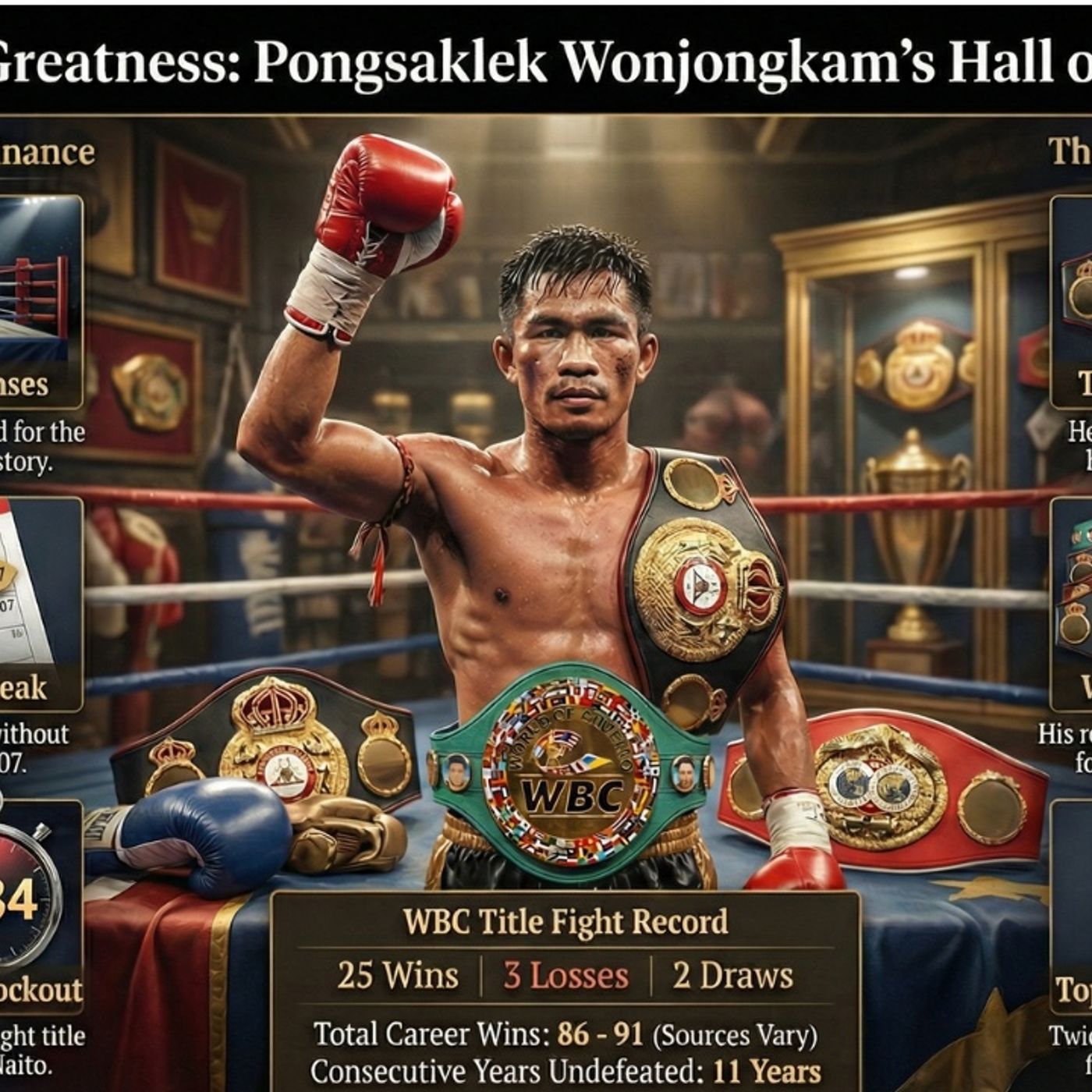
To the casual Western observer, the names that define the "sweet science" are often draped in the Stars and Stripes or the Mexican Tricolor. We speak of Oscar De La Hoya’s charisma or Bernard Hopkins’ longevity with practiced ease. Yet, in the 112-pound division—a weight class where technical purity and blistering speed often surpass the lumbering spectacles of the heavyweights—there exists a Thai legend whose statistical dominance dwarfs most modern icons. His name is Pongsaklek Wonjongkam, and he is the greatest fighter you have likely never heard of.
Despite a resume that rivals the historical invincibility of Carlos Monzon or Julio Cesar Chavez Sr., Wonjongkam remains an outlier in the American-centric consciousness. He is a "lock" for the International Boxing Hall of Fame (IBHOF) in theory, but in practice, he remains a ghost outside the hallowed halls of Canastota. This disconnect is not a failure of his talent, but a symptom of a "geographical bias" that treats the elite of the East as if they were fighting in a different, lesser dimension.
Become a supporter of this podcast: https://www.spreaker.com/podcast/shoulder-roll-virtual-boxing--6207307/support.
This episode includes AI-generated content.
Hosts & Guests
Transcript
Welcome to the debate. Today we are, uh, we're turning our eyes toward the kingdom of Thailand
to dissect a resume that quite frankly shouldn't really exist in the modern era of sports.
Yeah, we're looking at a fighter who didn't just dominate a division.
He, well, he basically held it hostage for over a decade.
Right. We are talking about the Thai flyweight legend, Pung's leg, Juan Zhangcom.
A name that is absolute royalty in Bangkok.
A, uh, a cult hero among the diehards in Tokyo.
And yet somehow a complete ghost in Canastodon, New York,
where the international boxing hall of fame resides.
And that is the central friction we need to resolve today.
Because as we have a man with a division record, 17 consecutive title defenses,
a 55 height winning streak, two distinct reigns as the lineal champion.
And yet years after becoming eligible, he is still waiting on the outside looking in.
It's a baffling omission on the surface,
but one that becomes clearer, though no less frustrating,
when you peel back the layers of geography and boxing politics.
So establishing our sides here, my position on this is rigid.
I represent the stance that the statistical dominance and sheer longevity of Juan Zhangcom
make him a mathematical lock for the hall.
His exclusion is a failure of the voting body to recognize objective,
quantified greatness.
And I represent the perspective that while your raw numbers look staggering on paper,
they actually give his critics ammunition.
My argument is that his true case requires a deeper contextual analysis.
We need to dismiss the padded record and look at who he beat and how he overcame the systemic
bias against lower weight Asian fighters. His quality, not his quantity, is the real argument.
Let's, um, let's open up those position statements,
because I really want to drill down on this idea of historical anomaly.
When we talk about the Hall of Fame,
we are usually talking about the best of the best, right?
The outliers.
Punk Suck Like Juan Zhangcom is a definition of a statistical outlier.
We are talking about a fighter who went undefeated from July 1996 to July 2007.
That is 11 years without a loss.
In the modern era, where promoters protect their assets and fighters maybe fight twice a year
for lucky, that kind of consistency is almost impossible to find.
It's definitely rare.
Extremely rare.
We celebrate guys like Joe Calzagi for retiring undefeated or Floyd Mayweather for his zero.
But Punk Suck Like fought more often and held his title longer than almost anyone in contemporary
boxing. He made 17 consecutive defenses of the Lineal and WBC Flyweight titles.
And just to clarify for the listener, when we say Lineal, we mean the man who beat the man,
the true championship lineage. In doing so, he broke the record of Miguel Conto,
who had 14 defenses.
Right, the Mexican legend.
Exactly. Cantos universally regarded as one of the greatest flyweights of all time.
He's a Hall of Famer, unquestioned.
So logically, if Cantos is in with 14 defenses, how do you justify keeping out the man who
eclipsed him with 17? When you look at streaks like that, 56 wins in a row, you are in the company
of Carlos Manzone and Julio Cesar Chavez. That is the Pantheon.
To deny him entry based on subjective bias is to deny the history of the division itself.
Well, that is a compelling argument, but I think you're leaning way too hard on the spreadsheet
here. How so? Because the sheer volume of his record is actually a double-edged sword.
I just don't buy that the number 17 is enough on its own. If those 17 defenses were against
nobody's, the number is completely hollow. But they weren't.
I know that, and you know that. But the casual western observer, and frankly, a lot of the voters,
they look at a record of 91 wins, five losses, and two draws.
And they see a lot of stay busy fights in Thailand against debutants or local journeymen.
He had a lot of non-title bouts that were essentially glorified exhibitions.
Which is incredibly common in Thai boxing culture. You stay active.
It is, but it clouds the water. It gives the detractors an easy out.
My position is that you have to strip away that padding to find the diamond.
The case for Panzaclek isn't that he won often.
Is that when the bell rang for a real fight against a real champion,
he was an absolute assassin. He'd be 11 former current or future world champions.
He didn't just defend the belt. He dismantled guys like Daisuke Naito and
Kokikameda on their home soil. The context of who he beat is far more impressive and far
more vital to his Hall of Fame pace than just how many times his hand was raised.
I think we are arriving at the first core disagreement here,
which is the quality of that resume. You mentioned the padding argument,
which is the favorite stick his critics love to beat him with.
They say, oh, he fought guys with losing records in between title fights.
Which he absolutely did. It's undeniable.
He did, but I'm not convinced by that line of reasoning as a tool for exclusion.
Because as you noted, every great fighter from that region stays active.
If you look at the hit list, the actual title fights,
it destroys the narrative that he was a protected fighter.
Let's talk about Daisuke Naito.
A great place to start. Naito was a legitimate world class fighter,
a massive Japanese superstar.
He was his greatest rival. They fought three times during the first reign.
And what happened in their second fight?
Punxaclek knocked him out in 34 seconds.
Yeah. That is the fastest knockout in flyway title history.
One punch. That isn't padding.
That is high level execution against the man who would go on to be a world champion.
It's iconic.
It was a masterpiece of South Paw timing.
Naito dipped to throw an uppercut,
and Punxaclek came over the top with a straight left that looked like it was fired from a cannon.
Naito was unconscious before he hit the campus.
Precisely.
And look at the other names, Luis Lazarte.
Oh, Lazarte was a nightmare to fight.
Right. A tough rugged Argentine who went on to become a world champion at 108 pounds.
He was known for being dirty, hard to look good against.
Punxaclek stopped him in two rounds.
He didn't just edge past him. He blew him out.
And that is rare.
Lazarte was a survivor.
To blow him out in two rounds shows a level of offensive fire power that people forget Punxaclek had.
They think of him as a pure technician, but the man could crack.
So I grant you, the a side of his resume is elite.
But I want to play devil's advocate here,
regarding the names that aren't on the resume.
I assume you mean the other stars of the era.
Yes, because this is the biggest knock on Punxaclek,
and the reason I think voters hesitate.
It's the what if factor.
During his reign, we saw the rise of Victor Chignin,
No Nito Donner, Omar Narvayez.
These were the other kings of the lower weight classes,
and Punxaclek fought exactly none of them.
That is a fair critique, but we have to look at why those fights didn't happen.
I agree, but the critics say he stayed in his comfort zone in Thailand
and actively avoided the unification bouts.
That's a really interesting point, though.
I would frame it entirely differently.
It wasn't avoidance.
It was the reality of boxing economics in the 2000s.
The flyweight division was completely fractured.
You had Narvayez holding the WBO belt hostage in Argentina for 16 defenses.
He never left never left home.
Exactly.
Right.
So why is Punxaclek the one penalized for not traveling to Argentina
when Narvayez wouldn't travel to Thailand?
And the promoters had zero incentive to cross the street.
Exactly.
Why would an American promoter pay to bring a tie legend
over to fight a guy like Darcinjan when the money just wasn't there?
HBO wasn't buying flyweight fights back then.
But Punxaclek did travel.
This is where your home fighter myth completely falls apart.
I'm with you there.
He fought in Japan eight times in title fights.
And Japan is not neutral ground for a tie fighter.
That is enemy territory.
It is arguably the most hostile environment for a visiting fighter
outside of maybe Mexico.
And he went there and won repeatedly.
He fought Naito three times in Japan.
He fought he to Nobu Honda in Japan.
He fought Tomonobu Shimizu in Japan.
And that Shimizu fight was a masterclass.
Shimizu was tall, rangel, a future champion.
Punxaclek broke him down and stopped him in seven rounds.
If you can go to Tokyo and knock out the local hero,
you are not a protected fighter.
But if we are talking about traveling and winning,
we have to talk about the second reign.
This to me is actually the strongest argument for his greatness.
Even more than the 17 consecutive defenses.
The resurrection.
The resurrection.
Because look, he lost the title to Naito in 2007.
The incredible streak was over.
He was 30 years old, which is ancient for a flyweight.
And the lower weights speed goes first.
Most people thought, okay, great run.
Hall of very good, but he's done.
And he didn't get it in immediate rematch for the title.
He really had to work his way back.
He had to grind for two solid years.
And then in 2010, he gets a shot at the WBC belt again.
But who does he have to fight?
Koki Kameda.
We really need to explain Koki Kameda to the listeners
who might not follow Japanese boxing.
In 2010, Koki Kameda was the Justin Bieber of Japan.
If Justin Bieber could knock you out,
he was a massive cultural phenomenon,
young, brash, undefeated, 22 and zero.
He had already held a title at light flyweight.
The fight was in Tokyo.
The entire Japanese boxing machine was behind him.
The script was absolutely written for Kameda
to beat the old lion and torch past the era.
And Pongzeklek burned the script.
He went into Tokyo and put on a technical clinic.
He was 32 years old, giving up height, giving up youth,
and he beat Kameda to the punch all night.
He used that veteran savvy, the distance control,
the subtle movement.
He won a majority decision,
but most neutral observers felt it was much wider than that.
I actually rewatched that fight recently.
What struck me was Pongzeklek's composure.
The crowd was screaming for Kameda.
Every time Kameda even threw a flurry, the arena shook.
But Pongzeklek never blinked.
He just popped that SouthPod jab, pivoted and countered.
To regain the Lineal Championship,
to start a second reign three years after losing it
against the prime killer like Kameda,
that is what separates the good champions
from the Hall of Fame legends.
It's the difference between having a prime
and having a career.
That went over Kameda cemented his legacy
because it proved the first reign
wasn't just about favorable matchmaking.
He beat the future of the division.
And let's not forget, he defended that second title four times.
Including a win over Suryansaur Rungvisa,
who went on to be an absolute monster at Superflightweight.
Exactly.
But to be fair to the whole picture,
we have to address the end of his career
because I think it unfairly colors people's memories.
He eventually lost to Sunnyboy Jaro in 2012.
A brutal loss.
Sixth round knockout.
It was a shocker.
It was named upset of the year by boxing scene.
But I would argue that the fact it was upset of the year
actually strengthens his Hall of Fame case.
How so?
Because punk select was 34 years old.
He had nearly 90 fights on his odometer.
And yet he was still so highly regarded,
still ranked in the top 10 pound for pound by Ring magazine,
that losing to a solid puncher like Jaro
was considered a massive earth shattering upset.
That tells you how high his stock was,
even in his twilight.
That's a really fair assessment.
If he had been seen as just a washed up veteran hanging on,
nobody would have called it an upset.
They would have just called it the end.
He was ranked pound for pound in 2006, dropped out,
and then climbed back in 2010 after the commuter fight.
Ring magazine had him right there alongside guys like Manipack Yao
and Floyd Mayweather.
So we have a guy who was top 10 pound for pound
in two different decades.
Rule the division for a total of 12 years, essentially,
and beat 11 world champions.
So why are we even having this debate?
Why isn't he in Canestota?
Well, now we get to the ugly part of the conversation,
the systemic bias.
It is the elephant in the room,
and it's wearing a maiden USA hat.
The International Boxing Hall of Fame electorate
is heavily comprised of American boxing writers.
And historically, if a fight didn't happen on HBO or Showtime,
or at least in Las Vegas or Atlantic City, it didn't happen.
It's the out of sight out of mind syndrome,
and it hits the lower weight classes the absolute hardest.
If you are a heavyweight, the world watches.
If you are a flyweight fighting at Bangkok or Tokyo,
you need to be undeniable just to get noticed.
And even being undeniable isn't always enough.
Look at the comparison to Vinnie Pazienza.
Oh, please don't get me started on Vinnie Paz.
Vinnie Pazienza was inducted recently.
Great story, obviously the broken net come back,
the movie with Miles Teller.
I get the fame aspect of it.
But look at the resume.
He was two and six in world title fights.
Two wins, six losses.
It never made a successful defense of his super well-to-weight title,
not one.
Meanwhile, Pong's Eclik 1.com was 22.2
and two in major title fights.
22 wins in world title bouts versus two.
Yet Pazienza gets in and one in calm weights.
It's a structural failure of the hall.
They are prioritizing narrative and American familiarity
over actual sporting achievement.
And it's not just Pong's Eclik.
Look at Uberta Romain.
Look at Pong King Pech.
King Pech is a tragical mission.
Thailand's first world champion.
He beat Pascual Perez in all time.
Great twice.
He beat fighting Harada.
These are legends and King Pech is an in.
It almost feels like there is a quota system
for Asian ciders.
Like, oh, we let in Kaosai Galaxy.
So we're good on Thailand for a while, which is absurd.
It's like saying, well, we have Ali.
So we don't need Larry Holmes.
Pong's act like paid sanctioning fees for 30 WBC title fights.
He was the face of the WBC flyweight division for a generation.
If the Hall of Fame is supposed to record the history of the sport,
you simply cannot tell the story of the 112 pound division
in the 21st century without Pong's act like Juan Junkum.
You really can't.
And I think the voters are slowly starting to wake up,
but the backlog is dangerous.
Every year he stays out, his name fades a little more
for the voters who never saw him live.
And that is exactly why we have to look at the cold hard facts.
You mentioned earlier that numbers lie.
But in this case, do they?
No.
In this case, the numbers were the headline,
but the film is the article.
The numbers say dominant, but the film says master.
He was a south paw with a beautiful jab,
incredible distance management,
and legitimate one punch power in the left hand.
He wasn't just winning decisions.
He was outclassing people.
And he was durable.
He took a lot of punches in 90 fights,
but was only stopped twice.
Once when he was completely green and once when he was old.
In his prime, his chin was iron.
I want to circle back to one statistic that I think sums it all up.
Between 2001 and 12, there were many flyweight champions.
We listed them earlier.
Duneer, Darchignan, Nervias, Lorenzo Para.
But only one man was a lineal champion
for the vast majority of that time.
Pong Sacklick.
He held the lineage.
He was the man who beat the man.
And he defended that distinction 17 times in his first reign.
I am just not convinced by any argument that places fame
or Western television exposure over that level of competitive consistency.
I agree.
And frankly, the argument that he missed the other greats is totally weak.
When you realize that none of those other greats
fought each other at flyweight, either.
Duneer didn't fight Darchignan at 112.
They fought at 115.
Nervias stayed in his lane in Argentina.
Pong Sacklick stayed in his lane.
He just happened to drive his car further
and much longer than anyone else.
That's a great way to put it.
He was the constant.
The variable was everyone else.
And let's give credit to the quality wins one more time.
Beating Edgar Sosa in 2011.
Sosa was a long-raining champion at 108 pounds.
He came up.
He was the mandatory.
He was highly ranked.
And Pong Sacklick at age 34 won a unanimous decision.
He didn't just beat the guys coming up.
He beat the established veterans too.
Beating Sosa.
Beating Cometa.
Beating Naito.
Beating Tuna Kawa.
These are four distinct chapters of a career.
Most fighters are lucky to have one defining chapter.
Pong Sack had four.
And yet we sit here debating his case.
We do.
But I think the tide is slowly turning.
As we get more distance from his era,
the padding arguments fade.
And the 17 defenses record stands like a monument.
It's the Miguel Conto effect.
Conto wasn't appreciated fully in his time
because he was a defensive wizard
who fought primarily in Mexico.
Now he's revered.
Pong Sacklick is the modern Conto.
As we wrap this up,
let's summarize our positions in light of the discussion.
For me, Pong Sacklick one-jong Comet
is an automatic induction based on historical precedent.
You cannot exclude the man
who broke the all-time division record for title defenses.
If the numbers matter and in sports they must,
he is a hall of favor.
And for me, even if you throw the record book
entirely out the window,
he gets in on the eye test
and the strength of his best nights.
He went into hostile territory in Japan
and beat the best they had to offer repeatedly.
He re-came the title against a younger superstar.
He was a complete fighter who fell victim to Western bias
but his quality is undeniable.
So the question remains,
is a Hall of Fame career defined by undeniable statistical dominance
or by the contextual quality of a fighter's hardest nights
in hostile territory?
That is for you to decide.
But reflecting on this,
whether you look at the 90-plus wins
or the hit list of 11 champions defeated,
there is clearly so much more to explore
in the history of the lower weight classes.
Absolutely.
We are looking at a master technician
who ruled his weight class for a decade.
The delay in his induction
is an indictment of the voting process,
not the fighter.
On that, we are in total agreement.
Thank you for listening to the debate.
See you next time.


