Loading...
About this Episode
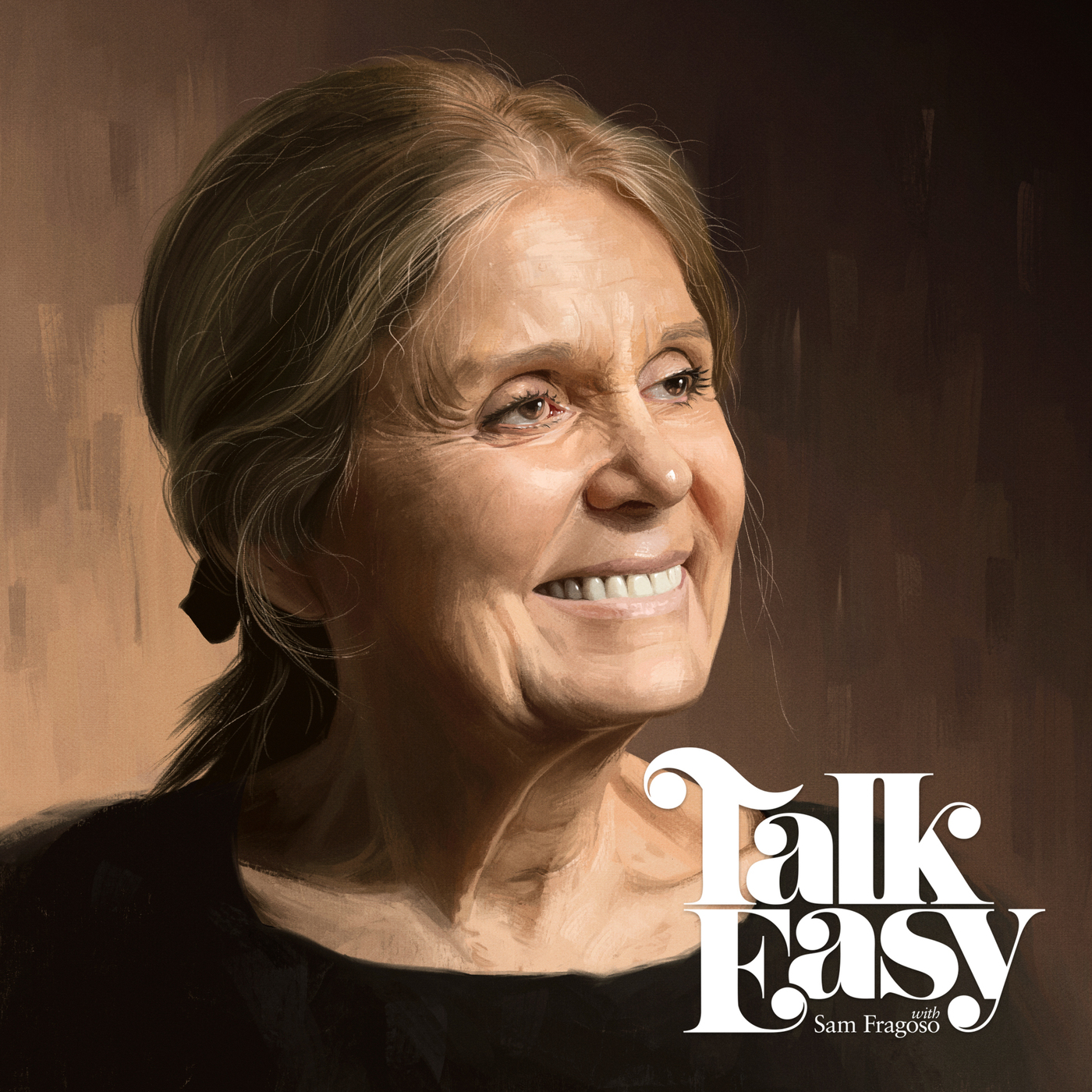
Rest in peace to writer and activist Gloria Steinem.
The trajectory of Steinem’s life and work was unparalleled. Her cultural and political impact, incalculable. We sat to discuss the life-altering procedure she had completed at age 22, why she helped create the women's liberation movement alongside Dorothy Pitman Hughes and Flo Kennedy, and how she learned to become angry—on her own behalf—about race and gender bias throughout America.
Original air date: December 15, 2019
As always, our email: [email protected].
See Privacy Policy at https://art19.com/privacy and California Privacy Notice at https://art19.com/privacy#do-not-sell-my-info.
Hosts & Guests
Transcript
In that period of time, and especially in places where there was not access to information
about what the women's movement was, for me in flow-cannotty or me in Dorothy Pittman
Hughes to go out on the hustings and talk, something happens when you're in a room physically
with other people that can't happen on the printed page, and I don't think I ever would
have learned that if it hadn't been for the movement and being forced out to speak.
That was glorious, Steinem. I'm Sam Fragoso, and this is Talk Easy. Welcome to the show.
There are a few people who have led a life as interesting, varied, and courageous as glorious Steinem.
For more than half a century, she was one of the defining voices of the feminist movement,
helping millions of women gain equality at home in the workplace and society at large.
She marched and organized, wrote essays and delivered speeches, formed shelters in crisis centers,
and in 1971, co-founded Ms. Magazine, all in service of a simple, if often contested truth,
that women should be able to live whatever life they chose. For Gloria, the work was never finished,
but unfortunately the work was never finished with her either. Like the rest of us,
she lived to see Roe v. Wade overturned in 2022 in the landmark Dobbs decision.
The Equal Rights Amendment, which she began fighting for in the early 70s, has yet to be added to the Constitution,
with, of course, many of those rights, values, and more is coming under renewed attack in the era of Donald Trump.
I feel proud, and I feel mad as hell. She told the New York Times in 2022,
we are still dealing with the same issues. But because of Steinem, the country she left behind
is profoundly different from the one she entered in 1934 in Toledo, Ohio.
She passed away this week at the age of 92 at her home in Manhattan.
And so today, in honor of the late activist and writer, we wanted to replay our conversation from 2019
around her book The Truth Will Set You Free, but first it will piss you off.
That title comes from a quote she popularized long ago, but then again, Steinem was always,
throughout her career, one step ahead, trying to carry us into a better and more just,
if imperfect future. Make she rest in peace.
This is Gloria Steinem.
Gloria, how are you doing right now?
You know, I'm doing okay because once I actually leave home, which of course takes some doing,
we all have kind of inertia about leaving home and get out on the road. It's interesting,
because you've talked to people and learned things that you didn't know. So it's interesting.
I have, I think, many things I don't know about you that I'd like to know.
I want to start, if you don't mind, at the opening of this book. It's called My Life on the Road,
and in it you wrote the following.
This book is dedicated to Dr. John Sharp of London, who in 1957, a decade before physicians in England,
could legally perform an abortion for any reason other than the health of the woman,
took the considerable risk of referring for an abortion a 22-year-old American on her way to India.
Knowing only that she had broken an engagement at home to seek an unknown fate,
he said, you must promise me two things. First, you will not tell anyone my name.
Second, you will do what you want with your life.
Can we go back to you being 22, afraid to get a procedure that was outlawed in many places?
Where are you at in that moment?
You know, I was really quite desperate. I was also delusional because I thought
I went riding in Central Park or through myself down the stairs somehow that this would accomplish an abortion.
Did you do that?
No, I didn't. But the mythology was very much part of our lives.
Remember that I am a product not even of the 60s but of the 50s.
I had left home and right after college graduation,
I was engaged to a very nice man who remained my friend the rest of his life.
But I knew that it was really not the right thing for either one of us.
And also marriage was made to seem the end of life then because you assumed your husband identity
and it was as if that was the only decision you could make.
So because I had a fellowship in India, I left early and worked as a waitress in London trying to waiting to get my visa.
And it was there that I realized that I was pregnant and I didn't know what to do.
I had this whole notion that if I went to Paris somehow, surely the French who were more liberal, you know, forgetting entirely that it was a Catholic country.
So just narrowly and with a lot of desperation and finding in the London equivalent of the yellow pages, the name of this doctor who turned out to be a wonderful man of, you know, a generous, principled man who I had so promised that I wouldn't say his name that I didn't say his name for years.
And when I was writing this book, I thought, all right, he cannot possibly be alive now. The laws have changed. I must thank him.
You picked him by random. Yes, out of the phone book, right? What do you make of that?
I don't know what to make of that. I mean, it was just luck or divine providence. But mainly it was him as a principled compassionate person.
I bring that passage up because it seems to me that 22 is a very precarious age.
Ideas are not fully formed. Ideas of self are just coming together. A life hasn't exactly been built. You finish college and decide to go to India. Are you afraid at all?
No, because of the way I grew up, I don't know if I can explain this. The world outside of home was safer than the world inside home. Not because my parents were in any way not good people, they were.
But my mother was not able to take care of herself. So our roles were reversed. I was looking after her. And my father, they had separated when I was about 10 and he was on the road all the time, buying and selling jewelry. And you know, he was a total wanderer.
And you went along with him? Well, when I was a child, I did. Yeah.
So it always seemed to me that the world outside the house was safer than the world in the house. And that meant that I was all not all that brave to be an adventure. It felt safer.
It felt just natural.
Well, natural, I don't know. I mean, I was well aware that other people lived in a different way. But it seemed to me that as long as I had an opportunity to have an exchange with another human being, then I had an equal chance of understanding or being understood.
It seems to me that when you go to India, some probably dormant quality that is generosity was poor, verbage here, but it sprung up. It seemed that it inspired you in many ways. Is that accurate?
Yes, I mean, this was an India that was only a decade or so after independence. And it was the object of the same kind of hope and optimism that South Africa would become later.
Also, it happened that my mother and both of my grandmothers were theosophists, which is a philosophy that comes from India in many ways. So as a little girl, I'd been reading Lotus Leaves for the Young.
I mean, I had a kind of sense of connection to India, both from the past and its own very exciting democratic future.
Were you writing over there?
I was because soon the $1,000 scholarship was out and I began writing for Indian newspapers, writing essays and columns for Indian newspapers.
I'm very curious to see how those read now.
Yes, I should look at them and see.
I think that the reason I was assigned was that people had a curiosity about what someone an outsider would see in India.
So I remember writing one called Sorry Psychology, which was really about the difference that you feel as a female human being dressed in a sorry. And you do feel different.
I mean, it is kind of a mobile dress that you can wear in many different ways and that subjects you to the breezes. And it's very different from Western dress.
You've talked about how plans are in some ways, they sort of are linked to class and economics that even have a plan is usually a measure of class.
I do think that that's something we don't think about usually that the ability to plan ahead is a measure of class because well to do families are perhaps planning for even generations forward.
Yes.
Whereas working people, poor people are just planning for the next week.
I think you say plan for Saturday.
That's what you've written.
Right.
I asked that because at 22 to 24 year in India, you seem to be smart enough to get there smart enough to write for an Indian newspaper.
I wondered were you making plans?
No, I was not, I mean, I was living an adventurous life before I did what I assumed one had to do, which was to marry and have children and lead one the life of.
The person you marry.
I mean, that was the message of the 1950s.
But did you believe you had to do that?
I did. I just kept putting it off.
I'll get around.
Yeah. No, I just kept putting it off.
Unfortunately, what we might think of as the women's movement or feminism or consciousness or whatever you want to call it both in this country and globally.
Sort of rose up.
And suddenly I realized that not everyone has to do the same thing.
You know, it's okay to choose your own unique life.
So that is a huge, huge gift.
Did you have a sense at that time in your 20s that you had been almost gifted this new start?
Because there weren't people who were going to perform this operation and that they did radically change the trajectory of your life.
Yes. No, even at that time, absolutely.
Because I could not have gone forward with traveling to India, pursuing the fellowship.
I don't know what would have happened to me exactly.
I was working in an espresso bar as a waitress in order to make a living.
I suppose I would have had to return home.
I don't know. I mean, it's kind of unimaginable.
But I was enormously relieved and felt free.
When you returned home, did you feel free coming back to America?
I did. But I was, by then, after two years in India, also greatly influenced, of course, by and changed, transformed by what I had seen.
And because you know, you've suddenly realized that most people in the world do not live the way we live here.
And the other thing was that when I came home, and I was staying with my sister and my mother in Washington, I suddenly realized what I should have realized before, which is how segregated we are.
I had grown accustomed to seeing many different hues of people in India, even though, of course, they also have a caste system and problems of division along color lines.
But at least every day in the street, you know, you see, you know, many different folks and many.
And I came home and realized that where I was living, even though in the summertime, I had been the only, when I was in college, I'd been teaching at a swimming pool in Washington, where all the families around that neighborhood were black and all the other lifeguards were.
So I was the only white person. So I, you know, I had that experience.
Well, you described that job as the most formative job that you've ever had.
Yeah, it's very helpful, I think, to be the only one.
And they were very patient with me and, you know, very funny and humorous and so patient.
Well, they just waited until I got over being self conscious.
And then they taught me to play Midwest and Koon Can and when it was raining and, you know, and made jokes about the kind of racist teenage boys who would, you know, go buy in their bikes and say something terrible.
So I realized how segregated society was, but I think when I came home from India, it was the first time I got mad on my own behalf.
How dare they tell me who my friends are and who my neighbors are. And I think that's quite healthy because otherwise, the dialogue is too often assuming that white people have the power to include black people and not the other way around.
So I think it was helpful that it wasn't a should or a do good kind of impulse that I got mad on my own behalf. You know, nobody can tell me who my friends are going to be.
How did your anger manifest itself at that time?
I think, you know, I just started to realize that if you, especially when the women's movement got started, that if you're starting an organization or a group of any kind, it has to look like the group that you have in mind, you can't start with all white folks and then later on include other,
the other, you know, which is already a mistake to say the other. But I was greatly helped because once the women's movement got started and I was writing for New York magazine, so I could write about it there, but I couldn't get articles published about the women's women elsewhere because it was just not seen as interesting or serious or I mean, my favorite response was an editor who said, yes, if he could publish my art.
I could publish my article saying women were equal, but he would have to publish an article saying women were unequal right next to it in order to be objective.
So I could see that it was going to be tough sledding. And since I was getting a few invitations to speak because of the columns I was writing for New York magazine, I realized that it was important to do.
I never, ever, ever spoken in public in my life and I had devoted much of my life to not doing that. I mean, if you devoted much your life to not doing that.
Yes, because I mean, I went to a speech teacher that when I was, you know, trying to do it, and she said, well, you've been two things in your life, a dancer and a writer and both mean you don't want to talk.
So, so I asked a friend of mine, a fearless friend of mine, who was running the first non sexist multi-racial childcare center in New York, if she would be interested in speaking together and she was.
So it was accidental, but fortunate that we ended up doing this together one white woman, one black woman going out and talking about the burgeoning growing women's movement.
Is there something about that period, you know, you get that job at New York magazine, and I think in 1968, you're writing for a bunch of publications before that.
A miss comes around in 1972.
Yes, we started Miss magazine then.
Yeah.
Do you think there's something in that time that people don't often talk about that gets overlooked?
I do. And it comes out of the, it comes out of my own experience, you know, speaking with Dorothy Pittman Hughes and Flo Kennedy, and you know, after Dorothy had a baby and wanted to stay home.
So it comes out of my personal experience, but then in one of the very early issues of Miss magazine, we published a Lewis Harris national poll on the women's movement of women's opinions of the whole feminist movement and issues.
And it turned out that 60 some percent of black women supported the women's movement and the basic issues of equality and only 30 some percent of white women.
And so that was true then. And I think it's probably true now because look at the last presidential election.
Right.
And which some 96% of black women voted for Hillary Clinton and 51% of white women voted for Donald Trump.
Yet the women's movement is frequently, I mean, you see the phrase white feminism online, which to me is a contradiction in terms of its white, it's not feminism.
So the image, I think, and to some extent, it's true the civil rights movement too, because I think the women, the black women in the civil rights movement have not been given their proper emphasis.
Part of the problem that I saw in revisiting that is how people like you, but especially you were described in the press.
And I want to play a clip here and revisit this for a moment if you don't mind.
Now guided by director Carl Charlson, here's a telescope profile of Gloria Steinem or childhood or work and her friends.
Why would they so zest me that, you know, what kind of girl is she? She seems like a real bitch.
Oh, she must be very aggressive and pushy. You know, they have these whole preconceived ideas that girl who gets to where Gloria is in life, what one has to do.
But it makes me sad because of the bitch part. I mean, that really gets to me. I guess maybe it's worse than I think.
I mean, I don't hear those comments, but what I've come to understand lately is it's not always personal.
It's that all women come in for this kind of stuff, because I keep meeting women who I've heard all my life are bitchy and pushy and so on and so forth.
I meet them and they're nice, compassionate people.
If you don't play your role, you know, if you dare to aspire to something, then you get it automatically.
But it's hard for me to remember that.
And there are other people who say, well, Gloria is a star, not a writer.
A lot of people say that. A lot of people talk about her star instinct that she's always just slightly too far ahead in the Amphonguard movement.
There are people who just make simple fun. Or get all kept.
Who called it the Shirley Temple of the New Left?
Al Cap and David's both kind of two of the few people I can accept criticism from and not care because I just don't think they know what's all that talking about.
It's great that you have that clip. That's amazing.
What do you make of that?
Well, I think it's true that if you don't play your role, you know, I mean anger, for instance, in women and in black men is viewed as more threatening than anger, which is fairly routine and white men.
And you can see that reaction to the same injustice or whatever it is that's making us angry is judged differently and who it comes from.
And, you know, it finally dawned on me that when I'm called a bitch, it took me a few years to realize that when I was called a bitch, I should just say thank you.
There's something else I play, which is the second criticism, which is that glorious dynamism is less of a writer and more of a star.
This tends to happen to anyone who becomes a figure in improvement.
It happened to Durem Akesan in the Black Lives Matter movement.
It's happened to known Chomsky just as a public intellectual.
I'm interested just Gloria in the 70s and 80s when this is all happening.
Did you feel the responsibility or the weight of being some sort of figure in this movement? Did that weigh at all?
Only in the sense that I should do my best not to appear by myself, you know, that I should always be part of a group, which I think does make sense.
Then also there was the other part of me that felt that I should be writing, you know, that I should be at home because I identify as a writer.
So to the extent that I was not doing that, I felt that I was perhaps not doing the right thing.
But in the moment, you make the best choices you can.
And it was clear that it was important, especially in that period of time, and especially in places where there was not access to information about what the women's movement was.
For me in flow Kennedy or me in Dorothy Pittman used to go out on the hustings and talk.
Something happens when you're in a room physically with other people that can't happen on the printed page.
And I don't think I ever would have learned that if it hadn't been for the movement and being forced out to speak.
And it's true. I mean, I've asked my friendly neighborhood neurologist if it's true that you don't produce oxytocin, you know, which is the most important thing.
And you know, which is the tend and befriend hormone that allows us to empathize with each other, not just to learn intellectually, which is very important, but also to sense what the other person is feeling.
If you produce that on the from the page, much as I love books or from the screen.
And she said, no, you don't.
So when male or female one were holding a baby, we're flooded with oxytocin.
When we see somebody who has an accident, even if we don't know them, we have an impulse to help.
Certainly the human species could not have survived without oxytocin.
And what I learned from going out to speak is how different it is to be with all five senses in a room together.
I learned to have enormous faith in it.
I see a very interesting woman in that clip.
I see someone trying to stay composed, a little bit nervous and smoking. How about that?
Even though I wasn't inhaling.
I guess I thought it was sophisticated as well.
You look sophisticated.
I think you're probably worth sophisticated.
But I also sense someone who is trying to do the right thing,
but is being pulled from all different directions.
And this happened throughout the 70s as Miss Grue and you became more of a public figure.
I could see in those appearances that you made, that you were trying to do the right thing,
and yet you had so many people constantly throwing punches.
And I have to imagine at some point you felt some of those.
Yes, no, I definitely did.
I mean, the most painful experience is being misunderstood by people who are your friends and allies.
It's one thing to be accused by people who disagree with you.
That's sometimes painful, but somewhat inevitable and makes sense.
But especially in groups of people who have not been able to exercise their power before,
there comes to be what is known in Australia, I think, as the tall, poppy syndrome
of what is known in the black community as crabs in the basket.
One person climbs up in the other's fold.
That was more present in the earlier days of the movement.
It's really not anymore.
I think we've all realized there's a place for all of us, and that's the point.
But at the time, there was a feeling of scarcity, I think, of attention.
It was an resentment from people you loved, and so that was painful.
It seemed clear in the documentary in her own words, I think it's called, on HBO.
You talk about this time when your career is taking off, and this movement is in full swing.
Your mother is sick. She gets increasingly sick.
And your sister is taking care of her for a majority of this time.
You have this quote that I will say, kind of broke my heart.
You said, I distance myself from my mother because I was so fearful of becoming her.
How do you feel about her and how you were in that time now?
No, I do have regrets.
I mean, especially because we were living on our own for such a long period of time.
So we kind of understood each other.
And then she lived with me. She couldn't live on her own, but she lived with my sister, who had six children.
And she managed to have a small job.
And I mean, she was feeling better.
But we didn't have the kind of intimacy that we had had when I was growing up.
I was traveling. She was living with my sister.
And I regret that.
But even more than that, I regret that she couldn't live her own life.
Because she had been a journalist, a pioneering, very early journalist one.
And there were very few women she'd actually been the managing editor of a newspaper in Toledo, which is very rare.
In the beginning, writing in a man's name.
Yes, right. See what great research you've done.
And when I'm beginning to lose my memory, so I'm going to call you up.
Call me anytime.
Okay.
Don't give me my number after.
Okay.
And most of all, I regret that she couldn't live her own life.
Secondarily, I regret that I, because of our closeness, wasn't there enough before she died.
And I've already outlived her.
But the fear of becoming her, it seems to me on paper that you are far distance away from becoming her.
I mean, you were on the road.
I mean, in this time, there's two decades here where you say that you never spent more than eight days consecutively at home.
It seems like you're very different from her.
Well, being mobile doesn't mean that you're different inside.
Right.
You know, maybe that's what I'm getting yet.
Yeah.
Where are those some of those?
She let a very different life in terms of travel or autonomy, which eluded her for, you know, most of her adult life.
She really couldn't function on her own.
So that's quite different.
Internally, I think we were way more alike.
And it's haunting to think who she could have been.
Those are maybe the saddest words in English.
What could have been.
And I hope that even though a lot of us, me included, and perhaps you two are living out the unlived lives of our parents or other people close to us.
Which is a worthy thing to do.
That we arrive at a place where each person can live out their own unique talents.
And I used to say this to my mother, you know, because she would say how she wanted to go to New York and work as a journalist.
And I would say, well, and also she fell in love with another man who was not my father who was working in the newspaper office.
And I would say to her, well, why didn't you, you know, marry the other man, go to New York, do I mean, whatever it was that you felt you truly wanted to do.
And she would say to me, but then you never would have been born.
And I never had the courage to say, but you would have been born.
Right.
In this case, maybe both of you are right.
Well, what is is, you know, and we can move forward, I think, by being our own authentic individual unique selves and helping other people to be their own authentic individual selves without group judgment.
And I get huge pleasure out of that. I have to say, I mean, I realized that we're supposed to feel rewarded by money.
And I'm certainly in favor of everybody having a nice place to live and food and dancing, you know, I'm all for that.
But when somebody comes up to me in the street and tells me that something I ever said or did helped them to do what they wanted to do, that is so much more rewarding than any amount of money I can think of.
I wouldn't have admitted the equality inequality in my own life, even though I would continually disseminate it against in journalism, journalism, which allows women to write about women and black people to write about black people and keeps the editorial decisions in white male hands.
I would not have admitted my own inequality, even though I had been refused apartments by landlords who would not rent for women and refused access to supposedly public places.
I would not admit it, even though I have been refused full participation in politics.
Now thanks to the spirit of equality in the air and to the work of many of my more foresighted sisters, I no longer accept society's judgment that my group is second class.
Was falling in love something you thought about or did in that time?
Oh, yes, absolutely. No, I mean, you know, I probably was a romance junkie.
I mean, there's something about what does that mean for you? Well, you know, you fall in love with somebody. There's this intense period of getting to know each other and exploring and so on. I mean, it's, it's, there's a reason I'm told why when you fall out of love, you crave chocolate because the epineph or whatever it is, there's a word for you.
There is a difference between romance and love and hopefully romance leads to love. But there is something infinitely exciting about really getting to know another person.
Did those partners at the time want you to be someone that you couldn't be?
Yes, in the beginning, because they're all living in an era in which marriage was the
be all and end all.
I guess I bring that up because a lot of the criticism of you at the time, which is
mystifying to read from my perspective, especially in 2019, but it's that how could you
write about women and feminism when you do not have children and you are not married?
That was a constant attack.
It's still even lingering now, although it's much less amplified.
Did that matter to you?
No, it really didn't because it always seemed to me that feminism meant that you got to
live the way that was right for you.
I would devoutly argue that women who are mothers are probably the least equally treated.
Some men are becoming equal fathers, but a lot are not.
Actually economically, at a minimum, we should be able to assess what mothers are women
who work in the home do at replacement level and make that tax deductible.
Why not?
We could do that with a simple legislation.
And yet that work, which is so indispensable, is not counted as work.
So we need to advocate for each other.
But I never was made to feel that I had to live in a way I was not on the contrary.
The movement let me understand that it was okay to live your own life and your own individual
choices.
Go right back after a quick break.
I think the best clothes you can own are probably the ones you spend the least amount of time
thinking about.
They're just there when you need them.
They fit well.
They work with everything you have and somehow they're always the first thing you reach
for in the morning.
That's what I've always liked about Quince.
They make those kind of everyday staples with premium materials.
They get a cotton, marina wool, and a 100% Mongolian cashmere.
Their cashmere sweaters start at just $60 and they also make fitted tees, pull those
pants and act of wear that you can easily work into what you already own.
I've had a few of their marina wool all season tees for just over a year now and I gotta say
they become exactly that kind of piece for me.
They're comfortable, easy to layer, and most importantly they've held up.
I keep reaching for them day after day.
Quince works directly with ethical factories and cuts out the middlemen which allows them
to price everything 50 to 80% less than similar brands.
And that approach goes beyond clothing too.
They make bedding, bath essentials, kitchen wear, and furniture as well.
Find your next fall favorites at Quince.
Download the Quince app for app exclusive offers.
Follow to quince.com slash talk easy.
Keep free shipping on your order in 365 day returns.
Now available in Canada and the UK too.
It's quince.com slash talk easy.
Movie is a global film company bringing great cinema to the world and to you.
Everything is hand picked with an emphasis on filmmakers and movies worth discovering
or in some cases rediscovering.
One film worth mentioning is Amoros Peros.
The landmark debut from filmmaker Alejandro G. In Uri2 is returning in a new 4K restoration.
Stars Gale Garcia Bernal with cinematography from Barbie filmmaker Rodrigo Prieto.
Set in Mexico City, the film begins with a fatal car crash that connects three very different
lives.
A story of brothers caught in a love triangle, a man who gives up everything for a beautiful
model and a hit man confronting his past.
In Uri2's non-linear multi-respective approach to storytelling was radical when the film premiered
more than 25 years ago.
It's influence though can still be seen across film and television today.
To experience Amoros Peros and more of the best of cinema, you can try movie free for
30 days at movie.com slash talk easy.
That's moviemubi.com slash talk easy for a whole month of great cinema for free.
When you turn 50, there seem to be a dramatic turning point in your life.
In 1987, a miss closed at least temporarily.
The movement I wouldn't say slowed down, but I think it changed speeds.
Well it didn't.
It became a foundation and then eventually became published by the...
It was continuously published, but yeah.
But personally for you, you've described that time as being particularly difficult.
You felt some depression.
It's hard to switch gears.
Well that was actually less connected to the magazine than that I was really, really,
really tired.
Naturally.
Seriously tired.
And I did something I've never before or since done in my life, which is to fall in love
with a man with whom I had nothing in common.
Sorry.
Yeah, right, right.
How did you do that?
I was tired and he was a great dancer.
What can I say?
And he...
Those two things seem contradictory.
He was tired, but we danced.
No, I put tired of work and not having any other life.
And he was funny.
He was a great dancer.
He also was successful in his field.
So all I had to do was show up for dinner.
I never had to worry about...
I mean, he took care of absolutely everything.
And it was fun.
It was educational, but it was...
I mean, all of the other...
Not that there are so many, but the other men I loved are still my friends.
Absolutely all of them.
But we were just two different.
We're not enemies, but we were just two different.
How did that affect you transitioning into your fifties?
And I think I got depressed by it because I was so tired and aware that I had done something
that wasn't true to who I was myself.
So it did...
I must say that up to then I thought that therapy was totally wonderful for other people,
but maybe I would rather do something practical like learn to roller skate.
You know?
I can't roller skate.
I mean, I had no...
I had a Midwestern attitude towards therapy, I think.
But at that point, I found...
Also, the other thing was that I had breast cancer for the first time and that was shocking.
So between those two things, I did kind of pause and say, you know, I want to wait and think
and figure out what I'm doing with my life. I did.
Well, something you did do in the aftermath of that is write a book called Revolution's From Within.
You did an interview in 1992 on MPR in which you said, women become ourselves again after 50.
I believe you were quoting Carolyn Helber from her book Writing a Woman's Life.
Do you believe that?
Do you feel like you became yourself after 50?
Well, I'm not trying to over generalize, but I do think that there's a way in which...
Maybe this is true somewhat for men too, but I think especially for girls and women,
we are our own selves climbing trees and saying, I know what I want, I know what I think.
And so up until we're about 10 or 11, then the so-called feminine role, the gender role, comes down upon us.
And it doesn't let up until we're about 50.
So I do think there are ways in which the people we are after we're 50, 60, 70,
more resemble the little girl who was climbing trees in the first place,
because the central years of life are more influenced, whether you are going along with the gender role or fighting the gender role,
it's enmeshed with the gender role.
And that's because the childbearing years and childbearing years,
in which there is more social imperative to act in a certain way.
You know, you do this thing in your writing and you even do it a little bit here,
where you are very good at talking about women, other women, specifically friends.
You think I'm not talking about myself enough?
I think you admit it to it.
In fact, the first draft of revolutions from within, you submitted,
or you sent it to a friend and your friend said, you're not in here.
Right, no, that's true.
I was writing the book that I wanted to read,
but I wasn't putting myself in which you have to, because you have to,
you have to be, you have to give the reader a person.
Well, so I'm going to give you something here,
because in one of my favorite chapters of this book,
Outrageous Acts and Everyday Rebellions,
does a chapter called In Praise of Women's Bodies.
The year is 1981 and you're writing about your time at an old-fashioned spa
in the company of 90 or so women.
You then go on to praise some of these women,
and I'd like to read a couple of descriptions here, if you don't mind.
You described one woman as a small, sturdy, young masseuse with strong hands
who dreams of buying a portable massage table
so that she can start a business of her own.
There are two women friends who speak only Spanish
and whose arrival causes uncertainty among locker mates
who speak no Spanish at all.
From them, we soon learn that the language of bodies and gestures
is universal.
The third woman, a tough, witty criminal lawyer
who wants to figure out how to use her legal talents
to advance other women.
In nudity, she relaxes enough to gift us with an epigram.
Most men want their wives to have a job at.
And there was one or more other women, yeah,
who had the stretch marks and the scars of Caesarian birth.
Yes.
And I was so struck by that because the bravery of the scars
that come from giving life as opposed to taking life and more.
How would you describe yourself?
Physically?
All of it, because you're capturing a bunch of different qualities
in those passages.
And that's the one thing I kind of wanted in here
is where Gloria fit into the equation.
Well, I'd never been with a group of nude women before.
And of course, I was nude too.
So you feel first exposed and then communal.
You feel literally your commonality.
I think I love the feeling of being useful.
It's the fun of organizing.
Well, we have this problem.
If we did this and that, maybe that would help.
It's just infinitely interesting.
I get hooked on it.
And I also love my idea of heaven as an editorial meeting,
because you're all sitting there, especially for magazines.
You're kind of thinking of the current events and what you.
And if it works, you come up with something collectively
that you could not have come up with individually.
And it's a real high.
It's absolutely my idea of heaven.
You described still some other people in describing you.
Well, that's it.
I mean, what can I say?
I think that's the...
You ask me a question that it will deliver what you have in mind.
No, I think it's your journalistic roots.
I understand.
I'm the same way I started in journalism.
Well, I'm quite willing to answer anything you ask me.
Well, that's very kind to you.
OK, let's do it.
You're married for the first time, 66 in 2000.
How did that feel?
Shocking.
I mean, I couldn't have done anything more dangerous
than jump out of a plane by myself without a bearer.
Because we hardly knew each other.
But we had fallen in love.
And he had been born in South Africa.
And he had all kinds of difficulty
with his legal status here.
We had consulted with lawyers about how to help him with his legal status.
It would have been possible to get an individual congressional bill passed through Congress,
but it sounded quite unlikely.
And they kept saying to us,
the only real way that you're certain of is if you marry,
because then it is the right of you as a citizen to marry.
And he will have legal status and so on.
And I thought, well, we have spent 30, 40 years
making the marriage laws equal.
I wouldn't anymore lose my name, my credit rating, my legal domicile and so on.
And we were also about to go to the Cherokee National Reunion in Oklahoma
because my friend, well, my man, I had often gone there
and we were going there together.
So I called up Wilma and I said, you know, I explained the situation.
And I said, you know, I'm thinking of getting married.
What do you think?
She said, well, I'll call you in the morning.
She went out and sat under the stars and called me in the morning.
And she said, yes, I think, you know, it's so we were married in a Cherokee ceremony,
you know, who could persist that walking around the fire.
And, you know, I say dangerous because we didn't really know each other that well.
But we were in love.
We would have been together anyway.
And it just seemed to make sense.
And actually it did in the end make a profound sense
because he lived 100% in the present,
absolutely in the present.
You know, he was always rescuing animals on the roadside.
And so I mean, he was just totally in the present.
And I live in the future when, of course,
you can't live totally in the future with all five senses.
So I learned from him, or at least I learned more from him to live in the present.
And he, as it turned out, because he became very ill after a couple of years,
he needed someone to accompany him on his journey out of life.
So it was right in both ways, even though we could not have known that at the time.
What did that experience teach you about mortality?
I mean, of course, we're all conscious of mortality and denying mortality,
our own mortality every minute.
But what I remember most about it is that Will my man,
killer, my friend, the chief of the Cherokee Nation
had almost died once herself in a very serious car accident, very serious.
And she came to visit David in the hospital.
And she told me that when she had this near death experience,
she imagined she felt that she was flying
through faster than any human being,
by that she was full of warmth and kind of worldview and just feeling,
okay, now I know what life is about,
and that she wanted to continue, but she had two little girls.
So she realized she should turn back and she turned back.
And her description, which I'm not doing justice to,
it was longer and more fervent and unforgettable of that near death experience,
was something I'll never forget.
And I so hope that David had that experience.
And I so hope that I, and you have that experience.
That's very kind of offer that to me.
I can't offer it, but it suggested.
Yeah, because we're such a death denying culture.
And death, of course, is...
I'm not denying it, I'm just afraid of it.
You know, other cultures are not as death denying as we are.
So I think we don't think about it,
and we sometimes even physicians who should know better,
view death as a defeat instead of a normal, natural part of life
that makes life more precious.
You fear it?
Well, I fear I just don't want to be dying, lying there saying,
but...
But...
Other than that, I don't think I fear it.
I mean, I just spent a weekend with a couple of women friends
talking about what we individually want at the end of life,
because we thought it was something, you know,
that people don't talk about, and we should talk about it.
It was fascinating.
I get the sense that there's still more for you to do.
Oh, yes, no, there's no shortage.
There's no shortage.
And I want to bring this a little bit full circle, if we can.
You know, going into 2020, we have done a wonderful job.
We should both be proud of ourselves for not mentioning
a person who runs this country, and I'm not going to still.
But it's going to be a long, arduous year,
something that is happening right now,
something you've been part of since 1970,
which is the Equal Rights Amendment.
In 1970, you gave a testimony
before the Senate Judiciary Committee on the ERA.
And I have a quote here from it, if you don't mind.
You said, during 12 years of working for a living,
I have experienced much of the legal and social discrimination
reserved for women in this country.
I have been refused service in public restaurants,
ordered out of public gathering places,
and turned away from apartment rentals.
Most important to me, I have been denied a society
in which women are encouraged or even allowed
to think of themselves as first class citizens
and responsible human beings.
That was in 1970, it passed Congress, but failed again.
Ratification in the US, it's looking like
because of Virginia, which flipped to a damn majority,
that there will be 38 states that ratified this.
And it seems possible going into 2020.
You have been part of this movement, this amendment,
for 50 years.
Do you think it's still deeply important right now?
Yes, the problem with the Equal Rights Amendment,
it always had two problems.
One, people thought we already had it.
And the other was that people didn't realize
how much it could transform.
So that has been its problem and continues to be its problem.
But I do think now it might be possible.
The remaining barrier is that it was the only constitutional
amendment that was given a deadline.
And now the House will have to vote.
And the House Judiciary Committee has voted
to remove the deadline, the limitation.
So it's possible that it will be.
It is crucial after all the constitution was patterned
after the Eroquois Confederacy, which included women
and did not have slavery.
I mean, we could at least after all these years,
finally be true to what we were imitating
in terms of a real democracy,
it wouldn't impact reproductive freedom necessarily,
which is, I mean, I think we still have to demonstrate
that bodily integrity, male and female,
that our autonomy and independence
begins with authority over our own physical selves.
But it would be very, very important
and very helpful in all kinds of ways.
Do you think it will happen?
I don't know, because I don't know whether the deadline
will be removed.
Lamal just explained some of the past problems
and you'll understand why.
Your trepidation.
Yeah, well, for a long time, we didn't understand
why it would get up to the last two votes, say, an Illinois.
And different people each time would vote against it
and that would happen state by state.
It took us a long time to understand
that the insurance industry,
and at that point, the average,
the most frequent occupation of a state legislator
was insurance agent because the insurance industry
was the last big, big, big industry
that was not regulated federally,
it was regulated state by state.
Right.
They were the real opposition to the Equal Rights Amendment
because they would have to stop sex segregating
their actuarial tables.
What that means is that even now frequently,
a woman who doesn't smoke pays a higher premium
than a man who does smoke because she might live longer.
Right.
So they had to stop race segregating,
but they haven't uniformly stopped segregating.
And it took us a while to realize
that that was the opposition to the Equal Rights Amendment.
I didn't want to go to into politics for a lot of reasons,
but I feel I need to bring this up to you before we leave.
The 2016 election seems to me to be a very crucial moment
in American history.
That feels like an understatement.
And there's a quote you have that you've been saying,
I think 30 years and it's on the nature of hope.
And you say when people ask me,
why I still have hope and energy after all these years,
I always say because I travel.
You seem to have a lot of hope in the basic decency
of people across this country and outside of this country.
Did 2016 at all shake your sense of hope?
Well, I don't think we can deny each other hope
because it is a form of planning.
So we...
There's another good quote.
Yeah, we can't, you know, but it is important to remember
that Trump, who I've never once called president,
lost by six million votes,
three for Hillary Clinton and three for other candidates.
He only won because of the Electoral College,
which is left over from the will of slave states
that wanted extra power,
even though many of their residents were slaves.
Yes, but you saw those people demonstrating.
I mean, you heard his base.
I agree with you.
It's an outdated format,
but I'm talking purely about the human spirit of people.
Yeah, well, I think that...
I mean, if you look at the polls,
it's some 30, 40% of the people
who support him and the majority who don't.
We should have won last time in terms of one person, one vote.
And now people are getting rid of state-by-state
the Electoral College.
I think it's very dangerous,
it's like a big wake-up call there to see so much
that is wrong with the country represented in the Oval Office.
And, you know, I'm not downplaying the danger for a moment,
but it is also true that we have the majority.
And it is true just in my wandering around the country
that I have never seen before in my life,
the degree of activism that I see now.
So he has made us woke big time, right?
Absolutely.
A very dangerous, a very dangerous way of getting woke.
And I'm not trying to predict what's going to happen.
I think we each have to do the most we possibly can
in order to get our democracy back, obviously,
or not even back, move forward.
I mean, we've never had a perfect democracy anyway.
But the people who voted for him,
the most, when asked why, the usual reason was
because he is a successful businessman,
and therefore he'll be able to run the country.
Of course, those of us in New York who know him know
he was absolutely not a successful businessman.
He had gone bankrupt many times.
Banks would no longer loan him money.
That's how he got in trouble with Saudi Arabia and Russia.
So somebody figured out that if he had only invested
the money he inherited at the going rate,
he would be richer than now.
Right?
So don't tell him that.
He's an accident of history in every way.
But if we learn from this,
if we learn to get rid of the Electoral College,
if we learn to, that if we don't vote, we don't exist.
If we learn how profoundly racist
and clinging to the old hierarchy,
at least a third of the country is,
then we'll have been almost, I'm not sure, worth the learning.
I know you are always someone who's gonna say,
I'm just part of a movement, but I am curious,
because you are 85.
Maybe you think about this from time to time,
but what do you want your legacy to be?
Or what do you want to have left behind?
Oh, that's not up to me.
I don't think.
I mean, you know, in a kind of general way,
I would hope that people think I did my best
and I tried to leave the world a little more just
than it was when I showed up,
but I don't think it's up to me.
You know, I think I find inspiration
or learning in the lives of people who came before me
that probably they wouldn't have predicted.
I will leave with trust.
You have a poem that you wrote 25 years ago,
and you wrote,
it's one of the very few poems I've ever written
from two decades ago when I was just beginning
to discover the blessings of aging.
I was going to read it, but perhaps you wouldn't mind reading it.
Okay.
If I can see, but I'm in.
Dear goddess, I pray for the courage to walk naked at any age
to wear red and purple to be unlady-like,
inappropriate, scandalous, and incorrect to the very end.
Do you think you're done that?
No, probably not.
I don't know.
I don't know.
I set you up so nicely.
All you had to do was say yes.
No, I just mean that I, you know,
that in communal situations,
where I anyway am not that conscious of the role I'm playing,
but I think that basically I've done that,
greatly aided by the fact that I've never had a job.
Nobody can fire me.
So, you know, and that is a gift of freelancing.
It makes it harder to pay the rent sometimes,
but it's a gift.
So I do think that because of that,
I've been more able to be who I actually am
and not worry about getting fired or what's going to happen
the next day or the next.
And that's a gift of my situation, a gift of my parents,
a gift of the movement, a big gift.
Well, you may not have had a job,
but I really do appreciate all the work you've done.
So it's a better honor having you.
And I would like to say that you are by far
in a way the most careful and thoughtful
and best prepared interviewer I've ever had.
And now that I am losing my memory,
I'm definitely calling you up on one.
We'll have to give you my number.
Okay.
Gloria Stein, thank you so much.
Thank you.
I'm Dan Heath.
On what it's like to be, I interview people about their jobs.
Here's a married couple that drives a long haul truck together.
We backed up and they loaded fresh, dead rats.
How many rats would you guess were back there?
There were 32,000 pounds of them.
32,000 pounds of frozen dead rats.
How about that, then?
Find out what it's like to be a long haul trucker,
a couple's therapists, or an FBI agent,
all on the podcast what it's like to be.


