
PFP314 | Stephan Kinsella, “Preface” (Rothbard at 100)
About this episode
Property and Freedom Podcast, Episode 314.
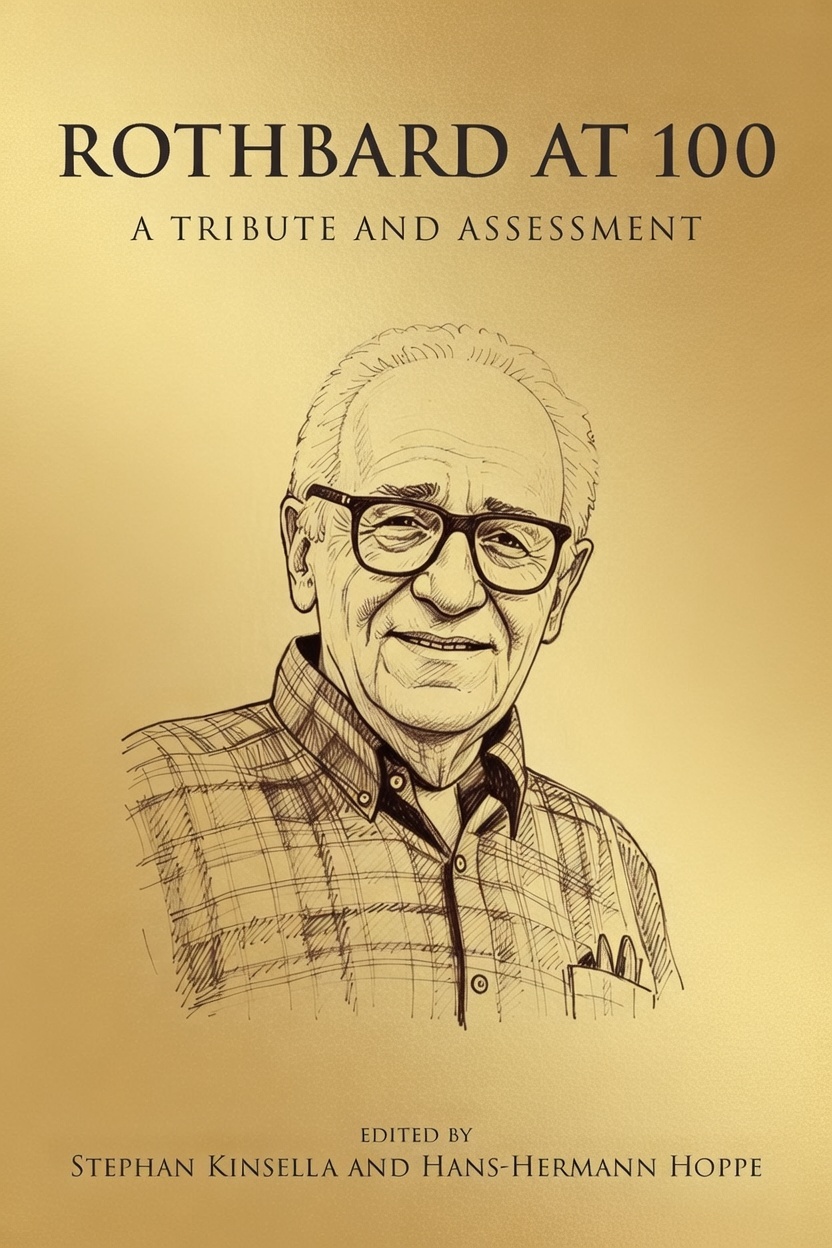
Thanks to volunteer efforts from Jorge Besada, AI-assisted audio narration of the main chapters of Rothbard at 100: A Tribute and Assessment (Papinian Press and The Saif House, 2026) is available at this PFS Youtube Playlist; the mp3 files may also be downloaded in this zip file.
The first two chapters—my Preface and Hans’s “Introduction”—are released today here on the Property and Freedom Podcast, with the other main chapters to be released sequentially weekly on Mondays.
Get every episode summarized
Each time Property and Freedom Podcast publishes, we email you a written briefing from the transcript — the topics, who appeared, and any specific claims, with the ad reads skipped.
Email me new episodesFree for 3 shows. No card needed.
Hosts & guests
Transcript ready
80 searchable segments. Every word is indexed and playable.
Full transcript
Property and Freedom Podcast — PFP314 | Stephan Kinsella, “Preface” (Rothbard at 100). Machine-transcribed; use the interactive transcript above to jump the player to any line.
Rothbard at 100, a tribute and assessment. Edited by Stefan Kinseller and Hans Hermann Hopper. Murray N. Rothbard, 1926 to 1995, was one of the world's greatest champions of human liberty. In his honor, and to commemorate his 100th birthday, on March 2, 2026, the property and freedom society, PFS, has assembled this collection of tributes to and commentary on him, and his work by PFS members, including many who knew him personally. Preface by Stefan Kinseller. The property and freedom society was founded in 2006 by Hans Hopper, 11 years after Murray Rothbard's death. As Hopper was Rothbard's most intimate associate, partner, friend, and student for the last decade of his life, the PFS is naturally home to admirers of Rothbard, and his brand of Austrian economics and anarcho-libertarianism.
Many of its founding members knew Rothbard personally and all were admirers. Most of its other members are also heavily influenced by, and indebted to, Rothbard's powerful body of ideas. The PFS, and all its members, are in an important sense Rothbard's children. The PFS is thus, in a sense, a sort of Rothbard institute under a different name. In fact, some critics, and even admirers, of the Ludwig von Mies's institute have also suggested that it, too, should instead be named the Rothbard institute, as its members and supporters are so obviously influenced by Rothbardianism. There is some merit to this charge, though this is not the insult the critics imagine it to be. Rothbard was Mies's most important student and expositor and the primary intellectual force behind the institute from its founding in 1982 until his death in 1995, as is also the case with the PFS. Those drawn to Missisian Austrian
economics also tend to have an affinity for Mies's is quite radical classical liberal political views and even more so for Rothbard's even more radical and better developed anarcho-capitalism. This is a natural progression, not a surprise at all, and no cause for criticism. It is only fitting, then, that an international array of PFS scholars commemorate his 100th birthday with this collection of tributes and reflections. This collection, released online at the Property and Freedom Society website on his 100th birthday, March 2, 2026, will be published in book form in upcoming months and presented and discussed at the 20th annual meeting of the PFS in Bodrum, Turkey, in September 2026. The contributions are all by long-time PFS members or supporters and friends, many of them founding members since its inaugural meeting in 2006 and most of them scholars and Rothbardians of one type or another.
Many of them knew Rothbard personally, some intimately, such as Hans Hopper, Rothbard students, Doug French, Lee Iglidy, and Jeff Barr, and colleagues such as Tom Dealer Enzo and Jeffrey Tucker. The contributors, in fact, include all three past presidents of the Mies's Institute, as well as Mr Tucker who, in his key role at the Mies's Institute, associated closely with Rothbard in the last decade of his life, the same period as Hopper's close association with Murray. We have arranged the essays into two parts, part one, by those who actually knew or met Rothbard in person, and part two, others who never met him but who have been deeply influenced by his work. As the essays in this volume attest, Rothbard was, in our eyes, the most important social theorist of the 20th century. Rothbard built on the soundest and most rigorous and developed school of economics, the practical branch best developed and
formalized by Mies's, and combined it with an individualist libertarian political philosophy even more consistent, radical, and uncompromising than Mies's is already admirable classical liberalism. Mies's systematized, formalized, improved on, and advanced the Austrian economics first initiated by Karl Manger and further developed by others such as Eugene von Boenbach. Rothbard built on and extended Mies's in economics and incorporated it into his radical anarchist libertarian views. Rothbard was the first modern libertarian with a complete, comprehensive, radical, and Mies's in Austrian informed political philosophy. To paraphrase Isaac Newton, writing in 1675, if Rothbard has seen further than others, it is by standing on the shoulders of giants in particular, on the shoulders of Mies's, whom many of us regard as the most brilliant economic think and not only of the last century but of all time. There is a reason Greedo Hull's man
entitled his biography of Mies's The Last Night of Liberalism, and it is also fitting that Fernando Kiuca entitled his tribute to Rothbard in this volume the first night of libertarianism. And it is why I refer to him, along with Hopper and Mies's, in my chapter, as the indispensable framework for Austro-Libiterianism. A festriffed, ball-liber amochorum, is a collection of scholarly and personal reflections in honor of an important thinker on some important occasion such as retirement and so on. It is rare for a scholar's over to be significant and influential enough to merit this, even rare is the scholar who warrants too. Mies's himself had too. The first was published on the occasion of the 50th anniversary of his doctorate at the University of Vienna in 1906. The second was published on the occasion of his 90th birthday, about which Mies's wrote to his wife, the only good thing about being a non-Aginarian, is that you are able to read your obituaries
while you are still alive. Rothbard's only festriffed was published when he was 62 and based on papers produced from a conference discussing Rothbard's work in the year of his 60th birthday. There can be little doubt that had he lived past the age of 68, another festriff in his honor would have been being produced by now, as was the case for his teacher, Mies's, as well as for his most important, informal, student and colleague, Professor Hopper, who also received two such accolades on the occasions of his 60th and 75th birthdays. We, his intellectual children and students at the PFS, could not let his 100th birthday pass without giving recognition, and tribute to this great and good man, to whom we are so grateful. We hope this volume serves as a fitting Gedenk's script, a posthumous festriffed in his honor. We are now in Rothbard's world, a world that is better, and changed, for his having been in it. Happy birthday, Murray, we love you.
About author Stefan Kinseller, a founding member of the PFS, is a libertarian writer and retired attorney in Houston. His publications include legal foundations of a free society, Houston, Texas, Papinian Press, 2023, LFS, against intellectual property, Auburn Alabama, Mies's institute, 2008, a life in liberty, libra amorcorum in honor of Hans Hermann Hopper, co-editor with Yurg Guigau Hool's man, Houston, Texas, Papinian Press, 2024, and international investment, political risk, and dispute resolution, a practitioner's guide, Second Ed. Most of my own publications cited here, and in this book, may be found at www.stefankinseller.com or www.c4cif.org slash ape. I hereby grant a CC-0, no rights reserved, license in this preface.
More episodes
More from Property and Freedom Podcast
PFP321 | Lee I. Iglody, “The Man Across the Hall: My Time with Professor Rothbar...
Property and Freedom Podcast
PFP320 | Jörg Guido Hülsmann, “Three Channels of Asset Inflation” (Rothbard at 1...
Property and Freedom Podcast
PFP319 | Douglas E. French, “Remembering Murray Rothbard: Teacher, Friend, and I...
Property and Freedom Podcast
PFP318 | Thomas J. DiLorenzo, “The Inspiring and Courageous Intellect of Murray...
Property and Freedom Podcast