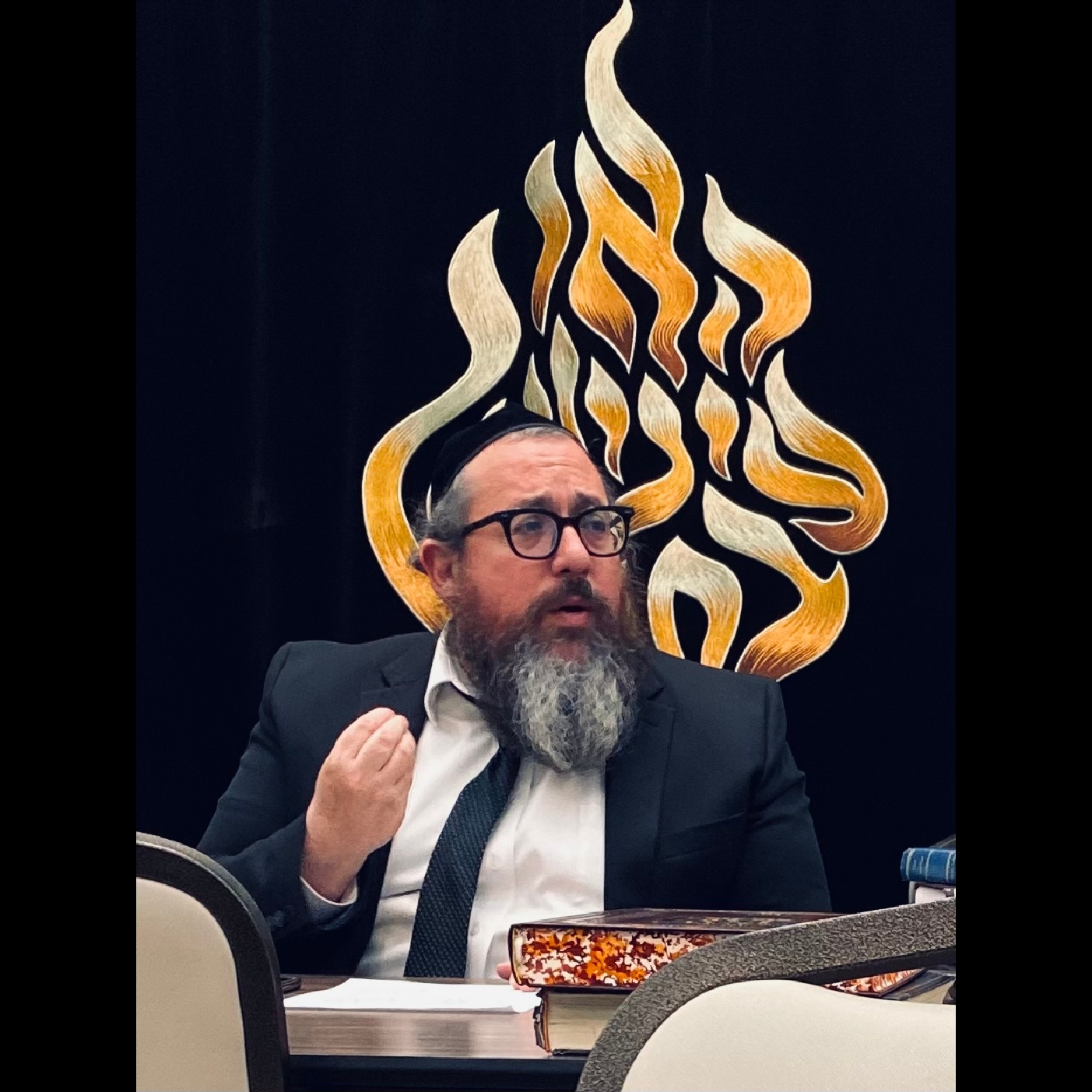
Parshas vayikra-Creating order in the Seder
About this episode
Get every episode summarized
Each time Rabbi Roizman Thursday Night Shiur publishes, we email you a written briefing from the transcript — the topics, who appeared, and any specific claims, with the ad reads skipped.
Email me new episodesFree for 3 shows. No card needed.
Hosts & guests
Transcript ready
655 searchable segments. Every word is indexed and playable.
Full transcript
Rabbi Roizman Thursday Night Shiur — Parshas vayikra-Creating order in the Seder. Machine-transcribed; use the interactive transcript above to jump the player to any line.
We're starting the next part of our share to continue from last week. Tonight's share was sponsored by Dr. Fred and Linda Kutcher, the ill-initimate Dr. Kutcher's wife's mother, Malka Bessafry. Did I get that right, Doctor? Yes. I got that right. Me and Dr. Kutcher learned together and I had an opportunity to know his family, so I did not know Mrs. Kutcher's mother, but I cannot just looking at the fruits of her life. I have no doubt that she was a remarkable woman and tremendous nervous for the whole family. Where's the share? I just want to tell you something that has nothing to do with what we're going to talk about. I was on a flight, so I got up this morning at a quarter to four
and I had a flight at seven o'clock at my Emmy International Airport. So why did I get up so early because I was worried a little bit about not making the flight. So we had an early flight, I got to the airport. So when I got to the airport, it was before Aloysa Shacher, it was before you could not have an at that time or anything like that. So I had the following thought I want to share with you, which I'm not. I used to think I knew the answer, but now that I thought about it, I'm not sure what the answer is. I'll tell you a very big problem that I had. The flight to Miami, does anybody know how long it takes? Four and a half hours. From here, from here to Miami's four and a half hours, it's the same amount of time to fly to New York. Now when you look at the map, it's a little bit weird, because Miami seems much closer than New York is.
And what's the answer that the world is round? The world is round. So it doesn't look like what it should look like on the map. That's the answer. So why am I... I'm sharing your thoughts at 4.30 in the morning. These are my thoughts now. So let me explain to you the problem that I had. When you fly from Arizona to America in the summer, so this is what happens. You leave in the morning or towards the afternoon. Let's say you get like an afternoon flight. And then the plane doesn't fly directly across, because the world is round. What it does is it flies over the North Pole. That's what happens. That is how the normal flight. From here to New York, it flies over the North Pole. Now what happens is that it's daytime. And then you go north. The sun doesn't set in the summer.
So it's still daytime. And when you land, it's the next morning. Okay? What happened to the nighttime? Push. No nighttime. All the time you're flying, it was always daylight. So when should you dive in my roof? When should you dive in my roof? You can't. Because it never becomes dark. It never becomes nighttime. So there are many truths. There are many times where it talks about can you put yourself into a situation where you're putter? Right? Can I not eat and fast till I become putter? Or let's say the classical case is people going on a ship voyage where they will have to be Michal Shabbos. Are you allowed to do that? Because there you have to be Michal Shabbos because of Picornephich. And I saw once that they asked this question about such a flight.
But this is different. I'll tell you why. Because this Shaila that I just presented to you never existed in all of history. Why? Because in all of history what I discussed is a question where somebody was obligated and then something made him putter. Something made him exempt. This question that I'm presenting now, you never became rife. Are you allowed to put yourself in a situation where you never become obligated? That's a question that I had this morning. And this question almost doesn't exist. Why? Because it's never prior to the concept of flight. There was never such a question of can you put yourself into a situation where you will never be shy of. You never obligated yourself. So you're going to Purim and Shushan Purim. So over there, what are you going to do?
You're going to leave. Right. So very good. So what you said is what Russia wise, he wants to use that over there. The difference is, I think, is because over there is that there's a technical thing with you Dalant's love. But over here, there was never but serious of night time. Never happened. So that's why I thought to myself that maybe that's it, yeah. What's the difference between being like Northern Alaska that doesn't get sunlight for 60 days or a year in the winter? Excellent. So that's the Daphars Israel in the Mishnais. He lived in Copenhagen and Stockholm. And he asked these types of shyness. I think there's somewhat of a difference. It's because if you live in a place, so then you have to adopt the clock of where you are. Or you don't live here. You can't live in the air. So you can add to where you live. You live on the ground. You live in the air. So you live in New York, Phoenix, wherever it might be.
So over there, you can't use the argument that you have to get a new clock. Right. That's really what Daphars Israel says. Daphars Israel, right. That you have to sort of adopt the clock. Like, how could a Jew live in a... How could a Jew ever live in Alaska, right? It would be impossible. Because he would always be part of... From my room. Which to me is like little Chicago, Ghanaiden. But that is... Is that... You want to see the winter? It's the bad one. Because then you don't see the summer. Yeah. My daughter went to... In the summer, she went to Reykjavik. So this wasn't... So she made half-dollar in the morning. Because in Iceland, in Reykjavik, she made half-dollar in the morning. Why? Because half-dollar at night was at two o'clock in the morning. But the Shabbos was two o'clock in some crazy time. So she made half-dollar the next morning. But over there, at least it's some darkness. At least for half an hour, it becomes dark.
Over here, when you go the more north, you go sometimes... The sun, you see the sun all the time. But it never goes down. So I don't know. This is something... I'll give a share about it. I once gave a share about it. And I said all these things. And I said, I went into the idea of making a sub-butter. I spoke about Tesvolve and you dial it. I spoke about it. But now, in retrospect, I think I was mistaken. I mean, I'm not saying all these things. There's a big piece, you can say. But I think that this is a new... I have a new way of thinking about this. The myths are shown. So I just want to share some thoughts that I had about that. Okay. Now let's talk about what we really came to speak about. What we really came to speak about is a little bit about the Indian of Paisach. And the idea of making order out of chaos. Why do I say order out of chaos? And this is the reason why. Is that if you look at many of the ideas of Paisach,
it's always in a matter of rushing and doing and things are not in a systematic fashion. So much so, the Rambam has a say there, ha-god there. I don't know if anybody saw the Rambam has a Nusah ha-god there. And some of the things he says there are very different to our ha-god there. The first word in the Rambams ha-god there. You know, the first word is first word. What's the first word in our ha-god there? Kadesh. Right? Kiddish. But what's in the maggot? Starting maggot, what's the first word? What? Avada ma'inu la paray. Before Avada ma'inu. What? Halachmania, right? So the first words in our ha-god are halachmania. Right? The first words in the Rambam's ha-god is bebehilu with a rush. Yotsu is so imitraim halachmania.
The first words in the Rambam's ha-god are bebehilu, which means with a rush running out. And many ideas you see in Pesach, there's a concept of rushing, or we have to go and leave this very second. If we don't leave now, we'll stay there forever, all these ideas. And on the other hand, there's a lot about the Pesach Seder, which talks about the concept of order and system. We spoke last week about the concept of Das, and how it relates to the Pesach Seder. And tonight, a little bit, I want to show you, we're not going to go through everything, but at least tonight, you'll come away with an appreciation, a little bit of a depth to what is going on in the Pesach Seder. The next year, we're going to talk about the 15 stations of the Pesach Seder. We're going to extend tonight's year to even a greater depth. But tonight, we're just presenting the beginnings of it. One of the principal ideas of the night of Pesach
is the concept that the order of the way the world is, is turned around. So I've used this example other times. This is a Moshele from the Reberachab. The Reberachab says an example to explain what the Pesach Seder is about. So if you could imagine, you have a two-year-old, two-and-a-half-year-old child. And everybody's sitting at the table. The table is very high. And the table is set for a banquet. And the table is laden. And you've got a fancy banquet. There are five spoons, and six forks, and seven different types of cups. And there's all kinds of foods on the table. It's like a bucharian wedding times two. You know? You can't see the table. There's no space. Mammish can't see the table. So the child is very excited.
He says, he tells the father, you know, wow, what's going on? He smells the smells. He hears the sounds. He asks the father, what's going on? There's two options the father could do. The father could explain to the child very exactly everything that he sees. He explains to him, there is a knife. And the knife has gold edges. And it has this shape. And next to that knife, there's a wider knife. And he goes, and he could go and explain every detail. And over here, there's a fish. And it's the color pink. And it has a little rose. And so he could go to great detail to explain to the child what is on the table. Another thing that the father could do is he could pick up the child and show him the table. And each one of these ways has a benefit and has a difficulty to it.
The benefit of explaining everything on the table is that the child now understands what he's looking at. And he appreciates it. He doesn't know what a knife is. He doesn't know what the strange fish is. He just smells and doesn't really understand what he's looking at. But if you go and explain it to him, you learn and feel it. So he appreciates what he's touching. He understands it. But if you pick him up, he sees everything at once. He sees everything at once. So on the one hand, he sees the beauty, sees the majesty. He sees the delicacies that are in front of him. But he doesn't really understand what he's looking at. Because he doesn't know what the knife is. He doesn't know that this wine is $2,000. And he doesn't know that this meat has been aged for three years in saffron butter.
You know? Marjoram, sorry. He doesn't understand all of that. The Pesach Seder, the Knight of Pesach, Hashem picks us up and he shows us everything that's available. The reason I don't know if you know, but Hasidim, every person gets his own caror. Gets his own plate with the semonum of the Seder. Every person gets his own. I don't know how these other people, other people I think, are just the balabaisas. But even that, what's the purpose of the caror? Now, if you have a real caror, a fancy caror, on top is a plate, and then there's the Zroya, which is the, what's it called, Shankbow. The Zroya is on the right, the egg is on the left,
and the center is the morrow. Then at the bottom is the charroses, and then over here is Chazaris. Right, and then there is this one thing. Charroses Chazaris. More assets, right? The egg we said. Carpas. Carpas, one second. Right, so it's like this. On this side, this charroses, on this side, this carpas. Right, and then, yeah, no, so I was right. So you have those five, but there has to be six, one second. I missed something. Oh, no, I got it, now I got it. Okay, let's do it again. On the right is Zroya. On the left is the egg. In the middle is the morrow. At the bottom, on the right is Charroses.
On the left is Carpas, and the center is Chazaris. Okay, there are six different cimodem. Now, at the bottom of the cimodem, come the matzes. There are three matzes. Interesting, I once saw a caura. According to Roshash, you have to use 12 matzes. Right? 12. He says, apart from the three, there's another 12. It's an old total of 15. So I saw a caura. It was mummous huge. It was like this. What? Well, it's like a shrivel. Like the best of shrivel. I saw a caura that had 12 matzes in it. One shrivel. What? I guess the, what? I think it was shlames. I think it was shlames. I think it was Barabiyaka Moshehilo. I think that's what I saw. I don't remember. I remember such a thing. Just remember this huge caura.
It was beautiful. It was also a beautiful caura. So, why do we sit? Why do we have a caura? And the reason is, what the caura represents is the entire picture of the Paisachseder, all at once. What does the caura represent? The three matzes are corresponding to Koen, Leivi and Israel. The Magala Mukha says, the three matzes are also Avram, Itzhak and Yakhav. Now, pay attention. The caura is on top of the matzes. What do the matzes represent? The matzes represent the Das, Chachmabina and Das. It represents the intellectual parts of the human being. The caura represents the emotions and the feelings of a person. The Chazaris, sorry, the Zroya is Chasid.
The Baitsa is considered to be Gavura and the Moral is the Ferris. The Chharoises is Netsakh. The Carpus is Hoyt and the Chazaris is you say. The plate itself is Malkos. So, the entire ten spheres are all encapsulated inside the caura. I will now come to explain something very simple, very beautiful. There was a great Macubul, his name was Erbasha Zalik Margolius and he asked Satmer Eber the following question. Usually, when a person behaves, the way a person acts is that his Makhshava, his thoughts affect his actions, his midas, his character. That's the way it normally works.
But on the Paiser's side, the caura is on top of the matzes. So, it seems that the character, the emotions, are above the Chakhma. Why is that the case? Listen to a beautiful explanation from Satmer Eber. Satmer Eber says that on the night of Paiser, we were all small children. And a small child is incapable of fully understanding what is happening. So, how does a child understand things? He understands the world through experience. He understands the world through emotions. That's how a child understands. And after time, those experiences and those emotions become a part of his intellect. It works in reverse order. The same way, like we said from the Rashaab, when Hashem picks up a child
and he shows in the Paiser's side. So, the child, he doesn't understand what he sees. But what does he know? He sees the beauty. He sees the delicacy. He sees the regal nature, the glory of this. He experiences this time. So, the idea, there is such an emphasis in the Haggadon children. It's because on the night of Paiser, in order for somebody to receive an elevated form of Das, he must break his own Das. He must limit his own understanding. You know, on the night of Paiser, we talk a lot about the concept of a moon-up shooter. What is a moon-up shooter? A moon-up shooter is things happening to me. I don't understand what's happening to me. I don't understand it. But what do I know? I know Hashem is the one that's doing it to me. So, how does somebody, is that something a person understands with his intellect?
No, I don't understand what's happening to me. Why is this happening? But I'm experiencing Hashem in my life through a moon-up shooter. The night of Paiser, we literally are experiencing God without understanding. Why? Because in order to receive a higher level of Hachmobina and Das, we have to elevate ourselves just like the child who's being picked up to see the Seder, to see the Matsub on the Seder team. I've said this story before, but as you can see, it's a sad story, but we can apply it in a way that maybe we'll give us understanding. I once saw from Rebaren Lopianski, he wrote a article about his father. His father, there was a 20-year difference between his father and his mother. His father was a Holocaust survivor, and he was 40 years old when he married his mother who was 20.
It's a whole story, it's beautiful what he writes about Rebaren Lopianski. But his father told him a story about Romotolopagramanski. Romotolopagramanski was probably one of the most intelligent, brilliant Tamidakhachamim that lived in Europe and tells. And he tells the following story. The story was that a father and son were walking in the ghetto in Lodz. The Nazis came, and they said they're doing a Kinderaktion. They're just taking children, only children. And the Nazis started to run around, and any child that they saw, they took the child and threw him in the back of the truck. There was a father and son walking with Arab Shabbos before the skier, and they started to run. And the father is running with his child, they're running and running and running. And the Nazis see, and he starts running after them.
And he grabs a hold of the child, and he starts to pull the child. And the father wants to run away, trying to pull the child. So the Nazi says, you want your son, no problem. He takes out his sidearm and kills the child in front of his father. He shoots him there, and he walks away. The father picks up his son, and he goes to the bottom of the apartment building. He digs a grave, and he buries his own son, there in that place. He goes upstairs, and as he walks in, his wife is lighting Nair Shabbos. He walks over to the table, and he bangs on the table, and all the Nairists fall over, and he says, now is not the time to light Nair Shabbos. And she understood what happened.
And she says to him, no, now is the time to light Nair Shabbos. And she picks up the Nairists, I don't know if she's allowed to allow her. She picks up the Nairists, and she relights the Nair Shabbos. When Rabatullah Pagramanski heard the story, he said the following. The man who lost his child had great and deeper mooner in Hashem, because he knew that Hashem had killed his son, and he was angry. Because he didn't understand, why did Hashem do this to me? And that is one level of a mooner. But his wife, who picked up the candles and relit them, that's a level of a mooner that we cannot understand. Because she understood why Hashem had done it, and she let the candles.
When we are by the Paiser Seder, there's a very famous casher. Why don't we make a broker on the Paiser Seder? Very famous casher, many tourists. One of the tourists that is when a person becomes a gar, when does he make a broker on the trailer? When does a gar make a broker on the trailer? He has to do it after. He can't do it before. Because he's not a idiot, he's not even making brokers. So I saw from some sayfer, some sayfer says that when we start off the Paiser Seder, we are going through a garrus. We are going through a conversion process. The broker that we make of Gaal is strong. At the end of maggit is the broker on the beginning of the Paiser Seder.
Over here, this idea is when we look at the Ka'ara. There is the idea of Zraya. The word Zraya says, When a person is looking at the Ka'ara, what's he looking at? Every person is looking at himself in the most complete sense. The Zraya represents the khasadim that a person does. A person when he organized, I don't know if you know, but there's an avayda to put everything in its place. When a person puts a Zraya, he has to ask himself, how much do I give myself to others? The egg is considered to be gvuro. Why egg gvuro? Reblable egg is said. An egg is something that looks like a stone but has life inside of it. The whole concept of gvuro is to show you
that even though something has limitation, life can grow within it. That's why there's a minig. I don't know if I've got it. There's a minig to eat eggs. Can I get carbon khagigo? By the pseudo. Before you start the pseudo, there's a minig to eat eggs. Why do we eat eggs? Because we're starving. It's been a long time. It's the first thing. The reason why we eat eggs is because the whole concept of gvula is like that. There's something that looks like it's dead, but the atom is going to come live from it. That's why we eat eggs. That's the music. The whole concept of gvura is, I think, I can't do it. It's not possible. But with gvura, a person is able to give life in those places that seem dead. That's gvura. The center, moral, is considered to be tefers. That's the idea of tefers. If you think about moral, what's tefers about moral? Moral is bitter. Moral is something that is what's the idea of moral?
Why is moral considered to be tefers? So the word moral is that cholesterol went through a merirus and from that merirus came matentoyer. I'll give an example. The Zoya says that Shavd-oisam bechoymer uvelevenum. He says that the hard slave labor of Mitsrayim turned into the calva choymer. It turned into teure itself. The merirus, the bitterness of Mitsrayim, is what turned into matentoyer. The Zoya Kurdish says that we don't have to suffer and struggle with physical subjugation in Godness anymore. If we are Amal Batoyra, if we toil and Torah, that takes the place of all physical difficulty. Only when we don't toil and Torah with the way we should, that's when Hashem sends us things that cause us challenges
and difficulties. But the etsym, the word moral, is to show you that merirus, the sometimes a person opens up a gammara. And he feels, I can't learn, it's bitter for me. He should know that that merirus, can turn into teferas, can become the most beautiful thing in the world. That's why merirus considered to be teferas. At the bottom is, is chyrosis, which is also the middle of natzach. Why is chyrosis considered to be the middle of natzach? Because the concept of chyrosis is something that, is something that is the cement that brings things together. What is the nature of cement? Cement is something that allows something to stay there forever. That's the concept of natzach. Many, many times, person has difficulties, challenges in life. What's the middle of natzach? It's chyrosis. It's the idea that I'm willing to stand up against it. I'm willing to be menacech.
I'm willing to overcome. That's the middle of natzach. The carpus, which is on the left side, is considered to be the middle of hoid. Because the carpus represents that idea that we start out the pseudo with carpus. Does anybody know why we eat carpus? Why do we eat carpus by the vice versa? Does anybody know? What's the point? What? Can I shut it like this? Somebody told me that the bookarians eat other stuff except for carpus. What? Just carpus? Somebody told me you pound other stuff. I thought it was a good idea. Make a sandwich. Make a sandwich? What? Straight away? That's correct. But right away, do you eat anything else except for potatoes? Celery? Celery. That's harsh. What does everybody eat? What do you eat for carpus?
Parsley. Parsley? Okay. Banana. Banana. The basic straw is to put a banana. The basic straw is to put a banana. The basic straw is to put a banana on the thing. I'm thinking of putting like a massive pineapple on the... In my house, we eat radishes and potatoes. My kids always eat too much potatoes at that time. You know, you're supposed to eat less radishes, whatever it is. When they're young, when they're... So the idea of carpus is like what she said. The purpose of the carpus is in order to ask. Yeah? Is in order to ask. Is that the children should ask what's going on? That's the purpose of carpus. That's called the middle of hoid. What's the middle of hoid? The middle of hoid is when you think that I'm going through a difficulty and this is the worst moment of my life. The middle of hoid is to realize that this was the best moment in your life.
And it's also to recognize and to see and to ask yourself, what is this world that I'm living in? That's the middle of hoid, which is the idea of carpus. By the way, I just want to say something. You know what the avoid of carpus? I don't know where everybody's going to be by the pace of say that. But the word hoid comes from the word of hoidah. I give a suggestion that will change your pace of say that. Before you eat a carpus or a little bit afterwards, you should go around and you should tell everybody in the table what you appreciate about that person. That's the middle of hoidah. Of hoid. Every day, we say moidim anachdolach. Do we think about what we're saying? The idea of moidim anachdolach is that we appreciate everything that Hashem did for us. For a person will go around the table. You can write notes. We say what you appreciate and what you see about every person at the table
it creates a gavaldi gachvivus. It creates a beauty and a closeness. So this is the idea essentially of the middle of hoid. The last thing I will finish with that is the concept of chazarus. The chazarus is the middle of your sight. So I want to read to you what the Taldis Yasser says what is considered to be the middle of your sight. He says like this. What do we use chazarus for? It's also a form of morrow. But why do we put it on the table? The chazarus itself has no purpose. We don't eat from it. We don't use it. It's all purpose is to remind us of the Indian of morrow. That's the whole purpose of it. The whole concept of your sight is the ability to take the entire chazarus and to utilize all of our abilities, our chazarus, the things we do for others
that we care about for others. Our guru, the times that we are able to withstand and to overcome. To Ferris, our connection to Amalatorio, Netsach, the idea that we cement things in our lives, we have red lines that will not pass. Hoid, a sense of appreciation. The chazarus is all of that in one picture. That's what the chazarus is. And then the plate itself is the malchus. The malchus is the totality of our lives. So to answer what's the order of the Paisar say? This Paisar, when you look at the Akhara, what are you looking at? A person could look at the Zraya. He says, what am I giving up myself? When he looks at all the aspects of what the person is actually looking at, he's looking at the deepest parts of himself. This is what the Akhara represents.
And in Metsach, next week, we're going to learn the 15-difference amount and explain the incredible depth of what hadas and the Akhara and everything is coming together into one complete picture of what the Paisar say there is all about. Sure.
More episodes
More from Rabbi Roizman Thursday Night Shiur

Parshas Nitzvavim-Vayeilech
Rabbi Roizman Thursday Night Shiur
Parshas ki savo
Rabbi Roizman Thursday Night Shiur
Parshas Mattos masai
Rabbi Roizman Thursday Night Shiur
Parshas Chukas Balak-The importance of ulterior motives
Rabbi Roizman Thursday Night Shiur