About this episode
Get every episode summarized
Each time The Propaganda Report publishes, we email you a written briefing from the transcript — the topics, who appeared, and any specific claims, with the ad reads skipped.
Email me new episodesFree for 3 shows. No card needed.
Hosts & guests
Transcript ready
596 searchable segments. Every word is indexed and playable.
Full transcript
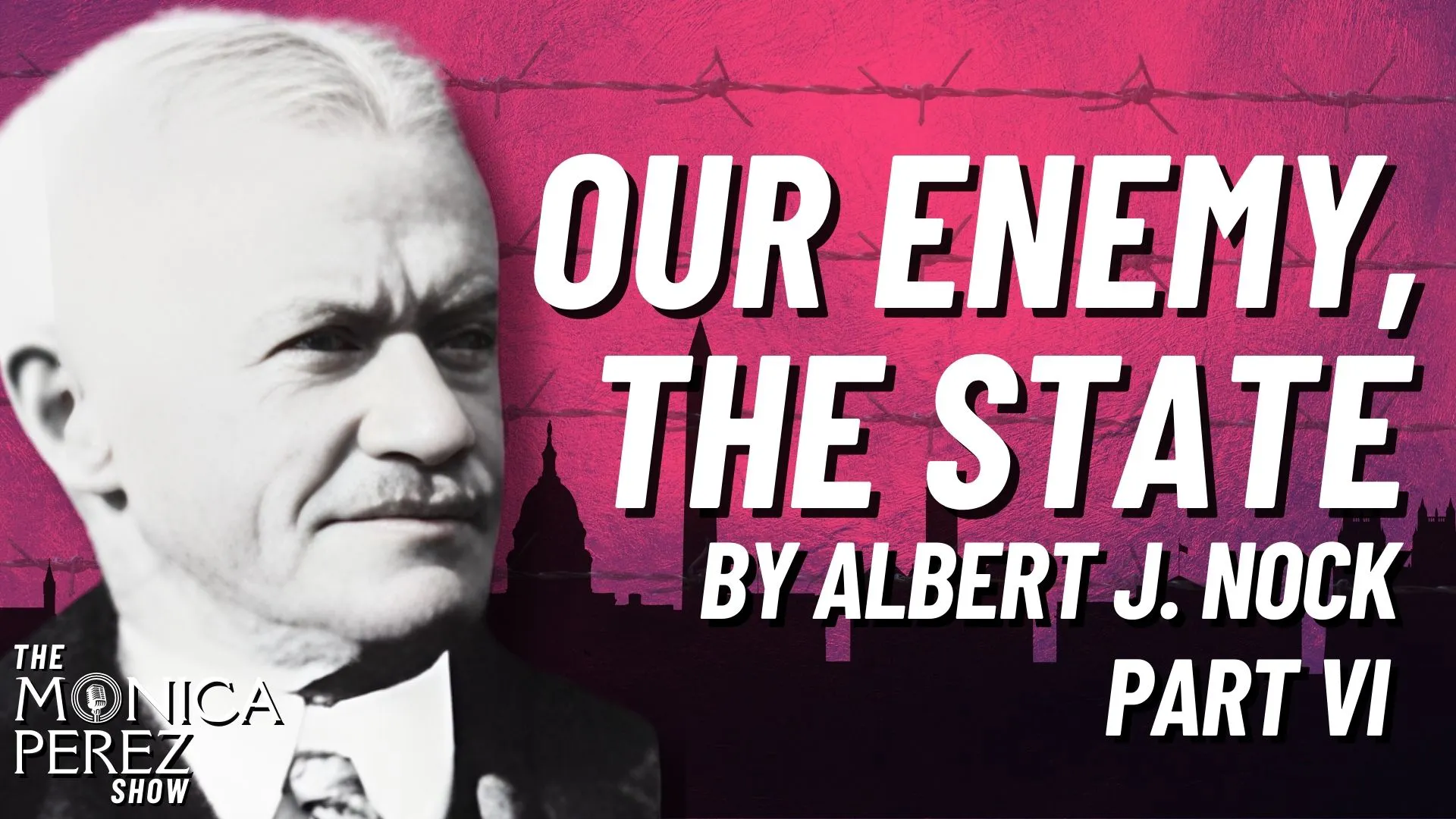
The Propaganda Report — Our Enemy, the State by Albert J. Nock, Part 6. Machine-transcribed; use the interactive transcript above to jump the player to any line.
This is Monica Perez. Thank you so much for tuning in for this hour. 6th episode of but 5th chapter of our enemy to state by Albert Cheynoch and I just love it. It's super libertarian. It's fundamental. It's fun and mental. But I feel like we have lost track of the fundamentals of libertarianism because we've fallen for this like identity stuff and your own interest which was just not the way I mean however you want to say this country was
founded and knock will will disabuse you of the conceived and liberty fantasies that you get from Rothbard who normally doesn't have fantasies but you I always said regardless of what the intention of the founders was the reality was that the people who I guess had representatives that tested to this or consented to this they had a certain understanding of what this contract and actually I'm listening to history homo sapiens talk about the whiskey rebellion and that's like I think was an aha moment or an awakening where they said oh my gosh like this really wasn't for us we fought this war but it was really for other interests and knock will support that but for me the expectation that the people had was consistent with with what we think of as the
constitution and the bill of rights and because of that I feel like that is our birthright even if it wasn't what they really meant and that's why I think it's really important to have a grounding in the libertarian basics chapter five it is a commonplace that the persistence of an institution is due solely to the state of mind that prevails towards it the set of terms in which men habitually think about it so long and only so long as those terms are favorable the institution lives and maintains its power and when for any reason men generally cease thinking in those terms it weakens and becomes inert at one time a certain set of terms regarding man's place in nature gave organized Christianity the power largely to control man's consciences and direct their conduct and this power has dwindled to the point of disappearance for no other reason than that man
generally stopped thinking in those terms the persistence of our unstable and iniquitous economic system is not due to the power of accumulated capital the force of propaganda or to any force or combination of forces commonly alleged at as its cause this is starting to sound like what my mom would say to me it is due solely to a certain set of terms in which men think of the opportunity to work yes this was the most important passage in this book to me this was life changing or mentally changing they regard this opportunity as something to be given okay so the persistence of our unstable and iniquitous economic system is not due to the power of accumulated capital the force of propaganda or to any force or combination of forces commonly alleged as its cause it is due solely to a certain set of terms in which men think of the opportunity to work they regard this opportunity as something to be given nowhere is there any other idea about it
than that the opportunity to apply labor and capital to natural resources for the production of wealth is not in any sense oh right but a concession this is all that keeps our system alive when men cease to think in those terms the system will disappear and not before I just thought that was monumental that people think of think of working as as a privilege as something you have to ask for the the how did he say it the opportunity to apply labor and capital to natural resources for the production of wealth it is a right and we should think of it that way and if you do you will not be a victim says I think the people who step off the grid choose the Benedict's option grow their own chickens they they understand that they're taking back the right to apply labor and capital to natural resources but if you see the trend that's coming and
I actually am going to talk to Ian Davis about his book the technology and the dark enlightenment with the technique and the dark enlightenment and and Courtney Turner talks about this a lot too about tokenization of natural resources and I just think of it in less abstract terms as black rock buying up single-family homes and renting them out getting driverless cars that we will not own it we are just getting removed from access to physical things from ownership of land and property and because we can't own the land or or don't think about owning the land and it give it all gets gobbled up we won't have the natural resources upon which to apply our own labor and capital hi he goes on it seems pretty clear that changes in the terms of thought affecting an institution are but little advanced by direct means they are brought about in obscure and circuitous ways and assisted by trains of circumstance which before the fact would appear quite unrelated
and they're erosive or solvent action is therefore quite unpredictable oh my gosh I didn't tell you the name of this so when I read the PDF it doesn't have a title for the book for the chapter the chapter this chapter was called in this in the hard copy politics and other fetishes very funny a direct drive at affecting these changes comes as a rule to nothing or more often than not turns out to be retarding they are so largely the work of those unimpassioned and imperturbable agencies for which Prince to Bismarck had such vast respect he called them the imponderabilia that any effort which disregards them or thrust them violently aside will in the long run find them stepping into abort its fruit I don't know he's saying I think he's saying that the animal spirits the zeitgeist or whatever is not
manipulable I don't know this was a hundred years ago and he's pretty spot on with a lot of this but there's been a lot of work on mass psychology many experiments done and I think they've made a lot of progress on manipulating the masses I agree with them about the work thing anyway let's keep going but he's saying how do you change that back let's see thus it is that we that what we are attempting to do in this rapid survey of the historical progress of certain ideas is to trace the genesis of an attitude of mind a set of terms in which now practically everyone thinks of the state and then to consider the conclusions towards which this psychical phenomenon unmistakably points instead of recognizing the state as quote the common enemy of all well disposed industrious and decent men the run of mankind with rare exceptions regards it not only as a final and indispensable entity but also as in the main beneficent the mass man ignorant of its history
regards its character and intentions as social rather than anti social and in that faith he is willing to put at its disposal an indefinite credit of navery mendacity and chicane upon which its administrators may draw at will instead of looking upon the state's progressive absorption of social power with the repugnance and resentment that he would naturally feel towards the activities of a professional criminal organization he tends rather to encourage and glorify it in the belief that he is somehow identified with the state and that therefore and consenting to its indefinite a grandisement he consents to something in which he has a share he is pro tanto a grandizing himself professor or tega ega set i think he was the one did we talk about this who defines the vet economic versus political means of wealth accumulation i believe it was him
professor or tega ega set and analyzes the state of mind extremely well the mass man he says confronting the phenomenon of the state sees it admires it knows that there it is furthermore the mass man sees in the state an anonymous power and feeling himself like it anonymous he believes that the state is something of his own suppose that in the public life of a country some difficulty conflict or problem presents itself the mass man will tend to demand that the state intervene immediately and undertake a solution directly with its immense and unassailable resources when the mass suffers any ill fortune or simply feels some strong appetite its great temptation is that permanent sure possibility of obtaining everything without effort struggle doubt or risk merely by touching a button and setting the mighty machine in motion it is the genesis of this attitude
this state of mind and the conclusions which inexorably follow from its predominance that we are attempting to get at through our present survey by that i think he means this book these conclusions may perhaps be briefly forecast here in order that the reader who is for any reason in disposed to entertain them may take warning of them at this point and close the book so if you don't want to hear it now is your chance to exit the unquestioning do not sure how to tackle your taxes are you sweating the small print you may be experiencing phomo the fear of messing up the answer using turbo tax on into a credit they help you get your biggest refund and then we help you do more with it with a personalized plan designed to help you hit your money goals it's time to take your taxes to the max start filing today
in the credit karma app determined even trucking maintenance of the attitude which professor or take it you guess that so admirably describes is obviously the life and strength of the state and obviously to it is now so inveterate and so widespread one may freely call it universal that no direct effort could overcome its inveteracy or modify it and least of all hope to enlighten it this attitude can only be sapped and mined by uncountable generations of experience in a course marked by recurrent calamity of a most appalling character when once the predominance of this attitude in any given civilization has become inveterate as so plainly it has become in the civilization of america all that can be done is to leave it to work its own way out to its appointed end the philosophic historian may content himself with pointing out and clearly elucidating its consequences as professor or take it you guess that has done aware that after this there is no more that one can do the result of this tendency he says
will be fatal spontaneous social action will be broken up over and over again by state intervention no new seed will be able to fructify society will have to live for the state man for the governmental machine and as after all it is only a machine whose existence and maintenance depend on the vital supports around it the state after sucking out the very marrow of society will be left bloodless a skeleton dead with that rusty death of machinery more gruesome than the death of a living organism such was the lamentable fate of ancient civilization yeah i i don't think he's wrong and it has gutted society and social power the revolution of 1776 to 1781 converted 13 provinces practically as they stood into 13 autonomous political units completely independent and they so continued until 1789
formally held together as a sort of league by the articles of confederation for our purposes the point to be remarked about this eight year period 1781 to 89 is that administration of the political means was not centralized in the federation but in the several units of which the federation was composed the federal assembly or congress was hardly more than a deliberative body of delegates appointed by the autonomous units it had no taxing power and no coercive power it could not command funds for any enterprise comments of the federation even for war all it could do was to apportion the sum needed in the hope that each unit would meet its quota see if you're going to do that you have to be sure they're going to support it and end up on top so you're going to hesitate to go to war there was no coercive federal authority over these matters or over any matters the sovereignty of each of the 13 federated units was complete well maybe that's what was
conceived in liberty by Rothbard according to Rothbard I don't know anyway thus the central body of this loose association of sovereignty has had nothing to say about the distribution of the political means this authority was vested in the several component units each unit had absolutely jurisdiction over its territorial basis and could partition it as it's so fit and could maintain any system of land tenure that it chose to establish interesting land tenure each unit set up its own trade regulations each unit levied its own tariffs one against another in behalf of its own chosen beneficiaries each manufactured its own currency and might manipulate it as it liked for the benefit of such individuals or economic groups as were able to get effective access to the local legislature each managed its own system of bounties concessions subsidies franchises and extra sized it with a view to whatever private interest its legislature might be influenced
to promote in short the whole mechanism of the political means was non-national the federation was not in any sense a state the state was not one but 13 within each unit therefore as soon as the war was over their reganit ones a general scramble for access to the political means it must never be forgotten that in each unit society was fluid this access was available to anyone gifted with the peculiar sagacity and resolution necessary to get at it hence one economic interest after another brought pressure of influence to bear on the local legislatures until the economic hand of every unit was against every other and the hand of every other was against itself the principle of quote protection which is we have seen was already well understood was carried to lengths precisely comparable with those to which it is carried in international commerce today and for precisely the same primary purpose the exploitation or in plain terms the robbery
of the domestic consumer mr. beard remarks that the legislature of New York for example pressed to the principle which governs tariff making to the point of levying duties on firewood brought in from Connecticut and on cabbages from New Jersey a fairly close parallel with the octua that one still encounters at the gates of french towns the primary monopoly fundamental to all others the monopoly of economic rent was sought with redoubled eagerness the territorial basis of each unit now included the vast holdings confiscated from british owners and the bar erected by the british british states proclamation of 1763 against the appropriation of western lands was now removed professor seculsky observes dryly that the early landlust which the colonists inherited from their european forebears was not diminished by the democratic spirit of the revolutionary fathers indeed not land grants were sought as a situously from local legislatures as they had been in earlier days from the steward dynasty and from colonial governors and the
mania of land jogging ran a pace with the mania of land grabbing among the men most actively interested in these pursuits were those whom we have already seen identified with them in the pre-revolutionary days such as the two morris's nox pickering james wilson and patria canry i had to tell my son that i might have been wrong about patria canry he admired me for always having an open mind knowing that it's possible that you're wrong in accepting that burden i might have to do more research on that but i was really going to the mat for for old pat there in my i think i might have to back off until the facts come in with their names also appear those of doer bingham mccain willing green leaf nickelson aron burr low see now i like daren burr because he killed Alexander hamilton so he's bad too
um i like to like somebody for killing somebody who would be dead by now anyway i don't know but i don't like hamilton because it was a big anyway low macomb wadsworth these are names that like still resonate ramson constable pier pond and others which now are less well remembered there's probably no need to follow out the rather repulsive trail of effort after other modes of the political means what we have said about the foregoing two modes tariffs and rental value monopoly is doubtless enough to illustrate satisfactorily the spirit and attitude of mind towards the state during the eight years immediately following the revolution the whole story of incensate scuffle for state created economic advantage is not especially animating nor is it essential to our purposes such as it is it may be read in detail elsewhere all that interests us is to observe that during the eight years of federation the principles of governments had forth by pain and
by the declaration continued in utter abayance not only did the philosophy of natural rights and popular sovereignty remain as completely out of consideration as when mr jefferson first lamented its disappearance but the idea of government as a social institution based on this philosophy was likewise unconsidered no one thought of a political organization as instituted quote to secure these rights by processes of purely negative intervention instituted that is with no other end in view than the maintenance of quote freedom and security the history of the eight year period of federation shows no trace whatever of any idea of political organization other than the state idea no one regarded this organization otherwise than as the organization of the political means and all powerful engine which should stand permanently ready and available for the irresistible promotion of this were that set of economic interests and the irrim imbremidiable disservice of others according as whichever said by whatever course of strategy might succeed in obtaining command
of its machinery it may be repeated that wall state power was well centralized under the federation it was not centralized in the federation but in the federated unit for various reasons some of them plausible many leading citizens especially in the more northerly units found this distribution of power on satisfactory and a considerable compact group of economic interests which stood to profit by redistribution naturally made the most of these reasons it is quite certain that dissatisfaction with the existing arrangement was not general for when the redistribution took place in 1789 it was affected with great difficulty and only through a coup d'etat organized by methods which if employed in any other field than that of politics would be put down at once as not only daring but unscrupulous and dishonorable yeah i believe you this situation in a word was that american economic interests had fallen into two grand divisions the special interest in
each having made common cause with a view to capturing control of the political means one division comprised the speculating industrial commercial and creditor interests with their natural allies of the bar and bench and pulpit and press so the speculating industrial commercial and creditor interests banks etc the other comprised chiefly the farmers and artisans and their debtor class generally see now i thought Patrick Henry was completely aligned with the farmers but this i i don't know i'm not seeing okay from the first these two grand divisions were colliding briskly here and there in the several units the most serious collision occurring over the terms of the massachusetts constitution of 1780 the state in each of the thirteen units was a class state as every state known to history has been and the work of maneuvering it in its function of enabling the economic exploitation of one class by another went steadily on like this guy does kind of sound like a communist once more
but this is a problem that i have if you believe in economic liberty you don't have to to fool yourself into defending capitalism just because lefties attack capitalism doesn't mean you have to defend it i mean and it comes down to the definition of capitalism i mean if capitalism is just employing labor and capital to natural resources of course that's what we want but it's financial capitalism it's cronyism it's all of that so this guy when he criticizes that he kind of does it without a lot of apology and it sounds like he's a communist and you know it's funny because then like marks becomes a taint agent of of economic liberty or economic justice not social justice but like the problem with capitalism is it hijacks government
to prevent people from engaging in the economic marketplace fairly so mark says and this happens even today people on the left today anti clonialist anti anti anti imperialists they end up being socialists all the time and it drives me crazy as i've mentioned before so mark says oh look this stuff is all bad let's just be communist and by the way wasn't he paid by the banks and the industrialists isn't that famous cartoon of the big money guys doling out the cash to marks so so they gave you the alternative which was another centralized system and this is a centralized system it's a shame we have to dodge all the language and everything try to work around it it gets hijacked easily and you know what are you gonna do general conditions under the articles of confederation were pretty good people had made a creditable recovery from the dislocation and disturbances due to the
revolution and there was a very decent prospect that mr. Jefferson's idea of a political organization which should be national and foreign affairs and non-national and domestic affairs might be found continuously practicable some tinkering with the articles seemed necessary in fact it was expected but nothing that would transform or seriously impair the general scheme the chief trouble was with the federation's weakness in view of the chance of war and in respect of debts due to foreign creditors the articles however carried provision for their own amendment and for anything one can see such amendment as the general scheme made necessary was quite feasible in fact when suggestions of revision arose as they did almost immediately nothing else appears to have been contemplated but the general scheme itself was as a whole objectionable to the interests grouped in the first grand division the grounds of their dissatisfaction are obvious enough
when one bears in mind the vast prospect of the continent one need used but little imagination to perceive that the national scheme was by far the more congenial to those interests because it enabled an ever closer centralization of control over the political means for instance leaving aside the advantage of having but one central tariff making body to chaffer with CHFFER instead of 12 any industrialist could see the great primary advantage of being able to extend his exploiting operations over a nationwide free trade area walled in by a general tariff the closer the centralization the larger the exploitable area that's what I think is going on right now like yeah maybe we're not going to have a world hedgemon but I feel like what's going on with China and Russia and like Greenland and Venezuela stuff we're saying okay we are we're enforcing the trilateral units and you get your unit and we get ours but for God's sake let's not
compete across boundaries because that'll drive us all into a into the ground any speculator and rental values would be quick to see the advantage of bringing this form of opportunity under unified control any speculator and depreciated public securities would be strongly for a system that could offer in the use of the political means to bring back their face value any ship owner or foreign trader would be quick to see that his bread was buttered on the side of a national state which if properly approached might lend him the use of the political means by way of a subsidy or would be able to back up some profitable but dubious freebooting enterprise with quote diplomatic representations or with reprisals oh yeah you could threaten them Trump is doing all of this stuff anyway the farmers and the debtor class in general on the other hand were not interested in these considerations but were strongly for letting things stay for the most part as they stood preponderance in the local legislature has gave them satisfactory control
of the political means which they could and did used to the prejudice of the creditor class and they did not care to be disturbed in their preponderance they were agreeable to such modification of the articles as should work out short of this but not to setting up a national replica of the British merchant state which they perceived was precisely what the classes grouped in the opposing grand division wished to do these classes aimed at bringing in the British system of economics politics and judicial control on a nationwide scale and the interest grouped in the second division saw that what this would really come to was a shifting of the incidents of economic exploitation upon themselves they had an impressive object lesson in the immediate shift that took place in Massachusetts after the adoption of John Adams a local constitution of 1780 they naturally did not care to see this sort of thing put into operation on a nationwide scale and they therefore looked with extreme disfavor upon any bait put forth for amending the articles
out of existence when Hamilton in 1780 objected to the articles in the form in which they were proposed for adoption and proposed the calling of a constitutional convention instead they turned to the cold shoulder as they did again to Washington's letter to the local governors three years later in which he adverted to the need of a strong coercive central authority yeah Hamilton was greatly influential on Washington and I forgot how bad a status to was not just the bank but this stuff very bad finally however a constitutional convention was assembled on the distinct understanding that it should do no more than revise the articles in such a way as Hamilton cleverly phrased it as to make them quote adequate to the exigencies of the nation and on the further understanding that all the 13 units should ascend to the amendments before they went into effect in short that the method of amendment provided by the articles themselves should be followed I'll tell you when people say they want a constitutional convention right now there's no way what you're going to get written
on paper is going to be better than what we have now written on paper and if it is you're not going to get it enforced any better than we're enforcing it now it's it is something deeper maybe it's the idea that you think jobs should be given maybe that is the basis of all the problems neither understanding was fulfilled the convention was made up wholly of men representing the economic interests of the first division the great majority of them possibly as many as four fifths were public creditors one third were land speculators somewhere money lenders one fifth were industrialists traders shippers and many of them were lawyers they planned and executed a coup d'etat simply tossing the articles of confederation into the waste basket and drafting a constitution de novo with the audacious provision that it should go into effect when ratified by nine units instead of by all thirteen more over with like audacity they provided that the document should not be submitted either to the congress or to the local legislatures but that it should go direct to a popular vote
unscrupulous methods employed and securing ratification need not be dwelt on here we are not indeed concerned with the moral quality of any of the proceedings by which the constitution was brought into being but only with showing their instrumentality and encouraging a definite general idea of the state and its functions and a consequent general attitude towards the state we therefore go on to observe that in order to secure ratification by even the nine necessary units the document had to conform to certain very exacting and difficult requirements the political structure which it contemplated had to be republican and form yet capable of resisting what Jerry anxiously called the excess of democracy and what Randolph termed its turbulence and bollies the task of the delegates was precisely analogous to that of the earlier architects who had designed the structure of the British merchant state with its system of economics politics and judicial control people do say we have merchant law they had to contrive something
that could pass muster as showing a good semblance of popular sovereignty without the reality Madison defined their task explicitly in saying that the conventions purpose was quote to secure the public good and private rights against the danger of such a faction democratic faction and at the same time preserve the spirit and form of popular governments under the circumstances this was a tremendously large order and the constitution emerged as it was bound to do as a compromised document or as mr. beard puts it very precisely a mosaic of second choices which really satisfied neither of the two opposing sets of interests it was not strong and definite and not definite enough in either direction to please anybody in particular the interest composing the first division led by Alexander Hamilton saw that it was not sufficient of itself to fix them in anything like a permanent impregnable position to exploit continuously the groups composing the second division to do this to establish the degree of centralization requisite to their purposes
certain lines of administrative management must be laid down which once established would be permanent the further task therefore in Madison's phrase was to quote administration the constitution into such absolutist modes as would secure economic supremacy by a free use of the political means to the groups which made up the first division this was accordingly done for the first 10 years of its existence the constitution remained in the hands of its makers for administration in directions most favorable to their interests for an accurate understanding of the newly erected systems economic tendencies too much stress cannot be laid on the fact that for these 10 critical years the machinery of economic and political power was mainly directed by the men who had conceived and established it Washington who had been chairman of the convention was elected president nearly half the senate was made up of men who had been delegates and the house of representatives was largely made up of men who had to do with the drafting or ratifying
of the constitution Hamilton Randolph and Knox who were active in promoting the document filled three of the four positions in the cabinet and all the federal judge ships without a single exception were filled by men who had a hand in the business of drafting or ratification or both of all the legislative measures enacted to implement the new constitution the one best calculated to ensure a rapid and steady progress in the centralization of political power was the judiciary act of 1789 this measure created a federal supreme court of six members subsequently enlarged tonight and a federal district court in each state with its own complete personnel and a complete apparatus for enforcing its decrees oh it had enforcement the act established federal oversight of state legislation by the familiar device of interpretation whereby the supreme court might nullify state legislative or judicial action which for any reason it saw fit to regard as unconstitutional yes I've always objected
to the reading of the 14th amendment which is after this as saying that the first amendment and all the amendments needed to be adhered to by the states I always advocated for and believe that the the correct way of interpreting it is that the constitution applies only to federal governments and that states can do whatever they want one feature of the act which for our purposes most noteworthy noteworthy is that it made the tenure of all these federal judgeships appointed not elective and for life thus marking almost the farthest conceivable departure from the doctrine of popular sovereignty semi collegiate says not talks about the political rather than nobility or heredity the move to democracy allows the rulers to recruit or draft additional bodies to do stuff like force the constitution while still making the force look like popular government yeah and think about the two-party system so think about the
immigration thing that's going back and forth right now there Biden makes a big giant mess and then Trump reacts with a big giant mess and we don't get to say this immigration policy is ridiculous it's deliberately arbitrary and disruptive and dangerous and violent and inhumane and unconstitutional and literally anyone you say that to is going to say well it's the other party of not mine who's really to blame for this or his ad fault there's no coherent policy and you could say that that's the problem with democracy but I would say that's the problem with the democracy that's not that's a farce and I mean democracy representative republic I don't even know how much it matters I've always kind of thought I'm an anarchist first and then I would say constitutional monarchist after that which is why I fell in love with Hans Hermann Hopper's book
Democracy the God that failed because he opens with that because I kept thinking what what moment in history was the real turning point and I thought about the civil war before that after that and I thought every single time you get to any big crisis it's like crisis and Leviathan you just get more government but the thing that really toppled the whole system I think was World War One in that it took out all the monarchs and were you know some of the monarchs I was just reading about the Norwegian monarchy and I know the Dutch monarchies in place the English monarchies in place but the Germans gone Austria hungry is gone all of that so yeah then you have no one to blame then you only have yourself to blame but in fact it's not a response to your wishes I definitely said it was it will take a republican about gun control first because a caller said that to me a caller
said that to me in the early years of my show so it was at least 10 years ago and boy has it I probably put in my glossary the expression the contrary law of democracy in my glossary 10 years I think I did that in like 2013 where what you what you fear the most the party party not yours is not going to get away with because you'll you'll go on to the mall with four million guns or whatever the mall and DC it's the party it's your party who brings you what you fear the most and they call it like left cover or right cover or we used to say silence the anti-war left under Obama and I would say silence the fiscal conservative right under Reagan I'm sorry it was very cheerful time but you look at the debt under Reagan I mean it compares the only one that dwarfs it
as the re-increasing debt under Trump the first one and I remember when Trump got elected who like oh he's great but why said he's not like well where the I said look at the end of his term whatever the reason things are not going to be going in the right direction we are not changing course in this country by electing someone some party who you think is an outsider that's just not happening the first chief justice was John Jay the learned and gentle Jay as beverage calls him and his excellent biography of Marshall all these names came up when I was in law school a man of superb integrity who was far above doing anything whatever in behalf of the accepted principle that estboni judisus ampliara jurist dictionum I don't know any latin at all else worth although I had my kids take Latin they went to Catholic school but my daughter wanted to be a lawyer which you know it does come in handy so I had her or I encouraged her to take Latin all
the way through high school which she did so hopefully that'll help her out anyway else worth and my son wants to be a doctor which will definitely come in handy although I don't know how he's going to navigate that system with his opinions about jabs and whatnot but if you want to be a dodged you should take Greek I believe that the sciences were fried by the Greeks and the laws were better Romans anyway else worth who followed him right now new fan dual customers can get up to three hundred dollars back in bonus bets every day for ten days place a tournament bet using the token and if it doesn't win you'll get up to three hundred dollars back in bonus bets every single day for ten days straight you can even mix things up with same game parles for a shot at a bigger pale fan dual it's time to dance 21 plus in president's lexate bonus bets are not with trouble and expire seven days after receive tokens are received an increments of one per day restrictions apply see terms at sportsbook.fandal.com gambling problem call 1-800 gambler also did nothing the succession however after j had declined a reappointment oh j had declined
reappointment then fell to john marshall who in addition to the control established by the judiciary acts over the state legislative and judicial authority are which rarely extended judicial control over both the legislative and executive branches of the federal authority I hate this so much and this I lay at times Jefferson's feet and I don't even think it's binding law but of course it is because we we accept it. Marry versus Madison I assume is what he's talking about thus affecting as complete and convenient a centralization of power as the various interest concerned and framing the constitution could reasonably have contemplated we may now see from this necessarily brief survey which anyone may amplify and particularize at his pleasure what the circumstances were which rooted a certain definite idea of the state still deeper in the general consciousness that idea was precisely the same in the constitutional period as that which we have seen prevailing in the two periods already examined the colonial period in the eight year period following the revolution nowhere in the history of the constitutional period do we find
the faintest suggestion of the declaration's doctrine of natural rights and we find its doctrine of popular sovereignty not only continuing in a bayon's but constitutionally as stocked from ever reappearing nowhere do we find a trace of the declaration's theory of governments on the contrary we find it expressly repudiated the new political mechanism was a faithful replica of the old disestablished British model but so far improved and strengthened as to be incomparably more close working and efficient and hands presenting incomparably more attractive possibilities of capture and control by consequence therefore we find more firmly implanted than ever the same general idea of the state that we have observed as prevailing hitherto the idea of an organization of the political means an irresponsible and all-powerful agency standing always ready to be put into use for the service of one set of economic interests as against another so he is preferring
the articles of confederation but he also pointed out that none of those states looked like they were trying to be a hero and not just enforce the political means over the economic means at the exploitation through the exploitation of the people are actually working. Dutch monarch is the silent killer yes yes yes hey Jack Republicans have selective memory when it comes to Reagan absolutely the Republican Party was a continuation of the big government federalists wigs which were like the British Tories wanted government solutions to everything I know is always the most disgusting people who make it to the top of the party for forest they used to call Reagan Red Ronnie wow because they were in the red or cuz he was red we mean way back in the day when he was the president of the screen actor skilled union the original Republicans were big governments the civil war to curb states rights yeah cuz Lincoln was Republican okay out of this
idea what idea the idea of an organization of the political means an irresponsible and all-powerful agency standing always ready to be put into use for the service of one set of economic interests against another yes we've established that okay out of this idea proceeded what we know as the party system of political management which has been effect in effect ever since here we go our purposes do not require that we examine its history in close detail for evidence that it has been from the beginning a purely bipartisan system since this is now a matter of fairly common acceptance in his second term Mr. Jefferson discovered the tendency towards bipartisanship and was both dismayed and puzzled by it I have elsewhere remarked his curious inability to understand how the cohesive power of public plunder works straight towards political bipartisanship partisanship I don't know I don't understand you in 1823 finding some who called themselves Republicans favoring the federalist policy of centralization like you guys are talking about in the chat he spoke of them
in a rather bewildered way as pseudo Republicans but real federalists but most naturally any Republican who saw a chance of profiting by the political means would retain the name and at the same time resist any tendency within the party to impair the general system which held out such a prospect in this way bipartisanship arises party designations become purely nominal and the state stated issues between parties become progressively trivial yes so true and both are more and more openly kept up with no other object than to cover from scrutiny the essential identity of purposes in both parties is that not still true this was a hundred years ago so so true that's the party system at once became in effect an elaborate system of fetishes which in order to be made as impressive as possible were chiefly molded up around the constitution and were put on show as constitutional principles the history of the whole post constitutional period from 1789 to
the present day is an instructive and cynical exhibit of the fate of these fetishes when they encounter the one only actual principle of party action the principle of keeping open the channels of access to the political means when the fetish of strict construction for example has collided with this principle it has invariably gone by the board the party that maintained its simply changing sides yes we have that side changing like crazy right now the anti-federalist party took office in 1800 as the party of strict construction yet once in office it played ducks and tricks with the constitution in behalf of the special economic interests that it represented i mean if he doesn't talk about marbury v madison as being a geverson thing i think he should the federalists were nominally for loose construction yet they fought bitterly every one of the opposing parties loose constructionist measures the embargo the protective tariff and the national bank they were constitutional nationalists of the deepest die as we have seen yet in their center and stronghold
new england they held the threat of secession over the country throughout the period of what they harshly called mr. madison's war the war of 1812 which was in fact a purely imperialistic adventure after annexation of florida and floridian and canadian territory in behalf of stiffening agrarian control of the political means but when the planting interests of the south made the same threat in 1861 they became fervid nationalists again such exhibitions of pure fetishism out new englanders became fervid nationals yet territorial integrity whatever the hell that means such exhibitions of pure fetishism always cynical and their transparent candor make up the history of the party system their reductio adf-sertum is now seen as perhaps complete one cannot see how it could go further in the attitude of the democratic party towards its historical principles of state sovereignty and strict construction a fair match for this however is found in a speech made the
other day to a group of exporting and importing interests by the mayor of new york always known as a republican in politics advocating the horrid democratic doctrine of a low tariff throughout our opposed constitutional period there is not on record as far as i know a single instance of party adherence to a fixed principle quah principle or to a political theory quah theory i always hated that they said quah lot in law school i think it means as a like prisoners were quah principle indeed the very cartoons on the subject show how widely it has come to be accepted that party platforms and their content of issues are so much sheer quackery and that campaign promises are merely another name for thimble rigging the work a day practice of politics has been invariably opportunist or in other words invariably conformable to the primary function of the state and it is largely for this reason that the state service exerts its most powerful attraction
upon an extremely low and sharp set type of individual so are there footnotes in this edition the pdf that i am reading the website is fam guardian dot org slash publication slash r enemy the state that definitely has footnotes and notes i would say at the end of each chapter so does this one really lengthy but i feel like this so this also has footnotes but they're at the bottom of the page and a lot of times i like to read the footnotes but i think even though this is my favorite book of all time like to read with you i think it might be a little dry so i'm getting a little feedback that fact i love it i personally would love to be folding my laundry to this right now but
so i'm not going to read the footnotes but i would have liked to but i think i'm going to less is more when it comes to pure pithy libertarian concepts the maintenance of the system of fetishes however it gives great enhancements of the prevailing general view of the state in that view the state is made to appear somehow deeply and disinterestedly concerned with great principles of action and hence in addition to its prestige as a pseudo social institution it takes on the prestige of a kind of moral authority thus disposing of the last message of the doctrine of natural rights by over spreading it heavily with the quicklime of legalism whatever a state sanctioned is right yeah that's a that's a very annoying thing that the law is a substitute for morality and ethics now the advantage of that and again this just as one of the many things that is a problem because of the the complexity of society
so i had telling pull on my show once and he looks at me at heart and horror when i recounted to him that when i was an investment banker and there were a lot of legal documents and i would like try to debate with my boss about what was right or wrong and he said there's no right or wrong there's what the lawyers say to do and doing that he said that's the way it is first of all you don't put yourself on the line by like taking a stand but more important our fiduciary duty is clearly defined as following these rules and laws that everyone knows about everyone depends on them they rely on them and that's how it's going to come out in a court of law so you can't go out of your way to be holier than the church here because we're all entering to these arms length transactions according to a certain set of laws that we know about so i'm not i myself i'm not arguing with not that whatever a state sanctioned is right is a wrong way of thinking of things
however it is important i mean they say and i've read this and i it's probably true that maybe the most important factor in a stable economic society like we have is reliable contracts contract law and i know i always and i think it's true that like the source of wall wealth or the the ability to to apply resources efficiently and create real wealth is cost accounting is understanding the relative value of the resources used labor and capital and natural resources and the value of the and products but yeah i mean these things are important and it's important to be able to rely on them communicate have some standards anyway let's let's go on because every time i make a comment like that he seems to address something a little you know more nuance than i had realized okay this double prestige is assiduously inflated by many agencies by
a state controlled system event okay the double prestige double prestige fetishes oh my god okay in addition to its prestige i'm rereading as a pseudo social institution takes on the prestige of a kind of moral authority so it doesn't really have social power it's stolen that and it doesn't really have moral authority it's stolen that too that's disposing the last vestige of the doctrine of natural rights by over spreading it heavily with the quick line of legalism okay this double prestige moral authority and social institution is assiduously inflated by many agencies by a state controlled system of education by a state dazzled pulpit by a merititious press by a continuous kaleidoscopic display of state pump panoply and circumstance and by all the innumerable devices of election hearing these last invariably take their stand on the foundation of some imposing principle as
witness the agonized cry now going up here and there in the land for a return to the constitution all this is simply quote the interested climbers and sophistry which means no more and no less than it meant when the constitution was not yet five years old and Fisher Ames was observing contemptuously that of all the legislative measures and proposals which were on the carpet at the time he scarce knew one that had not raised the same cry quote not accepting a motion for a adjournment i don't know what that means not accepting ex see not i don't know in fact such popular terms of electioneering appeal are uniformly and notoriously what Jeremy Bentham called imposter terms and their use invariably marks one thing and one only and marks a state of apprehension either fearful or expectant as the case may be concerning access to
the political means did i tell you this that my dad used to worry wonder he could not understand why rich people could be democrats and especially in rich states like Connecticut and i i don't think i ever got a chance to tell him when it was like became so obvious to me if a place is full of bankers or lawyers or accountants or economists or academics or anything where they depend on government money or government contracts or a lot of laws of course they're going to want the party they perceive as delivering a lot of laws so yeah that's that that's why people are worried they don't and that that comes down to like every level and i mentioned this too when i moved to texas i was like wow i've only ever lived in a democrat place like it's going to be no i thought it would be libertarian because it was republican nah uh people voted for their interests which i think washington said you cannot count on people to vote against their
interests anyway as we are seeing at the moment once let this access come under threat of straightening or stoppage the menist interests immediately drop out the spavine spavine sp a v i n e t what kind of war i've never seen that war before my life glandered glandered hobby of states rights or returns to the constitution and put it through its galvanic movements this is another thing i think like potent gets to take the high road on sovereignty and all that because it favors him to do so if if it didn't he wouldn't anyway but he gets to take the high road let the incidents of exploitation show the first sign of shifting and we hear it once from one source of quote interested climbers and sophistry that quote democracy is in danger the hour democracy is in danger and that the unparalleled excellences of our civilization have come
about solely through a policy of quote rugged individualism carried out under terms of quote free competition while from another source we hear that the enormities of laissez faire have ground the faces of the poor and obstructed entrance into the all caps more abundant life oh my gosh another thing i was reading in e and davis was all this mumbo jumbo like the musk teal crowd is saying about a i and a more prosperous world and i'm like more prosperous world when when not only all of the excess wealth gets sucked up into that that vortex at the top but it's like got a multiplier on it so all the prosperity that's created goes up and diminishes at the same time from where we were before because and even if you put dollar signs on it a lot of those dollar signs are just inflation anyway but monetizing everything women's work you know family
life putting a monetary value on every single thing maybe makes it look like you have a bigger monetary footprint but it doesn't mean that you have a better life it doesn't even mean that you have a more prosperous life the what is he calling it a more abundant life no i would argue the Italians had a more abundant life than the english for many many years and for you know it might be a nice task for a i but it's really the quotes and the citations that are so important yeah marks edlin is all over it but i wonder if he if he gets into the psychological experiments that were done in russia in the 50s and 60s because this is how i have an insight into like israel was it was it tack or surveillance in china is surveillance like different places that don't have our laws you crane i'm sure indian reservations we experiments are conducted either intentionally on our behalf or secretly on our behalf or we just hijacked the information
or spy on them or whatever but other places do all these are are like have each you know silos or whatever and i think in russia they did experimentation and then of course we go and say well we can't keep up with them if we don't do human experimentation anyway so i'll look i'll look in devlin's book maybe he'll come talk to me if i if i put enough effort to if i add some value this is your brain on music really i did not i don't know anything about that i'll have to look into it this is your brain on music daniel levitin the science of human levitin author of the organized mind this is your brain on music the science of human obsession interesting and here we conclude the last paragraph the general upshot of all of this is that we see politicians
of all schools and stripes behaving with the obscene depravity of degenerate children like the loose-footed gangs that infest the railway yards and perliest of gas houses and perliuse of gas houses each group tries to circumvent another with respect to the fruit accruing to acts of public mischief in other words we see them behaving in a strictly historical manner professor laske's elaborate moral distinction between the state and officialdom is devoid of foundation the state is not as he would have it a social institution administered in an anti-social way it is an anti-social institution administered in the only way an anti-social institution can be administered and by the kind of person who in the nature of things is best adapted to such service wow good one the state is not a social institution administered
in an anti-social institution administered in the only way an anti-social institution can be administered and by the kind of person who in the nature of things is best adapted to such service bam so true well look I know our enemy the state is on the dry side but I love it no you're so lucky because there were I think five full pages but that's that I'm not reading to you you're welcome but you know I love this stuff and love me love my dog you understand so next is chapter six and I believe that is the last chapter yes it is and and is it a short one my friends it is a short one always a pleasure chatting with you all and until next time this is Monica Perez
More episodes
More from The Propaganda Report

Rhythm, Riots & Revolution, part 5
The Propaganda Report

#SwalwellToo
The Propaganda Report

Rhythm, Riots & Revolution, part 4
The Propaganda Report

Technocracy and The Final Betrayal w/ Patrick Wood & Courtenay Turner
The Propaganda Report