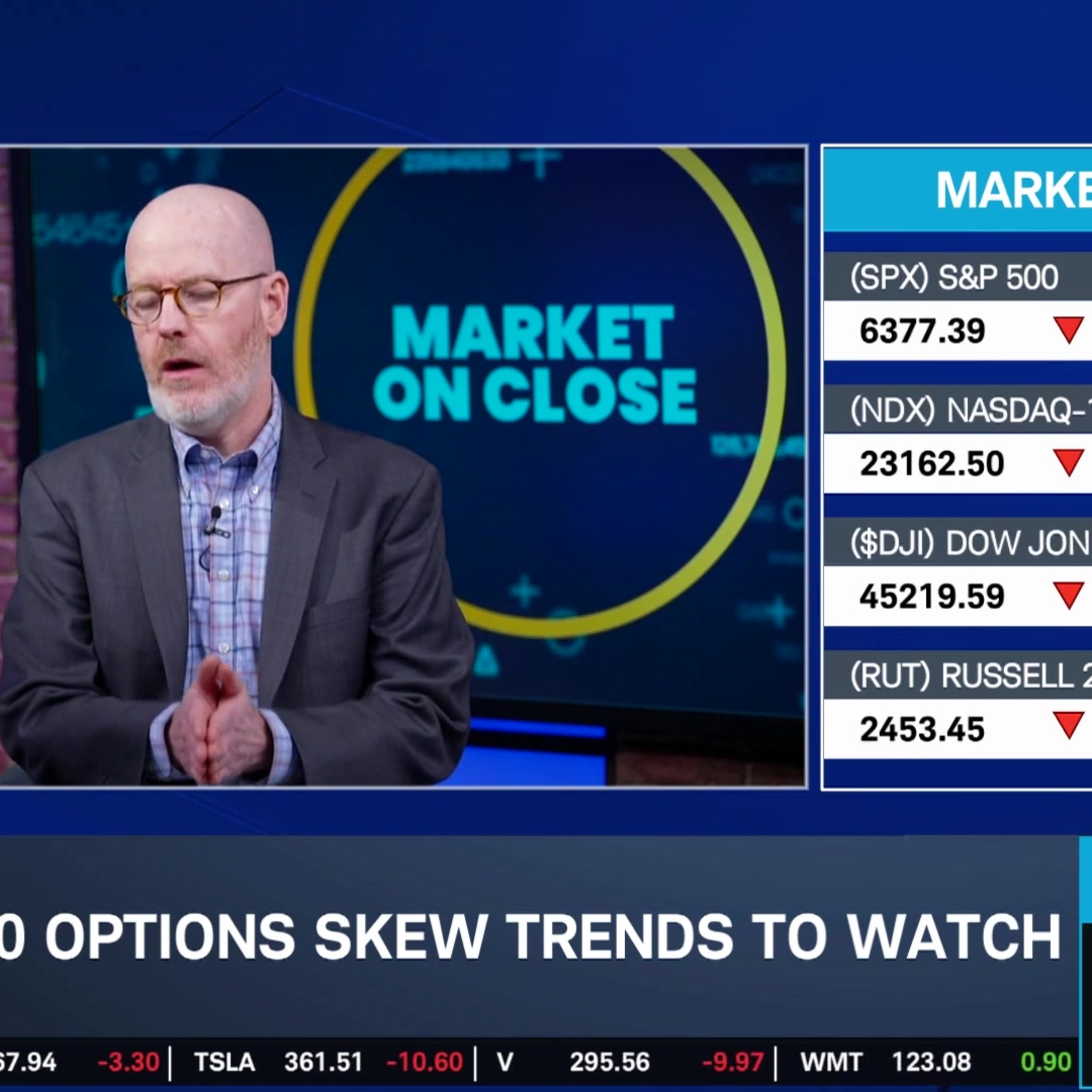
Options Skew Trends Takeaways & Why Tech is Seeing Major Inflows
About this episode
Kevin Davitt from Nasdaq shares his key takeaways from recent options skew trends. He says investors are “more likely to avoid making a bad decision” by watching these signals. He also argues options allow investors more flexibility in their strategies. He discusses the recent drawdowns in the Nasdaq and what history can tell us about what might be next. Kevin also looks at inside tech buying as tech inflows jump.
======== Schwab Network ========
Empowering every investor and trader, every market day.
Subscribe to the Market Minute newsletter - https://schwabnetwork.com/subscribe
Download the iOS app - https://apps.apple.com/us/app/schwab-network/id1460719185
Download the Amazon Fire Tv App - https://www.amazon.com/TD-Ameritrade-Network/dp/B07KRD76C7
Watch on Sling - https://watch.sling.com/1/asset/191928615bd8d47686f94682aefaa007/watch
Watch on Vizio - https://www.vizio.com/en/watchfreeplus-explore
Watch on DistroTV - https://www.distro.tv/live/schwab-network/
Follow us on X – / schwabnetwork
Follow us on Facebook – / schwabnetwork
Follow us on LinkedIn - / schwab-network
About Schwab Network - https://schwabnetwork.com/about
Get every episode summarized
Each time Schwab Network publishes, we email you a written briefing from the transcript — the topics, who appeared, and any specific claims, with the ad reads skipped.
Email me new episodesFree for 3 shows. No card needed.
Transcript ready
199 searchable segments. Every word is indexed and playable.
Full transcript
Schwab Network — Options Skew Trends Takeaways & Why Tech is Seeing Major Inflows. Machine-transcribed; use the interactive transcript above to jump the player to any line.
David, the head of index options content over at NASDAQ. Kevin, great to have you back in studio with us. I saw you put out a new piece about some of the challenges that we're encountering in the market right now. And I know you love sports. And there's quite a few sports analogies and they're aptly titled, Keep Yourself in the Game and Keep Coming Back. So as I was reading through it, one of the things that really sticks out is this implied volatility on 10% out of the money and DX calls. And what kind of opportunity that could create here. So just take me through some of the key takeaways in the article. And I'll also post this in case anybody wants to read it. Great, I appreciate that. And I'm glad that that is what stuck out. From a narrative standpoint, I do feel like there are a whole lot of analogies between optionality, capital markets, and in this situation sports, but really more broadly real life. And so I try to make those connections whenever possible. And I think it's helpful. And yesterday, I was at Riggly going to opening day with my son.
And there's nothing like that for maintaining perspective when you're with somebody that couldn't care less what the markets are up to. But that's not your audience, right? And your audience knows likely full well that the NASDAQ 100 has been down every week on a weekly basis since February standard expiration. That it's been down 10 of 13 weeks this week, which will come to an end here shortly. But those dynamics can open up opportunities, particularly for people that were proactive with options when I make the point about staying in the game. My belief is that options can save you from yourself, particularly if you've kind of passive hedges on, and keep you in the game during times like this, where you're more likely to avoid making a bad decision that you regret if and when markets turn around. Now, your point about 10% out of the money options.
These are one month, 10%, 110% moniness, if you're talking those terms, options. And I looked at them relative to at the money options in the NASDAQ 100 and relative to S&P 500 options. And on both metrics, they screened unusually cheap. Now, that comes with a caveat of like it would depend on how it's managed, but it's really interesting to see in the current environment that if you are interested in positioning for upside on a relative basis, NASDAQ 100 upside screens cheap, relative to a whole bunch of alternatives, that doesn't mean it's going to happen, but another example of how options can keep you flexible during times like this. And I know that you often take a look at historical precedence and trends when you're working on your content here. As far as times where we've seen a situation, I think we're down 10 out of 13 weeks so far this year on the NASDAQ, if we've seen a similar setup,
what has historically indicated to us? That is tough to be clear about, right, until we're on the other side of it. The analogies, I had a chart on drawdowns, whether we can pull it up or not, that's sort of besides the point. I think we have a couple of recent examples like late last year where we saw drawdowns that were similar in the NASDAQ 100. This one's getting slightly more considerable than those. And then when you go back to August of 2024, we saw this episodic risk around kind of de-risking and correlations moving up in a hurry. I would compare that to the risk off environment that we saw in 2022. That was more prolonged and more significant. Now, what plays out in this situation, right, like the past can give us some examples of what that looked like, how it came down,
but here and now the decision making, like looking back at 2022, how much impact that's going to have on positioning here and now remains to be seen. And this dynamic is different, but looking at options through way broader lens of is there a way I can express this better? Is I think really empowering and looking at dynamics as far as Schwab volumes are concerned? It does appear that they're finding optionality and valuable ways to express that in the NASDAQ 100 continuing to this day, like even in this difficult environment. And Kevin, what would have to change or shift to have this relative value opportunity disappear? So typically for a relationship like that, you're looking at one thing relative to another and whether one part of it outperforms. So what's happening with out of the money, NDX calls just as an example, if I can pull in some numbers,
typically those options traded about a four volatility premium to the S&P 500 and right now it's somewhere between one and one and a half fall points. Now, if that, if NDX upside, suddenly there was a demand for that type of exposure, whatever the headline or whatever the shift that occurs, then I would expect that that relationship moved back towards something normal and that could be opportunistic for somebody that spread it. Now, the other side is like flipping to is one more expensive than it ought to be. And I'm not here to opine on what that might be, but going back to my broader point, thinking not just through a sort of singular lens, saying, here I have all these tools that are available to me and ideally picking the one that best expresses the view that you want to. And you also cited some really interesting data from B of A watching their flows research. We've seen, I've likened a lot of the trading of late to a roller coaster ride. The rallies are short lived, where you know, just hold onto your lap bar.
But B of A highlighting that we are seeing a record amount of capital move into technology. I had to refresh my screen. I actually reread it twice and then not that I didn't trust you, but I did do as a confirmatory search to make sure that it was correct before I started writing my questions to talk to you about. How do you square that with the markets when we are on this roller coaster ride and we continue to fall today? So I did the very same thing and I don't have the same journalism background that you did, but I was skeptical. Then I looked at how much de-risking specific two tech occurred in the second half of 2025 and early 2026. This data is coming from one big bank, so you've got to take it for what that's worth. But I do believe and there was another sort of visual I shared that augmented this with respect to insider buying specific in technology names. So how do I square that? We have that up for the viewers here.
Now, just to be clear, this is not the B of A data that you're looking at. This is insiders in companies that are part of the XLK. That's a technology ETF. There's like 80 names there. But going back to your question about how do I square this? I think there's an element of potentially bottom picking in some names like meta that have come down dramatically. Microsoft, you've seen similar pullbacks. Alphabet less significant, but a big driver. And then beyond that, I think you're seeing insider buys at some of these companies that have performed very, very well this year. Your AMATs, your storage names that continue to perform well. And when you think about the potential magic of a broad-based index, how that squares with an ASDAQ 100 that's only down 10% year-to-date when so many of the big names that we have talked about year after year are down significantly more than that.
Yeah, certainly. And this data is very interesting. This insider buying specifically in the tech sector. What does this tell us? How should our viewers think about this kind of behavior? The way I'm not saying it's the right way, but in situations like that, my tendency is to look at other peaks and troughs in that data, and that I did find interesting. It goes all the way back to like 2010. And there was a very, very big pickup in 2011. For those two young to remember, we had a European sovereign debt issue back then. And then you look at forward returns. They were very, very good. That was in the midst of a roughly 20% broad market drawdown. There were similar sort of big pickups and insider buying in 2015. Forward returns there were also very strong and in 2020. Now troughs were more closely aligned with something closer to a market top.
I think it's very difficult to time market tops or bottoms. But my tendency is to say, where are the other highs and lows and how did that work out through time? That's the way I chose to look at that particular data. We'll have a great insight as always, and always a pleasure to have you in studio with us. We love having guests here with us in our Chicago headquarters.
More episodes
More from Schwab Network

JNJ Balances Growth, Patent Transitions, and Legal Overhangs
Schwab Network

nCino (NCNO) CEO on Earnings, AI in Banking & Overcoming "SaaS-pocalypse"
Schwab Network

The Big 3: NET, TWLO, ASTS
Schwab Network

Tie Lasater on Inflation Floors, Energy Risk, and Private Credit Stress
Schwab Network