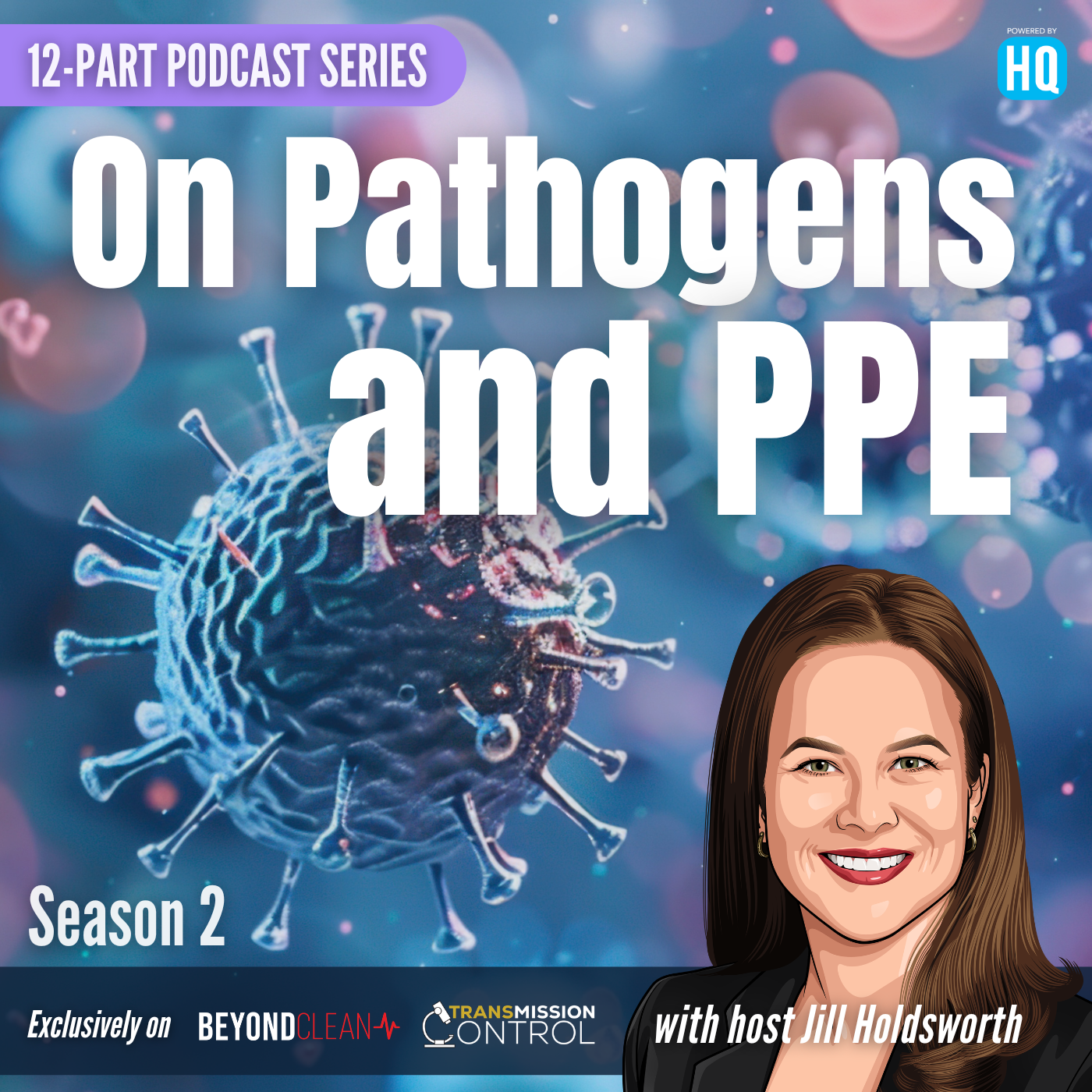
On Pathogens & PPE: Transporting Contaminated Instruments
About this episode
From the OR to SPD, those contaminated instruments are on the move, and so are pathogens! In this Season 2 premiere of "On Pathogens & PPE," host Jill Holdsworth and co-host Nicholas Day are joined by Rebecca Lauber, Kendall Ashe, Adam Okada, and Crystal Heishman to break down what really happens when soiled instruments leave the OR and make their journey to decontam. From point-of-use pre-treatment and biofilm build-up to OSHA requirements and AAMI standards, this crew digs into what it really means to move biohazards safely through your facility. Because soil transport isn't just about getting instruments from A to B -- it's about protecting everyone they pass along the way!
Over the next 12 weeks, Jill and special guests from across the industry will team up to share actionable strategies for fighting pathogens while building stronger partnerships between Sterile Processing and Infection Prevention teams. Whether you're in SPD, IP, or both—this series is designed to empower you and your team with the knowledge and tools that make a real difference!
New episodes of On Pathogens & PPE will release each Tuesday on all Beyond Clean & Transmission Control channels. A special thanks to our Year 2 sponsor, Healthmark, A Getinge Company, for making this series possible.
#BeyondClean #TransmissionControl #Healthmark #Getinge #OnPathogensAndPPE #SterileProcessing #InfectionPrevention #Podcast
*Disclaimer: The views provided by hosts and guests on this series do not represent any employer, company, or third party, and are solely that of the individuals themselves.
Interactive timestamps
Jump to segmentGet every episode summarized
Each time Beyond Clean Podcast publishes, we email you a written briefing from the transcript — the topics, who appeared, and any specific claims, with the ad reads skipped.
Email me new episodesFree for 3 shows. No card needed.
Transcript ready
263 searchable segments. Every word is indexed and playable.
Full transcript
Beyond Clean Podcast — On Pathogens & PPE: Transporting Contaminated Instruments. Machine-transcribed; use the interactive transcript above to jump the player to any line.
0:00On a microscopic level, they exist to kill. They travel, they attack, they hide. They even gather together in defense maneuvers. Pathogens are the enemies of every member of the healthcare team. On Pathogens and PPE, we give you the tools you need to fight these threats and win. So sit back, tune in, and let's make these microbes tremble at the sounds of your name. Hello and welcome to episode one of the second season of Pathogens and PPE. We are diving into everything about soil transport today. I am joined by my co-host Nick Day and for amazing guests stay tuned and we'll be right back after a word from our sponsors.
1:11Hey sterile squad, ever wish you could get the training you need exactly when you need it? That's exactly why HealthMark Academy was created. From on-demand training to monthly CE webinars and even tuition-based courses, they've got you covered. And if your HSPA certified, your completed CE credits automatically go straight to your HSPA account, no extra steps needed. HealthMark Academy is all about giving you the skills, knowledge, and confidence to keep you and your team informed. Join over 15,000 professionals already leveling up at academy.hmark.com, education made simple, practical, and just for you.
2:15Welcome to the first episode of Pathogens and PPE season two and we have an all-star guest list for you today. And I am Jill Holtworth here with my co-host Nick Day. Thanks so much for being here and co-hosting this first episode with me. How are you doing? Doing great. Thanks for having me. This is a great topic. Thank you so much. I hope you enjoyed this episode of Pathogens and PPE season two and we have an all-star guest list for you today. And I am Jill Holtworth here with my co-host Nick Day. And this first episode with me, how are you doing? Doing great. Thanks for having me. You know, this is a great topic we're talking about here today. Awesome. Why don't you tell everybody who you are, what you do, and how long you've been in the industry? Alright, so yes, as you alluded to, my name's Nick Liste. I have been in the industry for almost 20 years now. I started out at Cleveland Clinic and then worked my way over now to the University of Hospitals.
3:16Past six or so years, I've been a regional manager for sterile processing, high level disinfection, and equipment management, so clinical services, and recently elected to the Board of Directors for HSPA. So look forward to entertaining the crowd. Congratulations on the Board of Directors and we're all really excited to see what you do there. Thank you. Alright, I'm going to start around with our four guests and ask them to answer the same thing. I'm going to start with Rebecca. Hi, my name's Rebecca Lomber. I am a robotic and operations coordinator for Mount Sinai Hospital, been doing sterile processing for 10 years. I think I've done just about everything, every role is sterile processing, but now I am liaisoning between a perioperative services. So nice to be here today. So happy to have you here, Rebecca. Alright, we'll go with Kendall next. Hi, my name is Kendall Ash, Vice President General Manager with CS Medical.
4:16I'm a chemist by degree biochemistry. I've been in the medical device industry for a little over 15 years now. Last 10 years really focused more on the regulatory and quality side of medical devices. I've done about five different 510Ks with the FDA over that time. Yeah, excited to be here. Great. Thanks for being here. And Crystal. Hi, I'm Crystal Heishman, and I am currently the Enterprise Director for Sterile Processing at UK Health Care. Previously, for the last 16 years, I was in infection prevention, director of infection prevention, vascular access. I serve on many different boards and whatnot, and I'm very excited to be here today. And last but certainly not least, we have Mr. Adam Okada.
5:16Yeah, so I'm Adam Okada. I'm one of the clinical education specialists with HealthMark, a getting a company. Like Rebecca, I worked pretty much in every position in sterile processing. I used to build case carts. I started as a tech one, and then I got certified tech two, tech three. I've been a lead supervisor, manager of HLDN, SPD, and then now as an educator. I kind of have worked all over in sterile processing various Amy boards. I've helped write some of the HSPA manuals and some of the chapters there. So yeah, just like everybody else, I'm very excited to talk about this topic today. Awesome. Well, let's dive right in. So we are talking all about soil transport today of scopes, instruments, you name it. So we are going to start with just the overall question of why is this so important? And I'm going to start with Rebecca because I know that she feels very passionate about this topic of making sure that we are doing things right with soil transport. So Rebecca, tell us your thoughts about why is this so important that we do this correctly?
6:22Well, well, well, let's talk about soil transport. So I'd like to think of soil as a living thing. So it's in once it leaves that patient's side, it's no longer just dirty. It's moving biohazard. So what I believe is that when it comes to soil transportation, we have to keep that contained. And a big thing that I'm seeing, I love to do audits, random audits in different areas. And a big thing that I see is that we don't the containment system of these biohazards. So I've seen it where people are just rolling it out on a cart, open blood, open. You see it, no biohazards stick at all. You see it open case cards. And the thing is, people who are passing by are now being exposed to those biohazards. Great. Yeah, I was going to say Rebecca, to talk to us a little bit about cross contamination, safety and exposure.
7:25And you know, kind of, you know, how what you've seen with, you know, how you segregate those things with routes. So this is something that I love to talk about because when it comes to some hospitals, they have dedicated systems and dedicated hallways and dedicated elevators. And yet we still use them improperly. So when I'm talking about cross contamination, I'm not just talking about what we know as like from clean to, or sorry, dirty to clean. But I'm also talking about the movement of which, you know, we're exposing everybody in the area with those contaminants that are now we're transporting. And so a big thing is having those dedicated sections, dedicated areas in specific spots. My biggest piv is when people use elevators, patient elevators for biohazard transport. Yet we see that often in hospitals. So Crystal, I'm going to throw this one to you as the IP in the group.
8:29When we don't have dedicated elevator space or a dedicated biohazard elevator, what can we do to make sure that we're not contaminating people, places, things, all the things? How can we do that better? So what we can do is, of course, in the infection prevention world is do a risk assessment. To look and see what the best transport mode is or where we can go. Usually we try to find an elevator that's further away. So we can dedicate that toward more of the dirty or the service related transport, not always possible. But that's what we try to do. And then, of course, if we can't do that, then we try to time or do blocks of time for different transports. And then hopefully we're able to clean in between of those blocks. It's not easy when there's not dedicated areas, but it can work with their raise on the right page.
9:33And talking about times and author this to Adam, I know you've probably seen a lot of different things since you've worked everywhere. What would you say are best practices versus probably what you've seen before about transport times of these soiled carts? Maybe they're not in the OR right across from SPD or close to SPD say ED women's health, other places where maybe they sit for a day. But what would you say you see and what you should see? I mean, what we see is it's all over the place as far as transport times and when things are getting to serial processing, especially in areas like clinics that don't have that direct access to SPD or they finish cases on Friday and then they sit over a weekend. And then get transported on Monday morning over sterile processing. So we've seen like a lot of different, a lot of variation in the way that things are coming over. Ideally, what you want to see is when you're done with the case, you do pre-treatment on it and then it comes directly to the decontamination area where we can ideally start that decontamination process.
10:37The faster we get that, the less likely there is that blood will dry, that you're going to have biofilm starting to form. All of these things that make it very difficult for us to clean it effectively in sterile processing. So it's a tricky situation, especially I know in clinics where all you do is they finish a case, they put it in the dirty utility and then it's on somebody to go round and pick up. But I does need to be a priority because again, the longer those things sit and we also know the point of use treatment isn't always effective. If they're spraying it the way they should and using the right amounts and the copious amounts of pre-treatment, then great. But a lot of times they just sort of once or twice and then close it up and leave it there. And that's where we'll see blood start to dry and it makes them more difficult. So ideally, it's right away. It would rarely happen that way. Kendall, as our chemist, can you comment on maybe what happens when we don't pre-treat because we all know in an ideal world, we want pre-treatment to happen every time and then it gets transported immediately, right?
11:37But we know that doesn't happen as hard as we try. So what is the danger when things aren't pre-treated, whether it's instruments, scopes, probes, what have you? Thanks, Joel. I think that's a really good point to educate people on the why and the what happens to make sure that they really care about this. So all these leftover lipids, carbohydrates, proteins, extracellular material that just came out of cells or was maybe damaged in the process, left on the scope. If they're not removed quick enough, then that's where we get our dreaded biofilm. And the biofilm is dangerous for a couple of reasons. It can almost form a canopy, almost like a rainforest, you could think of it that way, over the surfaces of these medical devices. And when this canopy is formed, it actually allows the safe haven for the microorganisms to migrate under this canopy during the high level disinfection, during the sterilization process. So while you may rain down this high level disinfectant on there for five minutes or it goes through a long sterilization process, those microorganisms are protected by this biofilm canopy that's formed over the medical device.
12:45And then once the high level disinfectant, say, rinsed away or the sterling leaves, then those microorganisms can freely move out and multiply it a much greater rate than we're expecting, and then you could end up even with an HAI or healthcare acquired infection. So it's really, really important that this, you know, pre-treatment, pre-cleaning, bedside cleaning, whatever your facility wants to call it, and then transport all happens quickly and efficiently. That's actually a really cool analogy of rainforest with the high level disinfectant being the rain and can't get there. It's actually, I've never heard that before. That's really great. All right. So let's move on to what are the actual regulations that I'm going to start with, Adam, because he's Mr. Regulation and Standards himself. So Adam, what do we see as far as what the standards and regulations are actually telling us that we have to meet in terms of transported these items? I mean, there's two main things that you're going to look at. The first one is the OSHA Bloodborne Pathogen Standard, so exposing staff and patients in the environment to contamination.
13:55Like Nick said, that cross-contamination of the environment, that's the first thing you need to look at is that OSHA Bloodborne Pathogen Standard, and make sure that you're following what it says in there. The other one is the AME ST79 or 91 if you're doing flexible scopes, which all kind of echo and point to the OSHA document. But they talk about the fact that you need to label it. It needs to be labeled either in a red bag or with a biohazard label, and then a puncture-resistant leak proof on the sides and bottom. Basically, we don't want anything to be able to escape that transport container. So that's really what the standards and regulations are really talking about. Yeah, elaborating on that, as far as transportation and the DOT hazard materials, guidance documents and standards, what type of stuff have you seen as far as training for couriers and logistics teams, and the importance around that? I mean, I've never seen the training program for couriers. I think they definitely should be, because if they are transporting things off-site, and we're seeing, you know, Europe, I think, is like 60% off-site processing.
15:04And we're moving in that direction here in the US. We're a little bit slow to adopt it, but we're definitely going to start to see that a lot more. So there should be. And the new TIR document talking about external transport does talk about the need for training for couriers. Bloodborne pathogen training to make sure they know how to handle these things, separation of clean and dirty, the transport vehicle that we're talking about should be some type of temperature control. We don't want things in 100 degree heat to just sit there baking. So all those kinds of things are stuff you have to talk about. And then external transport, I would definitely go, I think it's TIR 109. Do I have that right? Yeah, so that's the document you really need to go to. So I have a big question, and I'll start with Crystal on this one. As an IP, this drives me crazy. Why do you think people are still using plastic bins for transport? Because you can get them cheaply at the dollar store. It's true, because sometimes if we have to go there, we need will make do and what my driver our own methods to make that happen.
16:11And so a lot of times those plastic bins are like, well, it's a bin. It's closed. But you know, it's not puncture proof. Those things shatter. If you if you stick something sharp through it. And they're like, what about type of wear? Well, not unless you're bringing your food with it too. But so yeah, so that's that's one of the things is that it's cheap, but something they can do on their own and they can they can make do. And one of the other things I found recently. I'm off topic for a quick second is that on the case cards and it's going to come back to the the bins, but on the case parts. I've noticed a lot of case parts. They're a little older and they have their little slide back and forth. This is clean dirty and not clean bio hazard. And so they kind of do the same with the bins. So it'll say dirty instead of bio hazard and according to our lovely regulations and our rules, it has to say bio hazard. And that's one thing that we forget sometimes. And I just remember that this week when I saw it and I was like, hey, it says dirty. We teach us bio hazard and they're like, no, no, it's not.
17:23Yeah, I think these are our great points. Kendall, I'm going to ask you this now about specifically our probes, our tea is what are you seeing that's unique to these items that we need to consider when finding a transport container. So I think there's a couple of things that are especially unique about tea probes versus a endoscopes or other sorts of medical devices, the tea probe, the end part of it, the insertion shaft will typically only be the part where there is the biofilm potentially building up the hazards, the soils, whereas the handle, the electrical connector typically pretty clean and unlike endoscopes, the tea probes aren't fully watertight water sealed. So depending on the orientation of how you're transporting this tea probe around, if it's got soils liquids all on the insertion shaft and you orient it improperly during transportation, you can cause severe damage to the tea probe because water soils can get into the handle, get into the electrical connectors that can cause issues.
18:31The second part is tea probes are very fragile in a couple different places. Most people know about the tips where the actual ultrasound crystals are, but also the shafts of the tea probes have lots of wires running along them. And if you bend those wires say less than a 12 inch diameter, then you're actually going to start damaging those wires slowly over time. So you might be losing image quality that you don't realize it's kind of like a slow change and then you start having cloudiness and images and you're not exactly sure what you're reading or not reading. But it's because you're maybe trying to force it into one of these rubber made containers or other things and transporting them through and not realizing the damage you're doing. So I think this comes back to podcasts like this and other training sessions of the why. And once we really start educating people on the why are we transporting it this way, why is the need, why do we need to do this to protect the patient, protect people walking by and protect yourself as the operator that's actually carrying this. I think that's where the key is.
19:32Yeah, it's a great point, Kendall. I think also, you know, putting almost putting like, you know, that financial aspect on the back end of it too, you know, how much these things cost, you know, if we're going to, you know, damage the probe and these things are upwards of 20,000 plus dollars. So I think, you know, making sure that that piece of stress as well as like, you know, conditions of participation with regulatory. You know, for back art, crystal have experience with the tea probes. If you want to elaborate on, you know, how if you transport, you know, just internally or externally, but what kind of documentation and processes do you have for your departments to kind of ensure this process is, you know, the loop. So I have quite a bit of experience with tea probes and reprocessing. First, I'd like to know Kendall or Rebecca or anybody. What are your thoughts on the long tubes, other transport tubes, the plastic ones that sometimes they use to leave the probes on the side of the ultrasound machine.
20:34I personally am not a fan of those. I've done many rounds. I never see them really cleaned. And even when I do get them, I do see, I mean, I've looked up, I have used and they're not even being cleaned with approved cleaners. So that's a massive concern for me when I think of like regulatory stuff. So I'm not a personal fan of those tubes that are on the side. I think for those exact same reasons you're mentioning, Rebecca, the tubes are, you know, they're at least a meter long. It's really hard to try and get a proper, you know, wipe or low level disinfected into there. Got forbid somebody puts a actual dirty probe into one and then trying to clean out one of those tubes that you can't reach an arm into. You got to use some sort of pole or something to clean out those tubes. It'd be much better to have a case specially designed to hold these probes, keeping the handle electrical connector away from the shaft. So we use those as a single use clean dirty and then toss.
21:37I wasn't a big fan of them because I don't like leaving probes on the side of ultrasound machines. But for transport, we transport those similar to the flexible scopes, making sure that they aren't coiled tightly that they're kind of free. At one point, we also ended up installing hooks on the side of the TE probes to keep folks from dropping them in the sinks because they crack. And like it was said, they are about $20,000 to replace. And I think it's $150 a day for a loaner or something. I'm going to bring up another point about transport. And I'm going to ask Rebecca if you've seen this. I just have a feeling that you probably have, but one of my pet peeves, I'm going to pick on anesthesia for a minute because it's sometimes it's just easy. But I would see anesthesia bringing their blades in, no transport container, sometimes not even anything around it. Just kind of like, hold it in their hands, walking around the OR, come in SPD, drop it, almost side the sink, and then walk out.
22:41And they think that that's okay, just kind of walking around with 30 instruments in their hands. So, one, have you seen this type of behavior really from anybody? It doesn't have to be an anesthesia. And how do we make them understand that this isn't okay for anybody, them or us? And how do we change their behavior? Well, I have seen that, but I've seen it on multiple levels. It's not just anesthesia. And when it's strictly not, I mean, I'm going to be, you know, a little off topic here. But I mean, I think it's the HBGB when I'm thinking about, you know, the transport cards for endoscopes. I mean, I know they say you're not supposed to be wearing gloves in the hallway, but I mean, the whole thing has biohazard on it. And depending on what the hospital is using, are they using the biodegradable containers or the hard plastic containers?
23:43So when I'm thinking about this particular situation, where you're just handling something that was just used on a patient, some like without gloves, some with gloves, no containers containers, I like to educate. That's the biggest part of this role. If we're not doing education within the departments, then we're doing a disservice, really. So what I do is I, when I see something, I speak on it in the moment, and then I hold an education session. There's no harm in that. But what I like to do is bring all of the departments in because just speaking to one department isn't educating everybody on the processes at hand. So I bring all multiple departments. I love that we're back at an audition. I'd love that we have some IPs on this because that's who I go to. If I'm getting trouble, having trouble with endo or anesthesia or any of these other departments that are just not transporting and not understanding point of use treatment and why it's important.
24:43I bring IPs in because for whatever reason, when they talk to a sterile processing manager director, maybe they'll listen, sometimes they do, but if their IP is there and saying, no, this is something that needs to happen, this is a survey risk, this is a problem, then all of a sudden they can get on board. So yes, education, but I also think about that answer. So my favorite answer obviously. But when we all work together, it is much easier. And sometimes the IPs have a different relationship with some of these other departments than sterile processing does, or maybe we're just more comfortable talking with some of the surgeons or some of the anesthesiologists, or we just don't care if they push back because we're just going to tell them you have to do it. So yes, doing a partnering is always best. So I love, I love this topic. Thank you all. Crystal, did you have something? And as in with transporting and Rebecca, but I have a really good topic because I just had this conversation the other day about transporting with PPE in the hallways.
25:47It's a very hard sell either way. So the way I usually explain it with not wearing gloves, when we're transporting like our carts and containers and things like that. You know, we say, please wipe it down with a disinfectant prior to transport, but the other thing is is when you're wearing gloves in the hallway and you're touching everything along the way. Not once are we doing hand hygiene, so we're touching elevator guns, we're touching this. So whatever, whatever was potentially on that container is now down the hall and upstairs or vice versa. And then whatever was upstairs is now downstairs. And so we do, it is really hard to educate on that piece of it because we're thinking our mom, you know, we want to wear our gloves because we're touching something dirty. But on the same token, we're not taking into account, we have to wash our hands when we're touching other things along that route as well. So big conversation.
26:50Always said, and this is never a popular comment that wearing gloves in the hallway is very selfish because you're only thinking of protecting yourself, but you're really putting everyone else that comes behind you or in contact with you. And in harm's way because of all the things that you're touching and spreading things to because just like you said, crystal, you're not doing hand hygiene before you touch elevator buttons and door knobs because you're protected. Why would you? So you're just kind of selfishly touching everything. I have one last question before we start to close and any of you can choose to answer this, but we see surveyors more commonly now focusing on clinical for so nursing floors, figuring out how can we make sure soil transport is compliant from the clinical floors to sterile processing or wherever reprocessing happens. So how can we make sure this is happening as well? Let's start. So what I've had to do in the past is limit on the floors where we're doing work, evaluate and then limit where we're doing bedside procedures where we're taking instrumentation.
28:02Usually you'll see it in the ICUs because sometimes they're doing bedside procedures, your ER really might have to hand procedures or real quick or airway things. So one limiting and then educating those specific areas as well as rounding and doing periodic audits is really helpful just for them to understand that how process we make sure there's signage up. So they understand the point of use cleaning step by step instructions because if you don't do it a whole lot, it doesn't really register to do it. Also, when our friends and surveyors come in, they can look at the sign and read word for word, the process and more. So in a sense it's kind of like a cultural norm in your organization then from the from the everything that you've reinforced about the standardized policies and training integration with the clinical teams. And my previous facility, yes, we did make that the norm and it took a long time to get there though because we had a lot of ICUs in different procedural areas.
29:13So it did take time and earlier we were talking about, you know, our blades for airways and so then we had to threaten to go fully disposable and. So it took it took a couple years to get everybody on board and continuous education and making sure all those areas had red bins and we had a way to switch those out yeah it's great. It just took them listening in this can't happen overnight right it's got to be a cultural build up to it's you know and a lot of multidisciplinary teams coming to the table IP as we alluded to on on the other questions you know this is a lot of bend you know vendor partners coming in and in servicing on products that they have that are that can help solve these issues and clinical teams IPs the sterile processing or processing teams. I love this infection teams but I think you know just as we're starting the close I think the Amy standards that have come out you know is a really good starting point for a lot of people that may not have a great process in place to help develop and you know implement some new policies and your guidelines for themselves.
30:29I just wanted to add something on this though because survey readiness is I love survey readiness and the thing that I just like I'll talk about survey readiness all day long so I think when it comes to this kind of stuff because I'm going to I know we're talking about soil transport. But I want to pull us out and just remember that I feel non compliance isn't about people not caring is about habits that are formed under things like pressure right so when people are fall under pressure they start to form habits that we might not you know want to happen but they happen out of what they feel is necessity right. So when I'm thinking about clinic floors and getting them on board just like crystal said do those rounds do those joint roundings whether it be with infection spd have those open dialogue and open conversations so when they see what those surveyors are going to see you know the open bin.
31:30The clean elevator there is all going to click together instead of it being a kind of like a point out process it's more of working together and hearing each other out I love walking processes because then it helps me understand. What are the roadblocks for those teams for that particular individual in their particular role that's great and I will add just one to bet here is start with places like your ED. Your women's health areas places where you don't think that they might have instruments or probes or all these things because that's where things tend to hide and die and you start opening up soiled rooms you'll find random instruments just laying on counter tops you'll find probes that have been broken and are just hanging on the sides of cards so. Start to really dig around in some of those areas and and you'll find find a lot to keep you busy for for quite some time. Alright as we start to close here i'm going to ask all four of you to give the listeners one thing that they can go and do in their facilities to improve their.
32:45Processes today whether it's assessment whether it's improvement of the actual process whether it's products something that you guys want to give the listeners that is an actionable step that they can go and do today and Adam i'm going to start with you. I mean I think like others have mentioned it really starts with that auditing process if you have like an audit form or something when you're going around to these areas and you have data so if you can collect data on how they're doing with point of use treatment or how they're doing with the. Transportation are things coming down the way they're supposed to that's a lot more powerful than just saying hey i wish you guys would do this but it's that doesn't really powerful unless you have something to back it up so i think that starts with auditing and then having that. Thank you were back at you have something that you can. Give people go and do what I would say is go find that one thing that really gets on your nerve that one thing that you want to make better in your department that you just do not understand why and get down to the reason say why why why until you get to the reason why it's happening and then focus on.
33:55Making that better just like Adam said he's talked about walking the process but we need to understand the why things are even happening until to be able to make things better and that include all of your team members on love it and kendo how about you. I think once you've figured that out I think it's the educating then the you know the lowest level people in the hospital they're actually touching some of these things on the why because they may not understand you know why they're having to follow this or why they're having to do this you know trying to make it so they can understand it and put it at their level so they understand like hey this is to protect you at the end of the day we want you to go home. You know safe and healthy just like we want the patients to go home safe and healthy so give them the reasons and power. Yeah I love that you keep coming back to the why people want to know why they're being told to do stuff not just because my boss told me I had to they want to know why are we being told to do this and then when they understand they're probably going to be more compliant.
34:58Crystal I would say explore I always like to say that I don't find trouble trouble finds me or vice versa it's true I'm not allowed to be unsupervised anywhere because I will find something. But yeah so explore look around find that three foot tall he must at shine and cath lab it's true they exist or. Like in some of your clinics who have dilators or they'll be cleaning. I mean wiping them instruments that may or may not be reusable and throwing them in pill packs so just explore watch listen and talk to folks that's the easiest way to start getting those relationships together and figuring out what the process is currently are Nick do you want to bring us home yeah absolutely I would yeah second that the last piece crystal you nailed it yeah I think utilizing the industry right.
36:00There's so many people out there that want to engage and help one another and and we have a huge community of sterile processing each other and vendor experts that are out there just waiting you know for people to reach out and support them you know if you find yourself stuck you know or for your organization isn't moving the needle. In the right direction in this category you know you know reach out on LinkedIn or reach out on you know to anyone in the network reach out to HSVA directly or Amy directly and they'll get you some guidance. Yeah great discussions here you know and I hope that you know the crowd takes away you know one thing you know is that this is a very important. Very important topic you know obviously there's new TIR documents TIR 109 around this and these standards you know with the FDA OSHA DOT and facility SOPs that that guide this stuff and directly financially affects organization your organization and affect patient safety and staff safety.
37:06Yeah I'll leave it at that thank you for for all you all do and keeping our patients and staff safe around this topic great thanks so much and thank you for all of you for being here today on this episode thanks so much everybody. All right everyone thanks for joining us today this was an awesome topic and presentation with four amazing speakers we appreciate everybody showing up and talking about cross contamination safety exposure regulation standards compliance containers everything from clinical functions and transportation off site to cavity endocavvy probes. This was some awesome conversation and enlightening education for everybody to take home and we hope that you guys can benefit and tune back in for the next episode thank you. A couple things that I really liked that came up during this episode was when Rebecca talked about soil transport as really you're moving biohazard around I thought that was actually a really cool way to think about it in in a non-cool way because you are you're moving biohazards around.
38:19And you have to make sure you're doing it in a safe way so that you don't contaminate people things and in crystal touched on how I peace should really be doing risk assessments when there's a question about elevators or routes to take and Adam mentioned there was a really need for training for careers and in probably a lot of people on how we transport all of these things but that that is a real need right now and Kindle's analogy about biofilm being a rainforest I just loved that night I'm probably going to steal it and use it from now on but what a fun episode so many great things that you can go and do right now in your facility and I hope that everybody can take away a little bit of something and go improve it in your hospital or your clinics or SPDs. Join us next time for episode two of the past legends and PPE podcast and keep fighting dirty and don't forget to wash your hands.
39:25Thanks for tuning in to this exclusive podcast series on pathogens and PPE for more information and clinical resources to help you fight dirty make sure to follow us on social media by searching for beyond clean and transmission control. you
More episodes
More from Beyond Clean Podcast
On Pathogens & PPE: The Challenge of Robotic Instrument Reprocessing
Beyond Clean Podcast

Season 20 Rewind - Not In Our House: A Team Approach to Decon Protection
Beyond Clean Podcast

Beyond Clean Canada: More Than Instruments: Supporting Canada's MDR Community
Beyond Clean Podcast
On Pathogens & PPE: Hand Hygiene in SPD
Beyond Clean Podcast