About this episode
Get every episode summarized
Each time Clark County Today News publishes, we email you a written briefing from the transcript — the topics, who appeared, and any specific claims, with the ad reads skipped.
Email me new episodesFree for 3 shows. No card needed.
Hosts & guests
Transcript ready
84 searchable segments. Every word is indexed and playable.
Full transcript
Clark County Today News — MAX at 40: Did Light Rail Empty Portland's Transit System?. Machine-transcribed; use the interactive transcript above to jump the player to any line.
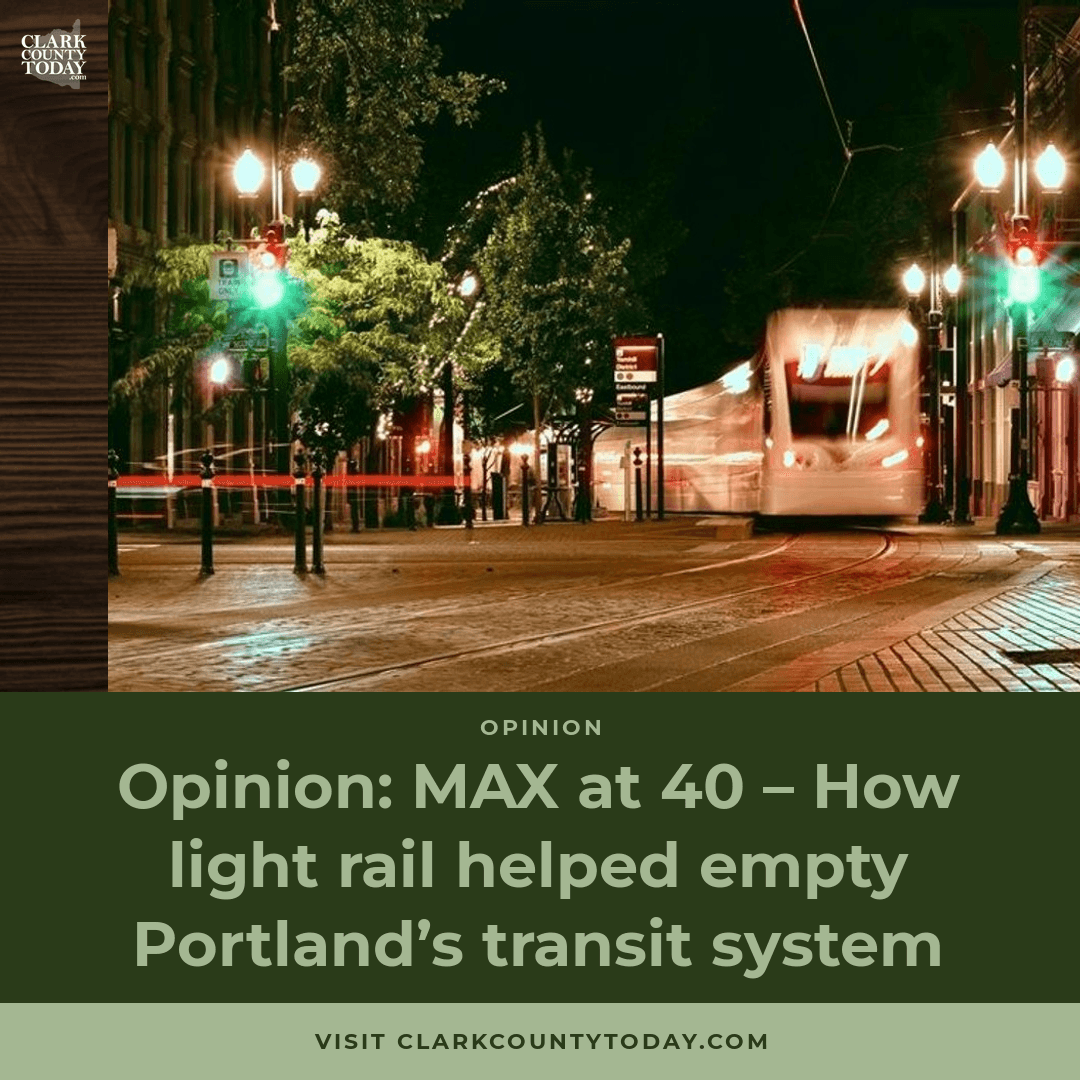
This opinion column was written by Randall O'Toole with Cascade Policy Institute. Editors note, this is the final commentary in a summer long series, Portland's War on Cars, from a new report by the Cascade Policy Institute, the Portland Transportation Disaster, the high cost of anti-auto planning in Portland. Trimett's first light rail line, which celebrates its 40th birthday on September 5th, put Portland on the map as a transportation innovator, leading the New York Times to call Portland the city that loves transit. Just the idea of building light rail, convinced President Carter to ask then-mayor Neil Goultchmidt to be the US Secretary of Transportation. Yet light rail is a fraud. Hardly innovative, articulated street cars coupled together date back to 1939. Light rail is an expensive, obsolete form of transportation that no longer fits today's decentralized urban areas. Getting locked into this technology, propelled Trimett and Portland down a path that severely damaged the region's transit and transportation systems. When Goultchmidt first proposed light rail, his real goal was to cancel the Mount Hood freeway,
without losing the federal funds that would have paid for 90% of that highway. Fortunately for him, but unfortunately for Portland transit riders, in 1973, Congress passed a law allowing cities to cancel freeways and spend those federal funds on transit improvements instead. Portland's transit system then consisted solely of buses. To use the federal funds and create union construction jobs and construction company profits, and the campaign contributions that went with them, Goultchmidt hit upon the idea of building light rail. He didn't choose light rail because it was flexible or efficient. Instead, he picked it because it was expensive and would consume those federal dollars. Rail advocates often claim that a single rail line can move more people than a multi-lane freeway, but that is simply not true. To calculate this, they typically assume the trains are full, while the cars each have only one occupant. The results are very different if we assume instead that both trains and autos are filled to capacity. A light rail station can serve only 20 trains an hour. When jamb with riders, a Portland light rail train can hold 334 people, so a light rail line can move 6,680 people an hour
in each direction. A freeway lane can move 2,000 cars an hour. The average car can hold 5 people, for 10,000 people an hour. If 300 of those cars are replaced with 160 passenger buses, the lane can move 14,500 people an hour. That's just one lane and Portland's two-track light rail line was supposed to cost as much as a four-lane freeway. It ended up costing much more than a four-lane freeway. To pay for its share of the cost overruns, Trimett increased fares and cut bus service. Thus the opening of the first light rail line was a cause of mourning for lost transit riders. Before light rail, Trimett bus ridership Pete in 1985 had almost 55 million trips per year. Then fell because of the fair increases and service cutbacks. In 1987, buses and trains together carried 7% fewer trips than buses alone in 1985. Ridership wasn't helped when the opening of light rail led Trimett to cancel express buses that went from Hollywood, Gateway, and other places to downtown. Those bus riders were expected to ride the slower and less comfortable light rail,
and not all of them did. Before it started building light rail, Trimett improvements to bus service had generated some of the fastest growth of any transit system in the nation. Bus ridership more than doubled between 1970 and 1980. Transit grew faster than driving as the share of Portland Urban Area workers commuting by transit rose from 6.9% in 1970 to 9.6% in 1980. Light rail reduced that to just 6.5% in 1990. Although the region's total number of workers grew by 21%, the number of transit commuters fell by 18%. Transit ridership grew as the west side and airport light rail lines were built. Partly because trips between Lloyd Center and downtown were free for many years. Yet transit never again came close to carrying 9.6% of Portland area commuters to work. The highest it reached was 7.9% in 2015. That was the year Trimett's most expensive light rail line to date opened, the $1.5 billion orange line. Despite all the hoopla over Tillicom Bridge,
this line was followed by more depressing results as bus plus light rail ridership dropped 5% between 2015 and 2019. The 2020 pandemic exposed another serious flaw in Trimett's light rail dreams. Because most Trimett light rail and bus routes went downtown, the transit system worked for people going to or from downtown, but not for people going to other places. Before the pandemic, 29% of downtown workers, the less than 5% of non-dontown workers, commuted by transit. That would have been fine in 1910 when most jobs were downtown. But jobs had been moving to the suburbs for more than a century, so that by the 2010s, only around 10% of Portland area jobs were downtown. The pandemic accelerated downtowns decline, as office workers were among the most likely to be able to work at home. Light rail carried only 55% as many riders in May 2026 as it had in May 2019. The 2024 share of Portland Urban Area workers commuting by transit was down to just 3.8%. The 60% drop in transit share of workers since 1980 can largely be attributed to the high costs
and inflexibility of light rail. In response to such profound changes in travel habits, bus routes, which can move more people per hour than light rail without dedicated infrastructure, can be changed overnight. In contrast, light rail requires so many years of planning and construction that by the time a new line is completed, the need for it may no longer exist. Rather than design its transit system to serve the modern metropolis, Trimett wants to remake Portland into a 19th century city by supporting high density housing projects along light rail lines. These four to six story housing projects were inspired by New York City tenements, built in the 1880s for workers who were too poor to ride street cars and had to live within walking distance of downtown jobs. But most people who come to Oregon want to enjoy our wide open spaces and prefer single-family homes over cramped apartments. To support the region's transit system however, Metro and state land use rules have severely restricted the construction of new single-family homes. Even though demand pushes up the cost of single-family housing, people don't want to live in high-density projects, so Trimett has
needed to subsidize such housing using federal transit dollars. Metro, Portland, and Oregon have used other federal and local funds to subsidize such projects as well. This makes Trimett just as complicit in Portland's housing crisis as Metro and the state. Efforts to change Portlander's housing preferences have failed just as badly as efforts to get people to ride an obsolete transit system that successfully serves only one of the Portland areas many job centers. Rather than celebrate the 40th anniversary of this transportation disaster, Trimett and Metro should use it to reflect on how they can redesign the region's transportation system so that it serves all Portland area residents, and not just those who work or live in downtown. Randall O'Toole is an adjunct scholar at Cascade Policy Institute, Oregon's free market public policy research organization. He is a transportation and land use policy analyst, and the author of several books, including American Nightmare, how government undermines the dream of home ownership, and romance of the rails, why the passenger trains we love are not the transportation we need.
More episodes
More from Clark County Today News

Was Belkot Punished Before the Rule Existed?
Clark County Today News

Paul Valencia Joins Final Score TV's Statewide Football Show
Clark County Today News

New Field, Old Traditions: Camas Football Season Opens
Clark County Today News

Vancouver Restaurant Shooting Under Investigation
Clark County Today News