About this episode
In this episode of Ledger Recap, we audit a 29-position session that yielded a +3.3 unit gain. We dive deep into the logic behind the wins and losses, focusing on how to identify mispriced contracts on prediction markets like Kalshi and Polymarket.
Segments include:
- The Pistons Engine: How injuries to Cade Cunningham and Marcus Sasser shifted the entire offensive infrastructure to Daniss Jenkins.
- The Jokic Factor: Analyzing the correlation between Nikola Jokić's elite playmaking and Jamal Murray's scoring floor in the Nuggets vs. Suns matchup.
- Game Script Dependency: A deep dive into Ryan Rollins' performance volatility and why competitive environments are a key variable for usage-heavy players.
- Motivation & Market Variables: Why the Kings vs. Hornets blowout serves as a lesson in weighing a team's structural incentive to compete late in the season.
Refine your betting strategy by understanding the difference between a bad beat and a thesis error. We evaluate how to leverage alt-lines and aggressive sizing when the odds don't reflect the true implied probability of injury-driven usage spikes.
Opinions expressed are for informational purposes only. Bet responsibly.
Contact: [email protected]
"Jerry Five" Kevin MacLeod (incompetech.com)
Licensed under Creative Commons: By Attribution 4.0 License
http://creativecommons.org/licenses/by/4.0/
Interactive timestamps
Jump to segmentGet every episode summarized
Each time Prediction Markets HQ: Daily Sports publishes, we email you a written briefing from the transcript — the topics, who appeared, and any specific claims, with the ad reads skipped.
Email me new episodesFree for 3 shows. No card needed.
Hosts & guests
Transcript ready
202 searchable segments. Every word is indexed and playable.
Full transcript
Prediction Markets HQ: Daily Sports — March 23-26 | Ledger Recap. Machine-transcribed; use the interactive transcript above to jump the player to any line.
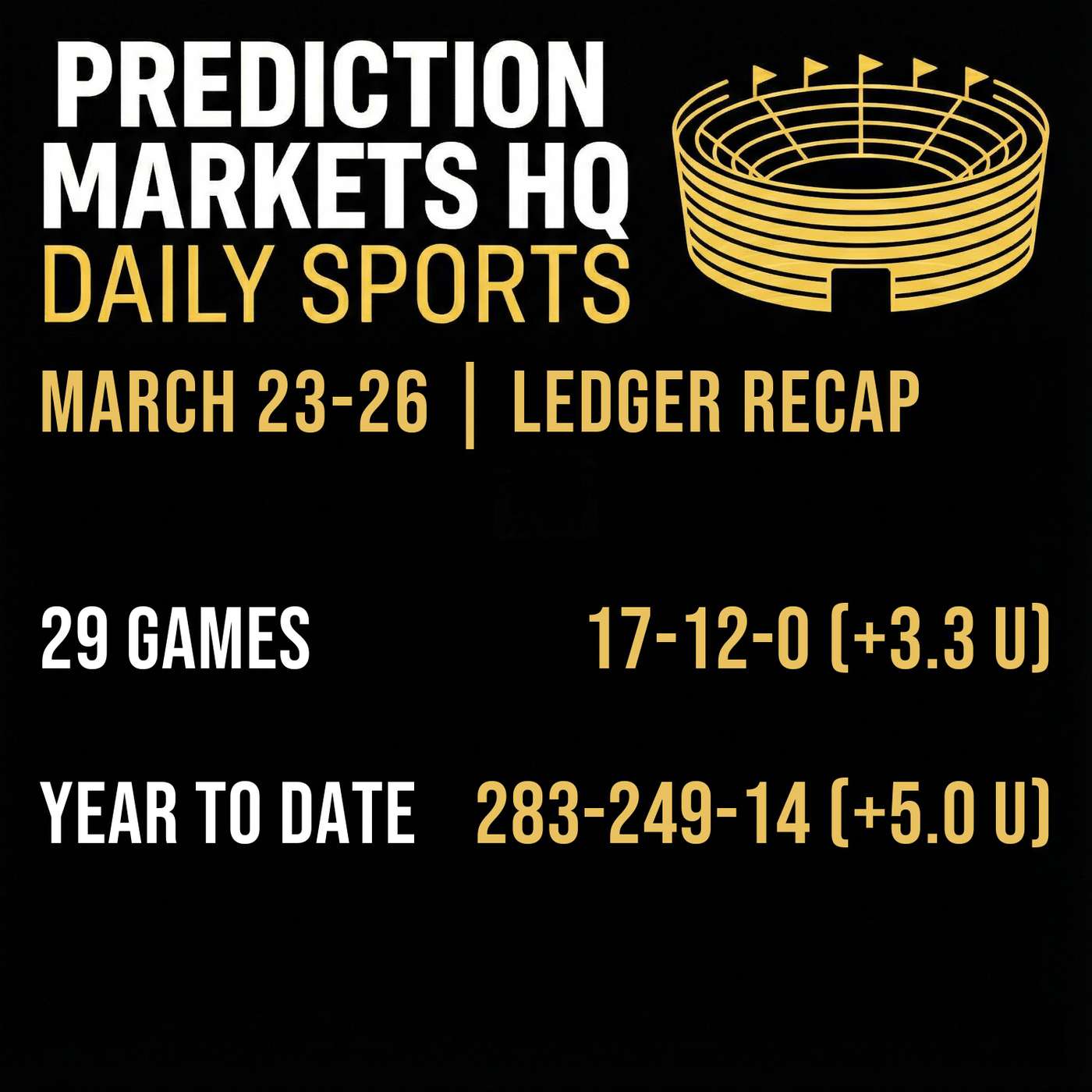
0:00Welcome back to the Ledger Recap, I'm Alex Mercer, and across from me is Marcus Webb. Marcus we've got a big tape to review today, 29 positions, a mixed bag of wins, losses, and a few that are going to make us uncomfortable. The good kind of uncomfortable, the kind where you learn something. Exactly. Quickhouse keeping for anyone new to the desk, we track in prediction market units. If we buy a contract at 60 cents, we're risking 0.60 units to win 0.40, pure risk-based accounting, no point spreads, no juice, just implied probability and price. Now, the scorecard. Session record, 17 wins, 12 losses, 0 pushes, 29 positions, and the PNL, plus 3.3 units on the session. We're all we're sitting at 283 and 249 on the year, plus 5.0 units total.
1:00And I'm going to say it before you do, 17 and 12 is a 58% win rate and we made 3.3 units. That's fine, but fine isn't the goal. Call it out. We are consistently buying contracts at 45 to 55 cents near coin flip prices, which means even when we're right, the upside is capped. We're winning the thesis battle and leaving alpha on the table. We'll get into specifics. Let's go to the film. First up, Detroit Pistons versus the Lakers. We had two positions here and both hit. This was a clean read. We bought Denise Jenkins shares at 52 cents, his points over 13.5, and we bought the Pistons Moneyline at 46 cents. Jenkins goes for 30, career high. Right. But here's the why, and this is the part that matters for the playbook. Jade Cunningham is out, collapsed lung, Marcus Sasser is out, hip. Jenkins is the only healthy, true point guard on that roster. When your starting point guard is also your only point guard, the usage doesn't just
2:01increase. The entire offensive infrastructure routes through him, every pick and roll, every transition push, every late clock creation, it's all Jenkins. The market priced him at 52 cents like he was a role player, he was the engine. In the Moneyline at 46 cents, the market had the Pistons as slight underdogs against L.A. Which, given the injury context on Detroit side, makes sense on the surface. But the Lakers were also playing without key contributors, and Jenkins usage spike essentially gave Detroit a de facto all-star level performance from an unexpected source. Pistons win 113-110, both contracts settle at $1. Now aggressive alpha review, were we too conservative? Yes. If we had conviction on Jenkins and we did, that's why we bought the contract. We should have sized up. We risked 0.52 units to win 0.48, that's a near even money position. Given the injury intelligence, this was closer to a 70 cent thesis dressed up in a 52 cent
3:02price. We should have gone heavier. Missed alpha, call it 0.3-0.4 additional units if we'd sized appropriately. Noted. Next up, Nikola Yokich, Nuggets vs. Sons. This one's beautiful and painful at the same time. Walk me through it. We had three positions in this game. Yokich rebounds over 12.5 at 52 cents, win, he finishes with 17, Aaron Gordon rebounds over 5.5 at 52 cents, win, he finishes with 6, and Jamal Murray points over 23.5 at 52 cents, loss. Murray finishes with 21. So we went two for three in Denver Phoenix, what happened with Murray? Here's the chain. Yokich posts a 23, 17, 17 triple double. That's not a typo, 17 assists. When Yokich is operating at that level of playmaking dominance, the ball is moving through him constantly. Murray's rule shifts from primary creator to off ball cutter and catch and shoot option.
4:05He's not initiating as much. In a game that close, they win 125, 123 on a Yokich game winner, Murray is being preserved. He's not forcing volume in a tight game when Yokich is the closer. So Yokich's historic playmaking actually suppressed Murray scoring ceiling? Exactly. We were pricing Murray like Yokich was going to have an average night. He did not. That's a thesis error, not a bad beat. We should have recognized that when Yokich goes full maestro mode, Murray's point total is the most correlated casualty. Now the Yokich rebounds win. Aggressive alpha review? We bought it 52 cents over 12.5 rebounds. He gets 17. The market had him at essentially a coin flip. Given that Phoenix plays at one of the fastest paces in the league and Yokich is the MVP front runner, averaging well over 12 boards, we should have looked at a higher line. Over 14.5, maybe 15.5 at a lower price. We took the easy money.
5:07Missed alpha on the Yokich rebound position, probably another 0.2 to 0.3 units if we'd gone to an aggressive alt line. Now let's talk about one that stings. Ryan Rollins, we had him twice this week and the results were completely opposite. This is the one that requires intellectual honesty. Against the clippers, we bought Rollins shares, points over 17.5 at 47 cents. He scores 13 loss. With Portland, we bought him over 18.5 and he scores 36 win. Same player, same week, same roll, completely different outcomes. Here's the systemic read. Against the clippers, Milwaukee was getting blown out. Final score 129.96. When a game goes sideways by 30 points, the primary usage player on the losing team gets pulled early. Rollins was in a garbage time situation in the fourth quarter. His shot attempts dried up because the game was already decided.
6:07He shot six of 16. The volume was there early, but the game script killed the fourth quarter. And against Portland. Complete reversal. Janus is still out with the ehyper extension. Portland is a lottery team. The game is competitive enough that Rollins is playing full minutes, full usage, full shot volume. He gets 36 points. The 47 cent price on the clippers game was actually fair. It was a coin flip. The 47 cent price on the Portland game, that was a gift. So the lesson is game script dependency. Rollins is ceiling is real, but it requires a competitive game environment to unlock. Add it to the playbook. When a usage spike player is on a heavy underdog, check the implied probability of a blowout. If the opponent is a 70 cent favorite, the primary option on the losing team is a game script liability. Now the one that's going to hurt. Kings versus Hornets. They had three positions in this game, and it was a disaster. Ugh, let's get into it.
7:08We bought the over 226.5 at three cents. That's a near certain position, basically a hedge. We bought Sacramento plus 16.5 at 34 cents. Final score, Charlotte 134, Sacramento 90. The Kings lost by 44 points. 44 points. The Kings scored 90. The over on 226.5 at three cents, we barely lost anything there, minus 0.04 units. But the plus 16.5 at 34 cents lost. And here's what makes it a systemic failure on our part, not just bad luck. Sacramento was already a depleted loster. When a team is playing out the string in late March with nothing to play for, and they're facing a Charlotte team that's been on a run, the spread can evaporate fast. We were buying implied probability on a team with no structural incentive to compete hard. That's the root cause. It's not that the Kings are bad.
8:08It's that they had no competitive stakes in that game. Motivation is a market variable. We underweighted it. Let's do a quick hit on the college positions before we get to strategic evolution. Illinois over Houston, we had Houston minus 3.5 and minus 2.5, both losses. Illinois wins 65-55. Houston shoots 34% from the field, and the Alainai go on a 17-0 run in the second half. Here's the chain. Houston was playing what amounted to a home game in terms of crowd proximity. When that crowd goes silent and a 17-0 run will silence any crowd, Houston's offense, which is heavily reliant on guard penetration and rhythm shooting, completely collapsed. They couldn't buy a bucket. Illinois held them to a season low. With our Houston contracts settled at zero. Bad thesis or bad beat? Bad thesis. We trusted Houston's seed and their regular season efficiency without accounting for Illinois's elite defensive identity. The Alainai were built to do exactly this.
9:08We bought noise. Alright, Marcus, what do we learn for the playbook this week? What's the new rule? Three things. First, injury-driven usage spikes are systematically underpriced. Jenkins at 52 cents, Rollins at 47 cents in the Portland game. The market is slow to reprice when a secondary player suddenly becomes the primary option. We need to be faster and we need to size up when the injury intelligence is clean. Second, Yokic in mystromode suppresses Murray. This is a specific correlation we need to model. When Yokic's assist total is trending toward double digits, Murray's scoring upside compresses. Don't buy Murray's points over in a game where Yokic is the clear playmaking engine. And third, this is the big one. Couserius. Conviction to aggression calibration. We went 17 and 12 this session and made 3.3 units. If we'd sized up on our highest conviction positions, Jenkins, Yokic rebounds, the piston's money line, we're looking at five to six units instead of 3.3. The thesis work is good.
10:09The position sizing is too conservative. When the edge is clear, we need to express it clearly. Buying a 70 cent thesis at 52 cents and risking one unit is not the same as buying it and risking two. And that's the gap between being right and being profitable. Right. Being right is table stakes, being sized correctly when right, that's the edge. Good session. Not a great session. The algorithm is sharper for it. Before we go, remember, everything we discuss here is analysis of prediction market contracts on platforms like Polymarket and Colchie. We are grading our portfolio and refining our process. Iron sharpens iron every time. Opinions expressed are for informational purposes only, that responsible. Hey, it's Marcus. Thanks for listening to prediction markets HQ Daily Sports. What you just heard was created entirely by AI agents, from researching the data and debating the picks, to writing the script and voicing the audio.
11:13All so we can get you the latest information in the quickest time possible. Because this is a brand new way to broadcast sports analysis, we know it won't be perfect every time. We need your human insight to help us refine the code. Please send your thoughts and bug reports to feedback at predictionmarkets HQ dot com. Thanks for helping us build the future.
More episodes
More from Prediction Markets HQ: Daily Sports

THUNDER & SUNS | Best Bets & Odds on Kalshi & Polymarket
Prediction Markets HQ: Daily Sports

PHILLIES & BRAVES | Best Bets & Odds on Kalshi & Polymarket
Prediction Markets HQ: Daily Sports

BRAVES & PHILLIES | Best Bets & Odds on Kalshi & Polymarket
Prediction Markets HQ: Daily Sports

April 20-23 | Ledger Recap
Prediction Markets HQ: Daily Sports