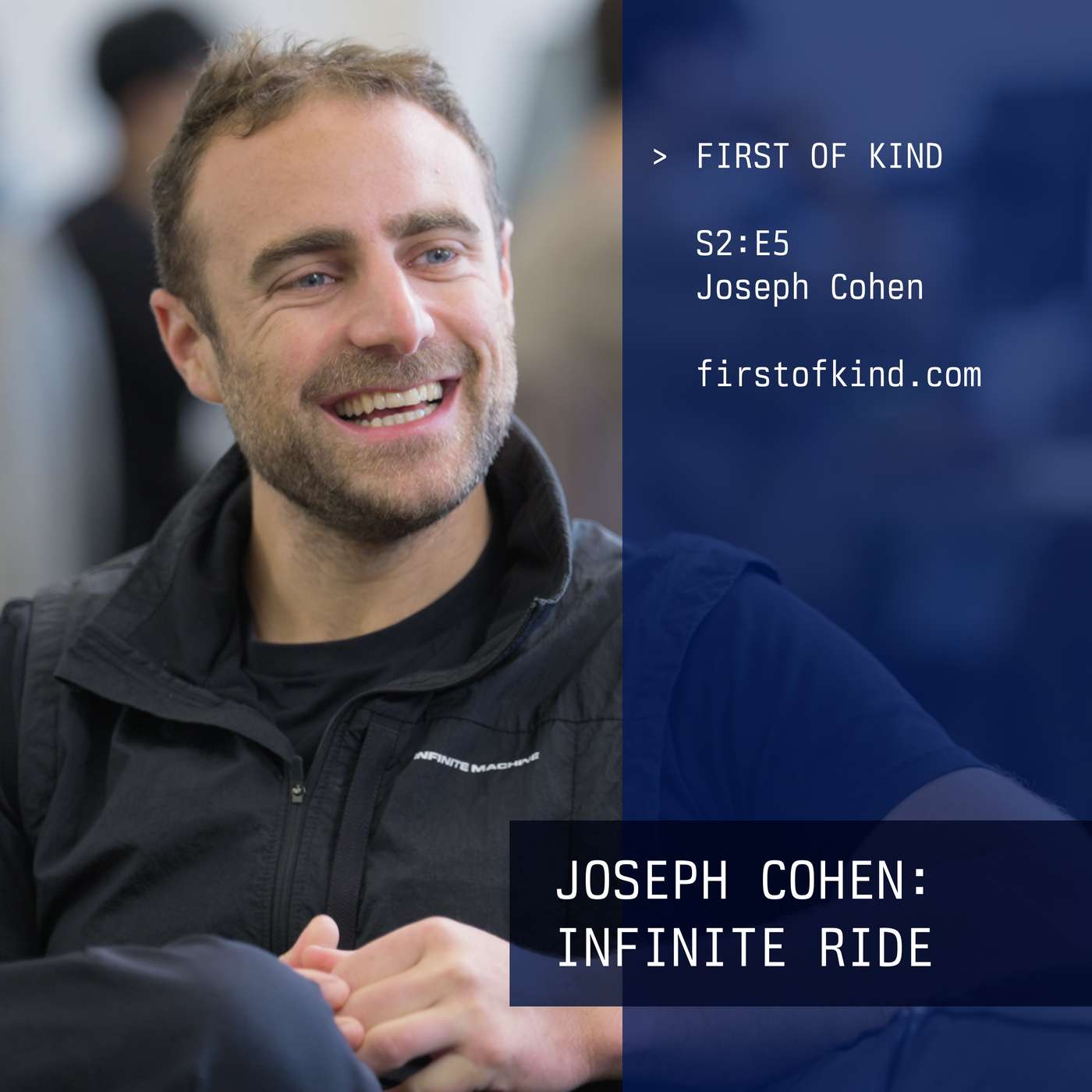
About this episode
What if you designed a new class of vehicle from the ground up?
Joseph Cohen first cofounded Universe, the mobile-first website builder, before turning his attention to the physical world. He and his brother Eddie Cohen now run Infinite Machine, an automotive company reimagining how people move through cities — not with cars, but with something entirely new, starting with the electric motorcycle.
We met at Infinite Machine's headquarters in New York City, where Joe walked us through the design philosophy behind “non-car” vehicles, why electrification unlocks radical new form factors, and what it means to bet on autonomous people over autonomous cars.
00:00 – Intro: Color Outside the Lines
01:50 – A New Symbol for Freedom
05:52 – The Stolen Vespa
09:49 – The P1 vs. The Vision Pro
12:52 – Hard Modernism
17:26 – Painters Who Paint Factories
19:42 – Ten Times the Trips
23:33 – The Vespa Has No Engine
27:51 – Ask New Questions
32:00 – The Company as Medium
34:11 – Outro: What Memories Will You Make
S2:E5 Joseph Cohen: Infinite Ride
Hosted by Soleio and produced by Room 3: room3nyc.com @room3nyc
First of Kind is powered by our sponsors:
Framer — framer.com
Cursor — cursor.com
Vercel — vercel.com
Profound — tryprofound.com
Website: firstofkind.com
YouTube: youtube.com/@firstofkind
𝕏: x.com/firstofkind
Threads: threads.com/firstofkind_
Instagram: instagram.com/firstofkind_
Hashtag: #FirstofKind
Interactive timestamps
Jump to segmentGet every episode summarized
Each time First of Kind publishes, we email you a written briefing from the transcript — the topics, who appeared, and any specific claims, with the ad reads skipped.
Email me new episodesFree for 3 shows. No card needed.
Hosts & guests
Transcript ready
476 searchable segments. Every word is indexed and playable.
Full transcript
First of Kind — Joseph Cohen: Infinite Ride. Machine-transcribed; use the interactive transcript above to jump the player to any line.
0:00We are in the business of enabling agency, enabling people to do what they want on their own terms, to live their own life, to color outside the lines. We're not interested in autonomous cars, we're interested in autonomous people. That's really the crux of the Infinite Machine idea. First of kind is a new series about design and tech told by its pioneers, sponsored by Framer, Cursor, Purcell, and profound. Joseph Cohen is designing the future of urban transport at his new company, Infinite Machine. We met at their headquarters where he described how their design method reimagines the American automotive. So, good see you, man. Thank you for hosting us. Thanks for coming. It's an honor. It's an honor. It's incredible to be here. You and I have known each other for quite some time. And I think in looking back through the Gmail inbox, I think we first connected when you were working on a company called the universe. And at the time, I don't think designer founders were fashionable.
1:00The very conceit of a mobile website builder, a mobile first website builder was just kind of zany. But it struck me that here was a guy that was pioneering something new. And I always kind of like keep a note for particular designers that are like, just going a little bit off piece, going off the reservation, and trying something novel. Because it's often those people that kind of uncover interesting territory in the process. And now that you're working on Infinite Machine, I really just want to spend today talking about that transition. And what I like to call the golden thread, the golden thread being at the center of every create enterprise, there's a story of the founder, the opening in the universe that was presented to him or her. And how they kind of like navigate it through it. And so let's talk a little bit about Infinite Machine. Like what kind of company is this? And how has it changed the way that you think about being Chief Designer Chief Executive?
2:01So Infinite Machine exists to make the best non-car vehicles in the world, and really rethink how people get around cities. When you look at the world, there's a couple trends that are really reshaping how we live and how we move. Number one is that we're increasingly urbanized. This is not a new fact. We're all aware of it. But more and more people live in cities. And that's a trend that's global. And I think it's something like 70% of the world will be living in cities within the next few years. And when people live in cities, their trips are much shorter. They're not getting on the freeway. They are traveling three, four, six miles to get to work and not 60 miles. And the second trend is this secular transition to electric energy. And away from internal combustion engines. And we've seen EV adoption grow tremendously. We're in a bit of a speed bump, but it's continuing unabated. And so when you add these two things together, we start to say, well, what are the vehicles that make sense to get around these urban environments?
3:02And increasingly, the answer is not a car. When you want to go to work, when you want to go out, when you want to hang out with friends, taking a car more often than not is slow, it's expensive, and it's not very fun. The car in its glory days was really a symbol of freedom. It was about the open road. It was about going wherever you wanted. And increasingly, that's not true. Car, when you think about a car, most people think about a headache. And we think that there's an opportunity to reintroduce a new symbol for freedom. That allows you to go wherever you want, whenever you want, and really unlock the environment that you live in. And we think that those vehicles are smaller, they're smarter, in some ways they're more beautiful, and they're designed in different ways than traditional cars. If you think about the auto space, it has been a canvas for some of the best design and engineering work of all time. However, I would argue that over the past 20, 30, even 40 years,
4:06it's ossified, it's become static. If you took the badge off of most cars, you wouldn't be able to tell the difference between them. And so I actually think the frontier in transportation, in vehicles, and in the design and creation of them is in alternatives, in new form factors that kind of rethink how we move around. So this company, Infinite Machine, exists to make the best of those vehicles, to really push the envelope, to create new forms, and to build a shared platform that can manifest itself in many different ways. We've started with a product called P1. It's kind of our roadster. It's a super high-end, electric-seated scooter. It goes 65 miles an hour, it's got a license plate, it's fully street legal, well, it's got car play, it's got tons of bells and whistles, cameras on the front of the back, it's super stable and smooth, the performance is amazing, it feels like you're kind of gliding through Earth, and that's now we've started deliveries for that product, and so that's fully in production.
5:06And then we've taken the core of that technology, the core of that platform, and we brought it down to a form factor that's more accessible, and could ride it in the bike lane, and so that product is called ALTO. ALTO is 20 mile per hour bike lane legal vehicle that takes a lot of the technology and thinking and supply chain from P1 and brings it into a form factor that you can get for $3,500 instead of $10,000 for P1. We have those two products right now, but we're going to be building on that platform over time, and really the thing that we're building is the machine of Infinite Machine, this engine that could produce vehicles from sketch through to mass production in a short amount of time, and really take risks in those form factors and change how people think about moving around the world. Amazing. I am, I'm really eager to hear a little bit about the genesis of the company. Was it inspired by the P1, or the earliest ideas of the P1, or was it more inspired by the opportunity space that you and Eddie saw?
6:06Tell me a little bit about the genesis of the Infinite Machine. I'd say this is extremely organic, and from day one was not intended to be a company. So the story of the company is that I started this with my brother Eddie. We always wanted to work on something together, whether it was a company or something. We weren't really sure, but we're less than two years apart, we're both designers, we're both builders, we're both entrepreneurs. I went more of the technology software route, and I went more of the brand physical products route. You know, I raised venture capital, he bootstrapped kind of two sides of a coin, and over five years ago, at the time we were both using Vespas to get around New York, and we found them to be this cheat code for the city. You could get anywhere anytime, really a lot of the value proposition of this non-car form factor. And, you know, I moved to San Francisco, I brought my Vespas, when I started when I'd go traveling, I'd rent one, because it really kind of changed how I thought about the place I was at.
7:09There's a lot of friction in becoming a Vesparider, not like something that's super mainstream, you kind of have to go to this one place to get it, you've got your motorcycle license, there's just a bunch of friction for it. And then, aesthetically, you're kind of in this 1960s Italy world, which works for some people, but in America. It's a very 20th century. Yeah, exactly. In a modern American city. It's super nostalgic, you know. And there's something to that, but it's not the thing that gets me lit up aesthetically. And so, early 2020, my Vespagot's stolen. And, Eddie and I always wanted to work on something, we love vehicles, all kinds, cars, motorcycles, scooters, but really all kinds of vehicles. There's such an epic product, it's kind of like the ultimate product in a way. It's really a product made up of like a hundred other products. So, we always have been nerds about that stuff, we're always kicking around ideas, we thought about doing an RV, we thought about doing different things. And when my Vespagot's stolen, I said, you know what, the future's electric. Let me see what electric vehicles are out there.
8:10In this space, when shopping was totally uninspired by everything that was out there, which at the time, mostly kind of things that I describe as like moving printers, plastic, just uninspiring things. And so, I went back to Eddie and I said, I think there's something we can do in this space. And we didn't know what we were getting into, and that was kind of the point. We were really excited about the idea of learning how you create a vehicle, like even a one-off vehicle. And so, this became our COVID-19 Wekins project. And it existed that way for about three and a half years until we, you know, honed in on the prototype of P1. And we were just so enamored by it as a product. And then we developed the conviction, hey, this category of personal electric vehicles, it's actually exploding. It's presently a $200 billion dollar of your global market. It's going to be a $500 billion dollar of your market within a decade. But there's no leading company in this space. There's no Apple of the category. There's no Tesla of the category.
9:10There's no one doing the best work, the best design, the best engineering. And that's what we think we're really good at. And we can make amazing products and synthesize ideas, and package them in ways that are accessible and inspiring to people. And that the supply chain in the infrastructure had emerged where we can really operate at that level, as opposed to, you know, we needed to architect some battery chemistry for the thing to work. We could really play the role of designers. And at that point, decided, you know what? We need to do this for real. We went full-time. And yeah, kind of, well-dusting into existence. I'd say also, you know, it was funded up until that point by us. Yeah. But I will say there was one kind of memory that sticks out, which was that when we finished the prototype P1, and that was the results of a bunch of different iterations, it was July of 2023. And we went for a ride. Our co-founder, Zach, who is the engineering mine behind Infinite Machine. We set up this kind of the ride course, and I was just on cloud nine.
10:17I was flying through space on this beautiful thing. And it really felt like the world was melting away. And I can have total freedom of movement. And I just felt like the coolest thing I'd ever experienced. That week, I was also invited to go to Apple. I was running Universe. And Apple had announced the Vision Pro. And they were shipping it like six months later, but they invited some app developers to come out and check it out. And so I went to Cupertino, went to Apple Park, they take your phone, they're allowed, your laptop, they put a little sticker on the camera, so you don't take picture of anything. So a whole pomp and circumstance, get to this room at Apple Park. Here's the Vision Pro, they unbox it. And I put it on my face, and I just felt stuck. I was inside of a screen, and I just wanted to get out. And I was just thinking back to my experience two days prior, on P1, flying through the world.
11:17And at that moment in time, I was like, I want to get away from the screen. I think that screens are amazing, and the internet's amazing, but we're at this point where we're kind of glued to our phones. And the idea of strapping a screen to my face is not the future I want to live in. And I think that technology can actually enable us to go out into the world, and live bigger lives, not smaller lives. And at that moment, it crystallized, and then we need to figure out how we did it, instrumentally, actually transitioned into me working on this, and that took some time, but that was the moment when I had where I crystallized it. Okay, this new thing is really pulling me. And then we developed the conviction, hey, this category of personal electric vehicles, it's actually exploding. It's presently a $200 billion dollar year global market. It's going to be a $500 billion dollar year market within a decade, but there's no leading company in the space. There's no Apple of the category. There's no Tesla of the category.
12:17There's no one doing the best work, the best design, the best engineering. And that's what we think we're really good at. And we can make amazing products and synthesize ideas, and package them in ways that are accessible, and inspiring to people. And that the supply chain in the infrastructure had emerged where we can really operate at that level, as opposed to, you know, we needed to architect some battery chemistry for the thing to work. We could really play the role of designers. And at that point, decided, you know what, we need to do this for real. We went full-time, and yeah, kind of, will this thing into existence? When you first pitched Infinite Machines to me, I remember walking away from that conversation, turning around my head, the idea of freedom. And I love that that's always been very central to Infinite Machine, especially in a world where we're in America, freedom is a pillar of our nation, the legacy of the vehicle, the automobile, it's largely centered around that feeling of freedom.
13:18But American culture is increasingly urban culture, right? And so it's like you're creating a new vehicle for this new culture. I want to talk a little bit about how you've married this brutalist style, this visual aesthetic, this idea of freedom, because I find that it's such a, if I had read it on a sheet of paper, I would have been like, what? That's very dissonant. But in practice, there's something really gorgeous and novel and beautiful and new about it. It works. And I'd love to hear, like, how you're currently thinking about the idea of freedom in the shape of the products that Infinite Machine is making. I think actually one of the throughlines of my career is this idea of freedom. Universe was a completely different product. It was a mobile website building tool. But that was really about freedom to build, freedom to create, and making that available to everyone with the phone. And Infinite Machine is about kind of freedom to explore, freedom to move. To me, they're two sides of the same coin.
14:19I think about the aesthetics of freedom a lot, because you can communicate things in different ways through aesthetics. And the context in which you're communicating matters. So where the world was in 2020 is very different than the world the world is in 2025. And when we were thinking about the aesthetic for Infinite Machine, to be honest, it was very intuitive. And I were really creating the thing that just hit with us. So I can kind of back into explaining it, which is, you know, we are at our core modernists. We believe that the future can be designed. We believe in rationality and reason and thinking. We believe in reducing, form down to its essential nature to accomplish the task. These are all things that we believe. But modernism has actually gone through different phases. There's the original modernism in the Bauhaus and, you know, post-war America. And that was kind of the genesis of it. It's the Seagram building in New York. It's really kind
15:20of the first expression of this hyper-rational, minimal approach to aesthetics and to form. Apple, I would argue, was kind of a neo-modernism. And I'd say that the Apple era, let's call it like 2000 to 2020, more or less, when they were really kind of pioneers, I described that as almost like a soft neo-modernism, where is rounded corners, large radii, genderless, kind of acceptable. And I think we're actually in a different moment. I think that we're in a moment where the world is volatile. Not everything is okay. And I think that modernism and thinking and good design actually can show us the way for the future. But it's a different version of modernism. That's more knowing. It's more nuance. It's more clear-eyed about the nature of the world. And I think about that as kind of like a hard modernism. A modernism that has a bit more edge that is, you know, it's looking at the world
16:26through the lens of like, we need to be a bit tough in how we approach this. So how do you reflect that in in in form? How do you reflect that in a vehicle? Well, instead of like, you know, most vehicles are these bulbous, you know, kind of round forms that are glossy. And to get it shapes. Exactly. Super organic. You think about 1950's Chevy's, or even a Vespas, this like, really rounded, very shiny form. But that doesn't feel like it's meeting the moment. I think that something that is a bit more honest in its craft and in its form, something that is inherently durable. That if it gets knocked up, it's not going to look worse. I mean, we're living in cities, right? These are things that are going to get beat up. And we wanted it to actually look better over time and not look worse like two days after you roll it off the lot. And so that found an expression in using stainless steel and powder coated aluminum and anodized aluminum. And these industrial processes. And so the zeitgeist is now embracing a new romance of industrialism and
17:34making things in the physical world. Which to me is amazing. There was a point in time. It's very rugged aesthetic. It's a very like kind of tactile aesthetic, right? Very tactile, very physical, and kind of embracing industry, embracing technology. And you know, there was a kind of a moment in art history, precisionism, where painters would paint factories. They literally paint landscapes of factories. And it was crazy, right? Like, you know, 20th century art. And I think like 10 years ago, that idea was absurd. The idea of artists kind of glamorizing the factory. But I actually think we're on the mend and that this glamorization romance or excitement around creating physical things is cool again. And that to me is awesome. We should lean into that and celebrate it because we exist in the physical world. Like, the digital world is incredible, and it's enabling of so many things. But ultimately, as humans, we exist in the physical world.
18:34We should make the physical world better. And to do that, we need the best minds working on this stuff and taking their shot and using their skills to manipulate the world in the way that they can. So I'd also say that one of our goals with Infinite Machine is to inspire people to do that. You know, if you think about it, we make vehicles. That's what we are. We're a vehicle company. But if you dig a couple of levels deeper, we are in the business of enabling agency, enabling people to do what they want on their own terms to live their own life, to color outside the lines. And we make things that enable people to do that. We make tools to do that. We're not interested in autonomous cars. We're interested in autonomous people. That's really the crux of the Infinite Machine idea. And we want to live in a world where people are creating their version of Infinite Machine. It's not going to be a vehicle company. But what is that dream obsession wish that you have for how the world could be better for how you can express your own self and your own work
19:36in some orthogonal way that the world was never thinking about? We want to live in that world. And we want more people to take that shot. Yeah. And I think for me, the thing that I've noted is it's a fight against this other secular trend that we're seeing, which is a reduction in social mobility, the ability to afford living in cities, right? And so that simple act of increasing the mobility of a given person living in the city extends their economic viability, extends their opportunity. It creates more surface area for luck. And I'm always enamored by technologies that do this. I create like that essentially like ratchet up the economic engine and create like more opportunities basically out of like the air, right? Whether the marketplaces or in your case, like making it simple, cheaper, safer, get from point A to point B, right? Totally. Because it just sort of all of a set of changes to landscape of where you live, how you relate to the world, and how you can potentially earn, how you can make money, how you spend time with people you care about and lot, right? Just doing that by the end degree at global scale is like an incredible mission to me.
20:39And having spent time like overseas and developing countries where you see a lot of infrastructure, where you see that a village is really constrained by the inability to move heavy objects or just to move people from point A to point B in a reasonable amount of time where people have to walk, makes you realize that like that has this like moral impetus behind it that I think is it that I'm completely enamored by. The way I think about that is there is the trips that take place today and something like 65% of trips in America are under five miles already. So we're like, okay, well, we make vehicles that are amazing at traveling under five miles. But the thing that that misses is when you make transportation easier at lower friction, you end up with a lot more trips. And so you think about, okay, what are all the things that are enabled by more trips? It's more economic opportunity, it's more connection, it's more memories, it's more cybernipitous experiences. We want to 10X the number of trips that are created in urban environments and we make tools for doing that. Also is classed as an e-bike, but it looks nothing like any e-bike in the world.
21:40And the reason for that is we didn't start with a bicycle and attach a motor to it, which is how every other e-bike works. We actually looked at the law and we said, okay, what does the government consider an e-bike? It turns out that an e-bike needs pedals, it needs to go under a certain speed, it needs a certain wattage power from the motor, it needs to be narrower than 36 inches. But it doesn't say anything about how an e-bike is made, or the form that that takes on. And so we thought from first principles, okay, what would we want if we were designing something from the ground up that lived within this envelope? Well, it would fit two people. You'd have a bunch more storage, the posture would not be sporty where you're like hunched over like a bicycle, but you'd be a bit more upright, like you are on P1. You'd have motorcycle grade hardware so that your brakes are really resilient. You'd have chunky wheels so they could deal with the trials and tribulations of being an urban environment. You'd have a real horn, you'd have turn signals, you'd have a headlight, all these things are not
22:42in normal e-bikes. It would be internet connected, it would be smart, it would use canned protocol, which is how components in a car talk to each other so we can diagnose issues and feed that information to the cloud, right? So we looked at it really as kind of an open design problem and we were not constrained by what had come before. I think if I had come from our industry already, there's no way that I would bring that kind of fresh thinking to it. And so to me, one of the reasons to go into new areas is because you do have that beginner's mind and you're going to end up making something that the industry would not have made because they were on this path dependent route to building what already exists. Right. You sort of locked into the best practices. Yeah. And much the way that the traditional automobiles sort of fall into this platonic form is that you remove the logo from all these SUVs, they all kind of look the same, right? One of the cool things on that note, so a VESPA is actually a really ingenious design. And it was basically created like 80 years ago. Yes. But the entirety of the drivetrain, the thing that makes the VESPA move is
23:45attached to the rear wheel. There's like an engine, a small engine, a transmission, kind of all built around this. But obviously like to fit an engine on top of a wheel, it needs to be a little bit bulky. And so if you think about the form of a VESPA, there's this bulbous rear end. That's to create space for the drivetrain for the engine. So that's really working within constraints. And they actually designed a process for creating the body of a VESPA that's unique. It's a stamping process that doesn't have an internal frame like a traditional motorcycle. They made an electric VESPA, but it uses the same design. That doesn't make sense. There's no engine. Whereas if you think about designing for electric, one of the cool things about electric vehicles is you can put the motor in the wheel inside of the rear wheel is where our motor is. And so now you really need to just figure out where you put the battery, just like kind of the biggest volume of the product. And then where you fit some of the internal components like the controller, which is basically like an electrical modulator.
24:48Those things though can be really anywhere on the vehicle. So in P1, it's in the floorboard. It's really close to the ground. So even though it's the heaviest part of the vehicle, it's very close to the floor so you don't feel a lot of that weight. In ALTO, it's under the seat and it's removable like a cartridge. So you can just bring it to your apartment and charge it for the use case of that product. Right. The point though is that we're working with different ingredients and actually electrification allows for much more creative form factors than traditionally with gas vehicles. The motor can be a lot smaller. They can fit in any wheel and you can be creative in how batteries work. They're using ultimately the same battery technology that's in your smartphone. So just think about what that enables in terms of form factors. And I think the ceiling on design is actually way, way higher because of that. You do a lot of prototyping with like just three printers to kind of like test out different form factors. Yeah. So we have a factory here that builds prototypes. Okay. And we can make a vehicle from scratch here. So we go from idea to actually moving vehicle. Right. We use a bunch of tools to do that. For plastics, we use 3D printing.
25:53And we have a bunch of different things there that are newly enabling. Like 10 years ago, making a vehicle would be much harder to do because we couldn't really use plastics. You would have to injection mold things which is very expensive. And so anything with plastic, we can 3D print. With metal things, we have a CNC machine so we can machine away a tool. We can also we have a plasma cutter which allows us to take a piece of sheet metal, cut it into a pattern and then we bend it to create the form. It's not a coincidence that like P1 has an angular aesthetic it's because it reflects in some ways the tools we use to make it. Like we were able to prototype that thing with our own equipment. Like if it had it as really kind of rounded form, we couldn't actually make that ourselves. Like we would have to buy a lot of expensive tools to do that. And so it is a reflection of our tools in that way. But I think the word you used earlier was like the honesty of that. Yeah. It's like this is its platonic form. This is like how it would present in the world based on like its point of origin. You can fancy it up down the road, but like here it
26:57is in its primal form. Yes. And the cool thing about that is how people respond to it. Mm-hmm. Because I've been dailying a P1 for four months now. Every day, I'm going around everywhere in the city. It's kind of my my tool. Yeah. And at every intersection, someone's like, what the heck is that? Like wow, that is so cool. And it's like every kind of person. It's like old ladies, it's kids, it's really every demographic of people. Wow, that's so cool. And that's the power of vehicles. They're inherently social. You're out in the world with them. They're highly self-expressive. They're the closest thing to fashion in the technology world. Right. And we're leaning into that. We realize that we can as a startup kind of command an outsized attention by bringing people in with that form. So in some ways, the kind of secret is that we're over investing in design to have a high ROI on our money in our life. What are the things that I also noted was you mentioned the word non-car a couple of times. And you and I both know Apple
28:00all enough that they're very deliberate about their concepts, the words that they choose to convey ideas that sort of sit around the products that they built. Everything from privacy to spatial computing, those are very deliberate choices. And I find that you're very deliberate in how you're talking about infinite machine and the class of products you're making. Why non-car versus smart bike? Like when you sort of think about the naming of concepts that are kind of critical to this company, what's the thinking behind it? Yeah. I mean, the first thing is that there aren't great words yet for this emerging category of vehicle. People call it micro mobility or light electric vehicles, our personal electric vehicles. And those work, they're fine. But I find that they're not grabbing enough. And they don't, I think, convey the level of the ambition that we have. And really our thesis is that the car was this incredible tool that defined the 20th century,
29:04defined America in many ways. But in this increasingly urbanized world, we need new tools. So enter the non-car. And that envelope is extremely expansive, right? It doesn't mean only bikes, doesn't mean only scooters. It could have three wheels, it could have four wheels, it could have no wheels at some point. It really is a problem statement. You know, I heard this quote once from Chuck Close, the artist. And he talked about how people are often obsessed with finding clever and creative solutions to problems. And he said, no, the thing, that is important. But if you want to really break new ground, you need to ask new questions. The question is actually the limiting factor of creativity. It's the framing device of ideas. It's the framing device of solutions. And so when we make the framing device known cars, it expands the universe of things we can do in the ways that we can think. By the way, cars are incredible and have been incredible in their own way. So we're not like anti-car, but we want to draw outside the lines of the car. And we will do
30:07things over time that, you know, you could sit inside of, not just on top of, but it will not look like a Model 3. It will be a new thing. And so, you know, it's not really best practice to find yourself by what you're not, but that's kind of the point. We are defining best practice in some ways because of that. So there is a subculture on the internet. It's called the fuck cars movement. And they have this massive like Reddit with hundreds of thousands of people in it. And it's really about this idea of like, in cities, we have a kind of, as humans, become second-class citizens to cars. Right. We take it for granted. But if you look around your average city street, the architecture is cars. Yeah. You've got cars parked on both sides of the road and then one lane and moving traffic. And everything about how you move around is dictated by cars. You wait at the corner for cars. You cross, you're kind of like, you're kind of subservient to the car. It doesn't need to be that way. And there's just someone profited on a billboard on the BQE
31:10in New York a couple of years ago. It said, ban cars, reinforce the roads. And we're not as aggressive in our language around that. But we are really excited about the idea of reinforcing the roads. Yeah. And bringing nature into cities and making cities utopian in that way. Like, we're really excited and inspired by another kind of redic cell culture, which is the solar punk movement, which is about like, in a world that's that's increasingly pessimistic, the most punk thing you can use being an optimist. And they do these amazing visualizations about these super green metropolis is, we're excited about that. We want that to exist. And we think that we can play a small part in willing that and bringing that into existence. Yeah. So I want you guys to own tropical brutalism like that. Exactly. That's not super cool. You know, the past 150 years, companies are really the dominant institutions of change in the world. And if you know how to create them, that is, in many ways, a more powerful medium than a painting or a film. You're really,
32:15you're building something that is kind of infinite in its outreach and bounds. It's living in breathing. Yes. And it's fucking with reality. You know, like it's interacting with reality. Whereas a film, you know, you go and I love film and you kind of walk away with it and change, it could change your life. A company is in your life. Yeah. And that's really cool. And so I think for both of us, a company became the ultimate design project. Like designing a company became this idea that it was boundless and could be encompassing of kind of everything that we can make. All kinds of disciplines, even like within our company now, we design vehicles, we design software, we design graphics, we design spaces. That's so cool. Like the expansiveness is the point. And for me, success is being able to continually expand the canvas and be able to have more surface area to design things. I do think in a word, tiny company. So we have everything to do. Like we've done very little so far. But I do think that Apple was kind of this
33:16landmark that really set the tone for what technology looks like in the physical world. And really kind of inspired a generation of designers and entrepreneurs. And at our most ambitious and loftiest, we hope to kind of fill a bit of the hole that I think has been left by Apple in this next season. There isn't a company right now that's making hardware that is really kind of pushing and setting the kind of tone for what technology can look and feel like in the physical world. Right. And we're building vehicles. And we will be building vehicles for the next foreseeable future. But that's not the limit of what we're going to be doing. Like we call the company Infinite Machine because we're very ambitious. And we want to build lots of stuff. And the companies that we're developing for creating vehicles, for shipping them, for servicing them can transfer to other fields that are adjacent to it. And I love that the vehicle can become an expression of more than just transportation. Yeah. That can become an
34:18expression of optimism. It can become an expression of just agency freedom as you've described it. And it can also be a thing that's like baked into the core lived experience. Like the thing that I'm going to walk away from with this conversation is yeah, like some of my favorite combos were sitting in a car moving through space. Right. And what combos could I have on the auto on the P1 and the vehicles that you make down the road that might be fundamentally rooted in just being moving through the world in that fashion. Right. Yeah. It's like what insights will you have? Right. What things will you see? Yes. What memories will you make with the passenger on the back of your vehicle? Exactly. What first dates are going to happen that turn into yes. Marriages and then families. That's really cool for us to be in the business of creating the circumstances for that to happen. I joke with my wife, we see these kids on like e-bikes back home. And a part of me is like, oh gosh, it's so dangerous. It should be wearing helmets. But then you realize that yeah,
35:18there's something very romantic about what they're doing. Like those kids are going to be chasing that feeling for the rest of the lives. 100%. You're creating a world where like maybe they don't have to. Maybe they can just have it every single day. Yeah. Yeah. Exactly. So thank you so much for taking the time to talk to me, man. Yeah. I'm super inspired by your career about this company that you're building, the products you've made. And I'm super excited to see where we go from here. No, thanks for coming. It's really been awesome to kind of share our story. But I'd love to share the rest of the space. You wanna see it? Yeah, let's do it. Yeah. Great. This is First of Kind. A new series about design and tech told by its pioneers. Sponsored by Framer, Kurser, Purcell, and profound. Follows on X, YouTube, Threads, Spotify, and Apple podcasts. The future belongs to designers who build.
More episodes


