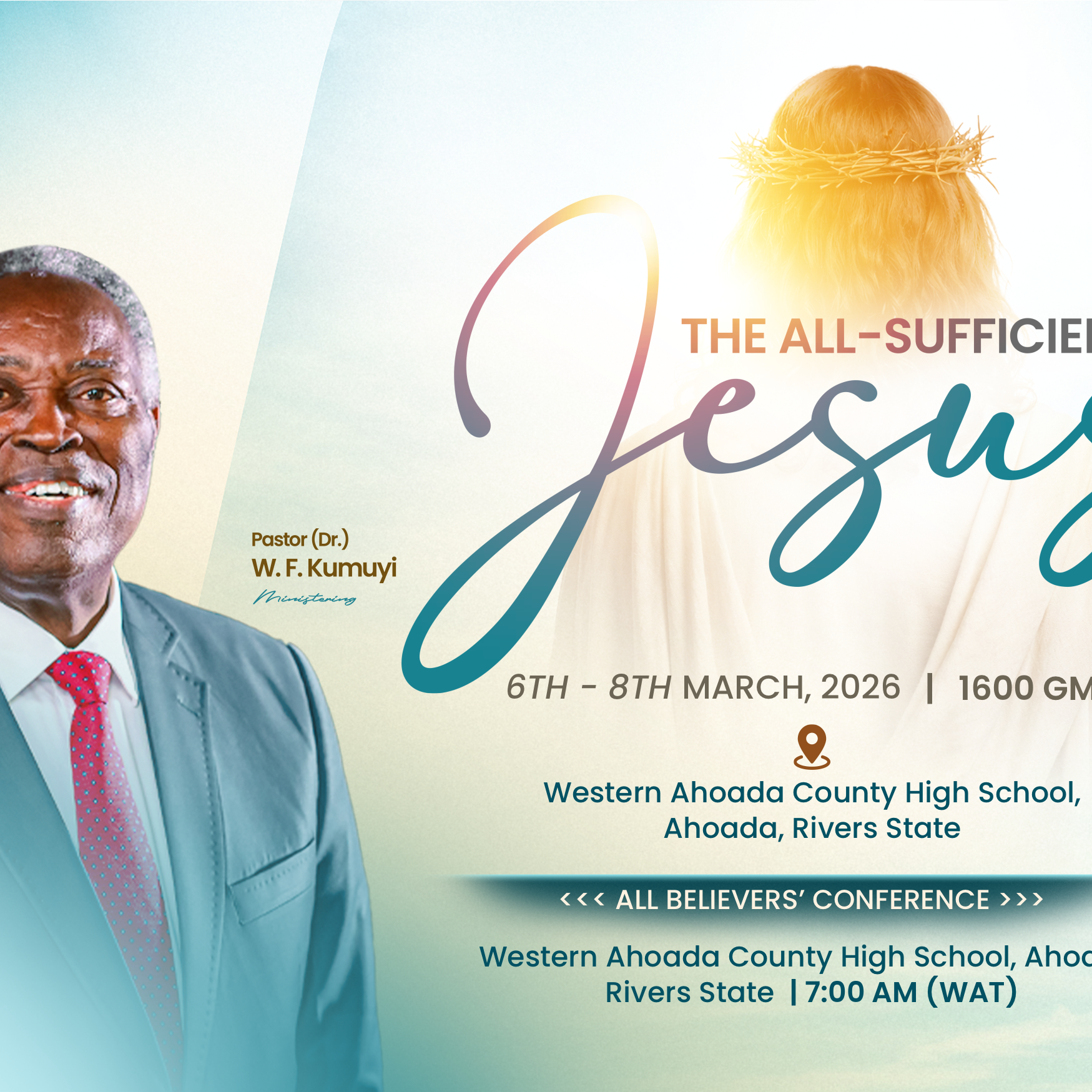
Jesus: The Merciful Mediator for All Men
About this episode
Jesus: The Merciful Mediator for All Men
This sermon was delivered by Pastor (Dr) W. F. Kumuyi at the recent Special Revival Program, themed "Jesus, the Life Changer," held in Bori, Rivers State, Nigeria. It focuses on the role of Jesus Christ as a Merciful Mediator for humanity. The message explains that because people are trapped in a "well of sin" through their own nature, they cannot achieve salvation through personal merit but must instead rely on divine intervention. Using the biblical story of blind Bartimaeus, the message illustrates how faith and the rejection of past identities lead to instantaneous miracles and healing. The message emphasises that Jesus is an Active Intercessor who is currently pleading for the forgiveness and restoration of all individuals. Finally, the message provides a structured call to repentance, offering a specific prayer for those seeking to surrender their lives to God. Thus, the collection serves as both a theological teaching and a practical guide for spiritual and physical transformation.
If you need the complete Pastor (Dr) W.F Kumuyi Message outline, download it via this link - https://tinyurl.com/JesusMercifulJLC20260303
Also, we love to hear from you. Send your feedback via this link - https://tinyurl.com/DrWFKumuyiPodcastFeedback
Please share this message with others. God bless you.
Interactive timestamps
Jump to segmentGet every episode summarized
Each time Biblical Deep Dive with Pastor (Dr) W.F Kumuyi publishes, we email you a written briefing from the transcript — the topics, who appeared, and any specific claims, with the ad reads skipped.
Email me new episodesFree for 3 shows. No card needed.
Hosts & guests

Transcript ready
221 searchable segments. Every word is indexed and playable.
Full transcript
Biblical Deep Dive with Pastor (Dr) W.F Kumuyi — Jesus: The Merciful Mediator for All Men. Machine-transcribed; use the interactive transcript above to jump the player to any line.
0:00Welcome to today's Deep Dive. I am so glad you're joining us. We have a genuinely fascinating exploration ahead of us today. They really do. We are looking closely at the art of mass persuasion, you know, the strategic use of vivid metaphors, and basically how complex theology gets distilled for a massive crowd. Right. And the scale of this is just incredible. It is. Our sources for this dive are twofold. We have a detailed sermon outline and a live transcript from this massive revival event. The event was called Jesus the Life Changer, and it took place on March 3, 2026. Emborey, River State, Nigeria. Exactly. And the primary speaker was pastor Dr. W. F. Camouille of the deeper Christian life ministry. Who was a highly influential figure? Very much so. Now before we jump in, I want to make our mission here crystal clear for you listening. As always on this show, we are examining these religiously charged sources entirely impartially. We are not here to endorse the theological viewpoints or, you know, validate the supernatural
1:00claims captured in these transcripts. Instead, our goal is to explore the underlying ideas, the incredibly powerful rhetorical structures, and really the raw human emotions that this original source material packed into. Because the mechanics of how a speaker effectively moves and mobilizes an audience of this scale, it's a masterclass in rhetoric. It really is. Okay, let's unpack this. When you are standing in front of thousands of people, where does this speech of this magnitude actually begin? Well, it begins by establishing a sweeping universal origin story. The goal is to instantly ground every single person in the audience, regardless of their background. So the opening premise sets the stage by claiming that humanity was created by God purely out of love and grace. The speaker paints a picture where human existence wasn't something man asked for. It's framed entirely as a divine favor. An initiative meant to establish a relationship. Exactly a relationship of mutual affection. But rhetorically speaking, you can't have a savior without a crisis. So the narrative quickly shifts to the fall of humanity
2:03through outside influence, specifically Satan. Yeah, I noticed the materials use a very specific set of verbs to describe this fall. It's not just framing human error as a simple mistake or a bad habit. How exactly does the speaker linguistically frame this concept of sin to a crowd of that size? It's highly deliberate. The speaker uses what we can call the three peas to define the problem. The transcript argues that sin didn't just happen. It prevailed, it penetrated, and it polluted lives. Prevailed, penetrated, polluted. Right. By using these active aggressive verbs, the rhetoric transforms an abstract moral concept into a hostile invading force. He describes it as fiercely possessive and pervasive. The psychological impact of that has to be significant. Huge. Because it tells the audience that their struggles aren't just private, quiet failings happening behind closed doors. It actually validates their feelings of being overwhelmed. By framing their struggles as an active occupation of their lives, that they're fighting against. And to really drive that feeling of being overwhelmed home, there's a highly
3:07specific image introduced early on. The slippery well analogy. Oh yeah, that's a powerful one. The speaker compares the human condition to falling into a deep, dark well. But the critical detail is that this well has absolutely no steps. And the walls are entirely slick. What is the psychological goal of bringing up such a helpless scenario? It's a brilliant metaphor designed to completely dismantle the concept of self-help. Wow. Think about the psychology of the audience for a moment. Most people have tried and failed to fix their own lives at some point. By describing a well with slick walls and no steps, the speaker provides a comforting explanation for those failures. That's not your fault you couldn't climb out. Exactly. The message is it doesn't matter how athletic, wealthy or intelligent you are. Once you're in this well, your personal attributes are completely useless because there is simply no leverage. Which speaks directly to the frustration you feel when personal resolutions fall apart. You know that feeling you make a firm decision on January
4:081st to stop drinking or stop smoking or change a toxic behavior and by February, you're right back where you started. And you feel terrible about yourself. But the well analogy offers this immense psychological relief. It tells you that your resolutions didn't fail because you didn't try hard enough. They failed because human hands literally cannot grip the slippery walls of the human condition. That is fascinating. And he takes it a step further to isolate the individual from earthly help. He points out the logical fallacy of expecting another person in the well to save you. A drowning person cannot pull another drowning person to safety. Right, if everyone around you is stuck in the same mud, nobody has the footing to pull you out. Therefore, the logical conclusion is absolute. You require an outside mediator. You need someone standing safely above the well, reaching down to pull you up. Here's where it gets really interesting. The transcript pivots sharply from this overwhelming hopelessness to the introduction of that exact mediator. And of course, in this context, that is Jesus. Right. But the speaker introduces him
5:12using grand ancient titles from the book of Isaiah, specifically referring to him as the wonderful counselor, the everlasting father, and the Prince of Peace. And look at how strategically the title counselor is deployed here. It directly addresses the universal human experience of decision fatigue and internal conflict. The speaker knows that the audience is burdened by the chaos of daily life. Oh, absolutely. Think about the last major career or relationship decision you made. We all know that exhausting mental tug of war. You have those two conflicting voices in your head. The one's driving you crazy. Yes, one is saying take the risk, do it, and the other is screaming, don't do it. It's a terrible idea. It creates pure paralysis. The rhetorical genius here is that the pastor is offering to permanently silence that exhausting noise for you. By presenting this mediator as the ultimate counselor, the promise is that the internal chaos of conflicting voices will be replaced by a single, clear, directive voice. An offer of profound psychological relief. And crucially, the transcript highlights a specific temporal nuance. This isn't framed as a
6:16historical event. Right. The language doesn't present Jesus as someone who did humanity a favor two millennia ago and then just step back. It insists on the present tense. Yes. The speaker quotes the book of Hebrews to insist that he ever live with to make intercession. The audience is told that at this exact second, this mediator is actively pleading their specific case before the father, actively praying for them right now, continually asking for mercy on your behalf because as the text argues, humanity fundamentally doesn't understand the consequences of its own actions. And to illustrate why this specific divine etiquette is necessary, the speaker brings in an incredibly relatable metaphor about hiring a defense lawyer. The courtroom analogy. Yes. Imagine you were on trial for your life. You hire a lawyer, you walk into the courtroom feeling confident, but the second your lawyer approaches the bench, the judge recognizes him. That's the best part. The judge points down and says, wait, that's the wanted criminal we've been looking for. And right there in front of you, your earthly lawyer is arrested, placed in chains and hauled
7:19out of the courtroom. This is a masterstroke in audience alignment. By tapping into a universal frustration, a corrupt failing justice system, the speaker completely bypasses dense theological jargon. He hits the audience right in their everyday grievances. Because in many parts of the world, relying on earthly authority figures often ends in disappointment or betrayal. Exactly. By evoking the image of a corrupt earthly lawyer who is guilty himself, the concept of needing a completely undefiled divine mediator suddenly feels urgently practical, not just theoretical. The speaker then contrasts that corrupt earthly lawyer with this divine advocate who is described as holy, harmless, and undefiled. And the way the transcript proves that harmlessness is really compelling. It focuses on the historical account of Jesus's arrest. Right, pointing out that when his enemies came for him, he submitted completely without fighting back or harming them. The text notes his presence was so powerful it knocked the arresting guards to the ground. But he didn't trample
8:20them or take advantage of their vulnerability. He simply allowed himself to be taken. Which perfectly resolves the courtroom metaphor. Because of that perfect restraint and lack of retaliation, he is presented as the only advocate who is clean enough to stand in the cosmic courtroom. He isn't defiled by the very crimes he's defending humanity against. That makes a lot of sense rhetorically. And this naturally transitions the speech into its second major structural theme, the absolute unequivocal rejection of human merit. This part of the transcript is fascinating because it completely levels the playing field of the crowd. The speaker makes it abundantly clear that nobody is going to receive miracles, healing, or deliverance by handing over a resume of their good deeds. It is a system based entirely on pure mercy, not merit. To enforce this, he uses a fascinating piece of mathematical logic to humble every single listener. He asks the crowd to consider their age. Whether a person is a 12-year-old child or a 30-year-old adult, they have been alive for thousands of days. Then comes the rhetorical
9:24trap. Yes. He asks, in all those thousands of days, have you ever told even one lie? Have you ever felt anger or hatred even once? And if you think about your own life just the last time you were sitting in terrible traffic, the implication is obvious. Everyone has. Everyone. Exactly. And mathematically, within this theological framework, that single instance of failure completely wipes out any claim to merit. It's an equalizing tactic. It puts the wealthiest, most successful person in the crowd on the exact same footing as the most destitute. Therefore, the speaker argues anything you receive from God from this point forward can only be accessed through pure, unadulterated mercy. He points to biblical examples to prove this, like the public in who wouldn't even look up to heaven but just beat his chest begging for mercy. Or Saul, who is actively persecuting people before being hit with mercy and becoming the Apostle Paul. Right. Which brings us to perhaps the most vivid story in this entire transcript, the account of Blind Bartimaeus from the book of Mark. It is a highly kinetic, emotional narrative.
10:31Bartimaeus is sitting by the highway begging. He realizes Jesus is passing by and he just starts screaming for mercy. And the crowd around him is embarrassed. They're telling him to shut up to stop making a scene. But he refuses to be silenced. He just cries out louder until he's finally called forward. What's fascinating here is the hyper-specific detail the speaker zooms in on right as Bartimaeus responds to that call. The transcript notes that before Bartimaeus even reaches Jesus, he casts away his garment. And this speaker takes time to explain the cultural context of this, right? Yes. This wasn't just a man taking off a jacket because it was warm. This garment was a specific identifiable cloak worn by blind beggars. It served a functional life-saving purpose. Like high visibility here. Exactly. So that oncoming chariots, horses, or travelers would recognize he was blind and wouldn't trample him on the busy road. It was literally his safety net. It was how society categorized him and how he protected himself within his limitation. So the psychological weight of him throwing that specific garment away
11:33is enormous. He throws it aside before he is even healed. Right. He is discarding his primary identification mark of being a blind man. He's actively moving from being identified by his problem to anticipating his miracle. This raises an important question for the crowd and it serves as the ultimate call to action. The speaker directly connects this ancient story to the thousands of people standing in front of him. He demands that they cast away their own garments of infirmity. He is asking them what crutch, what limiting label, what identity of brokenness are you wearing just as safe and comfortable. And he challenges them to physically and mentally throw it off right there in the moment to prepare for their own intervention. And this is exactly where we see a massive shift in the transcript. The entire energy of the event pivots from a listening experience into live kinetic action. The speaker transitions from theoretical preaching into manifesting marvels right there in the crowd. He tells the audience that if they believe without doubting, they can command literal mountains to be removed and cast into the sea.
12:35Leaning on the premise that God cannot lie. The atmosphere described in the text becomes incredibly visceral. The rhetoric shifts from persuasion to authoritative command. Pastor Kumui begins issuing highly specific physical instructions to the massive crowd. He tells everyone to raise one hand toward heaven as a posture of receiving. And to lay their other hand directly on the part of their own body where they are experiencing a physical challenge or sickness. Imagine standing in that crowd of thousands. Everyone simultaneously engaging in this physical act of prayer. The speaker then starts calling out specific debilitating ailments one by one. He commands arthritis to leave. He targets sniff necks and joints. He calls out glaucoma and cataracts loudly praying for the optic nerves to be revived. He moves through ulcers, kidney problems, and even commands insanity and emotional disturbances to be lifted. He is demanding instantaneous miraculous manifestations across the entire audience, instructing them to believe that the power of heaven is physically rolling their problems away
13:37in real time. Following this intense, emotionally peaking period of mass prayer, the transcript reveals the crucial logistical aftermath of such a massive gathering. The microphone is handed over to a secondary speaker, Pastor Moses. Right. From a structural standpoint, his role is entirely about retention, organization, and capturing the energy that was just generated. He immediately steps in to lead a counseling session for all the new converts. He uses this great affectionate term for them calling them newborn babies. He explains that if you drop a newborn baby out into the harsh world to fend for itself, it won't survive. It desperately needs nourishment. So he urgently mobilizes a massive team of counselors. Their job is to physically move through the crowd, pass out cards, and capture people's details. Ames addresses contact info. So the local churches can follow up. You can feel the urgency in his words. He repeatedly tells the crowd not to sit down or leave until they've filled out their paperwork. It's a fascinating look at the infrastructure required to sustain a movement.
14:39Pastor Moses also strategically builds the hype for the remaining days of the crusade. And in doing so, he drops a logistical detail that truly highlights the staggering scale of this gathering. He announces to the crowd that the local government chairman actually lifted the curfew on movement specifically so people could attend this event without fear of penalty. When a local government alters its security infrastructure for a church service, it tells you this isn't just a gathering. It's an event that commands the region's full attention. Absolutely. So what does this all mean for the momentum of the event? Well, he immediately leverages that massive scale to push the next series of meetings. He hypes up in all believers conference happening the very next morning at 720 AM sharp at the Polytechnic Convocation Arena. And he repeatedly emphasizes that there is a narrow registration fee making it completely accessible to everyone. But to really ensure the crowd returns for the next evening's revival, he drops one final astonishing narrative.
15:39To set expectations sky high for the next night, he recounts a story from the previous month when the leadership was in AquaEbum. The Miracle Story. Yes. Pastor Moses claims he personally witnessed a person with a twisted, visibly shorter leg receive a simple prayer. According to his public account to this crowd, the shorter leg miraculously grew out in real time to match the length of the longer leg. By ending the night with this dramatic, supposedly verified narrative, he ensures the audience leaves not just hopeful, but fiercely expectant. He tells them to bring their neighbors explicitly stating that nobody needs to suffer when this level of power is actively available. It's an incredible climax, perfectly designed to ensure the venue is packed the following day. If we connect this to the bigger picture, what this transcript provides is a genuine masterclass in crowd mobilization and empathetic communication. Look at the journey the speaker took the audience on. It really is quite a journey. He brilliantly wove together deeply relatable universal human struggles.
16:42We all know the quiet despair of being stuck in a situation we can't fix like slipping down that well. We all understand the systemic frustration of needing an advocate and finding out the earthly systems are corrupt. And we definitely all fight those exhausting internal voices of doubt and confusion. By pinpointing those exact psychological pressure points and answering them with a narrative of infallible divine intervention, the speaker creates an environment where tens of thousands of people feel individually seen, deeply understood and ultimately mobilized to action. I want you listening right now to consider the sheer rhetorical power of that journey. Regardless of where you stand on the theology, think about how effectively these carefully chosen metaphors take a massive, diverse crowd of individuals and unite them under a single emotional arc. The rhetoric safely guides them from feelings of inherent guilt and helpless paralysis straight into a posture of bold physical action and community belonging. It is a stunning display of persuasive architecture.
17:44And as we wrap up today's deep dive, I want to leave you with a final thought to mull over, stepping entirely outside of the religious context we've been analyzing. Think back to the story of Blind Bartimaeus and that high visibility clokey war. The safety net. Yes. What is your equivalent of the blind man's garment? What label? What excuse? Or what specific identification mark of your own limitation? Are you keeping wraps securely around your shoulders simply because it feels familiar and safe? And what might happen if today you decided you were finally ready to cast it away? Thanks for joining us on this deep dive. We'll see you next time.
More episodes
More from Biblical Deep Dive with Pastor (Dr) W.F Kumuyi

Divinely Planned Transformation by Grace for Glory
Biblical Deep Dive with Pastor (Dr) W.F Kumuyi

The Transformed Achiever: Lifting Limits through Faith and Diligence
Biblical Deep Dive with Pastor (Dr) W.F Kumuyi

The Sinner's Doom and the Saint's Destiny
Biblical Deep Dive with Pastor (Dr) W.F Kumuyi

The Path of Faith and the Peril of Obstinacy
Biblical Deep Dive with Pastor (Dr) W.F Kumuyi