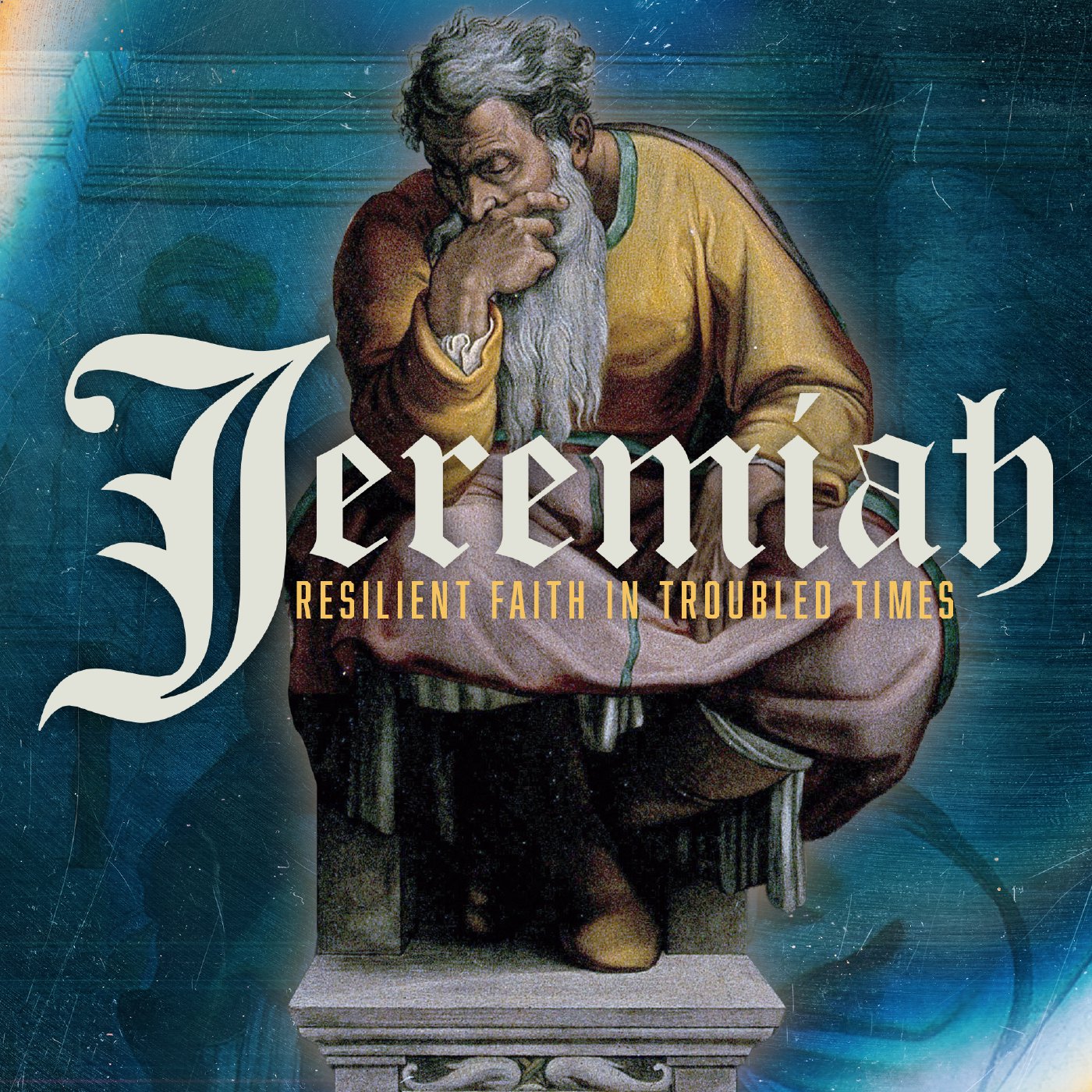
About this episode
Speaker: Dan Lyle
Get every episode summarized
Each time Crossway Milford Sermon Podcast publishes, we email you a written briefing from the transcript — the topics, who appeared, and any specific claims, with the ad reads skipped.
Email me new episodesFree for 3 shows. No card needed.
Hosts & guests
Transcript ready
368 searchable segments. Every word is indexed and playable.
Full transcript
Crossway Milford Sermon Podcast — Jeremiah - Jeremiah Buys a Field. Machine-transcribed; use the interactive transcript above to jump the player to any line.
Well, hey everyone, I'm Dave Ripper, lead pastor of Crossway Christian Church here in Southern New Hampshire, where our mission is all about practicing the way of Jesus together as we pursue God, build community, and unleash compassion. Thanks for listening to our Milford campus sermon podcast. I pray that what you hear today will help you experience God more deeply and live more and more like Jesus. Well, good morning. For those of you who do not know me, my name is Dan Lyle, one of the pastors here at Crossway. It's my joy, my honor, my privilege to be with you in this season of this body here in Milford. And so just thank you for allowing me to share with you and to be with you at this time. I'm going to pull a little bit of a Luke Winderack here for just a moment. I have a sermon planned and we're going to get to that yet as we were singing together
this morning, the Lord brought a passage to mind that I just want to quickly share with you. As a worship leader, this is probably one of my favorite Psalms, and Psalm 100. This is shout joyfully to the Lord all the earth. Serve the Lord with gladness. Come before him with joyful singing. Know that the Lord Himself is God. It is He who has made us and not we ourselves. We are His people and the sheep of His pasture. We are His people and the sheep of His pasture. He is our shepherd and we are in His care.
Amen. I remember being a little boy, I grew up in Baptist church and I spent my whole life in the Baptist church until I came here, but as a little boy growing up in a large traditional Baptist church, one of the things I remember the most was the sound of the room during Sunday morning worship. I remember it because you had a big organ on one side, two pianos on the other side trying to keep up with that big old organ, and I remember there's times where I would just stand there silently and listen to the congregation sing. I think that formed me as even as a little boy in ways that I don't even understand of this day. Just as we sang that last song, I sat in the back row. My head bowed just silently listening to the sheep of His pasture singing out to Him. That's a wonderful thing. So again, I'm honored to be here with you this morning.
So this morning we're going to talk about something that John invoked during our time of communion. This morning we're going to be talking about hope. But hope is easy to talk about when life is going the way that we expected it to go. When things are stable, when the future looks reasonably predictable, it's easy to talk about hope in those moments, but here's the thing. We don't really need much hope when things are good. We don't really need much hope when things are good. As Paul reminds us, hope that is seen is not what. Hope. Hope that is seen is not hope. He gives us this question, he says, for who hopes what he already sees?
Who hopes for what he already sees? G.K. Chesterson put it this way, he said, as long as matters are really hopeful, hope is mere flattery or platitude. It is only when everything is hope less, that hope begins to be a strength at all. Like all Christian virtues, it is as unreasonable as it is indispensable. When circumstances stretch out longer than we thought they would, when things we trust it begin to shake, when we look around in the path forward, when it feels completely uncertain, those are the moments when hope stops being a nice idea and it becomes something that we desperately, desperately need.
There's an irony to this, that when hope is what we need most, it's actually the hardest thing for us to hold on to. The world we live in right now, it gives us plenty of reason to feel unsettled, right? Every week seems to bring another headline, another crisis, another reminder that things are not as secure as we wish they were and if we're honest with ourselves, this is not just some sort of existential thing, sometimes this is much closer to home. This shows up in the quiet places of our lives, in the burdens that we carry for our families, in the disappointments that we didn't expect in the prayers that seemed to just kind of lingered unanswered.
Hope becomes most necessary precisely when circumstances feel most uncertain, and that's why Paul concludes his thoughts on hope by saying, if we hope for what we do not see with perseverance, we wait eagerly for it. We wait eagerly for that thing that we hope for. See biblical hope is not the same thing as optimism. It's not pretending that things are better than they actually are. It's not wishful thinking about the future. It's none of those things. Biblical hope is so much deeper than that. Hope is the settled confidence that God is still at work.
He is still at work, He is sovereign, in His providence He is ruling over us. Even when we cannot yet see what He is doing, He is still at work. And sometimes the way God forms that kind of hope in us, it is through what might look like from the outside, strange or an unreasonable act of faith. Today we're going to look at one of those moments of the life of the Prophet Jeremiah. The city of Jerusalem is surrounded by its enemies. The future of God's people looks pretty bleak. And Jeremiah himself has now been thrown into prison. And in the middle of that moment, God tells Jeremiah to do something that makes absolutely no sense at all.
As Israel is under siege, God tells Jeremiah to buy a field of all things. So we can get a sense of the story. Would you stand with me as we turn to Jeremiah chapter 32 as we read between verses 1 and 15? The word that came to Jeremiah from the Lord in the 10th year of Zedakaya, the King of Judah, which was the 18th year of Nebuchadnezzar. Now at that time, the army of the King of Babylon was besieging Jerusalem. And Jeremiah, the Prophet, was shut up in the court of the guard, which was in the house of the King of Judah, because Zedakaya, King of Judah, had shut him up, saying, why do you prophesy, saying, thus says the Lord, behold, I am about to give this city into the
hands of the King of Babylon, and he will take it. And Zedakaya, King of Judah, will not escape out of the hand of the Caldians, but he will surely be given into the hand of the King of Babylon. And he will speak with him face to face and see him eye to eye. And he will take Zedakaya to Babylon, and he will be there until I visit him to clairs the Lord. If you fight against the Caldians, you will not succeed. And Jeremiah said, the word of the Lord came to me, saying, behold, Hannibal, the son of Shalom, your uncle is coming to you, saying, but for yourself, buy for yourself my field, which is an anionth, for you have the right of redemption to buy it.
Then Hannibal, the uncle's son, came to me in the court of the guard, according to the word of the Lord, and said to me, buy the field that is at anionth, which is in the land of Benjamin, for you have the right of possession and the redemption is yours, buy it for yourself. Then I knew that this was the word of the Lord. I bought the field, which was at anionth, from Hamel, my uncle's son, and I weighed out the silver for him, 17 checkles of silver. I signed and sealed the deed, and called in witnesses, and weighed out the silver on the scales. Then I took the deed of purchase, both of the sealed copy containing the terms in the conditions and the open copy, and I gave the deed of purchase, barrage the son of
Nera, the son of Masha'a, in the sight of Hamel, my uncle's son, and in the sight of the witnesses who signed the deed of purchase, before all the Jews who were sitting in the court of the guard, and I commanded barrage in their presence, saying, thus says the Lord of hosts, the God of Israel, take these deeds in this sealed deed of purchase, and in this open deed, and put them in earthen jars, an earthen jar that they may last a long time. For thus says the Lord of hosts, the God of Israel, houses and fields and vineyards will again be bought in this land. This is the word of the Lord. Maybe see it. So I just want to give you a tip. I went to Bible College, I went to seminary. If you're ever sitting in a small group and you have to read from an Old Testament passage and you don't know how to pronounce the names, it truly does not matter what you actually
say, just say it with confidence, just say it with confidence because no one else actually knows how to pronounce it, so you're going to be good. To understand what's happening in this passage, we need to slow down and look carefully at Jeremiah's situation, right? Because what God asked Jeremiah to do here, it only makes sense when we realize just how bleak things really were. By this point in Judah's history, Babylon had already conquered the city once. The Babylonians had removed the rightful king and installed their own ruler over Judah, a puppet king whose very name reflected Babylon's control. His original name was Madden Nia, but the Babylonians changed it to Zedakaya. Even the king sitting on the throne carried a name given to him by a foreign emperor.
Judah was no longer truly free, but Zedakaya eventually, he rebelled against Babylon and when he did, the Babylonians came back and now the city of Jerusalem is under siege yet again. The Babylonian armies surrounded the city. The fall of Jerusalem is not some distant possibility anymore and is absolutely imminent. The outcome is not really in question here, Jerusalem is about the fall. And Jeremiah isn't watching all of this from some sort of safe distance. He's imprisoned. Zedakaya has had him locked up because Jeremiah has been faithfully delivering a message that the king does not want to hear. The Babylon is going to win and that city is going to fall.
So the prophet who is telling the truth about God and what he has said is now sitting in confinement while the city slowly collapses around him. And in this moment that while Jeremiah is sitting there in that prison that the Lord tells him something very, very specific, he says, your cousin is going to come to you. He's going to offer to sell you a field and when he does, I want you to buy it. I want you to buy it. Think about that for just a moment. The city is about to fall. The people are going into exile. The land itself is about to be overtaken by a foreign army.
And God tells Jeremiah to invest his money in a piece of property just a few miles outside of the city. A field that at this very, very moment Babylonian soldiers may already be marching across. From any normal perspective, this makes absolutely no sense. It makes no sense. It's a terrible investment. Jeremiah himself may never actually see the land that he is purchasing. So the obvious question is this, why would God ask Jeremiah to do something like this? Why would he ask him to do something like this? Moreover, why would Jeremiah actually do it? Why would he obey the Lord? Well, because this wasn't really about buying land.
This wasn't about buying land. This was an act of hope. This was the act of hope in the face of a bleak situation. Jeremiah does exactly what the Lord tells him to do. His cousin shows up just as God said he would. And he offers to sell Jeremiah the field and Jeremiah buys it. But Jeremiah doesn't just casually agree to the deal. The text slows down and walks us through the entire process. He was very intentional. He weighed out the silver. He signed the deal. He sealed the documents. He called witnesses to be present. Everything is done publicly and it's done legally. In other words, Jeremiah makes the purchase official.
This isn't some sort of symbolic or pretend thing. It's a real transaction, real money, real land, real legal documents. Jeremiah does something else that seems a little strange. He tells his scribe to take the deeds, both the sealed copy and the open copy, and to place them in a clay jar. Why? He does this to the last a long time. Jeremiah is essentially creating a kind of ancient document archive. He wants these papers to be preserved. But the question is preserved for whom? Because Jeremiah himself, right? He's probably never going to see this land.
He knows the exiles underway. He knows the people will be gone for decades. So why preserve the deed? The answer comes to us in verse 15, which says, for this is what the Lord of hosts, the God of Israel says, houses and fields and vineyards will again be bought in this land. That's the promise. Jeremiah buys the field because God says this is not the end of the story. This is not the end of the story. Yes, the city will fall. Yes, the people will go into exile. Yes, the land will lie desolate for a time. But one day, one day God will bring his people back. He will bring them home. And when that day comes, fields will be bought again.
Homes will be built again. Vineyards will be planted again. Jeremiah's purchase is a way of saying the destruction that is coming is not the final word. The destruction that's coming is not the final word. God's promises are the final word. Jeremiah knows that he will never walk in that field, but someone will. That kind of hope, it has a shape to it. This is a hope that invests in God's promises. It's a hope that rehearses God's promises. And it's a hope that becomes a hopeful presence in the world, no matter how dark or bleak it may appear to be.
And this is where we begin to see what hope really looks like. See, hope is not pretending the situation is better than it is. Jeremiah is an ignoring reality. So often, I think we do that as believers. We cover over all of our anxieties and all of our hardships with this thin veneer of Christian sentiment. And that is dangerous to us. It is dangerous to not acknowledge reality for what it is. That has nothing more than wishful thinking and a fool's hope. Jeremiah is not naive about the fall of Jerusalem and the chaos that surrounds him.
Hope in the Bible is never about the nine reality. It's about choosing which reality will ultimately define our perspective. Our wishful thinking or God's promised future. See, the king of Judah, he had plenty of wishful thinking. But it was of no value to him. He might have been sitting in the throne, but he was really locked in the prison of his own strength. And Jeremiah, while he sat in prison, was enthroned in the grace and the mercy and the hope of God. Jeremiah believes that what God has promised is more decisive than what he currently sees.
And so he acts accordingly and he buys the field. Eugene Peterson puts it this way. He says, hope is buying into what we believe. Hope is buying into what we believe. Jeremiah, he's spoken many words to God's chosen people. And now he is putting his money where his mouth is. He's literally buying into the future. God has promised. From the outside, it looks absolutely foolish. It looks impractical. It looks like a terrible investment for sure. But Jeremiah is not investing in this present moment. He is investing in God's future restoration. Hope, in other words, is investing your life in God's promise.
It's choosing to live today in light of what God says will be true tomorrow. And sometimes that kind of hope, it looks strange. Sometimes it looks unreasonable. Sometimes it looks foolish. But is that kind of hope that sustains the people of God through seasons when the future feels uncertain? When nothing makes sense. If hope means investing our lives in God's promises, one of the ways we sustain hope is by returning to it again and again and again, rehearsing God's promises over and over and over. Because when circumstances become overwhelming, our instinct is to interpret reality only through what we can see.
Only through what we can see. People of God have always learned to interpret their circumstances through the promises of God. Jeremiah knew what God had said. He knew the exile was coming. But he also knew that God had promised restoration. And that promise shaped how he lived in the present. Remember last week we said that our faith was eschatological. And then that's just a fancy theological term that means that all of our hope is rooted in the future fulfillment of all of God's promises. All of our present hope is rooted in the future fulfillment of all of God's promises.
For us those promises are even clearer than they were for Jeremiah, right? Even clearer. Because we get to see and to look upon part of the fulfillment that he could only look forward to and hope, right? We know what God has done through Jesus. We just celebrated that around the Lord's table. We know that sin has been defeated. We know that death is not the final word. The New Testament keeps pointing us towards that future. Paul writes in Romans 5, 3 through 4, that suffering produces what? Perseverance. And perseverance produces what? Character. And character produces what? Hope. Suffering produces perseverance. Perseverance character. And character, hope.
And later in 2 Corinthians, Paul reminds us that this momentary light affliction doesn't feel like when we're going through it, does it? It feels like anything but it feels so heavy. But this light and momentary affliction is producing for us what? An eternal weight of glory. An eternal weight of glory that is beyond all comparison. Hope grows as we rehearse those promises. As we remember, what God has done through Christ. And as we remind ourselves of what God has said, what He has said, He will do it.
Just as Israel's fall was inevitable, God's hope is inevitable. And the future that we place, the trust that we place in the future that He promises, it is inevitable. More of our hope is not meant to stay locked away inside of our hearts. It's not something we're just supposed to keep to ourselves. It's why we gather together in person. One of my worship leading heroes is a guy named Bob Caughlin. And there's an old phrase that was coined back in the 90s by a guy named Steve Camp. And it was, worship is for an audience one.
Everyone ever hear that phrase. worship is for an audience one. I appreciate the sentiment. I just don't think that's biblically accurate. We have tons of evidence throughout the Psalms of corporate worship. But Paul two separate times, once in Ephesians, once Colossians says that we gather together to sing to who? To each other. We sing Psalms, hymns, and spiritual songs to each other. And one of my heroes is Guy Bob Caughlin. I like the way he puts it better. He says worship is for God and it's ends and that it's for his glory, but it's for us and it's means. There's something special that happens when we gather together and we rehearse the hope of God together. As I sat in that black row silently this morning with my head bowed hearing you guys singing.
I was reminded of the hope of the Lord and I was encouraged and my faith was strengthened. There's something that's special that happens when we step outside of ourselves. When we do not lock our hope up inside of our hearts, it becomes visible in a way that we live among others and it becomes a hopeful presence. We see this in the life of Jeremiah, right? The city is under siege. Fear would have been everywhere. The future was uncertain and then Jeremiah, he buys a field. People would have noticed this. They would have asked why would anyone do that? Why would anyone do that? His action became a quiet but powerful witness.
It was a way of saying God is not finished with his people. God is not finished with his people. In a world that often feels anxious and uncertain, the church is called to live that same way. To invest where investment seems unlikely to bring a return. We're called to live with the same sort of hope, not with the naive optimism, not by denying reality. But with a steady confidence that God is still at work. Sometimes the most powerful witness we offer is simply living with hope when others are losing theirs. It is not all about us.
It is not all about me. Living with hope when others are losing theirs is an incredible gift that the Lord bestows upon us for the sake of someone else. So this is a hope that invests a hope that rehearses and a hope that is lived out in community. All this kind of begs the question. All begs the question, what field is the Lord calling you to buy this morning? How might he be calling you to invest your life?
One of my favorite theologians. He puts it this way. He says the most powerful work of God. The gathering of people out of Satan's clutches into Christ's kingdom comes not through warfare or politics, not through the influence of money or fame, but through the folly of what we preach. The folly that was preached to Jeremiah was by a field that is under siege, that is being trampled across by enemy commands, overrun by the field in hope because I am giving you a promise. What field is the Lord calling you to buy this morning?
What folly is he calling you to buy into this morning? What fools hope is he calling you to take up this morning? His promises are sure. They are inevitable. And we can plant our hope firmly on them this morning. Amen? Jesus, you are the greatest fulfilled promise ever. And you are the promise that keeps on giving. You were the promised Messiah who came to rescue and to save the lost.
And you were the promised Messiah who will come again, who will declare his reign over all of the created order, who will make all things right, who will separate the sheep from the goats. And who will wipe away the tear of every one of his precious sheep's eyes? And so, Lord, we rest in that hope this morning and we will live in the reality of it this morning. And we pray for strength, we pray for confidence to take up that hope. To take up that hope and to follow after you all of our days. Bless us with that confidence this morning and the reality that you will fulfill your promises.
We entrust our lives and we entrust our church to you this morning to you. Amen. Thank you so much for listening to the Crossway Christian Church Sermon Podcast. We're so glad you could join us and if you'd like to plug into the life of our community or have any questions that we might be able to answer, visit our website crosswaycc.org to connect with us. Until the next time, we can be with you. May the Lord bless you and keep you.
More episodes
More from Crossway Milford Sermon Podcast

Filled with the Spirit - An Unexpected Friend
Crossway Milford Sermon Podcast
Filled with the Spirit - The Spirit as Teacher
Crossway Milford Sermon Podcast
Filled with the Spirit - A New Heart and New Spirit
Crossway Milford Sermon Podcast
Filled with the Spirit - Alive & Living
Crossway Milford Sermon Podcast