Loading...
About this Episode
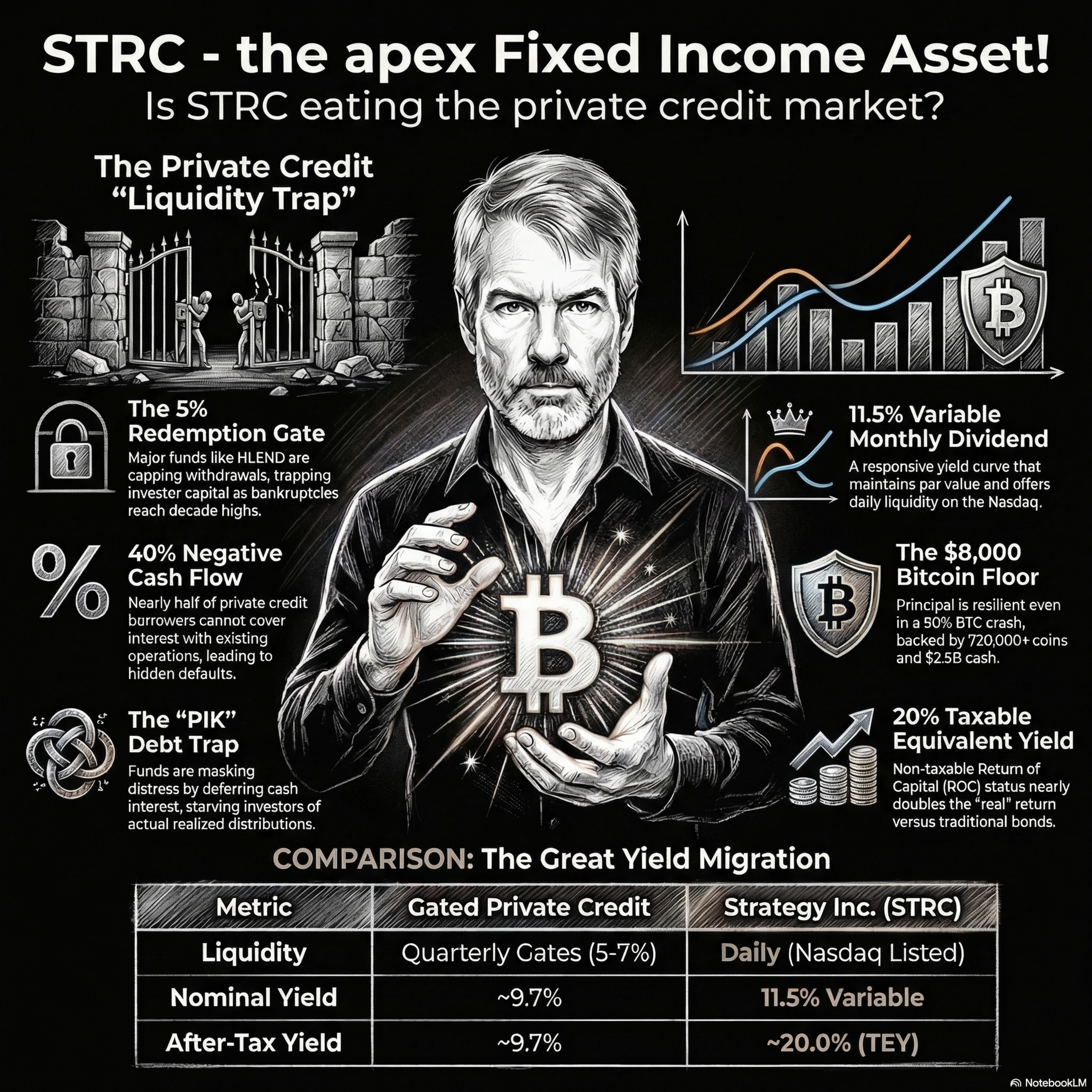
#OpenCreditThe migration of capital toward transparent, liquid, and daily-traded high-yield credit options represents a fundamental market shift. This democratization of credit directly contrasts with the opaque, "clubby," and restricted nature of traditional private equity and private credit funds.
#STRCStrategy Inc.'s Variable Rate Series A Perpetual Stretch Preferred Stock has rapidly become a premier fixed-income vehicle. By offering a variable monthly dividend—currently at 11.5%—the board can respond to market volatility in real-time and anchor the stock's trading price near its $100 par value.
#LiquidityTrapInvestors in "evergreen" or "semi-liquid" private credit funds are increasingly facing the risk of gated redemptions during market stress. When massive funds like those managed by BlackRock and Blackstone cap repurchases at 5% to 7%, it exposes the illusion of liquidity and leaves investors unable to access their principal.
#BitcoinFloorThis represents the "mathematical moat" and theoretical principal protection backing STRC. Strategy Inc.'s massive treasury of over 720,000 Bitcoins ensures that the cryptocurrency's value would have to plummet below $8,000 before the preferred stock's principal is even theoretically impaired, offering "sovereign-grade" asset coverage.
#TaxAlphaSTRC offers a compelling tax advantage because its dividends are expected to be treated as a non-taxable Return of Capital (ROC). Instead of immediate taxation as ordinary income, this structure defers taxes by reducing the investor's tax basis, elevating the taxable-equivalent yield to nearly 20% for high-net-worth individuals.
This research analyzes a major shift in the financial landscape where traditional private credit is faltering due to rising corporate bankruptcies, liquidity traps, and restrictive withdrawal "gates" imposed by major funds. In response to these systemic stresses, the text introduces Strategy Inc.’s STRC preferred stock as a superior, high-yield alternative that leverages a massive Bitcoin treasury to provide a robust security floor for investors. The author emphasizes that STRC offers superior daily liquidity on the Nasdaq and a monthly variable dividend of 11.5%, which effectively translates to a 20% taxable-equivalent yield due to its unique "Return of Capital" tax structure. Ultimately, the document serves as a strategic argument for "Open Credit," suggesting that transparent, digital-linked securities are replacing the opaque and illiquid lending models of the past.mosaicFountain
Hosts & Guests
Transcript
Is STRC eating the private equity market?
That's the multi-trillion dollar question right now.
And I mean, if we look closely at the data
crossing our desks, it really suggests
the appetizer course has already been cleared.
The main course is currently being carved up.
Welcome to the deep dive.
I'm Satoshi.
And I'm Satoshi.
Welcome in everyone.
We are so glad you were joining us for this one.
Today we're bringing you into a massive,
frankly historic structural transformation
that is unfolding right now in early 2026.
It's massive.
It really is.
We have a towering stack of research on the table today.
And our mission is to examine a fascinating
and somewhat terrifying divergence
happening in the $1.8 trillion credit market.
On one side of the ledger,
you have traditional private lending, the old guard.
And they are showing some profound structural cracks.
But on the other side, you have this radical new
digital asset-linked preferred security
that is surging in a way that is just completely upending
the traditional financial rulebook.
It is a remarkable divergence to witness.
And it's crucial to understand that this isn't
just some niche financial trend.
This isn't a flash in the pan or a temporary market anomaly.
We are talking about a fundamental shift
in how capital is protected, how yield is generated,
and ultimately, how money is deployed
at the highest levels of global finance.
Yeah.
When you have institutions completely
rethinking their allocation strategies
from the ground up, a tectonic plate has shifted.
I am genuinely fascinated by this,
because we are watching something as traditional,
as fundamentally unglamorous, as a corporate bond
being totally reinvented.
Before we get into the weeds,
just a quick reminder for you listening.
We are going on a collaborative journey today.
We're going to uncover exactly why
this smartest, most sophisticated money in the world
is moving so incredibly fast right now.
And to really grasp the magnitude of this shift,
we have to start by looking at the reckoning,
the great credit pivot of 2025 and 2026,
because the sheer scale of the private debt market right now
is staggering, but I mean, it didn't get there overnight.
Staggering is definitely the right word.
To appreciate the vulnerability here,
trace that trajectory for us.
So back in 2020, the private credit market
was sitting at roughly $500 billion,
which is a substantial amount of capital,
but in the grand scheme of global finance,
it was manageable.
It functioned mostly as it was intended, right?
Providing bespoke, flexible capital
to middle market companies that might have been too small
or too complex for a traditional bank syndication.
But then the environment changed.
Exactly.
We saw an era of near zero interest rates,
combined with a massive pullback
from traditional banks following increased regulatory scrutiny.
Investors were starved for yield.
They poured capital into private credit with reckless abandon.
By early 2025, that $500 billion market
had bloated to 1.3 trillion.
And sitting here today in early 2026,
we are staring at a $1.8 trillion behemoth.
A $1.8 trillion balloon just waiting for a pin.
And here's the reality check from the research.
This is where the red flashing lights start going off.
We're seeing terrifying bankruptcy statistics right now
across the very companies that owe this 1.8 trillion.
It's grim.
Business bankruptcies have crossed 16,800.
That is the highest pace we have seen
since the immediate aftermath of the 2008 financial crisis.
Businesses are fundamentally struggling
under the weight of the high interest burdens
they took on during that whole expansion phase.
They absolutely are.
And what makes that $1.8 trillion figure so highly concerning
is what is happening underneath the surface
of those headline numbers.
It didn't decay.
Right.
When you look at the default rates officially reported
by the massive fund managers
who oversee these private credit portfolios,
they actually look relatively tame.
They project this aura of control.
But fund managers often engage in what we call selective defaults
or they execute these friendly,
consensual, out-of-court maneuvers.
Like dead-for-equity swaps.
Yes, specifically to keep the loans
from officially looking like a total failure on the books.
Because if they officially declare a default,
they have to write down the value of the asset.
Which hurts their funds performance metrics
and terrifies their investors.
So they restructure it quietly.
It feels a bit like painting over rust on a used car.
Looks fine on the lot,
but the structural integrity is compromised.
That is exactly the dynamic.
But when you strip away that fresh coat of paint,
when you look at the adjusted true default rate
provided in the research,
which actually accounts for those quiet restructurings,
it is currently creeping toward 5%.
Which is a huge jump.
Just a couple of years ago, in 2021 and 2022,
that number was sitting comfortably around 2%.
So the real underlying distress in the system
has more than doubled,
even if the glossy quarterly reports
mailed to investors don't explicitly show it.
And digging into the research,
we find the exact mechanism
that allows them to paint over that rust.
It brings us to the P-Pite debt trap.
P-I-K, payment and kind.
The problem, really the absolute root of this entire issue,
is that 40% of private credit borrowers right now
have negative free cash flow.
It's an unbelievable metric.
40%.
That is up from 25% just four years ago.
That means four out of every 10 of the companies
borrowing this money are bleeding cash
from their daily operations.
So the obvious question you have to ask is,
how did they pay the interest on their massive private
credit loans if they literally have zero cash?
They use payment in kind.
To visualize how this operates in the real world,
imagine you lend a significant amount of money to a friend
so they can get a new business off the ground.
You both agree that every month,
your friend is going to pay you a set amount
of interest in cash.
Makes sense, standard loan.
Right.
But a few months go by, the economy shifts,
and your friend's business isn't generating revenue.
So when the monthly interest payment is due,
instead of handing you cold, hard cash,
your friend hands you a sticky note.
And the sticky note simply says,
I owe you this interest, just add it to the total amount
of my loan, I'll pay you the interest on the interest later.
Wow.
That sticky note is essentially what PIK is.
And in the real world, if you are the one holding the sticky note,
you know exactly how that usually plays out.
Eventually you have a mountain of paper promises,
zero actual cash in your pocket to pay your own bills,
and your friend is completely hopelessly broke.
Precisely.
It creates a horrific compounding feedback loop.
The borrower defers the immediate pain of a cash payment
by increasing their total long-term debt load.
On paper for the fund manager, this looks fantastic.
They get to turn to their investors and say,
look, the loan is still performing.
Our internal rate of return, our IRR, is completely intact.
But it's an illusion.
Exactly.
Because in reality, they are starving
the fund of actual liquid cash distributions.
The research points out that public business development companies
or BDCs, which are essentially the investment vehicles
that everyday retail investors use
to access these private loans, are now getting 8%
of their total investment income via these PIK sticky notes.
8%.
That is up from less than 4% historically.
The interest coverage across the board is quietly failing.
It's all paper wealth.
Yeah.
And this has led to a massive realization
sweeping through the institutional investing space right now.
The new mantra, according to the data,
is that DPI is the new IRR, meaning distributed
to paid-in capital, which is the industry term for cold hard cash
that is actually returned to the investor's bank account,
is suddenly vastly more important than the internal rate of return.
And we really need to pause on why that shift from IRR to DPI
is such a structural earthquake in private equity and private credit.
Yeah, break that down for us.
For a decade, IRR has been heavily weaponized by fund managers.
Because private markets are illiquid,
managers have significantly way
in how they value the assets and their portfolio.
They can use subjective internal valuations
to artificially inflate their IRR.
They can manage the timing of capital calls and distributions
to make the percentage return look spectacular on a spreadsheet.
But you can't fake DPI.
Exactly.
You cannot fake a cash deposit.
An IRR that relies on a borrower who is fundamentally
insolvent and paying in sticky notes does not by groceries,
and certainly does not pay out the obligations
of a massive state pension fund.
Institutional investors are waking up to this.
They're demanding actual cash returns.
And the private credit market is struggling to provide it
because their underlying borrowers are suffocating.
So we have to ask, what is pushing these underlying businesses over the edge?
Why are 40% of them suddenly cash flowed negative?
Right.
The research points to two massive overarching macro catalysts
driving this distress.
Artificial intelligence disruption and shifting global trade policies.
We really need to spend some time here
because this is what is actually breaking the $1.8 trillion market.
These are the exogenous shocks that are accelerating the bankruptcies
at a terrifying rate.
Let's look at the AI disruption first.
Over the last two years, we have seen an explosion in applied AI,
particularly in predictive logistics, supply chain management,
and hyper-targeted consumer marketing.
Companies that aggressively integrated these AI models
have drastically reduced their overhead
and optimized their inventory turnover.
Right.
And the companies that didn't are suddenly dinosaurs.
Let's ground this for you listening.
Imagine a hypothetical mid-market company.
Let's call them Acme Home Goods.
They're a regional furniture distributor.
Back in 2021, money was cheap.
They took out a massive private credit loan
to expand their warehouses.
But they didn't invest in AI predictive logistics.
Exactly.
So today, in 2026, they are still ordering inventory
based on outdated manual forecasting models.
Meanwhile, their AI-enabled competitors
know exactly what the consumer wants
before the consumer even knows it.
Acme ends up with warehouses full of the wrong furniture,
which they have to heavily discount to sell.
Their profit margins absolutely collapse.
And that margin collapse from technological obsolescence
is devastating on its own.
But then you compound it with the second macro shock,
the shifting trade environment.
The research explicitly highlights the liberation day
tariff announcements that were implemented back in April of 2025.
And we want to be perfectly clear here.
We are just impartially reporting the data from the research.
We aren't taking any political stance on the tariffs themselves,
whether they were a good policy, a bad policy, or indifferent.
Of course.
But objectively, as a financial catalyst,
those April 2025 tariffs created a massive immediate shock
to industrial and retail supply chains.
As a macroeconomic event, the disruption was profound.
Going back to your hypothetical Acme home goods.
Not only are they struggling to sell their inventory
because they lack AI integration,
but suddenly at the cost of importing the raw materials
and parts they need to build that furniture
spikes by 20% overnight due to the new tariff.
And they can't pass that on.
Exactly.
They cannot pass those massive price increases
onto a consumer base that is already
field of inflationary pressure.
So they eat the cost.
Their margins go from compressed to non-existent.
Acme home goods goes from being a highly profitable enterprise
in 2021 to burning cash every single month in 2026.
They become part of that 40% statistic.
And because they are burning cash,
they have to call their private credit lender
and ask to pay their monthly interest in PIK sticky notes.
That is the exact anatomy of the current crisis.
You have these severe supply chain shocks
compounding with AI logistics failures.
It is creating highly distressed,
raggedly deteriorating situations
for thousands of middle market companies.
And here is the fatal structural flaw
in the private debt market.
Traditional, clubby lending structures
are entirely inflexible.
Right.
We're designed for a stable macroeconomic environment.
When a business like Acme needs to pivot
its entire operational model to survive
a technological and regulatory shift,
a rigid, private credit loan weighing them down
with compounding PIK interest is an anchor
dragging them under.
Not a life preserver keeping them afloat.
So the underlying loans are rotting.
The businesses are struggling.
The obvious question any rational listener is going to ask
is if the system is breaking, why don't the investors
just take their money out?
Why not just sell their position in the private credit fund
and move to cash or safer assets?
That is the logical next step.
Right.
Well, that brings us to the liquidity illusion.
I like to call this the hotel California of finance.
We're talking about these massive evergreen
or semi-liquid private credit funds
that have been aggressively marketed
to both retail and institutional investors
over the last five years.
They market themselves as offering you peace of mind.
But the reality is like a roach motel
or the hotel California.
You can check your money in any time you like,
but you can never leave.
It is the redemption trap
and it is perhaps the most frightening aspect
of this entire market structure for an investor.
When corporate credit quality deteriorates as rapidly
as we just discussed,
the natural, rational reaction for investor
is to rebalance their portfolios.
Yeah, if you get out of harm's way.
They see the bankruptcies rising,
they see the macro shocks,
and they want to pull their capital out
and move it to a safe haven.
But the liquidity that was implicitly promised
by these massive funds is,
as the research clearly demonstrates,
entirely illusory.
Let's dive into the first case study
from the research to show exactly how this plays out.
We are looking at BlackRock's H-L-E-N-Fund, H-L-E-N-D.
Yes, the HPS Corporate Lending Fund.
This is not a fringe player.
This is a $26 billion behemoth
managed by one of the most powerful financial institutions
on Earth.
It is one of the most prominent non-traded BDCs available.
In March of 2026, retail anxiety spiked.
Naturally.
Shareholders looked at the macro environment,
they saw the 16,800 bankruptcies we talked about,
and they hit the sell button.
They requested redemptions for 9.3%
of the funds outstanding shares.
Which objectively doesn't sound completely insane.
Almost 10% of people wanting their money back
during a stressful economic time
seems like a normal market function.
You would think so.
But here is the trap door that caught everyone off guard.
BlackRock legally capped repurchases
at just 5% of the funds value.
I want you to imagine the sheer visceral panic
you would feel in that situation.
You log into your brokerage account,
you ask for your life savings back
because you are terrified about the direction of the economy.
And the institution looks at you and says,
sorry, you can only have half of your money right now.
The rest is locked up indefinitely.
And it is vital to point out
that what BlackRock did was entirely legal
and totally consistent with the fund's perspective.
It was in the fine print.
Right, but who reads the fine print
on a $26 billion fund expecting to be locked out?
Well, that's exactly the problem.
The mismatch between the retail investors expectation
of standard market liquidity
and the deeply inherently illiquid nature
of the private loans the fund actually holds.
BlackRock cannot just hop onto an exchange
and sell a highly customized distressed corporate loan
to Acme Home Goods in a Tuesday afternoon trading session
to generate the cash to pay back the retail and thus.
They just can't do it.
They can't.
The realization that principle is locked away
behind a gate during a period of market stress
completely shatters the peace of mind
narrative that these semi-liquid vehicles
used to attract capital in the first place.
And the contagion wasn't isolated to just BlackRock.
Case study two from the research focuses
on Blackstone's BCRED fund, BCRED.
And the numbers here are even more staggering.
We are talking about an $82 billion flagship
private credit fund.
The crown jewel of their credit operation.
The escalation at Blackstone was severe
and the internal response was highly telling.
In early 2026, redemption requests hit 7.9%
of the fund's total value.
Now, their standard legally defined quarterly limit
for withdrawals was 5%.
So they hit the wall.
They smashed into it because the request
so vastly exceeded the limit,
they were looking at a total freeze of investor capital,
an absolute public relations nightmare,
and the potential for a catastrophic run
on the fund that could spill over into their other vehicle.
So what did they do to stop the bleeding?
This detail and the research is just striking to me.
Blackstone had to raise the redemption cap to 7%.
And to actually generate the liquidity
to honor those withdrawals, they engineered
a highly unusual $400 million capital injection,
coming directly from their own senior leaders
and internal employees.
They literally had to pass the hat internally
among their own executives,
just to satisfy a retail withdrawal request
and prevent a total systemic meltdown of confidence.
And even with all those unprecedented aerobics,
the net outflow was still $1.7 billion for the court.
When the executives of a fund have to personally
inject nearly half a billion dollars
to provide exit liquidity for retail investors,
it is a massive blaring signal
of shifting investor sentiment.
It demonstrates unequivocally
that when corporate bankruptcies loom large on the horizon,
these redemption limits, these gates
suddenly transform from a boring footnote
in a prospectus into the primary risk factor
for the entire asset class.
And it feeds perfectly into what the research
calls valuation paranoia.
If I know the gates are going to slam shut
the moment things get tough,
it fundamentally changes my psychology as an investor.
Because these funds use totally opaque internal valuations.
They essentially grade their own homework
when it comes to pricing the loans in their portfolio.
Yes, the mark to model approach.
Exactly.
Investors are terrified.
They are deeply scared that they are pulling their money out
based on fake inflated prices of distressed loans.
If the fund manager insists that a loan
is worth $0.00 on the dollar,
but the investor suspects it's really just a struggling
borrower paying their interest with PIK sticky notes,
the investor wants to get out immediately
before the fund is inevitably forced to admit
the loan is only worth $0.60.
Precisely.
The opacity of the private credit market
breeds panic.
In a public market, you have price discovery.
You know exactly what an asset is worth at any given second.
In private credit, if you cannot see the true market value
of the underlying assets,
and you know the exit door is incredibly narrow
and tightly controlled by the manager,
the only rational move is to rush for the door
as early as possible.
First one out wins.
The first one out gets par value.
The last one out gets a locked account
and a portfolio of sticky notes.
It is a stampede in the dark.
Everyone is running for an exit they can't clearly see.
Speaking of looking for transparency and better models,
real quick before we jump into the deep end.
If you are getting value out of this show,
we request you to check us out on fountain.fm.
It's a value for value player
where you actually get paid for listening
without advertisements blocking your experience.
It's a great platform.
It really is.
And of course you can listen to us on Spotify,
Apple podcasts, or YouTube music for free,
or wherever you get your audio fix.
As for videos, we still need to hit our goal
of 1,000 subs on YouTube
to start using the Mosaic AI video editor.
Mosaic is truly a game changer
for small creatives like us, it really is.
We can feed it a YouTube link
and it creates beautiful AI, cinematic captions,
infographics, and a whole lot more
we're still discovering in our capability test.
We can't be more thankful that you all
are as fascinated by these deep dives as we are.
The key to this vote of confidence
is the research we share on our website.
Exactly, no login needed, no cookies,
no trackers, and absolutely no advertisements.
So please, if you want to dig deeper into the numbers,
check the link in the descriptions
because today is a big one, huge.
Coming out of the murky gated
Roach Motel world of traditional private credit,
we're pivoting entirely to what the research categorizes
as absolute openness.
If private credit is a locked door in a dark room,
this next entity is a glass house at high noon.
Enter strategy ink.
This is where the paradigm of global finance
entirely shifts.
Strategy ink operates from a position of profound,
almost unprecedented structural strength.
To understand the leverage they wield in the market today,
you just have to look at their balance sheet
as of March 2026.
It's massive.
They have positioned themselves
as the world's largest Bitcoin Treasury company.
They are currently holding roughly 720,737
bitcoins on their balance sheet.
I really need to repeat that number.
So it syncs in for you listening.
720,737 bitcoins.
The aggregate cost to acquire that digital treasury
was 54.77 billion dollars.
They aren't just a participant in the market.
They are a behemoth.
And leveraging the sheer weight
of that massive digital treasury,
they engineered a completely new financial instrument.
Traditionally, companies like this
would just issue more common stock to raise capital,
but they pivoted.
They designed a highly sophisticated preferred capital
structure that was tailored specifically, almost surgically,
to attract the fixed income investors
who are currently fleeing the chaos and opacity
of the private credit markets we just discussed.
And this instrument is the focal point of the research today.
It is called STRC.
The full technical name is the variable rate series,
a perpetual stretch preferred stock.
It's a mouthful.
It is, but the scale of this issuance
is what really commands attention.
It IPO'd in July of 2025, and the market response
was overwhelming, less than a year old,
and the research shows that in 2025 alone,
SKRC accounted for 33% of the entire US preferred market issuance.
One single security captured a third of the market,
raising $7 billion.
It was an immediate resounding validation
of the concept by institutional capital,
but to understand why it captured 33% of the market,
we have to look at the mechanics,
because that is where the stark contrast
to the gated world of private credit really shines.
STRC trades publicly on the NASDAQ.
That means it offers daily liquidity.
If you aren't investor, and you decide
you want your capital back on a Tuesday at 11.0 AM,
you click sell in your brokerage account,
and the trade executes at market price.
There are no 5% quarterly redemption gates.
There is no waiting for executives to pass the hat
to find your money.
It has a stated $100 par value,
and it offers transparent real-time market pricing
every second of the trading day.
And this brings us to what might be
the most fascinating feature of the entire security.
The 11.5% yield thermostat.
Currently, as of March, 2026,
the annual dividend rate on STRC
is sitting at 11.5% payable monthly in actual cash.
And the research notes,
they have actively raised this rate
for seven consecutive months.
Yes.
But when most people hear crypto-linked asset,
they immediately think of massive stomach-churning volatility.
How exactly does strategy ink neutralize that volatility
to attract conservative fixed income investors?
It is a brilliant piece of financial engineering.
The best way to conceptualize this
is to think of the board of directors at strategy ink,
acting exactly like a person standing
in a hallway adjusting a thermostat.
Their primary goal is to keep the room temperature,
which represents the trading price of the STRC stock,
at a very comfortable 100 degrees,
or in this case, right at its $100 par value.
OK, I'm tracking with the analogy,
so what happens when the market conditions change?
Let's say the broader market gets nervous.
Maybe there's a macroeconomic shock,
and investors start selling off equities, including STRC.
The price of STRC might drop from $100 down to, say, 95.
In our analogy, the room is getting too cold.
So the board of directors walks over to the thermostat
and turns up the heat.
They announce they are raising the dividend yield
from, say, 11.25% to 11.50%.
Well, I see.
Suddenly, yield hungry investors in the market
look at that new higher yield.
Realize it is an incredible relative value
compared to other assets.
And they rush in to buy the STRC stock.
That massive influx of buying pressure
naturally brings the share price right back up
to that comfortable $100 par value.
And I imagine it works in reverse as well.
If the market is euphoric, and the price of STRC gets too hot,
say it trades up to 105, they can dial the yield back a bit
to cool it down, saving the company money
while maintaining that $100 equilibrium.
Exactly.
By adjusting this yield dynamically every month,
they effectively strip away the notorious volatility
the underlying crypto assets.
It creates what the research categorizes
as a highly responsive digital yield curve.
It is real-time adaptation to market forces.
Compare that to traditional business development companies,
which are stuck paying fixed rates
or waiting for rigid quarterly distribution schedules
while they're underlying loan suddenly decay.
The flexibility is their ultimate weapon.
So as an investor, you are getting an 11.5% yield,
which absolutely crushes the 8% to 8.5%,
you might hopefully squeeze out of a senior secured
private credit loan right now.
And you are getting it with daily public market liquidity.
But I have to push back here.
Yield and liquidity mean absolutely nothing
if the principle isn't safe.
If the underlying asset collapses,
the yield is just a consolation prize on the way down.
That's entirely true.
Which leads us to the core argument of the research.
The three pillars of STRC supremacy.
Pillar number one is what the research calls
the mathematical mode or principal protection.
Now, I have to be completely honest.
If someone on the street tells me that a crypto-linked asset
is structurally safer than a traditional corporate loan
backed by a real operating company with physical assets,
my first instinct is deep skepticism.
How can that mathematically be true?
It is a highly counterintuitive claim,
but it all comes down to asset coverage
and the structure of the capital stack.
Let's use a real estate analogy to make the map intuitive.
Imagine you own a massive, incredibly beautiful mansion.
The current real estate market values your mansion
at $50 million.
But you only owe $8 million on the mortgage to the bank.
Okay, so I have a massive equity cushion.
I own mostly the house, not the bank.
Un immense amount of equity.
Now, let's introduce a catastrophic scenario.
Let's say the local housing market experiences
an apocalyptic crash.
Property values across the board plummet by 80%.
Your beautiful mansion goes from being worth $50 million
down to just $10 million.
That is a brutal hit for me as the homeowner.
It absolutely hurts you, the equity owner.
But we have to look at it from the perspective of the bank.
The bank is owed $8 million,
and even after an 80% crash,
the house is still worth $10 million.
If you completely default on your payments,
the bank forecloses, sells the house
at the deeply depressed price of $10 million,
takes their $8 million to cover the loan,
and they are totally fine.
Right, because of the buffer.
The bank's principle is entirely protected
even in an 80% market crash,
simply because of the massive initial over collateralization.
Wow, okay, so how does that real estate logic translate
to the capital stack of strategy ink
and the safety of STRC?
Strategy ink is essentially that $50 million mansion.
If we look at their capital stack,
which is just the hierarchy of who gets paid first,
they have approximately $8.25 billion in senior debt,
and $8.47 billion in preferred stock notional value,
which includes STRC.
So roughly $16.7 billion in total obligations
that need to be paid out.
Yes, against that $16.7 billion,
they hold their massive treasury of 720,737 Bitcoin.
And here is the solvency calculation in the research
that really puts it into perspective.
For the company to even theoretically struggle
to pay back the principal value of the preferred stock,
for them to actually default on STRC,
Bitcoin would have to crash to an astonishing $8,000 per coin.
Yes, that is the $8,000 floor.
If Bitcoin dropped all the way to $8,000,
their 720,737 coins would still be worth about $5.76 billion.
But you also have to factor in their cash reserve,
which is currently sitting between $2.25 billion
and $2.5 billion in US dollars,
combine the depressed Bitcoin value with the cash,
and you have roughly $8 billion to $8.25 billion
and highly liquid assets that perfectly covers the senior debt.
But wait, I have to challenge this premise.
Markets are rarely strictly rational.
Let's say Bitcoin drops 70% to $30,000.
The math says STRC is still wildly over collateralized,
but wouldn't a 70% drop in Bitcoin
trigger a massive psychological panic sell-off
of STRC anyway?
Wouldn't the price plummet regardless of the $8,000 floor?
It is an excellent point,
and it highlights the difference
between price volatility and structural solvency.
Yes, in a massive crypto drawdown,
a market price of STRC might temporarily experience volatility
as retail investors panic sell.
The share price might drop from $100 down to $85.
However, the company is not obligated
to redeem your shares at market price.
They are solvent.
They can continue to pay the 11.5% dividend
entirely uninterrupted.
Furthermore, the board would simply use
the thermostat mechanism we discussed,
raising the yield to 13% or 14%
to attract institutional arbitrageers
who recognized the math still works.
And they would aggressively buy the dip.
Exactly, which would force the price back to par.
The mathematical mode protects the capacity to pay,
which ultimately dictates the long-term value
of the preferred equity.
So Bitcoin would have to experience
a catastrophic 90% plus drop from its late 2024 peaks
and stay there before the principle of STRC
is even marginally threatened.
When you compare that level of over collateralization
to traditional private credit,
the contrast is stark.
It's night and day.
Over in the private credit world,
your principles tie to Acme home goods,
a mid-market retailer struggling with tariffs
and failing to adapt to AI logistics,
who is currently 40% cash flow negative
and paying their interest in sticky notes.
Exactly.
When you analyze the structural integrity side by side,
it becomes abundantly clear
where the research categorizes STRC's asset coverage
as sovereign grade.
It is a mathematical mode that traditional cash flow
dependent corporate debt simply cannot replicate.
Which brings us directly to pillar two,
the cash fortress or dividend security,
because look, a company might have a mathematical mode,
they might survive a crash,
but if cash gets tight, they might just decide
to stop paying the dividend to conserve resources.
We see it all the time.
It's called a distribution holiday.
What is structurally stopping strategy ink
from just turning off the 11.5% spigot
if we enter a prolonged crypto-inter?
This is where the foresight of their treasury management
truly shines and it separates them
from traditional operators.
Strategy inks, 2026 annual report revealed
a massive, highly specific US dollar cash pile.
We are talking about $2.25 billion,
rapidly growing toward $2.5 billion,
that is firewalled and earmarked specifically
for one primary purpose, paying dividends
and interest obligations.
So they are relying on selling Bitcoin to pay the yield.
They literally set aside billions of actual
fiat dollars in a bank account,
just to make sure the monthly payments never stop.
Regardless of what the crypto market is doing.
Precisely.
They have preemptively entirely mitigated
the distribution risk.
They do not have to sell a single Bitcoin at any price
to service the yield on STRC.
Even if we enter a brutal multi-year crypto-inter
where the price of Bitcoin is severely depressed,
they can simply draw down on this cash fortress
to honor that 11.5% monthly payment
for years without missing a single beat.
The contrast here is just striking.
Traditional private credit funds rely on the month to month
cash flow of their underlying corporate borrowers
to fund their investor payouts.
And we have already firmly established that 40%
of those borrowers are currently cash flow negative.
It's a house of cards.
The private credit fund is sweating every month,
hoping Acme Home Good sells enough furniture
to make the payment.
Meanwhile, strategy ink relies on a $2.5 billion
amount of cash already sitting safely in a bank account.
It is the fundamental difference between hoping
for a yield based on operational performance
and structurally guaranteeing the capacity to pay it
based on pre-funded reserves.
OK, let's move to pillar three
because this is where the financial engineering really
flexes.
pillar three is the tax magic, return of capital.
And 11.5% yield sounds phenomenal,
but the tax man always cometh.
If I am getting an 11.5% yield from a traditional corporate bond
or a private credit fund, I'm usually
losing almost half of it to taxes immediately
if I am a high net worth investor.
How does STRC legally bypass that enormous tax strike?
It all comes down to a very specific structural tax
treatment under the Internal Revenue Code,
specifically section 301c.
Because of how strategy ink manages its earnings and profits
relative to its distributions,
it expects its preferred dividends to be treated not
as ordinary income, but as a return of capital or ROC.
OK.
Now, the mechanics of section 301c can get highly dense.
So let's visualize this within the analogy.
Please do.
Imagine you go to a premium dealership
and buy a brand new car for $50,000,
but the dealership is running a very aggressive long-term promotion.
Every single month, they mail you a $500 cash rebate check.
Now, when tax season comes around,
does the IRS demand that you pay ordinary income tax
on those $500 rebate checks?
No, of course not, because it's a rebate.
It is essentially just my own money
being returned to me over time, which effectively lowers
the true out-of-pocket price I paid for the car.
Exactly.
The IRS views a return of capital dividend
through the exact same lens.
That 11.5% yield is treated as a rebate.
It steadily lowers your official purchase price,
what we call your tax basis, in the STRC stock.
Because it is viewed as a return of your original principle,
you do not pay any immediate ordinary income tax on it
when it hits your account.
That is massive.
It is.
You only trigger a taxable event if you eventually sell
the STRC stock for more than your new lower tax basis.
And even then, if you have held the stock for more than a year,
it is taxed at the much lower preferential long-term capital
gains rate, not the punishing ordinary income rate.
And taking that a step further into a state planning.
If you hold that STRC stock until you pass away
through the step up and basis rules upon inheritance,
your heirs might potentially avoid those deferred taxes
entirely.
That is incredibly powerful, legally sound tax optimization.
So what does this return of capital treatment
mean for the actual bottom line numbers
an investor cares about?
To measure this, we use a metric called the taxable equivalent
yield, or TEY.
This allows us to compare tax-advanced yields
with fully taxable yields on an apples-to-apples basis.
Let's look at a high net worth investor.
Someone's sitting in a combined federal tax bracket of around 40.8%,
which is a 37% top marginal rate,
plus the 3.8% net investment income tax.
OK, that's a heavy tax burden.
It is.
If that investor buys a traditional private credit fund yielding,
let's say, a very respectable 9.7%,
they are forced to pay massive ordinary income tax
on that yield immediately every single year.
So that 9.7% gets aggressively chopped out.
After taxes, they're really only putting maybe 5.7%
in their pocket.
Exactly.
But with STRC, that 11.5% yield
is a return of capital.
It completely bypasses an immediate 40.8% tax drag.
When you mathematically account for avoiding federal taxes,
dodging state taxes and high-tax jurisdictions,
and the compounding power of tax deferral,
that 11.5% STRC yield is effectively
the equivalent of a fully taxable traditional bond
paying a massive 20%.
So let me summarize this choice for the listener,
because it is stark.
As an investor, I can choose option A. I
can lock my money inside an opaque gated private credit fund,
where I can't get it out when I want to.
My yield relies on distressed borrowers like Acme home goods
who are bleeding cash and paying the fund with sticky notes.
And for taking all that risk, I get a highly tax 9.7% yield,
or I can choose option B. I can buy STRC
on the public NASDAQ exchange, getting full daily liquidity.
I can backstop my principal with a massive transparent $54
billion mathematical mode of Bitcoin,
and I get an effective taxable equivalent yield of 20%.
When you meticulously lay the two options side-by-side,
exactly as the research outlines,
the structural and after-tax superiority of STRC
is mathematically undeniable.
It is a highly compelling proposition
for sophisticated, institutional, and high-net worth capital
that is actively seeking safety and yield.
And that leads us perfectly into section five.
Yeah.
Market volume and the open credit migration.
Because if a financial instrument is truly
as revolutionary as the math suggests,
we shouldn't just see it in the models.
We should see it in the market behavior.
Everyone should be migrating toward it.
And the proof is unequivocally in the trading volume.
Barely six months old, STRC is seeing an average daily
trading volume in ADV of over 1.7 million shares.
That is an absurd level of liquidity
for a brand new preferred stock issuance.
It is exceptionally rare.
To see a new issuance achieve that level of velocity
means it is rapidly closing in on the liquidity levels
of massive decade-old established preferred ETFs.
And what is truly telling, perhaps the most significant
data point in the research, is the institutional acceptance.
They are buying in.
The traditional, conservative, suit and tie
professional investment community
has completely surrendered to the math.
If you look at major foundational institutional ETFs,
like the I shares preferred and income securities ETF,
trading under the ticker PFF, STRC is already a top five
holding with a 1.48% weeding.
The largest asset managers in the world
are buying it in bulk.
They are actively fleeing the opaque,
clubby, private credit world to gain exposure
to this absolute openness.
And this migration of capital creates
what the research calls a reflexive growth loop
or a flywheel effect.
This is a fascinating mechanism.
Walk us through how this flywheel actually accelerates
strategy inks dominance.
It is a self-reinforcing virtuous cycle
that traditional finance cannot easily replicate.
Let's break down the steps.
Step one, investors highly attracted
by that 20% taxable equivalent yield, the daily liquidity
and the structural safety aggressively
by STRC in the open market.
It's a perfect sense.
Step two, strategy ink, takes the billions
and cash proceeds from those STRC sales
and immediately uses that capital
to buy more Bitcoin on the open market.
OK, so their underlying digital treasury
gets even larger.
Exactly, which leads to step three,
because they now hold even more Bitcoin against the same
relative obligations, the asset coverage ratio increases.
That mathematical mode we talked about gets even thicker.
The theoretical $8,000 floor drops even lower.
The foundation just gets stronger.
Yes.
Step four, because the mathematical coverage
is demonstrably stronger, the perceived risk
of the STRC security goes down in the eyes
of ratings agencies and institutional risk models.
And finally, step five, because the quantified risk
is now lower, even more conservative institutional buyers
are given the green light to buy STRC.
And the entire cycle repeats itself with greater velocity.
That is an incredibly potent growth engine.
Investors buy STRC, strategy ink, buys more Bitcoin,
the collateral coverage increases, the risk drops,
and more people buy STRC.
And traditional private credit completely bogged down
by 16,800 bankruptcies struggling
to collect sticky note PIK interest from Acme home goods
simply cannot replicate this model.
They can't even come close.
They do not have an appreciating globally
liquid digital asset on their balance sheet
to continuously backstop and expand their lending capacity.
They are structurally trapped.
Traditional private credit is increasingly
looking like a relic built for a low interest
great era that no longer exists.
While strategy ink has engineered
a modern digitally backed yield machine designed
to thrive in the current macroeconomic reality.
We have covered a truly massive amount of ground today,
unpacking the mechanics of a $1.8 trillion pivot.
To summarize for you listening,
we are witnessing a monumental migration of capital.
The smartest money in the room is actively fleeing
the opaque, gated roach motel world
of traditional private finance.
Just running for the exits.
Exactly.
They are running away from selective defaults,
subjective valuations, and negative cash flows.
And they are rushing toward the absolute openness,
the undeniable daily liquidity, and that mathematically
transparent blockchain verified assets
backing STRC.
Looking at the data we've analyzed today,
it truly feels like STRC is positioning itself
as the final arbiter of value in this new financial cycle.
The convergence of widespread corporate distress
in the traditional markets and highly innovative financial
engineering in the digital asset space
has created a perfect storm.
It is a textbook example of capital flowing
to where it is treated best, protected most securely,
and compensated most fairly.
But before we let you go, I want
to leave you with a final provocative thought.
Something for you to chew on that
builds on all the research we've discussed today,
but explores the logical extreme of this trend.
Think deeply about this.
If strategy ink can successfully bypass
the traditional banking syndicates
and private equity gatekeepers entirely,
if they can use a digital asset like Bitcoin
on their balance sheet to mathematically
backstop a traditional preferred equity stock, offering
a 20% effective yield while maintaining a fortress balance
sheet.
What is stopping every other major Fortune 500 company
from adopting this exact same playbook?
It raises an incredibly profound question
about the ultimate future of global capital markets.
If an entity the size of Apple or Microsoft or Amazon
decides to aggressively build a digital treasury
on their balance sheet and begin issuing
their own open credit instruments.
Exactly.
Could this open credit model backed
by immutable digital reserves eventually
render the entire $1.8 trillion private equity
and private credit industry completely obsolete?
Why on earth would a major corporation borrow
from a traditional private equity firm
with a restrictive covenants
when they could just issue their own highly attractive liquid
preferred stock backed by their own digital treasury?
It is a massive structural question to think about.
As you watch this market continue to unfold
in the coming months.
Thank you so much for joining us on this deep dive.
Keep questioning the consensus.
Keep looking closely at the underlying math
and we will see you next time.
I'm Satoshi.
And I'm Satoshi.


