About this episode
Guests:
Katrina Navickas, history professor at the University of Hertfordshire and author of the book Protest and the politics of space and place, 1789–1848
Support public media with NPR+ and enjoy perks for over 25 podcasts like this one. This show’s perks include sponsor-free listening. Learn more at plus.npr.org.
See pcm.adswizz.com for information about our collection and use of personal data for sponsorship and to manage your podcast sponsorship preferences.
NPR Privacy Policy
Interactive timestamps
Jump to segmentGet every episode summarized
Each time Throughline publishes, we email you a written briefing from the transcript — the topics, who appeared, and any specific claims, with the ad reads skipped.
Email me new episodesFree for 3 shows. No card needed.
Hosts & guests

Transcript ready
301 searchable segments. Every word is indexed and playable.
Full transcript
Throughline — Is it time for a Luddite Renaissance?. Machine-transcribed; use the interactive transcript above to jump the player to any line.
0:00On Dear Life Kit, our team answers your listener questions with time-tested advice from past episodes. But we don't always agree. Opposite! No! That's not what we thought. What if he's the one? Oh my god. What? Listen to the latest juicy episode of Dear Life Kit on the Life Kit podcast in the NPR app or wherever you get your podcasts. The American people have not provided their consent to the complete takeover of our interpersonal relationships by artificial intelligence. What is happening? Why is this happening so fast? Why didn't I get a say in this? This comment did offloading. It's dangerous and it takes away thought and it takes away analysis. I feel like I'm living in a nightmare. What's happening with the eye right now is exactly why the lot I'd smash in the cat cat. They're calling it the summer of blood inspired by the first bloodites. If this was a disease, the cure is human connection.
1:01A lot of us are worried right now about how AI is changing the way we work and live. And sure, it isn't the first time in history that a new technology has upended society. But something about this moment feels more existential. Like the very core of who we are as human beings is under threat, challenging the way we think, communicate, connect. Meanwhile, data centers are popping up in cities across the country, prompting pushback from local communities, which is probably why some people are now calling themselves new bloodites and trying to spark a lot of renaissance. Now, I've heard that word thrown around a lot. I've even been accused of being a lot at myself on occasion. And I know that it generally means people who are antiquated or resistant to change or new technology. But who were they really? And what was their movement actually about? That's what one through line listener Drew Barrett wrote to us wanting to know. Hi, very nice to meet you.
2:01Hi, nice to meet you too. Drew talked to me from his home in Colorado. I live in Golden, but it's largely in Mendenver. Drew considers himself a modern let-ite. Thinking about him now, I think what I'd like synonymous with, like, you know, Neanderthal or something like that, where it's like a term that's like used to, as kind of disparaging, but it feels more like it was almost a labor movement. Labor activists or Neanderthals, heroes or villains. On this episode of Through Line, we're taking on Drew's question and digging into the story of the original let-ites. This message comes from the Center for U.S. Voters Abroad Foundation. U.S. citizens live, travel and serve all over the world.
3:03But wherever they are, they can stay connected to home through voting. U.S. citizens abroad may request an absentee ballot to vote in the 2026 election and requesting yours is easy. Keep your connection strong no matter how far away you are. Visit registerabroad.com to get started. Hey, what's your problem? No, seriously, are your grocery bills too high? Are you spending too much time on your phone? Maybe you're searching for a new job or you're trying to figure out how to set boundaries with your family? And ever's on your mind, life kit has you covered with three episodes every week on health, money, mental health and so much more. Listen to the life kit podcast in the NPR app or wherever you get your podcasts. Tanya, I think you did the best to interview that I've done. Seriously. Oh, that's a great question. I think I want to think about that question for the rest of my life. Oh, good question. This is Tanya Mosley, co-host of Fresh Air. And the questions are only the half of it.
4:04Listen to Fresh Air on the NPR app or wherever you get your podcasts. I'm curious when did you first hear the word Luddite? I'm from Nehmanchester in the Northwest of England. That's one of the areas that Luddites were active. So yeah, very much from childhood, really. This is Katrina Nabikas. A history professor at the University of Hartfordshire in the UK. And my new book is contested commons, a history protest in public space in England. Katrina thinks the OG letites get a bad rap. Hopefully I'm going to convince you that Luddite is a good word and it's a positive word because it represents a lot more than just being opposed to technology. But it's become this kind of shorthand, I think, that perhaps is we need to correct. I like this. I now set up a wager for us here. Kenny can convince me and also the listener that Luddite is actually a good word.
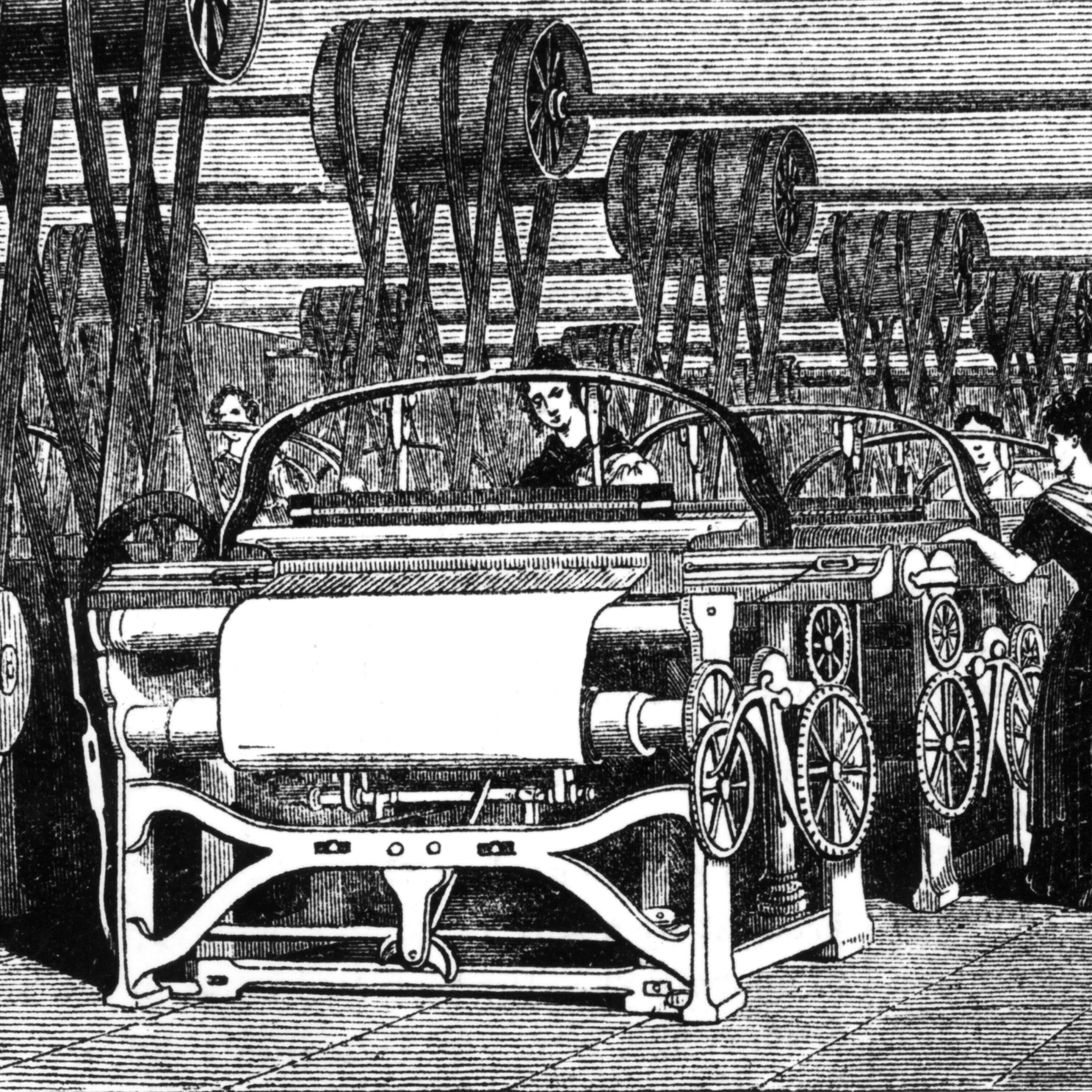
5:08Okay, now imagine we're traveling back in time to Katrina's hometown near Manchester, England, early 1800s. The country is at war with Napoleon's France. There's widespread poverty, food is hard to come by. Life is hard for a lot of people. And these new odd looking machines start popping up all over the place. This is the Industrial Revolution. And it's where the story of the Luddites begins. It's a time when employers are starting to introduce large factories. Most workers usually skilled men are being replaced by machinery increasingly powered by steam, the great inventions of the Industrial Revolution. Big cities like Manchester, Leeds, Birmingham were booming. More and more people were flocking to them and massive factories transformed what these
6:09cities looked like. Almost brutalist buildings with mechanized processes with set hours that you have to go in, a clock in and clock out, heavily polluted, heavily polluted rivers. A lot of these factories were producing textiles. And the workers in these textile factories were getting more and more worried about how this new technology was impacting the way they worked, how much money they could make, and the quality of life they and their families had. Eventually, it reached a boiling point. And the first attack that we know of happened on the 11th March, 1811, in a village called Arnold, in the stocking industry. Framework knitters, they gather outside the local exchange where the cloth is sold and then go around attacking the new machinery. That seems to set off a wave of attacks across the midlands in 1811.
7:12And then it spreads to West Yorkshire where the woolen mills are attacked by local woolen croppers as they're called. Not people, they're attacking only the machines. Yeah, they're attacking the machines. And then it escalates from there. People have broken machines before. What's unique about them is that they all start calling themselves LeDites. For the most part, the LeDites were an anonymous group, except for their leader, General Ned Ludd. Only one known image exists of him. It's a cartoon drawing of him in a dress, standing in front of an angry mob with a factory on fire in the background. This was all the authorities had to go on. But he seemed to be everywhere. The LeDites produced lots of rip materials, so they wrote threatening letters to their employers saying, if you do not take down your machinery, we will attack your factory. And General Ned.
8:14So in April 1812, the local employer who runs West Horton mill speaks with the magistrate who's a guy called Colonel Ralph Fletcher, who has a whole network of spies. This magistrate is employed spies to go into the pubs, listen to what the workers are saying, and then try and stir them up into attacking the mill. So on the 24th of April, West Horton mill, which has 200 of these cotton looms, 50 people start gathering outside it. And then there's further processions from the local villages all around. So this is Hill Country. People are coming down from the hills, little villages where these small workshops are, and they converge on West Horton mill. And from about 5pm onwards, they start breaking the windows, they start throwing burning wood into the mill to try and set fire to the machinery there. They get into the mill and start breaking the machinery.
9:17The Lodites and Wown-Uns for having a what's called Enoch, which is a big hammer, so a huge mallet thing. These machines are very large and require a lot of manpower, literally, to break them. And the riots basically go on all night. About 45 minutes after the riots started, the military arrived. Several people were later arrested. The government then clumps down hard on this. Over the next few years, the Lodites and the government played a cat and mouse game. There were major battles with hundreds of Lodites raining onto manufacturing plants, where the main goal was to take down the machines. There were also high-profile murders of company owners, like William Horsefall, who had a cannon installed at his mill to prevent Lodite attacks. Horsefall would be ambushed by four Lodites who were hiding along the road. But the government also fought back. The government passes the frame breaking out to 1912, which makes frame breaking a capital
10:22offence so you can get hanged for doing it. Some of the Lodites are caught and made an example out of the Rukana show trials after these bigger attacks. Several executions followed. And during these years, when the Lodites were squaring off against the machines and government courts, they were also waging a PR battle in the court of public opinion. The Lodites would create what was essentially propaganda to market their movement. So after a big attack, you'll see celebratory poetry written, songs written. It's part of folk culture, keeping the memory alive, passing the memory on to different groups of people. And many of these messages would include their leader, General Lod. She had no more year-old rhymes about bold Robin Hood. His feet I've a little admirer. I will sing the achievements of General Lod. Now the hero of Nottingham Shire. The Darbi is true in Nottingham too.
11:23Poor men to the jail they have been taking. They say the NEDLOD as I understood, a thousand wide frames has been breaking. Faldoral. Faldoral. What's Faldoral? I think it's just a kind of like do-do-do. Oh, Faldoral. Faldoral. Like, yeah, something like that. Got it. This whole time, the British authorities could not find any leads on General Lod. They don't know who General Lod is. They're still looking for him. But they never find him. Because, and this blew my mind when Katrina told me about it, NEDLOD. The guy they sang songs about who the authorities were hell-bent on tracking down. Well, it turns out more than likely he wasn't even real. I think it's a myth. No one could pin him down, but perhaps there was someone called NEDLOD. And that name seemed to stick with the reputation of breaking machinery that your employer is bringing in that will reduce your wages and reduce your skill level.
12:26She says there was a power in that mythology and almost prophetic quality to him. And then General Lod then creates his own extended universe. I'd like to see him as a kind of superhero with all the different characters involved in the extended universe. So he has a solicitor. He has lieutenant underneath him. All these characters appear as signatories to these anonymous letters. Because obviously people don't want to sign their own names because then they'll get caught. They're chasing a ghost. Yeah. Did people perceive the letterites as like what we would call today, rogue terrorists, you know, going around destroying things? Or did they have a different view of them? Certainly most of people in power, local gentry, aristocracy, authorities are completely opposed to Lodice. But in local communities, I think opinions are a lot more mixed because local communities support these skilled workers who are making their livelihood in small workshops.
13:32And there is this idea that yes, you should have control over your working conditions. What was the goal? Were they just like, we want to destroy the technology and go back to the way things were? Basically yes, they want to go back to their original working conditions, which is working in small workshops using a hand-powered machinery that they could use with skill. Their argument is that the machines produce less good quality cloth. So by mass production, it's cheapening the quality of their products, which then cheapens their reputation. They want to retain their higher wages. They're paid by pieces of cloth. Whereas in factories, they were paid weekly wages. They're worried about women and children being involved in working conditions, not just for a humanitarian position, but also from a wages position that women and children automatically paid less than men.
14:33So it's also a defense of skilled male labour. In a lot of ways, what you've described is a very sympathetic movement. I can relate to the fear that it sounds like motivated a lot of them. On the other hand, you've described real acts of violence, right? There was at least a few people who were murdered by the letates. So if going back to the wager, we are to think of them as good. How do we square those two things? As a historian, I'd say, the lookouts in 1812 had no choice. The options were very limited. Violence was one of the only options available to them. Today, we've got a lot more choice in agency. We have the vote. I don't men in Britain at that point didn't have democracy. They didn't have the vote. So this again was another way in which they were expressing their anger.
15:36Today, we've got a lot more options for political organisation and to express what we want to say. We've got much more freedom of expression in many respects than the letites hard in 1812. So I'm not condoning the violence of the murders, but actually my contention that we should think about let out in a positive way related to that kind of defence of your working conditions, your skill, your worth as an individual, against a system that seems to be removing that skill and that independence. A lot of what you're saying feels really resonant to today. You can see why there is a Luddite Renaissance, Konanko, that has emerged because when we think about AI, which arguably there's never been any technology, I mean, if they thought the steam engine was threatening, I mean, what would they think of AI, right? Like, it is truly an existential, it feels existential to not just work,
16:37but who we are as human beings. Yeah, so the Luddites, you've got it in one or about being human and machinery that takes away that sense of human agency is what they were opposing. Just as today, AI takes out the human from the machine. So I think that's the similarity with the fight around the unlimited or unrestrained use of AI. Yeah, forcing me to think more carefully about even if we're going to have the technology and it's here to stay, how do we incorporate into our lives rather than force humans to reshape themselves to fit the technology? Yeah, yeah. That's exactly what the Luddites were talking about, all singing about. That's Katrina Navikas, a history professor at the University of Hartfordshire in the UK. She has a new book called Contested Comments, a history of protests and public space in England.
17:39Thank you to our listener Drew Barrett, who asks us to look into the history of the Luddites. And that's it for today's show. Threwline was created by me and Romteen Adablui. This episode was produced by me and... Devon Kadiama. Molly Marcelo. Liana Simstrom. Jasmine Romero. Sarah Wyman. Julia Redpath. Amy Padula. Irene Noguchi. This episode was fact-checked by Nicolette Khan and mixed by Robert Rodriguez, music by Romteen Adablui and his band, Jopolec Trick. Thanks also to Johannes Dergi. I'm Randa Blvetta. Thanks for listening. Looking for love? One New York event promises to find you your perfect match using Palantir, though not affiliated with the actual software company. They can sue me. I could lose everything, but it would all be worth it. At least two people here have a spark. So no pressure.
18:41The facts, myths and dark jokes surrounding Palantir. Listen to Plenty Money on the NPR app or wherever you get your podcasts. This is Terry Gross, host of Fresh Air. I interviewed feminist icon Gloria Steinem several times over the years, and we've compiled a special episode to celebrate her life and legacy. Women become ourselves after 50. We drop a lot of baggage and really become much more of a true selves. Find it on the NPR app or wherever you listen to Fresh Air.
More episodes


