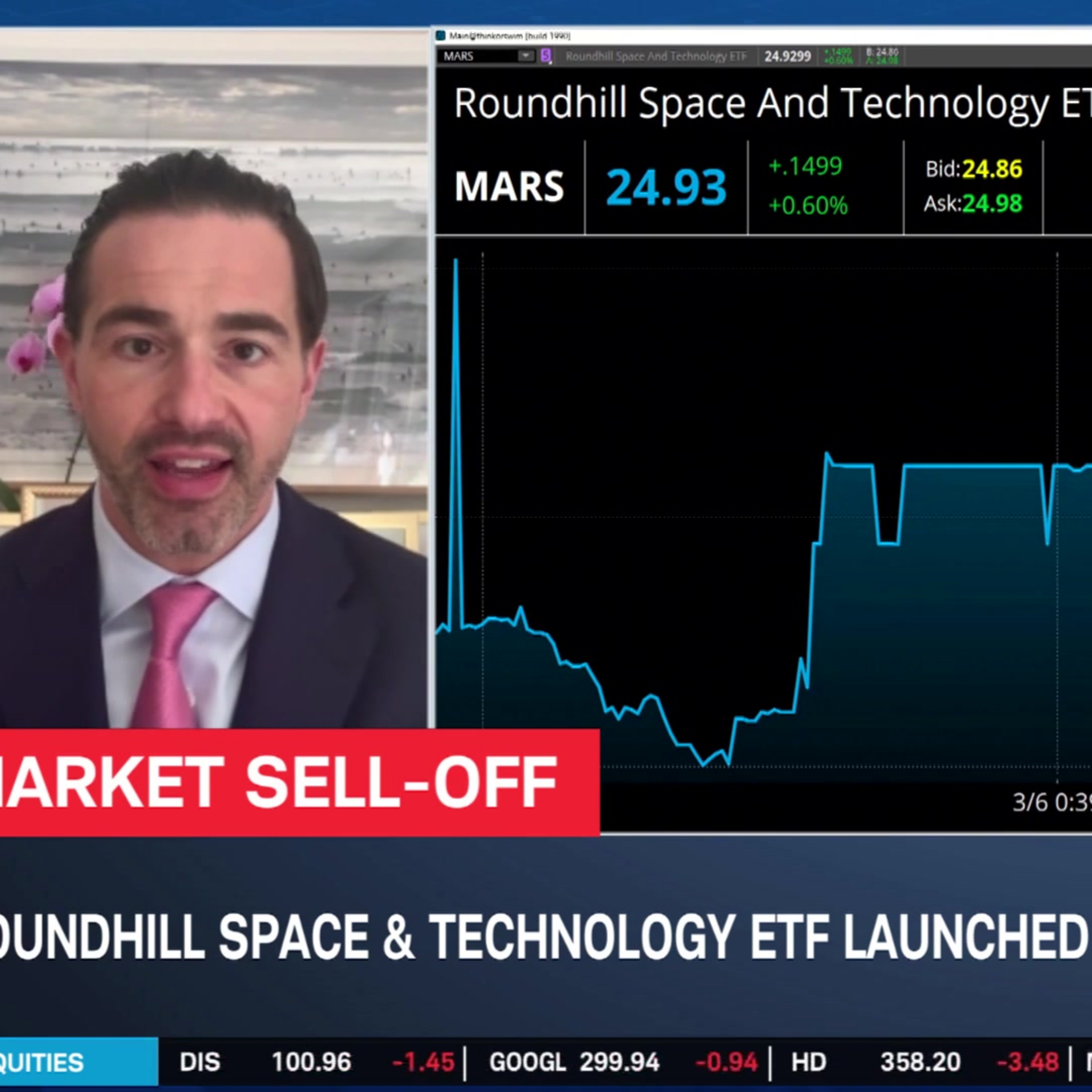
Investing in MARS: ETF Using RKLB, LUNR, ASTS & Others as Tech Evolves
About this episode
Dave Mazza with Roundhill Investments returns to the Watch List to talk about his firm's MARS ETF. It includes high-beta stocks in the space race like Rocket Lab (RKLB), Intuitive Machine (LUNR), and AST Spacemobile (ASTS) among others. Dave explains why Roundhill sees these names leading the space trade in the years ahead and the path of profitability for space-themed companies. AI is a corner of the market he sees as intertwined to space success.
======== Schwab Network ========
Empowering every investor and trader, every market day.
Options involve risks and are not suitable for all investors. Before trading, read the Options Disclosure Document. http://bit.ly/2v9tH6D
Subscribe to the Market Minute newsletter - https://schwabnetwork.com/subscribe
Download the iOS app - https://apps.apple.com/us/app/schwab-network/id1460719185
Download the Amazon Fire Tv App - https://www.amazon.com/TD-Ameritrade-Network/dp/B07KRD76C7
Watch on Sling - https://watch.sling.com/1/asset/191928615bd8d47686f94682aefaa007/watch
Watch on Vizio - https://www.vizio.com/en/watchfreeplus-explore
Watch on DistroTV - https://www.distro.tv/live/schwab-network/
Follow us on X – https://twitter.com/schwabnetwork
Follow us on Facebook – https://www.facebook.com/schwabnetwork
Follow us on LinkedIn - https://www.linkedin.com/company/schwab-network/
About Schwab Network - https://schwabnetwork.com/about
Get every episode summarized
Each time Schwab Network publishes, we email you a written briefing from the transcript — the topics, who appeared, and any specific claims, with the ad reads skipped.
Email me new episodesFree for 3 shows. No card needed.
Transcript ready
117 searchable segments. Every word is indexed and playable.
Full transcript
Schwab Network — Investing in MARS: ETF Using RKLB, LUNR, ASTS & Others as Tech Evolves. Machine-transcribed; use the interactive transcript above to jump the player to any line.
Joining me now for a look across the space economy is our next guest, Dave Mazza, chief executive officer, Round Hill investments. David, it's good to see you haven't talked to you in a while. Before we dive into the space race, I want to get your big picture take on the broad market, especially in the context of the volatility that we're seeing today amid the geopolitical issues that we have. Yeah, no, it's certainly been an interesting week for the markets, especially on the top of what we've already seen this year where there's been a broad based rotation, particularly with the impact of the software sell off. And I think what investors are really trying to parse through is particularly how long is this conflict going to go on? And then what does this conflict mean for the real world and the real world, of course, is oil and then the impact on consumption. So I think the market can absorb a shorter term conflict we've seen, actually the market do a great job of doing that. Of course, this is a bit different here because we're talking about Iran, we're talking to the straight up from us. And again, what does that mean for how long can oil prices, or how much can oil prices
go up, and how long is the straight effectively shut down, even if we're hearing that it's quote unquote, not shut. Yeah, right? Exactly. Because, you know, for all intents and purposes, it essentially is right now. But let's talk about Mars, the ETF, not the planet here, because I guess everything's getting messed up down here. So talk about this. You all are launching this ETF, M-A-R-S, is the ticker for this. Tell us a little bit about this as an investment theme and why space. Yeah, well, it's interesting. So I think human beings have been fascinated by space, essentially forever. But if we actually take a step back and think about the space economy, everyone thinks about it just purely from a space point of view. And it, of course, is relevant, but what's changed here is actually the real world applications for space. And it's less so of just sort of the impact of a new rock at the English, as exciting as that is, and more about the infrastructure that's being built in space from a satellite point of view, whether it's the ability to have greater communications, more effective
and efficient communications, and think about the sort of the impact that we have with the conflict in Iran, when we're looking at data, or governments are sort of monitoring the situation there, what they're using is information from space and from satellites to bring that communication back down to Earth. So I actually think, although on one hand, there's elements of the space economy that are speculative and sort of from the final frontier, in the actual real world, we're seeing those applications happen now, which is one of the reasons why investors are starting to gravitate toward this theme and why we launched an ETF to really capture those pure play companies at the forefront of the space economy. So tell me a little bit more about the everyday impact and how retail investors can relate to this, for instance, because space can feel very just out of reach and people may think more about rockets and what not, versus things like GPS, weather forecasting, how should we look across the value chain for the space economy? Yeah, no, certainly launching rockets plays a big role in this, whether it's a company
like Rocket Labs, or what we think about what's happening with SpaceX, which is of course a private company and has that potential for a really transformative IPO, not just for the broader markets, but of course the space economy. But if we take a step back, it's kind of happening here and now, right? So space has moved from being just this kind of final frontier to being an area where it's actually enabling better communications, more reliable communications across sort of real world applications. So what we're seeing is sort of direct to satellite connectivity with cell phones. We're seeing it with to your point around GPS. And now we've moved from sort of governments being at the forefront of launching satellites themselves toward private companies and governments relying on private companies to do that, which is one of the reasons why the runway, the potential for space docks is so great. Because again, it's more of actually like an infrastructure build or communications build
than simply about sort of bringing a new rocket to space. Let me ask you this Dave, we think about investing in space. One of the things that comes to mind right now are the drones that are being deployed in the war in Iran, right? And I'm curious to know, is your thinking that we'd start to see more of that from space, not necessarily drones, but some defense operations happening in space? Yeah, I think that's sort of where the next leg of this will come from. In order to have sort of this, in again, in addition to sort of the consumer applications of real world applications, the defense component of space is what's actually really exciting about its long-term potential. Is that, you know, we've moved from traditional kind of conventional type warfare to one that's sort of much more enabled by drones, enabled by communications via satellites. And that's why we're seeing governments partner with companies, many of the companies that
are in the Mars ETF to be able to sort of be more efficient on the battlefield, whether it's really doing reconnaissance, understanding where particular assets are, and then using that information to either help target or to help plan for where a conflict could go. And to your question specifically on drones, you need information from space to be ordered to have the drones fly efficiently. It's not just kind of someone looking out sort of in the field from a camera point of view. It's really sort of bringing in that automation, that information that can come from the broad satellite networks that are being built in order to actually make those much more efficient and much more targeted. And then, Dave, let me ask you, I want to go back to the point you brought up about SpaceX. I mean, this is expected to be the year of the mega-IPL SpaceX is projected to be one of those. And it's really the face of the modern space and industry, if you will. But, you know, investors can't invest in that right now. With your ETF, is there potential for a rotation into that as one of the companies within your
ETF wrapper? Well, I certainly think when SpaceX does IPO, that certainly would be an important element or potential company for inclusion. But to be quite honest, we don't have specific information about when that could happen. But in the meantime, you know, there are companies that are either compete with Starlink or with SpaceX in other ways, which is one of the reasons why even prior to a transformative IPO like SpaceX, we wanted to bring the CTF to market. There's companies like Rocket Lab, ASTS, Planet Lab, that are out there right now, kind of competing in the broader space economy, building the infrastructure that's needed to make this a long-term, durable theme, again, as opposed to something that is just focused on the final frontier, getting to the moon or getting to Mars, like our ticker implies. Dave, this is going to be a super easy, the easiest question I've ever asked you as we end our segment today. Would you go to space?
I would. To be quite honest, I've always been fascinated by it. There was one point like many young boys, I wanted to be an astronaut, clearly that didn't happen. I'm talking to you today, but I do think, again, it's an incredibly exciting thing. The space tourism, space tourism is another component here, but I do think it's important that actually, again, there's real world applications, even without bringing people to space for fun. All right, Dave, well, at least you created a wrapper around it for investors to get some exposure. That's Dave Moss, the CEO of Round Hill Investments, thank you, Dave.
More episodes
More from Schwab Network

JNJ Balances Growth, Patent Transitions, and Legal Overhangs
Schwab Network

nCino (NCNO) CEO on Earnings, AI in Banking & Overcoming "SaaS-pocalypse"
Schwab Network

The Big 3: NET, TWLO, ASTS
Schwab Network

Tie Lasater on Inflation Floors, Energy Risk, and Private Credit Stress
Schwab Network