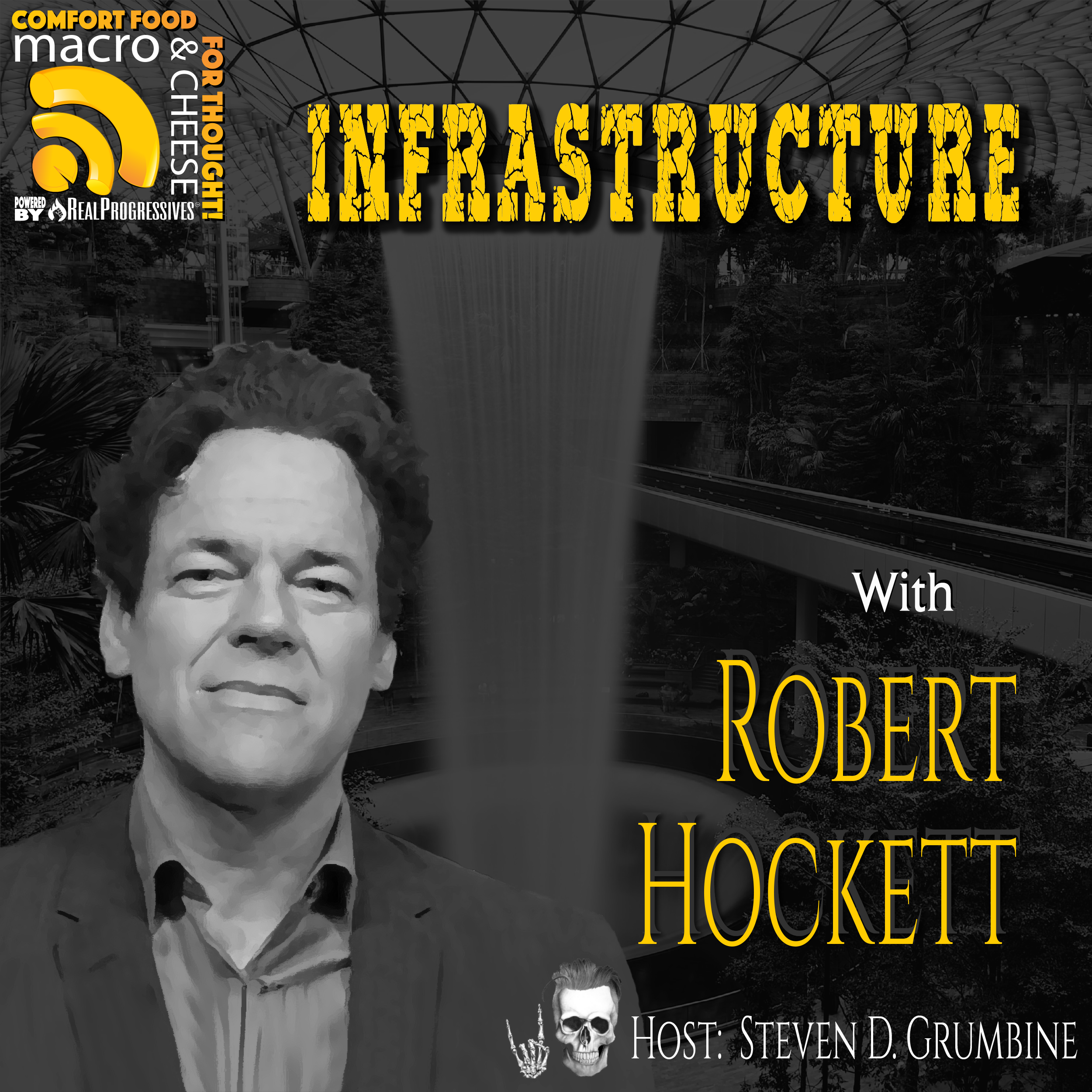
About this episode
This week Steve brings back Robert Hockett to help us understand the big “I” word - infrastructure.
Our focus on particular infrastructure depends on the social or public goals we have in mind. If we are a society that values mobility, we will concern ourselves with transportation infrastructure. If this were the 19th or early 20th centuries, we would be prioritizing infrastructure that facilitates industrial productivity. There’s also such a thing as “soft infrastructure.”
Our focus on particular infrastructure depends on the social or public goals we have in mind. If we are a society that values mobility, we will concern ourselves with transportation infrastructure. If this were the 19th or early 20th centuries, we would be prioritizing infrastructure that facilitates industrial productivity. There’s also such a thing as “soft infrastructure.”
It's probably worth noting that a lot of public policy discussion these days seems to be about social productivity. Right? To what extent are we adding to the material wealth of our society? To what extent are we improving our material well-being, society-wise, and we can think of productivity along those lines, right? To what extent are we producing better material lives for ourselves?
Robert and Steve dive into global supply chains, discussing how the Biden regime may be realizing the old methods of outsourcing our domestic supply of critical inputs to producers abroad isn’t working anymore. The pandemic’s disruption of the supply of semi-conductors, which predominantly come from China, caused a US shortage. On the one hand there’s some awareness of the value of nationalizing production, but the Biden administration seems unwilling to spend the money required to invest in the necessary infrastructure.
Bringing production back to the US would create jobs and reduce our reliance on imports, but the question remains: what about the inevitable environmental impact of increased domestic manufacturing? The need to radically evolve our energy production and resource extraction methods is more detrimental than ever as we face economic, and more importantly, ecological, catastrophe.
Robert and Steve discuss the need for a more egalitarian distribution of technology to maximize our ability to be more productive while becoming more efficient and reducing our collective footprint. It’s important to be reminded that any given policy has social implications, productive economic implications, environmental implications, and even mental health implications.
This episode is dense with useful information including, but not limited to, Senate procedures, political posturing, and America’s role in the world for better or worse.
Robert Hockett is the Edward Cornell Professor of Law at Cornell Law School, Visiting Professor of Finance at Georgetown University’s McDonough School of Business, and Senior Counsel at Westwood Capital, LLC. He specializes in the law, economics, and philosophy of money, finance, and enterprise organization in their theoretical and practical, their positive and normative, and their local, national, and transnational dimensions.
Follow Robert on Twitter @rch371
Get every episode summarized
Each time Macro N Cheese publishes, we email you a written briefing from the transcript — the topics, who appeared, and any specific claims, with the ad reads skipped.
Email me new episodesFree for 3 shows. No card needed.
Hosts & guests
No transcript yet
This episode has not been transcribed. Request it and it moves to the front of the queue.
More episodes
More from Macro N Cheese
Ep 379 - The Real Cost of War with L. Randall Wray
Macro N Cheese
May 9, 202654:58pending

Ep 378 - Revisiting the Stalin Eras Part 2: Context Not Caricature with Jeremy o...
Macro N Cheese
May 2, 20261:04:25pending

Ep 377 - Revisiting the Stalin Eras Part 1: Understanding Democratic Centralism...
Macro N Cheese
Apr 25, 202655:55pending
Ep 376 - Modern Monetary Theory & the Question of Democracy with Jim Byrne
Macro N Cheese
Apr 18, 20261:02:25pending