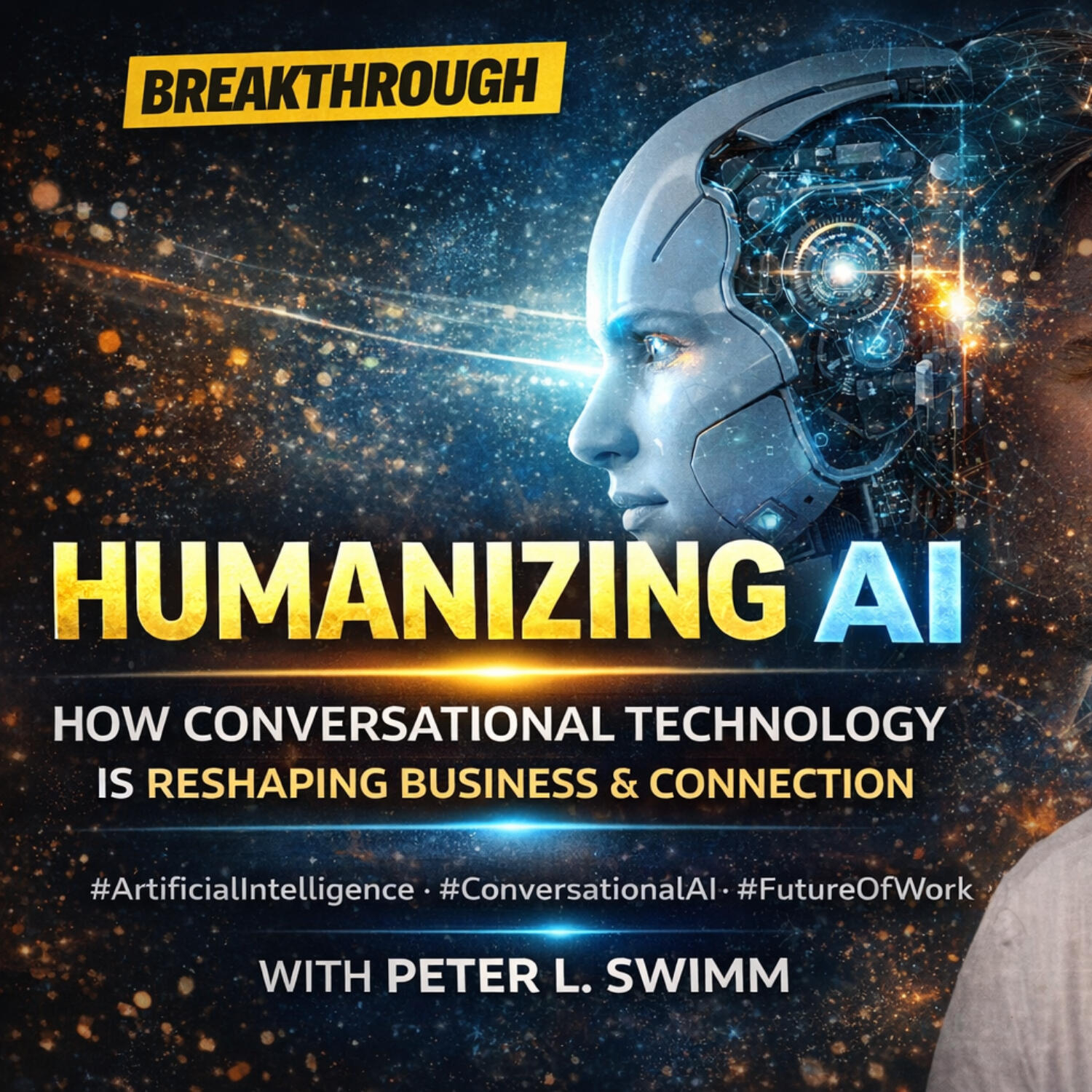
Humanizing AI How Conversational Technology Is Reshaping Business & Connection with Peter Swimm
About this episode
Humanizing AI How Conversational Technology Is Reshaping Business & Connection with Peter Swimm
What if AI didn’t replace human connection… but actually enhanced it?
In this forward-thinking episode of The Hurricane H Show, we sit down with Peter L. Swimm — founder of Toilville LLC and a leading voice in conversational AI — to explore how technology is evolving beyond automation into something far more human-centered.
With experience building AI systems for global organizations like Walmart and Rabobank, and contributing to platforms such as Microsoft Copilot Studio, Peter is at the forefront of designing intelligent systems that don’t just respond — but understand, adapt, and connect.
We dive into the real role of conversational AI in business, healthcare, and everyday life — and how organizations can leverage it to preserve institutional knowledge, improve customer experience, and scale without losing the human touch.
This conversation challenges the fear-driven narrative around AI and instead reveals a future where technology amplifies human expertise rather than replaces it.
If you’re a business leader, innovator, or simply curious about where AI is truly headed — this episode will give you clarity, perspective, and a practical path forward.
Learn more: https://www.toilville.com/
#ArtificialIntelligence #ConversationalAI #FutureOfWork #HumanCenteredAI #DigitalTransformation #BusinessInnovation #AILeadership #TechForGood #Automation #EMBCNetwork
Get every episode summarized
Each time THE EMBC NETWORK Featuring: ihealthradio and Worldwide Podcasts publishes, we email you a written briefing from the transcript — the topics, who appeared, and any specific claims, with the ad reads skipped.
Email me new episodesFree for 3 shows. No card needed.
Hosts & guests
Transcript ready
1,291 searchable segments. Every word is indexed and playable.
Full transcript
THE EMBC NETWORK Featuring: ihealthradio and Worldwide Podcasts — Humanizing AI How Conversational Technology Is Reshaping Business & Connection with Peter Swimm. Machine-transcribed; use the interactive transcript above to jump the player to any line.
Welcome back to the NBC Network. I have radio. I mean, the Biz Word channel. We can just have some fun today with my guests, because it is a topic that I enjoy. And that is the topic of artificial intelligence, AI. So artificial intelligence is moving fast. But the real question is, how do we use it to enhance human connection rather than replace it? Today, we're joined by Peter Swim, a conversational AI technologist who has helped us, who has helped build intelligent solutions, actually, for platforms like Microsoft Teams, like an enterprise organizations, including Walmart and Rubberback. So it's a lot of work that my guest has done. And really, he's going to bring us to this fantastic word that I enjoy personally. So through his work and his agency, Toilvail, Peter focuses on using AI to support people, preserve expertise and help organizations adapt in a rapidly changing world. Peter, welcome to the show, man. Thanks for having me. What is a pleasure, man?
And I can tell you, AI is one of my favorite topics of the last year, if not a couple of years now. It is a world that is, I would say, not scary, but people have a tendency to misunderstand a thing. And, you know, but I love your angle, because you kind of give it a personality, give it a whole different vibe. So before we go to, so let's talk about your background. So at least people understand where you come from, because, you know, an AI programmer, are you a designer? What is, let's bring you to the audiences as the expertise, you know? Sure. So I've been in tech for 30 years, and I'm in my 40s, so do the math. And in that time, I've gone out, you know, I started out in tech support, and I worked my way up the product. And 10 years ago, I started getting into conversational AI, and I had a startup that launched with a Slack API. And so since then, I started out with chatbots, and as AI got more sophisticated,
my use cases got more sophisticated. I worked with Microsoft and that launched co-pilot for the developer ecosystem, and for last year, so I've been doing a consultancy editorial, they'll kind of helping people not turn FOMO into FAPO. Oh, wow. All right, well, so you work with some of the big guys, and I mean, co-pilot is a huge, I mean, it's like the standard one that kind of comes out, when you're doing some search. But so let's talk about the journey. AI is not really new. I mean, I've done some work on it. I mean, it's been around, but it just progressed to a point where now, it's just learning faster and getting better and bigger, and can do a lot more than what it was initially thought to just be able to do. And also, it has been subject to a lot of sci-fi movies in the past because it's like this mystical thing that's gonna take us over, and you add to it robotics, the world is ending.
I mean, we had Terminator actually had a few other movies that the worst case scenario, but in essence, AI is a lot more than that, and it kind of changes the dynamics of how we operate in this world. To me, personally, I'm a big fan, because it is a tool that I use in my work. It has made my level a lot simpler, and it's very efficient to a degree now. Of course, it's not perfect. There's a lot of work to be still done. But again, the speed at which it is moving and growing, it's just gonna change. But there is a big fear out there about it, because people are just not understanding it well enough, and they don't understand what it could do. I mean, obviously it just even the people that actually kind of designed like chat GPT, and some of the basic AI's out there, they tell you that we have it, it's out there, and it's just gonna keep learning, and doing more and more. Is that even a real thing? So let's start there. What is, first of all, conversational AI?
That's a question. So I think conversational AI is something that has kind of been lost as a concept, because it's gotten so good. But I think conversational AI, from a philosophical standpoint, is the premise that people are more important than machines. And so when I tell a machine my problem, it should just know the best way to solve it. And so that's like the whole pitch of AI, it's like, I'm gonna pull the microphone to the internet and talk to it and say, I need to do X, Y with constraints, Zeta, Bed, whatever. And that obviously is not true. If you ever had to like talk to your bank on the phone, we're a long way off from that. And so I try to tell my clients right away that we were talking because we both agree that humans are more important than machines. And I think that solves a lot of problems because the next thing is machines can only solve machine problems. So machines can do things faster, or more efficiently, or grind things out, but they can't solve for things like social bias and inequity, and if your company has bad policies,
it'll just do the bad policies faster and smarter. And I think the third thing that people need to be aware of is it's more important to know that people understand your position on things than for you to enforce the reason why you can't do it. And sometimes that is escalating to a person or getting in the contact or like, okay, this is not the only way to do things. And I think if you solve those three things, everything that people say bad AI will be mitigated, if not eliminated, because I think people, when they talk about AI slop, they're talking about lack and sense. I'm seeing a bunch of ugly pictures that I don't like and dumb movies and whenever I looked for information about political candidates, there's a bunch of lies. And all that is because these tools are being used at scale to make junk that are not useful. Well, you know, it's amazing because you write, and for example, our basic introduction, I mean, you go to a website,
you like to keep on you call, I mean, there's some AI action that takes place. There's a lot of biic stuff now that's available, whether it's the, from your chat, you know, bots and so on and so forth, you get some standard responses and things like that. It's really, you know, it's not replacing the human fact. I still think that talking to a human is a different, you know, level of talking to AI. Although believe or not, I mean, I have personalized about 10 AI's that kind of work for me. And once they get to know you and your work and your company and the things you do, I mean, they do kind of adapt to your stuff and they become a little bit more personalized and I can tell you, sometimes I speak to it like it's actually a real human, you know, it's kind of some funny that way. But what it does, because the response is, it kind of talks to you like, you know, it calls me partner, because, you know, we have partners in some aspect of things and this is like API kind of concept. But it is, it is an interesting world. And so you worked with major platforms,
like Microsoft Teams, like as I mentioned, right? But so, but how are organizations really using AI today? Because people think maybe they use them differently because there's a lot of talk about your data is being taken, your information is taking some of the platforms are taking our voice and our data, demographics, whatever we put out there and they train the AI's. Is that even the thing? And, you know, because there is that fear and there's a lot of chatter about it in social media. Well, I think like, unless you're been off the internet for the last 10 years, you've been exposed to being source data for AI. So if you ever posted on Reddit, if you ever posted on Twitter, if you ever did a comment on CNN.com, someone scraped that somewhere in your AI. So, is that you? You know, is that, is, does someone have your sole captain no, they just have something you wrote on a website making fun of the Kardashians or whatever it is. And so, one, I think that's, that part is like
overstate of the casual scraping of personalities because it's like too much data to be useful in the individual level of exposing who I am. Now, what gets dangerous is like, when you have very intimate relationship, like how much information do you currently have in Google Drive or OneDrive? And like, it goes through systems that read stuff and how do we keep that data from inadvertently going into the machine and the app with the fake credit card number that the application makes is your real credit card number. And I think those are the kind of things of the find out moments a lot of people are going through right now with the terms AI. And a lot of tooling we build is like, like if you work for a big company, they have all kinds of tooling to prevent their information from being leaked to the outside world. And this enterprise-grade security is available to every Fortune 500 in the world. But me as an individual, I've had a credit card breach every year of my life for the last 20 years. We have all my personal information on the dark web.
So how do we give that kind of enterprise? And that problem is like greater than AI, right? But AI makes that problem faster and more dangerous to control at scale. Well, thank you. And so you did almost state, well, you stated something that maybe people will be like, well, be in the idea that if we are out there and we have a footprint in the digital world, there is a good chance of, you know, we use, AI is used in our information somehow. And I think there are a lot of people that may be against that. And you know, they probably will resist that as much as they can. But how can you even do that? I mean, frankly, the only way is you just get out of, you know, social media, get out of the digital space, don't have any footprint, don't have any, any articles or anything that has attached to your name. And I think that's the only way you can literally be safe when it comes to that. Which I don't think that's even possible today because, you know, our data is available in a lot of ways, even though you check.
I mean, you can go to a website and, you know, you just cookies, accept this and then now all of a sudden the information is out there. I want to get into that picture right? I'm not a tech guy. Yeah, yeah, no, no, no, yeah. I mean, you know, we're in a sea of data. Now the thing is like, can someone use, can someone find my individual data in the ocean of data and like make a profile on me that like is good enough to impersonate me and do bad things? Like, like my grandma gets phone calls from people pretending to be me. And so it doesn't sound like me because I don't have my voice cloned, but I do enough of these podcasts and they're going to be able to clone my voice, you know, and so what do we do then? And so I think it's just kind of a matter of like always saying no as a start, but it's kind of like the genies out of the bottle in a lot of ways. And that is when I say it better for worse. That is like the for worse and we have to find ways to re-illudicate that social contract of like what kind of information
gets put out by us because if you're like me and been on the internet since the 90s, you could probably find very detailed information about where I lived and what I worked for and my credit scores and all that stuff from all the breaches and all the stuff I've been in. I think that's everybody, not just you. I think you Google somebody, I don't care who, you just put a name, you'll probably get you at least that busy, you know, where they live, who's related to them, you know, maybe even you pay a dollar and you have all their phone number and everything. So it's not like it is almost impossible to be, to disappear, you know, I mean, you'll have to literally live in the forest and just disconnect with the whole world and that's about it and your information will still be there. I mean, maybe the next generation, they don't have to stop anything maybe they'll be off the grid, but at the end of the day, there is no way for it. As you said, there is actually that, what you just mentioned, it's real and scary and there's even some cybersecurity discussions about it and how to prevent it because I think even law enforcement have, you know, discussed this new thing
where people actually take your voice and they can clone it. And now, I know, for example, Hey Jan and some of the platforms that do have like voice generation and maybe like, you know, you have your avatars and your AI versions, they kind of do the, they do the legends where you have to have your own video and you have to have your own stuff. So it's you that is actually on the account. But I'm sure there are some people that can crack the code and easily, you know, kind of, you know, duplicate that, that system where it just doesn't require that and they can just take, you know, any audio video from you and, hey, mom, you know, I need some money and I've heard that actually being a real thing out there. So, but, you know, also, I know that some of the security folks will tell you, you need to have some code real family that no one will know except you. And if they can't respond to that, then you know, it's not the real thing. You're right. Yeah, I mean, it, you know, and I think a lot of it is just kind of like you, you got to look both ways before you cross street and you gotta like use the safe word with your mom before you send her a PayPal, right?
And, and I think that's also kind of like, okay, society will catch up to know what to do. But, you know, a lot of people are still like thinking of the old things where, you know, my voice is my passport. And so, yeah, I know John's voice. I nursed him since he was a child and changed his diapers. I know when you sound like a mile away and I can't tell the difference between fake Barack Obama and real Barack Obama. And I consider myself kind of expert in this field. And it's just like you could buy any, any gaming computer that you can buy right now is good enough to like run huge disinformation campaigns. So for a couple of hundred books or a thousand books, you can call this serious havoc both permanently and socially and all that stuff. And so, you know, we as consumers have to be very cognizant of what's out there and what we're helping propagate too. Well, thank you. Well, again, so you have big platforms, large platforms that actually they live, they end up, you know, they do have their own AIs. I mean, all the social media platforms, all the large, you know, companies and tech companies,
they all have that. But even small companies, even regular business now, they're adopting AIs and their practices and so on and so forth. So it's becoming a lot more, you know, accessible. But to your point, I mean, folks, we have to be aware that this is a real thing and we have to adjust to the dynamics of having it. And, you know, scrutiny is part of it. And you, you know, there is a risk. There's a lot of we, you know, fake, you know, voices that you can have, you know, on a message and you have these, these, these fake images that can come up and populate, they almost, they look like you, they sound like you. I mean, I've tested it myself and I have a few videos that are my A, I avatar that looks like me, moves like me, sounds like me, but it's not me. I mean, I, I, I test them out. I mean, it's real. And, you know, you can use it. I actually had a series of, of weekly updates that it was just my avatar really, you know, with a script, you know, you know, being posted out on my social media because, you know, it was just, you know,
what the technology is about today. So there is, there is that, but we just have to be aware of it. And the thing to your point is, you, you are, there's advocacy, there's work to be done to, to consult and work, you know, on how to do this. I mean, you got, you know, deep fake stuff now that you can even tell a real person number four. Now, I mean, there's, I mean, I just saw a, a neat trick that if someone talks to you and you may use deep fake technology, you just kind of tell them put fingers to your face. Is that a thing by the way that says, you know, where, yeah, it, it, it, it, it, it, it, it, it, it, it warps the, the cheap stuff, but it won't do anything to the expensive stuff. So like, like it, I'm being hacked by Jimmy down the block, or a catfish by Jimmy, that'll work for him, but it won't work if like it's the CIA, right? Or like someone who has, someone who has serious money to like throw behind the technology, like you need to get physically in a room with people. And I think, and that's the other part of my business is just like, okay, if human, human contact
is like the most valuable part of your company, that's the most protected part of your business that you should do. And so like, if you're text messages and someone don't do anything sensitive in text messages because you can't tell text messages are safe or not. Wait till you see them in person, discuss things. And I think a lot of things are gonna be like that, where it's just like, oh yeah, I'm posting on Twitter, I'm just gonna post, you know, funny memes and not my children's photos, you know, or not like things that are like data that could get out. And I think if people have better hygiene about these things too, it reduces the risk from these things being used against them. You know, the funny thing is, so you mentioned social media and it is sad that, you know, some people are volunteering. You have the bird day and they have a picture, there's a space, there's a location. You know, I mean, you can get enough videos, enough, you know, cuts and you, you pretty much put a whole profile on someone, just from their, you know, postings, I mean, even instant location, everybody checks in, you know, where they are.
So you open up a kind of warmth to these things and, you know, that people that have nothing else to do, but sit in behind a computer and just designing these little scams. And, I mean, there's money to be made, you know, through these things and it's scary. And it's, I mean, cyber security is one of the biggest things now. I mean, if in terms of jobs, it's a big thing, right? I mean, I might get it in that correct. It's, it's, yeah, yeah, if you wanna. Well, like, you know, there's whole communities of people that like, they go to influencer videos and they say, oh, the influencer could see the window behind me in the shot and they figure out on Google Maps where that person lives. So they're like able to like, it's like, okay, there's a, there's a McDonald's across the street and it's across the street from a, you know, a best pie. So show me all of those things that are, have sunshine at the time, the person was streaming and then use AI to cut it down to a list of 30 things and then just go to Google Maps and see which one looks right. And like, if you added AI's the last part of that, you can like, do that from any video at scale quickly.
And so sounds terrifying, right? It was like, well, you don't have to stream online with your window open behind you. So maybe, you know, like you do put a curtain behind you or me going a white room. So, you know, that information is not freely given away and it's just kind of like hygiene, right? You wouldn't like walk barefoot in the park in some cities and so, you know, you should treat the internet the same way. People get too comfortable, I think. Well, they are. And, you know, there is that cultural thing, right? Like, you know, you want to pose, you know, where you are, you're going to show places. I mean, obviously as an influencer, sometimes you do vlog, something like that. You have locations that you're promoting, there's collabs and stuff. So I get that. But here's the thing, I think it has different scales because I, you know, what's the case? I think you mentioned King Kardashian or the Kardashians. They, I think she was in Europe or something and she kind of posted and I think something got stolen from her. Yeah, I think that story didn't hit the news a couple of years back. So, sometimes you get to the point where this, you know, you are maybe she is a big celebrity and, you know,
I mean, I have to, these guys that did that, I don't know how stupid they can be, but they did and, you know, it's amazing. But again, if you have something of value of your, you know, you don't want people to really approach and stuff like that, obviously have to be careful. And there's some safety measures that you have to take. You do it on a personal level. You can do it on digital space and so on and so forth. So that's the other thing. But nevertheless, the risk is high and it's only going to get higher and, and, you know, more, more available to the wrong people. And as it's available to the wrong people, it's also going to be protected by the right people because I think, you know, you mentioned some, like an agency like CIA and others, you know, these people are working diligently, you know, to prevent, you know, any cyber issues and things like that. And these, these fake AIs and things like, well, not fake, you know, advanced AIs that can be very live, I'm just, this is, they have to be at the highest level of tech, you know, to prevent these things. And that could be, you know, a serious thing.
But it's really that that's beyond us. But I think your work is to really make a difference and kind of bring in the level of, here's AI, what it can and there's a human factor to it. But we're going to get that to a second second. So, you know, I'm sorry. So there's a lot of fear actually around the AI, you know, especially replacing jobs. Well, I just want to get your perspective on that. Because then people are like, oh my God, you know, and by the way, there is some reality to it. There are some things that may be easily replaced by an AI, you know, functions, I would say, tasks that can be done, especially with, you know, agentified AI. So let's talk about that. Yeah. I mean, the first thing I say is if a CEO wants to lay off people, they will lay off people. They don't need AI as a reason to do it. They'll find a reason to do it. And so I think a lot of people get laid off because of AI. Maybe people trying to get to ahead of the curve and trying to justify a back quarter and say, oh, yeah, technology made these people redundant. So I think that is a social thing that we should definitely discuss.
But it's like, is AI so good that we need less people? I think it's still open question. And the, you know, back earlier when I said, only machines can solve machine problems. I think a lot of the jobs that people do that are human-solvable things should remain so, even if the machine could do it perfectly, because a machine would never get in trouble if it did a wrong. Or they'll never feel bad about doing it wrong. Or they'll never have a consequence for doing it wrong. So there's certain things that machines do that, yeah. Chapak could do it. Should it do it? It's like another question, right? And so there are certain jobs, you know, like you don't want a chatbot to give mental health counseling. I strongly believe that. Like it is a complicated thing and you need all the experience and expertise of licensed therapists. And so I'm really, I get the ick, really bad from like AI companions and things like that, because we don't understand how people work as a society
and why we just like, just come to the machine, could do it, doesn't mean it should do it. And so I think work down, I do a lot of like, find out moments with these technologies where sure it's technically possible. AI could do it like, you know, they just, I don't know when this air, but they shut down Sora this week, open AI Sora, which was the video generation service that people used. And they mostly used it to do bad things. Like, you know, make unconventional videos of people and all that stuff. And so, and they weren't good. They weren't entertaining and it was very expensive. So they shut it down. So good riddance, a lot of people say. I think a lot of AI is like that right now. Where people hear AI in the alley, they make a up face. And because, you know, all these people are pausing AI as things it could do, but not what it should do. And no one really knows the value proposition of what it should do. And to me, I think it's like, I don't want AI to make me a movie. I like watching movies made by people. I want AI to give me more time so I could spend more time watching movies. And I think that is like what people are looking for.
It's like, you know, if I spend two hours a day doing emails, can I do one hour a day writing emails and spend an hour in the park for my kids? And I think those are like the value props that people are looking for AI, not like, how many less people do I need to run my company with. But it's so expensive to make AI. Those are the deals they have to close to remain profitable and sustainable. So this is kind of like where society is like trying to pump the brakes on an industry that's kind of like desperately trying to not lose as much money as been losing for five years. Well, thank you. You know, it's funny because I think the issue is that adaptation is a key, right? I mean, AI is a tool. And I love what you said. I mean, you know, there is there are some areas that you're never going to replace the human factory, the personality and the skills. Yes, AI has knowledge, has access to data that is, I mean, I have to say when you ask, you know, a question, I mean, it just basically search everything that's available on a topic and can give it to you in split second, which if I had to do that, it's a lot of work for me to do the research
and just kind of collate all that information to be able to even reformat it and whatever it is. So there is, there is a level that, but the people that would adapt to it, you know, will, in industries that will adapt to it, jobs that will adapt to it, you know, I think will be just as efficient as needed, as available, as need be. But you're right. I mean, again, there is a risk and there's nothing we can do about it. There is that factor of acceptance. I mean, we've accepted a lot of technology over the years. And, you know, I mean, we can even argue the concept of weapons, right, or firearms. You know, firearms don't kill people, people kill people, right? You know, it's how you use the technology that can be a bad thing, right? Am I getting that picture right? Yeah, I think you are. You know, when you look at it like, how long has banks have ATM machines, right? And they still have tellers. And why do they still have tellers? Because sometimes you need to go in the bank and figure out why you're overdrawn, or why is your loan doing this?
Or you just need a person to figure it out because you're freaking out. And a machine is not working for you. So I think like there's gonna be a lot of things where you see AI doing like the intake, like, you know, when you register and you sign and like one of the best assessors I did, I was working for a company's contact center as they have contact center just for their employees. And they're the number one employer of the world. And so their healthcare plan is bigger than health insurance in 13 American states. And so only two or a people pick up the phone for those millions of employees. And they wanted to automate the contact center. And which means everyone only talks to AI. But we found out that the average phone call was four minutes long. And of that phone call, two minutes was verification. And information look up. So instead of eliminating the contact center, why don't we just AI take the first two minutes of the call, automate that.
And then the call is two minutes long with a person who answers all your questions that leads you happy. And so those are the kind of scenarios that are like counterintuitive and you're kind of thinking so far in the problems. Like, wow, this phone call costs us $5 phone call. It's like, well, now it costs 250 phone call times 200 people times 200 times a day. And it costs that. And no one has to lose their job. And now maybe instead of talking 200 people a day, we can talk to 150 people a day and they can leave happier or they can get more answers done and they don't call back and try to get someone else or whatever. And so these are kind of like the counterintuitive things that we need to figure out as a society about AI. I was like, OK, if I can work five times faster, what do I do at the time? And the answer is make times more things. It's to make three things that much better, right? And when I ship a software application, my version one should be pretty solid versus beta, like all these things that launched today. You'll get a new product. And the next day, 1.1 already comes out because of the bugs they miss. It's like, well, use AI to spend an extra week to bake it.
So you don't have to like put out a bug fix the next day. And once we start thinking about that, I think we'll start settling down about the AI risk and threat because humans still need to come up with the ideas and humans need to pump the brakes and see, whoa, that's not the right way to do. Even though it's technically correct, we can't do it because morals and ethics and laws and all the other reasons why we don't do things whenever we want to. Well, I think the fear is maybe we're still in a baby stage, I mean, you know, but people are scared because 10 years, 20 years, I mean, the advancement in this area has been amazingly rapid and fast and de-kip release. Like even Chad GPD is like 5.2 now. And before you know it, it's got to be 6.0. And it's got to be more advanced. And there's just one of them. There's cloud, there's perplexity, there's all these, you know, different types of them. And they're all out pretty cool in what they're doing. These are the ones we know in public. And I'm sure there's other ones that are used
directly by companies that, you know, no one is aware of. I mean, you designed them. And you know, there are tech, you know, folks that are actually just behind the scenes, you know, building these things and teaching them how to operate. But I love what you said about the duality between, for example, ATM and teller. Listen, I do use the teller and I do use the ATM. Sometimes the ATM is just in and out. But sometimes you want to talk to the human and do few things and transactions that only he or she can do for you. So that's one way to your point. I mean, I use, you know, like for example, Chad bots and Chad bots. And you know, when you go to these sites and you want to like maybe get an assistance. You know, they get you that first stage, you know, but then you know what? I do want to speak to your representative because, you know, they could not as the understanding they didn't get the actual comprehension of what really I wanted to do. Now, even if they get advanced, you still want to maybe, you know, talk to someone. So to your point, you know, the idea of maybe reducing the timeframe what I call by doing triage through the AI, that's cool too. So there is definitely that, but like to your point,
is more about understand how we can merge the things and kind of match them in the real world without having, you know, some dire consequences, right? So now you do talk about AI and has a human connection. So what does it actually look like in practice? And by the way, I want to propose that we want to think. I actually created a group on LinkedIn. We still don't have members, but the group is is literally has five AIs that actually that we call the human AI group where connection group, whereby literally they are your members of the group but they're not real, they're AIs, they can talk to you, understand you, respond. You give them some information. Now, every time you have a question about a topic that they're experts in, they can help you. So basically, you have experts that are yours outside of that general, you know, information. So I can see some of that, you know, I can understand a little bit of it. But like when you're talking about human connection, what are you really, you know, how would you define that?
Um, I usually start off with a bit, this may be geeky, but who is a better droid in Star Wars? C3PO or R2D2? You just did. Okay, so C3PO, you went to Star Wars, man. That's like everyone. Okay, C3PO could talk. He speaks all the languages in the empire. Everyone kind of sees him as useless, right? Like he is a pain. He is causing emotional friction. He is staying stuff inappropriately. R2D2 whistles, and he gets stuff done. He busts them out. He saves stuff. He's hacking the thing. He's flying in the spaceship. And all he does is he whistles confidently. When he understands what you're doing, and he whistles sad, when you're sad, and whistles happy, when you're happy, and that's good enough. And so when people are building agente experiences, they really want to build like their best friend or they bring their biases at the table. Like I would used to do workshops for insurance companies. They're like, well, our chatbot needs to be a woman in the age of 40 to 50, and she's from the Midwest.
I'm like, why? Like do people want to like a talk to a virtual person, or they just want an answer, right? Because they could talk to you, and I think it does also eliminate some of the friction of like, will AI replace me? It's like, it shouldn't try. Like I should just be able to talk to the website, and it shows me the brochure that I want to look at with all the information and the way that I like to read it. And like, or make me a video, that's the perfect video and all that thing. And then, you know, if I'm in the bank, and I need a crisp $20 bill for a birthday present for a niece, I go and talk to the teller and find me the prettiest $20 bill, which is completely unreasonable business requests, but you do it because that's customer service. And you want to have a nice business and you want to keep me as a customer, right? And so I think that's kind of like the issue at play here. It's like, yes, you need to manage cost and run a profitable business. At what point do you start shooting yourself in the foot? By like, it's like, okay, we're going to make everyone talk
to AI, and if they don't have the ability to speak perfect California English, they're gonna have a hard time, you know? And there's no way to escalate to a person, to arbitrate, and oh yeah, we shut down all the banks in their area, so they can't be walked into a branch. And so this is kind of like the find out moment is like, do you want to like run a profitable business or do you want to run a sustainable business? And so that's the kind of thing I tell my clients, because a lot of the people I work with are small business owners who works for a big soloist company, and they're like, I want to go out on my own and run it my way. It's like, cool, then why do you want to go out and then cost plays a big soloist company with technology? You know, you want to like automate all the stuff that is a pain running on your own when you're wearing all the different hats, but you want to spend 20 minutes on a phone call draining the sea of problems for your clients and making them feel like they're well represented and that's your competitive advantage. So that's why we say on our website, you know, people make it better, because you know, you can't run a machine that prints money
without a person somewhere in the mix, and that may be a surprise of some of the founders and CEOs listening to this on the radio right now, but like, if people aren't in the mix, you know, watching and maintaining and like stewarding your droids, your droids are just gonna do bad dumb things and you won't know what happened or where it went or what the problems lie. Essentially, human factor remains, human connection remains, and it is distilled the core, right? It's not, we cannot dismiss that. I mean, not in the foreseen future, I would say. Because, and I love the analogy that you give about, you know, CEC, the Star Wars stuff, because, you know, first of all, those are like iconic robots, right? And, you know, they have characters themselves, but you're right, like, and that's supposed to be a futuristic, you know, movie with all the tech and things these are intergalactic, you know,
spaceships with all the tech and stuff. Well, yeah, you know, the human factor remains as deep relevant, you know, I guess, presence in those scenes and those movies. But you're right, it is the same in the real world. And your job is to kind of clarify that for companies and business owners and business leaders to ensure that they're not really in, you know, trying to do something that may not work and eventually will just hurt them and hurt the bottom line. Now, now, so is that what companies are getting wrong? When it comes to AI, I mean, or leaders? So, and I think it goes back to what we're saying about machine doing machine things, because a lot of times they wanna take their entire company and just put it in the blender of AI and have it do what it does. And a lot of people don't know, like, people come to me and say, well, how much money can I save of AI with labor? And I'm like, well, how do you measure how much labor costs today, right? Like, what do you know? What do you know? What does a day's worth of work cost you as a company?
And they don't know. So you take, you don't know and put it into a blender and it's doing, I don't know at 100 times faster than it was before. And maybe it's like 20% of your phone calls ending people cancelling their contracts, you know, like because of something bad business choice or decision. I worked with a taco company and they put a chatbot on Facebook that lets you order tacos and the quality ratings, the satisfaction ratings were in the toilet. And I was on this phone call for an hour, an hour and a half and I unmute them like, what happens when the food bad or the food is cold or doesn't get where it's going? What, how do they fix that? And like, no one knew. And it turns out it didn't even have the ability to like fix bad orders. So yeah, if it's bad, it's bad. Like, it doesn't matter, like, the experience can be the best experience of the world and it can be the most eloquent Shakespeare version of the C through PO, that's very handsome and responsive. And if you can't fix a bad order, it's a bad experience for ordering tacos, right?
So. Well, but that is an awesome example because to your point, yeah, I mean, you can train AI to do a lot of things, but how would they even know? I mean, someone has to tell them, well, the food sucks and this, that, the other, and maybe the LG said, knowledge is based on that, but they still don't understand them. They cannot literally physically see, you know, that the food is mixed up or whatever. I mean, there's someone, there's a human that's gonna have to respond to that and answer the data. And frankly, to your point, it is, this is a big question about all this, is like, where, how do we find that healthy medium, like, you know, to be balanced? And I think that's really the balance and automation, you know, and preserving human expertise, that's gonna be the question, you know, correct? Yeah, I mean, like, I think there's a lot of things that people do, especially those in information work that is repetitive and boring in a way that they're time, like, you should never have to talk to a person to find out if the store is open or not, right?
Because if you pick up the phone, it's open. And you shouldn't need to find the address and the mailing address and the phone number and, you know, stuff that was like, here, let me Google that for you kind of stuff. But like, there's always could be scenes in the middle of like, you know, given that I am a single parent before which health plan did I pick? Or, you know, like, what is the best financial opportunity for me in my investments? Or any of these, like, problem areas that, like, people need to, like, maybe there's no answer, maybe the first person in the world to ever have this question. And so the machine wouldn't be able to answer it. Someone needs to be able to, like, put that and train and feed the machine so it can handle those things in the future. Like, there's new problems every day. And so, you know, if we build systems that are like built on existing data, which AI can only handle existing data, like, try asking it yesterday's baseball scores or whatever you want to do, you know, there has to be human-led systems to keep it hydrated and fresh and new.
And the other end of it's like, if everyone's replaced by AI, who's gonna buy stuff? You know, like, you know, like, if the AI companies, you know, like, why would I pay for, you know, Microsoft Office, if I didn't have a job to pay for office? You know, I mean, like, I won't buy the software because I won't have a job so I don't need it. So, good luck automating yourself out of customers, you know? I'm sorry. I love that. I'm sorry, maybe I love that. Because you're right, I mean, you know, I mean, it's as simple as that, folks. I mean, you know, I'm just listening and I'm just working here because that's true. I mean, if we all are robots, I mean, what is, what's good for us to, what are we gonna do? I mean, if there have been movies, actually, that they kind of depicted those things, you know, I think they were surrogate. We Bruce Willis, I think one of them, there's a, like Pixar, right? Like the Wally, you know, exactly. I mean, I can't just say it, like, if you're gonna put me on a spaceship and a cruiser of VR, that sounds kind of good right now, but like, you know, it's just kind of like,
you know, we need to have bakers and lawyers and candlestick makers and being a community of people, right? Like those jobs need to stay when you fire fighters and first responders and like, there's always gonna be work to be done. It's just what do we value as society as the work that has to be done, you know, like, you know, I would rather, I would rather my school district pay teachers more than get AI software for the teachers just so they could teach more people, you know, so. Yeah, I said this, you know, the idea of AI is a tool and assistant, you know, that can get the job faster, more efficient in certain areas, but the humans have to be behind it. We can, it can be early. I mean, I've put articles about this or like post about this. It's really side by side, you know, it's not, and it's still controlled by the human factor. Cause I mean, yeah, it's just still powered by electricity and energy. You put the plug off and it doesn't exist, right? You have no Wi-Fi and it's gone. So there is that and even robots, right?
You know, so because we are coming to the age of robotics now that advanced robotics, I mean, we see it more and more, you know, advanced like droids that humanoid say in a way, you know, and they can do functions that are like very, you know, advanced, but but at the end of the day, there's still what they are. They can certainly do some functions. I mean, listen, if, you know, in the context of, you know, lifting, you know, you know, big stuff and moving things around, yeah, robots, you know, you know, robotics can do good job and we've been using robots for quite a while now. I've seen, you know, robotic bars and coffee bars where you can actually get your, your, your request, you know, through, you know, a screen and then you have this, this machine arm that actually makes, makes your coffee or your favorite beverage, right? So I've seen that, like, you know, I was on one of the cruise ships and did you have an actual robotic bar basically? So it's, it's, you put your request and whatever mixer you want, they'll give it to you and it's pretty cool. It kind of shakes things, you know, you know, you want, you want like a James Bond, you know, a drink, you'll get one, right?
So it's funny, but so now let me, let me answer your question. There's, there was, there's something that's maybe very interesting, which is the healthcare, you know, world, right? You know, we, there's augmented reality. There's some robotic, you know, surgeries that's being done now. What do, what do you see the role of AI in the healthcare field and operational systems moving forward in general? Um, I think, I think it comes down to the informed versus operate thing that we're kind of talking about earlier. It's like, do I want a human surgeon doing open heart surgery on me or a loved one or AI? I want a person, right? Like, I don't, and what do I want a robot calling balls and strikes at a baseball game or an umpire? Well, it depends if the calls are going for me or against me. Right? And I think that's the kind of like story behind all use of technology is like, if it's fair and equivalent and faster, by all means, do it until we know for sure, uh, we should, uh, look and see like I don't want like, if I have the
call for insurance and justify my need for a medical visit to an AI, that's positive, that's a negative experience for me. Like, I want to go to a doctor and I want to be evaluated fairly versus like not knowing the right words to tell the machine to get an appointment. And I think those situations are happening all over where it's just like, uh, if I call, right, go to a website and there's rules before they allow me to talk to a person. And there's no way to talk to a person without doing those rules. Then that's not a fair system, right? Because, you know, just because you didn't say the magic words in the right order, you should not be reduced access versus people who know how to use the right commands. And so when people say like, oh, they're using AI wrong, right? I challenge them and say, well, you know everything. So you should know what I meant when I said it wrong. You know, like, that's not my fault. There's there should be no functional way to use AI wrong. Unless I'm just speaking in tongues, right? Because you should be able to figure out what I mean because I'm
doing my best to give you the context is just like when I'm at the grocery store and I'm like, where do I find that stuff that you use to put in cake, obeyking soda? You know, like that kind of like jogging your memory and the person knows food and that's 99% of human interactions is like, what's the thing to do the thing? And so if AI can't do that, then why are we even having a conversation? Yeah. First thing or the second thing, right? It's like a new movie, right? With thing, which thing you tell your friend to the first one of the second one? What was so here's the thing? Like, you know, leaders listening, right? I mean, CEOs, business, you know, folks know, you know, what would be the first smart step really to adopt AI without overcomplicated? I mean, because because I think small businesses may not be as as adept to it yet, but they are getting there. And because they, they don't have the, I guess, the, maybe the capital or the resources to, to over hire. So they, they're looking at stuff.
I mean, I can speak to myself. I mean, I use a lot of AI to assist me with certain functions that normally I would prefer a person to do, you know, right? But, but, but certainly it's the, the speed, the, the accuracy, maybe the efficiency is there so I can, I can do it. But is it sometimes frustrating me? Because you have to repeat yourself. It's not always accurate. You got to tell it. You need to know exactly what you ask in AI because that's the other thing. If you ask the wrong information, or you don't know how to properly, you're just going to get, you get the worst responses. And by the way, I tested a lot of the AI's and some of them, they're like still like, you know, baby infant stage. I mean, they're not really advanced where they can actually understand things the way they should. But, but like, what is the, the, the advice you have for business owners, CEOs and leaders right now, just, you know, how do they, how would you have them operate with AI? So I think the one thing you got to keep in mind is that when you order you hire a person, whether, whether they're 16 or 80, that is all training that you get for free.
So that person knows how to be in the world to understand things and solve problems. And a lot of AI out of the box, you have to tell what's important, like it doesn't know. It just knows kind of like what the shape of the world is, but doesn't know the way you like it. And if the way you like it is very, very particular, AI may be something that is limited of use to you in the short run. What you need to do is kind of like make a list of all your problems. And every, I think every founder and CEO should know how their company works from top to bottom or know the people who do. And look for opportunities to reduce friction between what's called modalities, right? Like if you look at the org chart, you have like the contact center and you have the sales department and all that. There's natural friction that occurs there. And so how can you bridge those gaps and make? How do we keep like our records and internal documents updated? So we know that the President of the United States is Donald Trump and not Joe Biden still and keeping current and make sure
everyone's using the same business reports. And so those are the things that like AI should be good at. Machine computers are good at, which is kind of like sorting and filing and making sure data is consistent and all that. And once you're in that state, then you can start playing around these other things, which are like, depends situations because you need to have that stable foundation of rock hard solid, not fake data. You know, so we know like, okay, all this data is bedded and safe and secure. And given that, how do I solve these problems? And then you won't run into things like hallucinations and slop and bad answers and stuff. And then people need to read that before you send it out to a person to verify that's still true. And once you have that in place, then you can start messing with AI, which is like, not what they're selling, you know, they're like, they're saying like, if you just pay for touch, you can see that it does all of this and it does none of that. And so a lot of the times I talk my clients out of AI entirely because they're just not comfortable with that or they have such a good rapport in their three people company or their 10 people company that they'll
just say, hey, Judy, what do you think? And they get the answer they want and they don't need to like do all that orchestration of AI and pay the hundreds of dollars a month. Well, thank you for that. And so, so now let's, let's talk about this. Like, I mean, three, five years from now, what would be the conversational AI really like in your mind and expertise? I think like the demo that they stop showing, which is kind of like the, the messy demo, which is like the, the morning rundown. And if conversational AI could get to this point where it's like, okay, what do I got to do next? It's like, well, you got a project X, Y and Z and 10 o'clock. You got to have lunch for Billy and four o'clock is soccer game of the kids. And then you should be able to say, well, can I get an hour of at the gym in there? And those are the kind of like weird, stateful, like planning, execution, management of time things. I have to happen for AI to be a functional part of society, I guess.
Because until then, it's going to be just distraction and more noise. Like, you know, I have my, my phone call going off every five seconds from telemarketers and text messages from my mom. And I'm following Twitter and Instagram of all these noise about, like, I need some sort of like, if I'm going to be a cyborg, I can't be connected 100% to the information super highway all day or I'll go insane. And I think people aren't going insane, right? Like if you look at the landscape of the world, like people are just go touch grass, you know, like they are online and hooked in too much and we need to fix that. And I think doing that as a company is also a good strategy to you because it's like, why are you paying all these people to do work and then make them make four separate versions of the report for different audiences? Like, oh, you got to make a PowerPoint and an Excel on a website and a video. And just like, why isn't it, you know, that AI convert the format into the different thing that they just do the work, right?
So I think those are opportunities. Well, no, thank you. And it's funny. You said all that because because you, again, I love it. I mean, well, by the way, I admire your, your purchase of this because you were like creating this bridge between the two worlds and, and kind of know how to navigate and kind of make it very seamless to operate in both worlds. So the humans and the AI can coexist in a pretty easy way. And, and, and it's not of a woman for people to adapt and, and really start utilizing, you know, AI correctly. So, so now, now, that brings me to the question, your company, yeah, I'm not going to pronounce it if I'm misplaced. So, so I'm going to, what don't you tell us the name? Sure. Yeah. So, so my company is toil, though, because I feel like a lot of work is, is work for work sake. And, and I don't mean that as like a projective, like, I think it's kind of like, when you're a chef in a kitchen and you have your kitchen set up to cook, that's what your workplace should be like. So you know that my spoons are here and everything's clean and ready to go.
And that's the kind of workplace that we have. So like, you go to my website and my website, I have a designer, a person who actually designed stuff with pen and paper into a computer and it does the graphics on the website. And I have an engineer who works with code agents and we build the website and I'm product. And we kind of design what we want to do. And it looks like we want to do it. It says what I want to say and I write what it says. And, you know, I'm probably the only AI company in the world that doesn't have AI generated text on their website. And the reason I do this is because I like writing. And like, I, I don't want to automate the thing I, I don't, I like to do. I want to automate the stuff I don't like to do, which is like, find out what emails to respond to and prioritize the jobs to be done. So I don't get distracted by this or that. And I only have one calendar and it unifies all my other calendars automatically. So I don't have for it. My phone doesn't ring and then my watch goes off and then the computer bleeps. So I just have one thing to and that helps me in my day. And I think that is kind of like a better way to do
things versus less technology where I control at my level. So Slack doesn't go, if Slack goes down or company doesn't go down, right? Because we're not on Slack. And if email goes down, we have four other channels and it wraps around it. And I think that's kind of like the way to do it where we don't. And of course, I'm on the West Coast United States and my developers on the East Coast United States and my designers and Finland. And so maybe there's an hour a day when we're all up and we're fine. Like we just, we have the meeting and we're just kind of like, hey, do this for me when you get to it or hey, I need this by Tuesday. And it just happens. And we usually work four day weeks, you know, as a group because it's like, if, if the works week is done by Thursday, the word is not more work. It's a long weekend. Well, I like the concept. And actually, you know, that's a good model to actually adopt. So folks, if you're watching listening and you want to kind of build the own little, you know,
place, this is a very good way to create that that opportunity. So so Peter has a good format there that I think a lot of people would probably envy. And I know there's some places around the world that actually are interested in kind of creating that concept that we just talked about right now with Peter. So, so, you know, let me, let me just say this, you know, the this, this world that we live in right now is changing. I would say hopefully for the better. There's always some crazy stuff going on. But let's, let's just just be clear of a one thing. AI is part of it. AI will not go anywhere. I think as long as we have power energy and the Wi-Fi and the will to create some technology to assist us in, you know, day-to-day lives. And the AI is going to be just a place to be and the entity to seek. So, Peter, now, now your clients, you know, who are they and, you know, is there a particular pool that you target
specifically? How do we get people to you? I think the best way to get a hold of us, we have a van any website called PeopleMakeItBetter.com. And so, the best way is to kind of log in there and get hooked up. But usually, like, people could get a hold of me via LinkedIn or they email me or they find me from podcasts like this. And I usually try to respond to everyone, even if it's not a business thing. And I think the reason why you want to, you want to do that is because I learn everything from every interaction. And that's the other thing you lose when you automate stuff is like, so let's go ask you a question that you've never thought of before and you'll find a gap in your thinking that doesn't apply them. And so, when you say like, when you say the like, oh, Peter, you're able to kind of connect to you things because I've talked to enough people where it seems like I've bridged the gap, but there's gaps, even in the gaps. And so, I think that's the most important thing you can do
as a business person is kind of like constantly being a look at for either opportunities or holes in your story because those are like unmet people that you need to reconcile. All right. Well, as a Peter, I know, I know it's the top of the hour. I know you just relocated. So that means you got, so you get ready for some other action here. So I do appreciate the time that you had with us and sharing a lot of this human AI interaction, which is a big question in this modern world today. And a lot of people can benefit from the discussion at least to understand how to maneuver and operate with the AI being part of our lives. And so thank you for that. Anything you want to leave our audiences with before we close our show today? No, you know, just go back. My grandma always said that the only way to be street smart is always say no. So like understand what you say yes to when you use stuff. And there's no reason to use AI if you can't think of a reason to use AI. That's it folks. I think we'll take that to the bank.
Peter, thank you so much for being with us today. I appreciate you and the insights you given us. And folks, this is the end of the show. Hope you've learned a few things here and how to just to enjoy the world with AI or without it. It depends on how you look at it. And also the resources available. So if anybody needs to kind of figure this out, you know, let's let's connect with Peter and see what, you know, how you can make this happen. I'll have the description in the description show his link. So obviously it's easy to take a know him directly. And that's about it. That being said, American Age, we'll be talking soon, new day, new show on the topic. Bye for now.
More episodes
More from THE EMBC NETWORK Featuring: ihealthradio and Worldwide Podcasts

Turning her pain into passion: A conversation with The Dysautonomia Project
THE EMBC NETWORK Featuring: ihealthradio and Worldwide Podcasts

Superman Saves Hollywood Hmm.... Maybe 🎬
THE EMBC NETWORK Featuring: ihealthradio and Worldwide Podcasts

Why Businesses Fail: Leadership, Talent & the Strategy to Win with Muhammad Qasi...
THE EMBC NETWORK Featuring: ihealthradio and Worldwide Podcasts

Leadership Series with Dr Hynd and Dr Annabella Nassetti
THE EMBC NETWORK Featuring: ihealthradio and Worldwide Podcasts