About this episode
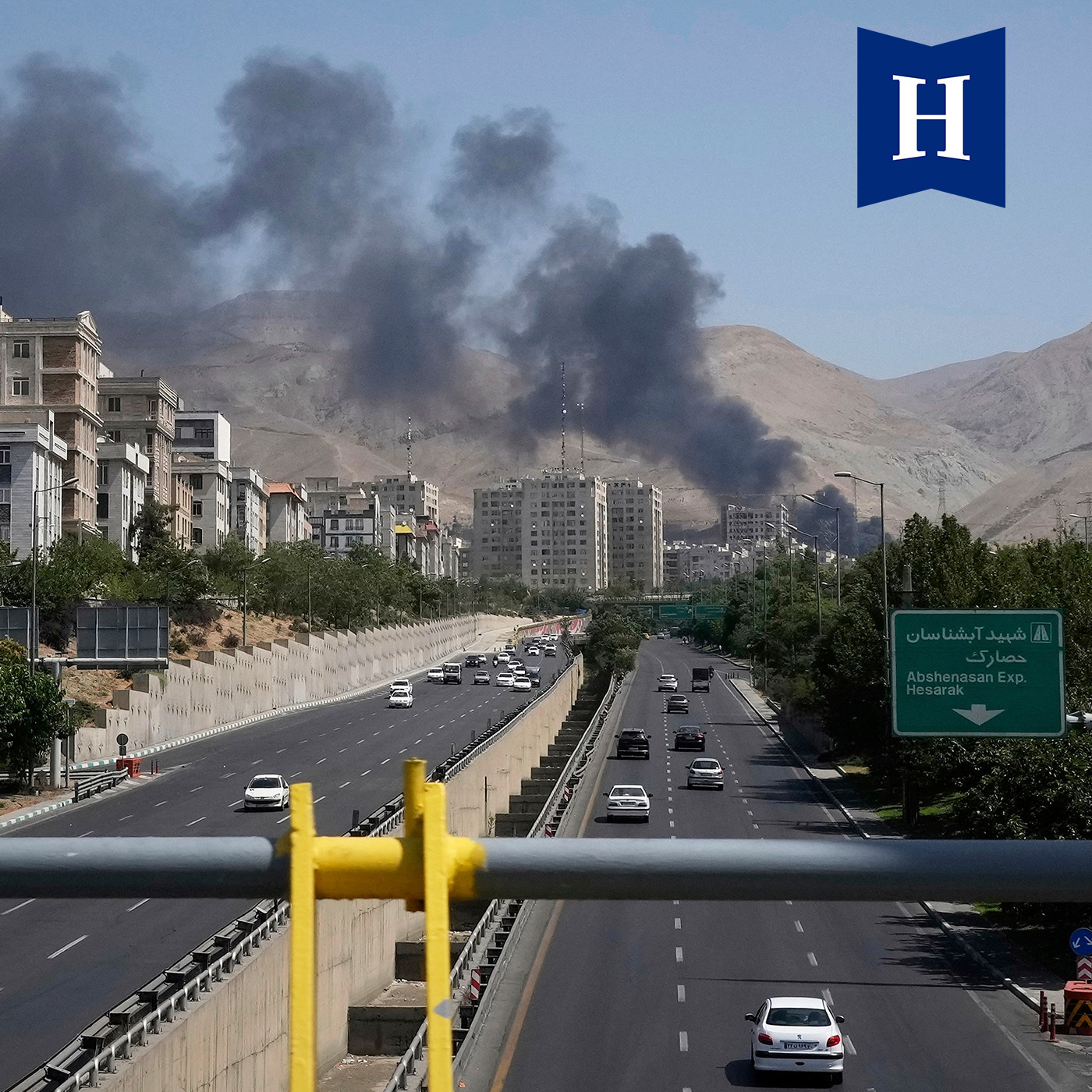
Rudyard Griffiths and Sean Speer discuss spiking oil prices and the economic fallout from escalating conflict between Israel, the United States, and Iran. They examine how spiking oil prices threaten to push North America into recession, impact household budgets and mortgage rates, and expose vulnerabilities in Canada's debt-dependent economy. They also explore whether market pressures will influence President Trump's war strategy and question the sustainability of America's unilateral approach without consulting allies.
The Hub is Canada's fastest growing independent digital news outlet.
Subscribe to The Hub's podcast feed to get all our best content:
https://tinyurl.com/3a7zpd7e (Apple)
https://tinyurl.com/y8akmfn7 (Spotify)
Watch a video version on YouTube: https://www.youtube.com/@TheHubCanada
Follow The Hub on X: https://x.com/thehubcanada?lang=en
CREDITS:
Amal Attar-Guzman - Producer
Elia Gross - Editor
Rudyard Griffiths and Sean Speer - Hosts
Vahid Salemi/AP Photo - Photo Credit
Hosted on Acast. See acast.com/privacy for more information.
Get every episode summarized
Each time Hub Podcasts publishes, we email you a written briefing from the transcript — the topics, who appeared, and any specific claims, with the ad reads skipped.
Email me new episodesFree for 3 shows. No card needed.
Transcript ready
159 searchable segments. Every word is indexed and playable.
Full transcript
Hub Podcasts — How the Iran War could trigger a Canadian recession. Machine-transcribed; use the interactive transcript above to jump the player to any line.
As the Israel-Arand U.S. War enters its second week, oil just hit $120 a barrel to explain what this could mean for everything from your mortgage to filling up at the pump, I'm joined by Sean Spear, my co-founder and editor at large. Sean, the single biggest spike in oil, really you got to go back to the 1970s and the energy crisis to see a similarly violent move for the international benchmark of oil brand crude. What's your take on this? What are the fallouts that listeners and viewers should be looking for to figure out what this means for all of us? Yeah, as you say, this affects so many aspects of our economy and society starting with
the economy itself. The U.S. economy lost 90,000 jobs last month. The Canadian economy is teetering on a recession. One has to assume, Roger, if oil prices remain elevated, even in the short term. It probably pushes the U.S. and Canada to say nothing of other parts in the world, either onto a really fragile economic plane or an outright recession. Then there's, of course, the impact on household budgets. This will necessarily have inflationary costs directly at the pumps, as you say, and then indirectly raising the price of everything that's transported around the world. Think of it as a large-scale carbon tax in that sense. I think this is huge, Roger. We can talk a bit about what it might mean for government budgets as well, but I think the short answer is, I don't think one can underestimate the economic significance of
this spike, and importantly, Roger, the probability that it remains elevated for some time. We still aren't getting shipments through the Strait of Amoris and Moose. I think there's a lot of uncertainty here that is going to have major economic repercussions. Yeah, and I think what everyone's coming to understand is that golf producers are having to do what's called a shut-in, where they take existing production. They have to, in a sense, cap these wells. They have to stop production. It takes, in some cases, weeks, months to fully unwind that. The longer the shut-in goes on, the longer the return to normal. I want to, though, focus listeners on this chart and talk to you about it, because I think this is really important for Canadians to understand. This is the five-year Canadian government bond, and look at it. You can see when the war happened for our listeners, basically, as soon as the war is declared, the yield on that bond spiked, and it's back up to almost 3 percent after a brief period
of decline. 3 percent on the five-year is higher than when the government of Canada through the Bank of Canada began this rate-cutting cycle. What is that now? A year and a half ago, multiple hundreds of basis points of front-and-cuts later, and we still have this all-important five-year government bond that mortgages are set off spiking. Why? Because of an inflation threat, a view that this war is going to be inflationary, and that bondholders want to get compensated with more yield to buy our debt on the basis that what they're going to get paid back in is going to be worth less because of inflation undermining our currencies, everybody's currencies around the world. Shaw, we are in the middle of, I think, one of the largest mortgage renewal cycles in Canadian history this year, and we're doing it at a time when Canadian real estate has
really had a tough 18 months. I worry about this chart. I worry about the effects of this war and how it's going to spill out well beyond the Middle East into things like Canada's all-important real estate industry, our single largest asset class in the country, bar none. Yeah, well said, Roger, but I think that's precisely right. The upward pressure on borrowing won't be constrained to the government. As you say, it will ripple out into business and consumer borrowing, and as we've documented at the hub, Canadian institutions from households to governments to businesses are addicted to borrowing. The government itself has some estimates about the effects of changes in the borrowing rate, what the sensitivity for government budgets and that same sensitivity runs through the entire economy. As I said out earlier, Roger, we were already in a pretty tenuous position before this,
and I think when you add this to the growing list of weights being held on Canada's economy, we could be in for some real challenges. Once I know about this, Roger, and why I'm so glad you underscored this point, is that then starts to manifest itself through households to the financial system and then to corporate borrowing in a way that can be pretty unpredictable and ultimately pretty damaging to the economy. The big question, Sean, I have, as we enter week two, is this disconnect between the President's rhetoric, because let's face it, Donald J. Trump is the person that either extends or ends this war, and his rhetoric seems to be on the extent thesis they're talking weeks, they've recast their war objectives in maximal terms, regime change, the President
is saying he wants a role in picking a RAN's new leader, Lindsey Graham, other people that seem to have the President's ear are talking about how the United States is going to run a Venezuela playbook on a RAN and have a say over its oil, and this is all about a strategic humbling of China, in other words, casting this war in much bigger geopolitical terms than just war against the Islamic Republic of Iran. But then, Sean, we know that this President tackles that in the face of real pressures in the past like Chinese control of rare earth minerals or Europe's maybe pushback on buying US treasuries in the face of threats around Greenland, that this is a mercurial President who can suddenly flip as well as flop. What is your sense of this, as we enter week two, is this time different for Donald J. Trump, and that's something we should be factoring into everything that we've talked about
up to this portion of hub hits, all the tale effects and disruption this war is causing to everything from oil prices to household balance sheets. Yeah, this is where economics and geopolitics intersect, as you've set out in previous conversations, Roger, the one influence that seems to be consistent over the President is markets. He'll ignore his own advisors, he'll ignore Republicans in Congress, he'll ignore other global leaders, but he won't ignore markets. We've seen him in various steps along the way, including with respect to tariffs, be responsive to those market forces, and so you're right. It's possible that in light of the market turmoil that we're seeing around the world, and the serious risks posed by high and sustained energy prices, we may see the President
choose a different path with respect to Iran. But I wouldn't underestimate how disruptive that is. Keep in mind that up until now, the President has talked about replacing the committee regime and we now have reports that another family member has stepped into the role as a supreme leader, so you ask yourself, what is this all for? What is the strategy? What was the motivation? What are the results of throwing the region Iranian society and the broader economy into such turmoil only to end up with the Iranian regime arguably strengthened, reinforced, and feeling ostensibly a bit hawkish in its capacity to have stared down the great Satan America and imposed itself on the region. This was always the risk of someone like Donald Trump engaging in such adventurism, the
lack of self-discipline, the lack of coherence would leave us weaker or not stronger. Yeah, I think you know, do look at markets as a barometer, but sometimes, and again, whether the President has the intestinal fortitude for this or not, we don't know yet. Sometimes though, strategic interests have to take priority for the sake of America's force posture in the world, its ability to deter at some future point a Chinese invasion of Taiwan for the Russian incursions into the Baltics. You know, the list goes on and on, where American power is can and will be tested. So I see this shown as a push and a pull, a battle of tensions right now between rising gas prices, probably the administration's ability to mitigate some of that through releases from the strategic petroleum reserve.
We have G8 ministers, G7 ministers meeting, finance ministers meeting today to talk about a broader international release of some reserves by the international energy agency. So look, some intermediary steps can be taken, I think, to blunt the pain of this remarkable run up in oil prices. And I guess it'll just come down to, I'd say watch the equity markets, watch the S&P 500. I think if you see a correction like the one that happened over the tariff tantrum last spring, almost a year ago, where you're into 15, 20 percent off highs, that's registering in every American's 401k, their retirement savings, those markets are priced to perfection right now. And I'll say today and throw it back to you for the final comment. I'll say today, actually, the markets are down again, but it's, you know, low single
digits in the United States. It surprises me. Maybe Mr. Market's right or Mrs. Market, that this isn't as big as I think others in the energy space think that this is in terms of a shock to the global economy, but right now I would say Donald Trump would look at those markets and say, hey, wait till I get to double digit losses on the S&P, then I'll start second guessing my strategic advisors. I agree with all that, but as we wrap up, I just want to emphasize your point about G7 countries now stepping up to try to solve for the supply damage done by this effectively unilateral America evasion of Iran without consulting its allies, Karni, Prime Minister Karni has said, for instance, that he had no prior warning. It kind of lays bare, doesn't it, Roger, the fallacy of the America first or America alone
doctrine that America is a tremendous superpower. It has extraordinary military capacities. We've been reminded in the past couple of months. But this idea that Donald Trump and the people around him can alienate and marginalize the allies and just dominate the world through brute force is being exposed as flawed here. I don't have any reason to think it will chase in the President, but it's a reminder that even a great superpower requires some friends. And here's hoping that one of the consequences is that over time, the subsequent American administrations and the American public are reminded of the benefits of bilateralism, multilateralism in some areas, because the cost and consequences of this action taken without the world is now being thrust on America and indeed the world.
Yeah, well, Sean, we'll continue to watch this at the hub. Get our energy experts will be weighing in over the course of this week. It's something we think we cover well here in Canada as a media organization. Feliz Chin, our Alberta bureau chief on top of this every day, Trevor Tum, one of Canada's top economists is an exclusive commentator here at the hub, deep knowledge of energy markets, budgets, finance, we're going to drill into it all this week. So head over to triplew.thehub.ca to check out our journalism. Sean, thanks for coming out and we'll talk again soon. You bet, thanks for having me.
More episodes
More from Hub Podcasts

The CBC’s 9/11 terrorism scandal reveals they operate in a separate reality
Hub Podcasts

Why Conrad Black is breaking with Trump over the Canada-U.S. trade war
Hub Podcasts

Trade war, separatism, and Canada’s trillion-dollar bet
Hub Podcasts

Why we support the now-dead Canada–U.S. deal
Hub Podcasts