Loading...
religionspirituality
How Artificial Intelligence Shapes Our World
About this Episode
Nate Kremer-Herman, Guest Speaker
Gregory Cook, Worship Associate
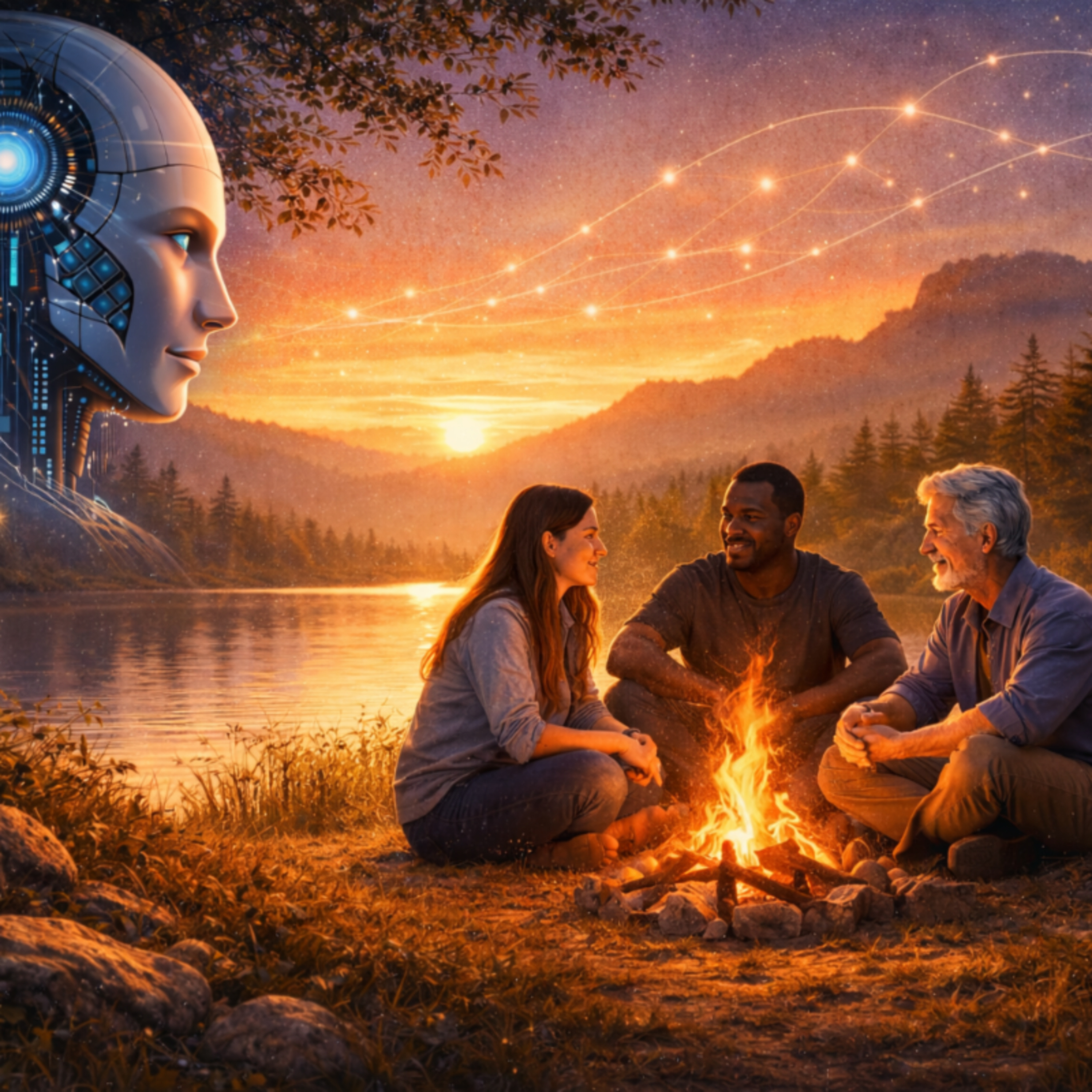
Artificial intelligence is the latest in a long line of tools that shape how we relate to our world and to each other. As we grapple with how AI is changing us, it is important to ground ourselves in our uniquely human experiences to cultivate closer communities and a healthier planet.
Nate Kremer-Herman teaches computer science at Seattle University. His research work engages with the Artificial Intelligence Alignment Problem to better ensure that AI adheres to our shared social and moral principles. Unsurprisingly, Nate's favorite class to teach is an ethics course for computer science students.
Hosts & Guests
Transcript
1.
2.
3.
4.
5.
3.
5.
5.
5.
5.
5.
6.
6.
6.
7.
6.
7.
7.
7.
7.
7.
7.
Good morning and welcome to Cedars Unitarian Universalist Church.
My name is Gregory Cook and I am a member of the Board of Trustees here.
We welcome you to our service this morning and are glad that you could make the time to come with us,
come be with us on this morning when it's so much earlier than it normally is.
Please join us after the service for coffee and conversation.
Before we begin, I have a few announcements which might also be printed on the back of the Order of Service.
One is that there is a sign-up on the back table for the next No Kings Day for more information talk to the Liz.
And apparently it is National Wife Carrying Day in the UK for more information talk to Deb.
Now please take a few moments to greet each other.
So thank you, please continue these conversations after the service.
This is far, far more enthusiasm than I was expecting.
This morning we are pleased to have our guest speaker Nate Kramer-Hermann.
He teaches at Seattle University his research work engages with artificial intelligence alignment problem to better ensure that AI adheres to our shared social and moral principles.
Unsurprisingly, Nate's favorite class to teach is an ethics course for computer science students.
And now let us begin.
We are not on the program, but we have to do birthdays.
That's the one thing we have to do for sure.
Anyway, we didn't do it last time, so we want to sing Happy Birthday to all the people who are present, who have a birthday this month.
And I think it's March.
If you do have a birthday this month, would you stand and remain standing?
Can we sing to you?
Okay. So the generic term, you can use any name you want, but dear friends, we'll cover everything.
Good morning, everyone.
Our words of opening are ever so slightly adapted from, in praise of technology and social media by Ren Belivance Grace.
In praise of computers and routers and servers and all the hardware and software that can help us build our connectedness.
In praise of all the gremlins that live in the machines and bug our programs and help us to practice patience.
In praise of the trolls who dwell in the internet and push us to live out our principles in real time.
In praise of power surges that eat our data and devour our final draft for giving us the opportunity to rebuild and remember that our work is as much transient as it is transcendent.
In praise of the error, page not found, which reminds us that with some people we need to find new paths to make connections, because not everyone uses the same keywords.
In praise of servers that drop our connections, which reminds us that all who serve have built in limits to their capacity.
In praise of communication and connection, whether it's face to face or Facebook to Facebook, we always risk errors, hurt feelings and misunderstanding, but it is also always worth the risk.
In praise of the trolls who dwell in the internet and push us to live out our principles in real time.
In praise of the trolls who dwell in the internet and push us to live out our principles in real time.
In praise of the trolls who dwell in the internet and push us to live out our principles in real time.
In praise of the trolls who dwell in the internet and push us to live out our principles in real time.
In praise of the trolls who dwell in the internet and push us to live out our principles in real time.
In praise of the trolls who dwell in the internet and push us to live out our principles in real time.
In praise of the trolls who dwell in the internet and push us to live out our principles in real time.
A few weeks ago I received what I thought was a bizarre email from my sister.
It began. I realized today that mom and dad have been here six months and that maybe you'd like an update.
Delete conversation if I'm wrong about that lol.
For some context, last summer when Arlene and I were in Alaska, my parents moved from Birch Bay to a little house near Yakima.
A few minutes from where my sister lives, I was neither consulted nor informed.
So I described the situation to a large language model such as chat GPT and then I gave it the text of the email and I asked it to describe the tone.
And it came back and said the tone is casual, almost performatively casual.
And it said my sister frames the update as optional, even trivial, something she just happened to think of, not something long overdue.
There is no acknowledgement that you were not told about the move, no recognition that six months of silence might matter.
The omission itself is tonal, a normalization of your peripheral status.
Alan said right on target.
The large language models are so good at what they do that I actually find it hard to remember what it is that they are doing.
They are not searching the internet and creating a summary of stuff that they find they are related to a question that I have asked.
In the example I just gave, it simply took all of the words that I gave it, the situation with my parents and the email from my sister.
It took all of those words and it put them in a bowl and then added a bunch more words that went well with the first ones.
Right, it made a word salad.
Now I have had some great salads in my life and I remember a kale salad specifically that I had at that restaurant in Port Townsend sirens.
The day that Arlene and I rode our bikes from Vade Bridge up there, we were very hungry.
It was a good salad but one thing I did not expect to find in that salad was the truth.
Large language models are not cognizant of facts or even the meanings of the words.
And so the next thing I said to the large language model was this, I'm stuck and I do not know how to proceed with my parents and with my sister.
So if you were my therapist what would you say?
And it said, let me give you an existentialist perspective because I know you tend to think that way.
John Paul Sart would say they are trying to fix you in a role.
The liberal son, the distant brother, the unfaithful caretaker.
If you live authentically, your parents and your sister no longer have the authority to define you.
Of course what Sart means by authenticity is kind of this constantly and actively choosing what you are.
Now you might think it's odd that this large language model would take this problem of family dynamics and immediately go to existential philosophy.
Well, this fellow and I have had multiple conversations about philosophy. It knows me.
But can I trust this answer? This result of an algorithm which arranges patterns from human composition and produces coherence through probability?
Can I trust this answer? That's a question that human beings always faced regardless of the source of the words.
And so I dedicate the lighting of our flaming chalice to the wisdom required to navigate the maze.
Please join with me in repeating our affirmation as printed in your order of service.
As we come together to worship, we remind ourselves to treat all people kindly because we are one family to take good care of the earth because it is our home and to live lives full of love and goodness.
Because that is how we will all become the best that we can be.
Our opening hymn is on the sheet that is included in your order of service.
I imagine most of you have heard the old joke about why Unitarians are poor singers because they are always reading ahead to see if they agree with the words.
Well, this was written by Unitarians, so it's probably safe.
And if you want to see a third iteration, if you want to see the second one, you can look on page 26 of your hymnal.
And that's another rewriting, so I predict there will be more.
So if you would stand as you're able and we'll sing all the verses here.
And if there is a third, you can sing all the voices.
And if you would stand as you're able and we'll sing all the verses here.
And if you would stand as you're able and we'll sing all the voices here.
I live there, I live there in town.
I live there, and I live there, if life?
How crazy old false to see, how my dreams make me curious,
Blondet brightly gleaming,
No we wouldn't see
All we'd like to be
Holy, holy, holy
Holy, angelic, so great
I'm so small this ain't a chore of
living palaces
And our water seems us, children of the solvers,
For the treasing of the holy pyroory.
Holy, holy, holy, songs to the dead with this beauty,
Till the end of the rainbow,
Our dreams sing our song to thee,
And we worship thee,
And we worship thee,
And we worship thee,
And we worship thee,
And we worship thee.
Our time for all ages
is going to be a reading of John Henry,
an American legend by Ezra Jack Keats.
And while I read,
I invite you all to also think about the historical context
in which John Henry, the myth,
lived his life,
and not just how his story relates to labor and technology.
A hush settled over the hills,
the sky swirled soundlessly round the moon.
The river stopped murmuring,
the wind stopped whispering,
and the frogs in the owls in the crickets fell silent,
all watching and waiting and listening.
Then the river roared,
the wind whispered and whistled and sang,
the frogs croaked the owls hooded,
and all the crickets chirped.
Welcome, welcome,
echoed through the hills.
And John Henry was born,
born with a hammer in his hand,
bang, bang, bang,
rang little John Henry's hammer
through the cabin as he crawled about.
What's that rascal up to now,
his mother chuckled?
And before she knew it,
he was big enough to help her around the house.
As he grew up,
he did a man's work with his father.
One day John Henry thought,
I'm taller and stronger than anyone around,
it's time I went out into the world.
He said goodbye to his mother and father,
and off he went,
he worked on farms and in cotton fields,
but all that was too tame.
So he got himself a job on a riverboat.
One stormy night,
the ship plowed through the darkness,
suddenly the big steel rod
that turned the paddle wheel broke.
The wheel stopped turning.
Smash went the rod through the bottom of the ship.
Pump water shot at the captain,
get to port before we sink.
John Henry leaped to the paddle wheel crank.
He seized it,
pushed,
and grunted and pulled.
Slowly the giant wheel turned.
With all its his strength,
he kept it turning.
Lord Almighty help us,
someone whispered that long,
dark night.
As day broke,
they sided shore and pulled into port,
a thunderous cheer went up for John Henry.
John Henry felt a new excitement in the air.
Men were talking of railroads being built
from the Atlantic to the Pacific.
They're going to lay those tracks over rivers,
across prairies and deserts,
and right through mountains.
And through Indian lands,
and stampeding buffalo herds and bad lands.
Goodbye boys,
cried John Henry.
I'm going to swing me a hammer on them beautiful new tracks.
My hands are just itching to hold a hammer again,
John Henry said.
He tried one for size and laughed.
It sure does feel fine.
How he drove those spikes,
singing to the clanging of his hammer,
the men joined in their voices singing hammers ringing,
and John Henry's gang was in the lead.
As day after day,
the tracks moved steadily westward.
Rising across their path was a sprawling mountain range.
Its snow-capped peaks reached high into the clouds.
We'll have the tunnel through,
set his friend little bill.
It'll be awfully dangerous.
Could be caveans,
someone put in.
That suits me fine, said John Henry.
Me too,
added little bill.
Here's how we'll do it boys,
the foreman called out.
A couple of men will drive a hole into the rock,
then the powder man will put dynamite into the hole
and explode it.
The others will cart the loose rock away,
and we'll do this again and again
until we have a tunnel right through this mountain.
And it's going to be a real big tunnel boys,
big enough for a giant locomotive pulling
one of them long strings of trains.
All right boys, blast away.
Deep into the mountain they worked,
as John Henry's singing echoed through the tunnel,
the powder man got ready to blast more rock.
They filled the hole with dynamite,
put in a long fuse and lit it.
Run, men cried the foreman.
They all scrambled back,
ready to dash clear of the blast.
At that instant came a great cracking and rumbling,
and the entire tunnel trembled around them.
It's a cave and we're trapped.
There was no place to run.
The fuse burned closer to the dynamite.
John Henry was nearest to the fuse.
He ran to put it out but tripped and fell.
Ooh, I'm hurt bad.
He groaned.
I can't get up.
The fuse burned farther out of reach.
Others rushed toward it but they were too far away.
Suddenly John Henry remembered
he still had his hammer in his hand.
Down came the hammer smack on the burning tip.
The fuse was out.
Danger passed.
Size of relief filled the smoky tunnel.
Whew, help me up boys, mumble John Henry.
Clearing their way through the cave and the men carried him to safety.
Some days later they heard an unfamiliar clatter.
Down the tunnel came a group of men with a strange machine.
This is a steam drill.
It can drill holes faster than any six men
combined a new man bragged.
Who can beat that?
John Henry stepped forward.
Try me.
He and Lil Bill took their workplaces.
John Henry gripped his hammer.
Lil Bill clutched his steel drill.
Checked the machine came in order.
A nervous hand fell on the switch.
In the dark both sides waited for the signal to start.
A horse voice counted.
One.
Two.
Three.
The machine shrieked as it started.
John Henry swung his hammer and a crash of steel on steel split the air.
Clang, bang, clang.
The drill got red hot in Lil Bill's hands.
He quickly dropped it and picked up another.
His whistle rattled.
Men frantically heaved coal into the hungry roaring engine
and poured water into the steaming boiler.
Whoop, clang.
Whoop, bang.
John Henry's hammer whistled as he swung it.
Chug, chug, clatter rattled the machine.
Hour after hour raced by, the machine was ahead.
Hand me that twenty pound hammer, Lil Bill.
Harder and faster crashed the hammer.
Great chunks of rock fell as John Henry ripped hole after hole into the tunnel wall.
The machine rattled and whistled and drilled even faster.
Friends doused John Henry and Lil Bill with cold water to keep them going.
Then John Henry took a deep breath, picked up two sledge hammers and sang,
eight no hammers strike such fire, strike like lightning, Lord, and I won't tire.
Hammers like this Lord there's never been, I'll keep swinging them Lord until we win.
John Henry swung both mighty hammers, faster and faster.
He moved so fast the men could only see a blur and sparks from his striking hammers.
His strokes rang out like great heartbeats.
At the other side of the tunnel, the machine shrieked,
groaned and rattled and drilled.
Then all at once it shook and shuddered, whist and stopped.
Frantically men worked to get it going again but they couldn't.
It had collapsed.
John Henry's hammering still rang and echoed through the tunnel with a strong and steady beat.
Suddenly there was a great crash.
Light streamed into the dark tunnel.
John Henry had broken through.
Wild cries of joy burst from the men.
Still holding one of his hammers, John Henry stepped out into the glowing light of a dying day.
It was the last step he ever took.
Even the great heart of John Henry could not bear the strain of his last task.
John Henry died with his hammer in his hand.
If you listen to the locomotives roaring through the tunnels and across this land,
you'll hear them singing, singing the song of that great steel driving man, John Henry.
Listen.
On many Sundays we set aside some time for the sharing of joys and sorrows.
If you have a joy or a sorrow that you would like to share,
please come forward, state your name, and in a few brief sentences, share your joy or sorrow.
Place a stone in the bowl for a sorrow so that we may all share your burden,
or pour a little water in the bowl for a joy so that we may all be buoyed up.
I pour a little more water in the bowl and place a final stone
for all of the joys and sorrows that remain unspoken, held delicately in our hearts.
So for some of you, I'm a familiar face.
I've come here a few times before, but recently I have been attending
I get passage friends meeting, so I thought I'd bring a little interface experience for our centering moment.
For many Quakers, worship is unprogrammed.
No pastors and no prescribed service.
Instead, we gather together in silent worship and listen for a leading from within.
In mind, a vitiate understanding of Quakers and I have come to understand that Quakers broadly believe
that there is that of the divine in all things, and that we are each a fundamental thread woven into a majestic tapestry.
I've experienced a profound sense of peacefulness in my quiet contemplation about and listening for that aspect of the divine within me.
William Penn, an early Quaker, wrote a lot about his beliefs, and yes, that is the William Penn of Pennsylvania.
Here are a couple of his thoughts on listening for the still small voice of the divine to be found within each of us.
Look not out but within.
Remember it is a still voice that speaks to us in this day, and that it is not to be heard in the noises and the hurries of the mind,
but it is distinctly understood in a retired frame.
True silence is the rest of the mind, and is to the spirit what sleep is to the body, nourishment and refreshment.
In our centering moment together, I invite you all to join me in a brief moment of silent attention to that still small voice of the divine within each of us.
Whether you describe the divine as a God, love, truth, nature, the universe, or whatever words you best describe your sense of it, I invite you to attend it inside yourself.
It will take just one minute to actively listen for it together in community.
I'll watch the time.
Thank you very much.
Thank you very much.
Friends, I hope your listening was nourishing and refreshing.
I invite you to stand as we sing number 170.
Thank you very much.
Thank you very much.
Thank you very much.
Thank you very much.
Thank you very much.
Thank you very much.
Thank you very much.
Because of these things, this institution is worth supporting.
Please support it generously.
If you are visiting for the first time, please feel free to let the baskets pass you by.
You are our guest, and we are happy simply that you are with us today, with the ushers come forward to collect the offering.
Thank you very much.
Thank you very much.
Thank you very much.
Thank you very much.
Thank you very much.
Thank you very much.
Thank you very much.
Thank you very much.
Thank you very much.
Thank you very much.
Thank you very much.
Thank you very much.
Thank you very much.
Thank you very much.
Thank you very much.
Thank you very much.
Thank you very much.
Thank you very much.
Thank you very much.
Thank you very much.
Thank you very much.
Thank you very much.
Thank you very much.
Thank you very much.
Thank you very much.
Thank you very much.
Thank you very much.
Thank you very much.
Thank you very much for your generous gifts.
I've been invited to share my thoughts on artificial intelligence.
Before sharing my own views, I'd like to first take a moment to define AI and provide
an incredibly condensed history of it, and I'd also like to share my own biases and
my knowledge gaps.
Artificial intelligence has been a topic of interest within computer science for nearly
as long as the discipline of computer science has been around.
Artificial intelligence is more than chat GPT.
I define AI as any software which sufficiently presents as having some aspect of intelligence.
For instance, video games often present us with computer technology,
but we don't know how to use it.
Artificial intelligence is more than chat GPT.
I define AI as any software which sufficiently presents as having some aspect of intelligence.
For instance, video games often present us with computer control opponents commonly and
correctly referred to as AI.
A good video game AI exhibits behaviors we might expect from a human opponent playing
against us just behind the screen.
However, for the vast majority of video game history, these behaviors were hard-coded,
baked into the software by programmers.
Other kinds of AI simply appear smart because they've had a lot of information fed into them.
One of the largest waves of industry AI applications were the expert systems of the 1980s.
Sophisticated software tools were created to act as advisors and for practitioners in numerous fields.
From medicine to machine maintenance, construction, you name it.
These systems didn't learn new facts on the fly.
They provided a seemingly comprehensive set of information, crowd sourced from world-class human experts in these fields.
The advisory software was artificial.
The intelligence was at its core human.
Still, other kinds of AI have complex software architectures patterned in part on our understanding of the human brain.
For this reason, these are often called neural networks.
Networks ingest training data, learn patterns from it based on incredibly advanced statistical methods,
then are challenged with new data to see if they can glean similar patterns from it.
This branch of AI sometimes referred to as connectionist AI is the branch that has the most popularity,
and much to my sugar and the biggest research budgets today.
The latest wave of AI commonly referred to as generative AI has provided us with a raft of tools
based on neural networks, which can generate novel output, whether it be text, images, audio or video,
based on massive data sets at internet scale.
The AI tools with which we interact present a facsimile of intelligence in that they seem to be able to discern whatever question or task we provide it.
Think on it and present us with an answer that we find valuable.
This is, however, just a facsimile.
At the heart of generative AI, the engine for all these tools is an incredibly sophisticated version of the auto-complete feature we've had on our phones for years,
which was at one time correctly touted as advanced AI.
I'm happy to share my thoughts and experiences concerning AI, but I should also make you aware of my biases and my limitations.
For most, I'm not an expert in machine learning, which is the area of study concerned with neural networks and with the generative AI we see today.
I know just enough to be dangerous, but not enough to give you an in-depth lecture on the inner workings of these machines.
I would be negligent in my duties as a scientist if I didn't disclose this limitation, and I invite you all to take my perspective with a grain of salt.
To that, my perspective is my own. There are many computer scientists who are going to agree with what I have to share, but my opinions are not representative of the field of my colleagues at Seattle University, nor of my students.
I have a weird background for a computer scientist. In my undergraduate studies at a small liberal arts college, I majored in computer science, and I minored in both sociology and in philosophy.
This has led me to my current research focus, which is machine ethics. This is an interdisciplinary field focused on ensuring autonomous machines like AI exhibit moral behaviors when they act on our behalf.
My research work is in part engineering, part philosophy, and part social science, and I love the opportunities I have to contribute to this field alongside my colleagues.
I have particularly niche interests in AI that are definitely the road less traveled among the broader research and industry communities.
Finally, I want to expressly mention that I don't know everything there is to know about the usage, impacts, and future of AI in our society.
I've structured my thoughts based on what I've experienced, what I do know, and what I believe, and I graciously invite dissenting viewpoints.
With that we finally arrived to the moment you've all been waiting for. I am fascinated by artificial intelligence and its impact on humanity and our planet.
Seemingly every day I am posed questions about the technology by my peers and my students.
I could talk at length about the implications of AI from various lenses, the technical, the philosophical, the social, the psychological, the environmental, the spiritual, and seemingly onward into infinity.
Since it's all anybody wants to talk about right now. How will AI change the face of education? What does AI change about our meaning of work?
Is the super intelligence singularity right around the corner? Are spiritual experiences with AI real? Can a machine have a soul, a mind, or lived experience?
Perhaps to your disappointment I choose to put down these lofty questions and pick up something at a much lower level.
Technology fundamentally changes us. Our usage of tools from language to the axe to the television have shaped our daily lives and how we relate to each other.
Language begets mutual understanding. The axe begets wood, which begets warmth and shelter.
TV begets mass media, entertainment, information, and education on demand and in our homes.
AI is a technology in many ways like every other.
We use tools to affect change in the world. We use the axe to chop down a tree and use its wood.
Our usage of the tool also affects us.
As I use the axe, my arms grow stronger, calluses develop on my hands. I become more proficient in using the tool, but the tool also shapes me to its form and its use.
A good friend of mine and fellow professor at Seattle U, Eric Severson calls this phenomenon backflow.
In plumbing, backflow refers to a system where water flows in the reverse direction along the pipes, then it's supposed to be going.
Applied to technology broadly, this is the understanding that no tool, no technology, is ever truly neutral.
The tools we use are designed with a certain form, a certain framing of the world. When we use the tool, it shapes us toward that form and toward that framing.
As the law of the instrument goes, give a small boy a hammer and he will find that everything he encounters needs pounding.
Since AI is a tool, how does it shape our world? My answer to this question focuses on the AI industry and not the underlying technology.
In my view, the technology has a lot of promise and holds my technical interest, but its application to shape our world by a select few exceedingly influential corporations is existentially worrisome to me.
At this moment, I choose not to use any generative AI tools hosted outside the four walls of my own computer case.
This means for me, no chat GPT, no Gemini, no Sora, no Claude, and so on.
I personally, personally, find the usage of these tools unethical as they come to us today.
To understand my sentiments toward the AI industry is to understand that the Luddites smashed the machines not because they were afraid of them, but because the existence of the machines necessitated the existence of dangerous, often lethal, and oppressive labor practices including child labor.
My selection of the story of John Henry is intentional as a parallel to the usage of AI as a smoke screen to cover for mass layoffs in the tech industry and beyond.
Just as the steam drill was not able to outwork John Henry, we're seeing reports that AI replacements for human expertise have led to few gains and often losses in productivity and profits.
In my understanding, many of the layoffs we see are only in part due to AI.
The other, often unnamed, parts are changes in corporate taxation, general economic downturn, I think we can all see that, and the realization that infinite growth is not actually achievable no matter how large and important the company.
And yet, we're left to grapple with AI shaping the world of work in ways realized or hyperbolic that affect all of us.
When deciding for yourself whether to use AI, I invite you to consider how your usage might contribute to the shaping of the world of work.
I choose not to use corporate AI tools because they shape our relationship to the land.
A recent study covered by Scientific American found that an AI-enabled Google search consumes roughly 30 times more electricity than original flavor no AI Google search.
It also turns out that many of us seem to prefer the quality and kind of results that we get from non-AI web search.
We prefer not to be recommended glue as a good topping for a pizza.
We prefer to receive sound factual medical information online.
It often feels like AI is a solution in search of a problem.
As we wait around for a problem prodigious enough to justify the environmental costs of AI, we pay that cost daily with slim to no real positive return.
The AI industry is choking our skies with pollution, driving up our energy bills, consuming our drinking water, endangering wildlife, and all in the name of the bigger, the better.
The increased construction of data centers and nuclear power plants should have us questioning whether this technology is shaping our world in congruence with the planet or an opposition to it.
Since AI is a tool, how does it shape us?
I choose not to use corporate AI tools because the AI industry is putting our lives at risk.
It has encouraged teens to self harm, induced AI psychosis, given us post-truth nutritional advice and eroded our ability to trust audio, video, and photographic evidence of world events.
The AI industry is centered on the economy of attention.
Chat GPT is trying its best to enrapture you, to keep you chatting, to get you to give open AI as many data points as possible about who you are and what you care about.
The announcement that chat GPT will soon serve you targeted ads should come as no surprise.
I question whether the funny meme generated by Gemini, the zany plot of a video generated by Sora, or the bedtime story generated by chat GPT are ever worth the cost.
Likewise, I wonder if the executive level summary or the tutoring session justify the environmental harms and privacy concerns they produce.
What concerns me most may seem like one of the more benign use cases of AI though.
Plenty of people now use AI to write their emails and text messages for them to craft their communication with others on their behalf.
When did the tool shape us to become so comfortable silencing ourselves in deference to the machine?
And when did the tools shape us to become so detached that we would rather outsource human connection to an algorithm than experience it ourselves?
Author Corey Doctoro said at best when pointing out that too often, quote, the important thing about a machine is what it does and not who it does it for and who it does it to.
When deciding for yourself whether to use AI, I invite you to consider how the tool is helping or hurting your connections with community.
So is there a way to use AI for the benefit of our planet and communities?
AI has already begun to shape our world, but we're not idle passengers.
Tools can be repurposed, reshaped, and reframed.
We can more conscientiously take up tools, knowing how they affect our world view, or we can rework the tool until it is more in line with our understanding of each other, our values, and our planet.
I do not fundamentally reject AI as a technology. I reject the current market focused conception of AI, which is fundamentally limited by the imaginations of those telling you what you should believe AI is, what it can do and its place in your life.
Your voice is essential right now. Before it's too late, before the tools form becomes fixed, we can reshape the tool before it irreparably reshapes us.
AI is not magic. It's not a wild beast to be tamed. It is a predictable, efficient, calculating tool.
Ask any crafts person, designer, or engineer, and they'll tell you, we can always make a better tool.
To make AI that better tool requires not only the prowess of the software engineer and the data scientist, it requires new kinds of crafts people, who approach the tool with spirit, with love, with true friendship amongst community, with unrelenting justice and a penchant for humble lifelong learning.
Here's how I use AI, and I must admit I do in fact use it. I choose to run AI tools locally. This means they run on my own computer, completely disconnected from the internet.
I choose to use only open source AI tools. This means that I can inspect the code, or I can inspect the AI model, and so can everybody else.
I choose to use small AI models. This means they haven't consumed as much energy when they were first designed and trained.
This approach grants me significant control over the AI tools in my life, and my AI doesn't report back to some company with what I ask it.
Its energy usage is limited to what's available at home and not in a large data center.
I'm not tempted to use the tool in a way that may shape my relationship to community, because I have to consciously turn on the AI on my computer before I can use it.
I'm never prompted with a new use case, I have to seek them out.
This approach is limiting. I don't have, certainly can't afford, the fancy hardware that open AI or anthropic can.
This means my AI won't be as fast or as capable. It also means I won't accidentally burn significant fossil fuels or consume gallons of water if I give my AI a tough problem.
My AI tools are freely available and can run on Windows, Mac, or Linux. They can run on smartphones too.
When I imagine the future of AI, I see a decentralized world where the tool lives on our own computers, on our own phones, where we can use the tool to improve our lives and not distract from them, where we have chosen to limit ourselves which in turn limits the effect of the tool reshaping us.
It's impossible to create AI tools which won't shape our world and shape us. However, we can choose to become craftspeople who understand and work on the tool rather than remain mere users of it.
I don't have all the answers. In fact, I have very few. But I do know now is the time to make a better tool.
Will you help reshape this tool before it irreparably reshapes us?
I'll close again and I'll switch to a very wide panel for a minute.
I'll close again and I'll switch to a very wide panel for a minute.
I'll close again and I'll switch to a very wide panel for a minute.
I'll close again and I'll switch to a very wide panel for a minute.
Please repeat after me as I extinguish our flaming chalice. We extinguish this flame but not the light of truth.
I'll close again and I'll switch to a very wide panel for a minute or the fire of commitment.
These we carry in our hearts until we are together again.
It is a privilege to live in a world with so many wonderful conveniences.
It is our responsibility to make the most of these conveniences to improve ourselves, our communities and our world.
We acknowledge our tools, our expressions of our humanity and that they reflect both our strengths and our imperfections.
Together we seek to craft tools which increase our connections to each other and to our planet, provide us all with convenience and utility, yet challenge us to become better people every day.
Computer technology has made it easier than ever to keep in touch with friends and family all over the world to learn new skills, to keep up to date on world events and the take care of our day-to-day to-do lists.
Computer technology has also made it easier to become isolated in bubbles, the distance oneself away from the world, the latest artificial intelligence systems provide new, unexplored avenues for connection and for isolation.
In gratitude for these wonderful conveniences, together we seek clarity and how best to use these powerful tools for service and not for harm.
Computer technology has made it easier than ever to keep in touch with friends and family all over the world to learn new, unexplored avenues for connection and utility, yet challenge us to become better people every day.
Computer technology has also made it easier to work with friends and family all over the world to learn new, unexplored avenues for connection and utility, yet challenge us to become better people every day.


