About this episode
Interactive timestamps
Jump to segmentGet every episode summarized
Each time Bright Side Universe publishes, we email you a written briefing from the transcript — the topics, who appeared, and any specific claims, with the ad reads skipped.
Email me new episodesFree for 3 shows. No card needed.
Hosts & guests

Transcript ready
247 searchable segments. Every word is indexed and playable.
Full transcript
Bright Side Universe — How About Making Mars Livable on a Budget?. Machine-transcribed; use the interactive transcript above to jump the player to any line.
0:00This episode is brought to you by State Farm. Listening to this podcast, smart move. Being financially savvy, smart move. Another smart move, having State Farm help you create a competitive price when you choose to bundle home and auto, bundling. Just another way to save with a personal price plan. Like a good neighbor, State Farm is there. Prices are based on rating plans that vary by state. Coverage options are selected by the customer. Availability, amount of discounts and savings and eligibility vary by state. On December 12, Disney Plus invites you to go behind the scenes with Taylor Swift in an exclusive six episode docu-series. I wanted to give something to the fans that they didn't expect. The only thing left is to close the book. The end of an era. And don't miss Taylor Swift, the era's tour, the final show featuring for the first time the torture poets to format. Student December 12, only on Disney Plus. Imagine something terrible happening to Earth
1:03and humans having to leave it as fast as possible. And you have to decide which planet will become your new home. Which one will you pick? Probably the first planet that comes to mind is Mars. It's relatively close. Like Earth, it's also a rocky planet. It even has an atmosphere, even though it's much thinner than what we have on our planet. But at the same time, the North Pole on Earth would seem balmy to you in comparison to Mars. On the red planet, the average temperature is minus 80 degrees Fahrenheit. The most radioactive areas on our home planet might seem harmless if you compare them with the surface of Mars. But what if we terraform Mars? Could we keep transforming the red planet until it becomes capable of supporting human life? It would be an enormous feat. Mars is an extremely dangerous place. Should you teleport there right now without any protective suit or anything, the gas in your blood would instantly turn into bubbles?
2:05You can probably imagine the consequences. Add oxygen deprivation, cold exposure, and radiation poisoning to the equation. And well, who's next? If we still decided to terraform Mars, we would need to create a stronger magnetosphere. We've got this protective magnetic layer on Earth. It shields us from the Sun's ultraviolet radiation. The red planet would also need a thicker atmosphere, again, for protecting us from harmful space stuff better. Right now, the Martian atmosphere is almost entirely composed of carbon dioxide with tiny amounts of oxygen. For us to live there comfortably, Mars would also need to be warmer. And if we manage to somehow warm the planet up, we'd also be able to release frozen carbon dioxide. At the moment, there are vast reserves of this gas at the red planet's polar caps and other areas. It would help the atmosphere to become thicker, making it possible for water to exist
3:05on the surface of the planet. Right now, there is some water on Mars. The atmosphere of the red planet is too thin for this water to stay in its liquid form. But under the surface of the planet, it's a different matter. You can find water under the surface of the planet in its polar regions. The only place where this water is visible is at the North Polar Ice Cap. Also, sometimes salty water flows down crater walls and... Exama is unpredictable. But you can flare less with eggless, a once-monthly treatment for moderate-disappear egg-sama. After an initial four-month or longer dosing phase, about four and ten people taking eggless achieved itch-relate and glare are almost glare-skinned at 16 weeks. And most of those people maintain skin that's still more glare at one year with monthly dosing. Empless, LibriKizumap, LBKZ. A 250-milligram per 2-milliliter injection is a prescription medicine used to treat adults and children 12 years of age and older who weigh at least 88 pounds or 40 kilograms with moderate-disappear egg-sama. Also called atopic dermatitis that is not well controlled with prescription therapies
4:06used on the skin or topicals or who cannot use topical therapies. Empless can be used with or without topical corticosteroids. Don't use, if you're allergic to empless, allergic reactions can occur that can be severe. Eye problems can occur. Tell your doctor if you have new or worsening eye problems. You should not receive a live vaccine when treated with ebglus. Before starting ebglus, tell your doctor if you have a parasitic infection. Ask a doctor about ebglus and visit ebglus.lili.com or call 1-800-LiliRX or 1-800-545-5979. It's not just something you made. It's the privilege that you get to work with your hands. It's building something that serves a purpose. Proof that you have the grit to keep going. At Simplend, we understand you take your craft seriously and we do too, which is why our products are built to the highest quality. We put in the work so you can perfect yours with purpose in every detail and crafted with intention. Simplend, built on craft, visit Simplend.com to shop. Hill sites and there are tiny quantities of water in the planet's atmosphere, but it only exists as vapor.
5:10If liquid water existed on the surface of the planet, it would make it easier for us to start growing plants. And plants, in turn, would begin to produce oxygen. But first of all, we would need to start the warming process. How? Well, Eli must suggest using nuclear energy to make Mars more livable. He says it could be done by creating a continuous flow of low-follow nuclear fusion explosions above the atmosphere of the planet. It could create something like numerous artificial suns. It could warm the planet, melting the frozen ice caps, which would then thicken the atmosphere, causing even more warming. Other strategies for Martian global warming include the diversion of asteroids into the poles of the planet or the large-scale production of greenhouse gases that could help us heat the red planet. Or we could create a giant space mirror as huge as the side of Mars. It would reflect tons of additional sunlight onto the planet.
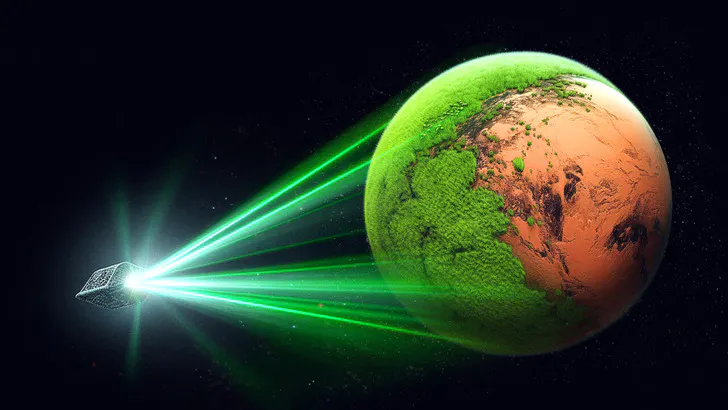
6:12The problem is all these projects would have exorbitant costs. It would also require serious upgrades in our technological capabilities. Could there be an easier and cheaper way of terraforming the red planet? It seems so. Casey Hanmer used to work in NASA's Jet Propulsion Laboratory. Now, he's the founder of a startup hoping to create carbon-negative natural gas by pulling carbon dioxide out of the atmosphere of our planet. He's also made a proposal to terraform Mars for a modest $10 billion. Sounds alluring. So, what is his idea? Mass-produced, small solar sales. These are already existing technologies, even though they appeared only recently. Such sales used sunlight to propel themselves, like ships used the wind to sail. These solar sales could be launched into low-earth orbit, and after that, they would fly themselves to Mars.
7:13There, they would reflect sunlight onto the night side of the planet. According to Hanmer's calculations, a decade of such launches could result in a 1% increase in temperature on Mars. Hanmer also believes that we could mass-produce solar cells at cell phone factories. All because a solar sail would need a processor, a camera for navigation, and some electronics to be able to transmit data just like a smartphone. In other words, solar sales would be like small satellites using cell phone technology. Each of these sales would also need a sail of its own, a thin space blanket weighing about 2 pounds. When unfurled, it would spend around the size of two basketball courts. With this plan involving solar sales.
8:30Enable people to terraform Mars. Hanmer doesn't think so. Even if we put loads of money into solar sales, they would only make the red planet warmer and more human. But they still wouldn't be enough to make Mars suitable for human life. Most scientists are also very skeptical about the very idea of terraforming this cold, dry world. They say that carbon dioxide and water vapor are the only greenhouse gases present on Mars. But there's just not enough of them to change the situation. Let's say we managed to melt the polar ice caps with a help of Elon Musk nuclear technology or solar sales. And still, this ice will only release enough carbon dioxide to bring the atmospheric pressure to 1.2% of what it is on Earth. Plus, most of the carbon dioxide gas wouldn't be accessible. And we wouldn't be able to mobilize it.
9:31Even if we decided to go through an energy-intensive process of the extraction of carbon dioxide from the planet's soil, dust, and minerals, we'd still only get the atmosphere to a mere 5% of where it needs to be. Water is another problem. It is salty on Mars. It might even be as salty as the oceans on our planet. But these salts aren't what you find on Earth. If a person consumed a certain amount of them, they would be highly toxic to the human body. Who's next? On our planet, these salts are formed as byproducts of rocket fuel, as well as in road flares and fireworks. Naturally, they only occur in very dry areas. If there are no particular bacteria to break them down, these substances accumulate year after year and their concentration in water is constantly increasing. But in theory, it's possible to purify even such water. The process of filtration could help the astronauts
10:34get rid of 90% of harmful substances. Then they could use a UV disinfection unit. This would also help get rid of any foreign molecules, if there are any, that might be hiding in the water. This stage would not only protect the astronauts, but also prevent them from bringing any dormant Martian microbes back to Earth. In other words, future travelers to Mars shouldn't have too many problems with drinking water on the red planet. But only if they bring the right purification equipment that can deal with any water quality. Because, however bad running out of water in the middle of a desert is, experiencing it on another planet sounds much more terrifying. Anyway, back to terraforming the red planet. When should start thinking about it, some worrying questions arise? Who is supposed to decide whether we should start this process? When should we start it? What if there's some form of life on the red planet, like indigenous microbes we haven't spotted yet,
11:34and our attempts to change their home will disturb them? What if they don't survive these changes? Now, what do you think? Share your thoughts in the comments. This episode is brought to you by Athletic Brewing Company. No matter how you do game day, on the couch, in the crowd, or manning the snack table, athletic brewing fits right in. With a full lineup of non-alcoholic beer styles, you can enjoy bold flavors all game-long. No hangovers, no buzz, no subbing out for water in the second half. Stuck the fridge for tip-off with a variety of non-alcoholic craft styles available at your local grocery store or online at AthleticBruing.com. Near beer, fit for all times.
More episodes
More from Bright Side Universe

Solar Eclipses That Changed Human History Forever
Bright Side Universe
Our Solar System Is Doomed Because of This Star
Bright Side Universe
7 Ancient Sites Some People Believe Were Built by ALIENS
Bright Side Universe
What Changed the Moon Forever? The Incredible Event That Shaped It
Bright Side Universe