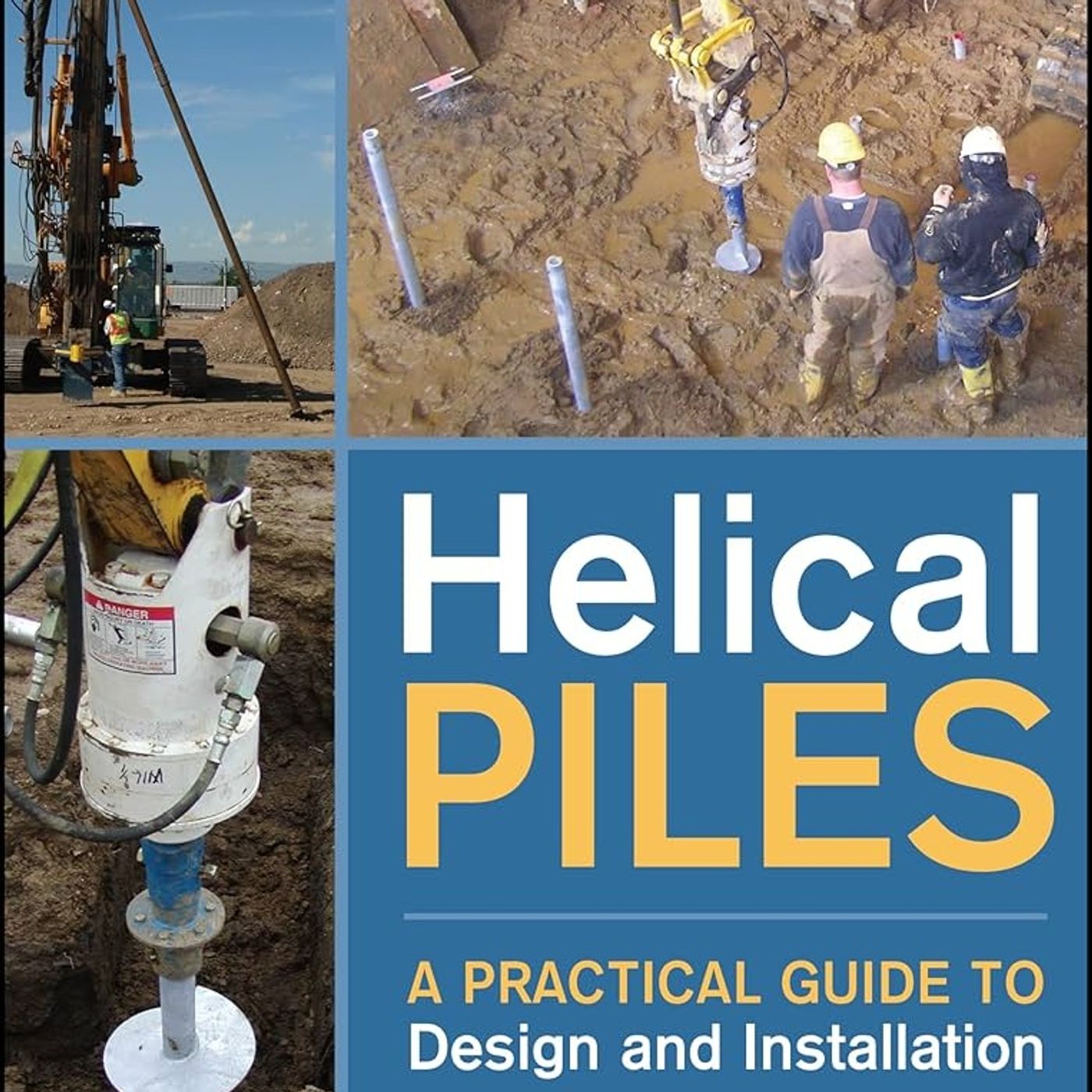
Helical Piles: A Practical Guide to Design and Installation
About this episode
Get the Book now from Amazon:
https://www.amazon.com/Helical-Piles-Practical-Design-Installation/dp/0470404795?&linkCode=ll2&tag=cvthunderx-20&linkId=7d121e08b43b813498f2f4385f9c139b&language=en_US&ref_=as_li_ss_tl
You can listen and download our episodes for free on more than 10 different platforms:
https://linktr.ee/civil_engineering_made_simple
Produced by:
https://www.podcaistudio.com/
Interactive timestamps
Jump to segmentGet every episode summarized
Each time Civil Engineering Made Simple publishes, we email you a written briefing from the transcript — the topics, who appeared, and any specific claims, with the ad reads skipped.
Email me new episodesFree for 3 shows. No card needed.
Hosts & guests
Transcript ready
777 searchable segments. Every word is indexed and playable.
Full transcript
Civil Engineering Made Simple — Helical Piles: A Practical Guide to Design and Installation. Machine-transcribed; use the interactive transcript above to jump the player to any line.
0:00Tyler Reddick here from 2311 Racing. Victory Lane? Yeah, it's even better with Chamba by my side. Race to chambacacino.com, let's Chamba. Don't purchase necessary, VTW Group, voidware prohibited by law, CTNCs, 21 Plus, sponsored by ChambaCacino. For those with type 2 diabetes or high blood pressure, you may be missing a hidden signal from your kidneys, an SOS for an increased risk of cardiovascular events like heart attack or stroke. The mission? Detect the SOS. Start at Detect the SOS.com. Learn how a simple UACR urine test can help identify kidney damage early. Talk to your doctor about getting screened. Go to Detect the SOS.com to learn more about UACR urine testing today. Brought to you by Beringer, Engelheim, Pharmaceuticals Inc. So you look at a towering electrical utility line or maybe a five foot thick radiation shielded concrete wall at a hospital. Right, the kind of heavy infrastructure you just walk right past every day. Exactly. And you naturally assume the foundation
1:00holding all that massive weight up was born in some high-tech laboratory somewhere. Oh, definitely. You picture super computers, wind tunnels, you know, teams of engineers and heart hats staring at digital models. Right. But what if I told you that one of the most versatile, reliable foundation technologies used in modern civil engineering was actually invented by accident? Which sounds completely made up, but it's not. It's really not. It was invented by a blind Irish brick maker who was just playing around with a boat sail. It's an amazing story. And it represents one of the most fascinating physical translations of force we have in geotechnical engineering today. Yeah. So today we are taking a deep dive into Howard A. Perko's definitive 2009 textbook. It's called Helical Piles, a practical guide to design an installation. It is essentially the Bible for the specific technology. Right. And we're going to extract exactly how this bizarre 19th century accident became the ultimate tool for modern infrastructure.
2:00We want to unpack the exact science, the mechanics, and the real world applications of these things. Because whether you are an engineering student, a young professional, we're just, you know, looking at a commercial high rise and wondering how it stays up. Or wondering why your own house is settling? Exactly. Understanding what happens underground is really the only way to understand how our built world actually stays standing. Our mission today is to turn you into a mini expert on Helical Piles. And this particular tech is basically a masterclass in using the earth's own properties to our advantage, rather than just, you know, fighting against it with brute force and poor concrete. So let's jump right into this origin story because the mechanics of it perfectly set up the modern science. The year is 1832. A long time ago for modern engineering. Right. And Alexander Mitchell is this brick maker in Ireland. Practically, he loses his sight entirely by the age of 21. But losing his vision didn't slow his mind down at all. Not even a little bit. He becomes completely obsessed with mathematics
3:01and mechanics. And specifically, he is deeply troubled by these catastrophic shipwrecks happening along the coast. Which were a massive problem back then. Huge problem. Yeah. So he wants to figure out a better way to build lighthouse foundations on soft marine soils. You know, places like sand reefs and tidal mud flats. Right. So these vital lighthouses wouldn't just wash away in violent storms. Exactly. Because the problem with traditional foundations of that era was their reliance on sheer gravity. Builders would just pile heavy stones or, you know, concrete blocks on top of the ground. Which works fine on solid rock I'm assuming. It works great on rock. Yeah. But it is completely useless if the ocean surge simply washes the soft sand out from underneath that heavy base. Mitchell recognized that he didn't need something heavier. He needed something that actively gripped the earth. But the breakthrough didn't actually happen while he was designing a lighthouse. No, it didn't. Mitchell was experimenting with a wind sail. He was trying to design a mechanism that
4:01would allow a boat to sail directly into a headwind. A tough engineering problem on its own. Right. So his prototype featured a broad flange screw meant to sit in the water. And that was connected by a spindle to a canvas covered screw up in the air. OK. So he sets the bottom water screw onto the dirt for a moment. And this massive gust of wind hits the canvas sail. The wind violently spins the entire contraption. And this is where the physics become just beautiful. The wind applied torque, which is a twisting force to the top of his device. Just spin it like a top. Exactly. But because of the pitch geometry of the screw flanges at the bottom, that rotational torque was instantly translated into downward axial force. Meaning it pulled itself downward. Yes, it literally screwed itself into the ground. So Mitchell tugs at the central spindle to pick his prototype back up, and it won't budge. It's stuck. Yeah. So he reaches down, traces his fingers along the earth. And through his sense of touch, he realizes the broad screw has embedded itself deeply
5:04and firmly into the solid ground. He accidentally invents the screw pile. Right. And within a few years, lighthouses are being built on his design, saving countless ships. But to understand how Mitchell's 1832 accident holds up an entire modern hospital wing today, we really need to look at the anatomy of the modern helical pile. What are we actually putting into the ground? Yeah, what is it? Well, based on Perkko's text, a modern helical pile is a highly engineered steel foundation. The very first component to enter the earth is called the lead section. OK, the lead section. Right. This has a tapered pilot point to guide it straight. And it features one or more helical bearing plates. So if I'm picturing this, think of these plates as thick steel screw threads. Yes. Or helices welded directly to the central steel shaft. But if you're trying to reach deep, stable earth, you don't just manufacture a single, like, 100-foot-long steel screw, right? That'd be impossible to transport. Oh, totally impossible. That's why you use extension sections. OK, how do those work?
6:05Once that initial lead section is twisted down into the soil, you stop. You take a plain steel shaft and you bolt it to the top of the lead section using a coupling. Oh, so you just piece it together as you go? Exactly. You resume twisting. You keep adding these extensions until you reach the bearing stratum. And the bearing stratum is? That's simply the deep layer of dense soil or a solid bedrock that is actually strong enough to carry the massive load of the building. Got it. And finally, once you've hit that depth, you attach a steel pile cap to the top. That cap directly connects the buried pile to the concrete or steel structure above ground. OK, I do want to clear up a terminology issue before we dive into the soil mechanics here. Because walking around construction sites, I hear a dozen different names for these things. Oh, yeah, it's a mess out there. Right, I hear helical piers, screw piles, torque anchors. Is it a pile or a pier? The terminology definitely causes a lot of geographical confusion. Like, in places like the Rocky Mountains, contractors often casually refer to anything
7:06drilled as a pier and anything hammered into the ground as a pile. This is just local slime. Basically, but in geotechnical engineering, we are bound by the International Building Code, the IBC. Right, the 2006 IBC is the book mentions. Yes. And the IBC defines a pile strictly by its mathematical geometry. Specifically, it's length the diameter ratio. OK, so a pile is just a long, skinny pier. Essentially, yes. The code states that a foundation element with a length equal to or greater than 12 times its diameter is a pile. Anything shorter is a pier. 12 times. OK, but why is there a mechanical reason behind this legal definition? Or is it just arbitrary? There's a very real mechanical reason. A short, squat pier acts like a rigid block in the soil. It transfers weight mostly through its flat bottom. Like standing flat-footed. Exactly. But a long slender pile flexes. It interacts with the surrounding soil friction along its entire shaft in a completely different mechanical way.
8:07Because these helical devices generally go much deeper than 12 times their shaft diameter, the mathematically and legally accurate term is helical pile. So helical pile, it is. Now knowing what they are is great. But here is the central puzzle for me. How does a slender steel screw actually hold up thousands of tons of concrete? Let's say I design a helical pile with three of these wide steel plates welded to the bottom of the shaft. How is the dirt underneath actually bearing that weight? Do your technical engineers analyze two completely distinct modes of failure to answer that question? When you stack multiple helical plates on a single shaft, the soil can react in two ways. OK, what's the first way? The first is called the individual bearing method. This assumes the plates are welded far enough apart on the shaft that each one acts independently. Far enough apart, meaning they don't interact. Right, the top plate carries a certain amount of soil, the middle plate carries its own separate layer of soil, and the bottom plate carries its own. The total holding capacity is just the sum of all three plates working alone.
9:09OK, I'd like to visualize this like the individual floors of a parking garage. That's a great analogy. Right, because each floor holds its own cars and the loads don't interact. But what happens if you weld those plates really close together? They can't possibly act independently then, right? You've just identified the second failure mode. It's called the cylindrical shear methods. Sylentrical shear. OK. If the helical plates are spaced closely, the soil trap between them gets locked in. Locked in? Yeah. As the massive weight of the building pushes down on the pile, the pile doesn't just push through the dirt. It actually shears a solid dense cylinder of soil completely out of the surrounding earth. Wow, so it makes a dirt pillar. Basically, yes. The capacity then becomes the bearing strength of the very bottom plate. Plus, the shear friction along the outside walls of that massive trapped cylinder of dirt. So if I'm the engineer sitting at my desk, designing a foundation for a high rise, I can't look underground to see if the soil is acting
10:10like individual floors or trapped cylinder. No, you can't. So how do I know which one is actually going to happen? You calculate both. Engineers use something called limit state analysis. OK, limit state. You run the complex mathematics for the theoretical capacity of the individual bearing method. And then you run the math for the cylindrical shear method. The lowest number you get is your limit state. Because the lowest number is the weakest link. Exactly. That is the point where the soil will mathematically fail first, so that is the absolute maximum load you can design for. But the textbook points out there is an actual tipping point where the physics switch, like an actual ratio. Yeah, researchers like Narcimaro and Bassett proved this by testing scale models in cylinders filled with clay. They discovered a highly predictable transition point. What's the point? If you take the spacing distance between the plates and divide it by the diameter of the plates, you get a ratio. If that ratio is roughly between 1.5 and 3.4, the pile switches behavior. OK, so if I put the plates closer together than 1.5.
11:12The dirt locks up and fails by cylindrical shear. And if I spread them further apart than 3.4. The soil flows to the gaps and it fails by individual bearing. The math is brilliant. But let me push back on the physical reality of this for a second. Sure. You were driving a long slender steel pipe 50 or 60 feet deep into the earth. If that soil is really soft, let's say we are building in coastal swamp mud. OK, really poor soil conditions. Right. Isn't that skinny column incredibly vulnerable? Think of trying to push a long, thin piece of wire through a wet sponge. I see where you're going. The wire itself might be made a strong metal, but because the sponge doesn't hug it tightly, the second you push down on the top of the wire, it just bows outward in buckles. It bends in half. That is a critical vulnerability. It's known as oiler's buckling, defined by the mathematician Leonhard Euler, all the way back in 1757. Wow, 1757. Yeah. While steel helical piles possess massive tensile and compressive strength, any slender column placed in soft loose soil
12:15is at risk of bending outward under a heavy load. So how do you prevent the building from sinking in the steel pile buckling like that wire in this sponge? The engineer has to calculate the structural stiffness of the steel shaft itself and weigh it against the lateral stability, which is that hugging force provided by the surrounding soil. Even mud has some hugging force. Even soft mud provides some lateral support. But if the calculations show the soil is simply too weak to brace the steel, the engineer has to intervene. What do they do? They will increase the diameter of the central steel shaft, making the pile physically wider and more rigid, so it doesn't need to rely on the soil to keep it standing straight. OK, so we have this mathematically perfect theory of sheer cylinders and buckling ratios on paper. But the earth doesn't care about our math. Not at all. Tyler Reddick here from 2311 Racing, another checkered flag for the books. Time to celebrate with Chamba. Jump in at chambacasino.com. Let's Chamba. No purchase necessary, BGW Group, Voidware Prohibited by Ma, CCNC, 21 Plus,
13:16sponsored by Chamba Casino. Transferring that theory into actual rocks and dirt requires flawless physical installation. Now, I know contractors use hydraulic torque motors. Basically massive, heavy-duty drills often attach to excavators. Right, they use those to rotate these piles into the ground. But I have an analogy about how this can go horribly wrong. Oh, that's here it. So if I am doing some woodworking, and I take my powered drill and just spin a wood screw really fast, but I don't push down hard enough on the back of the drill. This screw just spins in place. Exactly. It strips the wood, it chooses up all the fibers. And when I finally do get it flushed, I can probably pull it straight out of the wall with my bare hands because it has no grip whatsoever. Yeah, you destroyed the thread path. Right. Does that same mechanical failure happen in the earth with these piles? It translates perfectly. In geotechnical engineering, that downward pushing force you apply to the back of the drill is called crowd. Crowd? Yes. Applying constant, heavy crowd
14:16is the single most critical installation parameter for a helical pile. So you can't just spin the pile. You have to aggressively push it deep into the dirt while it turns. According to Perkko's text, the machinery operator must ensure the pile advances into the ground a distance equal to at least 80% of the blade's pitch during every single revolution. Wait, what is the pitch? The pitch is the vertical distance between the threads of the screw. So if the operator gets impatient or just doesn't apply enough crowd, and the pile spins without advancing that 80%, it causes this phenomenon called augering, which is the earth equivalent of stripping the wood. Precisely. The wide helical plates stop acting like anchors and start acting like drill bits. They churn, they blend, and they completely destroy the undisturbed soil structure that the engineer was relying on for strength. And what's the consequence of augering for the building sitting on top of it? Well, during installation, the torque drops immediately, which is a massive red flag. Okay.
15:17But more dangerously, it completely compromises the pile's tensile capacity. It's pullout strength. If the soil directly above the helical plates is churned into loose broken spoil, the pile can easily be ripped straight up out of the ground if the building is subjected to strong uplift forces. Like what kind of forces? Like hurricane winds trying to lift a roof or an earthquake? Wow. So the skill of the heavy machinery operator is literally the deciding factor between a successful foundation and a failing one. Absolutely. Now, you mentioned torque dropping as a red flag just now. I noticed the textbook places a massive, almost obsessive, emphasis on installation torque. Why is the rotational twisting force such a big deal? Because torque is arguably the single greatest advantage the helical pile system has over poured concrete. It all comes down to the capacity to torque ratio. The capacity to torque ratio? Yeah. As the hydraulic motor screws the steel pile deep into the ground, the resistance it meets from the dense soil can be measured continuously. OK, so it's like a real-time pressure dial
16:19reading exactly how hard it is to turn the screw. Exactly. And decades of empirical field data and energy models have proven a direct highly reliable mathematical correlation between how hard it is to twist that pile into the ground and how much weight that specific pile can ultimately hold. It's amazing. It serves as a real-time on-site verification of the pile's capacity. Think about a traditional poured concrete drilled shaft. Yeah. You pour the mix, you wait 28 days for it to cure, and then you might have to run a massive, expensive, static load test to see if it actually works. And if it doesn't, you're out a month of time and a lot of money. Right. But with a helical pile, you know the exact holding capacity, the very second the hydraulic motor stop spinning. That real-time verification is incredible. And because the installation relies entirely on clean rotation, meaning you aren't digging out giant messy holes or bringing in fleets of heavy concrete trucks, these piles unlock engineering solutions in environments where traditional foundations
17:20would be absolutely impossible. The versatility shown in Perkko's case studies is staggering. Yeah, I was looking at the section on extreme environments. Imagine trying to build a heavy timber nature walk through an environmentally sensitive wetland. Oh yeah, a swamp. Right, if you drive massive diesel-belching drill rigs into a swamp, you completely destroy the delicate ecosystem you were trying to let people look at. You'd ruin the whole point of the park. Exactly. Instead, they bring in incredibly small, lightweight track equipment. In some cases, they wait until the dead of winter when the marshes frozen solid. They leave essentially zero footprint. The operators just twist the helical supports straight through the surface ice, down through the swamp mud, and anchor them into the deep-bearing soil below. And then once. When the ice melts, the boardwalk is perfectly supported and the wetland is completely untouched. And it is not just outdoors. Take the Ohio State University MRI facility case study from the book. That's a great example. They needed to install a brand new foundation
18:20inside an existing finished university building. They had severely tight head root, maybe eight or 10 feet of clearance, and they needed to support massive five foot thick, radiation shielded concrete walls. A traditional drilled pier in an indoor scenario is an absolute nightmare. Why? You need huge clearance for the drill mast. The process creates tons of drill spoil, which is all the loose dirt you now have to somehow haul out of a finished hospital hallway. And the drilling creates heavy vibrations that could severely damage the existing brickwork of the university. But with helical piles. With helical piles, they drove small, highly maneuverable hydraulic machines right through the double doors. They took short sections of pipe, bolted the extensions on piece by piece under the low ceiling and screwed them silently into the earth. Oh, it's a no mess. Zero vibration and zero dirt excavated. It's essentially microscopic foundation surgery. Exactly. But let's look at hostile soil. Let's talk about expansive soils. Like the infamous swelling clay in the front range of Colorado.
19:21Oh, expansive soils are brutal. If you have a house built on this clay, when it rains, the soil absorbs the water and swells up like a giant sponge, it exerts so much upward force, it will literally lift a house off its foundation, crack the dry wall and snap the plumbing. It causes billions of dollars in damage. Right. So if concrete fails, how do helical piles solve this? To understand the solution, you have to visualize the friction. expansive soils exert massive upward heat forces on anything buried in them. A traditional concrete foundation is essentially a wide rough cylinder. OK. It has a massive amount of surface area. When the surrounding clay gets wet and expands, it grabs onto the rough sides of that entire concrete cylinder and physically pushes it upward. Because more surface area means more friction for the swelling soil to grab onto. Exactly. But a helical pile features a highly slender, central steel shaft. That narrow, smooth pipe minimizes the surface area
20:23exposed to what we call the active zone. The active zone. Yeah, that's the top 10 or 15 feet of soil that gets wet and swells. Meanwhile, the wide helical bearing plates are anchored deep underground well below that active zone and completely stable dry soil. Oh, is it? So the deep plates act like a heavy anchor resisting the upward pole, while the skinny steel shaft allows the swelling top soil to just slip right past it without gaining any grip. That is incredibly elegant engineering. But what if the damage is already done? The book details an amazing real world repair scenario, an aircraft hanger built on expansive soil that was heaving and settling so badly, the master concrete floor cloud was five and a half inches out of level. That's a severely compromised building. Right. How do you fix a heavy existing building that is already sinking into the earth? You use a technique called underpinning. Contractors excavate the dirt right next to the exterior of the sinking concrete foundation. They install a new helical pile immediately adjacent to the building, twisting it down past the bad soil
21:25into the deep stabiler. OK, so they put a new pile next to the old wall. Right. And once it is anchored, they attach a heavy duty steel underpinning bracket. One side of this bracket sits directly on top of the new steel pile. And the other side hooks underneath the old concrete foundation. Like a shelf. Yes. And using hydraulic jacks, they literally lift the heavy building back up to level, transferring the weight of the structure off the failing soil and permanently onto the new helical pile. But wait, visualize the geometry of that for a second. The pile is driven into the earth next to the wall, not directly underneath the center of gravity of the wall. Doesn't that offset create a weird mechanical stress? You're touching on a vital structural vulnerability called eccentricity. Accentricity. Because the pile is offset from the heavy wall pushing down on it, the downward weight of the building doesn't push straight down the pipe. It tries to twist or rotate the connecting bracket. This creates what engineers call an overturning moment. OK. So it's like standing on the very edge of a dining board.
22:28Your weight isn't pushing down the center of the board support. It's trying to snap the board downward at an angle. That's a perfect way to picture it. And the structural engineer must meticulously account for this overturning moment. Perko points out a fascinating mechanical nuance here. How that bending stresses absorb depends entirely on the stiffness of the steel pile. OK, also. If the pile shaft is highly rigid, the steel shaft itself absorbs the twisting force. But if the pile shaft is flexible, it bends slightly under the pressure. When it bends, that overturning moment is actually transferred backward into the building's original concrete foundation. Oh, wow. Yeah. The old concrete suddenly has to resist a massive new twisting force. Which means if you aren't careful, your repair bracket could just shatter the brittle old concrete you were trying to save in the first place. That is exactly why limit state analysis and calculating eccentricity is mandatory, not optional. I have one last vulnerability I have to ask about and it seems like the most obvious one. All right, what is it? We are taking bare steel and burying it permanently
23:31into wet mineral-rigged dirt. Doesn't the foundation just rust away to nothing? Underground corrosion is a reality for sure, but it is a highly predictable chemical process. Geotechnical engineers test the specific soils, electrical resistivity, to determine exactly how aggressive the corrosion will be at that specific site. OK, so they measure how bad it'll rust. Exactly. And based on those tests using something called the AC358 method, they calculate something called a sacrificial thickness. Sacrificial thickness. So they are installing steel that is mathematically intended to be eaten away by the earth. Yes. Let's say your limit state calculation show the structure strictly requires a pile that is a quarter-inch thick to hold the weight safely. But your soil tests show the earth will rust away an eighth of an inch of metal over the next 50 years. You simply manufacture the pile to be three-eighths of an inch thick. You are providing sacrificial steel to ensure the pile maintains its required structural integrity for its entire 50-year design life.
24:32That's brilliant. They can also galvanize the steel or attach sacrificial anodes using the exact same chemical principles used to protect the holes of cargo ships in salt water. It all comes back to calculating exactly what the earth is going to do and engineering a way to use that behavior to our advantage. Exactly. We started today with Alexander Mitchell, a blind brick maker who accidentally translated wind torque into downward axial force while playing with a boat sail. We moved through the geometry of piles versus piers and explored the brilliant limit state map that decides whether soil fails as individual floors or one massive sheared cylinder. And we saw how crucial the physical installation is. Without proper downward crowd, the pile augers destroying the soil structure and ruining the pullout capacity. But with proper installation, the torque gives us a perfect real-time verification of the foundation's strength, which allows engineers to freeze marshlands to build boardwalks, slide piles under low clearance hospital ceilings,
25:34and defeat the crushing upward heave of Colorado clay by using a slender shaft that just lets the swelling soils slip on by. It really is a versatile tool. Yes. Now, normally, we might try to quiz you on this, but honestly, the real test of understanding this text is how you look at the ground beneath your feet moving forward. However, let's do a quick knowledge check for the engineering students listening. All right, here's a short review exercise based on what we covered. If you were designing a helical pile with multiple bearing plates spaced very closely together. Remember the spacing ratio. Right. Which capacity analysis method must you check against the individual bearing method to find the limit state? And the answer to that is the cylindrical shear method. So we talked extensively about how the installation torque of a helical pile gives engineers a highly accurate, continuous data stream of the soil's density as it twists deeper into the earth. It acts as a real-time mechanical map of the soil profile. So I want to leave you with a thought that pushes the boundaries of Perkos text. Could the helical pile eventually
26:34replace the standard exploratory soil boring entirely? That's an interesting concept. Right. Right now, developers drill messy holes, pull up core samples and take them back to a lab to guess the strength of the earth. Why do that when you can simply screw a pile into the ground and measure the exact real-time holding capacity layer by layer inch by inch instantly? It could completely change side investigation. Next time you walk past an empty dirt lot, don't just see a patch of mud. Imagine the possibilities hidden underneath. You are looking at a complex environment where just by twisting a steel screw, we can read the Earth's deepest secrets. Just like Alexander Mitchell, tracing his fingers over that very first screw in the sand, discovering an accidental technology that would hold up the money world. A powerful perspective on how we interact with the infrastructure around us. Thanks for joining us on this deep dive. Keep questioning, keep learning, and we'll catch you on the next one. Hey, it's Mubba Wallace from 2311 Racing. You know what feels like forever?
27:35Sitting on a plane waiting for take-off. Good thing I've got Jumbo Casino with daily boost in social casino games on tap. This is a kind of fun that makes time fly. Why not turbocharge your downtime? Play now at JumboCasino.com. Let's Jumbo. Sponsored by Jumbo Casino, no purchase necessary, VGW GroupFord, where prohibited by law, 21 plus terms and conditions apply.
More episodes
More from Civil Engineering Made Simple

Construction Waterproofing
Civil Engineering Made Simple

Hollow Sections in Structural Applications
Civil Engineering Made Simple

Hydraulic Design Handbook
Civil Engineering Made Simple

Smart Connection Systems: Design and Seismic Analysis
Civil Engineering Made Simple