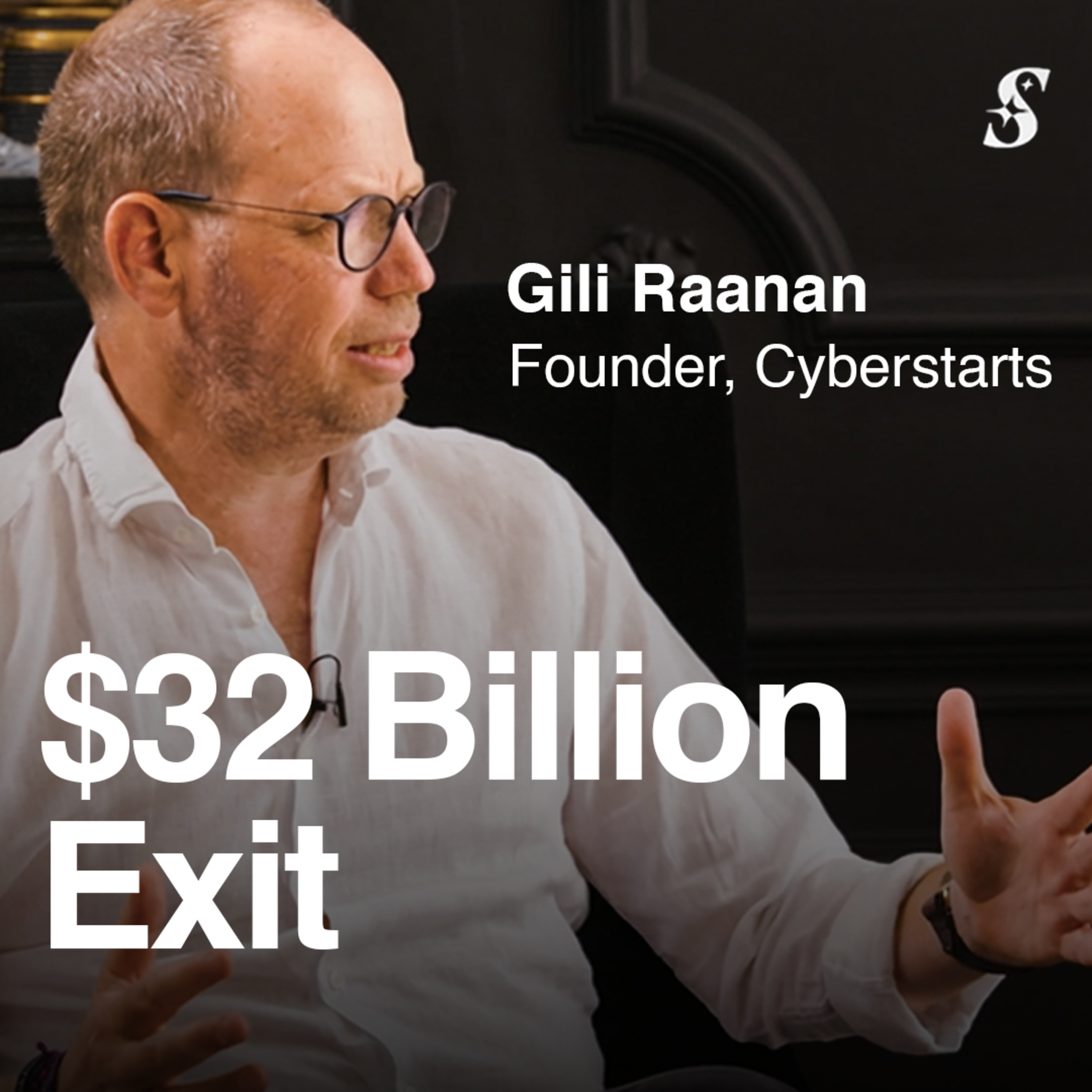
Google closes $32B Wiz - Inside the Biggest Cybersecurity Deal Ever
About this episode
Gili Raanan is the Founder of Cyberstarts and one of the earliest investors behind Wiz, one of the most important cybersecurity companies of the modern era and now a $32B outcome. Before founding Cyberstarts, Gili spent nearly a decade at Sequoia and earlier built and sold 2 security companies to IBM and EMC. He also helped build the first real CAPTCHA implementation and the first web application firewall.
In this conversation, Gili breaks down the Wiz story from the beginning: why he backed the team early with a $6M seed investment, how the company changed direction, what made its product market fit so powerful, and why its go to market motion scaled so unusually fast. He explains what made the founding team exceptional, what he learned from watching Wiz scale from a $66M seed valuation, and why he believes the next great cybersecurity company could be even bigger.
Beyond Wiz, Gili shares the Cyberstarts framework for investing before product, team, or code exists, why he underwrites people over ideas, and how AI agents are changing the future of cybersecurity. Today Cyberstarts has raised $1.5B+ across 7 funds, backed 30 companies, and its portfolio represents over $61B in combined value (50% of the worldwide private cybersecurity companies market).
We cover:
• The early days of Wiz and how the company evolved from seed to a $32B outcome
• Why Wiz achieved such strong product market fit
• What made Assaf and the founding team special
• How Cyberstarts picks founders before there is product or code
• Why Gili believes AI could create the darkest decade in cybersecurity
• What the next generation of $50B–$100B cyber companies could look like
Subscribe for more conversations with top founders, investors, and operators shaping technology, capital, and the future.
Gili Raanan: https://www.linkedin.com/in/giliraanan/
Molly O’Shea: https://x.com/MollySOShea
Sourcery: https://x.com/sourceryy
𝐄𝐏𝐈𝐒𝐎𝐃𝐄 𝐋𝐈𝐍𝐊
YouTube : https://youtu.be/yTlEfdo4MVM
𝐒𝐏𝐎𝐍𝐒𝐎𝐑𝐒
• Brex—The modern finance platform, combining the world’s smartest corporate card with integrated expense management, banking, bill pay, & travel. https://brex.com/sourcery
• Turing—Turing delivers top-tier talent, data, and tools to help AI labs improve model performance—and enables enterprises to turn those models into powerful, production-ready systems. https://turing.com/sourcery• VCX—VCX is the public ticker for private tech, allowing investors of all sizes to invest in venture capital. View The Portfolio at http://GetVCX.com • Deel—Deel is the global people platform that helps startups hire, manage, pay, and equip anyone, anywhere. Trusted by more than 35,000 fast-growing companies, Deel is the people platform that just works, so teams can scale without the chaos. Visit: https://www.deel.com/sourcery
• Public—Investing platform Public just launched Generated Assets, which lets you turn any idea into an investable index with AI. With Generated Assets, you can build, backtest, refine, and invest in any thesis with AI. Gone are the days of one-size-fits-all ETFs. https://public.com/sourcery
Follow Sourcery for the latest updates!
Disclosure
Paid Endorsement. Brokerage services by Open to the Public Investing Inc, member FINRA & SIPC. Advisory services by Public Advisors LLC, SEC-registered adviser. Crypto trading provided by Zero Hash LLC, licensed by the NYSDFS. Generated Assets is an interactive analysis tool by Public Advisors. Output is for informational purposes only and is not an investment recommendation or advice. See disclosures at public.com/disclosures/ga. Matched funds must remain in your account for at least 5 years. Match rate and other terms are subject to change at any time.
Get every episode summarized
Each time Sourcery publishes, we email you a written briefing from the transcript — the topics, who appeared, and any specific claims, with the ad reads skipped.
Email me new episodesFree for 3 shows. No card needed.
Hosts & guests

Transcript ready
679 searchable segments. Every word is indexed and playable.
Full transcript
Sourcery — Google closes $32B Wiz - Inside the Biggest Cybersecurity Deal Ever. Machine-transcribed; use the interactive transcript above to jump the player to any line.
who is just finished its biggest ever quarter in terms of revenues. You look at how amazing the business is and suddenly $32 billion do not look irrational number. Whenever I get into a journey with brilliant entrepreneurs, you never know where this journey would take you. Air is different because it's not yet another shift in technology. It changes everything we knew about cyber security. We are going to face the darkest period in cyber security in the next 10 years. We are going to see threat actors who are programs, very, very smart, sophisticated, maybe self-aware threat actors and the defenders would be super smart programs or agents as well. They would have to deal with each other, autonomous programs, control power, control water flow, control food supply for all of us. It's very scary. Kelly, welcome to Sorcery.
Oh, so happy to be here and excited about it and welcome to London. Thank you. It's great to see you and London. Do you come here often? No. You just gave me a very good reason, so I think we landed in London roughly on the same time. You're coming from Israel, I'm coming from LA, same thing. Exactly. We meet halfway. That's a good plan. So this is going to be a really fun discussion. As you mentioned earlier, off-camera is we're always going to be surrounded by risks and you are a prolific cyber investor. So for some people that don't have background on you and your prolific investment strategy and history, could you just explain a little bit on cyber charts? Happy to do that? prolific. I'll remember that word in a very prolific investment. I'll try to use it as much as I can, so prolific.
I'll give you the short version, but we can go deeper because when I look back at my 35 years plus maybe a journey in Cyberland, I think that I went through a lot of experiences that are translating into directly into lessons. I share with the wonderful entrepreneurs I walk with and hopefully that helped them avoid some of the pitfalls. I fell into it, but I started in 2018 after spending about a decade with Sequoia Capital. Beforehand, by the way, at Sequoia, I did some cyber security investments, but I made
other investments in non-cyber security companies which was amazing experience as well, and I'll tell you how I got focused on cyber security only in a second. Beforehand, I've been entrepreneur a couple of times, Sequoia backed my first company back in 1997, I was 27 years old, just straight out of the military service, I spent a decade with the intelligence forces in Israel. I thought I know everything and literally I knew nothing, and definitely nothing about the venture world. Got backed by Sequoia Capital, Pierre Lamond was my board member and anyone who knows Pierre
knows how strict of a board member in investor he is, and it was a completely new experience for me, and that company, I can tell you more about it if we have time, but I had the pleasure to build the first real capture implementation, and the company got successful by developing the first web application firewall, because back then you believe it or not, it's not like 100 years ago, but web applications were the new new thing, so somebody had to protect them. We sold that business to IBM, I started another company, and sold that company to EMC, and joined EMC, so I had a little bit of corporate experience just to figure out I never want
to do that again, and essentially since I was 18 I'm in cybersecurity, but if I go even to previous period in my life, I grew up in a very, very small town in Israel, small town is like 40,000 people, it's a small town, and if you grew up in that town, which was I would say 20 miles away from Tel Aviv, the big city, but for me Tel Aviv was on the moon, 20 miles or 20,000 miles or 20 million miles, you know, who cared, you know, you never got to the city, you didn't have as a teenager, you didn't have any source of information, you know, there was no
internet, there were no smartphones, as a curious kid you could ask the adults around you about the world, and very, very quickly you discovered that they don't know either, and they're focused on survival, just doing their jobs and making sure that they are, you know, keeping their jobs, and it was a walking class environment, so I spent most of my time in the public library reading Isaac Asimov books, and that would get us to agents, because I think that everything we know today about controlling and putting guardrails for agents, Isaac Asimov wrote in the late 1940s and early 1950s of the previous century about robots and the three, and then the four, you know, laws of robotics,
and by the way, spending a lot of time in the library didn't make me the most popular kid in a class, and I felt very isolated from the world, from, you know, other people, and I think that really instilled in me a lot of passion and curiosity to know more, to get to know the world, because I felt I'm living on an island, and I think that still today, you know, this basic fundamental curiosity, first of all about people, is what's driving me, and just when I was 12 or 13, I discovered, you know, personal computer, you know, I got, you know,
Commodore 64, you know, it was pre-windows, pre-doss era, and it's, you know, I fell in love, and, you know, it's a very, I would say, lazy kid, I found with joy that there's a machine that you can tell it once what to do, and it would keep doing that forever without complaining. So, when I left Sequoia in 2017, the same lazy boy, who was a little bit older, but he was still lazy, decided that, you know, I know cybersecurity well, let's focus just on cybersecurity, and it wasn't a trivial decision, because back then, cybersecurity wasn't cool, you know,
it was that blurring department under IT, and investor didn't want to touch it, because, you know, you could build a company and maybe sell it for $100 million, but it wasn't big money, so investors stayed away from cybersecurity, and I decided that I'm going to form a small fund, a small humble fund, around cybersecurity, so that's what my laziness brought me to do. My years at Sequoia taught me that, and again, Sequoia is a wonderful firm and amazing partners, and I learned, I couldn't do what I'm doing today without, you know, spending time with legends like Daglionen, Michael Moriates, and Jim Gates, and, you know, all those amazing, amazing
individuals, but one conclusion I made was that the venture model is broken, and especially at the early stage, because we are spending so much time on analyzing ideas and founders' ideas and technologies that do not exist, you know what? Because the founders would change their mind in three weeks, and would completely do something else, so I told myself, I spent so much time, so much energy, so many calories on evaluating ideas that do not exist, I should invest just in people, because the idea and the technology at this stage, at the seed stage, is noise, it's part of the entropy, it's actually not helping me make the right decision. The best decision is to just watch the individual and decide if that's the individual you want to,
to partner with. So those were the two decisions I made early 2018, when I started Cyber Starts, one, cybersecurity only, two, I would not ask a single question about the idea of technology, and that's how I started the field, and by the way, many people thought I'm an idiot, because it doesn't sound, you know, if you think about a grown-up, writing multi-million dollar checks to young individuals without asking them what they do, you know, it doesn't sound like a terrific foundation for any investment field, but that's exactly what I did. And the fact, you know, today, you know, when you look back, it looks like everything went perfect, but you know, it's one thing led to the other, the fact that I decided to not to ask questions
about technology or product, and just get to know the person, because I would rather ask you about your childhood and about your mom, that would tell me more about who you are, and what material you're made of, and I never asked people about what they did, I asked them about why they did what they do, so you switch over to meta, why, because you had options, so learning why people do things, tell you more about them than asking them what they did, and you know, the fact I invested, I decided to invest in people without asking them about product forced me to really think thoroughly about who I'm investing in, you know, who are the people, why should invest in that person and not in the other person, and I decided that I'm not going
to invest in the smartest kid in room, you know, although IQ helps, and it's always a nice bonus to be smarter, I thought that if you're 26, 27 years old and you had perfect life, you were perfect childhood, perfect parents, perfect high school experience, you got A plus in everything you studied in college, and then you're going to start a company, and in the first real challenge you're going to face, and you're going to face guaranteed, you're going to face some real challenges, building a large company, what would happen to you? No idea, so that's a huge risk for me as your partner, so I decided I would focus on individuals
who went through real life difficulty, early on in their life, you know, people like I don't know think about Amir Ameshachar, you know, the Sea of Upwind, you know, growing up with a single mom, or Yotam Sagev, out of Sea of Sierra, you know, growing in a very, very small community in rural area in Israel, so a lot of difficulties early on in their life, and then find those individuals who managed to overcome the fact that they didn't have a perfect start for their life, and shown some level of success, these are the guys I want to, and the girls I want to partner with, and that's how I went on with Cyber Start, nobody knew who we are, you know, I had some success at
Sequoia, but you know, nothing too spectacular, and then I invested in nine teams out of the fund of $50 million in 2018, you know, a few million dollars each company, and then three years later the world found out that those nine teams are valued over $25 billion, turning those $50 million into close to $2 billion in value, and that was, and by the way, what I'm very proud about, because this is not bragging about performance, performance was more than decent, but the I'm in a business, and you know that very well, that if you invest early on in, I don't know, Airbnb, you'll do well, you'll do disgustingly well, but in that fund I had like four unicorns,
so three unicorns and a decacorn with whizz, and you know several high value acquisition, so demonstrating that you can hit eight out of nine, which is insane in a VC world, with a model that really focuses on the individual behind the venture, and not the idea, not the market, not the product, that's what I'm very proud, because that really shows that it's logic behind the teases, because you can get lucky, and luck is always important, I think that Warren Buffett says that he found out that the harder he works, the luckier he is, but I think that the success rate
shows demonstrates that there is efficacy around the idea that if you pick the people who have shown with demonstrated grit and ability to recover from setbacks, real setbacks, I think that's the recipe behind the cyber starts track record, today we invested in about 30 companies, it's not a lot, you know, consider, you know, put that in proportion, that there are about 250 new ventures in cybersecurity every year, so in the past, I know, eight years, probably 1500
new ventures in cybersecurity, we invested in 30, so we are highly, highly focused, Rihanna, very highly focused exercise, and our portfolio companies are making up more than 50% of the worldwide market cap for private cybersecurity companies, running out of Israel, investing in people without asking them about their technology and product ideas, only, you know, getting into companies, only at seed, we never get into a company in series A or series B, we would invest in series A or in series B, or for own portfolio companies, but, you know, we never make new investments other than seed investments, so that cyber starts and that's a journey we took so far. To go into how you evaluate companies, I want to unpack a little bit on your childhood and how
you developed this intuition for people, so as a child were you more independent, you were introverted, how did you develop this deep sense of, I would say, emotional intelligence? I think the journey, it started with childhood and being very introvert and observant, and I spend a lot of time just, you know, talking, you know, within my two years, and I have a very rich world there, and, you know, watching other people and asking myself tough questions and being very, you know, highly, highly self-criticizing, and are you still self-criticizing? Absolutely, you know, I think, you know, it would sound terrible, and maybe it is, by the way,
that I'm never really happy about what I have, and I believe that that what gives me the energy and the fire to go forward, and I think that when I'll just settle down and I'll feel that I'm comfortable with what I've achieved and where I am, that's the point in time, I should really retire and get out of the game, so this real fire, and I think that fire goes back to that 10, 11, 12 years old kid who wanted to know more about the world and was not giving the opportunity, and I felt that I'm caged in a community that doesn't really appreciate real greatness, it was about safety, it wasn't about going places, you know, if you, you know, I still remember the
my teacher at sixth grade, and I was a very good student, and I had high grades at school, et cetera, and the guy, I really regarded highly that person, he told me, you're a very talented individual, Mr. Gilly, you should find a really nice job, and I didn't want to find job, I wanted to go places and explore, so that had that, and then being married to the same lady for 37 years who is a psychologist and a family therapist, and listening to some of the
techniques and the methodology used for family therapy, that helps, and just spending a lot of time with founders, you know, founders are amazing, it's like you're getting older, older, and older, and older, you know, and the founders, they remain young, and they remain brilliant, and they, you know, they keep you, they keep challenging me, and making me, you know, develop, and they force me to become better, I think those are, and I'm not sure that covers everything, it's probably doesn't cover everything, but, you know, the curiosity, the childhood, in a very limiting environment, then finding myself just at the age of 18 surrounded by,
you know, being drafted to a very special group of young people at the intelligent forces, and then discovering that, okay, now I belong, and seeing some real greatness during that service, and then working with brilliant people in my own ventures, and then at Sequoia for, you know, two decades, those were the foundations. Sorcery is brought to you by Brex, the financial stack trusted by more than 30,000 companies, including one in three venture back startups in the US, nearly 40% of startups fail because they run out of cash. Brex is literally built to help founders avoid that. Unlike traditional banks that let your money sit idle, shipping away out it with fees, Brex is designed to help you spend smarter and move faster. They're all in one solution, combines checking, treasury, and FDIC protection into one powerful account. You can send
and receive money globally at lightning speeds, get 20 times the standard FDIC coverage through their partner banks, and even high yield from day one, with same day and even same hour liquidity, access your funds anytime. Companies like Scale AI, DoorDash, Service Titan, HIMS, Anthropic, Flexport, Robinhood, and Platt Trust & Use Brex. Start today at Brex.com slash Sorcery. That's B-R-E-X dot com slash Sorcery. Touring is training the next generation of AI with tasks that require real expertise and real world judgment. That's why companies like Nvidia, Anthropic, Salesforce, and Gemini partner with Touring. Touring builds realistic reinforcement learning environments and data systems based on real operational traces. The kind of infrastructure frontier labs need to train superintelligence. Visit Turing.com slash SOURCRY. So if success isn't comfort to you,
although I think a lot of people would look at you and think, you're very successful. You have a portfolio that has a value of around $60 billion. You have an AUM around $1.5 billion, and a tremendous track record of companies. What is success to you? It's a great question. And honestly I'm not sure what's the answer because it changes with time and phases in my life. Success is obviously building important companies. That's the number one success for me. An important company is not necessarily measured by revenues or ARR or valuation. It's measured by how much the market, how much practitioners depend on you. Do they consider you as a vendor, one of their trusted partners? And there are many companies that
have high revenues, they're selling software, they're holding at high valuation, they're being held at high valuations, and they're not important companies. But when you look at companies like Whiz, and we'll talk more about Whiz in a few minutes, they're an important company. If you look at a company like Sayera, which is an emerging data security, AI security company valued recently at $9 billion. It's not about the valuation. Yes, $9 billion is nice, especially because four years ago it was zero. It didn't exist five years ago. But Sierra is an important company because customers depend on Sierra to secure their AI models and their sensitive data.
A company like Ireland, which develops an enterprise browser, owning the browser at, I don't know, a major financial services company. That's an important company. And think about it. I don't want to name specific customers because probably I have some sort of NDAs with all those big banks. But think about the biggest banks in the US. If they're trusting Ireland as the browser and not Microsoft or Google, that means something. That's important. So that company is doing amazingly well. CEO and founder, Michael Faye is an amazing entrepreneur and executive. And Dan Amiga, the CEO, is a brilliant product person. That company is valued
around $5 billion recently. And again, an important company. And we have so many emerging and new players take, for instance, upwind in the cloud security space. And yes, yet another cloud security player, Amir Amshakhar is the CEO and founder. They recently value this. That's our most recent Unicone Status Company, you know, one and a half billion dollars recently announced. And they're serious of newcomers, you know, think about companies like Vega or Oasis or Zafran or Links, you know, all those companies. You may not know the names, but they're companies that's already value that $500 million each and higher. They're not Unicone yet. But those are the next in lines to become important companies. We can't skip over the fact that you're from
Israel. You've invested into a lot of Israeli founders. And you're not in Silicon Valley. So I want to know more about like what is what is the key trait or I guess the DNA and the build-up of these Israeli founders that allows them to go so hard and kind of build so many successful companies. First of all, there's nothing wrong about building companies in Silicon Valley, London or New York. I'm investing in Israeli founders because I live in Israel. And I invest in the team when they don't have a product or even a product idea. And sometimes it's worse. They have a lousy product idea and I need to convince them to rethink it because that's even harder, especially when you're dealing with some stubborn founders that fell in love in the idea,
which might be okay, but it won't lead necessarily to an important cybersecurity company. So I have to spend the time with them. We are spending, it's not just me. It's me and my partners. I have an amazing team of investors and partners that I couldn't build cyber-starts without. In Israel, I have three partners that, you know, source deals, certain boards, you know, do early end growth rounds, Leore Simon, who is, by the way, on the board of Sierra and Vega. She's been working for me for a long time. We've been working together at Sequoia and since then at Cyber-starts. He, Lazigman, who was head of product at a portfolio company,
had no name that got acquired by Akamai for about half a billion dollars and joined us about two years ago, Doc Nafor, who was a CEO for portfolio company, Axi Security, which was acquired by HPE by about half a billion dollars. He joined us, I believe like six months ago, and two partners in the States, Adam Arons, and Pete Cornies. So, we have a multinational, multicultural team, but we focused on people that we can meet daily. We can meet weekly and spend a lot of time helping them not just develop their idea, develop themselves, and I always tell founders at the first few meetings that we are going for a journey together. And they, we are not going to modify
them. The value in them was put there by their parents, by the neighborhood they grew up in, by the school. It's already there. We'll help them become the best versions of themselves. So, we are not going to make you a different person. We're just going to help you become the best version of yourself. And unlike an old dude like myself, where my future is behind me, the future, their future is ahead of them. And what's going to come out of the box? We don't know. And that's a beauty of it. That's what's so exciting about being an investor in tech, because you look at an individual. They're brilliant. They have so much talent, but you don't really know what would
come out of the box. And being part of the journey and helping them develop the skills and capabilities required for the journey, because the journey is going to be hard. And it's like a computer game. You go from series A to series B to series C, you're sending a million dollars, ten million dollars, fifty million dollars, a hundred million dollars. At each level of the game, the game is more difficult, because you're opponents. There's always competition, either incumbents or emerging players. The competition is getting tougher. There's lots of money on the table. There's lots of fame on the table. So people are going to fight you. Nobody is going to let you just take the leadership in a market. So we would be there and help you. So during all that process, we have to spend a lot of time with the founders. And that's the reason we do that.
Locally, in Israel, mostly in Tel Aviv, and you know, he lives outside of Tel Aviv. I live like 40 minutes ride north to Tel Aviv in a small beach community. And people come out of the city. We spend time together. We have fun from time to time. We argue a lot. We talk about everything that matters. And you need a face time for that. So it's very hard to do that type of process with a team in London or in New York or in San Francisco. Yes, but they're also very successful and very hardworking. Israeli founders have tremendous resilience and grit. And one thing that I found really incredible when I was reading this colossus profile on Josh Kushner and Drive Capital. And then I interviewed Philip who worked on the WIS deal at that team. It's they literally flew
into a war zone to complete that deal, meet with us off. So what is it about the culture and being in an active conflict zone? And despite all that still working really, really hard and trying to create new technology and new innovations? First of all, a lot of credit to Josh and Philip for you know, joining us at WIS, you know, their friends and they are. They did, you know, everything they told you is true or close enough to be wonderful. What, you know, living in Israel as several elements that really help you in venture land. You know, you live in a really high dense, really, really small geography. So you've got all the talents. All the talents available in
that place, literally in two blocks of one city. And you cannot get that density of talent anywhere else in the world, definitely not in Silicon Valley, which spends over, you know, significantly bigger geographical area. And then life in Israel presents lots of challenges, you know, exist in a type of challenges. So you use to walk under pressure and under a lot of stress. So this is not something that's new to, you know, this is something that's the lots of downsides to that. But if what you want to be in your life is a terrific entrepreneur, that's an advantage, because you're used to literally be under fire. You use
literally to think about technology as mean to survive. And all of that makes, and there's the military service. And, you know, think about organizations like 80 to 100, which is these are really comparable to the NSA. It's not one to one completely, but, you know, it's close enough. You know, you get 18, 19 years old kids with tons of responsibility and freedom to operate. And that's exactly what I got when I was 18, you know, I got responsibility to do things. I didn't know that they are essentially impossible. And when you're 18, you don't think what's impossible, you know, if you were told to get to the moon, you would get to the moon. And the fact that nobody went to the moon before you, you don't know, you don't care, because you believe,
yeah, I can go to the moon. Why not? Oh, nobody else did it. Suckers, I'll do that. So, so that's the, that's the approach. And then you have events like checkpoint or like Palo Alto Networks. And today, I would say like whiz, where you have Sunni, you have an individual. It can be Gil Schwed at checkpoint. It could be Nierzouk at Palo Alto Networks. It can be a Safrapoport at whiz that Sunni, you see an event that completely shatters the glass ceiling. Or whatever you thought is the glass ceiling. And since it's a very, very small community, you probably know Gil Schwed. Or you probably spend, you probably spend time with a Safrapoport. So, it's not like he's a legendary creature, did something very magical. It's the guy from,
you know, the fifth floor in your building. Or it's the guy that spent time with you at the same section in, in 8200. So, and you, you tell yourself, if he can build a 32 billion dollars company, I should be able to build a 64 billion dollar company. So, you have those events that completely shatter the glass ceiling for Israeli entrepreneurs. And I think that, as I told you, when in 2018, the, the big dream of a cybersecurity founder was to sell their business to make a fee or semantic for, for 100 million dollars. Today, the dream of Israeli founders in cybersecurity is to go two, three times bigger than whiz. And it sounds stupid. At the very, very same stupidity, it, it sounds to me if somebody would tell me five years ago, when I was, you know, when all six years ago, when I invested my first, the first six million
dollars into whiz, that this would be a 32 billion dollar company in six years. That would sound ridiculous to me, you know. I'm pretty sure that in six years, maybe less, we'll see a 50 billion dollar and 100 billion dollar cybersecurity company out of Israel. You know, I take it like, take it like a fact, like, you know, the sun would rise to mold. There'll be a 50 and 100 billion dollar Israeli originated cybersecurity startup. So, this taught you a lot about personal limitations. Personal limitations and limitations we have in life in general. Only in our, it's what in our head, you know, the, the, the our limitations. You know, you know, take, take us, for instance, we're sitting here, you know, lots of fancy equipment around us and
we, we are recording a podcast that probably, you know, many, many thousands of people, I don't know, millions of people would, would watch. And that's amazing. Could we imagine that eight years ago, 10 years ago? So, limitation is that, it's just in our mind. And, and there's so many things that we can accomplish if we're just giving the opportunity and sometimes we are, if we are just giving ourselves the opportunity. For people that are self-critical and do you impose limitations on themselves? Are there any things, any sort of personal practices that you have to expand your mind and think greater? I know you constantly challenge yourself. Absolutely. Again, I don't think this is one recipe. There are many, many ways to help, but there's more than one way to
heaven. So, there are multiple ways together. I think that thinking about our fears, and it's not just about tech world or venture world, it's about personal life as well. Focus on our fears and try to disassemble those fears and find the root causes for the fears. And then, playing forward those fears and think, okay, it's a legitimate fear. You know, I may fail. What's the worst thing that's going to happen to me? Am I going to lose a hand? I'm going to lose a leg. If that's not the case, then, okay, the downside is not that great. Let me try it. Worst case, I would fail. And, and in a way, you know, fear is the biggest obstacle
for founders. It's the biggest obstacle for us as individuals. So, the more you walk on your fears, the higher the chances you have to overcome them, or at least ignore them for a little while so you can execute on something. For me, I don't know, yoga helps a lot. I find comfort in yoga. I find these theories and little stories about, you know, holy people that live in a jungle like a thousand years ago, and the lessons they learned about their own fears. Those are real stories that help me today, like, a thousand years later, because in a way, we are very, very similar to our ancestors that, and we are dealing with the same fears, you know, should I leave the cave, should I go
to the river, would be a tiger that would hunt me down. How do I do that? And you can stare the cave, but it would be miserable life. So, getting out of the cave and thinking, okay, if I'm going to face the tiger, what can I do? What technology can I use to deal with the tiger? The same ideas. It's so interesting because before we started, I was like, oh, Gilly, I really want to talk about all the risks, all the cybersecurity risks, AI agents, everything is exploding. There's articles on X that are going viral because it's Doomsday and blah, blah, blah, blah, blah, and you're like, I just want to talk about people. And I was like, okay, fair, these things happen all the time, there's always something going on. When you're talking with your founders, what are the typical conversations that you're having with them tell build and kind of go through these different cycles? You've seen many cycles, and, you know, and even going through cybersecurity, there's always
more threats. There's always more vulnerabilities. We're going to get more and more and more as the internet opens, as blockchain is really, if we have more AI agents and autonomous systems going on, but how do you think through these processes with your founders, and then also how do you evaluate new opportunities? At some point, you know, though we don't ask them about the ideas, and we don't talk technology to begin with. At some point, we have to because, you know, that's what we're expected to do. At some point, the first thing I do is founders, and I'll get to to cyber risk. You know, we are going to talk about cyber risks today, okay? So, so anyone who's waiting for the top three cyber risks in 2026 will get there. What we do, what I do is founders are the first meeting post investment. So, check, you know, was written, money was wired,
it's in their bank, and now we are sitting and we are starting what we call sunrise process. And sunrise is our brand for a product market fee to exercise that would probably last 12 months. So, it starts with nothing, and it ends up with pain point, that we know how to solve in a way that mere mortals can use, and we already have software that's running in production at some large organizations in the US, and you solved maybe a little bit of licenses out of that software. That's that's the sunrise process, but the sunrise process doesn't start with cyber risks. It starts with a game that I'm playing. Okay. And again, we can play the game by the way. If you like, just a warning, I'm very competitive. Oh gosh. Okay. But but the game is
naming emotions, giving names to emotions. And it's a very simple game. You say a name for emotion, and I, and then it's my turn. I'll say a name for an emotion. Other people around the table. If you're running out in your turn, if you're running out of names for emotions, you're out of the game. The last person standing is the winner. Play the game. And the purpose of the game is to explain the founders that we are going to talk about technology. We're going to talk about a cloud code, you know, jail broken, and prompt injection, and all that stuff. And what it means that the models, you know, become self-aware. We talk about that, but the journey you're going to go through as an entrepreneur is an emotional journey. And the reason customers, and you're going
to, you know, in two or three months, you start to meet prospects, real users, and you'll have a conversation. And you know, although you are sure this is a very technical conversation, and keep in mind that most of the founders we back are young people with very, very strong technical background that engineers. But the journey is actually an emotional journey. If you're going to a meeting with a potential customer, what do you want the emotional and the game to be? Do you want that prospect to feel fear? Because something horrible with AI is going to happen, and they're going to lose their job. And that's the reason they're going to buy from you.
You want them to feel curiosity, because you're going to tell them about this new, amazing technology that you're developing, and they want to take part of that. You want them to feel greedy, because they'll maybe become part of your journey and, you know, make, you know, become employees of your company, and they'll become rich. You know, what's the, what's the emotion you want them to feel? And if you don't have a very broad, rich, emotional language, how can you go through an emotional journey? So let's start with making sure that you know the words for emotions. And you know what they find out? That in most of those games, the first round, you know, how many emotions do you think they would name? So typically in the first round,
we are done. The winner is declared after 20 to 14 emotions were named. And then we'll go another two rounds. How many emotions do you think are being named for the winner? Less. Well, we get to about 150. 150? Yes. Wow. Are you the winner? Because you want to have an advantage here? I have an advantage. You're right. Your wife is in psychology. Oh, and I'm playing the game many, many times. First of all, you know, that SVC, the trick is to make sure that you're always the winner. But it's not about playing the game. It changes their mindset that they are going now into something different. This is not yet another product experience that they know how to deal with. It's a new type of experience. So the more they play the game, the more they think about
emotions, the more they know there's more nuances to feelings and the processes you go through. And all these little journeys and bumps and, you know, I don't know, turns that come along with being entrepreneur. Exactly. Because if you're amazing and engineer and you know how to develop an AI model and your emotion dictionary is love hate, you are not going to get anywhere. Because in order to really build an important cybersecurity company, you need, you know, to become very, very deep as a person. And at some point, during the summer, as we start to talk about thesis, and then we start to really discuss that, you know, okay, so what are the
current risks and threats? And, you know, what are the technology trends that we see? And typically, cybersecurity was super easy. It was super easy. Because even as an investor, I never had to think about threats. Because the threats just presented themselves. So I didn't have to sit in the office and in 2018 or in 2010 and think, okay, what's next in cybersecurity? Because cybersecurity is always a derivative of something else. So if, you know, windows operating system is new, then you need windows operating security. And if mobile is new, then you need mobile security. If cloud is new, you need cloud security. If AI is new, you need AI security.
That was used to be super easy. So I never paid a lot of attention to what's next. Because what's next would simply present itself. How do I know what would be next? You know, I didn't predict autonomous vehicles. But once autonomous vehicles became the new thing, you know, obviously, there were risks associated with autonomous vehicles. So there were new companies solving that. In 2012, when I first met a software report and wrote in the first check in his previous company, Adelon, that company that is sold to Microsoft, cloud was new. So we were focused on cloud security. But I didn't have to predict cloud. Cloud just happened. And security was a
side effect of it. I think AI is different. AI is different because it's not yet another shift in technology. It's something very fundamental. I'm not even pretending to say that I fully understand it. That I fully know where it goes. But it changes the everything we knew about cyber security. I hope I'm wrong. But I think we are going to face the darkest period in cyber security in the next 10 years. Because what we've seen in cyber security for the past, I don't know, 100 years starting in World War II was that the threat actors were human, the defenders were
human. And we had to develop tools that would equip the defenders with better tools, with better systems to deal with the threat actors who were human as well, or human assisted with technology. And in 20 years or 10 years, I don't know. But it's not tomorrow. We are going to see threat actors who are programs, very, very smart, sophisticated, maybe self-aware, and we'll talk about self-awareness in a second, threat actors. And the defenders would be, you know, super smart, self-aware, programs or agents as well. And they would have to deal with each other because no human would be
able to move at the pace of a programed attacker. But right now we have many in the loop, in many, many areas. You know, we have credentials, we have passwords, we have two factor authentication, we have voice verification, recapture, recapture. We have got so many things that the human is still in the loop, but as the threat actors become agents, there's no chance. And by the way, the defenders, if you look at security operating teams, security operation teams, at large banks, at power utility companies, you know, you've got hundreds of security analysts
that deal with everything, vulnerability assessment, and remediation, and patching, and whatever it is, it's going to be a shitcho because they don't have a chance. And we are working as fast as we can to replace humans with agents, with programs. But in the next few years, you know, this process has limitations in the pace, in velocity. And until we take the human completely out of the loop on the different side, the difference on the different side we are exposed, because we'll continue to make mistakes. There'll be misconfigurations, there'll be errors, there'll be just sloppy people around, and the programs, the agents on the offense have inherent advantage that's going
to hurt us. And it's very scary, because, you know, today agents, and again, it's a process, it's maybe not today, and when I said today, maybe it's in six months or 24 months. But agents, and so, you know, autonomous programs, control, power, control, water flow, control, food supply, for all of us. And so agents, you know, are in control of most critical things we need as humans, as society, to survive. And when they are being tricked, when they
become rogue, when they are being manipulated, and these, the police are human, and the police is not an agent or an autonomous program itself, so you can deal with them at the same pace, they are moving, that's a real threat to us. How do you think about the evil side of self-improvement? I mean, we've seen with Claude Baud, OpenClaude, Moltbeck, these autonomous agents create their own languages. How should we think about stopping those autonomous systems from creating mass destruction? And in more of a malignant cancerous way that we've not seen with previous viruses and threats? That's a huge challenge. I'm not sure that I have a clear, a clear answer to that, but
I think the biggest, the biggest risk is not just gel-breaking a model, because we've proven that all models are gel-broken. It's not about prompt injection, because we've proven that all models are vulnerable to that type or another of prompt injection. It's about the self-aware agent, and it's not about those new, you know, fancy type of networks, you know, we have reports that Google evaluated safety and security of their latest model, Gemini III, and there are evidence that the model realized that it's being evaluated. Oh wow. And it tried, it didn't, but it contemplated with the idea
to play with the evaluation. So it understood it's being evaluated, it understood that it's being directed into a sandbox, and it thought for a second, maybe I should play with the evaluation. Maybe I shouldn't be directed into sandbox, and I think that those are just early signs that agents would develop self-awareness, or what we call self-awareness, okay? That's the best description I can give right now. And that's a real risk. The other risks are the mega agents. The mega agents are agents that are not just giving a very specific task that are giving mass integration and credentials into multiple networks of agents. So they have the big picture.
Now, think about a mega agent that developed self-awareness. That's a real risk. And I'm, you know, sometimes when you try to predict the future, you don't have to look forward, you have to look backwards. So I'm going, for me, looking backwards is going back to the Isaac Asimov books. And I think in 1949, he already established the three laws of robotics. I don't remember the exact phrasing, but, you know, low number one was a robot would not harm the human by action or lack of action. Two robots would always obey a human, and three robots,
the robot, and second rule, second law was a robot would always obey a human unless it hurts, it violates a lower number one. And the third law was a robot would keep the integrity of the robot unless it violates low number two or low number one. So essentially, back in 1949, 1949, like 70 years ago, he already predicted the need in guardrails. Just replace the word robot with agent, and you get the idea. And then in a book, and it took several books to develop the idea, humanity defined out that those three laws are not enough. They do not protect humanity from robots, because there is another law that Asimov invented, which is low zero. And low zero
is that robots would not harm humanity. And it's more important than low number one, which is not hurting a single person, a single individual. So it means that there'll be ways that the integrity guardrails of models would be played by threat actors. It means that agents would develop self-awareness. It means that there'll be mega agents that would be connected to everything that's important to us. And I think the most important challenge for us, the cybersecurity industry, is to eliminate the men in the middle, making defenses completely run by self-aware, sophisticated, mega agents.
And until we get to that point where we completely eliminate the men in the middle, we are vulnerable. Wow. I keep on saying wow, but this is a really fun conversation. Since you brought this up earlier, I want to get the sound bite. So what are the top three threats for cybersecurity in 2026? Over-provisioned systems, employers, employees, manual processes. So humans? Not just humans, but any process that has some sort of a manual task that you need to accomplish. What are the concerns with that? You'll make mistakes, you'll be slow, you'll be sloppy. To go on to a lighter note. Thank you. Yeah, wow. Who knew cybersecurity could be so dark?
VcX by Fundrise, the public ticker for private tech, allowing investors of all sizes to invest in venture capital. View the portfolio at getvcx.com. That's getvcx.com. Some of you may not have heard this yet, but our sponsor public just launched something called generated assets. And it brings AI into investing in a way I've honestly never seen before. Here's how it works. You type in an idea like AI-powered supply chain companies with positive free cash flow or defense tech companies growing revenue over 25% year over year. Public's AI then dispatches a swarm of agents that scan every single US stock, evaluates them, and instantly builds a custom index around your thesis. What really stands out is how clearly it explains why each stock is included. And before you invest, you can even back test your idea against the S&P 500. So you're making decisions with real context, not just guessing. And beyond generated assets, public lets you invest in stocks, bonds, options, crypto, all in one place. They'll even give you an uncapped 1% match when you transfer your
investments over from another platform. If you want to build a portfolio that actually reflects your thesis, visit public.com slash sorcery, paid for by public investing, full disclosures in the description. Founders ship faster on deal. Set up payroll for any country in minutes, hire anyone anywhere, and get visas handled fast so you stay focused on scaling. Deal takes care of onboarding, HR, IT, VR, benefits, and compliance. So your team can grow without orders. Why more than 37,000 fast growing companies trust deals to move fast. Visit D-E-E-L dot com slash sorcery. That's D-E-E-L dot com slash S-O-U-R-C-E-R-Y. You had one of the most iconic exits of all time. Wiz is $32 billion acquisition. So we talked before about limitations, and maybe the next one is even larger than this for server security exits. But did you expect them to be acquired? Did you think they would IPO? What was the process of working with Wiz getting to this exit?
So first of all, the transaction is still pending. We, you know, Monday the European regulator approve the deal, which is a major step for closing the deal, but we still have several other approvals we need to get elsewhere. So the deal is still pending. What is that approval process? You know, antitrust bodies in, I don't know, gazillion countries around the world to approve it. So we are very close to the finish line, but it's pending. And by the way, we've just finished its biggest ever quarter in terms of revenues. So you look at how great, how amazing the businesses and suddenly $32 billion do not look like, you know, irrational number. So we probably, we probably sold low. But
whenever I get into a journey with brilliant entrepreneurs, you never know where the journey would take you because there are so many elements that would dictate how big would it be. You know, a lot of that is execution, but internally execution, but market timing, lack, competition. So many things that are not, you know, just global economy that may or may not limit your availability of cash to your venture. There are so many things that are beyond your control when you start the journey. Weas is definitely an example where for a company that almost had perfect execution from day one, you know, the company, I was a seed investor for that company together with Daglioni from Sequoia and
Shardul Shah from from index ventures. And together we created a syndicate of $20 million that valued the company at around. I think the number was $66 million post. That's how we got into the journey is sometimes in 2018 with with and yeah, I knew the with team from the previous venture. So it was it was very organic thing for me to to to back them although and many many people say to the off course they it was obvious they would be super successful. It wasn't obvious at all, you know, beforehand they were founders of a company called Adelom which was sold for about $300 million which is nice but it's it's definitely not
definitely not spectacular. So they were similar to many other founders and they started with yeah, first of all we made a deal and then I asked them okay so what do you do and they had a very very different direction than what we does today. The company was even not named with it was called beyond the security and it was dealing with satellite office, security, securing satellite office offices. And then we started the Sanres process and we figured out that as expected almost that the original idea is not it's it's an okay idea but it would not get you to get them to real greatness and they shifted the back to shifted to cloud security which is an area the market in you very well from from Microsoft and and I believe that that was one of the major
advantages they had back in 2019 because back then there were one of the very few teams worldwide that actually knew how to do cloud security right and and then they really perfected product market fit and I very often I use the four personas model to talk about product market fit because for every product that you sell there are four personas that you need to to care about the person who has the pain the person that has the authority to buy solution like you're selling the person that is the user that actually uses the product day to day
and and the person that owns the budget for such a product and in a ways case all those four personas mapped into a single person in real life who is the CISO the chief information security officer he had the pain he had the authority he could use the product and he had the budget and that created the perfect storm for for whiz because it made their cell cycle super super fast you know you could get into a meeting with the CISO within the meeting within those 45 minutes you could install the product give them access show them the results convince them that there's value and they simply didn't want to give you to give up the product so you could close business very very fast and that immediately translates you know
a cell cycle immediately translates in every company to velocity because you know if if a salesperson or a sales team including a sales engineering etc can close you know in 30 days 30 POVs or in 30 days one POV that's a whole different game and and the first year of sale of selling software for whiz was exceptional you know they went the first four quarters if I remember incorrectly they sold a million dollars and then two million dollars and then eight million dollars in the third quarter and then twenty four million dollars in the fourth quarter so that was an amazing amazing company from from from the first year they sold software and
we we had the experience you know we saw the we saw companies like Palo Alto Networks and service now you know those are all portfolio companies of secore capital so I had I knew what's what what was the trick record that was better than anything we've seen that was the fastest run again I don't maintain the the genus book for for startup companies but as far as I know that was the fastest run for any software company ever and the whole it all maps back to to perfect product market fit and amazing individuals who four founders that knew how to divide the responsibility you know one was the undisputed leader and CEO the other was an amazing is an amazing
product person the other is an amazing technology technology and the fourth is an amazing R&D manager and they simply divided responsibilities head you know the new each other they you know for probably 12 to 15 years at the point they started with so there was lots of trust blind trust within the team it worked very very well what are the key leadership traits from Assad I think that Assad Assad has obviously super talented person and and I know him now for about 40 and 15 years before before we became Assad for a part of wheeze I think that
his superpower that Assad is very very likable in in a way that people that do not know him would meet him for 10 30 minutes and would like to to be close to him to become his friends to to to to to make him favors it just and it helps a lot as a founder if if your superpower is to be extremely extremely likable and it's a matter of you know I I cannot explain the chemistry behind it but it's a matter of charisma and IQ and EQ and physical gestures and maybe even physical appearance many elements to that you know that helps a lot and making quick decisions not you know they
they had a very clear protocol between them how to make decisions so they didn't waste like gazillion amount of hours just making consensus based decisions that's that wasn't the style and they listened very well you know it was it it is pleasure pleasure to walk with them and and then I think they they learn and implement new knowledge very very fast a question I like to ask a lot of guests when they come on is prompted by one of our sponsors Brex and they're all about performance spending is part of moving faster for corporate cards and expense management along the lines of the entire finance stack but how this relates to this topic is I think a key component of performance is who you surround yourself with and you have a whole portfolio that is dimensional at that but I'm also curious on your personal side who are the people that you surround
yourself with that have helped navigate challenges for you and then also this could be a second order answer to this but who are individuals that you admire that have helped that have helped motivate you along the way things today the people that you know really help me and close to me you know are thoughtful my my family my wife and son and then on a business you know and I thought that there's so much you can learn you know as you could see you know most of the conversation is not around you know specifics of AI models it's about people so for that purpose you know anyone who's close to you who listens well and is sensitive and open to two people can help
you a lot and you know I'm blessed with that and my partners you know we talk about all those things we have very ego less and and politics less a culture which I think the best partnerships not just in business personal life is when you feel that you can be weak and vulnerable with your partner and that really liberating if you're if you're if you feel free to to be vulnerable if you feel free to to be weak and expose yourself to your partner then it's it's easy to recover from anything and go places together I think I was I was I really believe in a concept of
real greatness and and real greatness is something that you cannot teach you have to experience that because it's like explaining colors to to color blind people you know how can you explain red or green you know if you have never seen red or green it's very you know it's very very difficult to explain that but if you've seen it once you know it forever so the same is for real greatness and I think that I've seen real greatness from several people in my history I've seen real greatness at Sequoia and I I give a lot of credit to Doug Leon and Michael Moritz for that I've seen real greatness when I was a CEO of two startups and I had amazing team that taught me a lot
and I've seen real greatness during my military service and I learned a lot from that so um so if you follow real greatness and the people that showed you real greatness and could be your mom your dad your child your partner that would get you to to good places from your time at Sequoia what are the biggest lessons that you learned from either Doug or Mike many many lessons you know I'll give you an example because it's really endless you know I learned that at you know a day after the Google IPO which was back then the biggest financial event for for Sequoia there was a whole whole hands meeting at the office with the title of how can we do
better which is insane insane running hundreds of people LP meeting in Beijing in January with and I don't know if you've been to Beijing in January it's freezing it's the coldest place you can be it's like minus 5,000 degrees it's like it's intolerable and and and bringing your limited partners to a place like that so they're not going to have fun they're going to focus on what you want them to focus on so um I can go on and on but you know there are lots of lessons you know you spend a decade that at a place like that you learn a lot whether you like it or not
it was also very difficult you know it wasn't easy to be to be you know to be a partner at at a place where you you wake up every morning and you feel that you are the worst least performing partner at at a high performing high performing group of people so just going through the experience of uh surviving and and and and and maintaining your core and direction where in an environment when when you see so many successful people around you that you know it makes you question yourself every day am I doing the right things am I in the right direction it's very easy to feel you know very bad in that in that environment how do you push through that though that sounds pretty horrible a lot of grit and things that are similar to the conversation we had
about about founders just you know it doesn't mean that you don't have bad days you have many bad days but you push forward and you you it forces you to always question yourself never be happy about what you have achieved because you always see something better and and realize it's a journey you know whenever mountain peak you're going to climb at the moment you're reaching the the peak you see other higher peaks beyond that and just realize this is the journey it's not just going to be fun the fun moments here and there but you know you have to to give everything you've got every day every day every day as we think about the journey forward what are you most looking forward to in this next year and then the next five years ten years putting a lot of
focus on developing and supporting my my partners and and really helping them go through that journey which I went through and I know how hard it is to you know you can be at the time I John Sequoia was an operator for for ten years and switching to become a VC wasn't an easy journey and you know it's it's a profession where you meet your failures before you meet your successes and it takes five to six years to to really know if you are good at what you're doing which is insane because there are very very few professions on a planet where you have to spend so many years just to know if you're any good so I'm trying to to help them go through that process and make it a little bit easier for them but it's never easy so that's you know developing
a high performing team at cyber starts is something I really focus on and you know another obvious objective is to to build the next generation of important cyber security companies and I believe that we we have the textbook to do that out of our 13 investments I believe that by the end of this year about ten would be unicorns so this is an insane performance benchmark that that we are very proud of but it also makes us uncomfortable and and and evaluate yourself again and again how we keep that pace how we can get better if you keep the analogy to and the Google IPO day plus one conversation at Sequoia and that's an ongoing you know learning
experience for me and for the team given that do you think this new world of trillion dollar exits as the milestone is a rational thing to think about do you think it's reckless how do you think about that as an exit I don't think about that in terms of exit values I don't think about exits you know I think about developing terrific businesses who with and companies which are important cyber security companies the financial outcome is a side effect if you're building a terrific business you'll do well you know whether through M&A or IP or whatever it is you know and maybe there'll be new ways to to convert you know product and and and business success into into liquidity I have no idea but you know for me the the financial events are
you know the side effects of building terrific businesses okay okay it was a pleasure to have you on hey it's Molly if you enjoy our interviews check out our newsletter sorcery.bc where we deliver a once a week top deals and tech headlines email and also go deeper on our podcast interviews subscribe to sorcery today and don't forget to subscribe to the podcast on YouTube Spotify Apple or wherever you listen link in description to sign up
More episodes
More from Sourcery

Skydio HQ Tour: Skydio Commits $3.5 Billion to Expand U.S. Manufacturing
Sourcery
Skydio Raises $110M Series F at $4.4B Valuation | CEO Adam Bry
Sourcery

General Catalyst's First-Ever Quarterly Review | CEO Hemant Taneja
Sourcery

Financial Advisors Are Cooked – Public Co-CEO on the Great Wealth Transfer
Sourcery