About this episode
This episode of SpaceTime is brought to you with the support of Squarespace...your one-stop solution for building a professional online presence with ease. To explore our special offers, just visit www.squarespace.com/spacetime
SpaceTime Series 29 Episode 37 *Solving one of the mysteries of the Small Magellanic Cloud Astronomers may have finally solved one of the many mysteries of the Small Magellanic Cloud – a satellite dwarf galaxy the orbits the Milky Way. *Protecting astronauts from radiation in deep space NASA’s first manned mission to the moon in over half a century has been rolled out back to the launch pad and is now slated for launch on April first. *Another step forward in growing food in space Scientists have been putting their astronomical green thumbs to the test by trying to grow plants in simulated lunar and Martian soils. *The Science Report Study shows teen bullies are more likely to suffer faster biological ageing and obesity. Three new species of Australian rock-dwelling monitor lizards have been formally described. The spray-on fabric coating that can clean clothing without detergent. Skeptics guide to Florida’s skunk ape. https://spacetimewithstuartgary.com https://www.bitesz.com/show/spacetime/ This week’s guests include: Dr Trevor Lafleur from the University of New South Wales NASA Meteoroid Environment Office Lead Dr Bill Cooke from the Marshall Space Flight Centre Cryosat Principal Investigator Duncan Wingham University College London Ralph Cordey from EADS Astrium Research fellow Katharine Giles University College London And our regular guests: Alex Zaharov-Reutt from techadvice.life Tim Mendham from Australian Skeptics 🌏 Get Our Exclusive NordVPN deal here ➼ www.bitesz.com/nordvpn . The discounts and bonuses are incredible! And it’s risk-free with Nord’s 30-day money-back guarantee! ✌ If you’d like to support the podcast and gain access to bonus content by becoming a SpaceTime crew member, you can do just that through premium versions on Patreon, Spotify and Apple Podcasts. Details on the Support page on our website https://www.bitesz.com/show/spacetime/support/ For more SpaceTime and show links: https://linktr.ee/biteszHQ If you love this podcast, please get someone else to listen to. Thank you… For more podcasts visit our HQ at https://bitesz.com
Get every episode summarized
Each time SpaceTime with Stuart Gary publishes, we email you a written briefing from the transcript — the topics, who appeared, and any specific claims, with the ad reads skipped.
Email me new episodesFree for 3 shows. No card needed.
Hosts & guests
Transcript ready
329 searchable segments. Every word is indexed and playable.
Full transcript
SpaceTime with Stuart Gary — From Cosmic Collisions to Astronaut Safety. Machine-transcribed; use the interactive transcript above to jump the player to any line.
Tax season has arrived, and doing taxes without the right help can feel overwhelming. Into it, TurboTax is here now to guide you through it with confidence. Match with a TurboTax full-service expert who handles everything for you from start to finish. Your dedicated expert checks every single deduction and credit to help you get the best possible outcome so you can feel confident you're getting every dollar you deserve. And the best part, you'll see real-time updates on your expert's progress right on your phone while you live your life. Plus, you get unlimited expert help at no extra cost, even on nights and weekends during tax season. Visit TurboTax.com. Only available with TurboTax full-service experts, real-time updates only on iOS mobile app. So you're running out of closet space? The good news? You don't need to stop shopping. You just need to start selling, with the real real. The real real is the world's largest and most trusted resource for authenticated luxury resale, whether it's that mini bag that can't even fit your phone. Or those boots you never fully broke in. The real real handles everything, from photography and copywriting to shipping and pricing. So you can just sit back, get paid,
and make room for things that actually feel like you. And with 10,000 plus new arrivals every single day from top designers like Prada, Selene, Louis Vuitton, and Louis Vé, all for up to 90% off retail, you're bound to find something perfectly on brand to fill that extra closet space with. Plus, right now, you can get an extra $100 to shop when you sell for the first time. Make room for what feels like you. Go to therealreal.com to start selling and get your extra $100 to keep shopping at therealreal.com. That's therealreal.com. Terms apply. This is Spacetime Series 29 episode 37 for broadcast on the 27th of March 2026. Coming up on Spacetime, solving one of the mysteries of the small Magellanic Cloud, protecting astronauts from radiation in deep space, and another step forward in growing food beyond Earth. All that and more coming up on Spacetime.
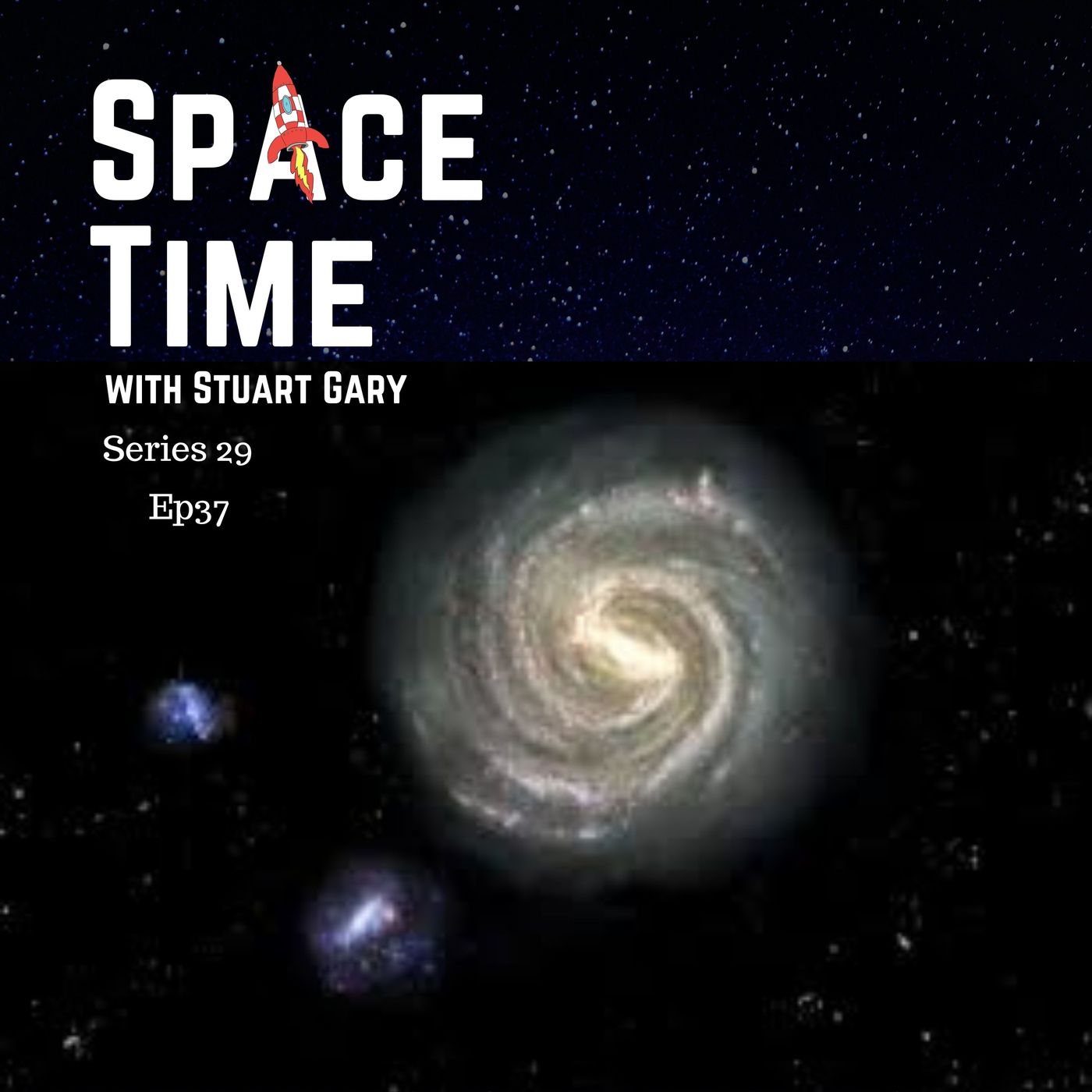
Astronomers may have finally solved one of the many mysteries of the small Magellanic Cloud, a satellite galaxy which orbits our own galaxy the Milky Way. Like all the other stars in our galaxy, the Sun and its solar system, which includes the Earth, circles around the Milky Way's Galactic Center, taking somewhere between 225 and 230 million years to complete each orbit. And from what we can tell, most other star systems and most other galaxies do the same around their Galactic centers. The funny thing is that's not what happens in the small Magellanic Cloud. This dwarf galaxy is one of the Milky Way's closest galactic neighbors. It's a small gas-rich galaxy visible to the unaided eye from the southern hemisphere and bound to our galaxy by gravity along with its companion, the Large Magellanic Cloud. All free galaxies, the small Magellanic Cloud, the Large Magellanic Cloud, and the Milky Way
have been interacting with each other for millions of years. The small Magellanic Cloud is also one of the most studied galaxies in the sky. Astronomers have catalogued at stars, mapped at scarce and attracted its motion for more than half a century. Yet a basic question about it has remained. Why don't its stars orbit around its galactic center the way stars in most other galaxies do? Now, a report in the astrophysical journal suggests the reason maybe due to a galactic collision between the small Magellanic Cloud and its larger companion, the Large Magellanic Cloud, millions of years ago. The findings also raise questions about how scientists use the small Magellanic Cloud as a reference point by understanding other galaxies across the history of the cosmos. The studies lead author Hermannish Rathor from Stuart Observatory says it's like seeing a galaxy transforming in live action. The small Magellanic Cloud contains more massing gas than it does in stars. Gas cools, contracts under its own gravity, and settles into a rotating disc.
The same process, they shape the spinning plane of our solar system. But when astronomers previously measured the motion of the small Magellanic Cloud stars using the Hubble Space Telescope in the Gaia satellite, they found the stars' white orbiting around the galactic center where stars in most other galaxies do. Rathor thinks the likely reason is the collision several hundred million years ago. He thinks the small Magellanic Cloud crashed directly through the Large Magellanic Cloud's disc. It would explain why birth galaxies are classified as disrupted spirals. During that collision, the Large Magellanic Cloud's gravity disrupted the small Magellanic Cloud's internal structure, and sent its stars into random disordered motion. Also, the Large Magellanic Cloud's gas applied a tremendous amount of pressure to the small Magellanic Cloud's gas, destroying its gas rotation. For decades, Telescope observations suggested that the gas inside the small Magellanic Cloud was rotating, but stars form out of gas and inherit its motion, which means if the gas was spinning,
the stars should be as well. But the new study now shows the rotation was simply an illusion of the viewing angle. The collision is stretching the small Magellanic Cloud, and gas moving towards and away from Earth along the stretch looks like rotation from certain perspectives. The authors use computer simulations tell it to match the known properties of the small and large Magellanic Clouds, their gas content, their total stellar mass, and their positions relative to the Milky Way. They paired their simulations with theoretical calculations how the small Magellanic Cloud's gas was affected as it plowed through the Large Magellanic Cloud's dense gas environment during the collision. The authors also developed new methods of reading the Scrabwood Star motions in a post-galactic collision, tools that can now be used to properly interpret what the Telescopes are actually measuring in the small Magellanic Cloud. And that matters because the small Magellanic Cloud is small, gas-rich, and low in heavy elements, all of which are properties that make it a standard yardstick for the kinds of galaxies that are thought to have existed in the very early universe.
And a galaxy that's still reeling from a collision may not be a clean reference point. A study by Rathor on colleagues last year showed that the collision also left a physical mark on the Large Magellanic Cloud, which could upset us probe dark matter. The Large Magellanic Cloud has a bar-shaped structure at its center, that bar is tilted out of the plane of the galaxy as a result of the collision. Rathor says that a degree of the tilt is tied to how much dark matter the small Magellanic Cloud contains, giving astronomers a new way to measure a substance that has never been directly detected and only inferred by its gravitational influence. This is space-time. Still to come, protecting astronauts from radiation in deep space, and another step forward in growing food beyond Earth. All that and more still to come. On space-time. This episode of space-time is brought to you by Squarespace, the platform that makes
building an incredible online presence not just possible, but effortless. Squarespace gives you all the tools you need to create a professional website, claim your perfect domain, promote your brand, and even get paid. All in one easy-to-use place. Whether you're showing off your portfolio, selling products, or booking clients, Squarespace has you covered. Let's talk about why Squarespace is recommended for anyone looking to offer professional services online. First, offering your services couldn't be easier. Squarespace gives you everything you need to impress your clients and streamline your business. You can set up a custom website to showcase consultations, events, or any experience you provide. Now let's talk about design. With Squarespace, you don't need any coding experience to have a website that truly stands out. Their cutting-edge design suite offers Blueprint A1, a smart website that creates a tailor-made design based on your industry, your goals, and your personality. All in just a few easy steps.
Or you can pick from a library of award-winning templates that easily customize your site with drag and drop editing and stylish visuals. Every website, no matter your starting point, it's fully flexible, visually stunning, and designed to help you look your very best online. So are you ready to get started? Head on to squarespace.com-spacetime for a free trial. And when you're ready to launch, use the offer code Spacetime to save 10% off your first purchase for a website or domain. That's squarespace.com-spacetime with the code Spacetime. And of course there's a link to the offer code in our show notes. Build your space online with Squarespace. There's a moment right before a home repair goes wrong. When you say, what if I try this? That's when things get really tricky. When it comes to heating, plumbing and electrical, just leave it to the experts. Crop Metcalf handles everything, from regular home maintenance to worry-free repairs.
Book today at serviceexpress.com and save $90 on an HVAC precision tune-up. Nest's first man mission to the moon in over half a century has been roared out back onto the launch pad and is now slated for flight on April 1st. Artemis 2 has spent the last few weeks back in the vehicle assembly building at the Kennedy Space Center in Florida, resolving a helium leak issue in the space-launch system rocket's upper stage. The 10-day Artemis 2 mission will send a crew of four astronauts around the moon and back to Earth in the process traveling further from our home planet than any human has ever ventured. As the astronauts travel around the moon, there will be far beyond the protective shielding of Earth's magnetic field. And so their Orion spacecraft will need to keep them safe from the dangers not just of the extreme temperatures and vacuum space, but also from exposure to radiation, both from deep-space cosmic rays and from the solar wind and space weather events streaming out from the sun. During their flight, both NASA and the National Oceanographic and Atmosphere
Administration knower will monitor the sun around the clock, translating space weather conditions into real-time decisions to protect the crew. Space weather refers to the changing conditions driven by solar wind and eruptions on the sun. Solar flares are the most powerful eruptions in our solar system, the strongest unleashing more energy than a billion hydrogen bombs, and coronal mass ejections are giant clouds of solar particles hundreds of times the size of the Earth that burst forth from the sun. Both solar flares and coronal mass ejections can affect technology, but the primary concern for astronauts are the solar particle events they can trigger, accelerating some subatomic particles to near the speed of light. Now, if a significant solar particle event occurs near the Artemis II crew, it could raise radiation levels inside the spacecraft. Too high total lifetime exposure of radiation will contribute to an increased risk of developing cancer. During the Artemis II mission, NASA will need to try and minimize the risk. Operations lead for space weather analysts, Mary Eurone, from NASA's Goddard Space Flight Center in
Greenbelt, Maryland, says the focus will be on real-time space weather analysis, prioritizing the solar and energetic particles and events that could produce them. The Goddard team will track any solar eruptions that occur, measuring how big they are, how fast they're moving, and how likely they are to generate energetic particles that will cross Orion's path. To achieve this, they'll use real-time data from sun-watching spacecrafts strategically placed around the solar system. These include NASA's recently launched interstellar mapping and acceleration probe IMAP, NASA's solar dynamic observatory, the joint NASA and European Space Agency Solar and Heli-3C observatory spacecraft SOHO, and know as geostationary operational environment satellite goes 19. And it doesn't in there other spacecraft will also help monitor the sun. And one of those is NASA's Perseverance Mars rover. See, due to Mars' current orbital position, Perseverance can look at the far side of the sun that the Earth can't see. And the rover's mass-cam-Z cameras will be able to give NASA's space weather teams
a view of the largest sun spots up to two weeks earlier so that the team can monitor and prepare for possible solar flares. The complication is energetic solar particles don't stream straight out from the sun. They tend to spiral along the sun's magnetic field lines, tracing loops tens of thousands of kilometers across and scattering geodiparticle collisions along the way. And the swarms usually so large that from inside, its particles seem to be coming from every direction. But it's a gradual rise in radiation, that gives analysts time to evaluate the situation. Now there are six radiation sensors aboard Orion designed to measure doses in different parts of the cabin. And the crew will also be wearing their own personal radiation trackers called active decometers. If radiation levels increase, Orion's onboard systems will display warnings and sound and alarm. NASA has those level thresholds that will be monitoring inside the capsule. The first signals a caution prompting closer monitoring coordination with medical and flight operations teams. A higher threshold triggers a recommendation for the crew to
take shelter. That raises an important question. How do you take shelter from radiation inside a tiny spacecraft? Well, radiation shielding in space is all about mass. Judge particles, you see, are slowed and absorbed as they pass through matter. So, the astronauts are trained to configure their cabin during a solar particle event, removing stowed equipment from storage bays and securing along the areas of the cabin to add extra mass between themselves and incoming particles. The complexity of solar particle events is one reason NASA places spacecraft across the solar system. During that solar storm back in January, we spoke about earlier, NASA analysts tracked a solar coronal mass ejection event on its way to Earth. When it arrived, satellites detected two distinct spikes in energy particles, where they would normally only be one. And it was measurements from NASA's bioscentral CubeSat, which is deployed during the Artemis-1 mission, which revealed what was happening. That spacecraft located some 88 million kilometers from Earth detected a distinct eruption that later merged with the coronal
mass ejection heading towards Earth. Automally, two separate eruptions occurred. And it doesn't end there. The crew on Artemis-2 will also need to account for exposure to Earth's radiation belts as well as galactic cosmic rays from deep space. The Van Allen radiation belts are two rings of high energy particles that surround the planet. Any mission headed towards the moon or beyond will need to pass through both them and the high energy galactic cosmic ray particles, which emanate from sources well beyond our solar system. Together, the radiation exposure from these sources is expected to be comparable to a one-month stay on the International Space Station, or about 5% of an astronaut's career radiation limit. And any additional exposure from solar radiation events would simply add to this space line. This report from NASA TV. Evruptions from the Sun can release more energy than a billion hydrogen bombs, and astronauts are about to head straight into this harsh domain. During NASA's Artemis-2 mission, astronauts will
leave Earth's protective magnetic field to travel around the moon. Out there, they'll be exposed to some of the harshest elements in space, including swarms of energetic particles from huge solar eruptions speeding across the solar system. If astronauts aren't prepared, these particles could put them at increased risk of developing cancers and other health problems. So during their 10-day journey, NASA and NOAA are monitoring the Sun 24-7 with spacecraft across the solar system. By tracking the direction and strength of eruptions in real time, scientists can see if energetic particles from the Sun will cross paths with the astronauts exposing them to radiation. Radiation exposure is measured inside of the Orion spacecraft with sensors, and each astronaut also wears a personal radiation tracker. So what happens if a solar storm strikes? If radiation levels become dangerous, astronauts take shelter. They reconfigure the cabin by stacking equipment and materials around the spacecraft to add extra shielding.
The more mass they have between themselves and incoming particles, the better protected they are. As astronauts travel into deep space for the first time in more than 50 years, will we watching the Sun to keep them safe? This is space time. Still to come, another step forward in growing space food, and later in the science report, the new spray on fabric coating that can clean clothing without the need of detergents. All that and more still to come on space time. Drew McIntyre Drew McIntyre here from WWE. Wheeled in the claymore can be a life of chaos. When I'm not dominating in the ring, Chumba Casino is how this warrior takes a rebrate. With hundreds of online social games and new weekly releases, there's always something fresh to try. In those daily boosts, next level, even my free time feels like Val Hallum. So when life feels like a battle,
kick up your feet, have some fun. And let's Chumba. No purchase necessary, VGW Group. Boyd we're prohibited by law, CTs and Cs. 21 plus sponsored by Chumba Casino. I've got Dan Morgan here on the pod. Say hi, Dan. Hey, how's it going today? It's going good, man. Tell us who you are and what you do. I'm Dan Morgan. I'm an attorney and a managing partner at Morgan and Morgan, which is America's largest injury law firm. That's pretty awesome. I think I saw Bill Board of yours recently that said 20 billion won. 20 billion is insane number. Yeah, 20 billion recovered. It's actually, I think, somewhere north, probably closer to 22, 23 after this year. And each year we get bigger and better and our army grows. So the number will hopefully keep getting bigger and bigger as time goes on. Awesome. So how does someone get in contact with Morgan and Morgan? What would I do if I got into an accident? Probably the easiest way is dialing pound law. It's pound 529 from your cell phone. We are always open. Our call center is always waiting to take your call. 24 7 365. Wow, Dan Morgan. From Morgan and Morgan,
America's largest injury law firm. Thanks for coming by the show. Thanks for having me. Visit forthepeople.com for an office near you. Scientists have been growing plants and the International Space Station using hydroponics for some years now. But scientists are now putting the astronomical green thumbs to the test by trying to grow plants in simulated lunar and Martian soils. Problem is lunar and Martian soils are known to be a pretty terrible medium for growing plant life. That's because they contain high concentrations of metals and don't allow water to filter through properly. Now, in new study in the journal Scientific Reports, a show that by adding fungi to lunar soil and combining that with regular earthworm excrement, it gives it that genuset qua needed for plant growth. And that's allowed them to grow chickpea plants. Meanwhile, in a second study, the authors followed the growth of microbes in a simulated Martian soil. And they say that in a sterile environment with similar atmospheric humidity to that of Mars, the little bugs were able to double their DNA mass over a period of 30 days. Problem is that by day 60, the life that had
grown had completely disappeared, so it's back to the drawing board. This is space time. And time to take another brief look at some of the other stories making using science this week with a science report. A new study has found that teenagers who are more aggressive during early adolescence may also be more likely to have faster biological aging and a higher body mass index by the age of 30. The research reported in the journal Health Psychology followed 121 teenagers from the age of 30 until they reached the age of 30, finding that higher levels of aggression in early adolescence was a good predictor for more advanced biological aging by the time they reached 30, even after accounting for gender, family income, serious childhood illnesses, and adolescent body shape. The authors believe that this link can be explained by the impact of
aggression on relationships. Teens who showed higher levels of aggression were also more likely to argue with parents and mistreat their friends as they grew older. Those continued relationship struggles, not early aggression by itself, were what ultimately predicted accelerated aging. Three new species of rock dwelling monitor lizards have now been formally described from the savannas of Northeastern Queensland. A report in the zoological journal of the Lyonan Society says the works revealed a previously unrecognized evolutionary lineage. The discovery led by scientists from the Australian National University identified the rainbow rock monitor Varanus Eridus, the orange-headed rock monitor Varanus Ambra, and the yellow-headed rock monitor Varanus Phosphorus. Scientists have developed a spray-on fabric coating, which they say can make clothing washable without detergent for more than a hundred laundry cycles. Modern laundry comes with a host of environmental issues, including the use of huge amounts of water and polluting detergents and
even increasing the release of microplastics from fabric. The new research reported in the journal communications chemistry tested a method of spraying alternating layers of two chemicals onto clothing to create a layer of water molecules in an attempt to prevent stains sticking as strongly to fabric. Comparing a conventional washing cycle with a rinse cycle for the spray clothing, you also say the coating matched or out-of-form the conventional method when it came to removing stains, bacteria, and fungi. They say the method would mean applying a relatively expensive spray during the clothing manufacturing process, but as the spray appears durable after sunlight exposure and over a hundred laundry cycles, this cost would eventually be offset as it could reduce water usage, electricity usage, and washing time by more than 80 percent. Well, I guess it's important to have a goal in life, and since he was 10, Dave Shealey has spent his years searching Florida's Everglades for a creature the locals called the skunk ape. Apparently, it's a close shorter relative of Bigfoot, and it's called the skunk ape because of
its foul smell. The skeptics' timidum says it's good to have meaning in your life. Anyway, there's his fellow who's got a bit of publicity lately named Dave Shealey. He runs what he calls a skunk ape research center in Florida in the Everglades. He did film, quite a lengthy film, actually, supposedly 2000, although I've seen stills from it, which are labeled 1997, so I'm not quite sure of that. Now, film in the open, mainly very, very shaky, bit out of focus, now they all of this Bigfoot or several of them wandering through the Everglades forest on the edge of the forest in and out of the trees, and then finally, actually, one of these things runs across this open area.
Almost looks like it's running towards him, but around sort of a longest path and end of the trees on the other side, it's quite near. It's not a deer, no? It doesn't seem to be a bear. Is it a man in the gorilla suit? It's a man in the gorilla suit, I would say. It seems to be waiting through shallow water because it's sort of flinging his arms around and pushing along with his leg. Yeah, I mean, it's at a focus. If 2000 is not really yourself from a smartphone, with sort of technologies that can remove shakes, etc. But he's now saying that he's been a lot of years seeing it, and he's had several encounters, had others, and they keep receiving reports, sort of Bigfoot tricings or skunk cakes, cycling. It's one of many people out there, they're very sincere, I think, unless he's after people to visit his research center. The trouble is, there's a lot of them out there, and there's a lot of bad evidence to put forward. His film is interesting, but you can look at it on YouTube, as well as he's the Patterson Gimlin film, that was the famous one taken in the 60s. We're able to be a man in a suit, or yeah, assess to be a man in a suit. Well, the suit admitted it. How they admitted it? Yeah, the guy who sold them the suit admitted it. All right. The guy who sold the suit is admitted it's okay, so this one I think will turn out to be sort of a man in a suit as well. Says here the skunk
ape is over six feet in height, airy and foul smelling. That sounds like every bouncer I've ever met. Okay, this is a Bigfoot bouncer running across between clubs in the Everglades. It's another story, another bit of fuzzy evidence. Someone suggested that Bigfoot have this psychic ability to make photos go blurry. Yes, that's expedition Bigfoot again there, where they have this remarkable power, both to become invisible on will and also to make electronics go haywire on will. That's right. They're very sophisticated for something that lives in a cave and eats grubs and rocks. Well, this is actually now because they're suggesting that they're interdimensional. Right, they disappear and you commit to the hard to why you can find them. Well, they come from other universes, this sort of thing. They haven't had a Bigfoot body, haven't had Bigfoot bones, now they've found other bones, but they haven't had Bigfoot bones, haven't found, you know, haven't got proper film evidence that is indisputable, all these things. So to count for the fact that there's a Robby mentioned, or wouldn't they be wearing silver suits or something like that, that's wrong with the vision. That's so cliché, honestly. It came with a policy heap out of that.
Don't look so logic in these things, do it? It's not logical. They say it's interdimensional because they got Robby's evidence, but they have to find another reason why there's Robby's evidence. One of them is suggesting that the psychic powers of Bigfoot can destroy the evidence, or that they are interdimensional, and that they don't leave anything behind. And there's so many people doing this, there's so many TV shows, there's people in the middle of the forest at night, or with at night, there's not a lot of stuff like that. Yeah, and you like the way that Bigfoot abducts a girl, it's coming up on HP. Yeah, well, that's been happened before as well. Bigfoot had been abducted. You happen up in Queensland too, actually, so I'm excited to get abducted. In fact, one of the very first sightings, or claims of Bigfoot is about a minor, or a forester, or something like that, in North West, the US being kidnapped, and they Bigfoot haven't taken to there sort of Bigfoot camp after a long time ago, that sort of thing. They're having a way with him, or what happened then? I think you didn't like to talk to them. Well, I'm sorry. There's one of many bits of evidence. That's the skeptics' timendum, and this is Spacetime.
And that's the show for now. Spacetime is available every Monday, Wednesday, and Friday through bytes.com, SoundCloud, YouTube, your favourite podcast download provider, and from Spacetime with StuartGarry.com. Spacetime is also broadcast through the National Science Foundation on Science Zone Radio, and on both iHeart Radio and TuneIn Radio. And you can help to support our show by visiting the Spacetime store for a range of promotional merchandising goodies, or by becoming a Spacetime patron, which gives you access to triple episode commercial free versions of the show, as well as lots of bonus audio content which doesn't go to air, access to our exclusive Facebook group, and other awards. Just go to Spacetime with StuartGarry.com for full details. You've been listening to Spacetime with StuartGarry. This has been another quality podcast production from bytes.com. Here's the truth. You could literally be adored by everyone, and then come home and still get
completely ignored by your own cat. It's classic cat behaviour. But new Shiba Premium puree is a lickable treat that changes all that. Their protein rich made with bone broth and have the smooth, creamy texture cats go crazy for, especially when it's hand fed. Yeah, it's more than a treat. It's a fast pass to favorite human status. So feed your cat Shiba and go from totally ignored to truly adored in just 12 days, guaranteed, or your money back. Learn more at Shiba.com. Looking for excitement, Chamba Casino is here. Play any time, play anywhere. Play on the train, play at the store, play at home, play with your board. Play today for your chance to win, and get daily bonuses when you log in. So why are you waiting for or don't delay? Chamba Casino is free to play. Experience social gameplay like never before. Go to Chamba Casino right now to play hundreds of games, including online slots, bingo, slingo, and more. Live the Chamba Casino dot com. No purchase necessary VGW group void for prohibited by law 21 plus terms and conditions apply.
More episodes
More from SpaceTime with Stuart Gary

Tatooine's New Neighbours, Mars Rover's Drilling Quest, and Soyuz 5's Maiden Voy...
SpaceTime with Stuart Gary

Venus's Hazy Secrets, Planetary Collision Insights, and Lunar Gateway Corrosion...
SpaceTime with Stuart Gary

Uranus' Ring Revelations, Africa's Rapid Rift, and Eris Rocket Mishap
SpaceTime with Stuart Gary

Milky Way's Black Hole Secrets, Solar Flare Spectacles, and Mars Rover Discoveri...
SpaceTime with Stuart Gary