About this episode
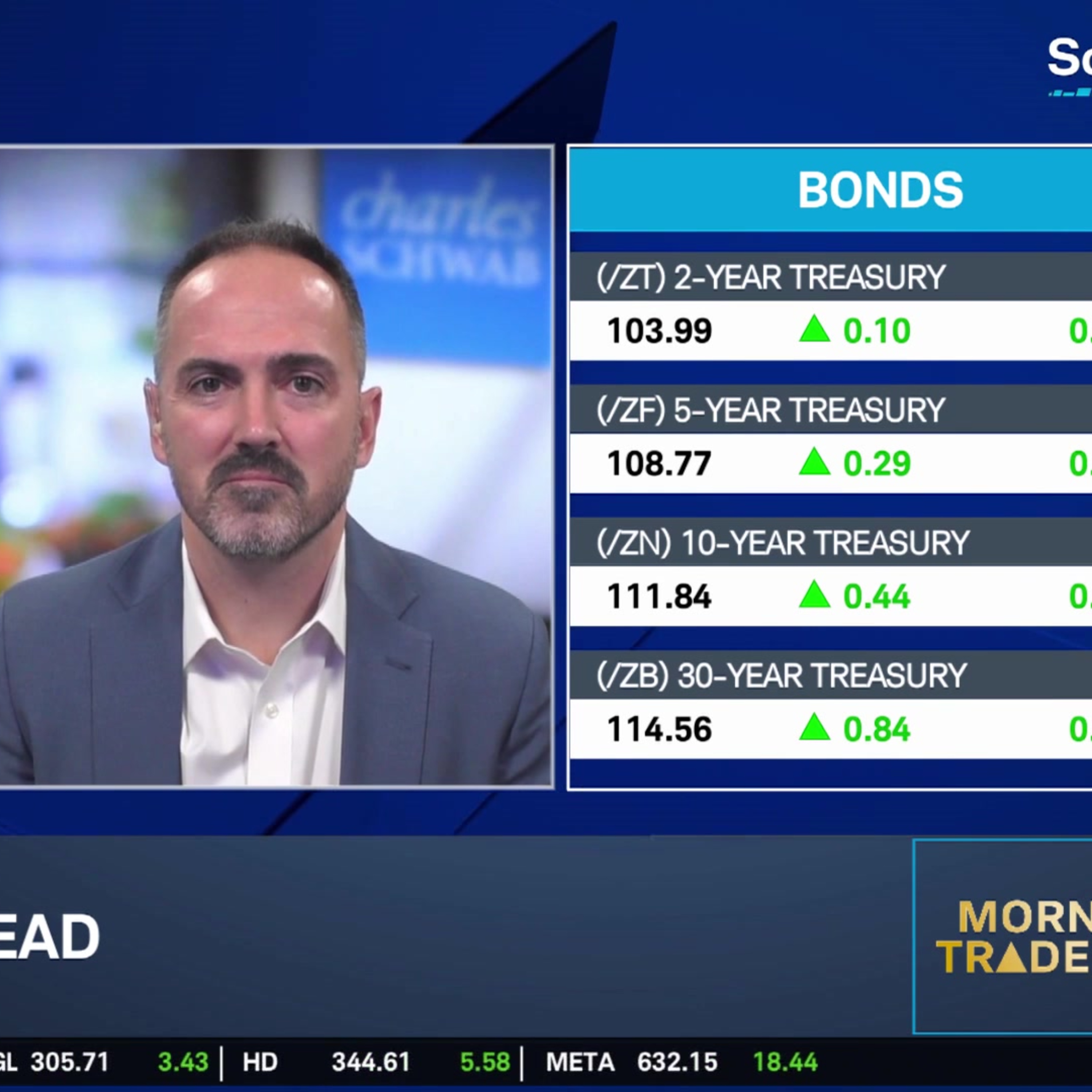
Today's Charles Schwab big picture panel focuses on the FOMC and what Fed governors will say regarding Wednesday's interest rate decision. Collin Martin talks about the conundrum the committee has when it comes to weighing persistent inflation against a job market struggling to find its footing. Recent economic data signal a resilient economy, according to Collin, suggesting the Fed will "take their time" to cut rates.
======== Schwab Network ========
Empowering every investor and trader, every market day.
Subscribe to the Market Minute newsletter - https://schwabnetwork.com/subscribe
Download the iOS app - https://apps.apple.com/us/app/schwab-network/id1460719185
Download the Amazon Fire Tv App - https://www.amazon.com/TD-Ameritrade-Network/dp/B07KRD76C7
Watch on Sling - https://watch.sling.com/1/asset/191928615bd8d47686f94682aefaa007/watch
Watch on Vizio - https://www.vizio.com/en/watchfreeplus-explore
Watch on DistroTV - https://www.distro.tv/live/schwab-network/
Follow us on X – / schwabnetwork
Follow us on Facebook – / schwabnetwork
Follow us on LinkedIn - / schwab-network
About Schwab Network - https://schwabnetwork.com/about
Get every episode summarized
Each time Schwab Network publishes, we email you a written briefing from the transcript — the topics, who appeared, and any specific claims, with the ad reads skipped.
Email me new episodesFree for 3 shows. No card needed.
Transcript ready
78 searchable segments. Every word is indexed and playable.
Full transcript
Schwab Network — FOMC to "Take Their Time" Cutting Interest Rates?. Machine-transcribed; use the interactive transcript above to jump the player to any line.
Welcome back to Morning Trade Live. It's time now for the big picture. Let's welcome in Colin Martin, head of fixed income research and strategy. Schwab set up a financial researcher. Colin, it's a central bank bananza this week. Of course, all lines on the Fed. We know what they're probably likely to do. But what are you expecting them to say? I mean, that's going to be the big thing we're paying attention to. We expect no change to Fed policy this week, which is in line with expectations. And that was our base case, even prior to all the headlines and updates with the war in Iran. We will get updated projections and the dot plots. So it'll be interesting to see how those shift, given the new realities that we're in right now, what that means going forward. It wouldn't be too surprising to see the projection for inflation to maybe increase relative to what we got in December. Maybe slightly slower economic growth, maybe a slightly higher unemployment rate. I think with the actual dot plot, we had a very wide range of views. Again, even before this
uncertainty picked up, that probably isn't going away anytime soon. It's going to be really important to hear from Powell, how he chooses his words. He's usually very careful with how he projects what the committee is thinking to see how they are thinking about this. Right now, inflation and inflation expectations are clearly on everyone's minds. That appears to be the driver of the bond markets right now. But it'll be interesting to hear from him with how long of a conflict they need to see or what sort of potential impact they need to see before they start to get worried about maybe the economic outlook if growth were to slow, potentially resulting in a slightly weaker labor market. It'll be interesting to see how they're kind of framing that and how it adjusts their balance of risks. There's certainly a lot of unknowns, particularly with respect to exactly how long this is going to drag on for. I mean, that's the million dollar question in these markets. And if you had the answer, I mean, great for you because obviously we've seen just how sensitive this market can be to any
slight hint or anything with respect to the duration here. I'm just wondering if the data, if the Fed is data dependent and that's what they said. The last time we heard from Powell, he mentioned an upgrade to the economy, he mentioned an upgrade to jobs. Since then, we've had that Q4 GDP effectively slashed in half with that revision. And then the jobs market still holding on, but sort of low higher, low fire. I'm just wondering what you make of the macro setup as far as what the data is indicated going into this particular meeting. It's a great way to frame it, Sam, because clearly economic fundamentals matter. So if we take a step back and go back to the end of February, before we got the conflict, we thought the economy was in a pretty good place. You mentioned the Q4 GDP report on the surface. It was a little bit weak, but if you dig under the surface, we think it was in line with the trend we've seen, meaning at or above the 2% trend that we've been expecting for GDP growth. So we thought the economy was still holding up well. We were
seeing signs of stabilization with the labor market. We saw the unemployment rate come down from its recent peaks by a few tents. We've seen initial jobless claims come down. We were seeing good things there. You mentioned the February jobs report that clearly through a wrench in the plan a little bit, a little bit weaker than expected, but adding that all together, we thought the economy was pretty good. So I think the Fed has to assume that that's where we are right now, and then the duration of the conflict is what's going to matter. I wish I had all the answers there, but if anything, as it relates to Fed policy, and I think with investor positioning, it just means that you should be patient, not overreact. We don't expect the Fed to overreact here. They're not going to make any changes to their policy, meaning, hey, we need to hike rates now because inflation and inflation expectations might pick up. They're going to take their time, see what the duration looks like, and then see what that economic impact is. If it ends up being relatively short-lived, the Fed probably doesn't need to do much, and they'll probably resume cutting rates later this year. The longer it goes on, and the longer inflation expectations
get embedded, and maybe worse unencored, maybe that holds their rate steady for longer than possible. But what we know is don't overreact if you're an investor, and we don't expect the Fed to really make any big changes right now, either. As I said, it's not just about the Fed this week either, though, Colin, as you look at very closely, the BOE is going to be making a rate call. So as the ECB, I think everybody is taking a bit of a wait and see approach right now, but I suppose that brings me to my question around, if you're investing in this market, are you chasing higher yields elsewhere? I'm just wondering, I believe, and I mentioned this to my previous guess, we've seen like a 50-basis point move in the GILTS market, while the US has been pretty rangebound, you and I have discussed that story for a number of months now. I'm just wondering what you're seeing as far as some of that demand is concerned for fixing come here. This is international. Yeah, we know we're seeing big moves everywhere. Not just here in the US, we're seeing
you know, bond yield shifts overseas as well. And our outlook is changing a little bit. Again, coming into the year, we had a more favorable view of the global bond markets. A lot of that hinged on our dollar outlook, and that was mostly based on compressing interest rate differentials, where we thought the ECB, for example, we're expecting to hold rates steady for the short run, and maybe they'd be done cutting rates altogether for the cycle, where the Fed was expected to continue cutting. So that, you know, falling interest rate differential means less of an yield advantage for the US, and also maybe a room for the dollar to weaken and a potential increase in local currencies. We're potentially shifting that a little bit, because you mentioned it, are there more opportunities elsewhere, but we're seeing more opportunities here also. I mean, the 10-year Treasury's up 25-30 basis points over the past few weeks, and we're seeing the direction of the dollar shift a little bit. If those interest rate differentials don't really come down, if US yields kind of stay elevated, that maybe that takes away a little bit of the demand for
the dollar, or other currencies rather. But also, given the uncertainty, the dollar is still king. This is something we talk about a lot. It hasn't lost its reserve currency status. Maybe demand has waned a little bit at the margins, but it's still the dollar. People still want Treasuries, and we think that might shift the view a little bit from here that you keep the dollar somewhat supported over the short run. Okay, makes sense. Colin, always appreciate it. Thanks so much for joining us today. Colin Martin, their head of fixed income research and strategy show up Center for Financial Research. We'll catch you next time.
More episodes
More from Schwab Network

JNJ Balances Growth, Patent Transitions, and Legal Overhangs
Schwab Network

nCino (NCNO) CEO on Earnings, AI in Banking & Overcoming "SaaS-pocalypse"
Schwab Network

The Big 3: NET, TWLO, ASTS
Schwab Network

Tie Lasater on Inflation Floors, Energy Risk, and Private Credit Stress
Schwab Network