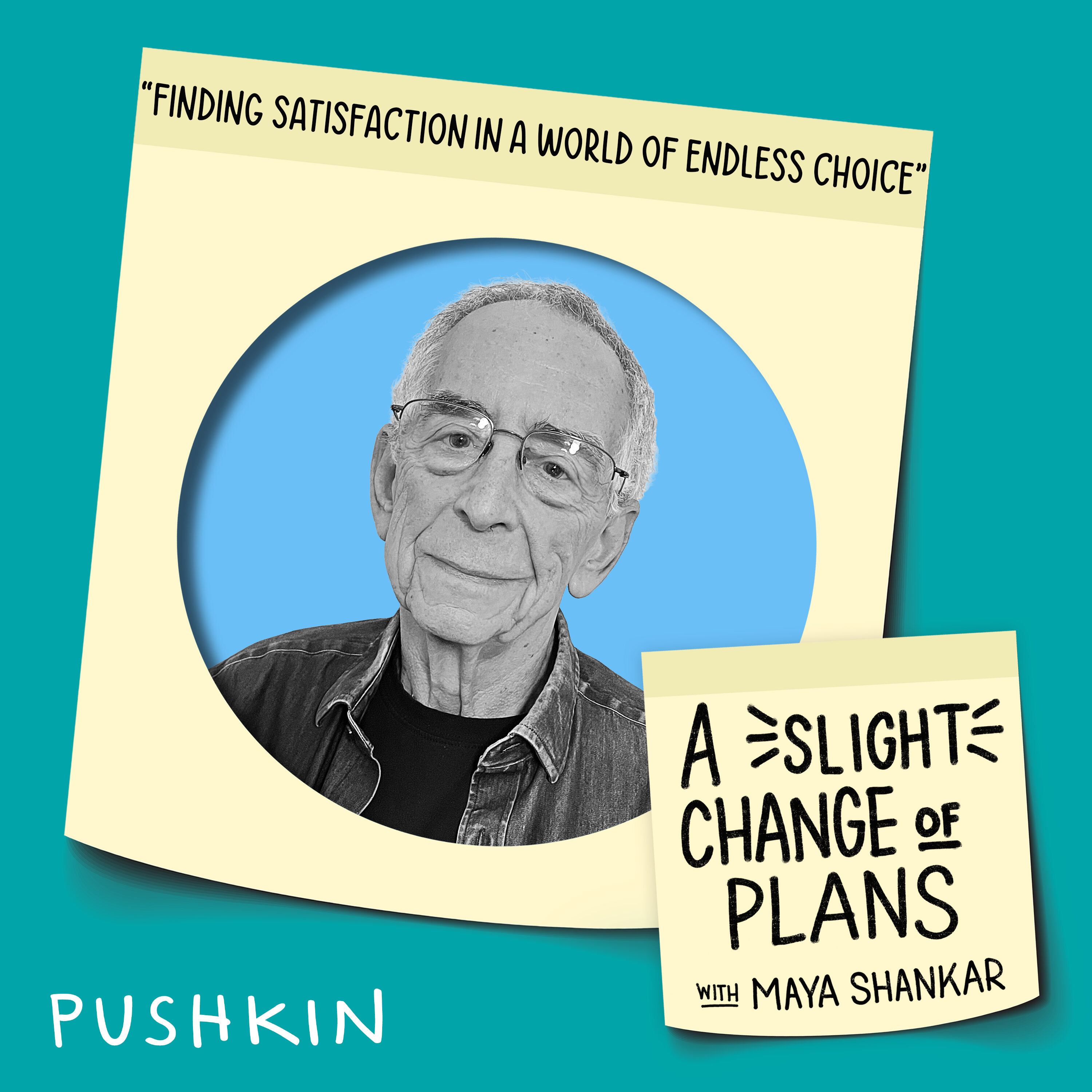
About this episode
Social Psychologist Barry Schwartz is an expert on decision making. His new book, (00:01:48) “Choose Wisely,” explores how the very tools we rely on to make “good” decisions can steer us wrong — and why endless options may be making us less satisfied, not more. In today’s episode, Maya sits down with Barry to unpack why choosing can feel so exhausting, the hidden costs of always trying to find the “best,” and what the rest of us can learn from people who are content with “good enough.”
And in case you missed it—Maya’s new book, (00:27:35) “The Other Side of Change,” is officially a bestseller! Order your copy at changewithmaya.com/book, or wherever you like to buy books.
See omnystudio.com/listener for privacy information.
Get every episode summarized
Each time A Slight Change of Plans publishes, we email you a written briefing from the transcript — the topics, who appeared, and any specific claims, with the ad reads skipped.
Email me new episodesFree for 3 shows. No card needed.
Hosts & guests
Transcript ready
874 searchable segments. Every word is indexed and playable.
Full transcript
A Slight Change of Plans — Finding Satisfaction in a World of Endless Choice. Machine-transcribed; use the interactive transcript above to jump the player to any line.
This is an I Heart Podcast. Guaranteed Human. This is Dr. Maya Shankar from a slight change of plans. All the talk of probiotics can get confusing. Which to take? Why? What does it do? Let's make it easy. Garden of Life's doctor formulated one daily women's probiotic is the number one women's probiotic. Why should you take it? Well Garden of Life transforms a range of probiotic strains to support digestive, immune, and vaginal health. Plus, this doctor formulated non-GMO formula is designed specifically for women. Simply put, this is an easy way to support your gut health. Garden of Life, formulas for feeling alive, available on Amazon. Number one, based on Serkana, 52-week multi-eulite unit sales ending November 20, 2025. These statements have not been evaluated by the Food and Drug Administration. This product is not intended to diagnose, treat, cure, or prevent any disease. Hey, it's Angela Yee.
Listen, we all want the best without having to pay the most. That's where Verizon comes in. Get this! Now you can take your AT&T or a T-Mobile bill into any Verizon store. They'll look at what you're paying and give you a better deal, period. Now is the time to head to Verizon for a deal you don't want to miss. You get the amazing coverage you want while keeping more cash in your pocket. Visit your local Verizon store to start saving today. Must provide recent consumer mobile bill in the name of the person redeeming the deal, additional terms and conditions apply. Being a small business owner isn't just a career. It's a calling. Chase for business knows how much heart and effort going to building something of your own. Manage all your business finances, from banking to payments to credit cards, all in one place with their digital tools. Plus, access online resources designed to help your business thrive. Learn more at chase.com slash business. Chase for business. Make more of what's yours. The Chase Mobile app is available for select mobile devices. Message and data rates may apply.
JP Morgan Chase Bank and a member FDIC. Copyright 2026, JP Morgan Chase and company. Pushkin. When our oldest grandchild was five-ish, my wife went with her to Supermarket to buy a toothbrush, and she got to the toothbrush section of the aisle, and there were 150 or so, and she stood there my five-year-old granddaughter and was just completely overwhelmed and paralyzed and finally said, Grandma, would you pick? Does this sound familiar? Maybe for you, it wasn't toothbrushes, but what couched to buy or what doctor to see.
Social psychologist Barry Schwartz, an emeritus professor at Swarthmore, has spent decades challenging the idea that more choice is always better. It makes making decisions harder. It makes making good decisions harder, and it ends up making you less satisfied even when you manage to make a good decision, because you know, somewhere out there is something that is even better. On today's show, Finding Satisfaction in a World Full of Endless Choice. I'm Maya Shankar, and this is a slight change of plans, a show about who we are and who we become in the face of a big change. Barry Schwartz is an expert on decision making.
His latest book is called Choose Wisely. In it, he challenges some of the conventional wisdom in tools people use to make decisions, as well as what it even means to make the right choice. We began with an overview of various models of decision making. There are all kinds of ways that people make decisions, right? Some people go with their gut. Others choose a decision based on what they think will minimize regret. Others go with their faith. They ask God, can you just give us a quick history lesson on these different models and how the scientific understanding of decision making has evolved over time? I'd be delighted. In some respects, this is the story that the book Choose Wisely is trying to tell. You went through all of the kinds of approaches that people might have to make decisions that would occur to me, going with your gut, relying on religious advice, relying on what your friends have chosen, relying on what respected elders have chosen,
relying on habit, do the same thing today that you did last week. All of these are ways to ease the burden of choosing. In effect, when you do any of those things, you're delegating the choice to some respected other person, either the previous you or an elder in the community or a good friend or what have you. What you just said reminds me of this very common refrain we have in these tough moments of decision making. Can you just decide for me? How many times do we ask that? We ask that of physicians. We ask that of our parents. We ask that of our friends, of our spouses, just make the choice for me. In fact, a lot of times in my life, I've wanted the universe to eliminate an option just so that I don't have to make the choice and have to deal with the psychic costs afterwards of regret and questioning whether I actually made the right choice or not. But here's the thing, from the perspective of the discipline of economics on the one hand
and the psychology of decision making, any one of those alternatives you described is inferior to doing it the right way. And to clarify, Barry, when you say, quote, the right way, you're referring to a framework called a rational choice theory, right? It is a model for how people ought to make decisions. And you actually take issue with this model, which we'll get to a bit later. But for now, tell us what this theory reports. Rational choice theory, mostly the product of economists, is the view that the way to make good decisions, rational choices is to assess how valuable each option is to you. And how likely it is to be as valuable as you think it is. Every decision is a prediction. We sometimes predict that we'll love a restaurant,
and we don't, we predict we'll love a car, and we don't, and so on. You create a little spreadsheet, you fill in for every option, those two numbers, and then you do the math. That's the way rational people make decisions. And let me just say there's a cousin to this that is much more consequential in a way, because it affects policy decisions of whole entities, rather than just yours and my decisions as individuals, and it's called cost-benefit analysis. What's the best way to reduce our carbon footprint? Lots of people have different ideas about that, and the idea is there probably is a best way, and the way you figure it out is you figure out how much it will cost to implement, and how large the benefit will be, and out of this analysis will come the clear answer to the question, and you implement it, not just for your own personal use,
but for the whole society's use. So we live with that kind of analysis all the time, and we're encouraged to do that kind of analysis when it's our own personal decisions. That's what rational choice theory is. It critically depends on being able to quantify things. Is that why you think people are drawn to this model, because it gives them a feeling of both ease and a feeling of confidence that they have done the work, if you will, and they have arrived at the right answer? I think maybe so. And let me say, it isn't incidental that this theory is called rational choice theory. Rational is not a descriptor. Rational is an evaluative term. What that means is rational choice theory is the right way to make a choice theory. Who wants to be irrational?
Yeah, of course. It's in a front to our intelligence to be told that we're being irrational. Exactly. So there's an horrific attach to it. And if they see weed articles and newspapers where policy decisions are being made using a framework very much like this, what more evidence do you need that this is what the smart and powerful people do? But to me, the critical notion is that the 50 years of research by psychologists on the errors we make and two Nobel Prizes in economics to psychologists who studied this. And never, not for a second, was there questioning of whether the standard for what counts as a rational decision is the right standard? It was all just presupposed. This is the right way to do it and let's study the ways in which people fall short. And the point of this book is to suggest
that the normative standard of rationality is catastrophically bad. You can't really use rational choice theory unless you can quantify how good the various outcomes will be for you and how likely they are to be that good. In other words, you need a value and a probability for everything you're thinking about and they need to be on the same scale so that you can compare one option against another with respect to all the things that matter to you so you can actually do the math. Putting discursive descriptions in that Excel spreadsheet isn't going to help you get to the answer and the problem is we give quantification more respect than it deserves. We are often driven by the dimensions that are most easily quantified
rather than by the dimensions that are actually most important to us. And that will lead to decisions that distort what we actually care about. There's also two other issues that I see. One is per the end of history illusion where we forget that we will keep changing. We assume we are a fixed entity and that all of our preferences will stay stable into the future and that we will be excellent cognitive forecasters and be able to anticipate how we'll feel. We know from decades of research that's simply not true. We're very bad at predicting how future events will make us feel. And then the second thing is that when it comes to large decisions you have to differentiate when it comes to how much value you think you'll get from it between what common and what call experiential happiness versus reflective happiness. So there are lots of choices we make where in the short term things are really hard. Think about having a newborn baby, right? That's a really hard experience. You're not sleeping. You're barely eating. You're not allowing your needs to be met.
But there's a massive payoff when you take moments to evaluate, hey, how's my life going? Do I feel fulfilled? Do I feel satisfied? And having that kid might give you a massive boost or maybe 30 years down the line it gives you that massive boost and then how do you differentiate between those and the Excel spreadsheet? But here too, the seduction of quantification screws you up because the long-term satisfaction that you're talking about can't be quantified in the way that the number of hours of sleep you get in night and the number of hours you can spend working on your latest project. You know, those are quantifiable. So what is salient and pointable at and measurable in this case is all the bad stuff. You know, and the things you're talking about play second fiddle because we don't know how to quantify them. But you're absolutely right. And let me say, since this is your wheelhouse, that one of the problems that rational choice theory has
is that it takes a snapshot of life in a given moment and freezes it and does not allow for you to change or the world to change. You know, it tricks us into thinking that decision-making should be easy and it's not. When I think about my subjective assessment of whether I made the best decision. So let's say I'm trying to choose the right car for me, okay? I we should not only integrate how well the car services my needs and meets my various preferences and expectations. We should also consider these other more meta components, namely how I feel about the decision that I made, whether it induces a feeling of regret in me, whether I have psychic stress because I'm constantly reevaluating if it was the right choice or not. Does rational choice theory
account for the psychic factors, the, well, again, when I'm calling meta factors of how we are in real time evaluating the decision that we made. Because if I'm really upset with the decision or it's causing me a lot of consternation, that will eat away at my positive utility. You ask very good questions. Oh, thanks very. Every question has a more complicated answer. I'm afraid. So there are a couple of ways to treat this view. You have to consider what you might call transaction costs. There is a price that you pay for complexifying your decision. And maybe it's not worth paying the price. Like mental transaction costs to be clear. Yes, and not just mental, you know, like it takes time and that's time that you could be spending doing something else like doing your job better. So that's one problem. If you factor in the transaction costs, you might adopt a different decision strategy.
Yes. The second thing is that from the economist point of view, adding options and thus making the decision more complicated can't be bad. And they can't be bad because if you're happy, alternating between two breakfast cereals, and I add a third one to the grocery shelf, you can ignore it. So adding an option doesn't make you worse off and it may make somebody better off. And if it's true of a third option, it's the same thing as true of a fourth and a fifth and a fifth and a hundredth. So that approach essentially doesn't acknowledge that the kind of costs you're worrying about exist. What I suggest in the book is that more is better than less, but a point is reached where still more starts to become worse. And it can become sufficiently worse
that instead of being liberated by all these options you're paralyzed. After the break, Barry gives us a path out of decision paralysis. We'll be back in a moment with a slight change of plans. Okay, you've got a lot going on and choosing the right probiotic might not be at the top of your to-do list. So let's make things simple. Garden of Life is the number one women's probiotic brand for a reason. It's specifically designed for women to support the immune system, vaginal health, and overall women's health. You can feel good knowing that this is the brand so many women trust for their gut health. Garden of Life transforms 16 diverse probiotic strains and 50 billion CFU to support digestive health and a flourishing gut flora. And if you're worried whether Garden of Life women's once daily probiotic is a real deal, don't. They're certified, non-GMO, and doctor formulated
for women's unique needs. To put it simply, this is an easy way to prioritize your gut health. Garden of Life, formulas for feeling alive, available on Amazon. Number one, based on Serkana, 52-week multi-elite unit sales ending November 20th, 2025. These statements have not been evaluated by the Food and Drug Administration. This product is not intended to diagnose, treat, cure, or prevent any disease. Hey everybody, it's Nate. All right, two truths to the lie. Here we go. I wear size 13 shoes. I can ride a unicycle, and I have been a Verizon customer for 27 years. Anybody, anybody? All three are true. I know. Riding unicycle is not hard, but Verizon isn't as expensive as you think. In fact, if you bring in your AT&T or T-Mobile build to a Verizon store, they'll give you a better deal. That's right, a better deal on the best network. With the most ways to save on plans, streaming, and phone deals, take that AT&T or T-Mobile build to your local Verizon store today, get your better deal and start saving for real.
Based on RootMetrics, best overall mobile network performance US, the second half 2025, all rights reserved, must provide recent consumer mobile in the name of the person redeeming the deal, additional terms, conditions, and restrictions apply. Being a small business owner isn't just a career, it's a calling. Chase for business knows how much heart and effort go into building something of your own. That's why they make your business growth, their priority. The team at Chase takes the time to understand your mission, where you are now, and where you want to go. Their broad range of solutions is designed with you in mind, so you can bring your ideas to life. From banking to payment acceptance to credit cards, you can conveniently manage all your business finances all in one place with their digital tools. Looking for tips and advice? Their online resources are always available to give you the solutions you need to help your business thrive. See how your business can get stronger and go farther with Chase for business. Learn more at chase.com slash business. Chase for business think more of what's yours. The Chase mobile app is available for select mobile devices,
message and data rates may apply, JP Morgan Chase Bank, NA, member FDIC. Copyright 2026, JP Morgan Chasing Company. Professor Barry Schwartz and I have been talking about the sneaky mental costs of decision making. One reason you might find choosing between options particularly stressful is because you're a maximizer. Psychologists contrast this with another type of decision maker, a satisfacer. I ask Barry to explain the difference. A maximizer is someone who's out for the best. Whatever that means, the best can be subjective. In fact, it is almost always subjective. But if you're buying a new appliance, you want the best appliance. And if you're buying a new car, you want the best car. And if you're buying a house, you want the best house, yada yada yada.
A satisfacer is someone who wants good enough. If you're lucky, you'll look at one thing. It meets your standards and you're done. And in some areas, that can mean very low standards. And in others, it can mean very high standards. But once you find good enough, you stop looking. And the reason this is important is that in the world, we currently live in, if you want the best, you have to look at every option. And as everybody knows, when you start looking at every option, you'll be dead before you get to the end of the list. So it's become an unachievable goal to find the best. I love that you articulate that a satisfacer can have very high standards. It's just that it's good enough against the backdrop of those high standards. It does not mean that you are okay with bottom of the barrel outcomes. It's really important at this point, because most people, when they hear
satisfying, which is a technical term invented by a Nobel Prize-winning psychologist slash economist 70 years ago, they don't hear it as a neutral description. Yes. You know, when you say satisfies, what people hear is settling. Yes, exactly. And nobody thinks that settling is neutral. I mean, it's used disparagingly in the context of relationships, for example, don't settle. Absolutely, you know? And so there's a word in parentheses that isn't stated. And that word is just. He's just settling, which is an implicit criticism. And so I think everybody is pushing us and we push ourselves not to accept good enough because we should have higher expectations of ourselves. We should make more demands of ourselves and so on. What we've found, and other people have found, is that it makes making decisions harder.
In some cases, close to impossible, it makes making good decisions harder. And it ends up making you less satisfied even when you manage to make a good decision. Totally. Because you know, somewhere out there is something that is even better. Absolutely. You know, if you get into, you know, 10 colleges, you can torture yourself to oblivion, trying to decide which of these colleges to go to, when people a little older than you know, it doesn't make a damn bit of difference. Totally. There's a New Yorker cartoon that I show sometimes when I give talks on this of a young woman who's got a sweatshirt that says brown parentheses, but my first choice was Yale. Now, it's funny, but imagine spending four years at Brown, a wonderful institution.
And every day you wake up with that sentence in your head. Yeah. Are you going to get as much out of being at Brown as you possibly can? Not on your life. You'll spend every day you're at Brown thinking how much better life would be if only you'd gotten into Yale. So it's not, it's not a frivolous problem. It's a very serious problem. It's debilitating. It makes people feel like they are consistently making bad decisions and it undermines confidence and sap's energy. So it's very, I think, very consequential. Yeah, my friends who are on dating apps feel this acutely, you know? It used to be that you, well, back in the good old days, right? You had a few options. Maybe it's who you went to school with or to church with or saw it your local community, whatever. And now what's so interesting about the dating app thing is it's not even like you had the 10 options laid out in front of you. It's that you know that if you keep swiping, you will keep getting more and more people.
So there is this counterfactual world of infinite options that lives in your head at all times which can really eat away at your ability to satisfy. A lot of the point of the paradox of choice is to show that even when people make good decisions by their own standards, they feel less good about them. Yeah, for a variety of reasons. You know, if it's not perfect, you regret having chosen it. If you haven't been able to look at all the options, you're sure that some option out there that you didn't get to would be better than the one that you ended up choosing. And all of that makes the quality, the subjective quality, the decision feel less good. Absolutely. Absolutely. I have so many reflections here. One is, I mean, you strike me as someone who's more of a satisfactory than a maximizer. Very much so. I'm curious to know for people listening who are, well, one, I'm imagining someone's listening, they might think, well, I'm not across the board, a satisfactory maximizer. There are certain areas of life,
certain domains of life, where I doesn't really matter to me what microwave I get. I'm a satisfactory in that domain. But when it comes to my long-term partner, I'm going to be a maximizer. So they might have that response. What I want to know from you is, is a satisfying mindset, something people can cultivate. Let's say that they're being driven crazy by their maximizing tendencies. Can they do something about it very or are we sort of destined just to be the way we are? So I have two things to say. First, you're absolutely right that nobody's a maximizer about everything. Which means, of course, that we all know how to be satisfieders, because there are some decisions where that's what we are. And people have, that most people's intuitions are, well, you know, with unimportant stuff, it's foolish to maximize. But when it gets to be important, why would you not look for the best? And it relationships is often where people, you know, can't imagine what it would mean
to look for a good enough life partner. So there's one or two studies where they try to induce people to take up maximizing or a satisfying orientation and suggest that you can create a satisfying orientation in people who on the questionnaires that we develop look like they're maximizers. How interesting. What's unsatisfying about that is you don't know how long this lasts. You're in the lab, you get something to read or to hear and it makes you a satisfacer for the next 30 minutes. And then what? I'm imagining someone reading this right before they get proposed too. That's an issue of proposal. I just need to last for 30 minutes, Barry. Yes, the unsolved confident proposer would probably ship that treatment condition to the
partner so that, you know, this is the golden 30-minute window when you're going to say yes. Yeah. But the other piece of evidence I have is that when the book, The Paradox of Choice, came out which was 20 years ago, I've got hundreds, maybe thousands of emails from people who said, I thought I was the only one who had this problem. I thank you so much for making it clear that the world has given me and a lot of other people this problem. You mean, when they said I didn't know I was the only one to suffer from this, it was the maximizing mindset, right? Correct. And it succeeded in changing the way they made decisions. So this is personal testimony. I obviously don't have any data about what A, whether they actually did change the way they make decisions and B, whether that lasts. I do think it's a meaningful that if a short intervention
where you're reading about someone who's a satisfy surface as a maximizer can give you that little nudge to think slightly differently, that's meaningful because at least shows this is malleable enough. And I also think that the mere recognition of these two concepts is powerful in its own right. I feel like when I was studying judgment and decision-making during my postdoc and was learning about these concepts, I'm just thinking through my daily decisions and when I find that I've been in the Google search rabbit hole for four hours trying to figure out what couch I want, I can at least use labels. To identify what's happening. And you can ask yourself this primary question. Is this decision worthy of the maximizing mindset given the cost I will incur to my psychological well-being? I absolutely agree. Giving a name to things often in many ways defuses the impact that these things will have
and finding out that you're just one among many will make you stop feeling like that you have some pathology that needs to be corrected. So I think that's right, naming things helps a lot and it can lead to very different strategies and very different approaches to making decisions. Yes. What I have just started doing is using a slightly different word to distinguish it from rational and the word is reasonable. And so it seems to me that what you want is reasonable choice theory which acknowledges that not everything can be quantified, not everything can be compared to everything else. All you can do is you're giving it your best shot and thinking about the aspects of the decision that seem important and how you'll respond to those aspects
and how the people you care about will with the understanding that you should not expect the level of precision that is greater than the problem you are trying to solve. There are certain kinds of decisions where it seems quite reasonable to try to be as precise as possible. You know, if you're deciding what bet to make in a gambling casino you should know the odds and you should know how much you're going to win and how much you're going to lose. The precision is there and there's no excuse for you not knowing it. But when you're trying to decide where to go on vacation or what job to take or how to discipline your kid who's just transgressed that kind of precision doesn't exist. And when you seek it or impose it you're distorting the problem that you need to solve rather than illuminating it. But you know, this is not snap your fingers and it goes away.
You've got habits. It's going to feel very uncomfortable in the beginning for you to break those habits and you'll think, oh, what did I, what opportunity did I pass up by not spending another 10 minutes looking? But over time you will discover that you feel maybe even better about your decisions and your day has suddenly added a couple of hours. So how about reasonable choice theory instead of rational choice theory? Love it. Barry, thank you so much for joining us. Thank you so much. It's such a pleasure to see you again. Hey, thanks so much for listening. If you know someone who's currently struggling
with the tough decision, make sure to send them this episode. And if you found life making choices for you, make sure to read my new book The Other Side of Change, who we become when life makes other plans. You can find it wherever you buy books or at the link in show notes. We'll be back in a week with another episode of a slight change of plans. I'll see you then. Bye. A slight change of plans is created written and executive produced by Mimeo Shunker. The slight change family includes our showrunner, Alexander Gerritan, our editor, Daphne Chen, our lead producer, Megan Luben, our associate producer, Sonia Gerwitt, and our sound engineer, Erica Huang. Louis Scarra wrote our delightful theme song and Ginger Smith helped arrange the vocals. A slight change of plans is a production of Pushkin Industries,
so big thanks to everyone there. And of course, a very special thanks to Jimmy Lee. Ooh. Think Verizon is expensive? Think again. Anyone can bring their AT&T or T-Mobile Bill to a Verizon store today and we'll give you a better deal. So bring us your bill. Walk in, run in, pogo, stick in, teleport if you can. Right on the back of a rollerblading yacker, lie in on the wings of a majestic Falcon. Any way you can, bring your AT&T or T-Mobile Bill to a Verizon store today and we'll give you a better deal on the best network. Based on root metrics, best overall mobile network performance, US Second half 2025, all right reserved. Must provide a very recent close paid consumer mobile bill in the name of the person where you need the deal,
additional terms, conditions, and restrictions apply. All the talk of probiotics can get confusing, which to take. Why? What does it do? Let's make it easy. Garden of Life's doctor formulated one-staley women's probiotic is the number one women's probiotic. Why should you take it? Well, Garden of Life transforms a range of probiotic strains to support digestive, immune, and vaginal health. Plus, this doctor formulated non-GMO formula is designed specifically for women. Simply put, this is an easy way to support your gut health. Garden of Life, formulas for feeling alive, available on Amazon. Number one, based on Serkana, 52-week multi-eulate unit sales ending November 20th, 2025. These statements have not been evaluated by the Food and Drug Administration. This product is not intended to diagnose, treat, cure, or prevent any disease. Exema is unpredictable. But you can flare less with ebglyce. A once-monthly treatment for moderate to severe eczema.
After an initial four-month or longer dosing phase, about four and ten people taking ebglyce, achieved itch relief and glare are almost glare skin at 16 weeks. And most of those people maintain skin that's still more glare at one year with monthly dosing. Ebglyce, LibriKizumap, LBKZ, a 250-mg per 2-mL injection is a prescription medicine used to treat adults and children 12 years of age and older who weigh at least 88 pounds or 40 kilograms with moderate to severe eczema. Also called atopic dermatitis that is not well controlled with prescription therapies used on the skin or topicals or who cannot use topical therapies. Ebglyce can be used with or without topical corticosteroids. Don't use if you're allergic to ebglyce. A allergic reactions can occur that can be severe. Eye problems can occur. Tell your doctor if you have new or worsening eye problems. You should not receive a live vaccine when treated with ebglyce. Before starting ebglyce, tell your doctor if you have a parasitic infection. Ask your doctor about ebglyce and visit ebglyce.lili.com or call 1-800-LiliRX or 1-800-545-5979. This is an iHeart podcast. Guaranteed Human.
More episodes
More from A Slight Change of Plans

“I Have One Goal: Keep You Alive”
A Slight Change of Plans

Can Uncertainty Be a Gift?
A Slight Change of Plans

The Hidden Wounds of Moral Injury
A Slight Change of Plans

Tenacity: Stories about perseverance | From The Story Collider
A Slight Change of Plans