About this episode
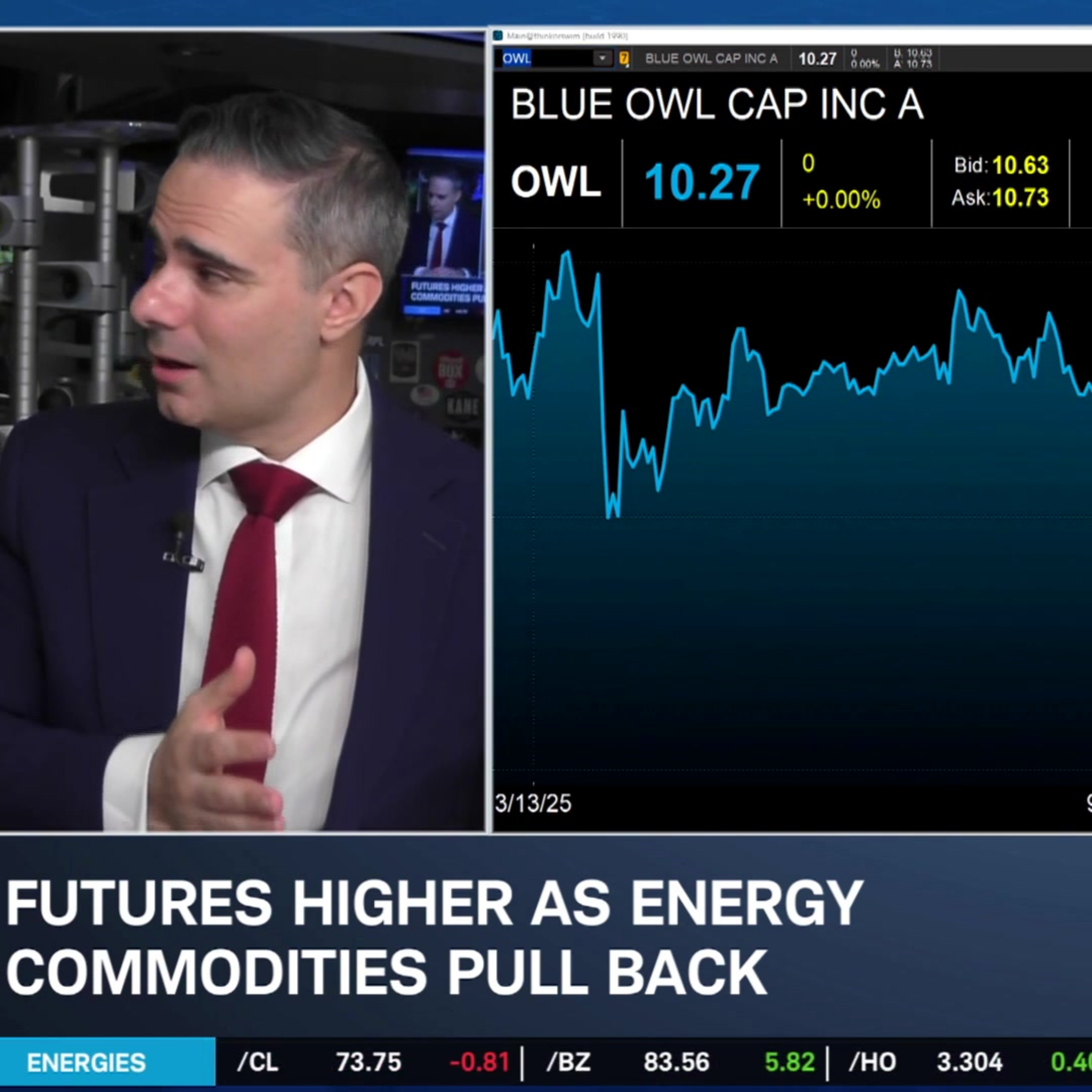
Steve Chiavarone anticipates continued rotation into “old economy” sectors like defense and aerospace. He still likes AI-buildout companies with construction, materials, energy, and related sectors. Steve is also looking at companies AI can’t disrupt or replace, like pharmacology or consumer staples. He examines the private credit markets and the risks he sees in the sector, though he doesn’t think the troubles there compare to the 2008-2009 crisis.
======== Schwab Network ========
Empowering every investor and trader, every market day.
Options involve risks and are not suitable for all investors. Before trading, read the Options Disclosure Document. http://bit.ly/2v9tH6D
Subscribe to the Market Minute newsletter - https://schwabnetwork.com/subscribe
Download the iOS app - https://apps.apple.com/us/app/schwab-network/id1460719185
Download the Amazon Fire Tv App - https://www.amazon.com/TD-Ameritrade-Network/dp/B07KRD76C7
Watch on Sling - https://watch.sling.com/1/asset/191928615bd8d47686f94682aefaa007/watch
Watch on Vizio - https://www.vizio.com/en/watchfreeplus-explore
Watch on DistroTV - https://www.distro.tv/live/schwab-network/
Follow us on X – https://twitter.com/schwabnetwork
Follow us on Facebook – https://www.facebook.com/schwabnetwork
Follow us on LinkedIn - https://www.linkedin.com/company/schwab-network/
About Schwab Network - https://schwabnetwork.com/about
Get every episode summarized
Each time Schwab Network publishes, we email you a written briefing from the transcript — the topics, who appeared, and any specific claims, with the ad reads skipped.
Email me new episodesFree for 3 shows. No card needed.
Transcript ready
130 searchable segments. Every word is indexed and playable.
Full transcript
Schwab Network — Finding Opportunities in the ‘Old Economy’. Machine-transcribed; use the interactive transcript above to jump the player to any line.
Welcome back to Opening Bell. We're getting ready for the trading day. We're moments away from the Opening Bells bringing here on Wall Street Steve Silver Owens with me, Deputy CIO at Federated Hermes, to talk about some of the market reaction we've been seeing. Obviously, volatility is something we would expect commodities taking off of oils is what we would expect now. What can we expect? Well, never know. I think despite the impression of chaos, it's all kind of supported the same trade though. And the trade is that we had an entire economy bill at, let's call, the altar of asset light businesses, right? It was all about software, it was all about subscription services, it was all about tech. What we've seen is AI has handed off and you've got this AI infrastructure when it's whether it's energy supplies being threatened, whether it's geopolitical uncertainty. The appetite now for the market is asset heavy businesses, things that are real and tangible. And so while it's looked chaotic, the reality is the trade's been the same all year by asset
heavy businesses, the same kind of stocks that no one wanted owned for the last several years. So when you say defense spending increase, what are you referring to? Well, you're shooting down, let's call it $8,000 drones with $2 million interceptors. They need to be replaced. We've all watched the news. How many missiles have we seen shot off of US aircraft carriers or battleships or dropped from planes? Those all need to be refilled. And so I think that's one element of increased defense spending. Secondly, if you're a country that's been deploying Russian or Chinese military tech, how's that worked out for you over the last couple of months? Not well. And we have a one and a half trillion dollar budget, military budget coming up again. Well, and I would expect you'll see even a supplemental to that. And on top of it, I think you're going to see foreign countries recognize that there's really no substitute for US tech, the US defense tech. And so that's an area where we expect to see a lot of demand. So those are the names like Lockheed Martin, Northrop
Grumman, General Dynamics, RTX. Yeah, and do you like all those? We like that entire space. We also find a lot of interest in some of the Asian defense names. Asian defense companies have more exposure to the Middle East than the European defense names do. So it's really kind of an East West story. Asian defense companies, US defense companies. And then obviously in the smaller cap space, you start to get into some of the drone makers and those get interesting as well. I was reading this morning that if the straight of hormones really is closed or sort of, you know, and ships going through will be set ablaze. And I know that the US has now said they'll provide Navy, you know, you can go with the Navy and they'll give you a deal on some of the insurance at a good price and things like that. But if the straight of hormones really gets shut to some certain extent, I saw that oil could go to $100. What do you think of that kind of concept? Is that that was a headline? Do you think that's appropriate? I don't think that's unreasonable. I mean, I think that's
probably more applicable to Brent than WTI. I mean, the US is in a position where if we needed to, we could just halt export of the commodity and have plenty for our own use. For the global market, that's a little different. That certainly is a risk that's out there. I thought the administration's moved yesterday to ensure those tankers and provide Navy escorts was hugely important and hugely positive. So I don't think that's going to happen if it does though. Yeah, $90 to $100 oil is not out of the question. What do you think at earnings season so far? This afternoon, of course, Broadcom will be really a big story. I mean, I think a lot of folks will focus on Broadcom today. In addition to around day five, but you can't leave out a big tech story. No, I think earnings season in general has been positive and remarkable. So positive in that we, we came into this year with about as aggressive of an earnings estimate as we could come, come to for this year next year and the year after. We were 10 or 15% above the street. We're a quarter in and we had to raise our
earnings estimates because of how strong the numbers have come in and how much the estimates have risen not just for this year, but the next two. I think we're in a world, especially because of AI, where earnings are going to be better than we expect, but the multiple might be a little bit lower than what we've seen. And it's hard not to be positive about that picture. The one, I would say negative in the earnings season for the Mag 7 is the earning season is usually when their share prices shine. You know, everyone wants to doubt their business models until you get to the earnings season and the great numbers come through because their cat backs numbers were so high that kind of held those stocks back. So it reinforces for us this idea that this rotation towards some of these old economy names is likely to continue. So let's talk about some of the names that you do like. I mean, maybe you can't name names, but maybe you could do sectors just so people understand where you mentioned defense, aerospace and defense. That's an area you like. What's another area you definitely like? Anything that's tied to the AI infrastructure build out, right? So what's
happening is AI was a story of tech companies and technology development. Now they're giving that to the folks in hard hats who actually need to build this infrastructure out. So you've got construction, you have materials, you have industrials, you have energy infrastructure, you have power power and energy. Those are areas that we really like. On the flip side, some of the companies that can be disrupted by AI are asset like businesses, right? You can AI a software company. Can AI candy bar? Can AI a medicine? So you get into those more defensive dividend sectors like pharma, like consumer staples. And then finally, if you're going to engage in $600 billion more of cat backs this year versus last year, you've got to hire someone to do that. So we like the consumer. So it's really about the consumer, this construction piece, these less disruptable businesses and defense. What's going on with private credit? How worried do we need to be? I mean, I know a lot of businesses were going to
private equity to get funding at a time where rates were higher. Private credit is liquidity drying up. Should we be concerned? Do we have a problem? Yeah, I think I think there's enough smoke around this that it should warrant your attention. I think a couple of things. One, the riskiest lending was pushed out of the banking system into the private markets. That's one. Two, I think you've got a lot of pensions and endowments that believe that private credit and private equity were something more and better than they actually were. What I don't think is that it's systemic though. I think if you're a private credit investor, you should be a little bit concerned. I think if you're a pensioner and endowment, you might want to be concerned. I think if you're those companies, you may want to be concerned. At the end of the day though, if I look at the banks and I look at the banks exposure to private lenders, it's about 5% of their assets. This isn't subprime. So is it a concern? Yes. Can it add to volatility? Yes. Do I think there's some substandard lending there? Yes. Could
AI lead to the disruption of companies that have borrowed through the private markets and find those private lenders in a really bad spot? Yes. Do I think that this is a kind of OA-09 systemic problem? Not based on what we've been able to find out so far. Also, I think about the Mag 7. Apple, just quickly, the App Store revenue did improve. We also have Apple announcing new products today. It was a big day for Apple, the MacBook Neo, with side-firing speakers. I wanted to get that out there folks. You have a, that's pre-order today available in stores March 11th. So they are delivering a new Mac and a new price. What do you think about these Mag 7 names? So they're out of favor right now because the amount of CapEx that they're engaging in. I'm not worried about them over the medium term though because this is going to go one of two ways. Either they're going to establish their verticals in AI the same way they did in the internet, right? Meta owns social, Apple owns mobile, Netflix owns streaming,
Google owns their activity. I do for the long term, but I think that we're still at a point where they're going to be out of favor for the next quarter or two. I think one of two things are going to happen. They're either going to really monetize this AI and people are going to be excited about that or they're going to decide that the CapEx was too much. They're going to cut back on that CapEx and then they go back to being the big free cash flow generators that they were. But I think the market is going to yearn of a kind of Missouri place. Show me. And so right now the market is more focused on AI bottlenecks like memory, like power and energy. And these guys are just in the penalty box for a little bit. But that doesn't change the fact that we like them long term. All right. And folks, I mean it's breaking news now, Apple's new Apple MacBook 13 inch liquid retina display starts at 599 499 for education available in four colors. And you could pre-order today March 11th would be available in stores. So keep an eye on Apple is more breaking news is coming there. That's a key name to watching Steve Chevron. Thank you so
much. It's wonderful to see you. Thank you for being here with us today as we kick off another trading day here on Wall Street. We're ready for some volatility, of course, right? Thank you so much. Steve Chevron, a federated Ermese.
More episodes
More from Schwab Network

JNJ Balances Growth, Patent Transitions, and Legal Overhangs
Schwab Network

nCino (NCNO) CEO on Earnings, AI in Banking & Overcoming "SaaS-pocalypse"
Schwab Network

The Big 3: NET, TWLO, ASTS
Schwab Network

Tie Lasater on Inflation Floors, Energy Risk, and Private Credit Stress
Schwab Network